RELIABILITY
VERSUS
VALIDITY
Reliability & Validity
 Reliability
Reliability
 “
“dependability”
dependability”
 is the indicator consistent?
is the indicator consistent?
 same result every time?
same result every time?
 Does not necessary measure what you think it measures
Does not necessary measure what you think it measures
(ex. May consistently measure something other than the
concept)
concept)
 Validity
Validity
 measurement validity - how well the conceptual and
measurement validity - how well the conceptual and
operational definitions mesh with each other
 does measurement tool measure what we think ?
does measurement tool measure what we think ?
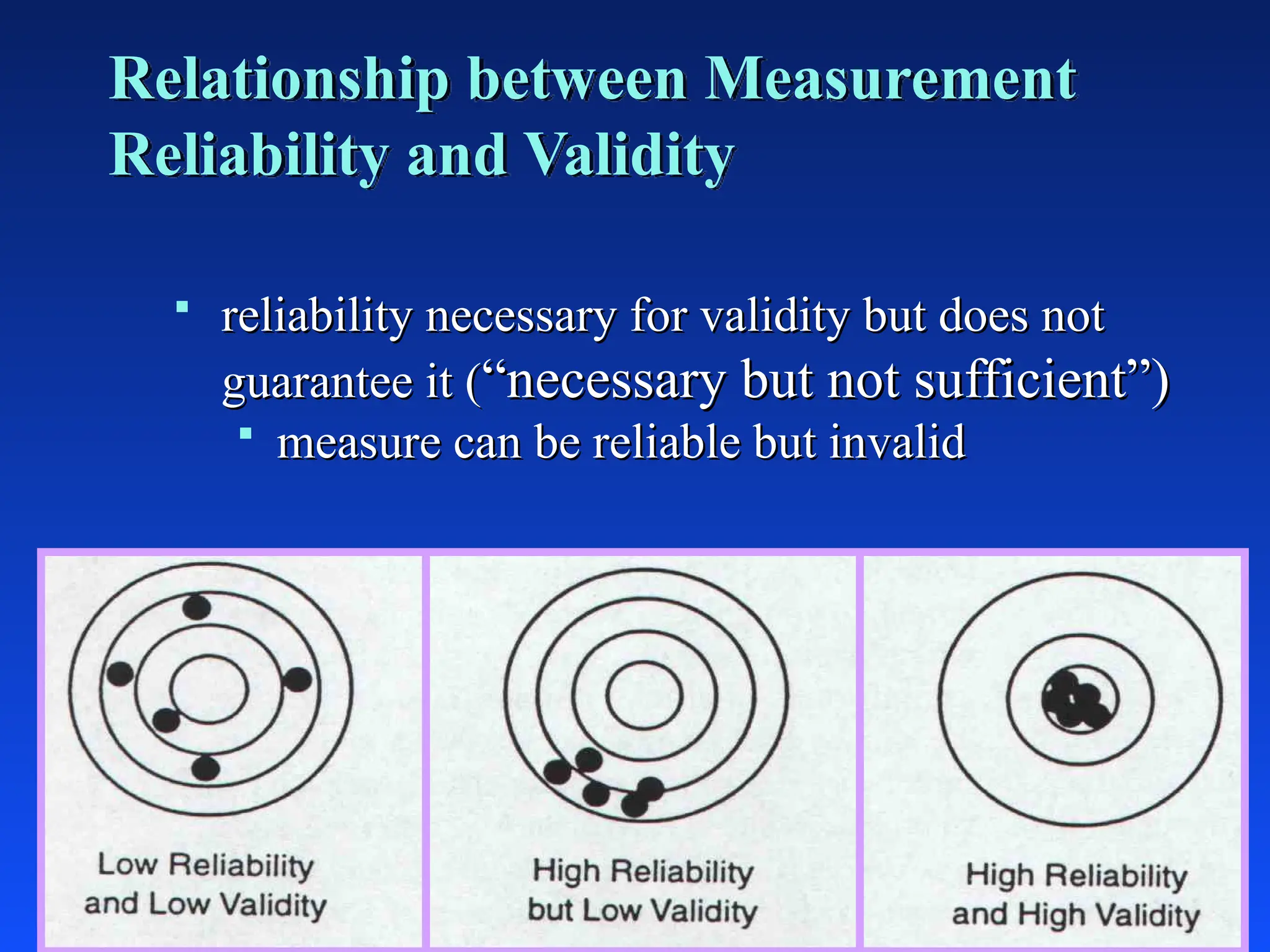
Relationship between Measurement
Reliability and Validity
 reliability necessary for validity but does not
reliability necessary for validity but does not
guarantee it (
guarantee it (“necessary but not sufficient”)
“necessary but not sufficient”)
 measure can be reliable but invalid
measure can be reliable but invalid
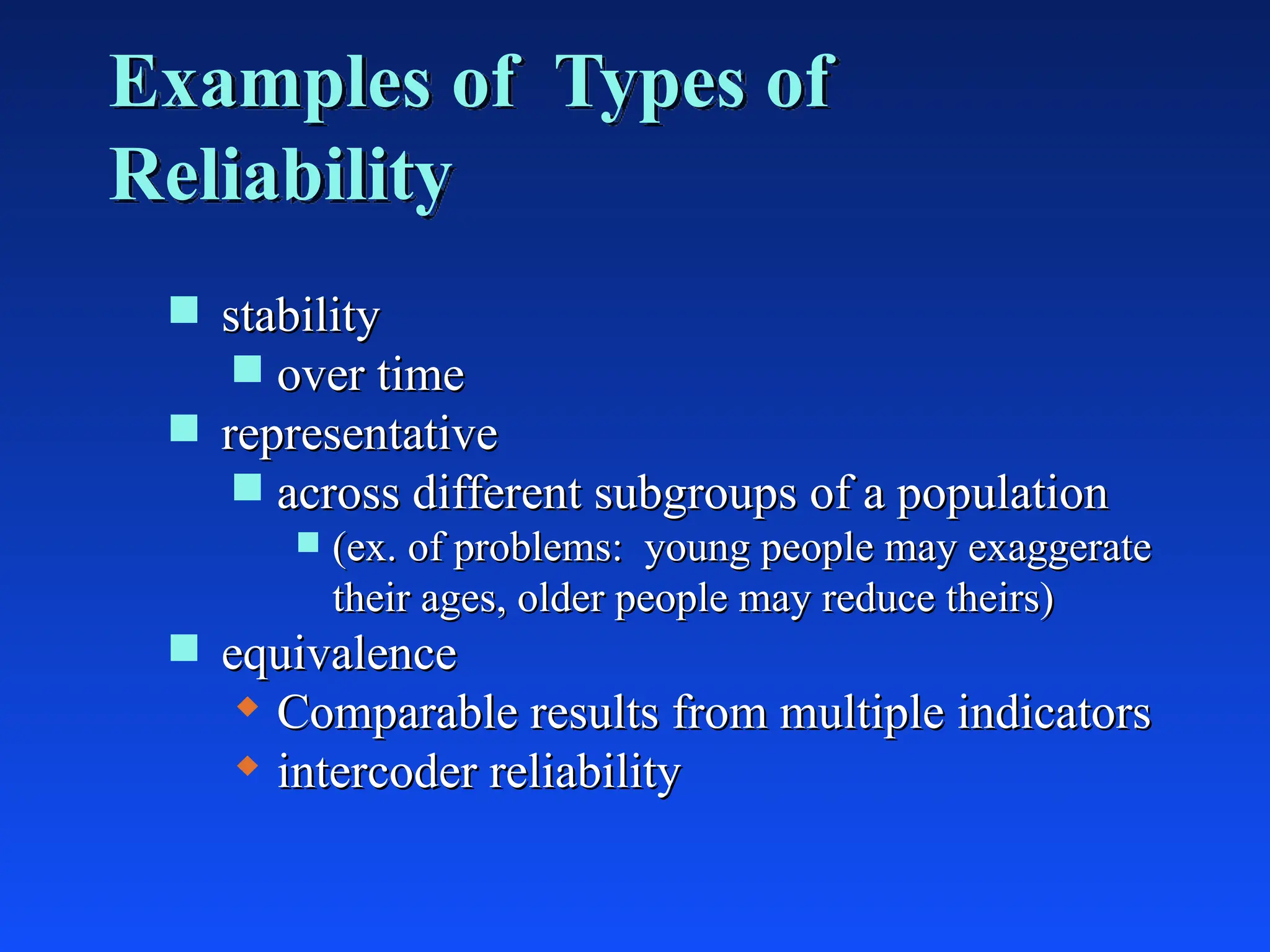
Examples of Types of
Reliability
 stability
stability
 over time
over time
 representative
representative
 across different subgroups of a population
across different subgroups of a population
 (ex. of problems: young people may exaggerate
(ex. of problems: young people may exaggerate
their ages, older people may reduce theirs)
 equivalence
equivalence
 Comparable results from multiple indicators
Comparable results from multiple indicators
 intercoder reliability
intercoder reliability
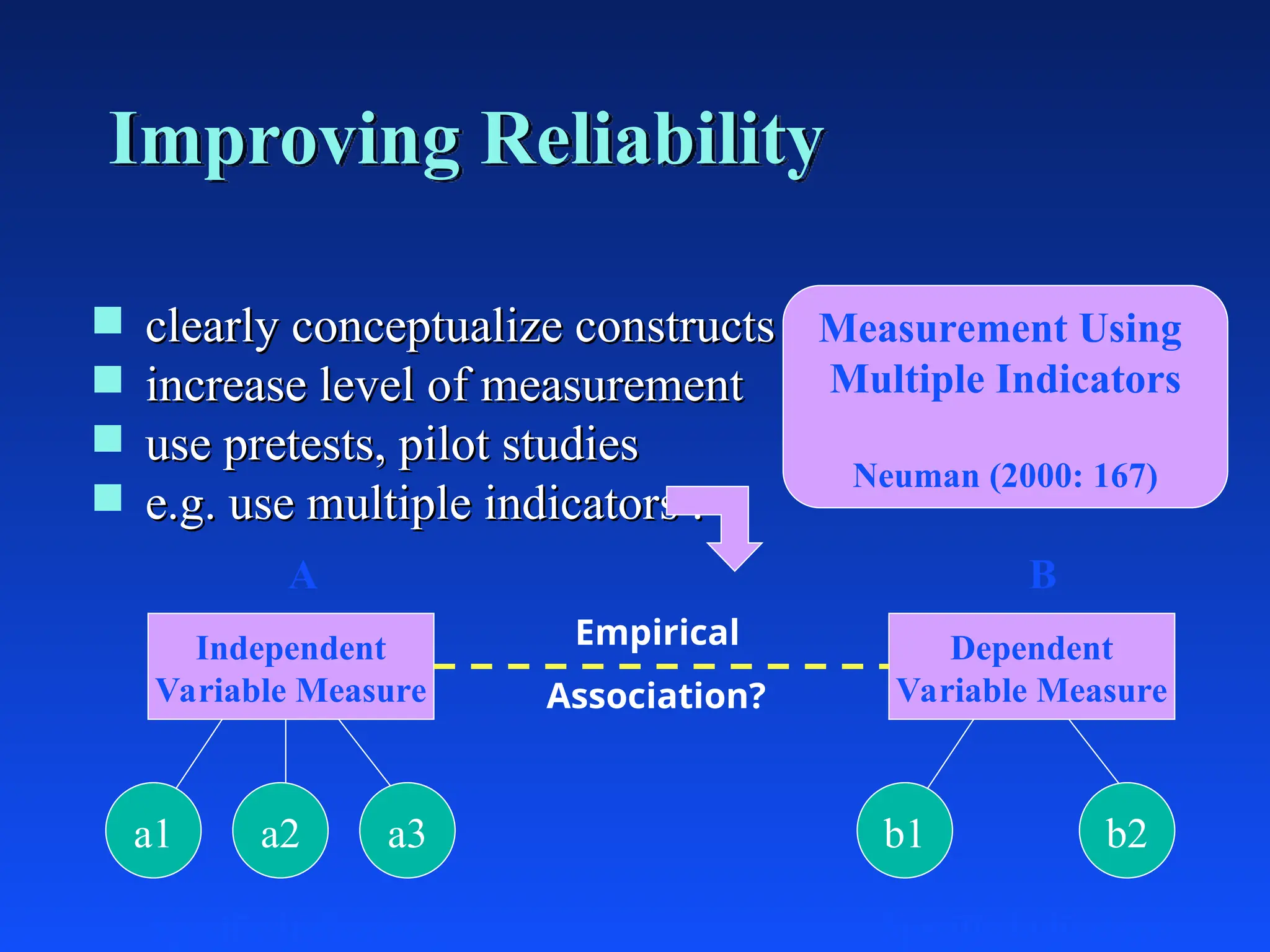
Improving Reliability
 clearly conceptualize constructs
clearly conceptualize constructs
 increase level of measurement
increase level of measurement
 use pretests, pilot studies
use pretests, pilot studies
 e.g. use multiple indicators :
e.g. use multiple indicators :
Dependent
Variable Measure
Independent
Variable Measure
Empirical
Association?
a2 a3
a1 b1 b2
A B
Specific Indicators
Specific Indicators
Measurement Using
Multiple Indicators
Neuman (2000: 167)
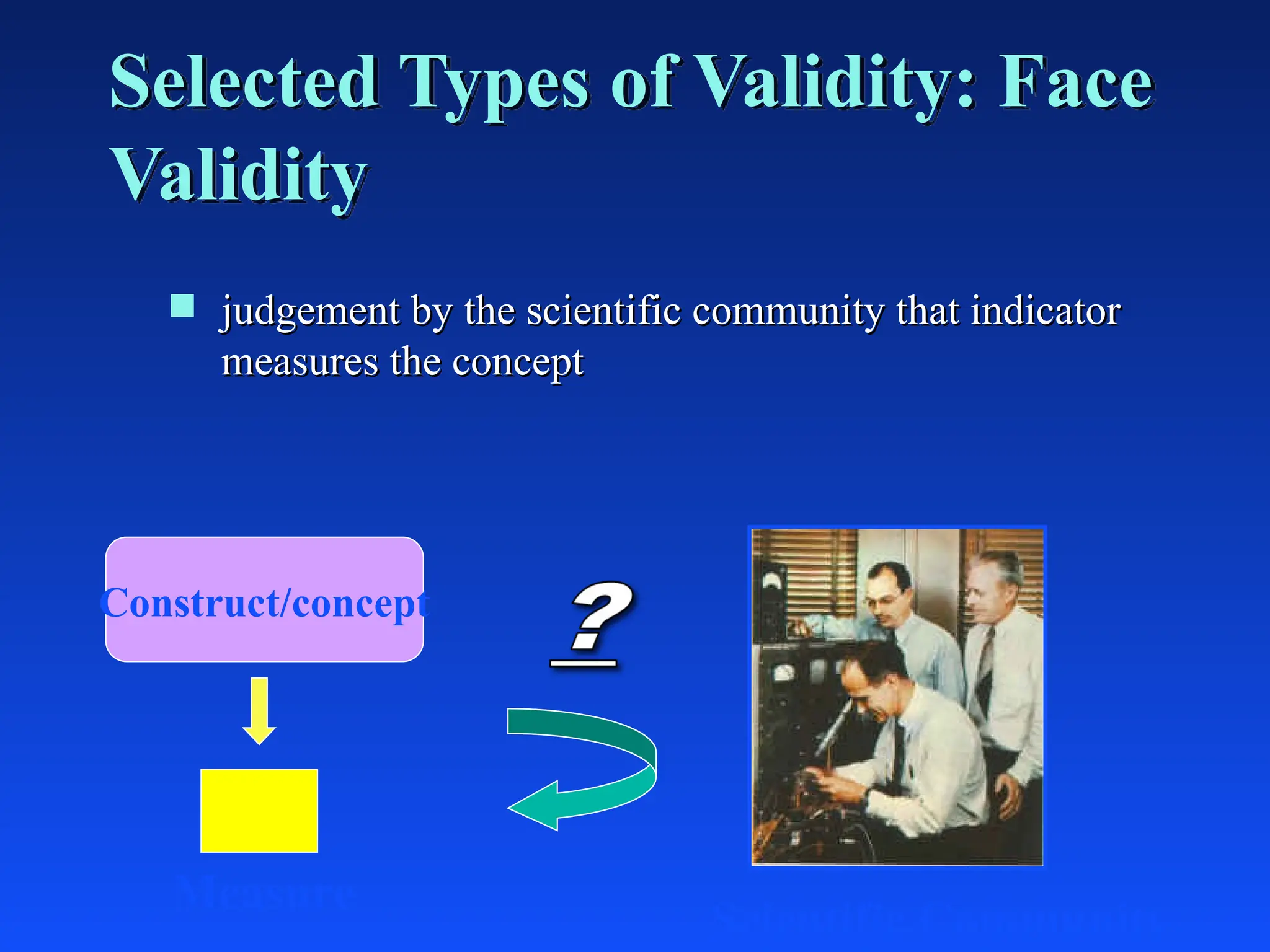
Selected Types of Validity: Face
Validity
 judgement by the scientific community that indicator
judgement by the scientific community that indicator
measures the concept
Construct/concept
Measure
Scientific Community
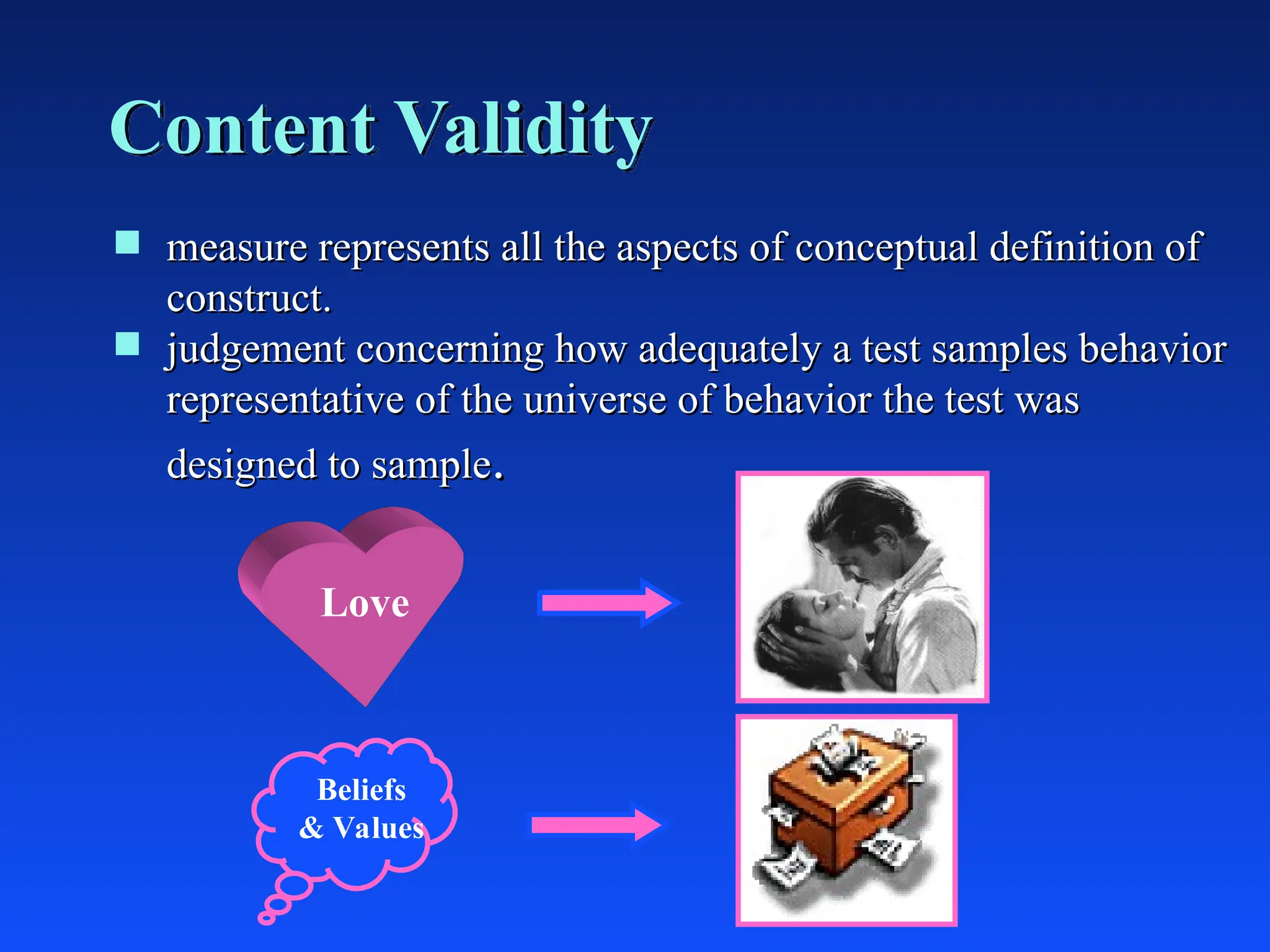
Content Validity
 measure represents all the aspects of conceptual definition of
measure represents all the aspects of conceptual definition of
construct.
construct.
 judgement concerning how adequately a test samples behavior
judgement concerning how adequately a test samples behavior
representative of the universe of behavior the test was
designed to sample
designed to sample.
.
Love
Beliefs
& Values
 Criterion
Criterion
 The validity of indicator is verified by comparing it with another
The validity of indicator is verified by comparing it with another
measure of the same construct
 Predictive
Predictive
 Relies on occurrence of future event or behavior for
Relies on occurrence of future event or behavior for
verification of indicator
 Concurrent
Concurrent
 relies on pre-existing accepted measure to verify indicator
relies on pre-existing accepted measure to verify indicator
 Construct Validity
Construct Validity
 A type of measurement validity that uses multiple indicators
A type of measurement validity that uses multiple indicators
 convergent and discriminate
convergent and discriminate
Some types of Measurement Validity
Other Dimensions
of Validity
 Internal Validity
Internal Validity
 no error of logic internal to research design
no error of logic internal to research design
 External Validity
External Validity
 results can be generalized
results can be generalized
 Statistical validity
Statistical validity
 correct statistical methodology chosen ?
correct statistical methodology chosen ?
 assumptions fully met
assumptions fully met
More terms & concepts for assessing
validity (usually in experimental research)
 Threats to Internal Validity
Threats to Internal Validity
 Selection bias
Selection bias
 History effects (something in context changes)
History effects (something in context changes)
 Maturation
Maturation
 Testing effect
Testing effect
 Instrumentation
Instrumentation
 Mortality
Mortality
 Statistical regression
Statistical regression
 Contamination
Contamination
 Compensatory behaviour
Compensatory behaviour
 Experimenter expectanc
Experimenter expectanc
 Threats to External Validity
Threats to External Validity
 Realism
Realism
 Reactivity
Reactivity
Another Aspect of Measurement
Design: Levels of Measurement
 1-Nominal (ex. Mother tongue)
1-Nominal (ex. Mother tongue)
 different categories (names, labels, images)
different categories (names, labels, images)
 not ranked
not ranked
 2-Ordinal (county fair prizewinners ranked by first, second & third prize)
2-Ordinal (county fair prizewinners ranked by first, second & third prize)
 different categories
different categories
 rank-ordered
rank-ordered
 attributes indicate relatively more or less of that variable
attributes indicate relatively more or less of that variable
 distance between the attributes of a variable is imprecise
distance between the attributes of a variable is imprecise
Levels of Measurement (cont’d)
 3- Interval Measures (age measured by 5 year age groups)
3- Interval Measures (age measured by 5 year age groups)
 different categories
different categories
 ranked in order
ranked in order
 Can tell amount of difference between categories
Can tell amount of difference between categories
 Usually no true zero
Usually no true zero
 4- Ratio Measures (age measured by date of birth)
4- Ratio Measures (age measured by date of birth)
 different categories
different categories
 ranked in order
ranked in order
 amount of difference between categories
amount of difference between categories
 also possible to state proportion (have a true zero)
also possible to state proportion (have a true zero)
 Relations between levels --
Relations between levels --can collapse from higher
can collapse from higher
into lower, not vice versa
Babbie (1995: 101)
The Research
Process

Validity versus Reliability_An Assessement.ppt

  • 1.
  • 2.
    Reliability & Validity Reliability Reliability  “ “dependability” dependability”  is the indicator consistent? is the indicator consistent?  same result every time? same result every time?  Does not necessary measure what you think it measures Does not necessary measure what you think it measures (ex. May consistently measure something other than the (ex. May consistently measure something other than the concept) concept)  Validity Validity  measurement validity - how well the conceptual and measurement validity - how well the conceptual and operational definitions mesh with each other operational definitions mesh with each other  does measurement tool measure what we think ? does measurement tool measure what we think ?
  • 3.
    Relationship between Measurement Reliabilityand Validity  reliability necessary for validity but does not reliability necessary for validity but does not guarantee it ( guarantee it (“necessary but not sufficient”) “necessary but not sufficient”)  measure can be reliable but invalid measure can be reliable but invalid
  • 4.
    Examples of Typesof Reliability  stability stability  over time over time  representative representative  across different subgroups of a population across different subgroups of a population  (ex. of problems: young people may exaggerate (ex. of problems: young people may exaggerate their ages, older people may reduce theirs) their ages, older people may reduce theirs)  equivalence equivalence  Comparable results from multiple indicators Comparable results from multiple indicators  intercoder reliability intercoder reliability
  • 5.
    Improving Reliability  clearlyconceptualize constructs clearly conceptualize constructs  increase level of measurement increase level of measurement  use pretests, pilot studies use pretests, pilot studies  e.g. use multiple indicators : e.g. use multiple indicators : Dependent Variable Measure Independent Variable Measure Empirical Association? a2 a3 a1 b1 b2 A B Specific Indicators Specific Indicators Measurement Using Multiple Indicators Neuman (2000: 167)
  • 6.
    Selected Types ofValidity: Face Validity  judgement by the scientific community that indicator judgement by the scientific community that indicator measures the concept measures the concept Construct/concept Measure Scientific Community
  • 7.
    Content Validity  measurerepresents all the aspects of conceptual definition of measure represents all the aspects of conceptual definition of construct. construct.  judgement concerning how adequately a test samples behavior judgement concerning how adequately a test samples behavior representative of the universe of behavior the test was representative of the universe of behavior the test was designed to sample designed to sample. . Love Beliefs & Values
  • 8.
     Criterion Criterion  Thevalidity of indicator is verified by comparing it with another The validity of indicator is verified by comparing it with another measure of the same construct measure of the same construct  Predictive Predictive  Relies on occurrence of future event or behavior for Relies on occurrence of future event or behavior for verification of indicator verification of indicator  Concurrent Concurrent  relies on pre-existing accepted measure to verify indicator relies on pre-existing accepted measure to verify indicator  Construct Validity Construct Validity  A type of measurement validity that uses multiple indicators A type of measurement validity that uses multiple indicators  convergent and discriminate convergent and discriminate Some types of Measurement Validity
  • 9.
    Other Dimensions of Validity Internal Validity Internal Validity  no error of logic internal to research design no error of logic internal to research design  External Validity External Validity  results can be generalized results can be generalized  Statistical validity Statistical validity  correct statistical methodology chosen ? correct statistical methodology chosen ?  assumptions fully met assumptions fully met
  • 10.
    More terms &concepts for assessing validity (usually in experimental research)  Threats to Internal Validity Threats to Internal Validity  Selection bias Selection bias  History effects (something in context changes) History effects (something in context changes)  Maturation Maturation  Testing effect Testing effect  Instrumentation Instrumentation  Mortality Mortality  Statistical regression Statistical regression  Contamination Contamination  Compensatory behaviour Compensatory behaviour  Experimenter expectanc Experimenter expectanc  Threats to External Validity Threats to External Validity  Realism Realism  Reactivity Reactivity
  • 11.
    Another Aspect ofMeasurement Design: Levels of Measurement  1-Nominal (ex. Mother tongue) 1-Nominal (ex. Mother tongue)  different categories (names, labels, images) different categories (names, labels, images)  not ranked not ranked  2-Ordinal (county fair prizewinners ranked by first, second & third prize) 2-Ordinal (county fair prizewinners ranked by first, second & third prize)  different categories different categories  rank-ordered rank-ordered  attributes indicate relatively more or less of that variable attributes indicate relatively more or less of that variable  distance between the attributes of a variable is imprecise distance between the attributes of a variable is imprecise
  • 12.
    Levels of Measurement(cont’d)  3- Interval Measures (age measured by 5 year age groups) 3- Interval Measures (age measured by 5 year age groups)  different categories different categories  ranked in order ranked in order  Can tell amount of difference between categories Can tell amount of difference between categories  Usually no true zero Usually no true zero  4- Ratio Measures (age measured by date of birth) 4- Ratio Measures (age measured by date of birth)  different categories different categories  ranked in order ranked in order  amount of difference between categories amount of difference between categories  also possible to state proportion (have a true zero) also possible to state proportion (have a true zero)  Relations between levels -- Relations between levels --can collapse from higher can collapse from higher into lower, not vice versa into lower, not vice versa
  • 13.
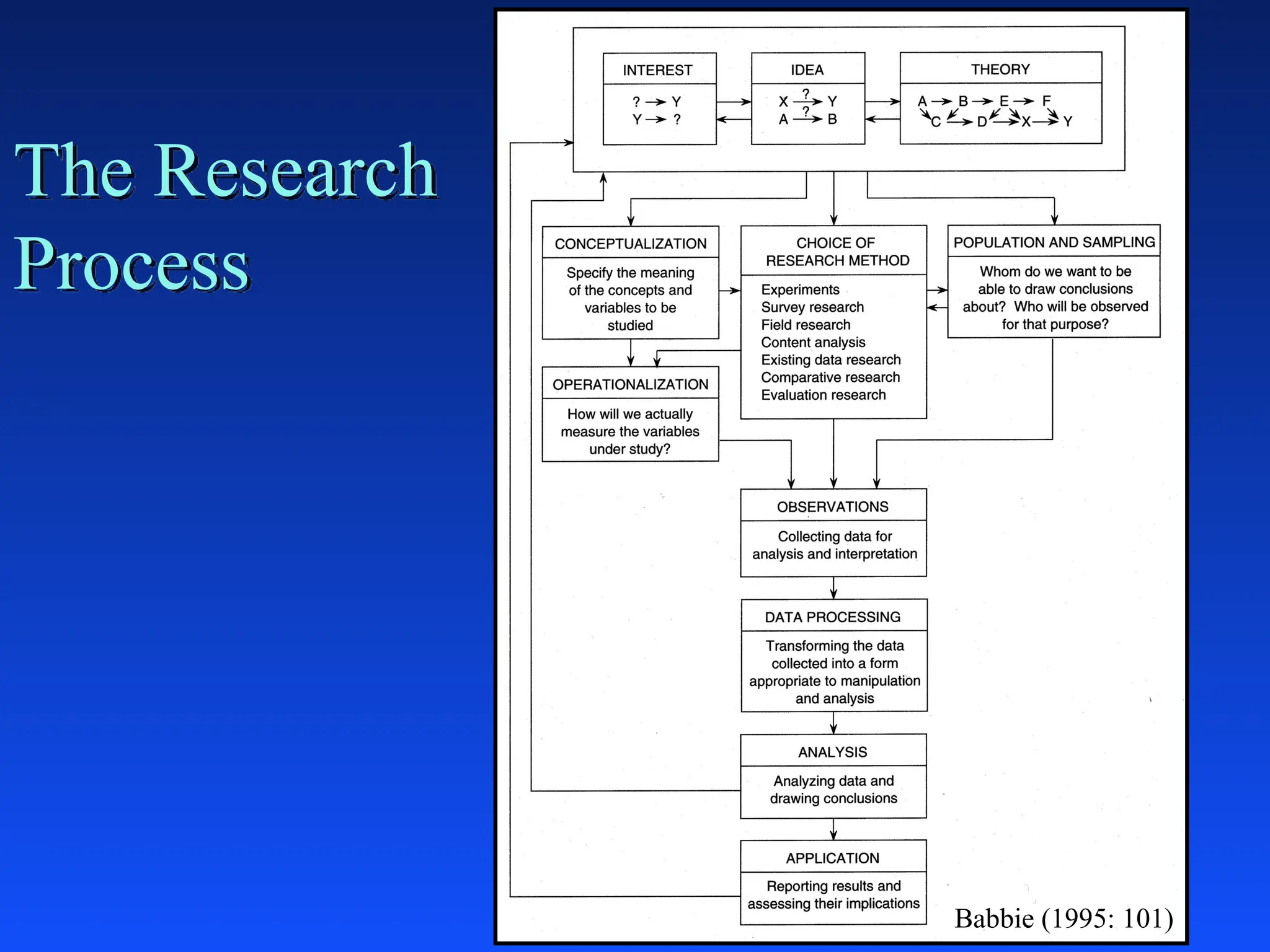
    Babbie (1995: 101) TheResearch Process