USING VRC BOOKS
FOR SOLS AND SHARING STUDENT LEARNING
Image from www.scuoleinviaggio.com
PRIMARY TITLES
• Eat Like a Bear by April Pulley Sayre
• The Most Magnificent Thing by Ashley Spires
• Sparky! By Jenny Offill
• Mr. Tiger Goes Wild by Peter Brown
STANDARDS OF LEARNING OBJECTIVES
• LA Reading K.8 The student will expand vocabulary
• a) Discuss meaning of words
• b) Develop vocabulary by listening to a variety of text read aloud
LA Reading 1.8 The student will expand vocabulary
LA Reading 2.8 & 2.9 The student will read and demonstrate
comprehension of Fiction and NonFiction Texts
setting, characters, beginning, middle end/ main idea / problem
& solution / ask and answer questions. (modified hi-ho song)
OBJECTIVES: THE WHAT & THE HOW
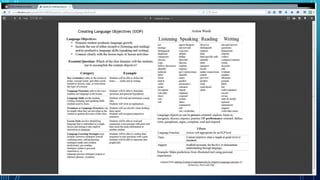
• Language Objectives = The How
• Focuses on ELLs BUT really just good practice for ALL students!!
• Effectively written language objectives:
• Are linked to standards-based content objectives
• Use active verbs to explain a specific student task
• Specify target language necessary to complete the task
• Emphasize development of expressive language skills: speaking and
writing
• Sheltered Instruction Observation Protocol (SIOP)
• http://www.elltoolbox.com/siop.html
EAT LIKE A BEAR (K-2)
• Language objectives: Students will explain how animals prepare
for hibernation using an ebook on PebbleGO. (animals eat
extra to prepare for their long sleep)
• Students will identify the many different foods bears eat in the
different seasons using the book Eat Like a Bear
• Students will distinguish two different food categories that
bears eat (plants or animals) omnivore using picture cards to
identify groups.
INSTRUCTION
Review hibernation with PebbleGo
Focus on the eating to gain weight
to survive
Read book
Discuss vocabulary with pictures
clues of what the bear is eating
(sedges, cutworm moths)
Students follow along with the
months of the year
Hand out picture cards to each
student (K-1)
Students identity which group they
belong in
2nd grade sort through pictures with
a partner
Show video of bear catching salmon
Research other animals that
Click HERE for Pictures for sorting
activity
SCIENCE SOLS - INVESTIGATE: OBSERVING,
CLASSIFYING AND SEQUENCING
• Life Process
• K.7 The student will investigate and understand basic needs
and life processes of plants and animals
• 1.5 The students will investigate and understand that animals
have badic needs and certain distinguishing characteristics
• 2.4 The student will investigate and understand that plants and
animals undergo and series of orderly changes as they mature
and grow
• 2.5 The student will investigate and understand that living
things are part of a system
THE MOST MAGNIFICENT THING (K-5)
• Reading 3.4, 4.4, 5.4: The student will expand vocabulary when
reading.
• Use knowledge of synonyms
• Use context to clarify meaning of unfamiliar words
• LA OBJECTIVE: Students will define PERSERVERSANCE using the
example of the character that does not give up.
• Students will define the word MAGNIFICANT using synonyms
then build a magnificent structure with cups.
INSTRUCTION
Ask students how they felt during an experience
that was just so hard they wanted to give up (mad,
angry, frustrated, sad, etc)
Explain the “new” word is when you want to give up
BUT you do not: Perseverance
Ask students to listen for examples of not giving
up in the story
Show book cover and point out Magnificent. Ask
students to come up with words that mean the
same (awesome, fantastic, terrific, amazing)
While reading the story stop each time the girl
keeps going and gives up. Note the illustrations
where there is a picture of what we do not usually
see (stinky cheese, mad cloud, lines coming out
when she is mad) Highlight shapes, hand motions
for “constructing” words
Can they identify the problem and solution?
Review vocabulary goals and have building cup
center
SPARKY! (K-5)
• 3.5, 4.5, 5.5 The student will read and demonstrate
comprehension of fictional text.
• 3.7, 4.9, 5.9 The student will demonstrate comprehension of
information from a variety of print and electronic resources.
• 3rd grade using dictionaries to define target vocabulary
• 4th grade main idea and supporting details
• 5th grade point of view
LANGUAGE OBJECTIVES
• K-2 The student will identify and discuss the characteristics a sloth
using the story, PebbleGo and video.
• K-2 The student will debate if the name Sparky matches the
characteristics of a sloth using the video and the story.
• K-5 The student will define and recognize an encyclopedia using a
print and online example of an encyclopedia.
• 3rd The student will define target vocabulary in the story using
dictionaries and graphic organizer.
• 4th The student will record supporting details using graphic
organizer.
• 5th The student will identify point of view using keywords identified
in the story.
INSTRUCTION
Ask students who has ever wanted a pet?
Explain the main idea of a girl wanting a pet
What is the problem in this story? Specific
conditions: no walking, bathing, feeding
Point out asking the librarian for information and
using an encyclopedia from the story and pause
for clarification on short research of a sloth
(PebbleGo, video Meet the Sloths – explain they
are NOT in habitat but you will see them in
“action”, older grades can predict why baby sloths
are in orphanage)
K-2 come up with new names for pet sloth, do
sloths make good pets. Can they identify a the
theme of having a pet? For companionship /love
3rd identify target vocabulary using dictionary
4th grade supporting details to main idea
5th grade point of view
Click HERE for vocabulary words
MR. TIGER GOES WILD (K-2)
• Setting
• Beginning, middle, end
• Problem and solution
• Predictions
• Compare fiction and nonfiction
• LA objective: The student will define and correctly identify the
difference of fiction and non fiction using the story and
examples of various tiger books.
INSTRUCTION
Define fiction and nonfiction books
Using book cover to predict what type of
book this will be
Students discuss story and point out what
makes this book fiction
Place books under chairs. Students will
look through the book and determine if it
is fiction or non fiction. Once they have
decided they will switch with their
matching table color. Then then will
trade with another student to switch their
fiction or nonfiction or vice versa
Can lead into animal research projects
(lego zoo, centers, etc)
ELEMENTARY TITLES (3-5)
• A Snicker of Magic by Natalie Lloyd
• Escape from Mr. Lemoncello’s Library by Chris Grabenstein
• Hoop Genius by John Coy
• Flight of the Honey Bee by Raymond Huber
SOL: EXPAND VOCABULARY, FICTION,
NONFICTION TEXT, RESEARCH
• LA Reading 3.4, 3.5, 3.6, 3.7
• LA Reading 4.4, 4.5, 4.6, Research 4.9
• LA Reading 5.4, 5.5, Research 5.9
• Research ideas:
• Libraries around the world
• Your favorite sports game (choose a sport or game to research: how was
it invented?)
• All about honey bees!!
• Elvis/Mountain Dog (research types of dogs or just working dogs and
what they can do)
BOOK CLUB IDEAS
• A Snicker of Magic
• http://www.scholastic.com/teachers/book/snicker-
magic#cart/cleanup
• Escape from Mr. Lemoncello’s Library
• http://www.chrisgrabenstein.com/kids/PDFs/escape-from-mr-
lemoncellos-library-study-guide.pdf
• http://www.chrisgrabenstein.com/kids/escape-from-mr-
lemoncellos-library.php
•
USING TECH TOOLS TO BUILD EXCITEMENT
• Chatter Pix App (Book Reviews and Book Talks and Sharing
Information ) NEW FAVORITE!!!
https://youtu.be/a_bP7amldK8
• Blabberize (Share what you know, book review and book Talks)
• http://blabberize.com/view/id/1313465
• http://blabberize.com/view/id/1327627
• Animoto (Like power Point but more awesome! – ENDLESS
Possibiltiies
• https://youtu.be/pIseLJnuUpY
• https://animoto.com/play/0lmlAu7M9hZqtEfiJfDmrA?autostart=1
ANIMOTO
https://animoto.c
om/
Select pricing at
the top
At the bottom
select: education
Are you a teacher?
Learn More –Click!
TWEEN TRIBUNE
• Nonfiction “news” articles sponsored by the Smithsonian
• Amazing free resource!!
• See up “classes”, assign articles, take a quiz
• www.tweentribune.com
• http://tweentribune.com/article/tween56/are-zombees-
doomsday-bees/
THANK YOU FOR COMING!!
• I hope that I have given you useful ideas to add MORE
excitement to your lessons.
• Visit my NEW site : https://hunt4books.wordpress.com/
• Presentation also available on Slide Share

VAASL presentation VRC 2015-16

  • 1.
    USING VRC BOOKS FORSOLS AND SHARING STUDENT LEARNING
  • 2.
  • 3.
    PRIMARY TITLES • EatLike a Bear by April Pulley Sayre • The Most Magnificent Thing by Ashley Spires • Sparky! By Jenny Offill • Mr. Tiger Goes Wild by Peter Brown
  • 4.
    STANDARDS OF LEARNINGOBJECTIVES • LA Reading K.8 The student will expand vocabulary • a) Discuss meaning of words • b) Develop vocabulary by listening to a variety of text read aloud LA Reading 1.8 The student will expand vocabulary LA Reading 2.8 & 2.9 The student will read and demonstrate comprehension of Fiction and NonFiction Texts setting, characters, beginning, middle end/ main idea / problem & solution / ask and answer questions. (modified hi-ho song)
  • 5.
    OBJECTIVES: THE WHAT& THE HOW • Language Objectives = The How • Focuses on ELLs BUT really just good practice for ALL students!! • Effectively written language objectives: • Are linked to standards-based content objectives • Use active verbs to explain a specific student task • Specify target language necessary to complete the task • Emphasize development of expressive language skills: speaking and writing • Sheltered Instruction Observation Protocol (SIOP) • http://www.elltoolbox.com/siop.html
  • 7.
    EAT LIKE ABEAR (K-2) • Language objectives: Students will explain how animals prepare for hibernation using an ebook on PebbleGO. (animals eat extra to prepare for their long sleep) • Students will identify the many different foods bears eat in the different seasons using the book Eat Like a Bear • Students will distinguish two different food categories that bears eat (plants or animals) omnivore using picture cards to identify groups.
  • 8.
    INSTRUCTION Review hibernation withPebbleGo Focus on the eating to gain weight to survive Read book Discuss vocabulary with pictures clues of what the bear is eating (sedges, cutworm moths) Students follow along with the months of the year Hand out picture cards to each student (K-1) Students identity which group they belong in 2nd grade sort through pictures with a partner Show video of bear catching salmon Research other animals that Click HERE for Pictures for sorting activity
  • 9.
    SCIENCE SOLS -INVESTIGATE: OBSERVING, CLASSIFYING AND SEQUENCING • Life Process • K.7 The student will investigate and understand basic needs and life processes of plants and animals • 1.5 The students will investigate and understand that animals have badic needs and certain distinguishing characteristics • 2.4 The student will investigate and understand that plants and animals undergo and series of orderly changes as they mature and grow • 2.5 The student will investigate and understand that living things are part of a system
  • 10.
    THE MOST MAGNIFICENTTHING (K-5) • Reading 3.4, 4.4, 5.4: The student will expand vocabulary when reading. • Use knowledge of synonyms • Use context to clarify meaning of unfamiliar words • LA OBJECTIVE: Students will define PERSERVERSANCE using the example of the character that does not give up. • Students will define the word MAGNIFICANT using synonyms then build a magnificent structure with cups.
  • 11.
    INSTRUCTION Ask students howthey felt during an experience that was just so hard they wanted to give up (mad, angry, frustrated, sad, etc) Explain the “new” word is when you want to give up BUT you do not: Perseverance Ask students to listen for examples of not giving up in the story Show book cover and point out Magnificent. Ask students to come up with words that mean the same (awesome, fantastic, terrific, amazing) While reading the story stop each time the girl keeps going and gives up. Note the illustrations where there is a picture of what we do not usually see (stinky cheese, mad cloud, lines coming out when she is mad) Highlight shapes, hand motions for “constructing” words Can they identify the problem and solution? Review vocabulary goals and have building cup center
  • 12.
    SPARKY! (K-5) • 3.5,4.5, 5.5 The student will read and demonstrate comprehension of fictional text. • 3.7, 4.9, 5.9 The student will demonstrate comprehension of information from a variety of print and electronic resources. • 3rd grade using dictionaries to define target vocabulary • 4th grade main idea and supporting details • 5th grade point of view
  • 13.
    LANGUAGE OBJECTIVES • K-2The student will identify and discuss the characteristics a sloth using the story, PebbleGo and video. • K-2 The student will debate if the name Sparky matches the characteristics of a sloth using the video and the story. • K-5 The student will define and recognize an encyclopedia using a print and online example of an encyclopedia. • 3rd The student will define target vocabulary in the story using dictionaries and graphic organizer. • 4th The student will record supporting details using graphic organizer. • 5th The student will identify point of view using keywords identified in the story.
  • 14.
    INSTRUCTION Ask students whohas ever wanted a pet? Explain the main idea of a girl wanting a pet What is the problem in this story? Specific conditions: no walking, bathing, feeding Point out asking the librarian for information and using an encyclopedia from the story and pause for clarification on short research of a sloth (PebbleGo, video Meet the Sloths – explain they are NOT in habitat but you will see them in “action”, older grades can predict why baby sloths are in orphanage) K-2 come up with new names for pet sloth, do sloths make good pets. Can they identify a the theme of having a pet? For companionship /love 3rd identify target vocabulary using dictionary 4th grade supporting details to main idea 5th grade point of view Click HERE for vocabulary words
  • 15.
    MR. TIGER GOESWILD (K-2) • Setting • Beginning, middle, end • Problem and solution • Predictions • Compare fiction and nonfiction • LA objective: The student will define and correctly identify the difference of fiction and non fiction using the story and examples of various tiger books.
  • 16.
    INSTRUCTION Define fiction andnonfiction books Using book cover to predict what type of book this will be Students discuss story and point out what makes this book fiction Place books under chairs. Students will look through the book and determine if it is fiction or non fiction. Once they have decided they will switch with their matching table color. Then then will trade with another student to switch their fiction or nonfiction or vice versa Can lead into animal research projects (lego zoo, centers, etc)
  • 17.
    ELEMENTARY TITLES (3-5) •A Snicker of Magic by Natalie Lloyd • Escape from Mr. Lemoncello’s Library by Chris Grabenstein • Hoop Genius by John Coy • Flight of the Honey Bee by Raymond Huber
  • 18.
    SOL: EXPAND VOCABULARY,FICTION, NONFICTION TEXT, RESEARCH • LA Reading 3.4, 3.5, 3.6, 3.7 • LA Reading 4.4, 4.5, 4.6, Research 4.9 • LA Reading 5.4, 5.5, Research 5.9 • Research ideas: • Libraries around the world • Your favorite sports game (choose a sport or game to research: how was it invented?) • All about honey bees!! • Elvis/Mountain Dog (research types of dogs or just working dogs and what they can do)
  • 19.
    BOOK CLUB IDEAS •A Snicker of Magic • http://www.scholastic.com/teachers/book/snicker- magic#cart/cleanup • Escape from Mr. Lemoncello’s Library • http://www.chrisgrabenstein.com/kids/PDFs/escape-from-mr- lemoncellos-library-study-guide.pdf • http://www.chrisgrabenstein.com/kids/escape-from-mr- lemoncellos-library.php •
  • 20.
    USING TECH TOOLSTO BUILD EXCITEMENT • Chatter Pix App (Book Reviews and Book Talks and Sharing Information ) NEW FAVORITE!!! https://youtu.be/a_bP7amldK8 • Blabberize (Share what you know, book review and book Talks) • http://blabberize.com/view/id/1313465 • http://blabberize.com/view/id/1327627 • Animoto (Like power Point but more awesome! – ENDLESS Possibiltiies • https://youtu.be/pIseLJnuUpY • https://animoto.com/play/0lmlAu7M9hZqtEfiJfDmrA?autostart=1
  • 21.
    ANIMOTO https://animoto.c om/ Select pricing at thetop At the bottom select: education Are you a teacher? Learn More –Click!
  • 22.
    TWEEN TRIBUNE • Nonfiction“news” articles sponsored by the Smithsonian • Amazing free resource!! • See up “classes”, assign articles, take a quiz • www.tweentribune.com • http://tweentribune.com/article/tween56/are-zombees- doomsday-bees/
  • 23.
    THANK YOU FORCOMING!! • I hope that I have given you useful ideas to add MORE excitement to your lessons. • Visit my NEW site : https://hunt4books.wordpress.com/ • Presentation also available on Slide Share