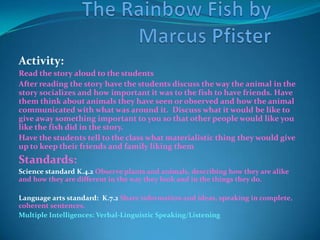
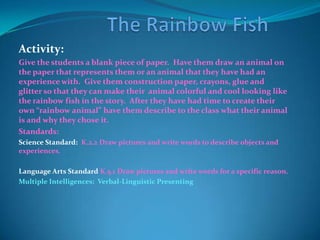
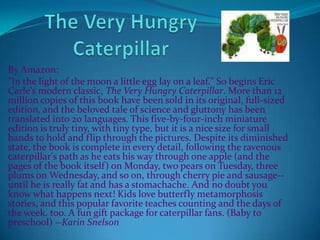
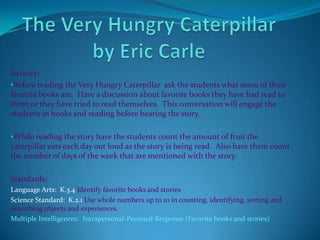
Ring-O ProjectEducation 356By:  Tara SpradleyTheme:  Animals
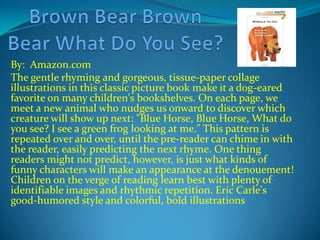
Brown Bear Brown Bear What Do You See?By:  Amazon.comThe gentle rhyming and gorgeous, tissue-paper collage illustrations in this classic picture book make it a dog-eared favorite on many children's bookshelves. On each page, we meet a new animal who nudges us onward to discover which creature will show up next: "Blue Horse, Blue Horse, What do you see? I see a green frog looking at me." This pattern is repeated over and over, until the pre-reader can chime in with the reader, easily predicting the next rhyme. One thing readers might not predict, however, is just what kinds of funny characters will make an appearance at the denouement! Children on the verge of reading learn best with plenty of identifiable images and rhythmic repetition. Eric Carle's good-humored style and colorful, bold illustrations
Brown Bear Brown Bear What Do You See? By Eric CarleActivity:Do a walk through with the book having the students identify the title page, the cover and back cover of the story discussing what is on it.
Have the students give examples of plants and animals that they predict the Bear on the cover of the story might see before reading the story.Standards:Science:  K.4.1 Give examples of plants and animalsLanguage arts: K.1.1 Concepts about print:   Identify the front cover, back cover and title page of the book.Multiple Intelligence: Logical-Mathematical Predicting (Predicting what the Bear will see)
Brown Bear Brown Bear What Do You See?Activity:Read the story aloud to the students have them say the rhyming parts of the story with the instructor while reading it aloud.
After reading the story map out with the students what they saw in the story have them order the animals in which the bear saw them, and have them county them so they get practice counting with animals in the story.
Standards:
Math Standard: K.1.6Count, recognize, represent, name and order a number of objects. (up to 10)
Language Arts standard:  K.1.10 Say rhyming words in response to an oral prompt.
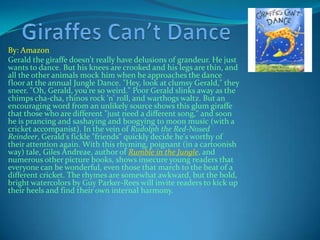
Multiple Intelligence:  Visual-Spatial mapping stories (Mapping out the order of the animals the bear saw)Giraffes Can’t DanceBy: AmazonGerald the giraffe doesn't really have delusions of grandeur. He just wants to dance. But his knees are crooked and his legs are thin, and all the other animals mock him when he approaches the dance floor at the annual Jungle Dance. "Hey, look at clumsy Gerald," they sneer. "Oh, Gerald, you're so weird." Poor Gerald slinks away as the chimps cha-cha, rhinos rock 'n' roll, and warthogs waltz. But an encouraging word from an unlikely source shows this glum giraffe that those who are different "just need a different song," and soon he is prancing and sashaying and boogying to moon music (with a cricket accompanist). In the vein of Rudolph the Red-Nosed Reindeer, Gerald's fickle "friends" quickly decide he's worthy of their attention again. With this rhyming, poignant (in a cartoonish way) tale, Giles Andreae, author of Rumble in the Jungle, and numerous other picture books, shows insecure young readers that everyone can be wonderful, even those that march to the beat of a different cricket. The rhymes are somewhat awkward, but the bold, bright watercolors by Guy Parker-Rees will invite readers to kick up their heels and find their own internal harmony.
Giraffes Can’t Dance By Giles AndreaeActivity:Read the story aloud to the students, after each page have the students discuss out loud predicting what they think is going to happen on the next page
After the story discuss the way the giraffe was moving in the story, discuss how all animals move, fast, slow, up in the air, down on the ground have the students brainstorm all of the ways they have been animals move like or not like the giraffe in the story.
Standards:
Science Standard: K.3.2 Investigate that things move in different ways, such as fast, slow, ect.
Language arts standard: K.2.2 Use pictures and content to aid comprehension and to draw conclusions or make predictions about story content.
Multiple Intelligence:  Interpersonal-Brainstorming (How animals they have seen move)Giraffes Can’t DanceActivity:  Have the students remember what they Giraffe in the story was trying to do, dance by asking them questions such as who, what and where.  Have them discuss how the Giraffe danced similar to them and how he danced differently than them. Once they have completely recalled the story, have the students get up out of their seats and spread out around the room.  Play various songs for them and have them get up and dance around the room, dancing to the beat of their own drum like the Giraffe in the story.

356ringoproject

  • 1.
    Ring-O ProjectEducation 356By: Tara SpradleyTheme: Animals
  • 2.
    Brown Bear BrownBear What Do You See?By: Amazon.comThe gentle rhyming and gorgeous, tissue-paper collage illustrations in this classic picture book make it a dog-eared favorite on many children's bookshelves. On each page, we meet a new animal who nudges us onward to discover which creature will show up next: "Blue Horse, Blue Horse, What do you see? I see a green frog looking at me." This pattern is repeated over and over, until the pre-reader can chime in with the reader, easily predicting the next rhyme. One thing readers might not predict, however, is just what kinds of funny characters will make an appearance at the denouement! Children on the verge of reading learn best with plenty of identifiable images and rhythmic repetition. Eric Carle's good-humored style and colorful, bold illustrations
  • 3.
    Brown Bear BrownBear What Do You See? By Eric CarleActivity:Do a walk through with the book having the students identify the title page, the cover and back cover of the story discussing what is on it.
  • 4.
    Have the studentsgive examples of plants and animals that they predict the Bear on the cover of the story might see before reading the story.Standards:Science: K.4.1 Give examples of plants and animalsLanguage arts: K.1.1 Concepts about print: Identify the front cover, back cover and title page of the book.Multiple Intelligence: Logical-Mathematical Predicting (Predicting what the Bear will see)
  • 5.
    Brown Bear BrownBear What Do You See?Activity:Read the story aloud to the students have them say the rhyming parts of the story with the instructor while reading it aloud.
  • 6.
    After reading thestory map out with the students what they saw in the story have them order the animals in which the bear saw them, and have them county them so they get practice counting with animals in the story.
  • 7.
  • 8.
    Math Standard: K.1.6Count,recognize, represent, name and order a number of objects. (up to 10)
  • 9.
    Language Arts standard: K.1.10 Say rhyming words in response to an oral prompt.
  • 10.
    Multiple Intelligence: Visual-Spatial mapping stories (Mapping out the order of the animals the bear saw)Giraffes Can’t DanceBy: AmazonGerald the giraffe doesn't really have delusions of grandeur. He just wants to dance. But his knees are crooked and his legs are thin, and all the other animals mock him when he approaches the dance floor at the annual Jungle Dance. "Hey, look at clumsy Gerald," they sneer. "Oh, Gerald, you're so weird." Poor Gerald slinks away as the chimps cha-cha, rhinos rock 'n' roll, and warthogs waltz. But an encouraging word from an unlikely source shows this glum giraffe that those who are different "just need a different song," and soon he is prancing and sashaying and boogying to moon music (with a cricket accompanist). In the vein of Rudolph the Red-Nosed Reindeer, Gerald's fickle "friends" quickly decide he's worthy of their attention again. With this rhyming, poignant (in a cartoonish way) tale, Giles Andreae, author of Rumble in the Jungle, and numerous other picture books, shows insecure young readers that everyone can be wonderful, even those that march to the beat of a different cricket. The rhymes are somewhat awkward, but the bold, bright watercolors by Guy Parker-Rees will invite readers to kick up their heels and find their own internal harmony.
  • 11.
    Giraffes Can’t DanceBy Giles AndreaeActivity:Read the story aloud to the students, after each page have the students discuss out loud predicting what they think is going to happen on the next page
  • 12.
    After the storydiscuss the way the giraffe was moving in the story, discuss how all animals move, fast, slow, up in the air, down on the ground have the students brainstorm all of the ways they have been animals move like or not like the giraffe in the story.
  • 13.
  • 14.
    Science Standard: K.3.2Investigate that things move in different ways, such as fast, slow, ect.
  • 15.
    Language arts standard:K.2.2 Use pictures and content to aid comprehension and to draw conclusions or make predictions about story content.
  • 16.
    Multiple Intelligence: Interpersonal-Brainstorming (How animals they have seen move)Giraffes Can’t DanceActivity: Have the students remember what they Giraffe in the story was trying to do, dance by asking them questions such as who, what and where. Have them discuss how the Giraffe danced similar to them and how he danced differently than them. Once they have completely recalled the story, have the students get up out of their seats and spread out around the room. Play various songs for them and have them get up and dance around the room, dancing to the beat of their own drum like the Giraffe in the story.

Editor's Notes