UX Fest 2021
The What and Why of
Continuous Discovery
– Teresa Torres
2
TOTALLYMONEY
Continuous Discovery
3
1. Minimum weekly touch point with customers
2. by the team building the product
3. where they conduct small [research activities?]
4. in pursuit of a desired product outcome
TOTALLYMONEY
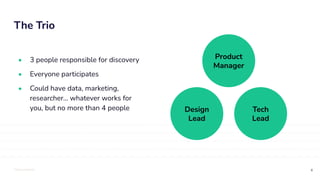
The Trio
4
• 3 people responsible for discovery
• Everyone participates
• Could have data, marketing,
researcher… whatever works for
you, but no more than 4 people
Product
Manager
Design
Lead
Tech
Lead
Most teams are inundated with ideas –
but not for the same opportunity
5
• We test our one idea but miss evidence that it’s not the best idea
• Is Usain Bolt fast? Yes!
• Now compare him to a cheetah, a Tesla, other humans… is he fast?
• We’re looking for a front-runner, not just a runner.
When an engineer doesn’t want to do
discovery, it’s probably because we’ve
been telling them for 30 years just to
take orders, not to think.
Start small. Invite them to an ideation
session. And you may be surprised how
soon they turn around.
6
Killing Products
– Amy Zima
7
The build, measure, learn, iterate myth
doesn’t mean your product should be a
graveyard of failed features
8
TOTALLYMONEY
Why should I kill products?
9
• Re-evaluate features when your value proposition shifts,
when your customer base shifts, and just after time passes
• Even after it’s built, it can still be costing you
• Do you know your customers’ core journeys? Do you know
they aren’t confused by all the options?
TOTALLYMONEY
When should I kill a product feature?
10
• When the value added by a feature does not justify its cost in
physical storage, employee time and usability
• When a feature has a bug that will take too much effort to fix
• When it’s blocking a development that adds more value
• When it’s a security risk
TOTALLYMONEY
How should I kill a product?
11
• Get consensus internally, using real data as evidence. Do a roadshow.
• Pick a date, announce it, and stick to it. Give notice to users and
communicate clear timelines.
• Explain why. Open a dialogue.
• Ask for user feedback.
• Celebrate and mourn.
This is work! But sometimes the biggest
opportunity you have is to simplify, or
give yourself more runway.
12
Finding Umami
– Vicki Tan
13
TOTALLYMONEY
What is it?
14
• Umami is deliciousness; a perfectly-balanced taste
• In product terms, it means looking beyond business metrics as KPIs
• Is our product performing a valuable societal function that can’t be
measured purely in revenue?
• Add an “umami metric” to our standard metrics
How to get the writing done
(for products)
– Scott Kubie
15
Word choices are design choices. If you
leave those design choices til the end of
the process, are you surprised it takes
longer than expected?!
16
TOTALLYMONEY
Make writers a part of your team
17
• Content writing is often left right to the end of a design process and
can be an afterthought
• Give writers ownership and responsibility for their part of the process
• Give them a proper brief with context and desired outcomes
Please pay your writers as much as your
designers.
Why would you pay someone less to
design half of your experience?
18
You’re Already a Researcher
– Greg Bernstein
19
TOTALLYMONEY
We all do research daily
20
• Choosing a new phone, planning a holiday, choosing a restaurant...
• If we can do these multifaceted processes, we can apply these skills to UX
research
• “We’re taking these travel planning skills and bringing them to work with us”
• The dangers of not doing research are that we create products that fail.
Examples are the Pontiac Aztec SUV crossover and the Amazon Fire Phone.
TOTALLYMONEY
How can we make research an embedded function?
21
• At Goretex they have a lattice-like structure rather than siloed teams
• At MailChimp the support team is embedded in the product team
• There is value to talking to the oft-overlooked teams in our company
(finance, commercial etc) as they have different touchpoints and
perspectives
• These different teams become partners to the design team, and feel
empowered to share perspectives
Be the one to ask: whose perspectives
are we missing?
22
• Start with customer support
• Ask for sources of truth
• Create an inventory
Avoiding Burnout
– Lauren Stoney
23
Burnout often comes not just from the
drive to succeed, but the fear to fail.
24
• Focusing on avoiding failure inhibits creativity
• Imagining failure scenarios is spending brain
power – thought time – on unhelpful stuff
TOTALLYMONEY
The most powerful tool for shifting worry: humour!
25
● Imagine your favourite comedy.
● Immerse yourself in it, how it makes you feel.
● Now picture the scenario you’re in, or are
worrying about, through the lens of that
comedy.
You are a peach.
I love peaches. Others don’t.
The peach? It’s just being a peach.
26
Design for Cognitive Bias
– David Dylan Thomas
27
Sometimes your autopilot gets things
wrong.
We call these errors cognitive biases.
28
TOTALLYMONEY
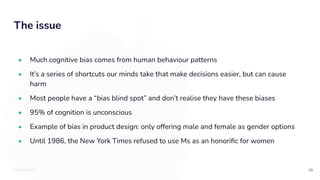
The issue
29
• Much cognitive bias comes from human behaviour patterns
• It’s a series of shortcuts our minds take that make decisions easier, but can cause
harm
• Most people have a “bias blind spot” and don’t realise they have these biases
• 95% of cognition is unconscious
• Example of bias in product design: only offering male and female as gender options
• Until 1986, the New York Times refused to use Ms as an honorific for women
TOTALLYMONEY
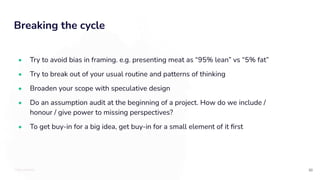
Breaking the cycle
30
• Try to avoid bias in framing. e.g. presenting meat as “95% lean” vs “5% fat”
• Try to break out of your usual routine and patterns of thinking
• Broaden your scope with speculative design
• Do an assumption audit at the beginning of a project. How do we include /
honour / give power to missing perspectives?
• To get buy-in for a big idea, get buy-in for a small element of it first
How We Get Wicked Good
– Karen Vanflouten
31
Being wicked good is being able to
endure long enough to build wisdom,
on top of your skills.
32
When I’m struggling at work, I fall back
on research and collaboration. They’ve
never failed me.
33
TOTALLYMONEY
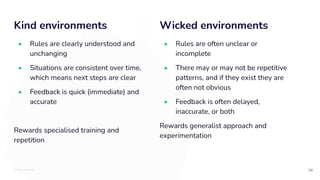
Kind environments
34
• Rules are clearly understood and
unchanging
• Situations are consistent over time,
which means next steps are clear
• Feedback is quick (immediate) and
accurate
Rewards specialised training and
repetition
Wicked environments
• Rules are often unclear or
incomplete
• There may or may not be repetitive
patterns, and if they exist they are
often not obvious
• Feedback is often delayed,
inaccurate, or both
Rewards generalist approach and
experimentation
TOTALLYMONEY
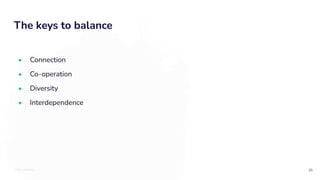
The keys to balance
35
• Connection
• Co-operation
• Diversity
• Interdependence
Trust that you are making progress even
if you can’t see it.
– Maggie Smith
36
Better Onboarding
– Krystal Higgins
37
TOTALLYMONEY
We fear customers...
38
• ...will leave if we don’t show them everything.
• ...won’t do anything later, if not now.
• ...have needs we can’t predict.
TOTALLYMONEY
Moving from front-loaded instruction to guided interaction
39
• What we consider onboarding today is actually first-time use
• Embedded guidance makes it more actionable and memorable
• Churn isn’t solved on the first run. There is short-, mid-, and long-term
churn. We build retentiveness over time.
• Meet people where they are. Some people skip steps. This is naturally
supported by distributing guidance throughout the process.
Alfonso Morris
– Growth Design
40
Every Netflix user is in some kind of A/B
test.
Staff have to ask engineering to put
them on a special user group that
doesn’t see tests!
41
TOTALLYMONEY
What’s a growth designer?
42
● Hybrid of designer, founder, product manager,
and growth lead
● The difference between product designer and
growth designer is that the latter spends more
time at the hypothesis stage, less at the craft
stage
The Psychology
of Dark Patterns
– Melissa Smith PhD
43
TOTALLYMONEY
Hallmarks of dark patterns
44
• Emotional manipulation
e.g. confirm shaming
• Time manipulation
e.g. “3 people viewing now”
• Task/intent manipulation
e.g. email notification panel that lets you reduce email
volume, but not unsubscribe
Practical Growth Design
– Molly Norris Walker
45
TOTALLYMONEY
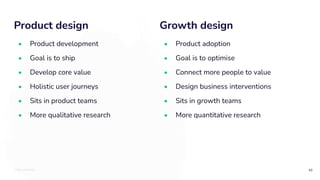
Product design
46
• Product development
• Goal is to ship
• Develop core value
• Holistic user journeys
• Sits in product teams
• More qualitative research
Growth design
• Product adoption
• Goal is to optimise
• Connect more people to value
• Design business interventions
• Sits in growth teams
• More quantitative research
TOTALLYMONEY
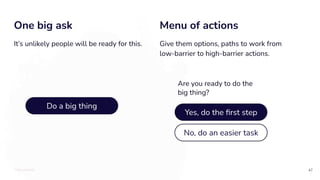
One big ask
47
It’s unlikely people will be ready for this.
Menu of actions
Give them options, paths to work from
low-barrier to high-barrier actions.
Do a big thing
Yes, do the first step
No, do an easier task
Are you ready to do the
big thing?
TOTALLYMONEY
Growth loops
48
• In-product feedback loops where user actions
influence others, triggering further actions which have
business value.
• For example: annual review app. Manager registers,
connects calendar, starts a 1:1, invites their report.
Report registers an account, connects their calendar,
invites a colleague to give 360 feedback. And so on.
• She shared some whiteboard activities which can
generate these kind of loops.

UX Fest 2021

  • 1.
  • 2.
    The What andWhy of Continuous Discovery – Teresa Torres 2
  • 3.
    TOTALLYMONEY Continuous Discovery 3 1. Minimumweekly touch point with customers 2. by the team building the product 3. where they conduct small [research activities?] 4. in pursuit of a desired product outcome
  • 4.
    TOTALLYMONEY The Trio 4 • 3people responsible for discovery • Everyone participates • Could have data, marketing, researcher… whatever works for you, but no more than 4 people Product Manager Design Lead Tech Lead
  • 5.
    Most teams areinundated with ideas – but not for the same opportunity 5 • We test our one idea but miss evidence that it’s not the best idea • Is Usain Bolt fast? Yes! • Now compare him to a cheetah, a Tesla, other humans… is he fast? • We’re looking for a front-runner, not just a runner.
  • 6.
    When an engineerdoesn’t want to do discovery, it’s probably because we’ve been telling them for 30 years just to take orders, not to think. Start small. Invite them to an ideation session. And you may be surprised how soon they turn around. 6
  • 7.
  • 8.
    The build, measure,learn, iterate myth doesn’t mean your product should be a graveyard of failed features 8
  • 9.
    TOTALLYMONEY Why should Ikill products? 9 • Re-evaluate features when your value proposition shifts, when your customer base shifts, and just after time passes • Even after it’s built, it can still be costing you • Do you know your customers’ core journeys? Do you know they aren’t confused by all the options?
  • 10.
    TOTALLYMONEY When should Ikill a product feature? 10 • When the value added by a feature does not justify its cost in physical storage, employee time and usability • When a feature has a bug that will take too much effort to fix • When it’s blocking a development that adds more value • When it’s a security risk
  • 11.
    TOTALLYMONEY How should Ikill a product? 11 • Get consensus internally, using real data as evidence. Do a roadshow. • Pick a date, announce it, and stick to it. Give notice to users and communicate clear timelines. • Explain why. Open a dialogue. • Ask for user feedback. • Celebrate and mourn.
  • 12.
    This is work!But sometimes the biggest opportunity you have is to simplify, or give yourself more runway. 12
  • 13.
  • 14.
    TOTALLYMONEY What is it? 14 •Umami is deliciousness; a perfectly-balanced taste • In product terms, it means looking beyond business metrics as KPIs • Is our product performing a valuable societal function that can’t be measured purely in revenue? • Add an “umami metric” to our standard metrics
  • 15.
    How to getthe writing done (for products) – Scott Kubie 15
  • 16.
    Word choices aredesign choices. If you leave those design choices til the end of the process, are you surprised it takes longer than expected?! 16
  • 17.
    TOTALLYMONEY Make writers apart of your team 17 • Content writing is often left right to the end of a design process and can be an afterthought • Give writers ownership and responsibility for their part of the process • Give them a proper brief with context and desired outcomes
  • 18.
    Please pay yourwriters as much as your designers. Why would you pay someone less to design half of your experience? 18
  • 19.
    You’re Already aResearcher – Greg Bernstein 19
  • 20.
    TOTALLYMONEY We all doresearch daily 20 • Choosing a new phone, planning a holiday, choosing a restaurant... • If we can do these multifaceted processes, we can apply these skills to UX research • “We’re taking these travel planning skills and bringing them to work with us” • The dangers of not doing research are that we create products that fail. Examples are the Pontiac Aztec SUV crossover and the Amazon Fire Phone.
  • 21.
    TOTALLYMONEY How can wemake research an embedded function? 21 • At Goretex they have a lattice-like structure rather than siloed teams • At MailChimp the support team is embedded in the product team • There is value to talking to the oft-overlooked teams in our company (finance, commercial etc) as they have different touchpoints and perspectives • These different teams become partners to the design team, and feel empowered to share perspectives
  • 22.
    Be the oneto ask: whose perspectives are we missing? 22 • Start with customer support • Ask for sources of truth • Create an inventory
  • 23.
  • 24.
    Burnout often comesnot just from the drive to succeed, but the fear to fail. 24 • Focusing on avoiding failure inhibits creativity • Imagining failure scenarios is spending brain power – thought time – on unhelpful stuff
  • 25.
    TOTALLYMONEY The most powerfultool for shifting worry: humour! 25 ● Imagine your favourite comedy. ● Immerse yourself in it, how it makes you feel. ● Now picture the scenario you’re in, or are worrying about, through the lens of that comedy.
  • 26.
    You are apeach. I love peaches. Others don’t. The peach? It’s just being a peach. 26
  • 27.
    Design for CognitiveBias – David Dylan Thomas 27
  • 28.
    Sometimes your autopilotgets things wrong. We call these errors cognitive biases. 28
  • 29.
    TOTALLYMONEY The issue 29 • Muchcognitive bias comes from human behaviour patterns • It’s a series of shortcuts our minds take that make decisions easier, but can cause harm • Most people have a “bias blind spot” and don’t realise they have these biases • 95% of cognition is unconscious • Example of bias in product design: only offering male and female as gender options • Until 1986, the New York Times refused to use Ms as an honorific for women
  • 30.
    TOTALLYMONEY Breaking the cycle 30 •Try to avoid bias in framing. e.g. presenting meat as “95% lean” vs “5% fat” • Try to break out of your usual routine and patterns of thinking • Broaden your scope with speculative design • Do an assumption audit at the beginning of a project. How do we include / honour / give power to missing perspectives? • To get buy-in for a big idea, get buy-in for a small element of it first
  • 31.
    How We GetWicked Good – Karen Vanflouten 31
  • 32.
    Being wicked goodis being able to endure long enough to build wisdom, on top of your skills. 32
  • 33.
    When I’m strugglingat work, I fall back on research and collaboration. They’ve never failed me. 33
  • 34.
    TOTALLYMONEY Kind environments 34 • Rulesare clearly understood and unchanging • Situations are consistent over time, which means next steps are clear • Feedback is quick (immediate) and accurate Rewards specialised training and repetition Wicked environments • Rules are often unclear or incomplete • There may or may not be repetitive patterns, and if they exist they are often not obvious • Feedback is often delayed, inaccurate, or both Rewards generalist approach and experimentation
  • 35.
    TOTALLYMONEY The keys tobalance 35 • Connection • Co-operation • Diversity • Interdependence
  • 36.
    Trust that youare making progress even if you can’t see it. – Maggie Smith 36
  • 37.
  • 38.
    TOTALLYMONEY We fear customers... 38 •...will leave if we don’t show them everything. • ...won’t do anything later, if not now. • ...have needs we can’t predict.
  • 39.
    TOTALLYMONEY Moving from front-loadedinstruction to guided interaction 39 • What we consider onboarding today is actually first-time use • Embedded guidance makes it more actionable and memorable • Churn isn’t solved on the first run. There is short-, mid-, and long-term churn. We build retentiveness over time. • Meet people where they are. Some people skip steps. This is naturally supported by distributing guidance throughout the process.
  • 40.
  • 41.
    Every Netflix useris in some kind of A/B test. Staff have to ask engineering to put them on a special user group that doesn’t see tests! 41
  • 42.
    TOTALLYMONEY What’s a growthdesigner? 42 ● Hybrid of designer, founder, product manager, and growth lead ● The difference between product designer and growth designer is that the latter spends more time at the hypothesis stage, less at the craft stage
  • 43.
    The Psychology of DarkPatterns – Melissa Smith PhD 43
  • 44.
    TOTALLYMONEY Hallmarks of darkpatterns 44 • Emotional manipulation e.g. confirm shaming • Time manipulation e.g. “3 people viewing now” • Task/intent manipulation e.g. email notification panel that lets you reduce email volume, but not unsubscribe
  • 45.
    Practical Growth Design –Molly Norris Walker 45
  • 46.
    TOTALLYMONEY Product design 46 • Productdevelopment • Goal is to ship • Develop core value • Holistic user journeys • Sits in product teams • More qualitative research Growth design • Product adoption • Goal is to optimise • Connect more people to value • Design business interventions • Sits in growth teams • More quantitative research
  • 47.
    TOTALLYMONEY One big ask 47 It’sunlikely people will be ready for this. Menu of actions Give them options, paths to work from low-barrier to high-barrier actions. Do a big thing Yes, do the first step No, do an easier task Are you ready to do the big thing?
  • 48.
    TOTALLYMONEY Growth loops 48 • In-productfeedback loops where user actions influence others, triggering further actions which have business value. • For example: annual review app. Manager registers, connects calendar, starts a 1:1, invites their report. Report registers an account, connects their calendar, invites a colleague to give 360 feedback. And so on. • She shared some whiteboard activities which can generate these kind of loops.