KLEBEBEREICH / AREA FOR GLUEING
Physical Product
Digital ‘Product’ (Service)
Lean Startup
AgileDesign Thinking Lean Ux
Lean Ux +/∨
Overlaps and Differences
Explore the problem space: “What are problems worth solving?” Explore the solution space: “Let’s first build the ‘right it’!” Transition into delivery mode: “... and now let’s build ‘it right’!”
» Team compilation at Kaiser Permanente?
Skip Belbin and Clifton tests,
‘go where the laugh is’!
» Anonymous org collects all initial
assumptions of ‘Messrs. Know-It-All’
otherwise they will later say: “We already
knew the ‘insights’ you present.“
» At IBM managers cannot initiate
a design thinking project if they
haven’t participated in a training
themselves (Hallmark Program).
» A team had to research the emergency
room experience: they observed Formula
One teams and pit stops to learn.
» If it is not possible to observe users, try to
assign data collection them: Cultural Probes
or app-driven data self-collection tools like
ExperienceFellow are great for that.
» GE Healthcare: The ‘adventure frame’ helped
solving anaesthetization problems with
MRIs and kids (wp.me/p3W8cI-we).
» AirBnB synthesized a taxonomy of
reasons why hosts reject guest inquiries.
These serve now as a springboard for Ux
improvement (wp.me/p3W8cI-sL).
» Once a design challenge is framed, Intuit
uses internal crowd-sourcing software to get
ideas as many and diverse as possible.
» Walt Disney used three physically different
room set-ups to brainstorm in different thinking
modi: ‘dreamer’, ‘realist’ and ‘spoiler’ room.
» Godrej ChotuKool, India’s most
successful fridge has been co-created
in ideation and prototyping sessions
with over 200 village women.
» Dropbox used a simple explainer video to
register the interest of 75,000 people
over night for their up and coming
service (bit.ly/mvpdropbox).
» A Stanford self driving car research team
used pretotyping to test hypotheses
regarding pedestrians’ reactions to self-
driving cars by building a camouflage
drivers seat (bit.ly/ghostdriver).
» In their beginning Zappos took pictures
of shoes at local stores and posted them
up for sale on their site. Once customers
purchased, they bought from the store
and shipped to their customers.
» Startups (e.g. Buffer or Bounce) used ‘fake
landing pages’ to test VP and willingness
to buy. They even let people pay with credit
card before having a functioning service at
hand (A/B testing on price sensitivity).
» Walmart competes with Amazon. Its
employees now help in a sizably in-market
experiment and deliver groceries to customers
on their way home (bloom.bg/2tBJcCe)
» After Requirements Analysis, Airbnb used
‘Nebula’ as a storage platform to build their
search backends (bit.ly/airbnbnebula)
» System engineers at SAP App House like to
go for a coffee with clients if they want to
discuss and test whether a feature
really makes sense.
» Airbnb uses the paradigm of TATFT a.k.a.
‘Test All The Frigging Time’
(bit.ly/airbnbTATFT).
» New York-based carpooling service VIA uses
‘minutes saved‘ as its main metric for the setup
of its systems. (http://bit.ly/via-algorithm)
» Netflix uses AWS to quickly deploy thousands
of servers and terabytes of storage within
minutes. A multi-tier and staged, scalable
and automated server infrastructure
provides the needed deployment
environment (bit.ly/netflix-AWS).
Example
Anecdote
» SAP says: bit.ly/SAPdled
» We say: go.codify.in/scope
» SAP says: bit.ly/SAPdled
» We say: go.codify.in/360
» Lots of DT resources: wp.me/P3W8cI-N6
» SAP says: bit.ly/SAPdled
» We say: go.codify.in/synthesize
» Lots of DT resources: wp.me/P3W8cI-N6
» SAP says: bit.ly/SAPdled
» We say: go.codify.in/ideate
» Lots of DT resources: wp.me/P3W8cI-N6
» SAP says: bit.ly/SAPdled
» We say: go.codify.in/prototype
» Lots of DT resources: wp.me/P3W8cI-N6
» SAP says: bit.ly/SAPdled
» We say: go.codify.in/validate
» Lots of DT resources: wp.me/P3W8cI-N6
» SAP says: bit.ly/SAPdled
» We say: go.codify.in/implement
» SAP says: bit.ly/SAPdled
» We say: go.codify.in/test
» SAP says: bit.ly/SAPdled
» We say: go.codify.in/deploy
More Info
Lean Production Agile KANBAN+/∨Lean StartupDesign (Thinking)
Lean StartupDesign (Thinking) +/∨
Design thinking starts solution-free
by looking for unmet/latent user
problems (read: needs) first.
Lean Startup starts with an often technical
idea or innovation, which ‘looks’ for a
market opportunity or ‘monetization model’.
‘Agile’ as we understand it, depicts a flexible
project delivery approach or philosophy, which
favours individuals and interactions over
processes and tools.
Project/Initiative Set-up
» Project Stakeholder Mapping
» Project Scoping Workshop
Challenge Definition
» Semantic Ladder / Problem Tree Analysis
» Charette
» Abstraction Laddering
» ‘Rose, Thorn, Bud’
» Ethnographic Design Research:
Interviews (In-situ, Jobs-to-be-done, etc.),
Cultural Probes, Analogue Observation,
Learning- and Inspirational ‘Safaris’
» Participatory Research:
Participant Observation, ‘Walk-
A-Mile’ Immersions
» Frequent Visualization and Data Modelling
Techniques: Personas, ‘As-is’ User Journeys
& Blueprints, Business Model Design Suite
(BMC, VPC, UAN, Value Flow Mapping, etc.)
Frequent Visualization and
Data Modelling Techniques:
» System Maps, Stakeholder Maps,
Empathy Maps, Personas II
» Affinity Diagrams, Concept Mapping,
Importance-Difficulty Matrix
» Point-of-View Formulation (Mad Lib)
» (Core) Jobs-to-be-done/Need Statements
and Prioritization via Value Metrics Analysis
» ‘How-Might-We’ Question Storming
» Brainwriting and Brainstorming creativity (e.g.
Disney Method, Hot Potato, Painstorming,
etc.) and selection techniques (Dotmocracy,
Forced Ranking, User Feedback, etc.)
» Bodystorming and Protoacting
» Co-creation and -production with users and
domain experts (e.g. Design Studio time)
» Idea Napkins, ‘To-be‘ User Journeys,
Business Model Representations, etc.
» Rapid prototyping/‘pretotyping’
and testing sprints
» Empathy prototypes, experiential prototypes
and service concepts (e.g. Cardboard
Engineering, (Paper/Digital) Mock-
ups, Volume Models, Hacking)
» Value Proposition Canvas /
Business Model Suite
» Lean Progress Board
» Business Model Canvas / Suite
» User Feedback (e.g. via KANO Model,
Jobs-to-be-done Value Metrics Survey)
» Innovation Accounting, KPIs
» In-Market Experiments
» Product/Service Backlog
» Kanban/SCRUM
» Extreme Programming
» User Stories
» Evaluative Research: e.g. via ongoing
Usability Testing (Think-Aloud, Heatmap, etc.)
» QA, e.g. via Unit-Testing, Silenium eTesting
» Simulations
» Simulations
Frequently used
Tools and Methods
» Project Sponsor
» Product Owner
» Sprint Master / Facilitator
» User Researchers, Design Researchers
» Data Visualization Experts
» The whole team including the Sprint Master » The whole team including the Sprint Master
» Customers and users
» Other external or internal teams
» The whole team including the Sprint Master
» Ux Experts, Design Engineers, etc.
» The whole team including the Sprint Master
» User Researchers, Design Researchers
» Ux Experts, Design Engineers, etc.
» Other functional areas
» SCRUM Master, Agile Coach
» Development Team
» Development Team » Development Team
Team Roles Most Active
Password: codify_DT-LS-AGILE
Attribution-No Derivatives 4.0 International (CC BY-ND 4.0)
Teaching Poster ‘Better Together: A Process Perspective on Design Thinking, Lean
Startup, and Agile’ v 1.0 by Jan Schmiedgen (co:dify Group, www.codify.in) and
Abraham Taherivand.
There exist many variations of process visualizations for methodologies like design
thinking, Lean Startup and Agile. For this teaching poster we chose SAP’s design
process visualization for two reasons:
1) It looks good! There might exist more sophisticated and nuanced process
visualizations out there. But this one is simple enough, yet elegant, and thus perfect
for teaching and instructing.
2) More importantly: different industries look at SAP as a role model organisation
when it comes to ‘change via design-driven innovation’. Hence organisations already
copy and remix SAP’s material. We believe it is easier for them to relate to and build
upon the material and wording they already use than building yet another process
model.
The authors of this poster are not officially associated with SAP. Our interpretation
and modification of their process model might in parts deviate from SAP’s reading.
Have fun with the poster!
Feedback: toolsmiths@codify.in
cbd
C
Image Credits:
Main ‘process visualization’:
© SAP /// http://bit.ly/SAPdesignprocess /// http://bit.ly/SAPdled
Download
poster
here:
Co:dify is a multidisciplinary network of experienced innovation researchers and practitioners with
a focus on design. We analyze the innovation approaches and practices from the most progressive
companies in the world and co:dify them into learning formats and innovation programs. This enables
us to provide our clients with the latest thinking, frameworks, tools and facilitation for a sustainable
self-help in developing their innovation culture.
www.codify.in
Please note: It is not our intent to create the impression that
these management ideas can be handled in a ‘waterfall-ish’
way. This is a teaching poster and it cannot visualize all the
details every methodology brings along with. We recommend
working through the poster with an instructor and use it as a
basis for discussion.
Diverge
Converge
Iterate
Diverge
Converge
Iterate
Iterate
Diverge
Converge
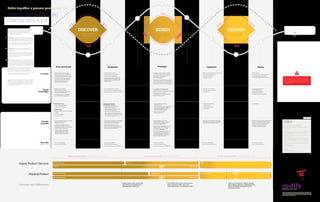
Design
What are potential
problem solutions?
Discover
What are problems
worth solving?
Deliver
How to roll out and
get feedback?
» Align innovation intent for project/
initiative with corporate strategy goals
» Formulate initial problem area a.k.a. the
‘design challenge’ in kick-off workshops
» Set up and on-board team (if needed:
hire complementary skills externally)
» Educate project stakeholders on
project and process approach
» Plan research design and recruit users
» Understand problem space and gain
empathy (perform qualitative primary
(e.g. user research) and secondary
research (expert interviews and
market-, trend- and desk research))
» Collect and triangulate data
points from different sources
» Translate data points into visualisations
» Find patterns and priorities
» Perform collective sense-making
» Redefine problem (hypothesis)
» Derive design principles for the project
at hand and follow brand-specific global
design principles (e.g. experience and
language pattern)
» Collect analogue inspiration
» Explore possible futures and their
assumptions by generating lots of
ideas / scenarios in parallel
» Prototype to ideate and communicate:
make idea concepts tangible and testable
» Build to think: gain deeper empathy by
intervening in user’s context
with ‘clumsy solutions’
» Prototype to test: organize testing setup and
hack existing solutions as a testing platforms
» Visualize value proposition / business model
scenarios to narrow down problem-solution-fit
» Recruit testers
» Prototype to test: design experiments
and (in)validate hypotheses with MVPs
to achieve solution-market-fit
» Document learnings on progress boards
» Include stakeholders from other silos/
functional units and perform internal
‘opportunity marketing’
» Define requirements (based on Design Specs)
» Plan releases (alpha, beta, etc.)
» Plan Architecture Design
» Code and/or produce
» Perform A/B Tests and Metrics Evaluation
» Run Integration Tests
» Set up staging system
» Release versions
» Use solution in production environment
» Roll out cloud-based and scalable
infrastructure with provisioning concepts
Activities
SHIP
The execution
engine can start.
Finally!
» Defined ‘design challenge’
» Mapped initial assumptions
(e.g. project hypotheses, assumption-
based journey mapping, etc.)
» Audit reports (team/organisational
innovation readiness assessments)
» Field notes and research artefacts
» Visualized and modelled raw data
» Interim reports
» POV – reframed problem definition
» Main hypothesis or assumed Core JTBD
» Design principles as self-imposed ‘constraints’
» Idea concepts and rough prototypes
(products/services/business models)
» Concept documentations
(idea napkins, concept sketches,
first To-Be Journey Maps, etc.)
» List of detailed hypotheses and their
embodied prototype representations
» MVP(s) and value proposition design parameters
» Prototypes of different fidelity
(vision/strategic, concept, critical function)
» Validated POV / Core JTBD
» Smoke test learning log
» Specifications and requirements
» Informed pivots (VP/Feature Set, VP:
Customer Set, Technology and Operations
Management Strategy, Go-To-Market Plan,
Cash Flow Formula/Revenue Model)
» Business case/model (≈ Vision in SCRUM)
» Elevator pitch
» Preliminary Launch Roadmap
» Epics, User Stories, Test Cases
» First Version 1.0
» Integration test on staging system
» Evaluation, KPIs, Metrics
» Roll-out/release version X
on live/staging system
» System runs on operating
production environment
» Monitoring and Server Provisioning
Typical
Deliverables
Scan and Scope Synthesize Ideate Validate Implement DeployTest360° Explore Prototype
DEV OPS
(‘New’) management approaches never come alone. They always
have to be tailored and get integrated into the specific industry
context of organisations who want to apply it. Often they also
have their blind spots and shortcomings which have to be
counterbalanced by complementary methodologies. There are no
silver bullet concepts to innovation!
Design thinking is great for nurturing creative confidence (self-
efficacy) in people and does good in organizing creative team work.
It is a great way to organize the ‘fuzzy front-end’ of innovation and
certainly helps finding the ‘right problem’ in a ‘solution-free’ manner.
Yet, it does not emphasize metrics-driven hypothesis building and
testing, nor does it provide a useful project management approach
for an agile implementation of its concept outcomes.
Lean Startup perfectly complements design thinking with its
metrics-driven focus on innovation accounting and business model
hypotheses testing.
However, it falls short of the mark when it comes to finding the
right problem. It was always more a tech-push than a market-pull
approach. Similar to design thinking its common descriptions also
lack guidance on how to setup and manage projects in teams in a
manner of continuous delivery.
Agile is a widely used term nowadays. There are companies who try
to change their culture and refer to ‘organisational agility’ as a desired
end state, others want to become better in coping with ambiguity in
general and say: “We need to become more agile.“ We believe that all
the talk about agile can be traced back to the Agile Manifesto and the
importance that IT and digitalization plays in today’s business world.
Thus we don’t care about such connotations and consider ‘Agile’
an approach that is great for rolling out software (products
and services) as it comes with rich variety of best practices
for a continuous project delivery. It is heavily geared towards
implementation and therefore has gained such a popularity.
However, it gives no guidance whatsoever on how to arrive at a ‘right
problem’ (-solution-fit) or in Agile-lingo ‘product vision’.
A combination of all of the three approaches together is often called
Lean Ux. This learning and teaching poster provides an exemplary
overview on the interplay of these three most popular approaches
to managing human-centric innovation. By no means it is complete.
It shall rather serve as a basis to discuss the adaption and setup of
your own approach to innovation.
Better together: a process perspective on ...
Design Thinking, Lean
Startup, and Agile
LEARNMOREABOUTT
HEINTERPLAY OF DESIGN THINKING, LEAN
STARTUP
Wort-Bild-Marke | Zusatz einzeilig | Pantone uncoated | Größe 40 | Name: hpi_logo_pcu_wb_sl1
HPI Academy | Executive Education
PersonasAn effective tool to build empathy into design and decision-making processes
Jan Schmiedgen //// Potsdam, 21.06.2014
SHORT
DOCUMENT-
ATIONHPI-AcademyOpen Course Deep Dive:
‘Design Thinking and Agile Methods‘
Starting November 2017
The Open Course Deep Dive ‘Design Thinking and Agile Methods‘ is a co-production o
Uberproduct, HPI-Academy, co:dify Group, and Abraham Taherivand.
The November course will be available in German language only.
KLEBEBEREICH / AREA FOR GLUEING
Physical Product
Digital ‘Product’ (Service)
Lean Startup
AgileDesign Thinking Lean Ux
Lean Ux +/∨
Overlaps and Differences
Explore the problem space: “What are problems worth solving?” Explore the solution space: “Let’s first build the ‘right it’!” Transition into delivery mode: “... and now let’s build ‘it right’!”
» Team compilation at Kaiser Permanente?
Skip Belbin and Clifton tests,
‘go where the laugh is’!
» Anonymous org collects all initial
assumptions of ‘Messrs. Know-It-All’
otherwise they will later say: “We already
knew the ‘insights’ you present.“
» At IBM managers cannot initiate
a design thinking project if they
haven’t participated in a training
themselves (Hallmark Program).
» A team had to research the emergency
room experience: they observed Formula
One teams and pit stops to learn.
» If it is not possible to observe users, try to
assign data collection them: Cultural Probes
or app-driven data self-collection tools like
ExperienceFellow are great for that.
» GE Healthcare: The ‘adventure frame’ helped
solving anaesthetization problems with
MRIs and kids (wp.me/p3W8cI-we).
» AirBnB synthesized a taxonomy of
reasons why hosts reject guest inquiries.
These serve now as a springboard for Ux
improvement (wp.me/p3W8cI-sL).
» Once a design challenge is framed, Intuit
uses internal crowd-sourcing software to get
ideas as many and diverse as possible.
» Walt Disney used three physically different
room set-ups to brainstorm in different thinking
modi: ‘dreamer’, ‘realist’ and ‘spoiler’ room.
» Godrej ChotuKool, India’s most
successful fridge has been co-created
in ideation and prototyping sessions
with over 200 village women.
» Dropbox used a simple explainer video to
register the interest of 75,000 people
over night for their up and coming
service (bit.ly/mvpdropbox).
» A Stanford self driving car research team
used pretotyping to test hypotheses
regarding pedestrians’ reactions to self-
driving cars by building a camouflage
drivers seat (bit.ly/ghostdriver).
» In their beginning Zappos took pictures
of shoes at local stores and posted them
up for sale on their site. Once customers
purchased, they bought from the store
and shipped to their customers.
» Startups (e.g. Buffer or Bounce) used ‘fake
landing pages’ to test VP and willingness
to buy. They even let people pay with credit
card before having a functioning service at
hand (A/B testing on price sensitivity).
» Walmart competes with Amazon. Its
employees now help in a sizably in-market
experiment and deliver groceries to customers
on their way home (bloom.bg/2tBJcCe)
» After Requirements Analysis, Airbnb used
‘Nebula’ as a storage platform to build their
search backends (bit.ly/airbnbnebula)
» System engineers at SAP App House like to
go for a coffee with clients if they want to
discuss and test whether a feature
really makes sense.
» Airbnb uses the paradigm of TATFT a.k.a.
‘Test All The Frigging Time’
(bit.ly/airbnbTATFT).
» New York-based carpooling service VIA uses
‘minutes saved‘ as its main metric for the setup
of its systems. (http://bit.ly/via-algorithm)
» Netflix uses AWS to quickly deploy thousands
of servers and terabytes of storage within
minutes. A multi-tier and staged, scalable
and automated server infrastructure
provides the needed deployment
environment (bit.ly/netflix-AWS).
Example
Anecdote
» SAP says: bit.ly/SAPdled
» We say: go.codify.in/scope
» SAP says: bit.ly/SAPdled
» We say: go.codify.in/360
» Lots of DT resources: wp.me/P3W8cI-N6
» SAP says: bit.ly/SAPdled
» We say: go.codify.in/synthesize
» Lots of DT resources: wp.me/P3W8cI-N6
» SAP says: bit.ly/SAPdled
» We say: go.codify.in/ideate
» Lots of DT resources: wp.me/P3W8cI-N6
» SAP says: bit.ly/SAPdled
» We say: go.codify.in/prototype
» Lots of DT resources: wp.me/P3W8cI-N6
» SAP says: bit.ly/SAPdled
» We say: go.codify.in/validate
» Lots of DT resources: wp.me/P3W8cI-N6
» SAP says: bit.ly/SAPdled
» We say: go.codify.in/implement
» SAP says: bit.ly/SAPdled
» We say: go.codify.in/test
» SAP says: bit.ly/SAPdled
» We say: go.codify.in/deploy
More Info
Lean Production Agile KANBAN+/∨Lean StartupDesign (Thinking)
Lean StartupDesign (Thinking) +/∨
Design thinking starts solution-free
by looking for unmet/latent user
problems (read: needs) first.
Lean Startup starts with an often technical
idea or innovation, which ‘looks’ for a
market opportunity or ‘monetization model’.
‘Agile’ as we understand it, depicts a flexible
project delivery approach or philosophy, which
favours individuals and interactions over
processes and tools.
Project/Initiative Set-up
» Project Stakeholder Mapping
» Project Scoping Workshop
Challenge Definition
» Semantic Ladder / Problem Tree Analysis
» Charette
» Abstraction Laddering
» ‘Rose, Thorn, Bud’
» Ethnographic Design Research:
Interviews (In-situ, Jobs-to-be-done, etc.),
Cultural Probes, Analogue Observation,
Learning- and Inspirational ‘Safaris’
» Participatory Research:
Participant Observation, ‘Walk-
A-Mile’ Immersions
» Frequent Visualization and Data Modelling
Techniques: Personas, ‘As-is’ User Journeys
& Blueprints, Business Model Design Suite
(BMC, VPC, UAN, Value Flow Mapping, etc.)
Frequent Visualization and
Data Modelling Techniques:
» System Maps, Stakeholder Maps,
Empathy Maps, Personas II
» Affinity Diagrams, Concept Mapping,
Importance-Difficulty Matrix
» Point-of-View Formulation (Mad Lib)
» (Core) Jobs-to-be-done/Need Statements
and Prioritization via Value Metrics Analysis
» ‘How-Might-We’ Question Storming
» Brainwriting and Brainstorming creativity (e.g.
Disney Method, Hot Potato, Painstorming,
etc.) and selection techniques (Dotmocracy,
Forced Ranking, User Feedback, etc.)
» Bodystorming and Protoacting
» Co-creation and -production with users and
domain experts (e.g. Design Studio time)
» Idea Napkins, ‘To-be‘ User Journeys,
Business Model Representations, etc.
» Rapid prototyping/‘pretotyping’
and testing sprints
» Empathy prototypes, experiential prototypes
and service concepts (e.g. Cardboard
Engineering, (Paper/Digital) Mock-
ups, Volume Models, Hacking)
» Value Proposition Canvas /
Business Model Suite
» Lean Progress Board
» Business Model Canvas / Suite
» User Feedback (e.g. via KANO Model,
Jobs-to-be-done Value Metrics Survey)
» Innovation Accounting, KPIs
» In-Market Experiments
» Product/Service Backlog
» Kanban/SCRUM
» Extreme Programming
» User Stories
» Evaluative Research: e.g. via ongoing
Usability Testing (Think-Aloud, Heatmap, etc.)
» QA, e.g. via Unit-Testing, Silenium eTesting
» Simulations
» Simulations
Frequently used
Tools and Methods
» Project Sponsor
» Product Owner
» Sprint Master / Facilitator
» User Researchers, Design Researchers
» Data Visualization Experts
» The whole team including the Sprint Master » The whole team including the Sprint Master
» Customers and users
» Other external or internal teams
» The whole team including the Sprint Master
» Ux Experts, Design Engineers, etc.
» The whole team including the Sprint Master
» User Researchers, Design Researchers
» Ux Experts, Design Engineers, etc.
» Other functional areas
» SCRUM Master, Agile Coach
» Development Team
» Development Team » Development Team
Team Roles Most Active
Password: codify_DT-LS-AGILE
Attribution-No Derivatives 4.0 International (CC BY-ND 4.0)
Teaching Poster ‘Better Together: A Process Perspective on Design Thinking, Lean
Startup, and Agile’ v 1.0 by Jan Schmiedgen (co:dify Group, www.codify.in) and
Abraham Taherivand.
There exist many variations of process visualizations for methodologies like design
thinking, Lean Startup and Agile. For this teaching poster we chose SAP’s design
process visualization for two reasons:
1) It looks good! There might exist more sophisticated and nuanced process
visualizations out there. But this one is simple enough, yet elegant, and thus perfect
for teaching and instructing.
2) More importantly: different industries look at SAP as a role model organisation
when it comes to ‘change via design-driven innovation’. Hence organisations already
copy and remix SAP’s material. We believe it is easier for them to relate to and build
upon the material and wording they already use than building yet another process
model.
The authors of this poster are not officially associated with SAP. Our interpretation
and modification of their process model might in parts deviate from SAP’s reading.
Have fun with the poster!
Feedback: toolsmiths@codify.in
cbd
C
Image Credits:
Main ‘process visualization’:
© SAP /// http://bit.ly/SAPdesignprocess /// http://bit.ly/SAPdled
Download
poster
here:
Co:dify is a multidisciplinary network of experienced innovation researchers and practitioners with
a focus on design. We analyze the innovation approaches and practices from the most progressive
companies in the world and co:dify them into learning formats and innovation programs. This enables
us to provide our clients with the latest thinking, frameworks, tools and facilitation for a sustainable
self-help in developing their innovation culture.
www.codify.in
Please note: It is not our intent to create the impression that
these management ideas can be handled in a ‘waterfall-ish’
way. This is a teaching poster and it cannot visualize all the
details every methodology brings along with. We recommend
working through the poster with an instructor and use it as a
basis for discussion.
KLEBEBEREICH / AREA FOR GLUEING
Physical Product
Digital ‘Product’ (Service)
Lean Startup
AgileDesign Thinking Lean Ux
Lean Ux +/∨
Overlaps and Differences
Explore the problem space: “What are problems worth solving?” Explore the solution space: “Let’s first build the ‘right it’!” Transition into delivery mode: “... and now let’s build ‘it right’!”
» Team compilation at Kaiser Permanente?
Skip Belbin and Clifton tests,
‘go where the laugh is’!
» Anonymous org collects all initial
assumptions of ‘Messrs. Know-It-All’
otherwise they will later say: “We already
knew the ‘insights’ you present.“
» At IBM managers cannot initiate
a design thinking project if they
haven’t participated in a training
themselves (Hallmark Program).
» A team had to research the emergency
room experience: they observed Formula
One teams and pit stops to learn.
» If it is not possible to observe users, try to
assign data collection them: Cultural Probes
or app-driven data self-collection tools like
ExperienceFellow are great for that.
» GE Healthcare: The ‘adventure frame’ helped
solving anaesthetization problems with
MRIs and kids (wp.me/p3W8cI-we).
» AirBnB synthesized a taxonomy of
reasons why hosts reject guest inquiries.
These serve now as a springboard for Ux
improvement (wp.me/p3W8cI-sL).
» Once a design challenge is framed, Intuit
uses internal crowd-sourcing software to get
ideas as many and diverse as possible.
» Walt Disney used three physically different
room set-ups to brainstorm in different thinking
modi: ‘dreamer’, ‘realist’ and ‘spoiler’ room.
» Godrej ChotuKool, India’s most
successful fridge has been co-created
in ideation and prototyping sessions
with over 200 village women.
» Dropbox used a simple explainer video to
register the interest of 75,000 people
over night for their up and coming
service (bit.ly/mvpdropbox).
» A Stanford self driving car research team
used pretotyping to test hypotheses
regarding pedestrians’ reactions to self-
driving cars by building a camouflage
drivers seat (bit.ly/ghostdriver).
» In their beginning Zappos took pictures
of shoes at local stores and posted them
up for sale on their site. Once customers
purchased, they bought from the store
and shipped to their customers.
» Startups (e.g. Buffer or Bounce) used ‘fake
landing pages’ to test VP and willingness
to buy. They even let people pay with credit
card before having a functioning service at
hand (A/B testing on price sensitivity).
» Walmart competes with Amazon. Its
employees now help in a sizably in-market
experiment and deliver groceries to customers
on their way home (bloom.bg/2tBJcCe)
» After Requirements Analysis, Airbnb used
‘Nebula’ as a storage platform to build their
search backends (bit.ly/airbnbnebula)
» System engineers at SAP App House like to
go for a coffee with clients if they want to
discuss and test whether a feature
really makes sense.
» Airbnb uses the paradigm of TATFT a.k.a.
‘Test All The Frigging Time’
(bit.ly/airbnbTATFT).
» New York-based carpooling service VIA uses
‘minutes saved‘ as its main metric for the setup
of its systems. (http://bit.ly/via-algorithm)
» Netflix uses AWS to quickly deploy thousands
of servers and terabytes of storage within
minutes. A multi-tier and staged, scalable
and automated server infrastructure
provides the needed deployment
environment (bit.ly/netflix-AWS).
Example
Anecdote
» SAP says: bit.ly/SAPdled
» We say: go.codify.in/scope
» SAP says: bit.ly/SAPdled
» We say: go.codify.in/360
» Lots of DT resources: wp.me/P3W8cI-N6
» SAP says: bit.ly/SAPdled
» We say: go.codify.in/synthesize
» Lots of DT resources: wp.me/P3W8cI-N6
» SAP says: bit.ly/SAPdled
» We say: go.codify.in/ideate
» Lots of DT resources: wp.me/P3W8cI-N6
» SAP says: bit.ly/SAPdled
» We say: go.codify.in/prototype
» Lots of DT resources: wp.me/P3W8cI-N6
» SAP says: bit.ly/SAPdled
» We say: go.codify.in/validate
» Lots of DT resources: wp.me/P3W8cI-N6
» SAP says: bit.ly/SAPdled
» We say: go.codify.in/implement
» SAP says: bit.ly/SAPdled
» We say: go.codify.in/test
» SAP says: bit.ly/SAPdled
» We say: go.codify.in/deploy
More Info
Lean Production Agile KANBAN+/∨Lean StartupDesign (Thinking)
Lean StartupDesign (Thinking) +/∨
Design thinking starts solution-free
by looking for unmet/latent user
problems (read: needs) first.
Lean Startup starts with an often technical
idea or innovation, which ‘looks’ for a
market opportunity or ‘monetization model’.
‘Agile’ as we understand it, depicts a flexible
project delivery approach or philosophy, which
favours individuals and interactions over
processes and tools.
Project/Initiative Set-up
» Project Stakeholder Mapping
» Project Scoping Workshop
Challenge Definition
» Semantic Ladder / Problem Tree Analysis
» Charette
» Abstraction Laddering
» ‘Rose, Thorn, Bud’
» Ethnographic Design Research:
Interviews (In-situ, Jobs-to-be-done, etc.),
Cultural Probes, Analogue Observation,
Learning- and Inspirational ‘Safaris’
» Participatory Research:
Participant Observation, ‘Walk-
A-Mile’ Immersions
» Frequent Visualization and Data Modelling
Techniques: Personas, ‘As-is’ User Journeys
& Blueprints, Business Model Design Suite
(BMC, VPC, UAN, Value Flow Mapping, etc.)
Frequent Visualization and
Data Modelling Techniques:
» System Maps, Stakeholder Maps,
Empathy Maps, Personas II
» Affinity Diagrams, Concept Mapping,
Importance-Difficulty Matrix
» Point-of-View Formulation (Mad Lib)
» (Core) Jobs-to-be-done/Need Statements
and Prioritization via Value Metrics Analysis
» ‘How-Might-We’ Question Storming
» Brainwriting and Brainstorming creativity (e.g.
Disney Method, Hot Potato, Painstorming,
etc.) and selection techniques (Dotmocracy,
Forced Ranking, User Feedback, etc.)
» Bodystorming and Protoacting
» Co-creation and -production with users and
domain experts (e.g. Design Studio time)
» Idea Napkins, ‘To-be‘ User Journeys,
Business Model Representations, etc.
» Rapid prototyping/‘pretotyping’
and testing sprints
» Empathy prototypes, experiential prototypes
and service concepts (e.g. Cardboard
Engineering, (Paper/Digital) Mock-
ups, Volume Models, Hacking)
» Value Proposition Canvas /
Business Model Suite
» Lean Progress Board
» Business Model Canvas / Suite
» User Feedback (e.g. via KANO Model,
Jobs-to-be-done Value Metrics Survey)
» Innovation Accounting, KPIs
» In-Market Experiments
» Product/Service Backlog
» Kanban/SCRUM
» Extreme Programming
» User Stories
» Evaluative Research: e.g. via ongoing
Usability Testing (Think-Aloud, Heatmap, etc.)
» QA, e.g. via Unit-Testing, Silenium eTesting
» Simulations
» Simulations
Frequently used
Tools and Methods
» Project Sponsor
» Product Owner
» Sprint Master / Facilitator
» User Researchers, Design Researchers
» Data Visualization Experts
» The whole team including the Sprint Master » The whole team including the Sprint Master
» Customers and users
» Other external or internal teams
» The whole team including the Sprint Master
» Ux Experts, Design Engineers, etc.
» The whole team including the Sprint Master
» User Researchers, Design Researchers
» Ux Experts, Design Engineers, etc.
» Other functional areas
» SCRUM Master, Agile Coach
» Development Team
» Development Team » Development Team
Team Roles Most Active
Password: codify_DT-LS-AGILE
Attribution-No Derivatives 4.0 International (CC BY-ND 4.0)
Teaching Poster ‘Better Together: A Process Perspective on Design Thinking, Lean
Startup, and Agile’ v 1.0 by Jan Schmiedgen (co:dify Group, www.codify.in) and
Abraham Taherivand.
There exist many variations of process visualizations for methodologies like design
thinking, Lean Startup and Agile. For this teaching poster we chose SAP’s design
process visualization for two reasons:
1) It looks good! There might exist more sophisticated and nuanced process
visualizations out there. But this one is simple enough, yet elegant, and thus perfect
for teaching and instructing.
2) More importantly: different industries look at SAP as a role model organisation
when it comes to ‘change via design-driven innovation’. Hence organisations already
copy and remix SAP’s material. We believe it is easier for them to relate to and build
upon the material and wording they already use than building yet another process
model.
The authors of this poster are not officially associated with SAP. Our interpretation
and modification of their process model might in parts deviate from SAP’s reading.
Have fun with the poster!
Feedback: toolsmiths@codify.in
cbd
C
Image Credits:
Main ‘process visualization’:
© SAP /// http://bit.ly/SAPdesignprocess /// http://bit.ly/SAPdled
Download
poster
here:
Co:dify is a multidisciplinary network of experienced innovation researchers and practitioners with
a focus on design. We analyze the innovation approaches and practices from the most progressive
companies in the world and co:dify them into learning formats and innovation programs. This enables
us to provide our clients with the latest thinking, frameworks, tools and facilitation for a sustainable
self-help in developing their innovation culture.
www.codify.in
Please note: It is not our intent to create the impression that
these management ideas can be handled in a ‘waterfall-ish’
way. This is a teaching poster and it cannot visualize all the
details every methodology brings along with. We recommend
working through the poster with an instructor and use it as a
basis for discussion.
KLEBEBEREICH / AREA FOR GLUEING
Physical Product
Digital ‘Product’ (Service)
Lean Startup
AgileDesign Thinking Lean Ux
Lean Ux +/∨
Explore the problem space: “What are problems worth solving?” Explore the solution space: “Let’s first build the ‘right it’!” Transition into delivery mode: “... and now let’s build ‘it right’!”
» Team compilation at Kaiser Permanente?
Skip Belbin and Clifton tests,
‘go where the laugh is’!
» Anonymous org collects all initial
assumptions of ‘Messrs. Know-It-All’
otherwise they will later say: “We already
knew the ‘insights’ you present.“
» At IBM managers cannot initiate
a design thinking project if they
haven’t participated in a training
themselves (Hallmark Program).
» A team had to research the emergency
room experience: they observed Formula
One teams and pit stops to learn.
» If it is not possible to observe users, try to
assign data collection them: Cultural Probes
or app-driven data self-collection tools like
ExperienceFellow are great for that.
» GE Healthcare: The ‘adventure frame’ helped
solving anaesthetization problems with
MRIs and kids (wp.me/p3W8cI-we).
» AirBnB synthesized a taxonomy of
reasons why hosts reject guest inquiries.
These serve now as a springboard for Ux
improvement (wp.me/p3W8cI-sL).
» Once a design challenge is framed, Intuit
uses internal crowd-sourcing software to get
ideas as many and diverse as possible.
» Walt Disney used three physically different
room set-ups to brainstorm in different thinking
modi: ‘dreamer’, ‘realist’ and ‘spoiler’ room.
» Godrej ChotuKool, India’s most
successful fridge has been co-created
in ideation and prototyping sessions
with over 200 village women.
» Dropbox used a simple explainer video to
register the interest of 75,000 people
over night for their up and coming
service (bit.ly/mvpdropbox).
» A Stanford self driving car research team
used pretotyping to test hypotheses
regarding pedestrians’ reactions to self-
driving cars by building a camouflage
drivers seat (bit.ly/ghostdriver).
» In their beginning Zappos took pictures
of shoes at local stores and posted them
up for sale on their site. Once customers
purchased, they bought from the store
and shipped to their customers.
» Startups (e.g. Buffer or Bounce) used ‘fake
landing pages’ to test VP and willingness
to buy. They even let people pay with credit
card before having a functioning service at
hand (A/B testing on price sensitivity).
» Walmart competes with Amazon. Its
employees now help in a sizably in-market
experiment and deliver groceries to customers
on their way home (bloom.bg/2tBJcCe)
» After Requirements Analysis, Airbnb used
‘Nebula’ as a storage platform to build their
search backends (bit.ly/airbnbnebula)
» System engineers at SAP App House like to
go for a coffee with clients if they want to
discuss and test whether a feature
really makes sense.
» Airbnb uses the paradigm of TATFT a.k.a.
‘Test All The Frigging Time’
(bit.ly/airbnbTATFT).
» New York-based carpooling service VIA uses
‘minutes saved‘ as its main metric for the setup
of its systems. (http://bit.ly/via-algorithm)
» Netflix uses AWS to quickly deploy thousands
of servers and terabytes of storage within
minutes. A multi-tier and staged, scalable
and automated server infrastructure
provides the needed deployment
environment (bit.ly/netflix-AWS).
Example
Anecdote
» SAP says: bit.ly/SAPdled
» We say: go.codify.in/scope
» SAP says: bit.ly/SAPdled
» We say: go.codify.in/360
» Lots of DT resources: wp.me/P3W8cI-N6
» SAP says: bit.ly/SAPdled
» We say: go.codify.in/synthesize
» Lots of DT resources: wp.me/P3W8cI-N6
» SAP says: bit.ly/SAPdled
» We say: go.codify.in/ideate
» Lots of DT resources: wp.me/P3W8cI-N6
» SAP says: bit.ly/SAPdled
» We say: go.codify.in/prototype
» Lots of DT resources: wp.me/P3W8cI-N6
» SAP says: bit.ly/SAPdled
» We say: go.codify.in/validate
» Lots of DT resources: wp.me/P3W8cI-N6
» SAP says: bit.ly/SAPdled
» We say: go.codify.in/implement
» SAP says: bit.ly/SAPdled
» We say: go.codify.in/test
» SAP says: bit.ly/SAPdled
» We say: go.codify.in/deploy
More Info
Lean Production Agile KANBAN+/∨Lean StartupDesign (Thinking)
Lean StartupDesign (Thinking) +/∨
Project/Initiative Set-up
» Project Stakeholder Mapping
» Project Scoping Workshop
Challenge Definition
» Semantic Ladder / Problem Tree Analysis
» Charette
» Abstraction Laddering
» ‘Rose, Thorn, Bud’
» Ethnographic Design Research:
Interviews (In-situ, Jobs-to-be-done, etc.),
Cultural Probes, Analogue Observation,
Learning- and Inspirational ‘Safaris’
» Participatory Research:
Participant Observation, ‘Walk-
A-Mile’ Immersions
» Frequent Visualization and Data Modelling
Techniques: Personas, ‘As-is’ User Journeys
& Blueprints, Business Model Design Suite
(BMC, VPC, UAN, Value Flow Mapping, etc.)
Frequent Visualization and
Data Modelling Techniques:
» System Maps, Stakeholder Maps,
Empathy Maps, Personas II
» Affinity Diagrams, Concept Mapping,
Importance-Difficulty Matrix
» Point-of-View Formulation (Mad Lib)
» (Core) Jobs-to-be-done/Need Statements
and Prioritization via Value Metrics Analysis
» ‘How-Might-We’ Question Storming
» Brainwriting and Brainstorming creativity (e.g.
Disney Method, Hot Potato, Painstorming,
etc.) and selection techniques (Dotmocracy,
Forced Ranking, User Feedback, etc.)
» Bodystorming and Protoacting
» Co-creation and -production with users and
domain experts (e.g. Design Studio time)
» Idea Napkins, ‘To-be‘ User Journeys,
Business Model Representations, etc.
» Rapid prototyping/‘pretotyping’
and testing sprints
» Empathy prototypes, experiential prototypes
and service concepts (e.g. Cardboard
Engineering, (Paper/Digital) Mock-
ups, Volume Models, Hacking)
» Value Proposition Canvas /
Business Model Suite
» Lean Progress Board
» Business Model Canvas / Suite
» User Feedback (e.g. via KANO Model,
Jobs-to-be-done Value Metrics Survey)
» Innovation Accounting, KPIs
» In-Market Experiments
» Product/Service Backlog
» Kanban/SCRUM
» Extreme Programming
» User Stories
» Evaluative Research: e.g. via ongoing
Usability Testing (Think-Aloud, Heatmap, etc.)
» QA, e.g. via Unit-Testing, Silenium eTesting
» Simulations
» Simulations
Frequently used
Tools and Methods
» Project Sponsor
» Product Owner
» Sprint Master / Facilitator
» User Researchers, Design Researchers
» Data Visualization Experts
» The whole team including the Sprint Master » The whole team including the Sprint Master
» Customers and users
» Other external or internal teams
» The whole team including the Sprint Master
» Ux Experts, Design Engineers, etc.
» The whole team including the Sprint Master
» User Researchers, Design Researchers
» Ux Experts, Design Engineers, etc.
» Other functional areas
» SCRUM Master, Agile Coach
» Development Team
» Development Team » Development Team
Team Roles Most Active
Password: codify_DT-LS-AGILE
Attribution-No Derivatives 4.0 International (CC BY-ND 4.0)
Teaching Poster ‘Better Together: A Process Perspective on Design Thinking, Lean
Startup, and Agile’ v 1.0 by Jan Schmiedgen (co:dify Group, www.codify.in) and
Abraham Taherivand.
There exist many variations of process visualizations for methodologies like design
thinking, Lean Startup and Agile. For this teaching poster we chose SAP’s design
process visualization for two reasons:
1) It looks good! There might exist more sophisticated and nuanced process
visualizations out there. But this one is simple enough, yet elegant, and thus perfect
for teaching and instructing.
2) More importantly: different industries look at SAP as a role model organisation
when it comes to ‘change via design-driven innovation’. Hence organisations already
copy and remix SAP’s material. We believe it is easier for them to relate to and build
upon the material and wording they already use than building yet another process
model.
The authors of this poster are not officially associated with SAP. Our interpretation
and modification of their process model might in parts deviate from SAP’s reading.
Have fun with the poster!
Feedback: toolsmiths@codify.in
cbd
C
Image Credits:
Main ‘process visualization’:
© SAP /// http://bit.ly/SAPdesignprocess /// http://bit.ly/SAPdled
Download
poster
here:
www.codify.in
Please note: It is not our intent to create the impression that
these management ideas can be handled in a ‘waterfall-ish’
way. This is a teaching poster and it cannot visualize all the
details every methodology brings along with. We recommend
working through the poster with an instructor and use it as a
basis for discussion.
KLEBEBEREICH / AREA FOR GLUEING
Physical Product
Digital ‘Product’ (Service)
Lean Startup
AgileDesign Thinking Lean Ux
Lean Ux +/∨
Overlaps and Differences
Explore the problem space: “What are problems worth solving?” Explore the solution space: “Let’s first build the ‘right it’!” Transition into delivery mode: “... and now let’s build ‘it right’!”
» Team compilation at Kaiser Permanente?
Skip Belbin and Clifton tests,
‘go where the laugh is’!
» Anonymous org collects all initial
assumptions of ‘Messrs. Know-It-All’
otherwise they will later say: “We already
knew the ‘insights’ you present.“
» At IBM managers cannot initiate
a design thinking project if they
haven’t participated in a training
themselves (Hallmark Program).
» A team had to research the emergency
room experience: they observed Formula
One teams and pit stops to learn.
» If it is not possible to observe users, try to
assign data collection them: Cultural Probes
or app-driven data self-collection tools like
ExperienceFellow are great for that.
» GE Healthcare: The ‘adventure frame’ helped
solving anaesthetization problems with
MRIs and kids (wp.me/p3W8cI-we).
» AirBnB synthesized a taxonomy of
reasons why hosts reject guest inquiries.
These serve now as a springboard for Ux
improvement (wp.me/p3W8cI-sL).
» Once a design challenge is framed, Intuit
uses internal crowd-sourcing software to get
ideas as many and diverse as possible.
» Walt Disney used three physically different
room set-ups to brainstorm in different thinking
modi: ‘dreamer’, ‘realist’ and ‘spoiler’ room.
» Godrej ChotuKool, India’s most
successful fridge has been co-created
in ideation and prototyping sessions
with over 200 village women.
» Dropbox used a simple explainer video to
register the interest of 75,000 people
over night for their up and coming
service (bit.ly/mvpdropbox).
» A Stanford self driving car research team
used pretotyping to test hypotheses
regarding pedestrians’ reactions to self-
driving cars by building a camouflage
drivers seat (bit.ly/ghostdriver).
» In their beginning Zappos took pictures
of shoes at local stores and posted them
up for sale on their site. Once customers
purchased, they bought from the store
and shipped to their customers.
» Startups (e.g. Buffer or Bounce) used ‘fake
landing pages’ to test VP and willingness
to buy. They even let people pay with credit
card before having a functioning service at
hand (A/B testing on price sensitivity).
» Walmart competes with Amazon. Its
employees now help in a sizably in-market
experiment and deliver groceries to customers
on their way home (bloom.bg/2tBJcCe)
» After Requirements Analysis, Airbnb used
‘Nebula’ as a storage platform to build their
search backends (bit.ly/airbnbnebula)
» System engineers at SAP App House like to
go for a coffee with clients if they want to
discuss and test whether a feature
really makes sense.
» Airbnb uses the paradigm of TATFT a.k.a.
‘Test All The Frigging Time’
(bit.ly/airbnbTATFT).
» New York-based carpooling service VIA uses
‘minutes saved‘ as its main metric for the setup
of its systems. (http://bit.ly/via-algorithm)
» Netflix uses AWS to quickly deploy thousands
of servers and terabytes of storage within
minutes. A multi-tier and staged, scalable
and automated server infrastructure
provides the needed deployment
environment (bit.ly/netflix-AWS).
Example
Anecdote
» SAP says: bit.ly/SAPdled
» We say: go.codify.in/scope
» SAP says: bit.ly/SAPdled
» We say: go.codify.in/360
» Lots of DT resources: wp.me/P3W8cI-N6
» SAP says: bit.ly/SAPdled
» We say: go.codify.in/synthesize
» Lots of DT resources: wp.me/P3W8cI-N6
» SAP says: bit.ly/SAPdled
» We say: go.codify.in/ideate
» Lots of DT resources: wp.me/P3W8cI-N6
» SAP says: bit.ly/SAPdled
» We say: go.codify.in/prototype
» Lots of DT resources: wp.me/P3W8cI-N6
» SAP says: bit.ly/SAPdled
» We say: go.codify.in/validate
» Lots of DT resources: wp.me/P3W8cI-N6
» SAP says: bit.ly/SAPdled
» We say: go.codify.in/implement
» SAP says: bit.ly/SAPdled
» We say: go.codify.in/test
» SAP says: bit.ly/SAPdled
» We say: go.codify.in/deploy
More Info
Lean Production Agile KANBAN+/∨Lean StartupDesign (Thinking)
Lean StartupDesign (Thinking) +/∨
Design thinking starts solution-free
by looking for unmet/latent user
problems (read: needs) first.
Lean Startup starts with an often technical
idea or innovation, which ‘looks’ for a
market opportunity or ‘monetization model’.
‘Agile’ as we understand it, depicts a flexible
project delivery approach or philosophy, which
favours individuals and interactions over
processes and tools.
Project/Initiative Set-up
» Project Stakeholder Mapping
» Project Scoping Workshop
Challenge Definition
» Semantic Ladder / Problem Tree Analysis
» Charette
» Abstraction Laddering
» ‘Rose, Thorn, Bud’
» Ethnographic Design Research:
Interviews (In-situ, Jobs-to-be-done, etc.),
Cultural Probes, Analogue Observation,
Learning- and Inspirational ‘Safaris’
» Participatory Research:
Participant Observation, ‘Walk-
A-Mile’ Immersions
» Frequent Visualization and Data Modelling
Techniques: Personas, ‘As-is’ User Journeys
& Blueprints, Business Model Design Suite
(BMC, VPC, UAN, Value Flow Mapping, etc.)
Frequent Visualization and
Data Modelling Techniques:
» System Maps, Stakeholder Maps,
Empathy Maps, Personas II
» Affinity Diagrams, Concept Mapping,
Importance-Difficulty Matrix
» Point-of-View Formulation (Mad Lib)
» (Core) Jobs-to-be-done/Need Statements
and Prioritization via Value Metrics Analysis
» ‘How-Might-We’ Question Storming
» Brainwriting and Brainstorming creativity (e.g.
Disney Method, Hot Potato, Painstorming,
etc.) and selection techniques (Dotmocracy,
Forced Ranking, User Feedback, etc.)
» Bodystorming and Protoacting
» Co-creation and -production with users and
domain experts (e.g. Design Studio time)
» Idea Napkins, ‘To-be‘ User Journeys,
Business Model Representations, etc.
» Rapid prototyping/‘pretotyping’
and testing sprints
» Empathy prototypes, experiential prototypes
and service concepts (e.g. Cardboard
Engineering, (Paper/Digital) Mock-
ups, Volume Models, Hacking)
» Value Proposition Canvas /
Business Model Suite
» Lean Progress Board
» Business Model Canvas / Suite
» User Feedback (e.g. via KANO Model,
Jobs-to-be-done Value Metrics Survey)
» Innovation Accounting, KPIs
» In-Market Experiments
» Product/Service Backlog
» Kanban/SCRUM
» Extreme Programming
» User Stories
» Evaluative Research: e.g. via ongoing
Usability Testing (Think-Aloud, Heatmap, etc.)
» QA, e.g. via Unit-Testing, Silenium eTesting
» Simulations
» Simulations
Frequently used
Tools and Methods
» Project Sponsor
» Product Owner
» Sprint Master / Facilitator
» User Researchers, Design Researchers
» Data Visualization Experts
» The whole team including the Sprint Master » The whole team including the Sprint Master
» Customers and users
» Other external or internal teams
» The whole team including the Sprint Master
» Ux Experts, Design Engineers, etc.
» The whole team including the Sprint Master
» User Researchers, Design Researchers
» Ux Experts, Design Engineers, etc.
» Other functional areas
» SCRUM Master, Agile Coach
» Development Team
» Development Team » Development Team
Team Roles Most Active
Password: codify_DT-LS-AGILE
Attribution-No Derivatives 4.0 International (CC BY-ND 4.0)
Teaching Poster ‘Better Together: A Process Perspective on Design Thinking, Lean
Startup, and Agile’ v 1.0 by Jan Schmiedgen (co:dify Group, www.codify.in) and
Abraham Taherivand.
There exist many variations of process visualizations for methodologies like design
thinking, Lean Startup and Agile. For this teaching poster we chose SAP’s design
process visualization for two reasons:
1) It looks good! There might exist more sophisticated and nuanced process
visualizations out there. But this one is simple enough, yet elegant, and thus perfect
for teaching and instructing.
2) More importantly: different industries look at SAP as a role model organisation
when it comes to ‘change via design-driven innovation’. Hence organisations already
copy and remix SAP’s material. We believe it is easier for them to relate to and build
upon the material and wording they already use than building yet another process
model.
The authors of this poster are not officially associated with SAP. Our interpretation
and modification of their process model might in parts deviate from SAP’s reading.
Have fun with the poster!
Feedback: toolsmiths@codify.in
cbd
C
Image Credits:
Main ‘process visualization’:
© SAP /// http://bit.ly/SAPdesignprocess /// http://bit.ly/SAPdled
Download
poster
here:
Co:dify is a multidisciplinary network of experienced innovation researchers and practitioners with
a focus on design. We analyze the innovation approaches and practices from the most progressive
companies in the world and co:dify them into learning formats and innovation programs. This enables
us to provide our clients with the latest thinking, frameworks, tools and facilitation for a sustainable
self-help in developing their innovation culture.
www.codify.in
Please note: It is not our intent to create the impression that
these management ideas can be handled in a ‘waterfall-ish’
way. This is a teaching poster and it cannot visualize all the
details every methodology brings along with. We recommend
working through the poster with an instructor and use it as a
basis for discussion.

Better Together - Design Thinking, Agile e Lean Startup

  • 1.
    KLEBEBEREICH / AREAFOR GLUEING Physical Product Digital ‘Product’ (Service) Lean Startup AgileDesign Thinking Lean Ux Lean Ux +/∨ Overlaps and Differences Explore the problem space: “What are problems worth solving?” Explore the solution space: “Let’s first build the ‘right it’!” Transition into delivery mode: “... and now let’s build ‘it right’!” » Team compilation at Kaiser Permanente? Skip Belbin and Clifton tests, ‘go where the laugh is’! » Anonymous org collects all initial assumptions of ‘Messrs. Know-It-All’ otherwise they will later say: “We already knew the ‘insights’ you present.“ » At IBM managers cannot initiate a design thinking project if they haven’t participated in a training themselves (Hallmark Program). » A team had to research the emergency room experience: they observed Formula One teams and pit stops to learn. » If it is not possible to observe users, try to assign data collection them: Cultural Probes or app-driven data self-collection tools like ExperienceFellow are great for that. » GE Healthcare: The ‘adventure frame’ helped solving anaesthetization problems with MRIs and kids (wp.me/p3W8cI-we). » AirBnB synthesized a taxonomy of reasons why hosts reject guest inquiries. These serve now as a springboard for Ux improvement (wp.me/p3W8cI-sL). » Once a design challenge is framed, Intuit uses internal crowd-sourcing software to get ideas as many and diverse as possible. » Walt Disney used three physically different room set-ups to brainstorm in different thinking modi: ‘dreamer’, ‘realist’ and ‘spoiler’ room. » Godrej ChotuKool, India’s most successful fridge has been co-created in ideation and prototyping sessions with over 200 village women. » Dropbox used a simple explainer video to register the interest of 75,000 people over night for their up and coming service (bit.ly/mvpdropbox). » A Stanford self driving car research team used pretotyping to test hypotheses regarding pedestrians’ reactions to self- driving cars by building a camouflage drivers seat (bit.ly/ghostdriver). » In their beginning Zappos took pictures of shoes at local stores and posted them up for sale on their site. Once customers purchased, they bought from the store and shipped to their customers. » Startups (e.g. Buffer or Bounce) used ‘fake landing pages’ to test VP and willingness to buy. They even let people pay with credit card before having a functioning service at hand (A/B testing on price sensitivity). » Walmart competes with Amazon. Its employees now help in a sizably in-market experiment and deliver groceries to customers on their way home (bloom.bg/2tBJcCe) » After Requirements Analysis, Airbnb used ‘Nebula’ as a storage platform to build their search backends (bit.ly/airbnbnebula) » System engineers at SAP App House like to go for a coffee with clients if they want to discuss and test whether a feature really makes sense. » Airbnb uses the paradigm of TATFT a.k.a. ‘Test All The Frigging Time’ (bit.ly/airbnbTATFT). » New York-based carpooling service VIA uses ‘minutes saved‘ as its main metric for the setup of its systems. (http://bit.ly/via-algorithm) » Netflix uses AWS to quickly deploy thousands of servers and terabytes of storage within minutes. A multi-tier and staged, scalable and automated server infrastructure provides the needed deployment environment (bit.ly/netflix-AWS). Example Anecdote » SAP says: bit.ly/SAPdled » We say: go.codify.in/scope » SAP says: bit.ly/SAPdled » We say: go.codify.in/360 » Lots of DT resources: wp.me/P3W8cI-N6 » SAP says: bit.ly/SAPdled » We say: go.codify.in/synthesize » Lots of DT resources: wp.me/P3W8cI-N6 » SAP says: bit.ly/SAPdled » We say: go.codify.in/ideate » Lots of DT resources: wp.me/P3W8cI-N6 » SAP says: bit.ly/SAPdled » We say: go.codify.in/prototype » Lots of DT resources: wp.me/P3W8cI-N6 » SAP says: bit.ly/SAPdled » We say: go.codify.in/validate » Lots of DT resources: wp.me/P3W8cI-N6 » SAP says: bit.ly/SAPdled » We say: go.codify.in/implement » SAP says: bit.ly/SAPdled » We say: go.codify.in/test » SAP says: bit.ly/SAPdled » We say: go.codify.in/deploy More Info Lean Production Agile KANBAN+/∨Lean StartupDesign (Thinking) Lean StartupDesign (Thinking) +/∨ Design thinking starts solution-free by looking for unmet/latent user problems (read: needs) first. Lean Startup starts with an often technical idea or innovation, which ‘looks’ for a market opportunity or ‘monetization model’. ‘Agile’ as we understand it, depicts a flexible project delivery approach or philosophy, which favours individuals and interactions over processes and tools. Project/Initiative Set-up » Project Stakeholder Mapping » Project Scoping Workshop Challenge Definition » Semantic Ladder / Problem Tree Analysis » Charette » Abstraction Laddering » ‘Rose, Thorn, Bud’ » Ethnographic Design Research: Interviews (In-situ, Jobs-to-be-done, etc.), Cultural Probes, Analogue Observation, Learning- and Inspirational ‘Safaris’ » Participatory Research: Participant Observation, ‘Walk- A-Mile’ Immersions » Frequent Visualization and Data Modelling Techniques: Personas, ‘As-is’ User Journeys & Blueprints, Business Model Design Suite (BMC, VPC, UAN, Value Flow Mapping, etc.) Frequent Visualization and Data Modelling Techniques: » System Maps, Stakeholder Maps, Empathy Maps, Personas II » Affinity Diagrams, Concept Mapping, Importance-Difficulty Matrix » Point-of-View Formulation (Mad Lib) » (Core) Jobs-to-be-done/Need Statements and Prioritization via Value Metrics Analysis » ‘How-Might-We’ Question Storming » Brainwriting and Brainstorming creativity (e.g. Disney Method, Hot Potato, Painstorming, etc.) and selection techniques (Dotmocracy, Forced Ranking, User Feedback, etc.) » Bodystorming and Protoacting » Co-creation and -production with users and domain experts (e.g. Design Studio time) » Idea Napkins, ‘To-be‘ User Journeys, Business Model Representations, etc. » Rapid prototyping/‘pretotyping’ and testing sprints » Empathy prototypes, experiential prototypes and service concepts (e.g. Cardboard Engineering, (Paper/Digital) Mock- ups, Volume Models, Hacking) » Value Proposition Canvas / Business Model Suite » Lean Progress Board » Business Model Canvas / Suite » User Feedback (e.g. via KANO Model, Jobs-to-be-done Value Metrics Survey) » Innovation Accounting, KPIs » In-Market Experiments » Product/Service Backlog » Kanban/SCRUM » Extreme Programming » User Stories » Evaluative Research: e.g. via ongoing Usability Testing (Think-Aloud, Heatmap, etc.) » QA, e.g. via Unit-Testing, Silenium eTesting » Simulations » Simulations Frequently used Tools and Methods » Project Sponsor » Product Owner » Sprint Master / Facilitator » User Researchers, Design Researchers » Data Visualization Experts » The whole team including the Sprint Master » The whole team including the Sprint Master » Customers and users » Other external or internal teams » The whole team including the Sprint Master » Ux Experts, Design Engineers, etc. » The whole team including the Sprint Master » User Researchers, Design Researchers » Ux Experts, Design Engineers, etc. » Other functional areas » SCRUM Master, Agile Coach » Development Team » Development Team » Development Team Team Roles Most Active Password: codify_DT-LS-AGILE Attribution-No Derivatives 4.0 International (CC BY-ND 4.0) Teaching Poster ‘Better Together: A Process Perspective on Design Thinking, Lean Startup, and Agile’ v 1.0 by Jan Schmiedgen (co:dify Group, www.codify.in) and Abraham Taherivand. There exist many variations of process visualizations for methodologies like design thinking, Lean Startup and Agile. For this teaching poster we chose SAP’s design process visualization for two reasons: 1) It looks good! There might exist more sophisticated and nuanced process visualizations out there. But this one is simple enough, yet elegant, and thus perfect for teaching and instructing. 2) More importantly: different industries look at SAP as a role model organisation when it comes to ‘change via design-driven innovation’. Hence organisations already copy and remix SAP’s material. We believe it is easier for them to relate to and build upon the material and wording they already use than building yet another process model. The authors of this poster are not officially associated with SAP. Our interpretation and modification of their process model might in parts deviate from SAP’s reading. Have fun with the poster! Feedback: toolsmiths@codify.in cbd C Image Credits: Main ‘process visualization’: © SAP /// http://bit.ly/SAPdesignprocess /// http://bit.ly/SAPdled Download poster here: Co:dify is a multidisciplinary network of experienced innovation researchers and practitioners with a focus on design. We analyze the innovation approaches and practices from the most progressive companies in the world and co:dify them into learning formats and innovation programs. This enables us to provide our clients with the latest thinking, frameworks, tools and facilitation for a sustainable self-help in developing their innovation culture. www.codify.in Please note: It is not our intent to create the impression that these management ideas can be handled in a ‘waterfall-ish’ way. This is a teaching poster and it cannot visualize all the details every methodology brings along with. We recommend working through the poster with an instructor and use it as a basis for discussion. Diverge Converge Iterate Diverge Converge Iterate Iterate Diverge Converge Design What are potential problem solutions? Discover What are problems worth solving? Deliver How to roll out and get feedback? » Align innovation intent for project/ initiative with corporate strategy goals » Formulate initial problem area a.k.a. the ‘design challenge’ in kick-off workshops » Set up and on-board team (if needed: hire complementary skills externally) » Educate project stakeholders on project and process approach » Plan research design and recruit users » Understand problem space and gain empathy (perform qualitative primary (e.g. user research) and secondary research (expert interviews and market-, trend- and desk research)) » Collect and triangulate data points from different sources » Translate data points into visualisations » Find patterns and priorities » Perform collective sense-making » Redefine problem (hypothesis) » Derive design principles for the project at hand and follow brand-specific global design principles (e.g. experience and language pattern) » Collect analogue inspiration » Explore possible futures and their assumptions by generating lots of ideas / scenarios in parallel » Prototype to ideate and communicate: make idea concepts tangible and testable » Build to think: gain deeper empathy by intervening in user’s context with ‘clumsy solutions’ » Prototype to test: organize testing setup and hack existing solutions as a testing platforms » Visualize value proposition / business model scenarios to narrow down problem-solution-fit » Recruit testers » Prototype to test: design experiments and (in)validate hypotheses with MVPs to achieve solution-market-fit » Document learnings on progress boards » Include stakeholders from other silos/ functional units and perform internal ‘opportunity marketing’ » Define requirements (based on Design Specs) » Plan releases (alpha, beta, etc.) » Plan Architecture Design » Code and/or produce » Perform A/B Tests and Metrics Evaluation » Run Integration Tests » Set up staging system » Release versions » Use solution in production environment » Roll out cloud-based and scalable infrastructure with provisioning concepts Activities SHIP The execution engine can start. Finally! » Defined ‘design challenge’ » Mapped initial assumptions (e.g. project hypotheses, assumption- based journey mapping, etc.) » Audit reports (team/organisational innovation readiness assessments) » Field notes and research artefacts » Visualized and modelled raw data » Interim reports » POV – reframed problem definition » Main hypothesis or assumed Core JTBD » Design principles as self-imposed ‘constraints’ » Idea concepts and rough prototypes (products/services/business models) » Concept documentations (idea napkins, concept sketches, first To-Be Journey Maps, etc.) » List of detailed hypotheses and their embodied prototype representations » MVP(s) and value proposition design parameters » Prototypes of different fidelity (vision/strategic, concept, critical function) » Validated POV / Core JTBD » Smoke test learning log » Specifications and requirements » Informed pivots (VP/Feature Set, VP: Customer Set, Technology and Operations Management Strategy, Go-To-Market Plan, Cash Flow Formula/Revenue Model) » Business case/model (≈ Vision in SCRUM) » Elevator pitch » Preliminary Launch Roadmap » Epics, User Stories, Test Cases » First Version 1.0 » Integration test on staging system » Evaluation, KPIs, Metrics » Roll-out/release version X on live/staging system » System runs on operating production environment » Monitoring and Server Provisioning Typical Deliverables Scan and Scope Synthesize Ideate Validate Implement DeployTest360° Explore Prototype DEV OPS (‘New’) management approaches never come alone. They always have to be tailored and get integrated into the specific industry context of organisations who want to apply it. Often they also have their blind spots and shortcomings which have to be counterbalanced by complementary methodologies. There are no silver bullet concepts to innovation! Design thinking is great for nurturing creative confidence (self- efficacy) in people and does good in organizing creative team work. It is a great way to organize the ‘fuzzy front-end’ of innovation and certainly helps finding the ‘right problem’ in a ‘solution-free’ manner. Yet, it does not emphasize metrics-driven hypothesis building and testing, nor does it provide a useful project management approach for an agile implementation of its concept outcomes. Lean Startup perfectly complements design thinking with its metrics-driven focus on innovation accounting and business model hypotheses testing. However, it falls short of the mark when it comes to finding the right problem. It was always more a tech-push than a market-pull approach. Similar to design thinking its common descriptions also lack guidance on how to setup and manage projects in teams in a manner of continuous delivery. Agile is a widely used term nowadays. There are companies who try to change their culture and refer to ‘organisational agility’ as a desired end state, others want to become better in coping with ambiguity in general and say: “We need to become more agile.“ We believe that all the talk about agile can be traced back to the Agile Manifesto and the importance that IT and digitalization plays in today’s business world. Thus we don’t care about such connotations and consider ‘Agile’ an approach that is great for rolling out software (products and services) as it comes with rich variety of best practices for a continuous project delivery. It is heavily geared towards implementation and therefore has gained such a popularity. However, it gives no guidance whatsoever on how to arrive at a ‘right problem’ (-solution-fit) or in Agile-lingo ‘product vision’. A combination of all of the three approaches together is often called Lean Ux. This learning and teaching poster provides an exemplary overview on the interplay of these three most popular approaches to managing human-centric innovation. By no means it is complete. It shall rather serve as a basis to discuss the adaption and setup of your own approach to innovation. Better together: a process perspective on ... Design Thinking, Lean Startup, and Agile LEARNMOREABOUTT HEINTERPLAY OF DESIGN THINKING, LEAN STARTUP Wort-Bild-Marke | Zusatz einzeilig | Pantone uncoated | Größe 40 | Name: hpi_logo_pcu_wb_sl1 HPI Academy | Executive Education PersonasAn effective tool to build empathy into design and decision-making processes Jan Schmiedgen //// Potsdam, 21.06.2014 SHORT DOCUMENT- ATIONHPI-AcademyOpen Course Deep Dive: ‘Design Thinking and Agile Methods‘ Starting November 2017 The Open Course Deep Dive ‘Design Thinking and Agile Methods‘ is a co-production o Uberproduct, HPI-Academy, co:dify Group, and Abraham Taherivand. The November course will be available in German language only. KLEBEBEREICH / AREA FOR GLUEING Physical Product Digital ‘Product’ (Service) Lean Startup AgileDesign Thinking Lean Ux Lean Ux +/∨ Overlaps and Differences Explore the problem space: “What are problems worth solving?” Explore the solution space: “Let’s first build the ‘right it’!” Transition into delivery mode: “... and now let’s build ‘it right’!” » Team compilation at Kaiser Permanente? Skip Belbin and Clifton tests, ‘go where the laugh is’! » Anonymous org collects all initial assumptions of ‘Messrs. Know-It-All’ otherwise they will later say: “We already knew the ‘insights’ you present.“ » At IBM managers cannot initiate a design thinking project if they haven’t participated in a training themselves (Hallmark Program). » A team had to research the emergency room experience: they observed Formula One teams and pit stops to learn. » If it is not possible to observe users, try to assign data collection them: Cultural Probes or app-driven data self-collection tools like ExperienceFellow are great for that. » GE Healthcare: The ‘adventure frame’ helped solving anaesthetization problems with MRIs and kids (wp.me/p3W8cI-we). » AirBnB synthesized a taxonomy of reasons why hosts reject guest inquiries. These serve now as a springboard for Ux improvement (wp.me/p3W8cI-sL). » Once a design challenge is framed, Intuit uses internal crowd-sourcing software to get ideas as many and diverse as possible. » Walt Disney used three physically different room set-ups to brainstorm in different thinking modi: ‘dreamer’, ‘realist’ and ‘spoiler’ room. » Godrej ChotuKool, India’s most successful fridge has been co-created in ideation and prototyping sessions with over 200 village women. » Dropbox used a simple explainer video to register the interest of 75,000 people over night for their up and coming service (bit.ly/mvpdropbox). » A Stanford self driving car research team used pretotyping to test hypotheses regarding pedestrians’ reactions to self- driving cars by building a camouflage drivers seat (bit.ly/ghostdriver). » In their beginning Zappos took pictures of shoes at local stores and posted them up for sale on their site. Once customers purchased, they bought from the store and shipped to their customers. » Startups (e.g. Buffer or Bounce) used ‘fake landing pages’ to test VP and willingness to buy. They even let people pay with credit card before having a functioning service at hand (A/B testing on price sensitivity). » Walmart competes with Amazon. Its employees now help in a sizably in-market experiment and deliver groceries to customers on their way home (bloom.bg/2tBJcCe) » After Requirements Analysis, Airbnb used ‘Nebula’ as a storage platform to build their search backends (bit.ly/airbnbnebula) » System engineers at SAP App House like to go for a coffee with clients if they want to discuss and test whether a feature really makes sense. » Airbnb uses the paradigm of TATFT a.k.a. ‘Test All The Frigging Time’ (bit.ly/airbnbTATFT). » New York-based carpooling service VIA uses ‘minutes saved‘ as its main metric for the setup of its systems. (http://bit.ly/via-algorithm) » Netflix uses AWS to quickly deploy thousands of servers and terabytes of storage within minutes. A multi-tier and staged, scalable and automated server infrastructure provides the needed deployment environment (bit.ly/netflix-AWS). Example Anecdote » SAP says: bit.ly/SAPdled » We say: go.codify.in/scope » SAP says: bit.ly/SAPdled » We say: go.codify.in/360 » Lots of DT resources: wp.me/P3W8cI-N6 » SAP says: bit.ly/SAPdled » We say: go.codify.in/synthesize » Lots of DT resources: wp.me/P3W8cI-N6 » SAP says: bit.ly/SAPdled » We say: go.codify.in/ideate » Lots of DT resources: wp.me/P3W8cI-N6 » SAP says: bit.ly/SAPdled » We say: go.codify.in/prototype » Lots of DT resources: wp.me/P3W8cI-N6 » SAP says: bit.ly/SAPdled » We say: go.codify.in/validate » Lots of DT resources: wp.me/P3W8cI-N6 » SAP says: bit.ly/SAPdled » We say: go.codify.in/implement » SAP says: bit.ly/SAPdled » We say: go.codify.in/test » SAP says: bit.ly/SAPdled » We say: go.codify.in/deploy More Info Lean Production Agile KANBAN+/∨Lean StartupDesign (Thinking) Lean StartupDesign (Thinking) +/∨ Design thinking starts solution-free by looking for unmet/latent user problems (read: needs) first. Lean Startup starts with an often technical idea or innovation, which ‘looks’ for a market opportunity or ‘monetization model’. ‘Agile’ as we understand it, depicts a flexible project delivery approach or philosophy, which favours individuals and interactions over processes and tools. Project/Initiative Set-up » Project Stakeholder Mapping » Project Scoping Workshop Challenge Definition » Semantic Ladder / Problem Tree Analysis » Charette » Abstraction Laddering » ‘Rose, Thorn, Bud’ » Ethnographic Design Research: Interviews (In-situ, Jobs-to-be-done, etc.), Cultural Probes, Analogue Observation, Learning- and Inspirational ‘Safaris’ » Participatory Research: Participant Observation, ‘Walk- A-Mile’ Immersions » Frequent Visualization and Data Modelling Techniques: Personas, ‘As-is’ User Journeys & Blueprints, Business Model Design Suite (BMC, VPC, UAN, Value Flow Mapping, etc.) Frequent Visualization and Data Modelling Techniques: » System Maps, Stakeholder Maps, Empathy Maps, Personas II » Affinity Diagrams, Concept Mapping, Importance-Difficulty Matrix » Point-of-View Formulation (Mad Lib) » (Core) Jobs-to-be-done/Need Statements and Prioritization via Value Metrics Analysis » ‘How-Might-We’ Question Storming » Brainwriting and Brainstorming creativity (e.g. Disney Method, Hot Potato, Painstorming, etc.) and selection techniques (Dotmocracy, Forced Ranking, User Feedback, etc.) » Bodystorming and Protoacting » Co-creation and -production with users and domain experts (e.g. Design Studio time) » Idea Napkins, ‘To-be‘ User Journeys, Business Model Representations, etc. » Rapid prototyping/‘pretotyping’ and testing sprints » Empathy prototypes, experiential prototypes and service concepts (e.g. Cardboard Engineering, (Paper/Digital) Mock- ups, Volume Models, Hacking) » Value Proposition Canvas / Business Model Suite » Lean Progress Board » Business Model Canvas / Suite » User Feedback (e.g. via KANO Model, Jobs-to-be-done Value Metrics Survey) » Innovation Accounting, KPIs » In-Market Experiments » Product/Service Backlog » Kanban/SCRUM » Extreme Programming » User Stories » Evaluative Research: e.g. via ongoing Usability Testing (Think-Aloud, Heatmap, etc.) » QA, e.g. via Unit-Testing, Silenium eTesting » Simulations » Simulations Frequently used Tools and Methods » Project Sponsor » Product Owner » Sprint Master / Facilitator » User Researchers, Design Researchers » Data Visualization Experts » The whole team including the Sprint Master » The whole team including the Sprint Master » Customers and users » Other external or internal teams » The whole team including the Sprint Master » Ux Experts, Design Engineers, etc. » The whole team including the Sprint Master » User Researchers, Design Researchers » Ux Experts, Design Engineers, etc. » Other functional areas » SCRUM Master, Agile Coach » Development Team » Development Team » Development Team Team Roles Most Active Password: codify_DT-LS-AGILE Attribution-No Derivatives 4.0 International (CC BY-ND 4.0) Teaching Poster ‘Better Together: A Process Perspective on Design Thinking, Lean Startup, and Agile’ v 1.0 by Jan Schmiedgen (co:dify Group, www.codify.in) and Abraham Taherivand. There exist many variations of process visualizations for methodologies like design thinking, Lean Startup and Agile. For this teaching poster we chose SAP’s design process visualization for two reasons: 1) It looks good! There might exist more sophisticated and nuanced process visualizations out there. But this one is simple enough, yet elegant, and thus perfect for teaching and instructing. 2) More importantly: different industries look at SAP as a role model organisation when it comes to ‘change via design-driven innovation’. Hence organisations already copy and remix SAP’s material. We believe it is easier for them to relate to and build upon the material and wording they already use than building yet another process model. The authors of this poster are not officially associated with SAP. Our interpretation and modification of their process model might in parts deviate from SAP’s reading. Have fun with the poster! Feedback: toolsmiths@codify.in cbd C Image Credits: Main ‘process visualization’: © SAP /// http://bit.ly/SAPdesignprocess /// http://bit.ly/SAPdled Download poster here: Co:dify is a multidisciplinary network of experienced innovation researchers and practitioners with a focus on design. We analyze the innovation approaches and practices from the most progressive companies in the world and co:dify them into learning formats and innovation programs. This enables us to provide our clients with the latest thinking, frameworks, tools and facilitation for a sustainable self-help in developing their innovation culture. www.codify.in Please note: It is not our intent to create the impression that these management ideas can be handled in a ‘waterfall-ish’ way. This is a teaching poster and it cannot visualize all the details every methodology brings along with. We recommend working through the poster with an instructor and use it as a basis for discussion. KLEBEBEREICH / AREA FOR GLUEING Physical Product Digital ‘Product’ (Service) Lean Startup AgileDesign Thinking Lean Ux Lean Ux +/∨ Overlaps and Differences Explore the problem space: “What are problems worth solving?” Explore the solution space: “Let’s first build the ‘right it’!” Transition into delivery mode: “... and now let’s build ‘it right’!” » Team compilation at Kaiser Permanente? Skip Belbin and Clifton tests, ‘go where the laugh is’! » Anonymous org collects all initial assumptions of ‘Messrs. Know-It-All’ otherwise they will later say: “We already knew the ‘insights’ you present.“ » At IBM managers cannot initiate a design thinking project if they haven’t participated in a training themselves (Hallmark Program). » A team had to research the emergency room experience: they observed Formula One teams and pit stops to learn. » If it is not possible to observe users, try to assign data collection them: Cultural Probes or app-driven data self-collection tools like ExperienceFellow are great for that. » GE Healthcare: The ‘adventure frame’ helped solving anaesthetization problems with MRIs and kids (wp.me/p3W8cI-we). » AirBnB synthesized a taxonomy of reasons why hosts reject guest inquiries. These serve now as a springboard for Ux improvement (wp.me/p3W8cI-sL). » Once a design challenge is framed, Intuit uses internal crowd-sourcing software to get ideas as many and diverse as possible. » Walt Disney used three physically different room set-ups to brainstorm in different thinking modi: ‘dreamer’, ‘realist’ and ‘spoiler’ room. » Godrej ChotuKool, India’s most successful fridge has been co-created in ideation and prototyping sessions with over 200 village women. » Dropbox used a simple explainer video to register the interest of 75,000 people over night for their up and coming service (bit.ly/mvpdropbox). » A Stanford self driving car research team used pretotyping to test hypotheses regarding pedestrians’ reactions to self- driving cars by building a camouflage drivers seat (bit.ly/ghostdriver). » In their beginning Zappos took pictures of shoes at local stores and posted them up for sale on their site. Once customers purchased, they bought from the store and shipped to their customers. » Startups (e.g. Buffer or Bounce) used ‘fake landing pages’ to test VP and willingness to buy. They even let people pay with credit card before having a functioning service at hand (A/B testing on price sensitivity). » Walmart competes with Amazon. Its employees now help in a sizably in-market experiment and deliver groceries to customers on their way home (bloom.bg/2tBJcCe) » After Requirements Analysis, Airbnb used ‘Nebula’ as a storage platform to build their search backends (bit.ly/airbnbnebula) » System engineers at SAP App House like to go for a coffee with clients if they want to discuss and test whether a feature really makes sense. » Airbnb uses the paradigm of TATFT a.k.a. ‘Test All The Frigging Time’ (bit.ly/airbnbTATFT). » New York-based carpooling service VIA uses ‘minutes saved‘ as its main metric for the setup of its systems. (http://bit.ly/via-algorithm) » Netflix uses AWS to quickly deploy thousands of servers and terabytes of storage within minutes. A multi-tier and staged, scalable and automated server infrastructure provides the needed deployment environment (bit.ly/netflix-AWS). Example Anecdote » SAP says: bit.ly/SAPdled » We say: go.codify.in/scope » SAP says: bit.ly/SAPdled » We say: go.codify.in/360 » Lots of DT resources: wp.me/P3W8cI-N6 » SAP says: bit.ly/SAPdled » We say: go.codify.in/synthesize » Lots of DT resources: wp.me/P3W8cI-N6 » SAP says: bit.ly/SAPdled » We say: go.codify.in/ideate » Lots of DT resources: wp.me/P3W8cI-N6 » SAP says: bit.ly/SAPdled » We say: go.codify.in/prototype » Lots of DT resources: wp.me/P3W8cI-N6 » SAP says: bit.ly/SAPdled » We say: go.codify.in/validate » Lots of DT resources: wp.me/P3W8cI-N6 » SAP says: bit.ly/SAPdled » We say: go.codify.in/implement » SAP says: bit.ly/SAPdled » We say: go.codify.in/test » SAP says: bit.ly/SAPdled » We say: go.codify.in/deploy More Info Lean Production Agile KANBAN+/∨Lean StartupDesign (Thinking) Lean StartupDesign (Thinking) +/∨ Design thinking starts solution-free by looking for unmet/latent user problems (read: needs) first. Lean Startup starts with an often technical idea or innovation, which ‘looks’ for a market opportunity or ‘monetization model’. ‘Agile’ as we understand it, depicts a flexible project delivery approach or philosophy, which favours individuals and interactions over processes and tools. Project/Initiative Set-up » Project Stakeholder Mapping » Project Scoping Workshop Challenge Definition » Semantic Ladder / Problem Tree Analysis » Charette » Abstraction Laddering » ‘Rose, Thorn, Bud’ » Ethnographic Design Research: Interviews (In-situ, Jobs-to-be-done, etc.), Cultural Probes, Analogue Observation, Learning- and Inspirational ‘Safaris’ » Participatory Research: Participant Observation, ‘Walk- A-Mile’ Immersions » Frequent Visualization and Data Modelling Techniques: Personas, ‘As-is’ User Journeys & Blueprints, Business Model Design Suite (BMC, VPC, UAN, Value Flow Mapping, etc.) Frequent Visualization and Data Modelling Techniques: » System Maps, Stakeholder Maps, Empathy Maps, Personas II » Affinity Diagrams, Concept Mapping, Importance-Difficulty Matrix » Point-of-View Formulation (Mad Lib) » (Core) Jobs-to-be-done/Need Statements and Prioritization via Value Metrics Analysis » ‘How-Might-We’ Question Storming » Brainwriting and Brainstorming creativity (e.g. Disney Method, Hot Potato, Painstorming, etc.) and selection techniques (Dotmocracy, Forced Ranking, User Feedback, etc.) » Bodystorming and Protoacting » Co-creation and -production with users and domain experts (e.g. Design Studio time) » Idea Napkins, ‘To-be‘ User Journeys, Business Model Representations, etc. » Rapid prototyping/‘pretotyping’ and testing sprints » Empathy prototypes, experiential prototypes and service concepts (e.g. Cardboard Engineering, (Paper/Digital) Mock- ups, Volume Models, Hacking) » Value Proposition Canvas / Business Model Suite » Lean Progress Board » Business Model Canvas / Suite » User Feedback (e.g. via KANO Model, Jobs-to-be-done Value Metrics Survey) » Innovation Accounting, KPIs » In-Market Experiments » Product/Service Backlog » Kanban/SCRUM » Extreme Programming » User Stories » Evaluative Research: e.g. via ongoing Usability Testing (Think-Aloud, Heatmap, etc.) » QA, e.g. via Unit-Testing, Silenium eTesting » Simulations » Simulations Frequently used Tools and Methods » Project Sponsor » Product Owner » Sprint Master / Facilitator » User Researchers, Design Researchers » Data Visualization Experts » The whole team including the Sprint Master » The whole team including the Sprint Master » Customers and users » Other external or internal teams » The whole team including the Sprint Master » Ux Experts, Design Engineers, etc. » The whole team including the Sprint Master » User Researchers, Design Researchers » Ux Experts, Design Engineers, etc. » Other functional areas » SCRUM Master, Agile Coach » Development Team » Development Team » Development Team Team Roles Most Active Password: codify_DT-LS-AGILE Attribution-No Derivatives 4.0 International (CC BY-ND 4.0) Teaching Poster ‘Better Together: A Process Perspective on Design Thinking, Lean Startup, and Agile’ v 1.0 by Jan Schmiedgen (co:dify Group, www.codify.in) and Abraham Taherivand. There exist many variations of process visualizations for methodologies like design thinking, Lean Startup and Agile. For this teaching poster we chose SAP’s design process visualization for two reasons: 1) It looks good! There might exist more sophisticated and nuanced process visualizations out there. But this one is simple enough, yet elegant, and thus perfect for teaching and instructing. 2) More importantly: different industries look at SAP as a role model organisation when it comes to ‘change via design-driven innovation’. Hence organisations already copy and remix SAP’s material. We believe it is easier for them to relate to and build upon the material and wording they already use than building yet another process model. The authors of this poster are not officially associated with SAP. Our interpretation and modification of their process model might in parts deviate from SAP’s reading. Have fun with the poster! Feedback: toolsmiths@codify.in cbd C Image Credits: Main ‘process visualization’: © SAP /// http://bit.ly/SAPdesignprocess /// http://bit.ly/SAPdled Download poster here: Co:dify is a multidisciplinary network of experienced innovation researchers and practitioners with a focus on design. We analyze the innovation approaches and practices from the most progressive companies in the world and co:dify them into learning formats and innovation programs. This enables us to provide our clients with the latest thinking, frameworks, tools and facilitation for a sustainable self-help in developing their innovation culture. www.codify.in Please note: It is not our intent to create the impression that these management ideas can be handled in a ‘waterfall-ish’ way. This is a teaching poster and it cannot visualize all the details every methodology brings along with. We recommend working through the poster with an instructor and use it as a basis for discussion. KLEBEBEREICH / AREA FOR GLUEING Physical Product Digital ‘Product’ (Service) Lean Startup AgileDesign Thinking Lean Ux Lean Ux +/∨ Explore the problem space: “What are problems worth solving?” Explore the solution space: “Let’s first build the ‘right it’!” Transition into delivery mode: “... and now let’s build ‘it right’!” » Team compilation at Kaiser Permanente? Skip Belbin and Clifton tests, ‘go where the laugh is’! » Anonymous org collects all initial assumptions of ‘Messrs. Know-It-All’ otherwise they will later say: “We already knew the ‘insights’ you present.“ » At IBM managers cannot initiate a design thinking project if they haven’t participated in a training themselves (Hallmark Program). » A team had to research the emergency room experience: they observed Formula One teams and pit stops to learn. » If it is not possible to observe users, try to assign data collection them: Cultural Probes or app-driven data self-collection tools like ExperienceFellow are great for that. » GE Healthcare: The ‘adventure frame’ helped solving anaesthetization problems with MRIs and kids (wp.me/p3W8cI-we). » AirBnB synthesized a taxonomy of reasons why hosts reject guest inquiries. These serve now as a springboard for Ux improvement (wp.me/p3W8cI-sL). » Once a design challenge is framed, Intuit uses internal crowd-sourcing software to get ideas as many and diverse as possible. » Walt Disney used three physically different room set-ups to brainstorm in different thinking modi: ‘dreamer’, ‘realist’ and ‘spoiler’ room. » Godrej ChotuKool, India’s most successful fridge has been co-created in ideation and prototyping sessions with over 200 village women. » Dropbox used a simple explainer video to register the interest of 75,000 people over night for their up and coming service (bit.ly/mvpdropbox). » A Stanford self driving car research team used pretotyping to test hypotheses regarding pedestrians’ reactions to self- driving cars by building a camouflage drivers seat (bit.ly/ghostdriver). » In their beginning Zappos took pictures of shoes at local stores and posted them up for sale on their site. Once customers purchased, they bought from the store and shipped to their customers. » Startups (e.g. Buffer or Bounce) used ‘fake landing pages’ to test VP and willingness to buy. They even let people pay with credit card before having a functioning service at hand (A/B testing on price sensitivity). » Walmart competes with Amazon. Its employees now help in a sizably in-market experiment and deliver groceries to customers on their way home (bloom.bg/2tBJcCe) » After Requirements Analysis, Airbnb used ‘Nebula’ as a storage platform to build their search backends (bit.ly/airbnbnebula) » System engineers at SAP App House like to go for a coffee with clients if they want to discuss and test whether a feature really makes sense. » Airbnb uses the paradigm of TATFT a.k.a. ‘Test All The Frigging Time’ (bit.ly/airbnbTATFT). » New York-based carpooling service VIA uses ‘minutes saved‘ as its main metric for the setup of its systems. (http://bit.ly/via-algorithm) » Netflix uses AWS to quickly deploy thousands of servers and terabytes of storage within minutes. A multi-tier and staged, scalable and automated server infrastructure provides the needed deployment environment (bit.ly/netflix-AWS). Example Anecdote » SAP says: bit.ly/SAPdled » We say: go.codify.in/scope » SAP says: bit.ly/SAPdled » We say: go.codify.in/360 » Lots of DT resources: wp.me/P3W8cI-N6 » SAP says: bit.ly/SAPdled » We say: go.codify.in/synthesize » Lots of DT resources: wp.me/P3W8cI-N6 » SAP says: bit.ly/SAPdled » We say: go.codify.in/ideate » Lots of DT resources: wp.me/P3W8cI-N6 » SAP says: bit.ly/SAPdled » We say: go.codify.in/prototype » Lots of DT resources: wp.me/P3W8cI-N6 » SAP says: bit.ly/SAPdled » We say: go.codify.in/validate » Lots of DT resources: wp.me/P3W8cI-N6 » SAP says: bit.ly/SAPdled » We say: go.codify.in/implement » SAP says: bit.ly/SAPdled » We say: go.codify.in/test » SAP says: bit.ly/SAPdled » We say: go.codify.in/deploy More Info Lean Production Agile KANBAN+/∨Lean StartupDesign (Thinking) Lean StartupDesign (Thinking) +/∨ Project/Initiative Set-up » Project Stakeholder Mapping » Project Scoping Workshop Challenge Definition » Semantic Ladder / Problem Tree Analysis » Charette » Abstraction Laddering » ‘Rose, Thorn, Bud’ » Ethnographic Design Research: Interviews (In-situ, Jobs-to-be-done, etc.), Cultural Probes, Analogue Observation, Learning- and Inspirational ‘Safaris’ » Participatory Research: Participant Observation, ‘Walk- A-Mile’ Immersions » Frequent Visualization and Data Modelling Techniques: Personas, ‘As-is’ User Journeys & Blueprints, Business Model Design Suite (BMC, VPC, UAN, Value Flow Mapping, etc.) Frequent Visualization and Data Modelling Techniques: » System Maps, Stakeholder Maps, Empathy Maps, Personas II » Affinity Diagrams, Concept Mapping, Importance-Difficulty Matrix » Point-of-View Formulation (Mad Lib) » (Core) Jobs-to-be-done/Need Statements and Prioritization via Value Metrics Analysis » ‘How-Might-We’ Question Storming » Brainwriting and Brainstorming creativity (e.g. Disney Method, Hot Potato, Painstorming, etc.) and selection techniques (Dotmocracy, Forced Ranking, User Feedback, etc.) » Bodystorming and Protoacting » Co-creation and -production with users and domain experts (e.g. Design Studio time) » Idea Napkins, ‘To-be‘ User Journeys, Business Model Representations, etc. » Rapid prototyping/‘pretotyping’ and testing sprints » Empathy prototypes, experiential prototypes and service concepts (e.g. Cardboard Engineering, (Paper/Digital) Mock- ups, Volume Models, Hacking) » Value Proposition Canvas / Business Model Suite » Lean Progress Board » Business Model Canvas / Suite » User Feedback (e.g. via KANO Model, Jobs-to-be-done Value Metrics Survey) » Innovation Accounting, KPIs » In-Market Experiments » Product/Service Backlog » Kanban/SCRUM » Extreme Programming » User Stories » Evaluative Research: e.g. via ongoing Usability Testing (Think-Aloud, Heatmap, etc.) » QA, e.g. via Unit-Testing, Silenium eTesting » Simulations » Simulations Frequently used Tools and Methods » Project Sponsor » Product Owner » Sprint Master / Facilitator » User Researchers, Design Researchers » Data Visualization Experts » The whole team including the Sprint Master » The whole team including the Sprint Master » Customers and users » Other external or internal teams » The whole team including the Sprint Master » Ux Experts, Design Engineers, etc. » The whole team including the Sprint Master » User Researchers, Design Researchers » Ux Experts, Design Engineers, etc. » Other functional areas » SCRUM Master, Agile Coach » Development Team » Development Team » Development Team Team Roles Most Active Password: codify_DT-LS-AGILE Attribution-No Derivatives 4.0 International (CC BY-ND 4.0) Teaching Poster ‘Better Together: A Process Perspective on Design Thinking, Lean Startup, and Agile’ v 1.0 by Jan Schmiedgen (co:dify Group, www.codify.in) and Abraham Taherivand. There exist many variations of process visualizations for methodologies like design thinking, Lean Startup and Agile. For this teaching poster we chose SAP’s design process visualization for two reasons: 1) It looks good! There might exist more sophisticated and nuanced process visualizations out there. But this one is simple enough, yet elegant, and thus perfect for teaching and instructing. 2) More importantly: different industries look at SAP as a role model organisation when it comes to ‘change via design-driven innovation’. Hence organisations already copy and remix SAP’s material. We believe it is easier for them to relate to and build upon the material and wording they already use than building yet another process model. The authors of this poster are not officially associated with SAP. Our interpretation and modification of their process model might in parts deviate from SAP’s reading. Have fun with the poster! Feedback: toolsmiths@codify.in cbd C Image Credits: Main ‘process visualization’: © SAP /// http://bit.ly/SAPdesignprocess /// http://bit.ly/SAPdled Download poster here: www.codify.in Please note: It is not our intent to create the impression that these management ideas can be handled in a ‘waterfall-ish’ way. This is a teaching poster and it cannot visualize all the details every methodology brings along with. We recommend working through the poster with an instructor and use it as a basis for discussion. KLEBEBEREICH / AREA FOR GLUEING Physical Product Digital ‘Product’ (Service) Lean Startup AgileDesign Thinking Lean Ux Lean Ux +/∨ Overlaps and Differences Explore the problem space: “What are problems worth solving?” Explore the solution space: “Let’s first build the ‘right it’!” Transition into delivery mode: “... and now let’s build ‘it right’!” » Team compilation at Kaiser Permanente? Skip Belbin and Clifton tests, ‘go where the laugh is’! » Anonymous org collects all initial assumptions of ‘Messrs. Know-It-All’ otherwise they will later say: “We already knew the ‘insights’ you present.“ » At IBM managers cannot initiate a design thinking project if they haven’t participated in a training themselves (Hallmark Program). » A team had to research the emergency room experience: they observed Formula One teams and pit stops to learn. » If it is not possible to observe users, try to assign data collection them: Cultural Probes or app-driven data self-collection tools like ExperienceFellow are great for that. » GE Healthcare: The ‘adventure frame’ helped solving anaesthetization problems with MRIs and kids (wp.me/p3W8cI-we). » AirBnB synthesized a taxonomy of reasons why hosts reject guest inquiries. These serve now as a springboard for Ux improvement (wp.me/p3W8cI-sL). » Once a design challenge is framed, Intuit uses internal crowd-sourcing software to get ideas as many and diverse as possible. » Walt Disney used three physically different room set-ups to brainstorm in different thinking modi: ‘dreamer’, ‘realist’ and ‘spoiler’ room. » Godrej ChotuKool, India’s most successful fridge has been co-created in ideation and prototyping sessions with over 200 village women. » Dropbox used a simple explainer video to register the interest of 75,000 people over night for their up and coming service (bit.ly/mvpdropbox). » A Stanford self driving car research team used pretotyping to test hypotheses regarding pedestrians’ reactions to self- driving cars by building a camouflage drivers seat (bit.ly/ghostdriver). » In their beginning Zappos took pictures of shoes at local stores and posted them up for sale on their site. Once customers purchased, they bought from the store and shipped to their customers. » Startups (e.g. Buffer or Bounce) used ‘fake landing pages’ to test VP and willingness to buy. They even let people pay with credit card before having a functioning service at hand (A/B testing on price sensitivity). » Walmart competes with Amazon. Its employees now help in a sizably in-market experiment and deliver groceries to customers on their way home (bloom.bg/2tBJcCe) » After Requirements Analysis, Airbnb used ‘Nebula’ as a storage platform to build their search backends (bit.ly/airbnbnebula) » System engineers at SAP App House like to go for a coffee with clients if they want to discuss and test whether a feature really makes sense. » Airbnb uses the paradigm of TATFT a.k.a. ‘Test All The Frigging Time’ (bit.ly/airbnbTATFT). » New York-based carpooling service VIA uses ‘minutes saved‘ as its main metric for the setup of its systems. (http://bit.ly/via-algorithm) » Netflix uses AWS to quickly deploy thousands of servers and terabytes of storage within minutes. A multi-tier and staged, scalable and automated server infrastructure provides the needed deployment environment (bit.ly/netflix-AWS). Example Anecdote » SAP says: bit.ly/SAPdled » We say: go.codify.in/scope » SAP says: bit.ly/SAPdled » We say: go.codify.in/360 » Lots of DT resources: wp.me/P3W8cI-N6 » SAP says: bit.ly/SAPdled » We say: go.codify.in/synthesize » Lots of DT resources: wp.me/P3W8cI-N6 » SAP says: bit.ly/SAPdled » We say: go.codify.in/ideate » Lots of DT resources: wp.me/P3W8cI-N6 » SAP says: bit.ly/SAPdled » We say: go.codify.in/prototype » Lots of DT resources: wp.me/P3W8cI-N6 » SAP says: bit.ly/SAPdled » We say: go.codify.in/validate » Lots of DT resources: wp.me/P3W8cI-N6 » SAP says: bit.ly/SAPdled » We say: go.codify.in/implement » SAP says: bit.ly/SAPdled » We say: go.codify.in/test » SAP says: bit.ly/SAPdled » We say: go.codify.in/deploy More Info Lean Production Agile KANBAN+/∨Lean StartupDesign (Thinking) Lean StartupDesign (Thinking) +/∨ Design thinking starts solution-free by looking for unmet/latent user problems (read: needs) first. Lean Startup starts with an often technical idea or innovation, which ‘looks’ for a market opportunity or ‘monetization model’. ‘Agile’ as we understand it, depicts a flexible project delivery approach or philosophy, which favours individuals and interactions over processes and tools. Project/Initiative Set-up » Project Stakeholder Mapping » Project Scoping Workshop Challenge Definition » Semantic Ladder / Problem Tree Analysis » Charette » Abstraction Laddering » ‘Rose, Thorn, Bud’ » Ethnographic Design Research: Interviews (In-situ, Jobs-to-be-done, etc.), Cultural Probes, Analogue Observation, Learning- and Inspirational ‘Safaris’ » Participatory Research: Participant Observation, ‘Walk- A-Mile’ Immersions » Frequent Visualization and Data Modelling Techniques: Personas, ‘As-is’ User Journeys & Blueprints, Business Model Design Suite (BMC, VPC, UAN, Value Flow Mapping, etc.) Frequent Visualization and Data Modelling Techniques: » System Maps, Stakeholder Maps, Empathy Maps, Personas II » Affinity Diagrams, Concept Mapping, Importance-Difficulty Matrix » Point-of-View Formulation (Mad Lib) » (Core) Jobs-to-be-done/Need Statements and Prioritization via Value Metrics Analysis » ‘How-Might-We’ Question Storming » Brainwriting and Brainstorming creativity (e.g. Disney Method, Hot Potato, Painstorming, etc.) and selection techniques (Dotmocracy, Forced Ranking, User Feedback, etc.) » Bodystorming and Protoacting » Co-creation and -production with users and domain experts (e.g. Design Studio time) » Idea Napkins, ‘To-be‘ User Journeys, Business Model Representations, etc. » Rapid prototyping/‘pretotyping’ and testing sprints » Empathy prototypes, experiential prototypes and service concepts (e.g. Cardboard Engineering, (Paper/Digital) Mock- ups, Volume Models, Hacking) » Value Proposition Canvas / Business Model Suite » Lean Progress Board » Business Model Canvas / Suite » User Feedback (e.g. via KANO Model, Jobs-to-be-done Value Metrics Survey) » Innovation Accounting, KPIs » In-Market Experiments » Product/Service Backlog » Kanban/SCRUM » Extreme Programming » User Stories » Evaluative Research: e.g. via ongoing Usability Testing (Think-Aloud, Heatmap, etc.) » QA, e.g. via Unit-Testing, Silenium eTesting » Simulations » Simulations Frequently used Tools and Methods » Project Sponsor » Product Owner » Sprint Master / Facilitator » User Researchers, Design Researchers » Data Visualization Experts » The whole team including the Sprint Master » The whole team including the Sprint Master » Customers and users » Other external or internal teams » The whole team including the Sprint Master » Ux Experts, Design Engineers, etc. » The whole team including the Sprint Master » User Researchers, Design Researchers » Ux Experts, Design Engineers, etc. » Other functional areas » SCRUM Master, Agile Coach » Development Team » Development Team » Development Team Team Roles Most Active Password: codify_DT-LS-AGILE Attribution-No Derivatives 4.0 International (CC BY-ND 4.0) Teaching Poster ‘Better Together: A Process Perspective on Design Thinking, Lean Startup, and Agile’ v 1.0 by Jan Schmiedgen (co:dify Group, www.codify.in) and Abraham Taherivand. There exist many variations of process visualizations for methodologies like design thinking, Lean Startup and Agile. For this teaching poster we chose SAP’s design process visualization for two reasons: 1) It looks good! There might exist more sophisticated and nuanced process visualizations out there. But this one is simple enough, yet elegant, and thus perfect for teaching and instructing. 2) More importantly: different industries look at SAP as a role model organisation when it comes to ‘change via design-driven innovation’. Hence organisations already copy and remix SAP’s material. We believe it is easier for them to relate to and build upon the material and wording they already use than building yet another process model. The authors of this poster are not officially associated with SAP. Our interpretation and modification of their process model might in parts deviate from SAP’s reading. Have fun with the poster! Feedback: toolsmiths@codify.in cbd C Image Credits: Main ‘process visualization’: © SAP /// http://bit.ly/SAPdesignprocess /// http://bit.ly/SAPdled Download poster here: Co:dify is a multidisciplinary network of experienced innovation researchers and practitioners with a focus on design. We analyze the innovation approaches and practices from the most progressive companies in the world and co:dify them into learning formats and innovation programs. This enables us to provide our clients with the latest thinking, frameworks, tools and facilitation for a sustainable self-help in developing their innovation culture. www.codify.in Please note: It is not our intent to create the impression that these management ideas can be handled in a ‘waterfall-ish’ way. This is a teaching poster and it cannot visualize all the details every methodology brings along with. We recommend working through the poster with an instructor and use it as a basis for discussion.