#AC12 Overview
Overview, business models and customer development.
             Adapted Steve Blank’s E245
Agenda
•   Introductions.
•   Program overview.
•   Our expectations.
•   Program objectives.
•   Introduction to Customer Development.
•   Week one milestones.
•   Week one housekeeping.
•   Key reading for the program.
Introductions
(& what we help you with).
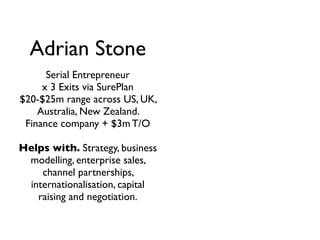
Adrian Stone
      Serial Entrepreneur
     x 3 Exits via SurePlan
$20-$25m range across US, UK,
    Australia, New Zealand.
 Finance company + $3m T/O

Helps with. Strategy, business
 modelling, enterprise sales,
    channel partnerships,
 internationalisation, capital
   raising and negotiation.
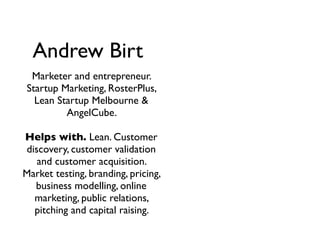
Andrew Birt
  Marketer and entrepreneur.
 Startup Marketing, RosterPlus,
   Lean Startup Melbourne &
          AngelCube.

Helps with. Lean. Customer
discovery, customer validation
   and customer acquisition.
Market testing, branding, pricing,
  business modelling, online
  marketing, public relations,
  pitching and capital raising.
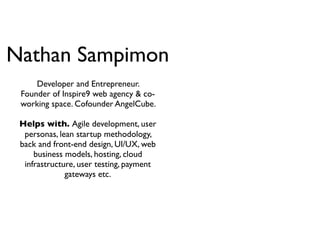
Nathan Sampimon
     Developer and Entrepreneur.
 Founder of Inspire9 web agency & co-
 working space. Cofounder AngelCube.

 Helps with. Agile development, user
  personas, lean startup methodology,
 back and front-end design, UI/UX, web
     business models, hosting, cloud
  infrastructure, user testing, payment
              gateways etc.
And of course.
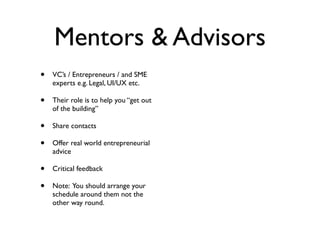
Mentors & Advisors
•   VC’s / Entrepreneurs / and SME
    experts e.g. Legal, UI/UX etc.

•   Their role is to help you “get out
    of the building”

•   Share contacts

•   Offer real world entrepreneurial
    advice

•   Critical feedback

•   Note: You should arrange your
    schedule around them not the
    other way round.
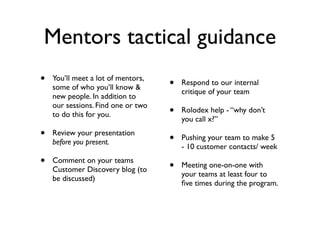
Mentors tactical guidance
•   You’ll meet a lot of mentors,
                                    •   Respond to our internal
    some of who you’ll know &
                                        critique of your team
    new people. In addition to
    our sessions. Find one or two
    to do this for you.             •   Rolodex help - “why don’t
                                        you call x?”
•   Review your presentation
                                    •   Pushing your team to make 5
    before you present.
                                        - 10 customer contacts/ week
•   Comment on your teams
                                    •   Meeting one-on-one with
    Customer Discovery blog (to
                                        your teams at least four to
    be discussed)
                                        five times during the program.
Weekly Schedule
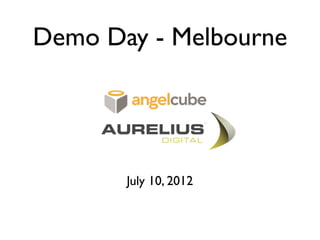
Demo Day - Melbourne


       July 10, 2012
Demo Day - Sydney
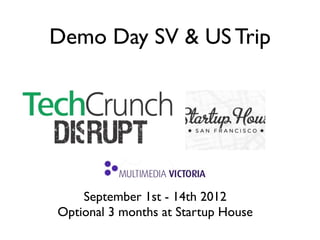
Demo Day SV & US Trip


    September 1st - 14th 2012
Optional 3 months at Startup House
Budgeting the $20,000
13 Week Journey
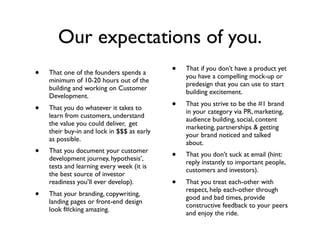
Our expectations of you.
•   That one of the founders spends a       •   That if you don’t have a product yet
                                                you have a compelling mock-up or
    minimum of 10-20 hours out of the
                                                predesign that you can use to start
    building and working on Customer
                                                building excitement.
    Development.
•   That you do whatever it takes to        •   That you strive to be the #1 brand
                                                in your category via PR, marketing,
    learn from customers, understand
                                                audience building, social, content
    the value you could deliver, get
                                                marketing, partnerships & getting
    their buy-in and lock in $$$ as early
                                                your brand noticed and talked
    as possible.
                                                about.
•   That you document your customer
                                            •   That you don’t suck at email (hint:
    development journey, hypothesis’,
                                                reply instantly to important people,
    tests and learning every week (it is
                                                customers and investors).
    the best source of investor
    readiness you’ll ever develop).         •   That you treat each-other with
                                                respect, help each-other through
•   That your branding, copywriting,
                                                good and bad times, provide
    landing pages or front-end design
                                                constructive feedback to your peers
    look f#cking amazing.
                                                and enjoy the ride.
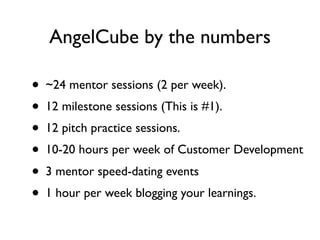
AngelCube by the numbers

• ~24 mentor sessions (2 per week).
• 12 milestone sessions (This is #1).
• 12 pitch practice sessions.
• 10-20 hours per week of Customer Development
• 3 mentor speed-dating events
• 1 hour per week blogging your learnings.
Program Objectives
AngelCube is really about
getting Out of The Building

• AngelCube is not just about mentor sessions.
• AngelCube is not just about “getting feedback”
• AngelCube is not just about learning to pitch.
• AngelCube is about the work you do outside the building...

It’s the difference between a vision and a hallucination
(Steve Blank).
Program objectives.
•   Going from idea or “a product” to a business.
    – Business Model + Customer Development
    – Hypotheses testing of the business model(s)
    – Getting “out of the building”
    – Execution. Product development/refinement.

• Product/Market Fit.
• Positioning (Messaging & Mindshare)
• Economics (Cost of Acquisition)
• Growth (Marketing, PR, Partners, Momentum)
• Investor Readiness. (Pitching. Intro’s. Knowledge, etc)
Two types of Startups.
Before product market fit.
& After product market fit.

Marc Andreeseen, Founder Netscape & Andreeseen Horowitz Capital
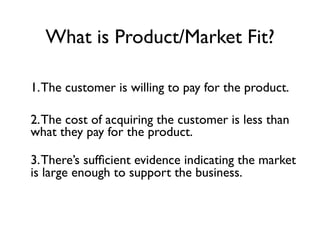
What is Product/Market Fit?

1. The customer is willing to pay for the product.

2. The cost of acquiring the customer is less than
what they pay for the product.

3. There’s sufficient evidence indicating the market
is large enough to support the business.
Before product market fit.
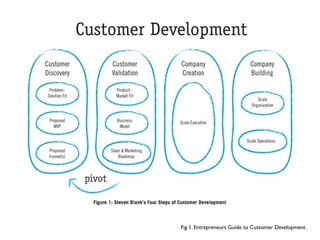
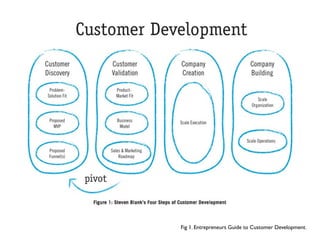
Fig 1. Entrepreneurs Guide to Customer Development.
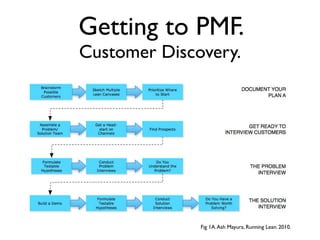
Getting to PMF.
Customer Discovery.


              Fig 1A. Ash Mayura, Running Lean. 2010.
But
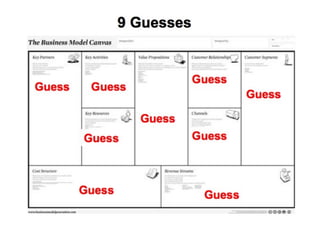
Realize they’re hypotheses
Test the Riskiest
Assumption First!
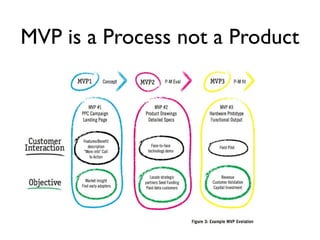
MVP is a Process not a Product
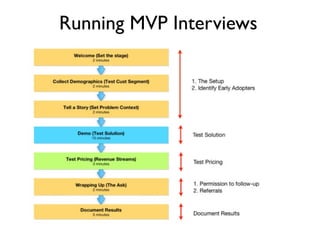
Running MVP Interviews
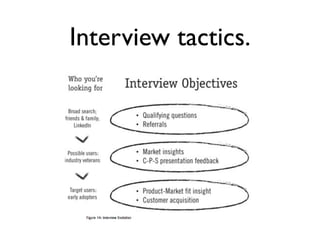
Interview tactics.
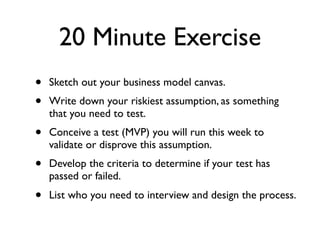
20 Minute Exercise
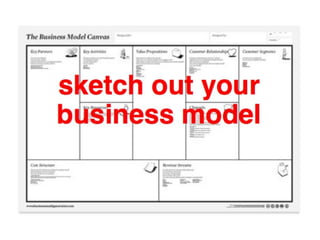
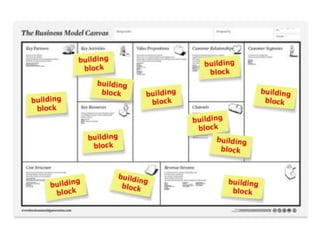
•   Sketch out your business model canvas.
•   Write down your riskiest assumption, as something
    that you need to test.
•   Conceive a test (MVP) you will run this week to
    validate or disprove this assumption.
•   Develop the criteria to determine if your test has
    passed or failed.
•   List who you need to interview and design the process.
Let’s talk about
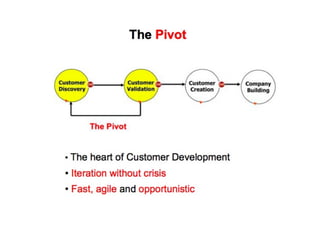
   pivoting.
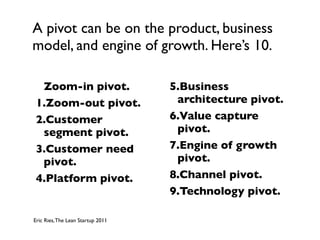
A pivot can be on the product, business
model, and engine of growth. Here’s 10.

  Zoom-in pivot.                   5.Business
 1.Zoom-out pivot.                  architecture pivot.
 2.Customer                        6.Value capture
  segment pivot.                    pivot.
 3.Customer need                   7.Engine of growth
  pivot.                            pivot.
 4.Platform pivot.                 8.Channel pivot.
                                   9.Technology pivot.

Eric Ries, The Lean Startup 2011
I recommend that every
startup have a regular
pivot or persevere
meeting.
Eric Ries, The Lean Startup 2011
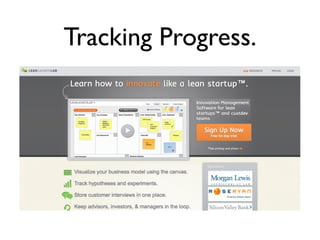
Tracking Progress.
After product market fit.
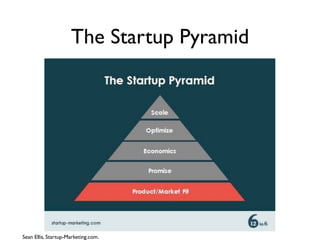
The Startup Pyramid


Sean Ellis, Startup-Marketing.com.
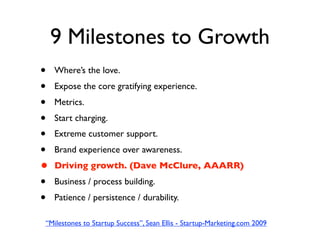
9 Milestones to Growth
•   Where’s the love.
•   Expose the core gratifying experience.
•   Metrics.
•   Start charging.
•   Extreme customer support.
•   Brand experience over awareness.
•   Driving growth. (Dave McClure, AAARR)
•   Business / process building.
•   Patience / persistence / durability.

“Milestones to Startup Success”, Sean Ellis - Startup-Marketing.com 2009
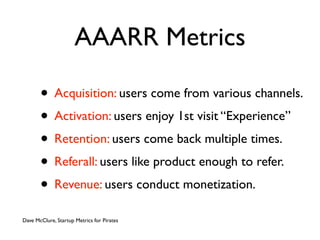
AAARR Metrics

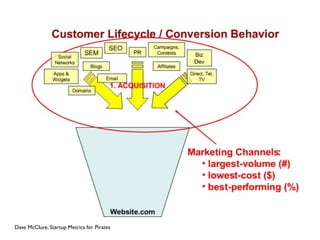
       • Acquisition: users come from various channels.
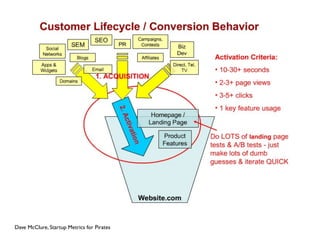
       • Activation: users enjoy 1st visit “Experience”
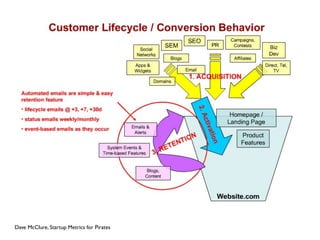
       • Retention: users come back multiple times.
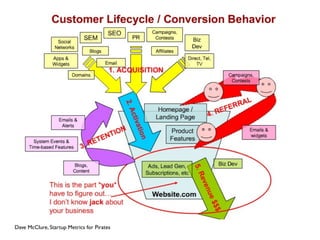
       • Referall: users like product enough to refer.
       • Revenue: users conduct monetization.
Dave McClure, Startup Metrics for Pirates
Complex?
CustDev has just four steps.
Fig 1. Entrepreneurs Guide to Customer Development.
Milestones
 Week 1
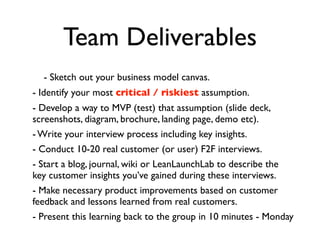
Team Deliverables
  - Sketch out your business model canvas.
- Identify your most critical / riskiest assumption.
- Develop a way to MVP (test) that assumption (slide deck,
screenshots, diagram, brochure, landing page, demo etc).
- Write your interview process including key insights.
- Conduct 10-20 real customer (or user) F2F interviews.
- Start a blog, journal, wiki or LeanLaunchLab to describe the
key customer insights you’ve gained during these interviews.
- Make necessary product improvements based on customer
feedback and lessons learned from real customers.
- Present this learning back to the group in 10 minutes - Monday
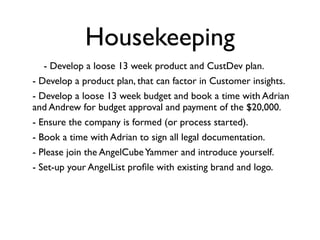
Housekeeping
   - Develop a loose 13 week product and CustDev plan.
- Develop a product plan, that can factor in Customer insights.
- Develop a loose 13 week budget and book a time with Adrian
and Andrew for budget approval and payment of the $20,000.
- Ensure the company is formed (or process started).
- Book a time with Adrian to sign all legal documentation.
- Please join the AngelCube Yammer and introduce yourself.
- Set-up your AngelList profile with existing brand and logo.
The boardoom reimagined.
  Blog Customer Development progress as a
  narrative following this format.
• Keep score of the strategy changes with the
  Business Model Canvas
• Comment/Dialog with advisors and
  investors on a near-realtime basis.
Networks we use.
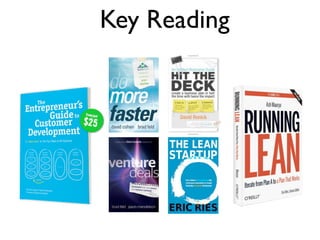
Key Reading
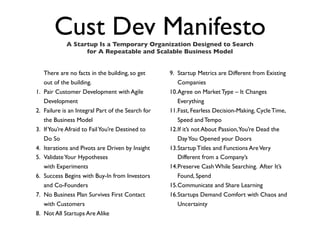
Cust Dev Manifesto
              A Startup Is a Temporary Organization Designed to Search
                    for A Repeatable and Scalable Business Model


     There are no facts in the building, so get      9. Startup Metrics are Different from Existing
     out of the building.                               Companies
1.   Pair Customer Development with Agile            10.Agree on Market Type – It Changes
     Development                                        Everything
2.   Failure is an Integral Part of the Search for   11.Fast, Fearless Decision-Making, Cycle Time,
     the Business Model                                 Speed and Tempo
3.   If You’re Afraid to Fail You’re Destined to     12.If it’s not About Passion,You’re Dead the
     Do So                                              Day You Opened your Doors
4.   Iterations and Pivots are Driven by Insight     13.Startup Titles and Functions Are Very
5.   Validate Your Hypotheses                           Different from a Company’s
     with Experiments                                14.Preserve Cash While Searching. After It’s
6.   Success Begins with Buy-In from Investors          Found, Spend
     and Co-Founders                                 15.Communicate and Share Learning
7.   No Business Plan Survives First Contact         16.Startups Demand Comfort with Chaos and
     with Customers                                     Uncertainty
8.   Not All Startups Are Alike

Angel cube content week1

  • 1.
    #AC12 Overview Overview, businessmodels and customer development. Adapted Steve Blank’s E245
  • 2.
    Agenda • Introductions. • Program overview. • Our expectations. • Program objectives. • Introduction to Customer Development. • Week one milestones. • Week one housekeeping. • Key reading for the program.
  • 3.
    Introductions (& what wehelp you with).
  • 4.
    Adrian Stone Serial Entrepreneur x 3 Exits via SurePlan $20-$25m range across US, UK, Australia, New Zealand. Finance company + $3m T/O Helps with. Strategy, business modelling, enterprise sales, channel partnerships, internationalisation, capital raising and negotiation.
  • 5.
    Andrew Birt Marketer and entrepreneur. Startup Marketing, RosterPlus, Lean Startup Melbourne & AngelCube. Helps with. Lean. Customer discovery, customer validation and customer acquisition. Market testing, branding, pricing, business modelling, online marketing, public relations, pitching and capital raising.
  • 6.
    Nathan Sampimon Developer and Entrepreneur. Founder of Inspire9 web agency & co- working space. Cofounder AngelCube. Helps with. Agile development, user personas, lean startup methodology, back and front-end design, UI/UX, web business models, hosting, cloud infrastructure, user testing, payment gateways etc.
  • 7.
  • 8.
    Mentors & Advisors • VC’s / Entrepreneurs / and SME experts e.g. Legal, UI/UX etc. • Their role is to help you “get out of the building” • Share contacts • Offer real world entrepreneurial advice • Critical feedback • Note: You should arrange your schedule around them not the other way round.
  • 9.
    Mentors tactical guidance • You’ll meet a lot of mentors, • Respond to our internal some of who you’ll know & critique of your team new people. In addition to our sessions. Find one or two to do this for you. • Rolodex help - “why don’t you call x?” • Review your presentation • Pushing your team to make 5 before you present. - 10 customer contacts/ week • Comment on your teams • Meeting one-on-one with Customer Discovery blog (to your teams at least four to be discussed) five times during the program.
  • 10.
  • 11.
    Demo Day -Melbourne July 10, 2012
  • 12.
    Demo Day -Sydney
  • 13.
    Demo Day SV& US Trip September 1st - 14th 2012 Optional 3 months at Startup House
  • 14.
  • 15.
  • 16.
    Our expectations ofyou. • That one of the founders spends a • That if you don’t have a product yet you have a compelling mock-up or minimum of 10-20 hours out of the predesign that you can use to start building and working on Customer building excitement. Development. • That you do whatever it takes to • That you strive to be the #1 brand in your category via PR, marketing, learn from customers, understand audience building, social, content the value you could deliver, get marketing, partnerships & getting their buy-in and lock in $$$ as early your brand noticed and talked as possible. about. • That you document your customer • That you don’t suck at email (hint: development journey, hypothesis’, reply instantly to important people, tests and learning every week (it is customers and investors). the best source of investor readiness you’ll ever develop). • That you treat each-other with respect, help each-other through • That your branding, copywriting, good and bad times, provide landing pages or front-end design constructive feedback to your peers look f#cking amazing. and enjoy the ride.
  • 17.
    AngelCube by thenumbers • ~24 mentor sessions (2 per week). • 12 milestone sessions (This is #1). • 12 pitch practice sessions. • 10-20 hours per week of Customer Development • 3 mentor speed-dating events • 1 hour per week blogging your learnings.

  • 18.
  • 19.
    AngelCube is reallyabout getting Out of The Building • AngelCube is not just about mentor sessions. • AngelCube is not just about “getting feedback” • AngelCube is not just about learning to pitch. • AngelCube is about the work you do outside the building... It’s the difference between a vision and a hallucination (Steve Blank).
  • 20.
    Program objectives. • Going from idea or “a product” to a business. – Business Model + Customer Development – Hypotheses testing of the business model(s) – Getting “out of the building” – Execution. Product development/refinement. • Product/Market Fit. • Positioning (Messaging & Mindshare) • Economics (Cost of Acquisition) • Growth (Marketing, PR, Partners, Momentum) • Investor Readiness. (Pitching. Intro’s. Knowledge, etc)
  • 21.
    Two types ofStartups. Before product market fit. & After product market fit. Marc Andreeseen, Founder Netscape & Andreeseen Horowitz Capital
  • 22.
    What is Product/MarketFit? 1. The customer is willing to pay for the product. 2. The cost of acquiring the customer is less than what they pay for the product. 3. There’s sufficient evidence indicating the market is large enough to support the business.
  • 23.
  • 24.
    Fig 1. EntrepreneursGuide to Customer Development.
  • 25.
    Getting to PMF. CustomerDiscovery. Fig 1A. Ash Mayura, Running Lean. 2010.
  • 28.
  • 30.
  • 31.
    MVP is aProcess not a Product
  • 32.
  • 33.
  • 34.
    20 Minute Exercise • Sketch out your business model canvas. • Write down your riskiest assumption, as something that you need to test. • Conceive a test (MVP) you will run this week to validate or disprove this assumption. • Develop the criteria to determine if your test has passed or failed. • List who you need to interview and design the process.
  • 35.
  • 38.
    A pivot canbe on the product, business model, and engine of growth. Here’s 10. Zoom-in pivot. 5.Business 1.Zoom-out pivot. architecture pivot. 2.Customer 6.Value capture segment pivot. pivot. 3.Customer need 7.Engine of growth pivot. pivot. 4.Platform pivot. 8.Channel pivot. 9.Technology pivot. Eric Ries, The Lean Startup 2011
  • 39.
    I recommend thatevery startup have a regular pivot or persevere meeting. Eric Ries, The Lean Startup 2011
  • 40.
  • 41.
  • 42.
    The Startup Pyramid SeanEllis, Startup-Marketing.com.
  • 43.
    9 Milestones toGrowth • Where’s the love. • Expose the core gratifying experience. • Metrics. • Start charging. • Extreme customer support. • Brand experience over awareness. • Driving growth. (Dave McClure, AAARR) • Business / process building. • Patience / persistence / durability. “Milestones to Startup Success”, Sean Ellis - Startup-Marketing.com 2009
  • 44.
    AAARR Metrics • Acquisition: users come from various channels. • Activation: users enjoy 1st visit “Experience” • Retention: users come back multiple times. • Referall: users like product enough to refer. • Revenue: users conduct monetization. Dave McClure, Startup Metrics for Pirates
  • 45.
    Dave McClure, StartupMetrics for Pirates
  • 46.
    Dave McClure, StartupMetrics for Pirates
  • 47.
    Dave McClure, StartupMetrics for Pirates
  • 48.
    Dave McClure, StartupMetrics for Pirates
  • 49.
  • 50.
    Fig 1. EntrepreneursGuide to Customer Development.
  • 51.
  • 52.
    Team Deliverables - Sketch out your business model canvas. - Identify your most critical / riskiest assumption. - Develop a way to MVP (test) that assumption (slide deck, screenshots, diagram, brochure, landing page, demo etc). - Write your interview process including key insights. - Conduct 10-20 real customer (or user) F2F interviews. - Start a blog, journal, wiki or LeanLaunchLab to describe the key customer insights you’ve gained during these interviews. - Make necessary product improvements based on customer feedback and lessons learned from real customers. - Present this learning back to the group in 10 minutes - Monday
  • 53.
    Housekeeping - Develop a loose 13 week product and CustDev plan. - Develop a product plan, that can factor in Customer insights. - Develop a loose 13 week budget and book a time with Adrian and Andrew for budget approval and payment of the $20,000. - Ensure the company is formed (or process started). - Book a time with Adrian to sign all legal documentation. - Please join the AngelCube Yammer and introduce yourself. - Set-up your AngelList profile with existing brand and logo.
  • 54.
    The boardoom reimagined. Blog Customer Development progress as a narrative following this format. • Keep score of the strategy changes with the Business Model Canvas • Comment/Dialog with advisors and investors on a near-realtime basis.
  • 55.
  • 56.
  • 57.
    Cust Dev Manifesto A Startup Is a Temporary Organization Designed to Search for A Repeatable and Scalable Business Model There are no facts in the building, so get 9. Startup Metrics are Different from Existing out of the building. Companies 1. Pair Customer Development with Agile 10.Agree on Market Type – It Changes Development Everything 2. Failure is an Integral Part of the Search for 11.Fast, Fearless Decision-Making, Cycle Time, the Business Model Speed and Tempo 3. If You’re Afraid to Fail You’re Destined to 12.If it’s not About Passion,You’re Dead the Do So Day You Opened your Doors 4. Iterations and Pivots are Driven by Insight 13.Startup Titles and Functions Are Very 5. Validate Your Hypotheses Different from a Company’s with Experiments 14.Preserve Cash While Searching. After It’s 6. Success Begins with Buy-In from Investors Found, Spend and Co-Founders 15.Communicate and Share Learning 7. No Business Plan Survives First Contact 16.Startups Demand Comfort with Chaos and with Customers Uncertainty 8. Not All Startups Are Alike