Low code development platform
and Outsystems
Dzung Nguyen
Outlines
- Low-code platform introduction
- Outsystems introduction
- Outsystems features
- Demo
- Q&A
2
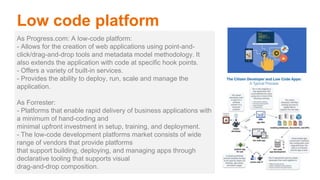
As Progress.com: A low-code platform:
- Allows for the creation of web applications using point-and-
click/drag-and-drop tools and metadata model methodology. It
also extends the application with code at specific hook points.
- Offers a variety of built-in services.
- Provides the ability to deploy, run, scale and manage the
application.
As Forrester:
- Platforms that enable rapid delivery of business applications with
a minimum of hand-coding and
minimal upfront investment in setup, training, and deployment.
- The low-code development platforms market consists of wide
range of vendors that provide platforms
that support building, deploying, and managing apps through
declarative tooling that supports visual
drag-and-drop composition.
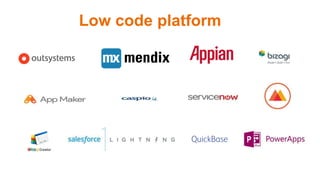
Low code platform
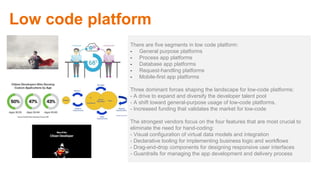
There are five segments in low code platform:
- General purpose platforms
- Process app platforms
- Database app platforms
- Request-handling platforms
- Mobile-first app platforms
Three dominant forces shaping the landscape for low-code platforms:
- A drive to expand and diversify the developer talent pool
- A shift toward general-purpose usage of low-code platforms.
- Increased funding that validates the market for low-code
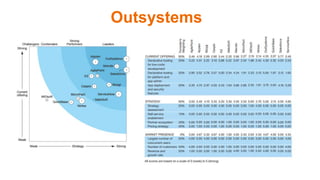
The strongest vendors focus on the four features that are most crucial to
eliminate the need for hand-coding:
- Visual configuration of virtual data models and integration
- Declarative tooling for implementing business logic and workflows
- Drag-and-drop components for designing responsive user interfaces
- Guardrails for managing the app development and delivery process
Low code platform
Low code platform
Low code platform
Low code platform
Low code platform
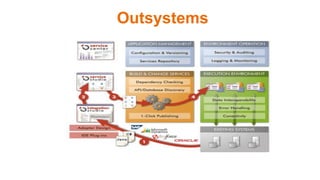
Outsystems
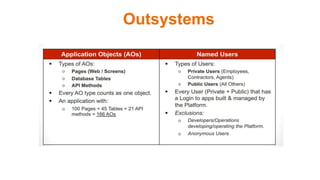
Outsystems
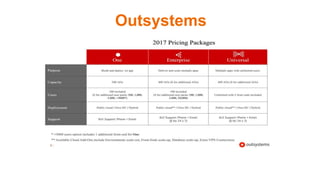
Outsystems
Outsystems
Outsystems
Outsystems
Outsystems
Outsystems
Outsystems
Outsystems
Outsystems
Outsystems
Outsystems
Outsystems
Outsystems
Outsystems
Outsystems
Outsystems
Outsystems
Outsystems
Outsystems
Outsystems
Demo
Q&A
Thank you for your attention!

Low code platform and Outsystems

  • 1.
    Low code developmentplatform and Outsystems Dzung Nguyen
  • 2.
    Outlines - Low-code platformintroduction - Outsystems introduction - Outsystems features - Demo - Q&A 2
  • 3.
    As Progress.com: Alow-code platform: - Allows for the creation of web applications using point-and- click/drag-and-drop tools and metadata model methodology. It also extends the application with code at specific hook points. - Offers a variety of built-in services. - Provides the ability to deploy, run, scale and manage the application. As Forrester: - Platforms that enable rapid delivery of business applications with a minimum of hand-coding and minimal upfront investment in setup, training, and deployment. - The low-code development platforms market consists of wide range of vendors that provide platforms that support building, deploying, and managing apps through declarative tooling that supports visual drag-and-drop composition. Low code platform
  • 4.
    There are fivesegments in low code platform: - General purpose platforms - Process app platforms - Database app platforms - Request-handling platforms - Mobile-first app platforms Three dominant forces shaping the landscape for low-code platforms: - A drive to expand and diversify the developer talent pool - A shift toward general-purpose usage of low-code platforms. - Increased funding that validates the market for low-code The strongest vendors focus on the four features that are most crucial to eliminate the need for hand-coding: - Visual configuration of virtual data models and integration - Declarative tooling for implementing business logic and workflows - Drag-and-drop components for designing responsive user interfaces - Guardrails for managing the app development and delivery process Low code platform
  • 5.
  • 6.
  • 7.
  • 8.
  • 9.
  • 10.
  • 11.
  • 12.
  • 13.
  • 14.
  • 15.
  • 16.
  • 17.
  • 18.
  • 19.
  • 20.
  • 21.
  • 22.
  • 23.
  • 24.
  • 25.
  • 26.
  • 27.
  • 28.
  • 29.
  • 30.
  • 31.
  • 32.
  • 33.
    Thank you foryour attention!