Overview of UVPhotography
Dr Sudhir Sharma,
Forensic Expert ,
NFSU, Campus Delhi
2.
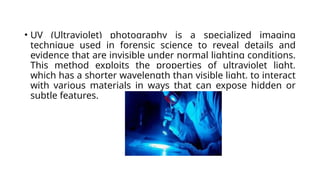
• UV (Ultraviolet)photography is a specialized imaging
technique used in forensic science to reveal details and
evidence that are invisible under normal lighting conditions.
This method exploits the properties of ultraviolet light,
which has a shorter wavelength than visible light, to interact
with various materials in ways that can expose hidden or
subtle features.
3.
Understanding Ultraviolet Light
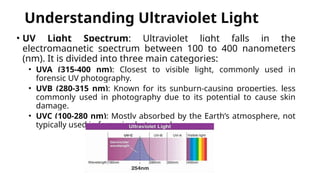
•UV Light Spectrum: Ultraviolet light falls in the
electromagnetic spectrum between 100 to 400 nanometers
(nm). It is divided into three main categories:
• UVA (315-400 nm): Closest to visible light, commonly used in
forensic UV photography.
• UVB (280-315 nm): Known for its sunburn-causing properties, less
commonly used in photography due to its potential to cause skin
damage.
• UVC (100-280 nm): Mostly absorbed by the Earth’s atmosphere, not
typically used in forensic photography.
4.
Principles of UVPhotography
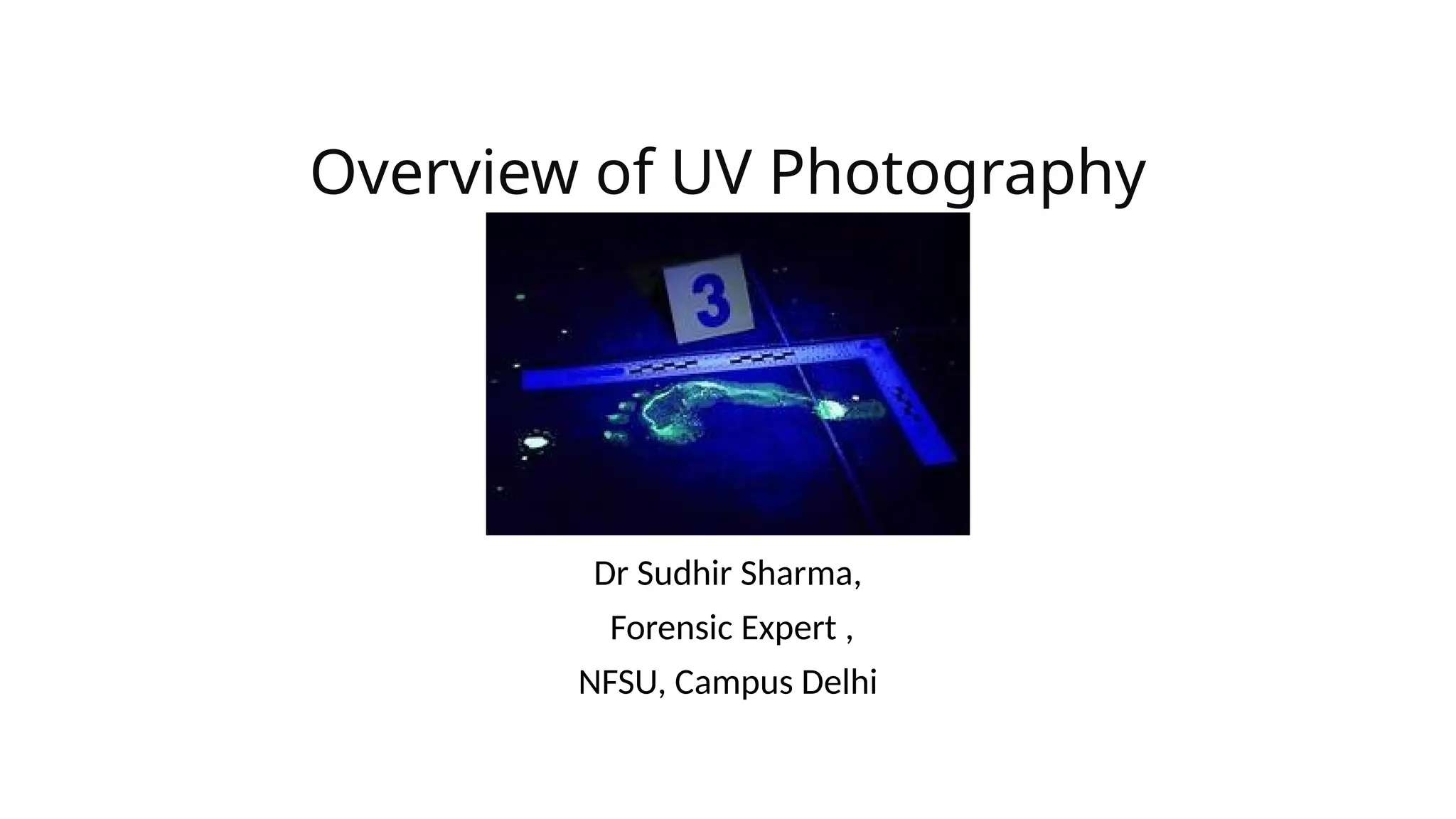
• Fluorescence and Absorption: When UV light strikes certain
substances, it can cause them to fluoresce, emitting visible light that can
be captured by a camera. Other materials may absorb UV light
differently than they do visible light, creating contrast and revealing
details that would otherwise be missed.
• Camera Equipment: UV photography requires specialized equipment:
• UV-Sensitive Cameras: Standard cameras are usually modified to be
sensitive to UV light by removing filters that block UV rays.
• UV Filters: Attached to the camera lens, these filters allow only UV light
to reach the camera sensor, blocking visible and infrared light.
• UV Light Sources: These include UV lamps, LEDs, or flashlights that emit
light in the UV spectrum. They are used to illuminate the subject during
photography.
5.
Applications of UVPhotography in
Forensic Science
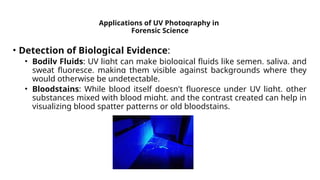
• Detection of Biological Evidence:
• Bodily Fluids: UV light can make biological fluids like semen, saliva, and
sweat fluoresce, making them visible against backgrounds where they
would otherwise be undetectable.
• Bloodstains: While blood itself doesn't fluoresce under UV light, other
substances mixed with blood might, and the contrast created can help in
visualizing blood spatter patterns or old bloodstains.
6.
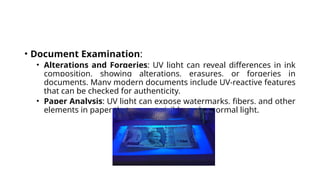
• Document Examination:
•Alterations and Forgeries: UV light can reveal differences in ink
composition, showing alterations, erasures, or forgeries in
documents. Many modern documents include UV-reactive features
that can be checked for authenticity.
• Paper Analysis: UV light can expose watermarks, fibers, and other
elements in paper that are not visible under normal light.
7.
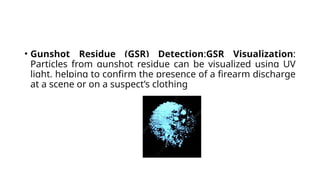
• Gunshot Residue(GSR) Detection:GSR Visualization:
Particles from gunshot residue can be visualized using UV
light, helping to confirm the presence of a firearm discharge
at a scene or on a suspect’s clothing
8.
Advantages of UVPhotography
• Non-Destructive Testing: UV photography is a non-invasive
and non-destructive method, meaning it does not alter or
damage the evidence being examined.
• Revealing Hidden Evidence: UV light can expose evidence
that is not visible to the naked eye, such as latent
fingerprints, subtle bloodstains, or document alterations.
• Versatility: UV photography can be applied to a wide range
of forensic evidence, making it a versatile tool for
investigators.
9.
Challenges and Limitations
•Safety Concerns: Prolonged exposure to UV light can be
harmful to both the skin and eyes. Forensic professionals
must use protective wear such as UV-blocking glasses and
cover exposed skin.
• Specialized Equipment Required: Effective UV
photography requires specific equipment that can be costly
and requires proper training to use effectively.
• Environmental Interference: Ambient light, especially
sunlight, can interfere with UV photography by adding
unwanted visible light, so scenes often need to be darkened
or controlled environments are used.
10.
Case Examples
• CrimeScene Investigation: At a crime scene, UV photography might
be used to locate bodily fluids that are not visible under normal light.
For example, a crime scene investigator might use UV light to scan a
bed sheet for traces of semen or saliva, which would fluoresce under
UV illumination.
• Document Forgery Detection: UV photography has been used to
reveal forged signatures on legal documents. Different inks may
fluoresce differently, making alterations visible when viewed under
UV light.
• Old and Faded Evidence Recovery: UV photography has been
employed to examine historical documents or faded ink on old
papers, where the original writing has become difficult to read.
11.
Legal Considerations
• Admissibilityof Evidence: For UV photographs to be admissible in
court, it is essential to document the photographic process
meticulously. This includes noting the type of UV light source, the
camera settings used, and any filters applied.
• Explanation of Findings: In legal proceedings, forensic experts
must be able to clearly explain how UV light interacts with different
materials and why it reveals certain evidence. This includes a
discussion of the science behind fluorescence and absorption.
• Chain of Custody: As with all forensic evidence, maintaining a strict
chain of custody is crucial to ensure the integrity of the UV images
from the moment they are captured to their presentation in court.
12.
Future Trends inUV Photography
• Technological Advances: As camera technology continues to
improve, UV-sensitive sensors are becoming more accurate and
affordable. This could lead to wider adoption of UV photography in
forensic investigations.
• Integration with Other Imaging Techniques: UV photography is
increasingly being used in conjunction with other techniques, such as
infrared (IR) photography and 3D scanning, to provide a more
comprehensive analysis of evidence.
• AI and Image Analysis: The use of artificial intelligence and machine
learning in forensic image analysis could enhance the interpretation
of UV photographs, helping to automate the detection of specific
evidence types.
13.
Conclusion
• UV photographyplays a crucial role in forensic science by
revealing evidence that is invisible under normal lighting
conditions. Its non-destructive nature, versatility, and ability
to uncover hidden details make it an invaluable tool for
investigators. However, it requires specialized equipment
and training, and there are safety considerations that must
be taken into account. As technology advances, the
capabilities of UV photography are likely to expand, offering
even more powerful tools for forensic analysis.



![CTEV [ clubfoot] DR ARUN LAL ,DR MOHAMED ASHRAF travancore medical college k...](https://cdn.slidesharecdn.com/ss_thumbnails/ctevclubfootdrarunlaldrmohamedashraftravancoremedicalcollegekollamkeralaindia-260208063247-18fc466c-thumbnail.jpg?width=640&height=640&fit=bounds)

