MARK LESTER MENDOZA-FLORES, R.C
Instructor / Lecturer
MARK LESTER FLORES 2012
Brief history of Police
Photography
The word “photography” was
coined by Sir John Herschel,
who first used the term in 1839,
the year photographic process
became public.
MARK LESTER FLORES 2012
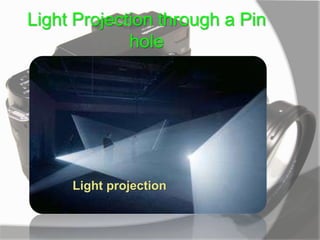
Light Projection through a Pin
hole
Light projection
MARK LESTER FLORES 2012
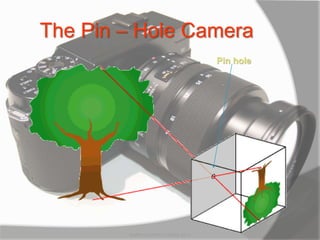
The Pin – Hole Camera
Pin hole
MARK LESTER FLORES 2012
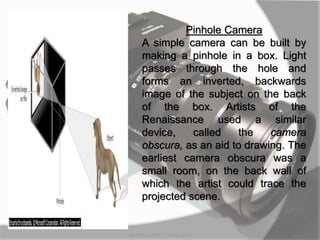
Pinhole Camera
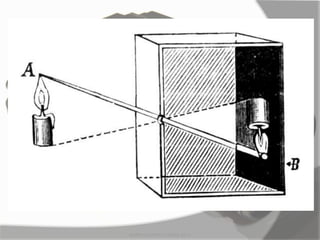
A simple camera can be built by
making a pinhole in a box. Light
passes through the hole and
forms an inverted, backwards
image of the subject on the back
of the box. Artists of the
Renaissance used a similar
device, called the camera
obscura, as an aid to drawing. The
earliest camera obscura was a
small room, on the back wall of
which the artist could trace the
projected scene.
MARK LESTER FLORES 2012
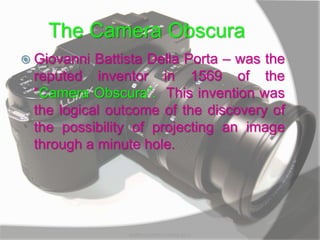
The Camera Obscura
 Giovanni Battista Della Porta – was the
reputed inventor in 1569 of the
“Camera Obscura”. This invention was
the logical outcome of the discovery of
the possibility of projecting an image
through a minute hole.
MARK LESTER FLORES 2012
The Camera Obscura
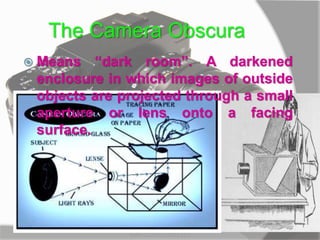
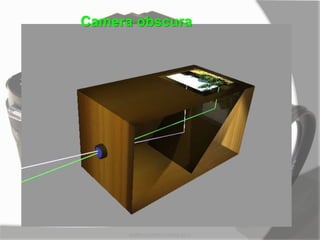
 Means “dark room”. A darkened
enclosure in which images of outside
objects are projected through a small
aperture or lens onto a facing
surface.
MARK LESTER FLORES 2012
Camera obscura
MARK LESTER FLORES 2012
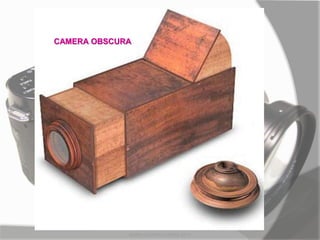
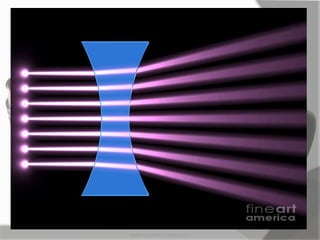
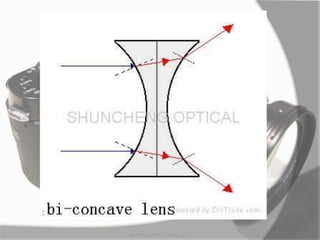
CAMERA OBSCURA
MARK LESTER FLORES 2012
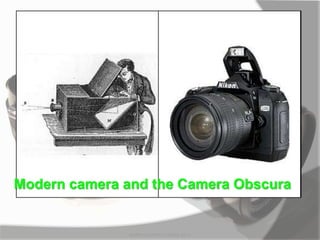
Modern camera and the Camera Obscura
MARK LESTER FLORES 2012
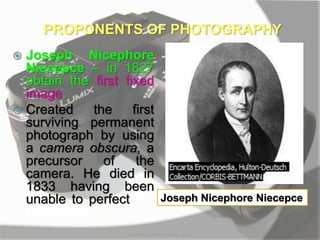
 Joseph Nicephore
Niecepce – in 1827
obtain the first fixed
image.
 Created the first
surviving permanent
photograph by using
a camera obscura, a
precursor of the
camera. He died in
1833 having been
unable to perfect the
technology.
PROPONENTS OF PHOTOGRAPHY
MARK LESTER FLORES 2012
Joseph Nicephore Niecepce
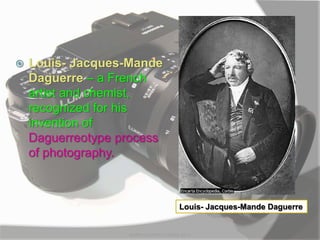
 Louis- Jacques-Mande
Daguerre – a French
artist and chemist,
recognized for his
invention of
Daguerreotype process
of photography.
MARK LESTER FLORES 2012
Louis- Jacques-Mande Daguerre
Daguerreotype – were the
forerunners of our modern film.
- It was made of a copper plate
coated with silver and exposed to
iodine vapor before it was exposed
to light.
- To create the image on the plate, it
must be exposed to light for about
15 minutes.
MARK LESTER FLORES 2012
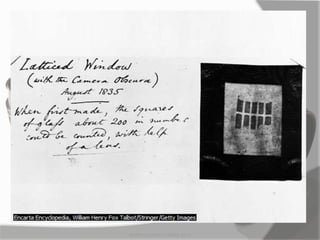
 Henry Fox Talbot – in 1834 created
permanent (negative) images.
- He use paper, soaked in silver chloride and
fixed with a salt solution.
- He the one created positive images by
contact printing onto another sheet of paper.
Calotype – process in the year 1840.
- in this process, Talbot coated paper sheets
with silver chloride to create an intermediate
negative image.
MARK LESTER FLORES 2012
Brief History of Forensic
Photography
 Forensic Photography
- sometimes referred to as police
photography, forensic imaging or crime
- is the art or science of documenting
photographically a crime scene and
evidence for laboratory examination
and analysis for purposes of court trial.
MARK LESTER FLORES 2012
Police Photography- is an art or
science that deals with the study of
the principles of photography, the
preparation of photographic evidence
and its application to police work.
Scene photography - is the art of
producing an accurate reproduction f
a crime scene or an accident using
photography for the benefit of a court
or to aid in an investigation.
MARK LESTER FLORES 2012
Photograph - is an image created by light
falling on a light-sensitive surface usually
photographic film or electronic image.
Photograph - is an image created by light falling on a light-sensitive surface usually photographic film or electronic image.
MARK LESTER FLORES 2012
Basic Importance of crime
photography:
 Refresh memory
 Preserve memory
 Save money
Objectives Of Photography
1.To produce a pictorial record of the crime scene.
2.To help in keeping the police officer’s memory
inn remembering accurately as to where the
locations of physical evidence are found.
3.To help in securing and obtaining confession,
description, deposition and information relating to
the case. MARK LESTER FLORES 2012
USE OF PHOTOGRAPHY
 Identification
 Record
 Presentation
 Substitution
 Deciding factor
MARK LESTER FLORES 2012
PRINCIPLES OF PHOTOGRAPHY
 A photograph is both the mechanical and
chemical result of photography. To produce a
photograph, light is needed aside from
sensitized materials (film or papers). Light
radiated or reflected by the subject must
reach the film while all other lights are
excluded. The exclusion of all other lights is
achieved by placing the film inside a light
tight box (camera).
 The effect of light on the film is not visible in
the formation of images of objects. To make it
visible, we need or require a chemical
processing of the expose film called
development.
MARK LESTER FLORES 2012
 The visual effect of light on the film after
development varies when the quantity
quality of light the reached the emulsion
of the film. To grant in the amount of light
will produce an opaque or very black
shade after development. Too little will
produces a transparent or white shade
after a development.
 The amount of light reaching the film is
dependent upon several factors like
lightning condition, lens opening, used,
shutter speed used, filter used etc.
MARK LESTER FLORES 2012
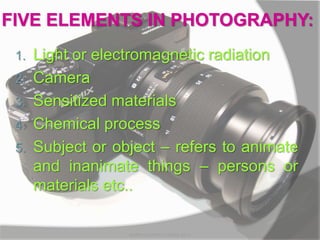
FIVE ELEMENTS IN PHOTOGRAPHY:
1. Light or electromagnetic radiation
2. Camera
3. Sensitized materials
4. Chemical process
5. Subject or object – refers to animate
and inanimate things – persons or
materials etc..
MARK LESTER FLORES 2012
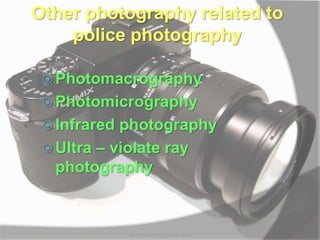
Other photography related to
police photography
 Photomacrography
 Photomicrography
 Infrared photography
 Ultra – violate ray
photography
MARK LESTER FLORES 2012
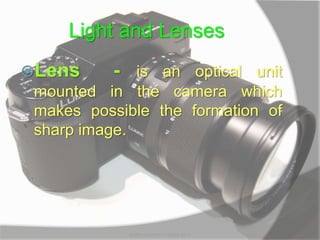
Light and Lenses
Lens - is an optical unit
mounted in the camera which
makes possible the formation of
sharp image.
MARK LESTER FLORES 2012
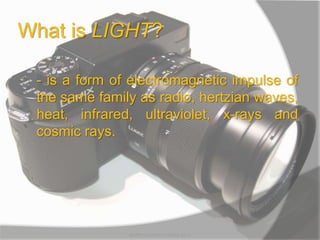
What is LIGHT?
- is a form of electromagnetic impulse of
the same family as radio, hertzian waves,
heat, infrared, ultraviolet, x-rays and
cosmic rays.
MARK LESTER FLORES 2012
Principle of LIGHT
- light, or visible light, is electromagnetic
radiation of a wavelength that is visible to
the human eye(about 400-700nm).
- in the context of science, light is
sometimes used to refer to the entire
electromagnetic spectrum.
MARK LESTER FLORES 2012
Electromagnetic Spectrum
- is a continuum of all electromagnetic
waves arranged according to
frequency and wavelength. The sun,
earth, and other bodies radiate
electromagnetic energy of varying
wavelength. Electromagnetic energy
passes through space at the speed f
light in the form of sinusoidal waves.
MARK LESTER FLORES 2012
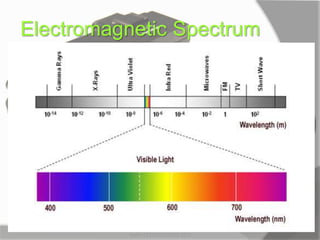
Electromagnetic Spectrum
MARK LESTER FLORES 2012
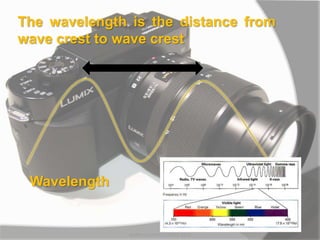
The wavelength is the distance from
wave crest to wave crest
Wavelength
MARK LESTER FLORES 2012
Electromagnetic Radiation
 In terms of classical theory, the flow of
energy at the universal speed of light
through a material/ medium in the form of
the electric and magnetic fields that make
up electromagnetic waves such as radio
waves, visible light and gamma rays. In
such a wave, time- varying electric and
magnetic fields are mutually linked with
each other at right angles.
MARK LESTER FLORES 2012
Measurement of light (expressed
in nanometer)
0 – 30 – X-ray
30 – 400 – Ultra – violate
400 – 700 – visible light
700 – 1000nm – Infrared light
1000 – up nm – Radio waves
MARK LESTER FLORES 2012
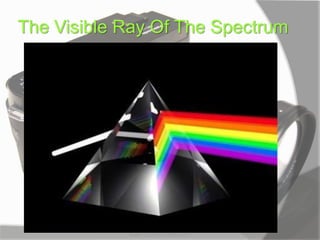
The Visible Ray Of The Spectrum
MARK LESTER FLORES 2012
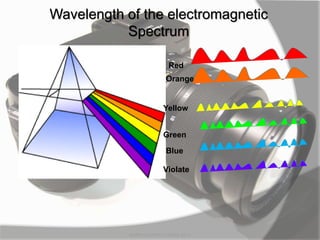
Wavelength of the electromagnetic
Spectrum
Red
Orange
Yellow
Green
Blue
Violate
MARK LESTER FLORES 2012
Objects Which Affect Speed Of
Light
 Transparent objects – objects or mediums
which merely slow the speed of light but allow
it to pass freely.
 Opaque objects – objects which divert or
absorb light, but allow no light to pass through it.
 Translucent objects – which allow light to
pass through them in such way that the outline of
the light source is not clearly visible. Ex. Glass,
ground glass oiled paper, water.
MARK LESTER FLORES 2012
How Light Changes
Direction
1. Reflection – is a change in the direction
of light wave which occurs whenever light
waves comes in contact with the surface of
an object/subject but does not allow the
wave to pass through it.
MARK LESTER FLORES 2012
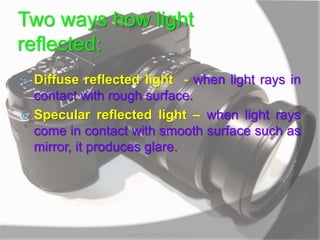
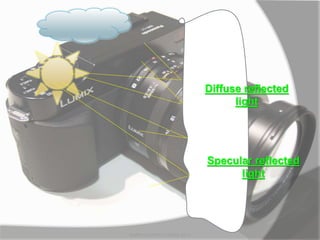
Two ways how light
reflected:
 Diffuse reflected light - when light rays in
contact with rough surface.
 Specular reflected light – when light rays
come in contact with smooth surface such as
mirror, it produces glare.
MARK LESTER FLORES 2012
Diffuse reflected
light
Specular reflected
light
MARK LESTER FLORES 2012
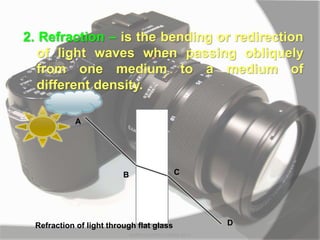
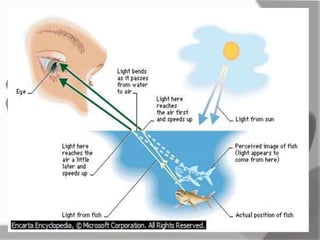
2. Refraction – is the bending or redirection
of light waves when passing obliquely
from one medium to a medium of
different density.
A
B C
D
Refraction of light through flat glass
MARK LESTER FLORES 2012
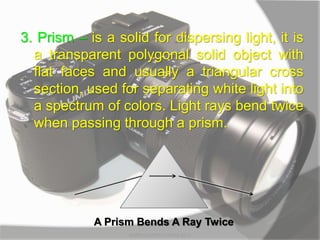
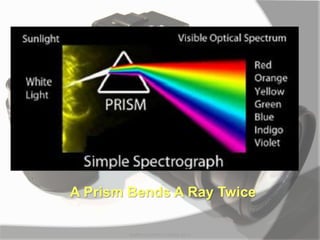
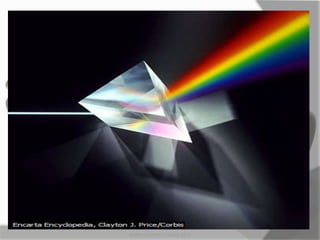
3. Prism – is a solid for dispersing light, it is
a transparent polygonal solid object with
flat faces and usually a triangular cross
section, used for separating white light into
a spectrum of colors. Light rays bend twice
when passing through a prism.
A Prism Bends A Ray Twice
MARK LESTER FLORES 2012
A Prism Bends A Ray Twice
MARK LESTER FLORES 2012
Significance of Lenses
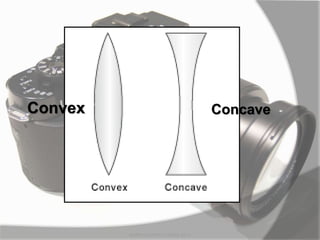
 A lens is a piece of transparent material
with at least one curved surface, which
refracts, or bends light rays coming from
an object.
 Lenses are usually made out of glass or
plastic and they have special property
which can give good results.
MARK LESTER FLORES 2012
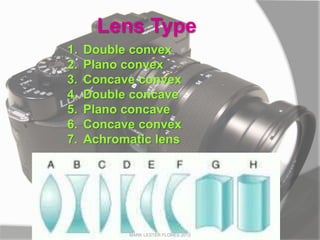
Lens Type
1. Double convex
2. Plano convex
3. Concave convex
4. Double concave
5. Plano concave
6. Concave convex
7. Achromatic lens
MARK LESTER FLORES 2012
Convex Concave
MARK LESTER FLORES 2012
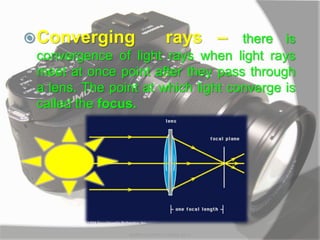
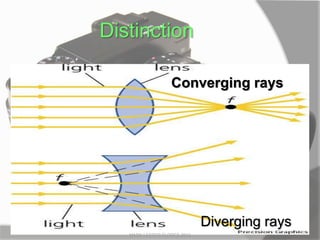
Converging rays – there is
convergence of light rays when light rays
meet at once point after they pass through
a lens. The point at which light converge is
called the focus.
MARK LESTER FLORES 2012
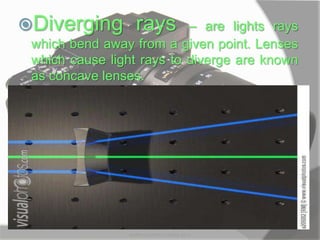
Diverging rays – are lights rays
which bend away from a given point. Lenses
which cause light rays to diverge are known
as concave lenses.
MARK LESTER FLORES 2012
Distinction
Converging rays
Diverging rays
MARK LESTER FLORES 2012
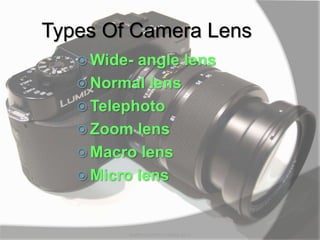
Types Of Camera Lens
 Wide- angle lens
 Normal lens
 Telephoto
 Zoom lens
 Macro lens
 Micro lens
MARK LESTER FLORES 2012
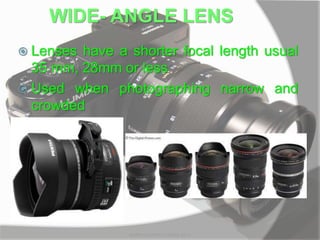
WIDE- ANGLE LENS
 Lenses have a shorter focal length usual
35 mm, 28mm or less
 Used when photographing narrow and
crowded
MARK LESTER FLORES 2012
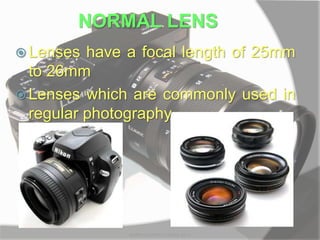
NORMAL LENS
 Lenses have a focal length of 25mm
to 26mm
 Lenses which are commonly used in
regular photography
MARK LESTER FLORES 2012
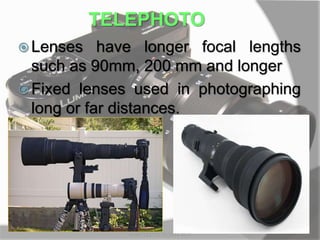
TELEPHOTO
 Lenses have longer focal lengths
such as 90mm, 200 mm and longer
 Fixed lenses used in photographing
long or far distances.
MARK LESTER FLORES 2012
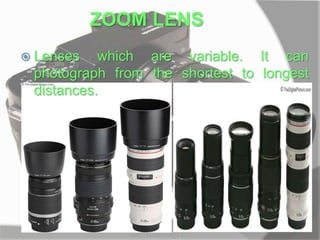
ZOOM LENS
 Lenses which are variable. It can
photograph from the shortest to longest
distances.
MARK LESTER FLORES 2012
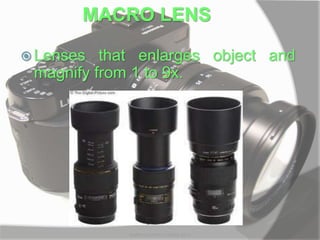
MACRO LENS
 Lenses that enlarges object and
magnify from 1 to 9x.
MARK LESTER FLORES 2012
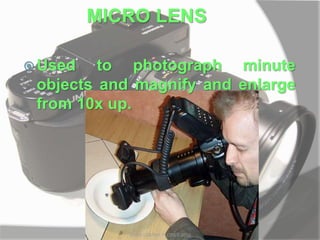
MICRO LENS
 Used to photograph minute
objects and magnify and enlarge
from 10x up.
MARK LESTER FLORES 2012
How lens affect photographic
images?
 Lens aberration – is an anomaly of the
which causes distortion of the image
due to lens curvature or color at the
edge of the lens.
 Aberration – as an optical distortion of an
image caused by a lens.
MARK LESTER FLORES 2012
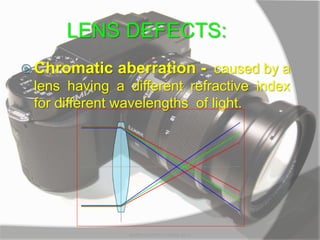
LENS DEFECTS:
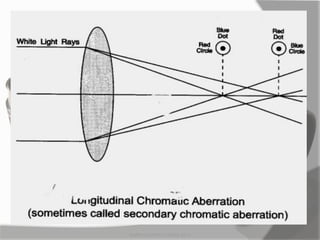
 Chromatic aberration - caused by a
lens having a different refractive index
for different wavelengths of light.
MARK LESTER FLORES 2012
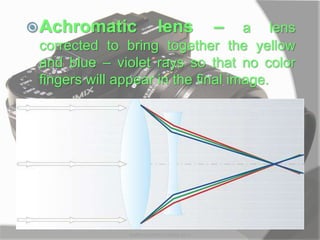
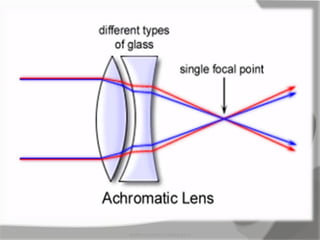
Achromatic lens – a lens
corrected to bring together the yellow
and blue – violet rays so that no color
fingers will appear in the final image.
MARK LESTER FLORES 2012
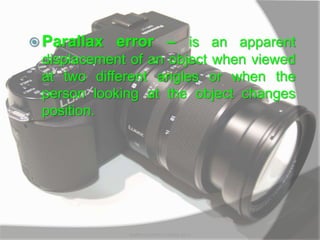
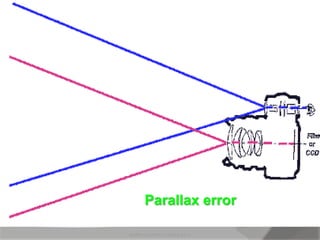
 Parallax error – is an apparent
displacement of an object when viewed
at two different angles or when the
person looking at the object changes
position.
MARK LESTER FLORES 2012
Parallax error
MARK LESTER FLORES 2012
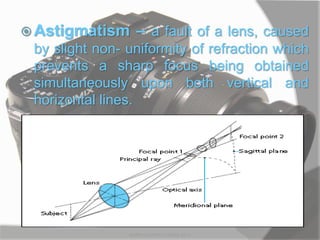
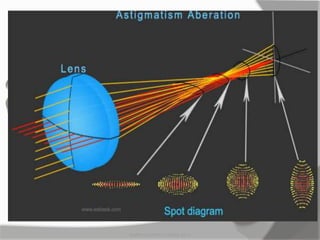
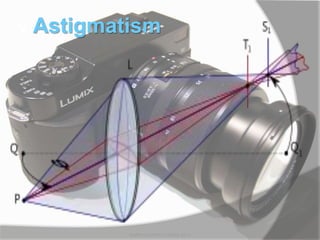
 Astigmatism – a fault of a lens, caused
by slight non- uniformity of refraction which
prevents a sharp focus being obtained
simultaneously upon both vertical and
horizontal lines.
MARK LESTER FLORES 2012
v Astigmatism
MARK LESTER FLORES 2012
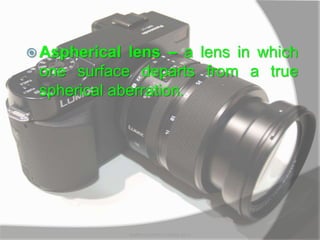
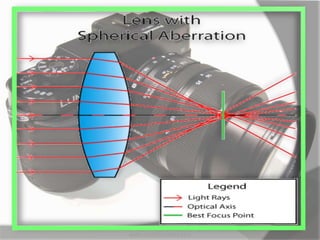
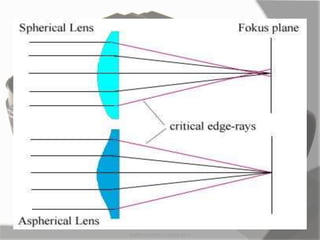
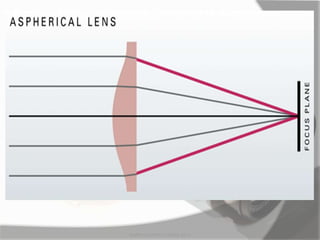
 Aspherical lens – a lens in which
one surface departs from a true
spherical aberration.
MARK LESTER FLORES 2012
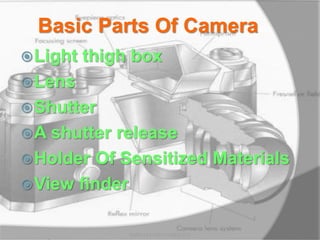
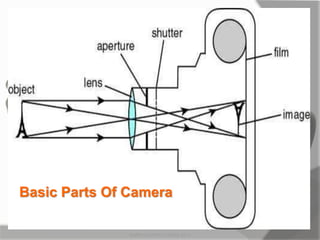
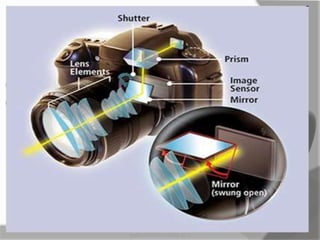
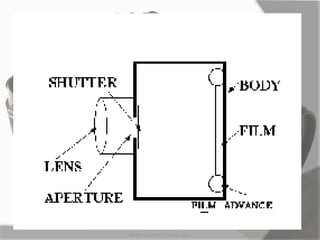
Basic Parts Of Camera
Light thigh box
Lens
Shutter
A shutter release
Holder Of Sensitized Materials
View finder
MARK LESTER FLORES 2012
Basic Parts Of Camera
MARK LESTER FLORES 2012
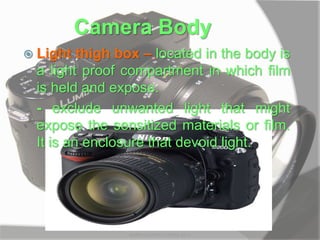
Camera Body
 Light thigh box – located in the body is
a light proof compartment in which film
is held and expose.
- exclude unwanted light that might
expose the sensitized materials or film.
It is an enclosure that devoid light.
MARK LESTER FLORES 2012
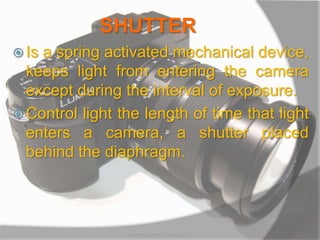
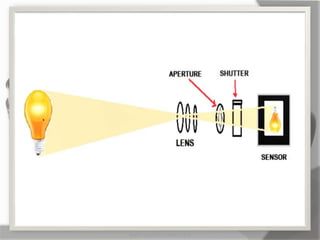
SHUTTER
 Is a spring activated mechanical device,
keeps light from entering the camera
except during the interval of exposure.
 Control light the length of time that light
enters a camera, a shutter placed
behind the diaphragm.
MARK LESTER FLORES 2012
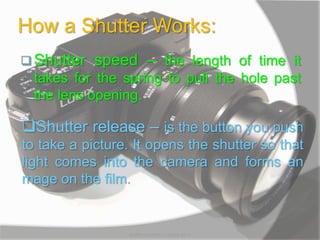
How a Shutter Works:
 Shutter speed – the length of time it
takes for the spring to pull the hole past
the lens opening.
Shutter release – is the button you push
to take a picture. It opens the shutter so that
light comes into the camera and forms an
mage on the film.
MARK LESTER FLORES 2012
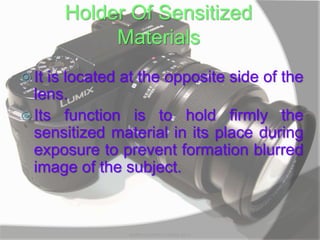
Holder Of Sensitized
Materials
 It is located at the opposite side of the
lens.
 Its function is to hold firmly the
sensitized material in its place during
exposure to prevent formation blurred
image of the subject.
MARK LESTER FLORES 2012
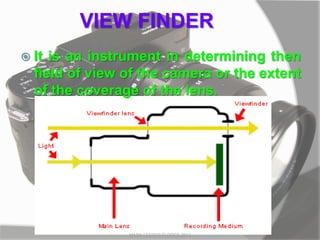
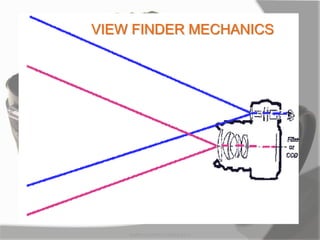
VIEW FINDER
 It is an instrument in determining then
field of view of the camera or the extent
of the coverage of the lens.
MARK LESTER FLORES 2012
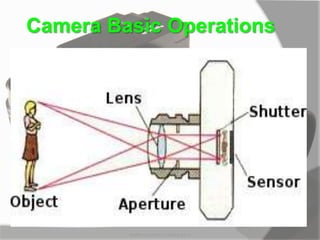
Camera Basic Operations
MARK LESTER FLORES 2012
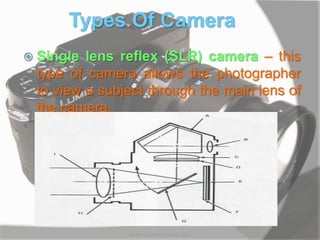
Types Of Camera
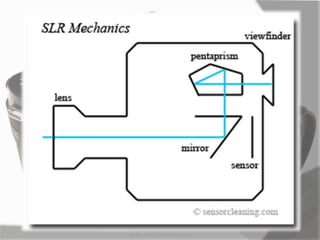
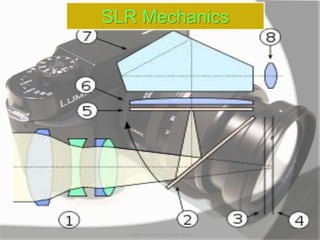
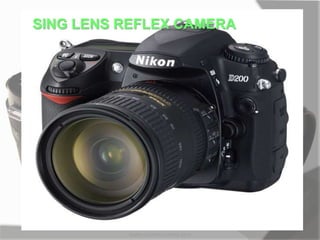
 Single lens reflex (SLR) camera – this
type of camera allows the photographer
to view a subject through the main lens of
the camera.
MARK LESTER FLORES 2012
SLR Mechanics
MARK LESTER FLORES 2012
SING LENS REFLEX CAMERA
MARK LESTER FLORES 2012
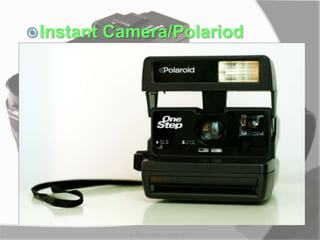
Instant Camera/Polariod
camera -
MARK LESTER FLORES 2012
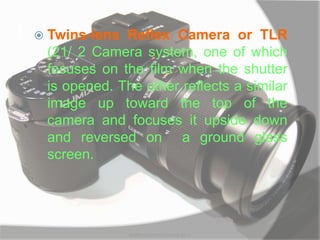
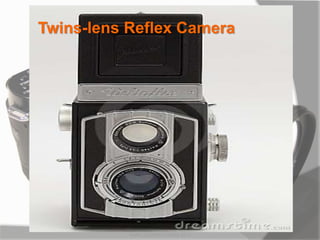
t  Twins-lens Reflex Camera or TLR
(21/ 2 Camera system, one of which
focuses on the film when the shutter
is opened. The other reflects a similar
image up toward the top of the
camera and focuses it upside down
and reversed on a ground glass
screen.
MARK LESTER FLORES 2012
Twins-lens Reflex Camera
MARK LESTER FLORES 2012
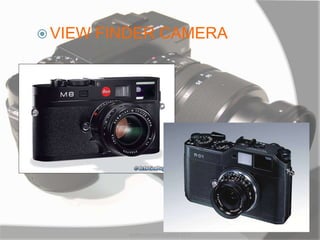
 VIEW FINDER CAMERA
MARK LESTER FLORES 2012
VIEW FINDER MECHANICS
MARK LESTER FLORES 2012
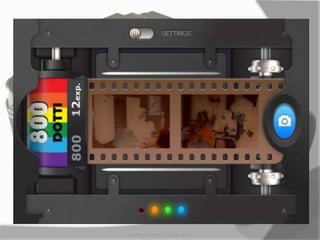
FILM
 Film contains minute grains of silver
halide suspended in animal gelatin and
coated on celluloid material.
 Is a sheet of celluloid used as a base for
photographic sensitive material.
 A cellulose tape or plate where silver salts
are suspended, capable of recording
light.
MARK LESTER FLORES 2012
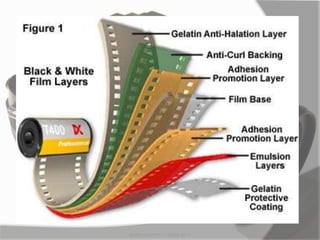
The Basic Parts of the Film
 Base
 Emulsion
 Anti – halation banking
MARK LESTER FLORES 2012
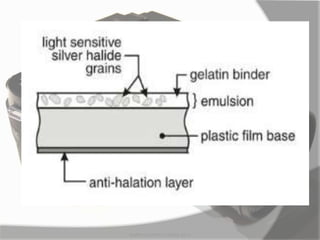
Film Base
 A film is a transparent substrate which acts
as a support medium for the
photosensitive emulsion that lies atop it.
Despite the numerous layers and coatings
associated with the emulsion layer, the
base generally accounts for the vast
majority of the thickness of any given film
stock.
MARK LESTER FLORES 2012
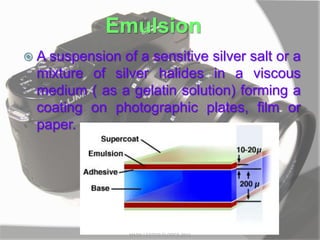
Emulsion
 A suspension of a sensitive silver salt or a
mixture of silver halides in a viscous
medium ( as a gelatin solution) forming a
coating on photographic plates, film or
paper.
MARK LESTER FLORES 2012
Anti – halation banking
 A layer found in modern photographic film. It
is placed between the light sensitive
emulsion and the tough film base, or
sometimes on the back of the film base.
 The light that passes through the emulsion
and the base is absorbed by the opaque
anti-halation layer.
MARK LESTER FLORES 2012
Characteristics of B & W
Films
 Emulsion speed
 Spectral sensitivity
 Granularity or Graininess
Emulsion speed
a.ASA (American Standards Associations) rating.
This is expressed in arithmetical value.
b.DIN (Deutsche Industrie Normen) rating, which
expressed in the logarithmic value.
c.ISO (International Standards Organization)
rating. This is expressed in the combined
arithmetical and logarithmic value.
MARK LESTER FLORES 2012
 Spectral sensitivity
a. Blue sensitive film – sensitive to UV
rays and blue color only.
b. Orthochromatic film – sensitive to UV
rays , to blue and green color. It is not
sensitive to red color only.
c. Panchromatic film – sensitive to UV
radiation to blue, green and red light or
all colors.
d. Infrared film – sensitive to UV rays, to
blue, green, red light and infrared rays.
MARK LESTER FLORES 2012
 Granularity or Graininess
- this refers to the size of the metalic
silver grains that are formed after
development of an exposed film.
- generally, the size of metallic silver
are dependent on the emulsion speed of
the type of developing solution that is
used in processing.
MARK LESTER FLORES 2012
 Film speed – film sensitivity to
light.
 Shutter speed – how long light
is allowed through the lens.
 Lens speed – largest opening of
a lens ( smallest f/-number)
MARK LESTER FLORES 2012
EXPOSURES
 Is making a photographic record by
exposing sensitive material to light
action, the quantity of light allowed to
act is expressed in terms of the length
of time the action is allowed to continue
with effective lens aperture used.
 Is a simply a combination of the
aperture and shutter speed.
MARK LESTER FLORES 2012
 Over exposure – refers to film
exposure with too great light action
resulting from a long period of
exposure with too large lens opening.
 Under–exposure – refers to
insufficient light action during
exposure, too high shutter speed, too
small lens aperture or a combination
of the factors.
MARK LESTER FLORES 2012
Lens Opening
The size of lens opening is
referred to as the f-stop or 1-
number.
As the f-stop decreases, the size
of the lens opening increases. It
gets bigger in such a way that
each lends opening lets in exactly
twice as much as the preceding
opening. MARK LESTER FLORES 2012
 Diaphragm – the mechanical device
which allows and conveniently to adjust
the aperture.
- It is an integral part of the lens system.
- It is a thin opaque structure with an
opening (aperture) at its center.
- The role of diaphragm is to STOP the
passage of light, except for the light
passing through the aperture.
MARK LESTER FLORES 2012
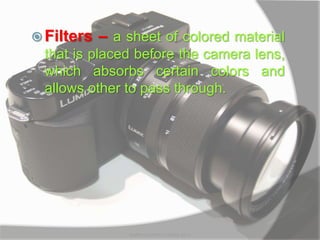
 Filters – a sheet of colored material
that is placed before the camera lens,
which absorbs certain colors and
allows other to pass through.
MARK LESTER FLORES 2012
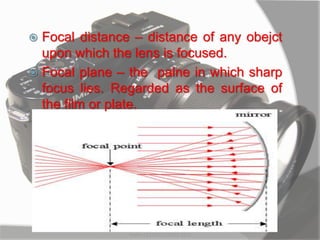
 Focal distance – distance of any obejct
upon which the lens is focused.
 Focal plane – the palne in which sharp
focus lies. Regarded as the surface of
the film or plate.
MARK LESTER FLORES 2012
 Depth of field – the distance from the
closest clear object in a photograph to
the farthest clear object; the nearest and
farthest distance apparently in sharp
focus on a given object being
photographed.
MARK LESTER FLORES 2012
Concept of Exposure
We expose film to light so that image of
the object or subject will be recorded in the
sensitized material through the manipulation of
lens aperture and shutter speed. Exposure
determines how much light gets to the film. The
amount of light allowed to get inside the camera to
reach the sensitized material (film) is controlled by
the lens aperture and shutter speed. The
combination of the two is necessary to capture the
proper quantity of light.
MARK LESTER FLORES 2012
FILM DEVELOPMENT
 A process whereby photographic film is
treated after photographic exposure to
produce the desire negative or positive
image.
 The process transforms the latent image
into a visible image and makes it
permanent.
MARK LESTER FLORES 2012
 Film developer – it is a chemical agent
or solution (in Kodak developer, D-76 is
used) which causes development to
take place.
 Stop bath – an acid bath which
instantly checks the process of
development.
 Fixer – a solution used for removing
the residual sensitive silver from a
development film thereby rendering the
image permanently.
MARK LESTER FLORES 2012
 Over – development – refers to
development at too long a time at too
high temperature resulting in excessive
contrast.
 Under – development – means
insufficient development due to either
solution is too weak or overworked; too
low temperature, insufficient agitation
thus resulting in a thin negative lacking
contrast.
MARK LESTER FLORES 2012
Cardinals in Film Development
 Developing
 Washing
 Stop bath
 Fixing
 Washing / Rinsing
 Drying
MARK LESTER FLORES 2012
QUESTIONS
MARK LESTER FLORES 2012
Thank you
MARK LESTER FLORES 2012
Name: MARK LESTER M. FLORES
Status: Married
Age: 22, years old
B- DAY : Dec 4, 2013
Connected: Gov. Alfonso D. Tan College
Tangub CITY
Contact # : 09061424768

POTHOGRAHY. forensic reviewer future RC..

  • 1.
    MARK LESTER MENDOZA-FLORES,R.C Instructor / Lecturer MARK LESTER FLORES 2012
  • 2.
  • 3.
    Brief history ofPolice Photography The word “photography” was coined by Sir John Herschel, who first used the term in 1839, the year photographic process became public. MARK LESTER FLORES 2012
  • 4.
    Light Projection througha Pin hole Light projection MARK LESTER FLORES 2012
  • 5.
    The Pin –Hole Camera Pin hole MARK LESTER FLORES 2012
  • 6.
    MARK LESTER FLORES2012 Pinhole Camera A simple camera can be built by making a pinhole in a box. Light passes through the hole and forms an inverted, backwards image of the subject on the back of the box. Artists of the Renaissance used a similar device, called the camera obscura, as an aid to drawing. The earliest camera obscura was a small room, on the back wall of which the artist could trace the projected scene.
  • 7.
  • 8.
    The Camera Obscura Giovanni Battista Della Porta – was the reputed inventor in 1569 of the “Camera Obscura”. This invention was the logical outcome of the discovery of the possibility of projecting an image through a minute hole. MARK LESTER FLORES 2012
  • 9.
    The Camera Obscura Means “dark room”. A darkened enclosure in which images of outside objects are projected through a small aperture or lens onto a facing surface. MARK LESTER FLORES 2012
  • 10.
  • 11.
  • 12.
    Modern camera andthe Camera Obscura MARK LESTER FLORES 2012
  • 13.
     Joseph Nicephore Niecepce– in 1827 obtain the first fixed image.  Created the first surviving permanent photograph by using a camera obscura, a precursor of the camera. He died in 1833 having been unable to perfect the technology. PROPONENTS OF PHOTOGRAPHY MARK LESTER FLORES 2012 Joseph Nicephore Niecepce
  • 14.
     Louis- Jacques-Mande Daguerre– a French artist and chemist, recognized for his invention of Daguerreotype process of photography. MARK LESTER FLORES 2012 Louis- Jacques-Mande Daguerre
  • 15.
    Daguerreotype – werethe forerunners of our modern film. - It was made of a copper plate coated with silver and exposed to iodine vapor before it was exposed to light. - To create the image on the plate, it must be exposed to light for about 15 minutes. MARK LESTER FLORES 2012
  • 16.
     Henry FoxTalbot – in 1834 created permanent (negative) images. - He use paper, soaked in silver chloride and fixed with a salt solution. - He the one created positive images by contact printing onto another sheet of paper. Calotype – process in the year 1840. - in this process, Talbot coated paper sheets with silver chloride to create an intermediate negative image. MARK LESTER FLORES 2012
  • 17.
  • 18.
    Brief History ofForensic Photography  Forensic Photography - sometimes referred to as police photography, forensic imaging or crime - is the art or science of documenting photographically a crime scene and evidence for laboratory examination and analysis for purposes of court trial. MARK LESTER FLORES 2012
  • 19.
    Police Photography- isan art or science that deals with the study of the principles of photography, the preparation of photographic evidence and its application to police work. Scene photography - is the art of producing an accurate reproduction f a crime scene or an accident using photography for the benefit of a court or to aid in an investigation. MARK LESTER FLORES 2012
  • 20.
    Photograph - isan image created by light falling on a light-sensitive surface usually photographic film or electronic image. Photograph - is an image created by light falling on a light-sensitive surface usually photographic film or electronic image. MARK LESTER FLORES 2012
  • 21.
    Basic Importance ofcrime photography:  Refresh memory  Preserve memory  Save money Objectives Of Photography 1.To produce a pictorial record of the crime scene. 2.To help in keeping the police officer’s memory inn remembering accurately as to where the locations of physical evidence are found. 3.To help in securing and obtaining confession, description, deposition and information relating to the case. MARK LESTER FLORES 2012
  • 22.
    USE OF PHOTOGRAPHY Identification  Record  Presentation  Substitution  Deciding factor MARK LESTER FLORES 2012
  • 23.
    PRINCIPLES OF PHOTOGRAPHY A photograph is both the mechanical and chemical result of photography. To produce a photograph, light is needed aside from sensitized materials (film or papers). Light radiated or reflected by the subject must reach the film while all other lights are excluded. The exclusion of all other lights is achieved by placing the film inside a light tight box (camera).  The effect of light on the film is not visible in the formation of images of objects. To make it visible, we need or require a chemical processing of the expose film called development. MARK LESTER FLORES 2012
  • 24.
     The visualeffect of light on the film after development varies when the quantity quality of light the reached the emulsion of the film. To grant in the amount of light will produce an opaque or very black shade after development. Too little will produces a transparent or white shade after a development.  The amount of light reaching the film is dependent upon several factors like lightning condition, lens opening, used, shutter speed used, filter used etc. MARK LESTER FLORES 2012
  • 25.
    FIVE ELEMENTS INPHOTOGRAPHY: 1. Light or electromagnetic radiation 2. Camera 3. Sensitized materials 4. Chemical process 5. Subject or object – refers to animate and inanimate things – persons or materials etc.. MARK LESTER FLORES 2012
  • 26.
    Other photography relatedto police photography  Photomacrography  Photomicrography  Infrared photography  Ultra – violate ray photography MARK LESTER FLORES 2012
  • 27.
    Light and Lenses Lens- is an optical unit mounted in the camera which makes possible the formation of sharp image. MARK LESTER FLORES 2012
  • 28.
    What is LIGHT? -is a form of electromagnetic impulse of the same family as radio, hertzian waves, heat, infrared, ultraviolet, x-rays and cosmic rays. MARK LESTER FLORES 2012
  • 29.
    Principle of LIGHT -light, or visible light, is electromagnetic radiation of a wavelength that is visible to the human eye(about 400-700nm). - in the context of science, light is sometimes used to refer to the entire electromagnetic spectrum. MARK LESTER FLORES 2012
  • 30.
    Electromagnetic Spectrum - isa continuum of all electromagnetic waves arranged according to frequency and wavelength. The sun, earth, and other bodies radiate electromagnetic energy of varying wavelength. Electromagnetic energy passes through space at the speed f light in the form of sinusoidal waves. MARK LESTER FLORES 2012
  • 31.
  • 32.
    The wavelength isthe distance from wave crest to wave crest Wavelength MARK LESTER FLORES 2012
  • 33.
    Electromagnetic Radiation  Interms of classical theory, the flow of energy at the universal speed of light through a material/ medium in the form of the electric and magnetic fields that make up electromagnetic waves such as radio waves, visible light and gamma rays. In such a wave, time- varying electric and magnetic fields are mutually linked with each other at right angles. MARK LESTER FLORES 2012
  • 34.
    Measurement of light(expressed in nanometer) 0 – 30 – X-ray 30 – 400 – Ultra – violate 400 – 700 – visible light 700 – 1000nm – Infrared light 1000 – up nm – Radio waves MARK LESTER FLORES 2012
  • 35.
    The Visible RayOf The Spectrum MARK LESTER FLORES 2012
  • 36.
    Wavelength of theelectromagnetic Spectrum Red Orange Yellow Green Blue Violate MARK LESTER FLORES 2012
  • 37.
    Objects Which AffectSpeed Of Light  Transparent objects – objects or mediums which merely slow the speed of light but allow it to pass freely.  Opaque objects – objects which divert or absorb light, but allow no light to pass through it.  Translucent objects – which allow light to pass through them in such way that the outline of the light source is not clearly visible. Ex. Glass, ground glass oiled paper, water. MARK LESTER FLORES 2012
  • 38.
    How Light Changes Direction 1.Reflection – is a change in the direction of light wave which occurs whenever light waves comes in contact with the surface of an object/subject but does not allow the wave to pass through it. MARK LESTER FLORES 2012
  • 39.
    Two ways howlight reflected:  Diffuse reflected light - when light rays in contact with rough surface.  Specular reflected light – when light rays come in contact with smooth surface such as mirror, it produces glare. MARK LESTER FLORES 2012
  • 40.
  • 41.
    2. Refraction –is the bending or redirection of light waves when passing obliquely from one medium to a medium of different density. A B C D Refraction of light through flat glass MARK LESTER FLORES 2012
  • 42.
  • 43.
    3. Prism –is a solid for dispersing light, it is a transparent polygonal solid object with flat faces and usually a triangular cross section, used for separating white light into a spectrum of colors. Light rays bend twice when passing through a prism. A Prism Bends A Ray Twice MARK LESTER FLORES 2012
  • 44.
    A Prism BendsA Ray Twice MARK LESTER FLORES 2012
  • 45.
  • 46.
    Significance of Lenses A lens is a piece of transparent material with at least one curved surface, which refracts, or bends light rays coming from an object.  Lenses are usually made out of glass or plastic and they have special property which can give good results. MARK LESTER FLORES 2012
  • 47.
    Lens Type 1. Doubleconvex 2. Plano convex 3. Concave convex 4. Double concave 5. Plano concave 6. Concave convex 7. Achromatic lens MARK LESTER FLORES 2012
  • 48.
  • 49.
    Converging rays –there is convergence of light rays when light rays meet at once point after they pass through a lens. The point at which light converge is called the focus. MARK LESTER FLORES 2012
  • 50.
    Diverging rays –are lights rays which bend away from a given point. Lenses which cause light rays to diverge are known as concave lenses. MARK LESTER FLORES 2012
  • 51.
  • 52.
  • 53.
  • 54.
    Types Of CameraLens  Wide- angle lens  Normal lens  Telephoto  Zoom lens  Macro lens  Micro lens MARK LESTER FLORES 2012
  • 55.
    WIDE- ANGLE LENS Lenses have a shorter focal length usual 35 mm, 28mm or less  Used when photographing narrow and crowded MARK LESTER FLORES 2012
  • 56.
    NORMAL LENS  Lenseshave a focal length of 25mm to 26mm  Lenses which are commonly used in regular photography MARK LESTER FLORES 2012
  • 57.
    TELEPHOTO  Lenses havelonger focal lengths such as 90mm, 200 mm and longer  Fixed lenses used in photographing long or far distances. MARK LESTER FLORES 2012
  • 58.
    ZOOM LENS  Lenseswhich are variable. It can photograph from the shortest to longest distances. MARK LESTER FLORES 2012
  • 59.
    MACRO LENS  Lensesthat enlarges object and magnify from 1 to 9x. MARK LESTER FLORES 2012
  • 60.
    MICRO LENS  Usedto photograph minute objects and magnify and enlarge from 10x up. MARK LESTER FLORES 2012
  • 61.
    How lens affectphotographic images?  Lens aberration – is an anomaly of the which causes distortion of the image due to lens curvature or color at the edge of the lens.  Aberration – as an optical distortion of an image caused by a lens. MARK LESTER FLORES 2012
  • 62.
    LENS DEFECTS:  Chromaticaberration - caused by a lens having a different refractive index for different wavelengths of light. MARK LESTER FLORES 2012
  • 63.
  • 64.
    Achromatic lens –a lens corrected to bring together the yellow and blue – violet rays so that no color fingers will appear in the final image. MARK LESTER FLORES 2012
  • 65.
  • 66.
     Parallax error– is an apparent displacement of an object when viewed at two different angles or when the person looking at the object changes position. MARK LESTER FLORES 2012
  • 67.
  • 68.
     Astigmatism –a fault of a lens, caused by slight non- uniformity of refraction which prevents a sharp focus being obtained simultaneously upon both vertical and horizontal lines. MARK LESTER FLORES 2012
  • 69.
  • 70.
  • 71.
     Aspherical lens– a lens in which one surface departs from a true spherical aberration. MARK LESTER FLORES 2012
  • 72.
  • 73.
  • 74.
    Basic Parts OfCamera Light thigh box Lens Shutter A shutter release Holder Of Sensitized Materials View finder MARK LESTER FLORES 2012
  • 75.
    Basic Parts OfCamera MARK LESTER FLORES 2012
  • 76.
    Camera Body  Lightthigh box – located in the body is a light proof compartment in which film is held and expose. - exclude unwanted light that might expose the sensitized materials or film. It is an enclosure that devoid light. MARK LESTER FLORES 2012
  • 77.
    SHUTTER  Is aspring activated mechanical device, keeps light from entering the camera except during the interval of exposure.  Control light the length of time that light enters a camera, a shutter placed behind the diaphragm. MARK LESTER FLORES 2012
  • 78.
  • 79.
  • 80.
    How a ShutterWorks:  Shutter speed – the length of time it takes for the spring to pull the hole past the lens opening. Shutter release – is the button you push to take a picture. It opens the shutter so that light comes into the camera and forms an mage on the film. MARK LESTER FLORES 2012
  • 81.
    Holder Of Sensitized Materials It is located at the opposite side of the lens.  Its function is to hold firmly the sensitized material in its place during exposure to prevent formation blurred image of the subject. MARK LESTER FLORES 2012
  • 82.
  • 83.
    VIEW FINDER  Itis an instrument in determining then field of view of the camera or the extent of the coverage of the lens. MARK LESTER FLORES 2012
  • 84.
    Camera Basic Operations MARKLESTER FLORES 2012
  • 85.
    Types Of Camera Single lens reflex (SLR) camera – this type of camera allows the photographer to view a subject through the main lens of the camera. MARK LESTER FLORES 2012
  • 86.
  • 87.
  • 88.
    SING LENS REFLEXCAMERA MARK LESTER FLORES 2012
  • 89.
  • 90.
    t  Twins-lensReflex Camera or TLR (21/ 2 Camera system, one of which focuses on the film when the shutter is opened. The other reflects a similar image up toward the top of the camera and focuses it upside down and reversed on a ground glass screen. MARK LESTER FLORES 2012
  • 91.
  • 92.
     VIEW FINDERCAMERA MARK LESTER FLORES 2012
  • 93.
    VIEW FINDER MECHANICS MARKLESTER FLORES 2012
  • 94.
    FILM  Film containsminute grains of silver halide suspended in animal gelatin and coated on celluloid material.  Is a sheet of celluloid used as a base for photographic sensitive material.  A cellulose tape or plate where silver salts are suspended, capable of recording light. MARK LESTER FLORES 2012
  • 95.
    The Basic Partsof the Film  Base  Emulsion  Anti – halation banking MARK LESTER FLORES 2012
  • 96.
  • 97.
    Film Base  Afilm is a transparent substrate which acts as a support medium for the photosensitive emulsion that lies atop it. Despite the numerous layers and coatings associated with the emulsion layer, the base generally accounts for the vast majority of the thickness of any given film stock. MARK LESTER FLORES 2012
  • 98.
    Emulsion  A suspensionof a sensitive silver salt or a mixture of silver halides in a viscous medium ( as a gelatin solution) forming a coating on photographic plates, film or paper. MARK LESTER FLORES 2012
  • 99.
    Anti – halationbanking  A layer found in modern photographic film. It is placed between the light sensitive emulsion and the tough film base, or sometimes on the back of the film base.  The light that passes through the emulsion and the base is absorbed by the opaque anti-halation layer. MARK LESTER FLORES 2012
  • 100.
  • 101.
    Characteristics of B& W Films  Emulsion speed  Spectral sensitivity  Granularity or Graininess Emulsion speed a.ASA (American Standards Associations) rating. This is expressed in arithmetical value. b.DIN (Deutsche Industrie Normen) rating, which expressed in the logarithmic value. c.ISO (International Standards Organization) rating. This is expressed in the combined arithmetical and logarithmic value. MARK LESTER FLORES 2012
  • 102.
     Spectral sensitivity a.Blue sensitive film – sensitive to UV rays and blue color only. b. Orthochromatic film – sensitive to UV rays , to blue and green color. It is not sensitive to red color only. c. Panchromatic film – sensitive to UV radiation to blue, green and red light or all colors. d. Infrared film – sensitive to UV rays, to blue, green, red light and infrared rays. MARK LESTER FLORES 2012
  • 103.
     Granularity orGraininess - this refers to the size of the metalic silver grains that are formed after development of an exposed film. - generally, the size of metallic silver are dependent on the emulsion speed of the type of developing solution that is used in processing. MARK LESTER FLORES 2012
  • 104.
     Film speed– film sensitivity to light.  Shutter speed – how long light is allowed through the lens.  Lens speed – largest opening of a lens ( smallest f/-number) MARK LESTER FLORES 2012
  • 105.
    EXPOSURES  Is makinga photographic record by exposing sensitive material to light action, the quantity of light allowed to act is expressed in terms of the length of time the action is allowed to continue with effective lens aperture used.  Is a simply a combination of the aperture and shutter speed. MARK LESTER FLORES 2012
  • 106.
     Over exposure– refers to film exposure with too great light action resulting from a long period of exposure with too large lens opening.  Under–exposure – refers to insufficient light action during exposure, too high shutter speed, too small lens aperture or a combination of the factors. MARK LESTER FLORES 2012
  • 107.
    Lens Opening The sizeof lens opening is referred to as the f-stop or 1- number. As the f-stop decreases, the size of the lens opening increases. It gets bigger in such a way that each lends opening lets in exactly twice as much as the preceding opening. MARK LESTER FLORES 2012
  • 108.
     Diaphragm –the mechanical device which allows and conveniently to adjust the aperture. - It is an integral part of the lens system. - It is a thin opaque structure with an opening (aperture) at its center. - The role of diaphragm is to STOP the passage of light, except for the light passing through the aperture. MARK LESTER FLORES 2012
  • 109.
  • 110.
     Filters –a sheet of colored material that is placed before the camera lens, which absorbs certain colors and allows other to pass through. MARK LESTER FLORES 2012
  • 111.
     Focal distance– distance of any obejct upon which the lens is focused.  Focal plane – the palne in which sharp focus lies. Regarded as the surface of the film or plate. MARK LESTER FLORES 2012
  • 112.
  • 113.
     Depth offield – the distance from the closest clear object in a photograph to the farthest clear object; the nearest and farthest distance apparently in sharp focus on a given object being photographed. MARK LESTER FLORES 2012
  • 114.
    Concept of Exposure Weexpose film to light so that image of the object or subject will be recorded in the sensitized material through the manipulation of lens aperture and shutter speed. Exposure determines how much light gets to the film. The amount of light allowed to get inside the camera to reach the sensitized material (film) is controlled by the lens aperture and shutter speed. The combination of the two is necessary to capture the proper quantity of light. MARK LESTER FLORES 2012
  • 115.
    FILM DEVELOPMENT  Aprocess whereby photographic film is treated after photographic exposure to produce the desire negative or positive image.  The process transforms the latent image into a visible image and makes it permanent. MARK LESTER FLORES 2012
  • 116.
     Film developer– it is a chemical agent or solution (in Kodak developer, D-76 is used) which causes development to take place.  Stop bath – an acid bath which instantly checks the process of development.  Fixer – a solution used for removing the residual sensitive silver from a development film thereby rendering the image permanently. MARK LESTER FLORES 2012
  • 117.
     Over –development – refers to development at too long a time at too high temperature resulting in excessive contrast.  Under – development – means insufficient development due to either solution is too weak or overworked; too low temperature, insufficient agitation thus resulting in a thin negative lacking contrast. MARK LESTER FLORES 2012
  • 118.
    Cardinals in FilmDevelopment  Developing  Washing  Stop bath  Fixing  Washing / Rinsing  Drying MARK LESTER FLORES 2012
  • 119.
  • 120.
  • 121.
    MARK LESTER FLORES2012 Name: MARK LESTER M. FLORES Status: Married Age: 22, years old B- DAY : Dec 4, 2013 Connected: Gov. Alfonso D. Tan College Tangub CITY Contact # : 09061424768