Classifying European
Institutions of Higher Education

Ideas, Concepts, Goals


Prof.dr. F. van Vught
University of Twente, The Netherlands
European Higher Education


 Diversity is a strength

 But what do we know about it?

 Classification to increase
 transparency
Classifications are International
Phenomena


Carnegie Classification (USA): 1973,
1976, 1994, 2000, 2006


Chinese higher education
classification: 2007
Functions of Higher Education
Classifications


tool for research
transparency instrument (various
stakeholders)
base for governmental policies
instrument for institutional strategies
(profile, mission)
instrument for better ranking
Classification and Rankings

the methodologies of ranking are judged to
be ‘simplistic and lacking transparency’.
(Hazelkorn, 2007)

‘with increasing competition between
institutions, … it is likely that rankings will
continue to grow in importance … Further
consideration and acknowledgement of
wider factors (than in a single league table
only) should be considered so that the
diversity of institutional mission and focus is
taken into account’. (HEFCE, 2008)
Stakeholders’ Interests


transparency for students
transparency for business & industry
and other organisations
transparency for policy makers
transparency for researchers
profiling instrument for higher
education institutions
The Classification Project


stakeholders approach: exploration
and discussions

first phase: basic design principles
first phase: first set of schemes and
indicators

second phase: second adapted set
of schemes and indicators
The Classification Project:
design principles


inclusive for all European HEIs

a posteriori information

multi-dimensional

non-hierarchical

focus on ‘objective’ data
The Classification Project:
design principles


non-prescriptive

flexible

parsimonious regarding extra data-
needs

related to European Register of
Quality Assurance Agencies
The Classification Project:
first set of schemes


Education
• Types of degrees offered
• Range of subjects offered
• Orientation of degrees
• European educational profile
The Classification Project:
first set of schemes


Research and Innovation
• Research intensiveness
• Innovation intensiveness
• European research profile
The Classification Project:
first set of schemes

Student and Staff Profile
• International orientation
• Involvement in life long
  learning
The Classification Project:
first set of schemes

Institutional Characteristics
• Size
• Mode of delivery
• Community services
• Public/private character
• Legal status
The Classification Project:
The second phase


analysis of existing data sources


in-depth case studies


survey; to assess relevance, validity,
reliability and feasibility
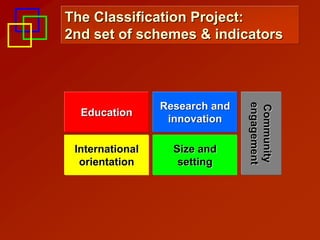
The Classification Project:
2nd set of schemes & indicators


                 Research and


                                engagement
                                engagement
                                Community
                                Community
  Education
                  innovation

 International     Size and
  orientation       setting
The Classification Project:
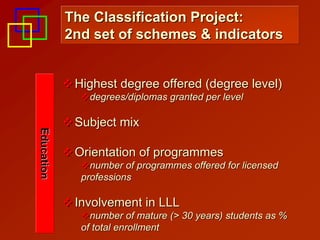
            2nd set of schemes & indicators


             Highest degree offered (degree level)
               degrees/diplomas granted per level

             Subject mix
Education
Education


             Orientation of programmes
                number of programmes offered for licensed
              professions

             Involvement in LLL
                number of mature (> 30 years) students as %
              of total enrollment
The Classification Project:
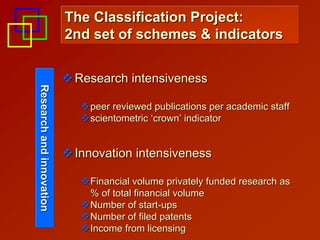
                          2nd set of schemes & indicators


                           Research intensiveness
Research and innovation


                             peer reviewed publications per academic staff
                             scientometric ‘crown’ indicator


                           Innovation intensiveness

                             Financial volume privately funded research as
                             % of total financial volume
                             Number of start-ups
                             Number of filed patents
                             Income from licensing
The Classification Project:
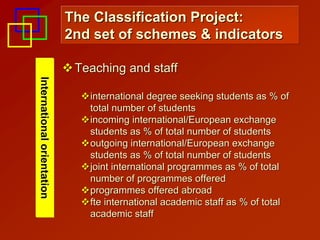
                            2nd set of schemes & indicators

                             Teaching and staff
International orientation


                               international degree seeking students as % of
                               total number of students
                               incoming international/European exchange
                               students as % of total number of students
                               outgoing international/European exchange
                               students as % of total number of students
                               joint international programmes as % of total
                               number of programmes offered
                               programmes offered abroad
                               fte international academic staff as % of total
                               academic staff
The Classification Project:
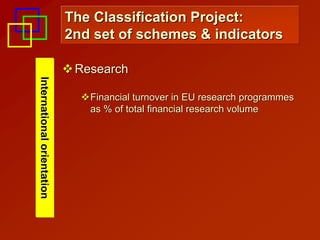
                            2nd set of schemes & indicators

                             Research
International orientation


                               Financial turnover in EU research programmes
                               as % of total financial research volume
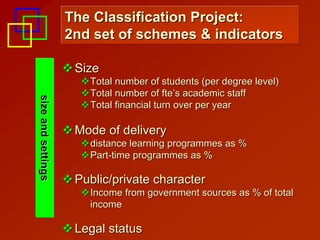
The Classification Project:
                    2nd set of schemes & indicators

                     Size
                       Total number of students (per degree level)
                       Total number of fte’s academic staff
size and settings
size and settings


                       Total financial turn over per year

                     Mode of delivery
                       distance learning programmes as %
                       Part-time programmes as %

                     Public/private character
                       Income from government sources as % of total
                       income

                     Legal status
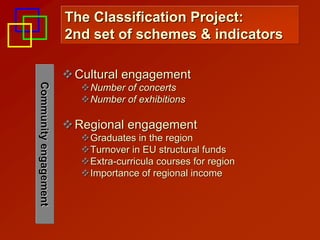
The Classification Project:
                       2nd set of schemes & indicators

                        Cultural engagement
Community engagement


                          Number of concerts
                          Number of exhibitions

                        Regional engagement
                          Graduates in the region
                          Turnover in EU structural funds
                          Extra-curricula courses for region
                          Importance of regional income
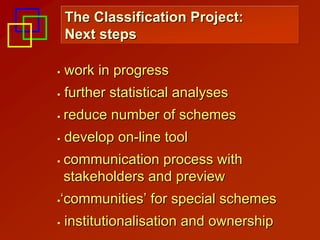
The Classification Project:
Next steps

work in progress
further statistical analyses
reduce number of schemes
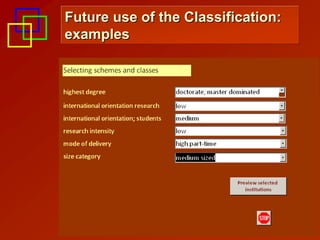
develop on-line tool
communication process with
stakeholders and preview
‘communities’ for special schemes
institutionalisation and ownership
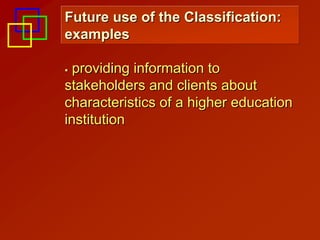
Future use of the Classification:
examples

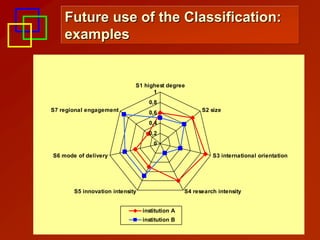
  providing information to
stakeholders and clients about
characteristics of a higher education
institution
Future use of the Classification:
    examples


                             S1 highest degree
                                   1
                                   0,8
S7 regional engagement             0,6                 S2 size

                                   0,4
                                   0,2
                                     0

S6 mode of delivery                                        S3 international orientation


       S5 innovation intensity                   S4 research intensity


                                 institution A
                                 institution B
Future use of the Classification:
examples

 providing assistance to institutional
strategies and inter-institutional
partnerships, benchmarking, and
networking
Future use of the Classification:
examples
Classifying European Institutions
of Higher Education


Thank you for your attention!


This project has been funded with support from the European Commission.
This presentation content reflects the views only of the author. The Commission
cannot be held responsible for any use which may be made of the information
contained therein.

Utr. prog frid. frans van vught

  • 1.
    Classifying European Institutions ofHigher Education Ideas, Concepts, Goals Prof.dr. F. van Vught University of Twente, The Netherlands
  • 2.
    European Higher Education Diversity is a strength But what do we know about it? Classification to increase transparency
  • 3.
    Classifications are International Phenomena CarnegieClassification (USA): 1973, 1976, 1994, 2000, 2006 Chinese higher education classification: 2007
  • 4.
    Functions of HigherEducation Classifications tool for research transparency instrument (various stakeholders) base for governmental policies instrument for institutional strategies (profile, mission) instrument for better ranking
  • 5.
    Classification and Rankings themethodologies of ranking are judged to be ‘simplistic and lacking transparency’. (Hazelkorn, 2007) ‘with increasing competition between institutions, … it is likely that rankings will continue to grow in importance … Further consideration and acknowledgement of wider factors (than in a single league table only) should be considered so that the diversity of institutional mission and focus is taken into account’. (HEFCE, 2008)
  • 6.
    Stakeholders’ Interests transparency forstudents transparency for business & industry and other organisations transparency for policy makers transparency for researchers profiling instrument for higher education institutions
  • 7.
    The Classification Project stakeholdersapproach: exploration and discussions first phase: basic design principles first phase: first set of schemes and indicators second phase: second adapted set of schemes and indicators
  • 8.
    The Classification Project: designprinciples inclusive for all European HEIs a posteriori information multi-dimensional non-hierarchical focus on ‘objective’ data
  • 9.
    The Classification Project: designprinciples non-prescriptive flexible parsimonious regarding extra data- needs related to European Register of Quality Assurance Agencies
  • 10.
    The Classification Project: firstset of schemes Education • Types of degrees offered • Range of subjects offered • Orientation of degrees • European educational profile
  • 11.
    The Classification Project: firstset of schemes Research and Innovation • Research intensiveness • Innovation intensiveness • European research profile
  • 12.
    The Classification Project: firstset of schemes Student and Staff Profile • International orientation • Involvement in life long learning
  • 13.
    The Classification Project: firstset of schemes Institutional Characteristics • Size • Mode of delivery • Community services • Public/private character • Legal status
  • 14.
    The Classification Project: Thesecond phase analysis of existing data sources in-depth case studies survey; to assess relevance, validity, reliability and feasibility
  • 15.
    The Classification Project: 2ndset of schemes & indicators Research and engagement engagement Community Community Education innovation International Size and orientation setting
  • 16.
    The Classification Project: 2nd set of schemes & indicators Highest degree offered (degree level) degrees/diplomas granted per level Subject mix Education Education Orientation of programmes number of programmes offered for licensed professions Involvement in LLL number of mature (> 30 years) students as % of total enrollment
  • 17.
    The Classification Project: 2nd set of schemes & indicators Research intensiveness Research and innovation Research and innovation peer reviewed publications per academic staff scientometric ‘crown’ indicator Innovation intensiveness Financial volume privately funded research as % of total financial volume Number of start-ups Number of filed patents Income from licensing
  • 18.
    The Classification Project: 2nd set of schemes & indicators Teaching and staff International orientation International orientation international degree seeking students as % of total number of students incoming international/European exchange students as % of total number of students outgoing international/European exchange students as % of total number of students joint international programmes as % of total number of programmes offered programmes offered abroad fte international academic staff as % of total academic staff
  • 19.
    The Classification Project: 2nd set of schemes & indicators Research International orientation International orientation Financial turnover in EU research programmes as % of total financial research volume
  • 20.
    The Classification Project: 2nd set of schemes & indicators Size Total number of students (per degree level) Total number of fte’s academic staff size and settings size and settings Total financial turn over per year Mode of delivery distance learning programmes as % Part-time programmes as % Public/private character Income from government sources as % of total income Legal status
  • 21.
    The Classification Project: 2nd set of schemes & indicators Cultural engagement Community engagement Community engagement Number of concerts Number of exhibitions Regional engagement Graduates in the region Turnover in EU structural funds Extra-curricula courses for region Importance of regional income
  • 22.
    The Classification Project: Nextsteps work in progress further statistical analyses reduce number of schemes develop on-line tool communication process with stakeholders and preview ‘communities’ for special schemes institutionalisation and ownership
  • 23.
    Future use ofthe Classification: examples providing information to stakeholders and clients about characteristics of a higher education institution
  • 24.
    Future use ofthe Classification: examples S1 highest degree 1 0,8 S7 regional engagement 0,6 S2 size 0,4 0,2 0 S6 mode of delivery S3 international orientation S5 innovation intensity S4 research intensity institution A institution B
  • 25.
    Future use ofthe Classification: examples providing assistance to institutional strategies and inter-institutional partnerships, benchmarking, and networking
  • 26.
    Future use ofthe Classification: examples
  • 27.
    Classifying European Institutions ofHigher Education Thank you for your attention! This project has been funded with support from the European Commission. This presentation content reflects the views only of the author. The Commission cannot be held responsible for any use which may be made of the information contained therein.