Erasmus Mundus Joint Master Degrees
Sofia, December 2018
Mirko Varano
varano@kth.se
WHAT IS IT?
• Consortium of minimum 3 degree awarding HEIs
• Minimum 3 Programme Countries involved
• 1 Integrated joint programme at Master level
• Embedded mobility
• Joint or multiple degrees issued
• Grants for students and staff
• 4 intakes + sustainability measures
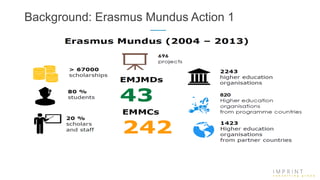
Background: Erasmus Mundus Action 1
OUTCOMES FOR STUDENTS
• improved learning performance;
• enhanced employability and improved career prospects;
• increased sense of initiative and entrepreneurship;
• increased self-empowerment and self-esteem;
• improved foreign language competences;
• enhanced intercultural awareness;
• more active participation in society;
• better awareness of the European project and the EU values;
• increased motivation for taking part in future (formal/non-formal) education or
training after the mobility period
• abroad.
OUTCOMES FOR STAFF
• improved competences, linked to their professional profiles
• broader understanding of practices, policies and systems in education across countries;
• increased capacity to trigger changes in terms of modernisation
• greater understanding of interconnections between formal and non-formal education, vocational
training and the labour market;
• better quality of their work and activities in favour of students;
• greater understanding and responsiveness to social, linguistic and cultural diversity;
• increased ability to address the needs of the disadvantaged;
• increased support for and promotion of mobility activities for learners;
• increased opportunities for professional and career development;
• improved foreign language competences;
• increased motivation and satisfaction in their daily work.
OUTCOMES FOR INSTITUTIONS
• increased capacity to operate at EU/international level (international Strategies, reinforced
cooperation with partners from other countries, increased allocation of financial resources)
• preparation implementation, monitoring and follow up of EU/international projects;
• innovative and improved way of operating towards their target groups (more attractive
programmes, improved qualifications of teaching and training staff; improved recognition and
validation of competences)
• more modern, dynamic, committed and professional environment inside the organisation
(integration of good practices and new methods into daily activities; planning strategically the
professional development of their staff in relation to individual needs and organisational
objectives
WHY?
The main objective of the EMJMD programme is to attract, select and fund
excellence.
AND
Foster innovations and excellence in HEIs;
Increase the attractiveness of European Higher Education;
Improve the competences and skills of Master graduates
for the labour market. (Industry must be involved).
Contribute to the objectives of Europe 2020 Strategy and of the Education and
Training strategic framework 2020.
EMJMD - Specific conditions
 Fully developed at the time of application including a draft Consortium Agreement
 Graduated students shall receive a joint or double degree with a joint diploma supplement;
 Worldwide visibility & awareness raising activities;
 A joint Quality Assurance plan with agreed milestones and
follow-up actions
 Language courses at the host institution;
 Student representatives & student testimonials
 Liaison with EM Alumni Association
 60 – 90 – 120 ECTS
 At least 3 Programme Countries
 Studies in at least 2 programme countries
 4 consecutive student intakes
 15 – 27 student scholarships &
 4 scholars per intake (up to 8 weeks)
 Application deadline February 2019 12:00 (CET)
EMJMD: The hard facts
 Candidates must hold a Bachelor degree and
 Enroll full-time in one of the partner HEIs
 75% of the grants to partner countries
 Virtual mobility doesn’t replace physical
mobility
EMJMD: The hard facts (cont.)
• Applicant/coordinator: a HEI established in a Programme Country that submits the project proposal on behalf of all
the partners
 represents and acts on behalf of the group of participating organisations vis-à-vis the European Commission;
 bears the financial and legal responsibility for the proper operational, administrative and financial implementation of the entire
project;
 coordinates the EMJMD in cooperation with all other project partners.
• Partners: degree-awarding HEIs recognised as such by the relevant authorities of the Programme or Partner Country in
which they are established and any private or public organisation that contributes actively to the preparation,
implementation and evaluation of the EMJMD.
• Associated partners (optional): additionally the EMJMD study programme may also benefit from the involvement of
associated partners. These organisations contribute indirectly to the implementation of specific tasks/activities and/or
support the dissemination and sustainability of the EMJMD. Such contribution may for example take the form of
knowledge and skills transfer, the provision of complementary courses or backing possibilities for secondment or
placement. For contractual management issues, “associated partners” are not considered as part of the EMJMD
consortium because they have a more limited role in the implementation of the EMJMD, as their expertise is called
upon on an ad-hoc basis.
• Affiliated entities (optional): Organisations which contribute to the achievement of project objectives and activities
Consortium
 a higher education institution (HEI);
 a public or private, a small, medium or large
enterprise (including social enterprises);
 a public body at local, regional or national level;
 a non-profit organisation, association, NGO;
 a research institute.
Possible participants
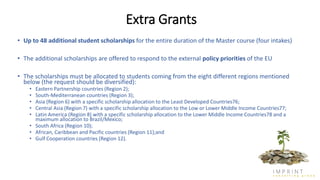
• Up to 48 additional student scholarships for the entire duration of the Master course (four intakes)
• The additional scholarships are offered to respond to the external policy priorities of the EU
• The scholarships must be allocated to students coming from the eight different regions mentioned
below (the request should be diversified):
• Eastern Partnership countries (Region 2);
• South-Mediterranean countries (Region 3);
• Asia (Region 6) with a specific scholarship allocation to the Least Developed Countries76;
• Central Asia (Region 7) with a specific scholarship allocation to the Low or Lower Middle Income Countries77;
• Latin America (Region 8) with a specific scholarship allocation to the Lower Middle Income Countries78 and a
maximum allocation to Brazil/Mexico;
• South Africa (Region 10);
• African, Caribbean and Pacific countries (Region 11);and
• Gulf Cooperation countries (Region 12).
Extra Grants
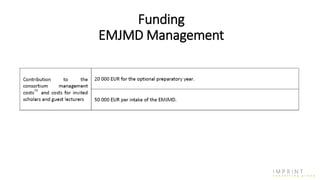
Funding
EMJMD Management
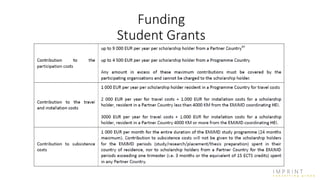
Funding
Student Grants
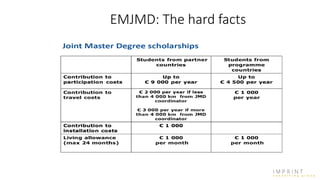
EMJMD: The hard facts
Award Criteria 1: Relevance of the project (40/100)
 Sustainability beyond the funding period
 Relevant competencies for employability
 Increasing attractiveness
 Innovation & excellence
 Jointness in the programme design and structure.
Award Criteria 2: Quality of the project design (20/100)
 Institutional commitment;
 Jointly developed curriculum;
 Organised mobility scheme and plan for effective involvement of
scholars;
 Consistent use of European transparency and recognition tools
 Student support and language training;
 Students’ rights and obligations;
 Effective integration and networking.
Award Criteria 3: Quality of the project team (20/100)
 Expertise and added value of involved partners/staff
 Role and tasks of each partner
 Joint management of student application and
selection
 Calculation of participation costs and management of other
financial resources.
Award Criteria 4: Impact and dissemination (20/100)
 Impact at institutional level and how the JMD supports the
internationalisation strategy of partner institutions;
 Promotion and dissemination activities;
 Internal evaluation methods;
 External evaluation process and the role of quality assurance bodies;
 Convincing sustainability strategy;
 How employers will be involved.
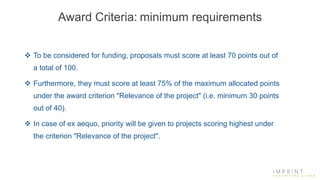
Award Criteria: minimum requirements
 To be considered for funding, proposals must score at least 70 points out of
a total of 100.
 Furthermore, they must score at least 75% of the maximum allocated points
under the award criterion "Relevance of the project" (i.e. minimum 30 points
out of 40).
 In case of ex aequo, priority will be given to projects scoring highest under
the criterion "Relevance of the project".
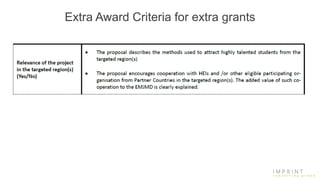
Extra Award Criteria for extra grants
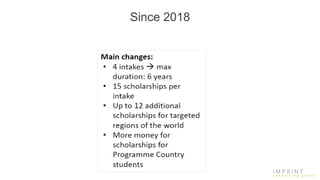
Since 2018
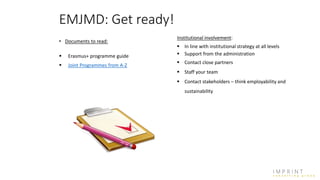
• Documents to read:
 Erasmus+ programme guide
 Joint Programmes from A-Z
EMJMD: Get ready!
Institutional involvement:
 In line with institutional strategy at all levels
 Support from the administration
 Contact close partners
 Staff your team
 Contact stakeholders – think employability and
sustainability
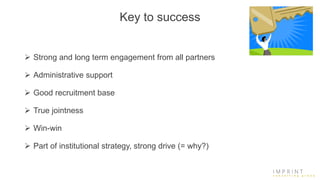
Key to success
 Strong and long term engagement from all partners
 Administrative support
 Good recruitment base
 True jointness
 Win-win
 Part of institutional strategy, strong drive (= why?)
EMJMD – examples
http://ec.europa.eu/programmes/erasmus-plus/projects/
EMJMD – how to apply
 Call: https://eacea.ec.europa.eu/erasmus-plus/funding/key-action-1-
erasmus-mundus-joint-master-degrees-2018_en
 How to apply: https://eacea.ec.europa.eu/erasmus-plus/funding/key-
action-1-erasmus-mundus-joint-master-degrees-2018_en
 E-form and user guide: https://eacea.ec.europa.eu/documents/eforms_en
 Annexes: https://eacea.ec.europa.eu/erasmus-plus/funding/key-action-1-
erasmus-mundus-joint-master-degrees-2018_en
 Distance calculator: http://ec.europa.eu/programmes/erasmus-
plus/resources/distance-calculator_en

Erasmus Mundus Joint Master Degrees

  • 1.
    Erasmus Mundus JointMaster Degrees Sofia, December 2018 Mirko Varano varano@kth.se
  • 2.
    WHAT IS IT? •Consortium of minimum 3 degree awarding HEIs • Minimum 3 Programme Countries involved • 1 Integrated joint programme at Master level • Embedded mobility • Joint or multiple degrees issued • Grants for students and staff • 4 intakes + sustainability measures
  • 3.
  • 4.
    OUTCOMES FOR STUDENTS •improved learning performance; • enhanced employability and improved career prospects; • increased sense of initiative and entrepreneurship; • increased self-empowerment and self-esteem; • improved foreign language competences; • enhanced intercultural awareness; • more active participation in society; • better awareness of the European project and the EU values; • increased motivation for taking part in future (formal/non-formal) education or training after the mobility period • abroad.
  • 5.
    OUTCOMES FOR STAFF •improved competences, linked to their professional profiles • broader understanding of practices, policies and systems in education across countries; • increased capacity to trigger changes in terms of modernisation • greater understanding of interconnections between formal and non-formal education, vocational training and the labour market; • better quality of their work and activities in favour of students; • greater understanding and responsiveness to social, linguistic and cultural diversity; • increased ability to address the needs of the disadvantaged; • increased support for and promotion of mobility activities for learners; • increased opportunities for professional and career development; • improved foreign language competences; • increased motivation and satisfaction in their daily work.
  • 6.
    OUTCOMES FOR INSTITUTIONS •increased capacity to operate at EU/international level (international Strategies, reinforced cooperation with partners from other countries, increased allocation of financial resources) • preparation implementation, monitoring and follow up of EU/international projects; • innovative and improved way of operating towards their target groups (more attractive programmes, improved qualifications of teaching and training staff; improved recognition and validation of competences) • more modern, dynamic, committed and professional environment inside the organisation (integration of good practices and new methods into daily activities; planning strategically the professional development of their staff in relation to individual needs and organisational objectives
  • 7.
    WHY? The main objectiveof the EMJMD programme is to attract, select and fund excellence. AND Foster innovations and excellence in HEIs; Increase the attractiveness of European Higher Education; Improve the competences and skills of Master graduates for the labour market. (Industry must be involved). Contribute to the objectives of Europe 2020 Strategy and of the Education and Training strategic framework 2020.
  • 8.
    EMJMD - Specificconditions  Fully developed at the time of application including a draft Consortium Agreement  Graduated students shall receive a joint or double degree with a joint diploma supplement;  Worldwide visibility & awareness raising activities;  A joint Quality Assurance plan with agreed milestones and follow-up actions  Language courses at the host institution;  Student representatives & student testimonials  Liaison with EM Alumni Association
  • 9.
     60 –90 – 120 ECTS  At least 3 Programme Countries  Studies in at least 2 programme countries  4 consecutive student intakes  15 – 27 student scholarships &  4 scholars per intake (up to 8 weeks)  Application deadline February 2019 12:00 (CET) EMJMD: The hard facts
  • 10.
     Candidates musthold a Bachelor degree and  Enroll full-time in one of the partner HEIs  75% of the grants to partner countries  Virtual mobility doesn’t replace physical mobility EMJMD: The hard facts (cont.)
  • 11.
    • Applicant/coordinator: aHEI established in a Programme Country that submits the project proposal on behalf of all the partners  represents and acts on behalf of the group of participating organisations vis-à-vis the European Commission;  bears the financial and legal responsibility for the proper operational, administrative and financial implementation of the entire project;  coordinates the EMJMD in cooperation with all other project partners. • Partners: degree-awarding HEIs recognised as such by the relevant authorities of the Programme or Partner Country in which they are established and any private or public organisation that contributes actively to the preparation, implementation and evaluation of the EMJMD. • Associated partners (optional): additionally the EMJMD study programme may also benefit from the involvement of associated partners. These organisations contribute indirectly to the implementation of specific tasks/activities and/or support the dissemination and sustainability of the EMJMD. Such contribution may for example take the form of knowledge and skills transfer, the provision of complementary courses or backing possibilities for secondment or placement. For contractual management issues, “associated partners” are not considered as part of the EMJMD consortium because they have a more limited role in the implementation of the EMJMD, as their expertise is called upon on an ad-hoc basis. • Affiliated entities (optional): Organisations which contribute to the achievement of project objectives and activities Consortium
  • 12.
     a highereducation institution (HEI);  a public or private, a small, medium or large enterprise (including social enterprises);  a public body at local, regional or national level;  a non-profit organisation, association, NGO;  a research institute. Possible participants
  • 13.
    • Up to48 additional student scholarships for the entire duration of the Master course (four intakes) • The additional scholarships are offered to respond to the external policy priorities of the EU • The scholarships must be allocated to students coming from the eight different regions mentioned below (the request should be diversified): • Eastern Partnership countries (Region 2); • South-Mediterranean countries (Region 3); • Asia (Region 6) with a specific scholarship allocation to the Least Developed Countries76; • Central Asia (Region 7) with a specific scholarship allocation to the Low or Lower Middle Income Countries77; • Latin America (Region 8) with a specific scholarship allocation to the Lower Middle Income Countries78 and a maximum allocation to Brazil/Mexico; • South Africa (Region 10); • African, Caribbean and Pacific countries (Region 11);and • Gulf Cooperation countries (Region 12). Extra Grants
  • 14.
  • 15.
  • 16.
  • 17.
    Award Criteria 1:Relevance of the project (40/100)  Sustainability beyond the funding period  Relevant competencies for employability  Increasing attractiveness  Innovation & excellence  Jointness in the programme design and structure.
  • 18.
    Award Criteria 2:Quality of the project design (20/100)  Institutional commitment;  Jointly developed curriculum;  Organised mobility scheme and plan for effective involvement of scholars;  Consistent use of European transparency and recognition tools  Student support and language training;  Students’ rights and obligations;  Effective integration and networking.
  • 19.
    Award Criteria 3:Quality of the project team (20/100)  Expertise and added value of involved partners/staff  Role and tasks of each partner  Joint management of student application and selection  Calculation of participation costs and management of other financial resources.
  • 20.
    Award Criteria 4:Impact and dissemination (20/100)  Impact at institutional level and how the JMD supports the internationalisation strategy of partner institutions;  Promotion and dissemination activities;  Internal evaluation methods;  External evaluation process and the role of quality assurance bodies;  Convincing sustainability strategy;  How employers will be involved.
  • 21.
    Award Criteria: minimumrequirements  To be considered for funding, proposals must score at least 70 points out of a total of 100.  Furthermore, they must score at least 75% of the maximum allocated points under the award criterion "Relevance of the project" (i.e. minimum 30 points out of 40).  In case of ex aequo, priority will be given to projects scoring highest under the criterion "Relevance of the project".
  • 22.
    Extra Award Criteriafor extra grants
  • 23.
  • 24.
    • Documents toread:  Erasmus+ programme guide  Joint Programmes from A-Z EMJMD: Get ready! Institutional involvement:  In line with institutional strategy at all levels  Support from the administration  Contact close partners  Staff your team  Contact stakeholders – think employability and sustainability
  • 25.
    Key to success Strong and long term engagement from all partners  Administrative support  Good recruitment base  True jointness  Win-win  Part of institutional strategy, strong drive (= why?)
  • 26.
  • 27.
    EMJMD – howto apply  Call: https://eacea.ec.europa.eu/erasmus-plus/funding/key-action-1- erasmus-mundus-joint-master-degrees-2018_en  How to apply: https://eacea.ec.europa.eu/erasmus-plus/funding/key- action-1-erasmus-mundus-joint-master-degrees-2018_en  E-form and user guide: https://eacea.ec.europa.eu/documents/eforms_en  Annexes: https://eacea.ec.europa.eu/erasmus-plus/funding/key-action-1- erasmus-mundus-joint-master-degrees-2018_en  Distance calculator: http://ec.europa.eu/programmes/erasmus- plus/resources/distance-calculator_en