Course management, visibility,
 sustainability and promotion

        Dominika Csizmadia
         TEMA Consortium
European Territories
(Civilisation, Nation, Region and City):
       Identity and Development
TEMA Consortium (I)
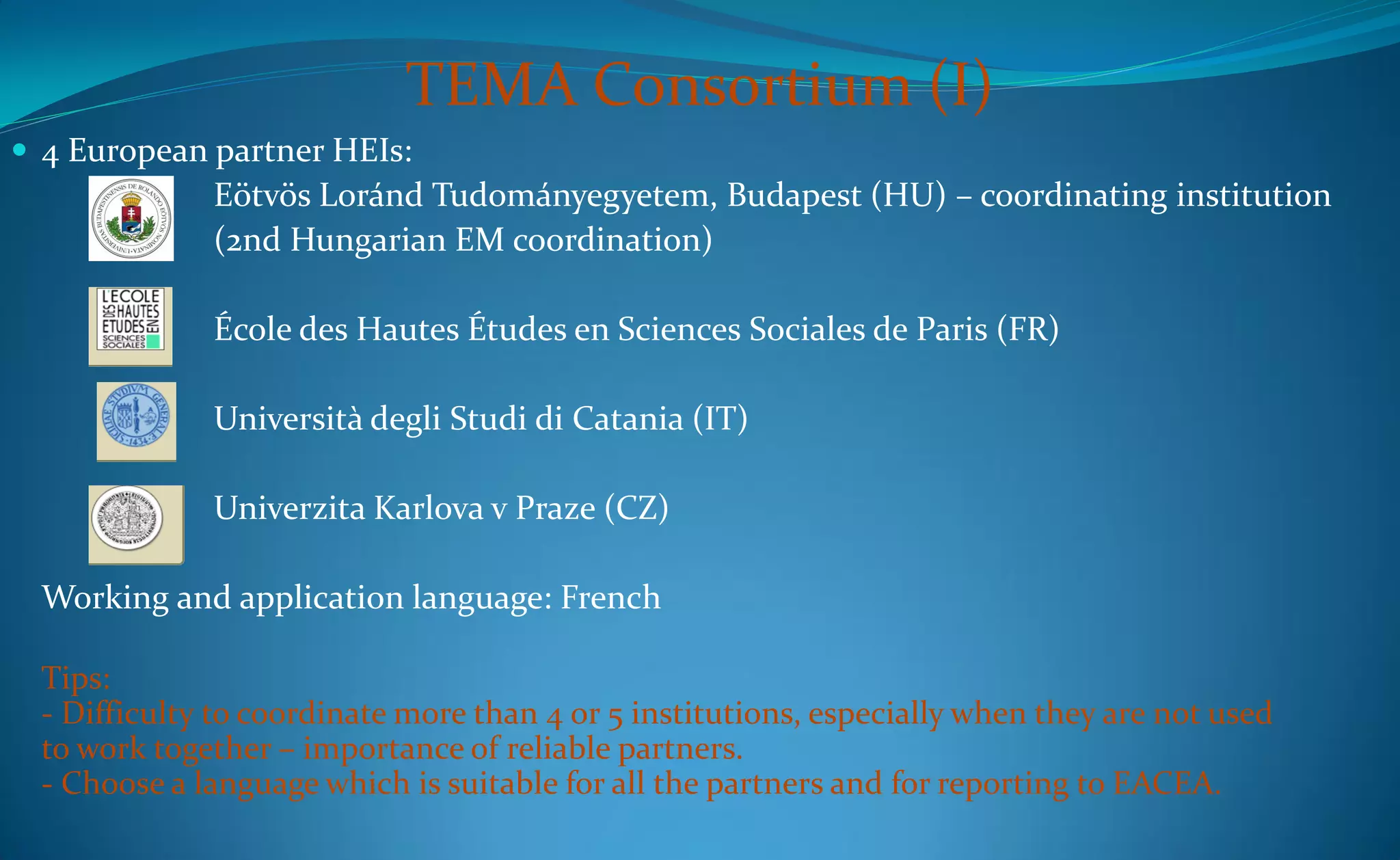
 4 European partner HEIs:
              Eötvös Loránd Tudományegyetem, Budapest (HU) – coordinating institution
              (2nd Hungarian EM coordination)

              École des Hautes Études en Sciences Sociales de Paris (FR)

              Università degli Studi di Catania (IT)

              Univerzita Karlova v Praze (CZ)

  Working and application language: French

  Tips:
  - Difficulty to coordinate more than 4 or 5 institutions, especially when they are not used
  to work together – importance of reliable partners.
  - Choose a language which is suitable for all the partners and for reporting to EACEA.
TEMA Consortium (II)
 14  associated members: HEIs, administrative and professional
 organisms, such as ministries, embassies, city halls, research
 institutions, offices of architecture etc.
 Objective: to increase their number every year.

 Tip: they can be involved in promotion campaign and sustainability plan.


 No 3C consortium partners, but 8 3C HEIs expressed their interest to
 cooperate with the TEMA EMMC

 Tip: if you do not have 3C HEIs in your consortium, get them sign a Declaration of
 intent. It is an asset for your application and they can be involved in promotion
 campaign.
TEMA Consortium (III)
                                                 MODEL
                                           DECLARATION OF INTENT
                                  For the TEMA Erasmus Mundus Master Course

As the ………… of the University of ……… I want to express my interest and support for the Erasmus Mundus Joint
Master Course entitled TEMA – European Territories: Identity and Development.
I am convinced that the joint, multidisciplinary Master Programme in the field of urban and regional development
studies does not only play an important role in the development of the common European curriculum, but it is also
most valuable for non-European students, who would be provided with an in-depth understanding of European
cohesion policy and regional development. Master TEMA is a unique opportunity to understand identity through the
social scientific analysis of territory.
Hereby, I confirm that the ……………… (University, Faculty, Department etc.) is very much interested in this Master
Programme, which meets perfectly our high standards and helps training experts of urban development and
administration in the European and non European countries. We would be glad to send our students and scholars to
the Consortium’s institutions and, setting up a structured co-operation with them, to receive European students and
scholars in our University.
Sincerely,
…………………..
History of TEMA (I)
Cooperation that led to the EM application – best practice for consortium cooperation

1. Long term relationship between the partner HEIs
 based on ELTE – EHESS 2 decades cooperation in research and teaching at MA and
   doctoral level
 Catania – EHESS’s partner
 Prague – Czech and Hungarian collegues worked together in different research projects
   in Urban History

2. Next step towards reinforcing this cooperation: Erasmus bilateral agreements between
  all four partners
  Problem: no double or joint degree, only mutual recognition of the student’s mobility
  period, translated into ECTS
History of TEMA (II)
3. 2005 – 2008: Socrates/Erasmus curriculum development project with the
  participation of the 4 partners + Universities from Cluj, Sofia & Salamanca
 consortium agreement signed by 6 HEI (Salamanca quit)
 EMMC offered by 4 HEIs (Sofia quit, Cluj takes part as an AM)

4. TEMA as an EMMC
 first EM application in 2009 – rejected
 EMAP training in Larnaka in February 2010 – „never give up”
 second EM application in 2010 – selected

5. TEMA EMMC is not the final stage of our cooperation.
   Next step: TEMA EMJD?

Tip: a prospective EMJD is an element of the development & sustainability plan
TEMA Master Course (I)
1. An interdisciplinary, research based Master Course in applied humanities within
   the international context of Social Sciences, that proposes the analysis of political
   use and scientific representation of territorial units (civilisation, nation, region,
   city)
2. Open to students with a BA/BSc in History, Geography, Anthropology,
   Ethnography, Cultural studies, Urban Studies, Architecture, Nationalism Studies,
   Law, Economy, Administration
3. Course content (double objective of homogeneity and complementarity):
 core syllabus organised in four major modules (civilisation, region, nation, city)
   taught in all partner HEIs
 specialised seminars : highlight the specificity of each partner
 intensive week in September focusing on a specific subject of TEMA
 internship in semester 2 or 3 – placement at associated members
 master’s thesis or internship report (in Catania’ s case) in semester 4
TEMA Master Course (II)
4. Language policy:
 tuition languages: English and French, a good command of both is required for
   application to the TEMA EMMC (one language certificate is required)
 compulsory language & civilisation courses in semester 3, optional ones in all semesters

5. Mobility scheme: compulsory mobility in semester 3 and optional one in semester 2
  and/or 4 – students choose the hosting institution for their mobility period
6. Degree:
 students receive double or multiple degrees (depending on their mobility scheme)
 accreditation process for joint degree – legally possible for each partner HEI

Tips:
- Joint degree can enhance the attractiveness of TEMA, as part of the development &
sustainability plan.
- In your application, state clearly the procedures towards the joint degree and give detailed
information about relevant legislation in each consortium country.
A. 3. – Course management, visibility
                   and sustainabilty measures
                         (20 % of the max. score)
This part focuses on

 Cooperation mechanisms within the consortium (A. 3. 1.)
 Partner HEIs’ financial contribution & financial management (A. 3. 2.)
 Development & sustainability plan designed to ensure the proper
  implementation and continuity of the EMMC beyond the period of
  Community funding (A. 3. 3.)
 Course promotion measures to increase the EMMC’s visibility and attractiveness
  (A. 3. 4.)
A. 3. 1. Cooperation mechanisms within the
                 consortium (I)
 Cooperation mechanisms established during the Curriculum Development project.
  Terms & conditions of the cooperation defined in the 2008 Consortium agreement.
 Adaptation of the existing Agreement to the administrative and financial
  provisions specific to the management of an EMMC.
 Amendment based on a separate document agreed by all partners (organisational
  aspects, definition of the partners’ role, agenda with key dates for the academic
  year etc.).
Tips:
- If your consortium has not signed an Agreement yet, you might need a document agreed by all
partners already at the stage of application:
a. partners must know what exactly they are embarking on,
b. you have to prove that your Master Course is ready to start and is just waiting for the students
and the EU funding.
- Do not annex this document to your application without clearly describing the cooperation
mechanisms in A. 3. 1. – it might be considered as a way of breaking the 20 pages rule!
A. 3. 1. Cooperation mechanisms within the
                   consortium (II)
                      Management unit (4 bodies)

1. Management Committee
 principal board of the consortium
 composed of the TEMA scientific managers, the TEMA Secretariat and the legal
    and financial representatives of each partner
 responsible for the entire program of the TEMA European Master Course,
    including educational, financial and administrative levels of operation
 sets up priorities and strategic orientations for running, promoting and
    improving the TEMA Master Course
A. 3. 1. Cooperation mechanisms within the
                   consortium (III)
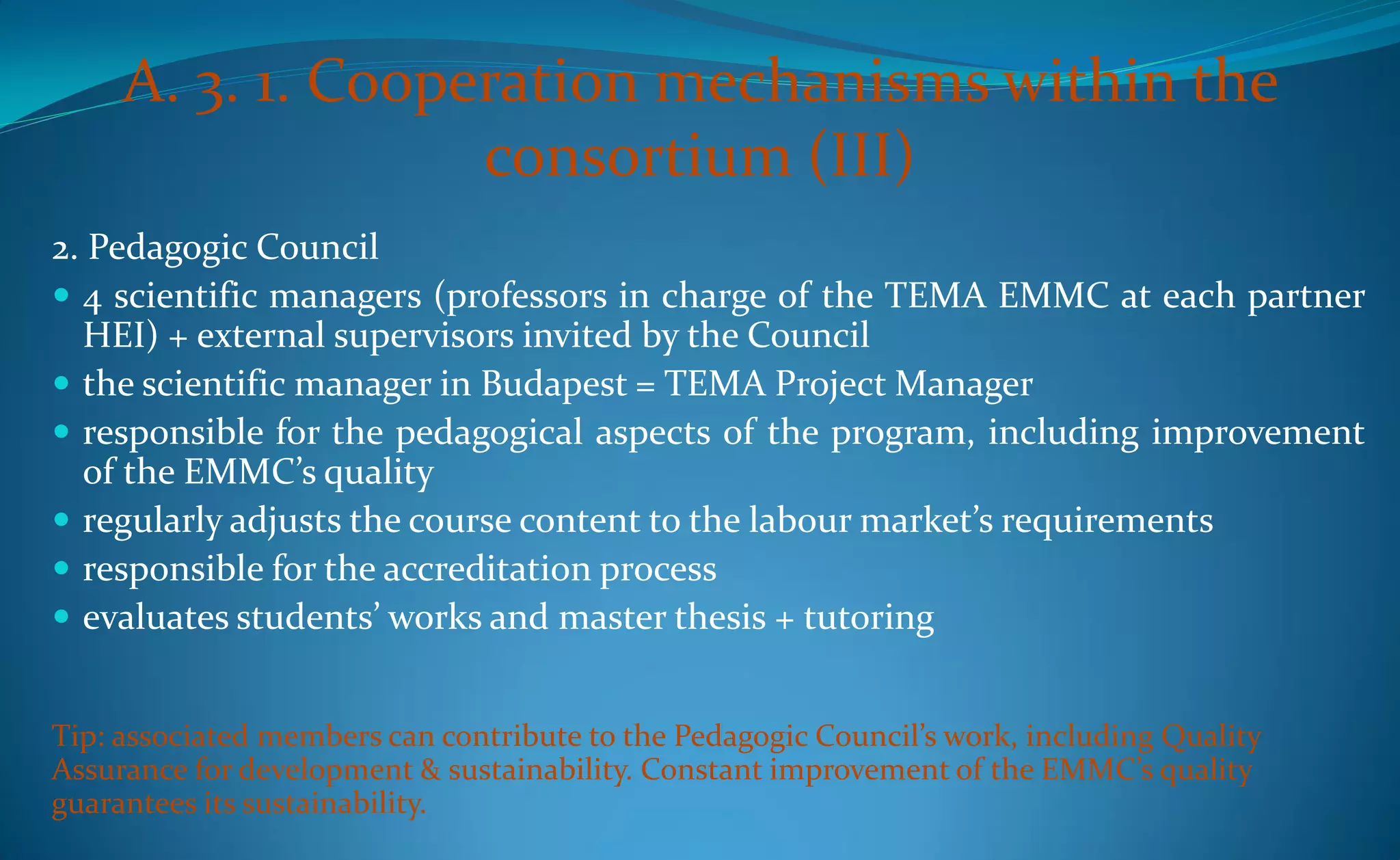
2. Pedagogic Council
 4 scientific managers (professors in charge of the TEMA EMMC at each partner
  HEI) + external supervisors invited by the Council
 the scientific manager in Budapest = TEMA Project Manager
 responsible for the pedagogical aspects of the program, including improvement
  of the EMMC’s quality
 regularly adjusts the course content to the labour market’s requirements
 responsible for the accreditation process
 evaluates students’ works and master thesis + tutoring


Tip: associated members can contribute to the Pedagogic Council’s work, including Quality
Assurance for development & sustainability. Constant improvement of the EMMC’s quality
guarantees its sustainability.
A. 3. 1. Cooperation mechanisms within the
                consortium (IV)
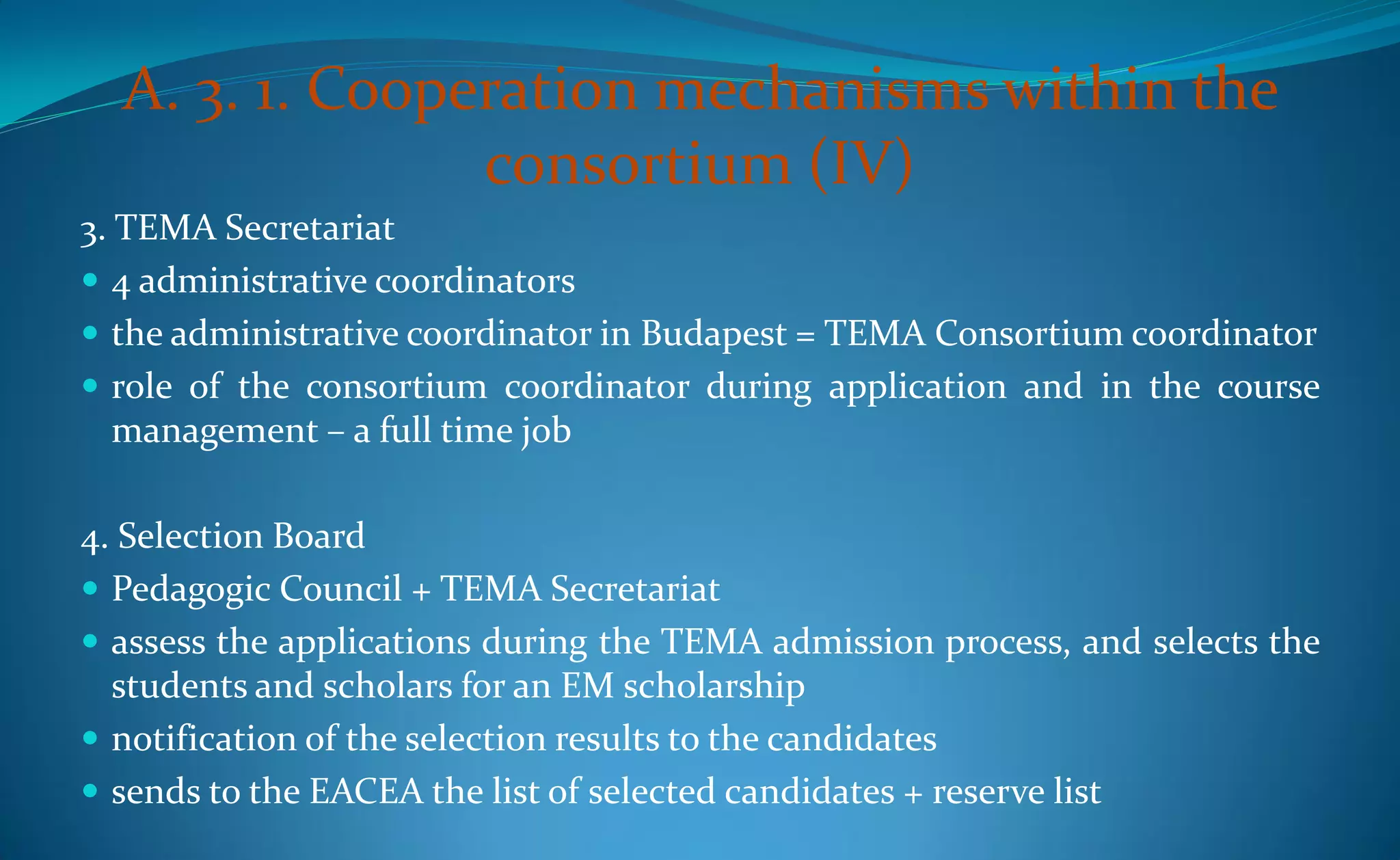
3. TEMA Secretariat
 4 administrative coordinators
 the administrative coordinator in Budapest = TEMA Consortium coordinator
 role of the consortium coordinator during application and in the course
   management – a full time job

4. Selection Board
 Pedagogic Council + TEMA Secretariat
 assess the applications during the TEMA admission process, and selects the
  students and scholars for an EM scholarship
 notification of the selection results to the candidates
 sends to the EACEA the list of selected candidates + reserve list
A. 3. 1. Cooperation mechanisms within the
                   consortium (V)
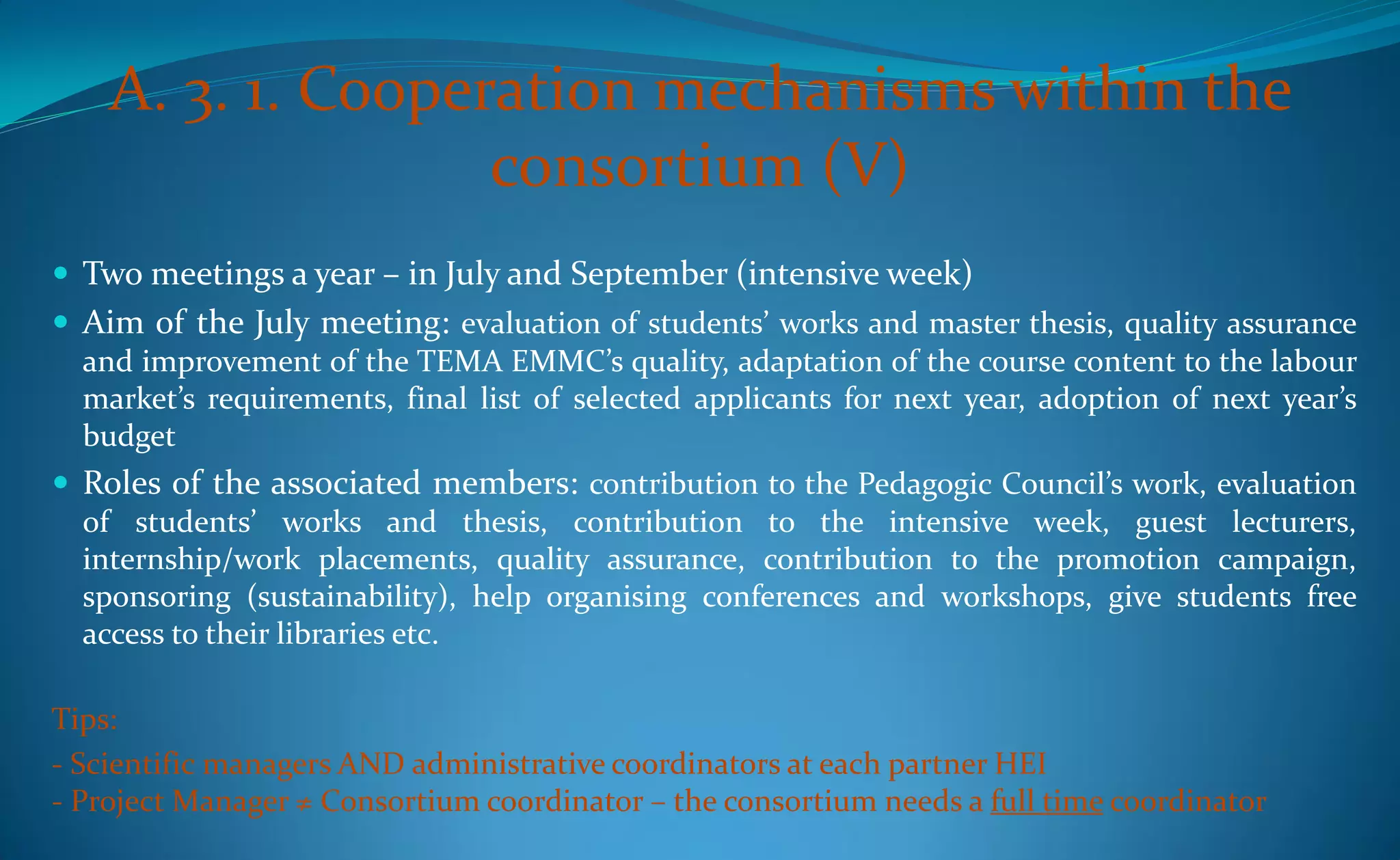
 Two meetings a year – in July and September (intensive week)
 Aim of the July meeting: evaluation of students’ works and master thesis, quality assurance
  and improvement of the TEMA EMMC’s quality, adaptation of the course content to the labour
  market’s requirements, final list of selected applicants for next year, adoption of next year’s
  budget
 Roles of the associated members: contribution to the Pedagogic Council’s work, evaluation
  of students’ works and thesis, contribution to the intensive week, guest lecturers,
  internship/work placements, quality assurance, contribution to the promotion campaign,
  sponsoring (sustainability), help organising conferences and workshops, give students free
  access to their libraries etc.

Tips:
- Scientific managers AND administrative coordinators at each partner HEI
- Project Manager ≠ Consortium coordinator – the consortium needs a full time coordinator
A. 3. 2. Partner HEIs’ financial contribution &
                financial management (I)
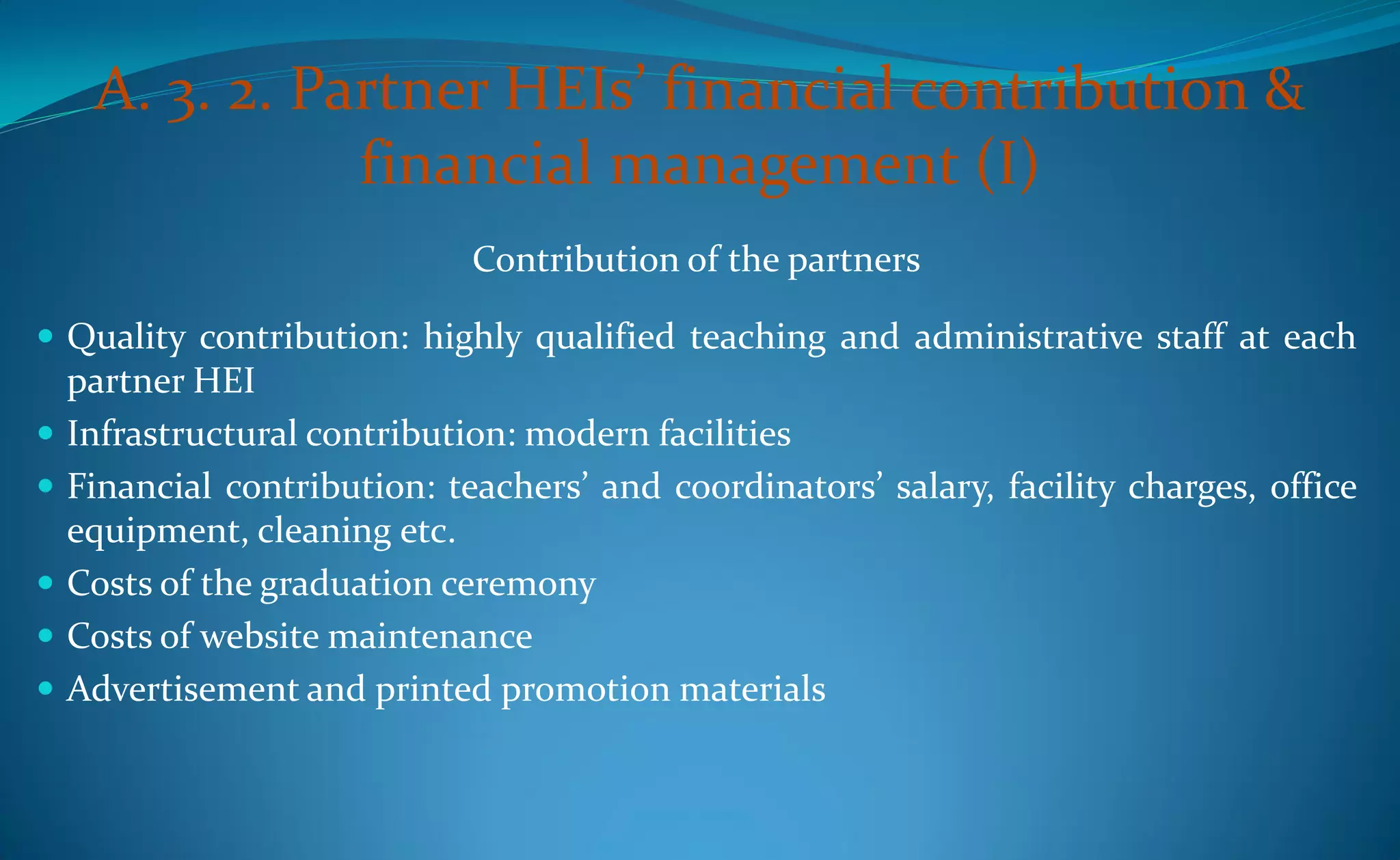
                              Contribution of the partners

 Quality contribution: highly qualified teaching and administrative staff at each
    partner HEI
   Infrastructural contribution: modern facilities
   Financial contribution: teachers’ and coordinators’ salary, facility charges, office
    equipment, cleaning etc.
   Costs of the graduation ceremony
   Costs of website maintenance
   Advertisement and printed promotion materials
A. 3. 2. Partner HEIs’ financial contribution &
           financial management (II)
           Role of the coordinating institution in the financial management

 ELTE is in charge with the financial management of the TEMA EMMC
 Not only because it is the coordinating institution, but also for scholarship taxation
  reasons (in the time of our first application, disparity of taxation in the consortium
  countries. Today EM scholarships are not taxed anymore, but we kept this
  structure)
 The annual budget is adopted by each partner once we have the total number of
  enrolled students
 The 30.000 € flat-rate, the EM student scholarships and the tuition fees are paid on
  ELTE’s bank account and distributed to the students and among the partners by
  ELTE.

Tip: check relevant taxation laws in each partner country to avoid disparity of scholarships.
A. 3. 2. Partner HEIs’ financial contribution &
           financial management (III)
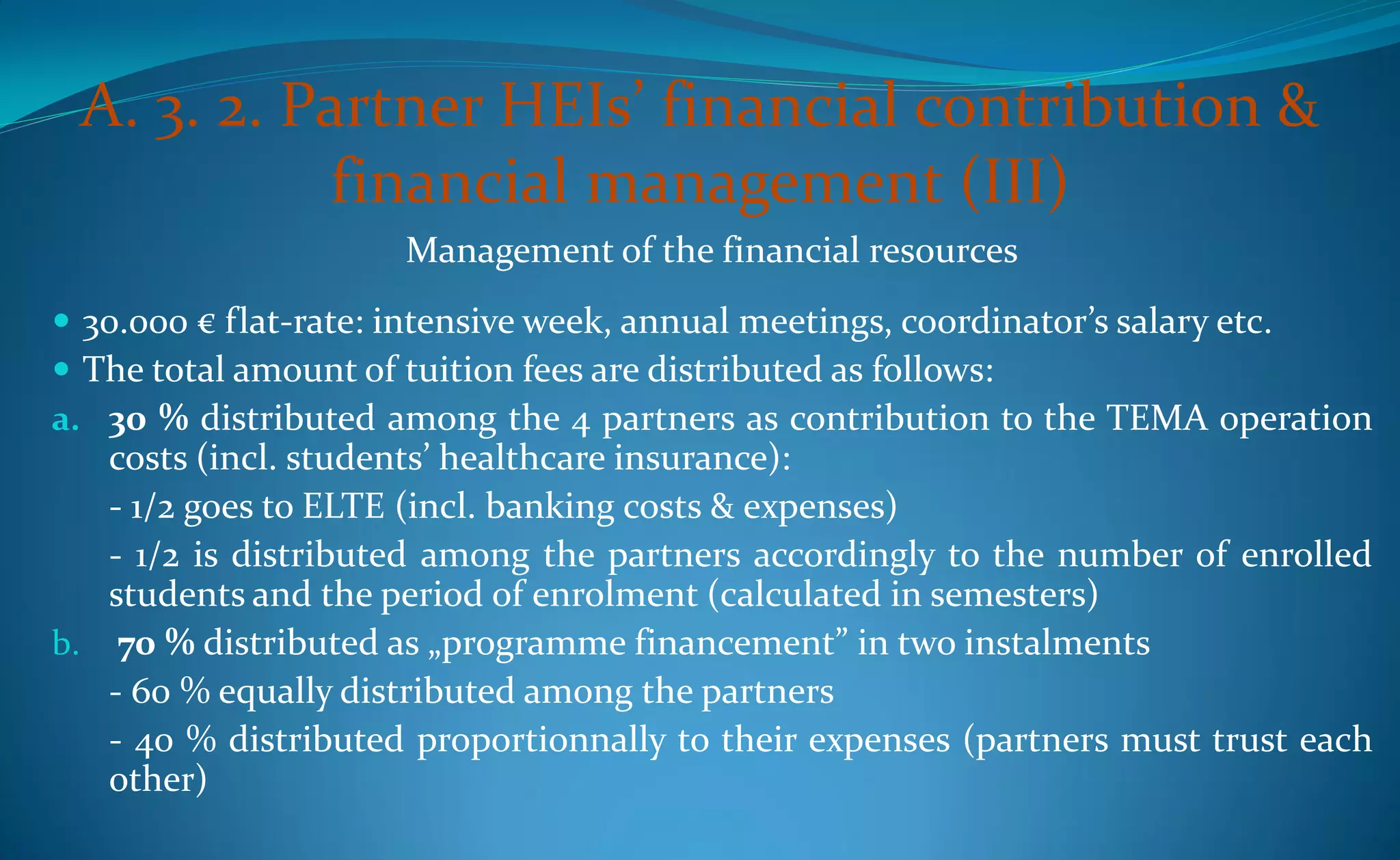
                     Management of the financial resources
 30.000 € flat-rate: intensive week, annual meetings, coordinator’s salary etc.
 The total amount of tuition fees are distributed as follows:
a. 30 % distributed among the 4 partners as contribution to the TEMA operation
   costs (incl. students’ healthcare insurance):
   - 1/2 goes to ELTE (incl. banking costs & expenses)
   - 1/2 is distributed among the partners accordingly to the number of enrolled
   students and the period of enrolment (calculated in semesters)
b. 70 % distributed as „programme financement” in two instalments
   - 60 % equally distributed among the partners
   - 40 % distributed proportionnally to their expenses (partners must trust each
   other)
A. 3. 2. Partner HEIs’ financial contribution &
             financial management (IV)
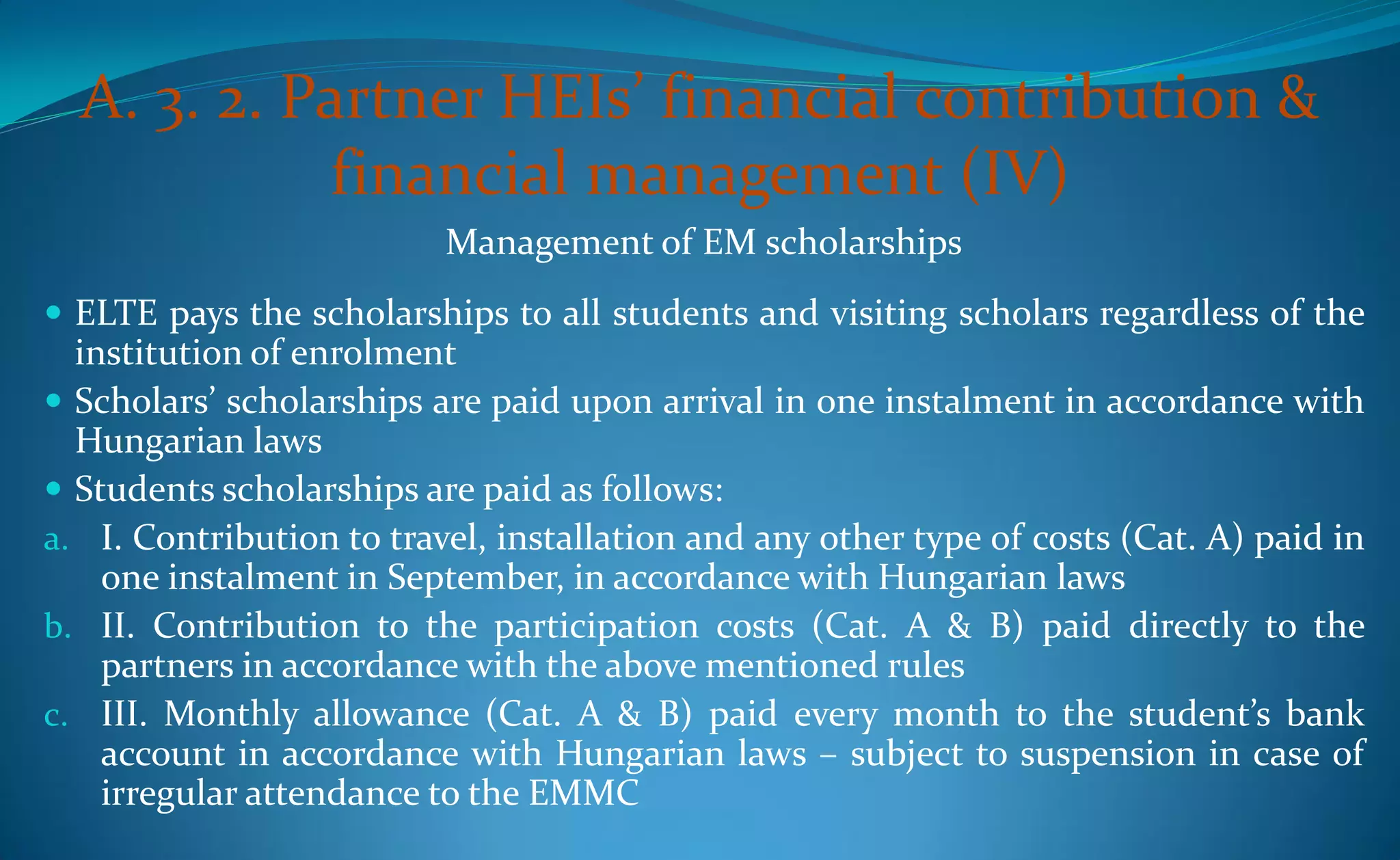
                          Management of EM scholarships
 ELTE pays the scholarships to all students and visiting scholars regardless of the
  institution of enrolment
 Scholars’ scholarships are paid upon arrival in one instalment in accordance with
  Hungarian laws
 Students scholarships are paid as follows:
a. I. Contribution to travel, installation and any other type of costs (Cat. A) paid in
    one instalment in September, in accordance with Hungarian laws
b. II. Contribution to the participation costs (Cat. A & B) paid directly to the
    partners in accordance with the above mentioned rules
c. III. Monthly allowance (Cat. A & B) paid every month to the student’s bank
    account in accordance with Hungarian laws – subject to suspension in case of
    irregular attendance to the EMMC
A. 3. 2. Partner HEIs’ financial contribution &
           financial management (V)
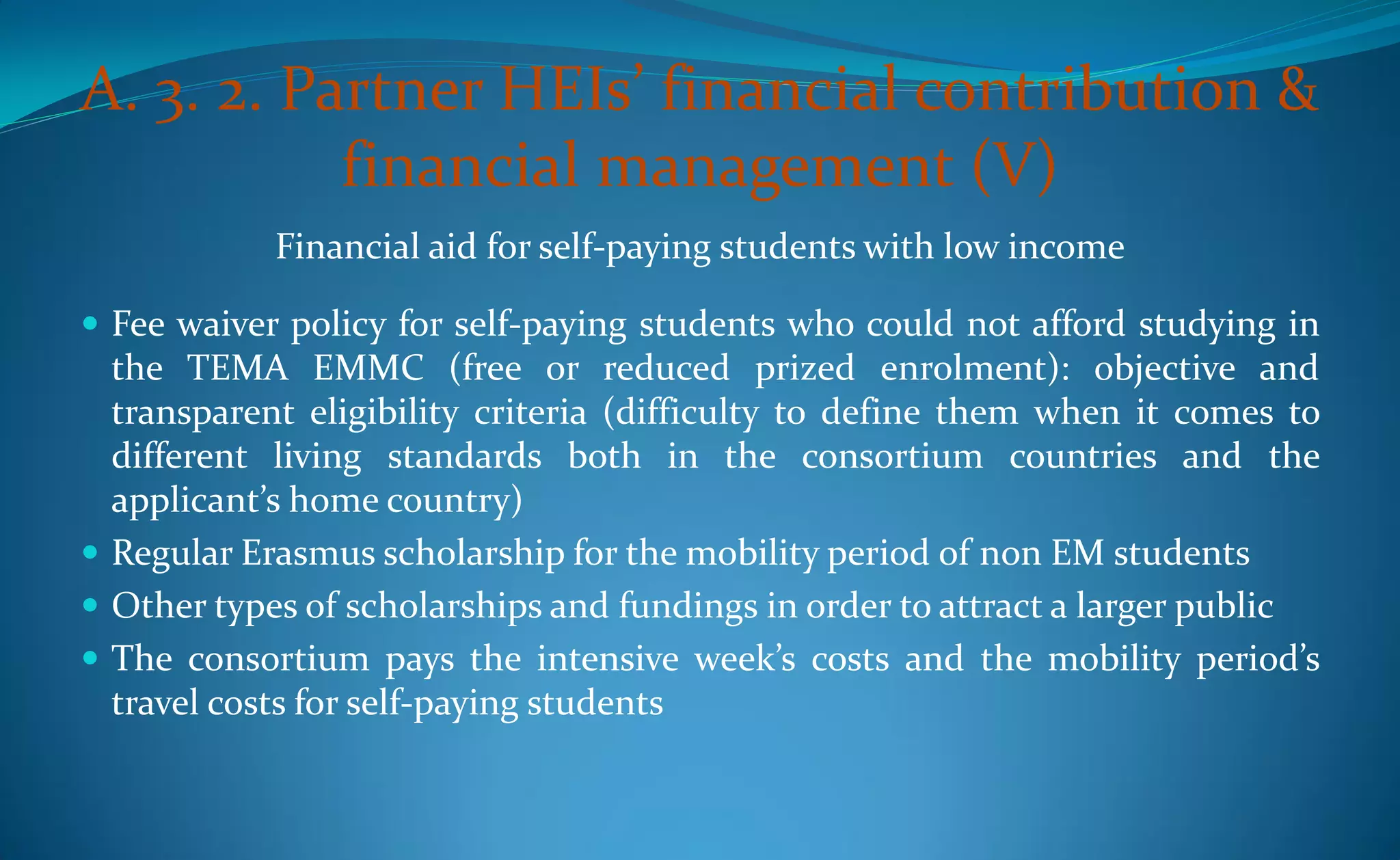
            Financial aid for self-paying students with low income

 Fee waiver policy for self-paying students who could not afford studying in
  the TEMA EMMC (free or reduced prized enrolment): objective and
  transparent eligibility criteria (difficulty to define them when it comes to
  different living standards both in the consortium countries and the
  applicant’s home country)
 Regular Erasmus scholarship for the mobility period of non EM students
 Other types of scholarships and fundings in order to attract a larger public
 The consortium pays the intensive week’s costs and the mobility period’s
  travel costs for self-paying students
A. 3. 3. Development & sustainability plan (I)
    1. 3 types of actors involved in the development & sustainability plan
             – what benefit for them in the mid- and long run?

 Students – attractiveness of the EMMC & career perspectives


 Partner institutions – extension of their existing partnerships and networks,
 new forms of cooperation, joint doctoral programmes based on the EMMC

 Professional sectors, including (current and prospective) associated
 members – possibility to employ highly qualified and bi-/multilingual
 people whose training was adapted to the professional sectors’ requirements
A. 3. 3. Development & sustainability plan (II)
              2. Concrete measures for enhancing attractiveness
 Extension to the EMMC to an EMJD: continuation of the EMMC in the
  academic sector
 Highly valuable degree & career opportunities in the professional sector
 Funding opportunities other than EM both for students and the consortium
  – looking for new partners
 Fee Waiver Policy


Tips:
- During the promotion campaign provide students not requesting an EM scholarship
with a list of funding opportunities (other than EM).
- Inform in the selection notification letter applicants who are not selected to an EM
scholarship but admitted to your EMMC about other funding opportunities.
- Inform potential sponsors about your EMMC (i. e. Embassies offering government
scholarships, private funds etc.).
A. 3. 3. Development & sustainability plan (III)
   3.     Objectives and expected results based on 3 sustainablity indicators
                            (presented in a table)

 Implementation costs of the EMMC

 Number of students

 Number of scholarships other than EM


Tips:
- In your application, avoid description in general terms and present concrete steps and
measures to safeguard the development and the viability of the project in the long run.
- Present a table with objectives, expected results and figures – excellent example of best
practice.
- Provide a short but clear explanation to the table.
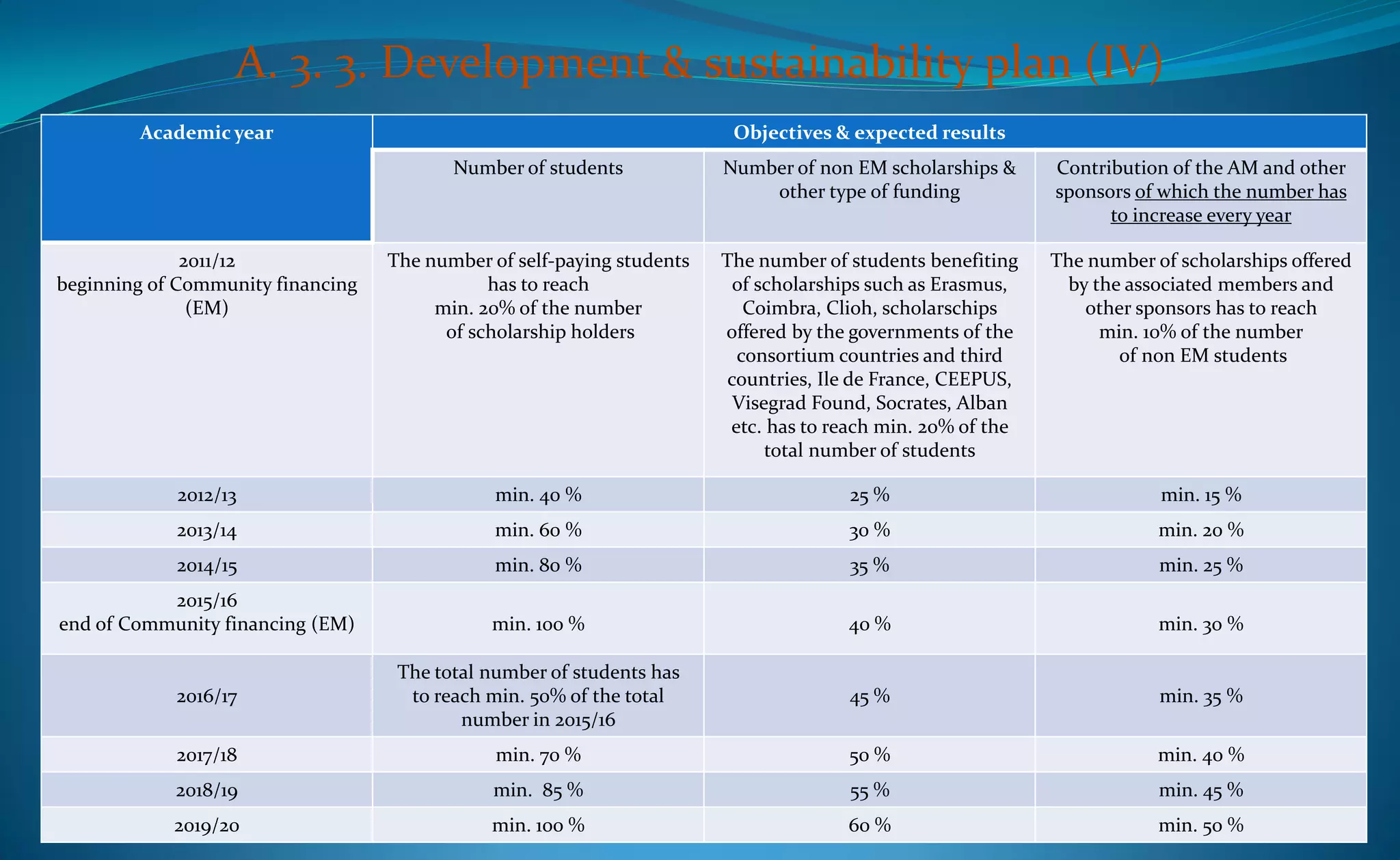
A. 3. 3. Development & sustainability plan (IV)
        Academic year                                                    Objectives & expected results
                                          Number of students            Number of non EM scholarships &      Contribution of the AM and other
                                                                            other type of funding            sponsors of which the number has
                                                                                                                   to increase every year

              2011/12              The number of self-paying students   The number of students benefiting    The number of scholarships offered
beginning of Community financing              has to reach                of scholarships such as Erasmus,     by the associated members and
               (EM)                     min. 20% of the number             Coimbra, Clioh, scholarschips         other sponsors has to reach
                                         of scholarship holders         offered by the governments of the          min. 10% of the number
                                                                          consortium countries and third             of non EM students
                                                                         countries, Ile de France, CEEPUS,
                                                                          Visegrad Found, Socrates, Alban
                                                                         etc. has to reach min. 20% of the
                                                                              total number of students

            2012/13                            min. 40 %                              25 %                               min. 15 %
            2013/14                            min. 60 %                              30 %                               min. 20 %
            2014/15                            min. 80 %                              35 %                               min. 25 %
           2015/16
end of Community financing (EM)               min. 100 %                              40 %                               min. 30 %

                                    The total number of students has
            2016/17                  to reach min. 50% of the total                   45 %                               min. 35 %
                                           number in 2015/16
            2017/18                            min. 70 %                              50 %                               min. 40 %
            2018/19                           min. 85 %                               55 %                               min. 45 %
            2019/20                           min. 100 %                              60 %                               min. 50 %
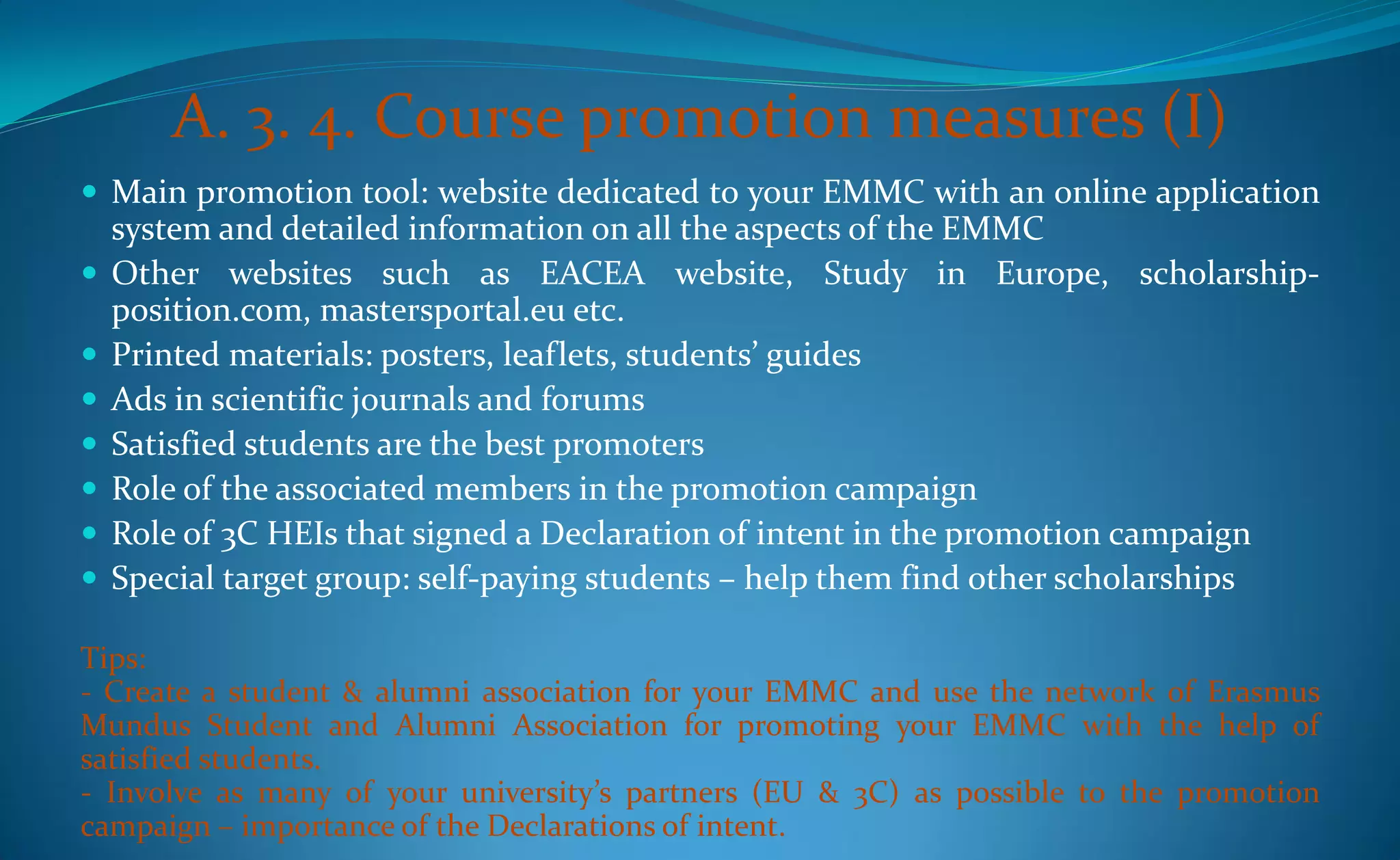
A. 3. 4. Course promotion measures (I)
 Main promotion tool: website dedicated to your EMMC with an online application
    system and detailed information on all the aspects of the EMMC
   Other websites such as EACEA website, Study in Europe, scholarship-
    position.com, mastersportal.eu etc.
   Printed materials: posters, leaflets, students’ guides
   Ads in scientific journals and forums
   Satisfied students are the best promoters
   Role of the associated members in the promotion campaign
   Role of 3C HEIs that signed a Declaration of intent in the promotion campaign
   Special target group: self-paying students – help them find other scholarships

Tips:
- Create a student & alumni association for your EMMC and use the network of Erasmus
Mundus Student and Alumni Association for promoting your EMMC with the help of
satisfied students.
- Involve as many of your university’s partners (EU & 3C) as possible to the promotion
campaign – importance of the Declarations of intent.
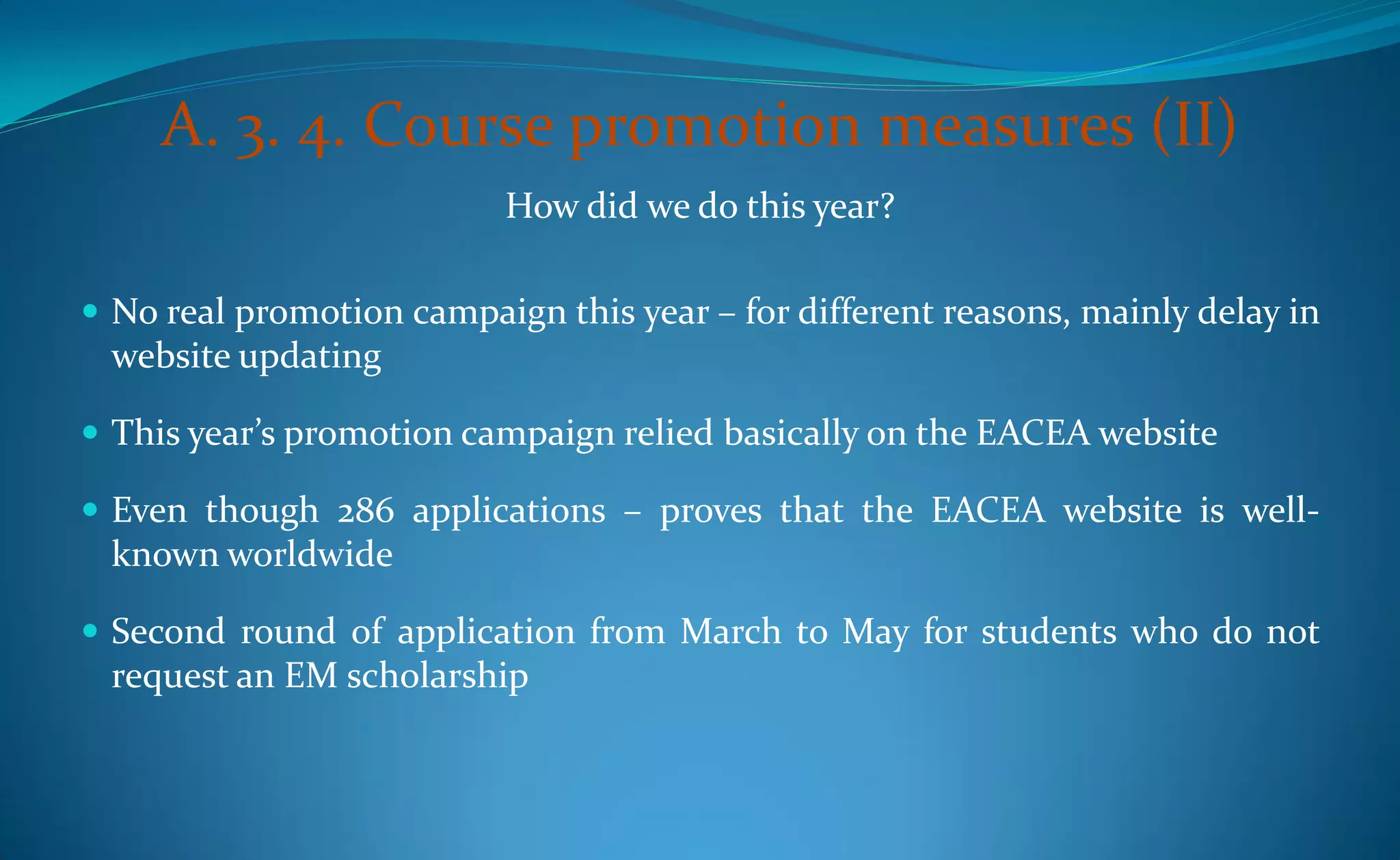
A. 3. 4. Course promotion measures (II)
                           How did we do this year?

 No real promotion campaign this year – for different reasons, mainly delay in
 website updating

 This year’s promotion campaign relied basically on the EACEA website

 Even though 286 applications – proves that the EACEA website is well-
 known worldwide

 Second round of application from March to May for students who do not
 request an EM scholarship
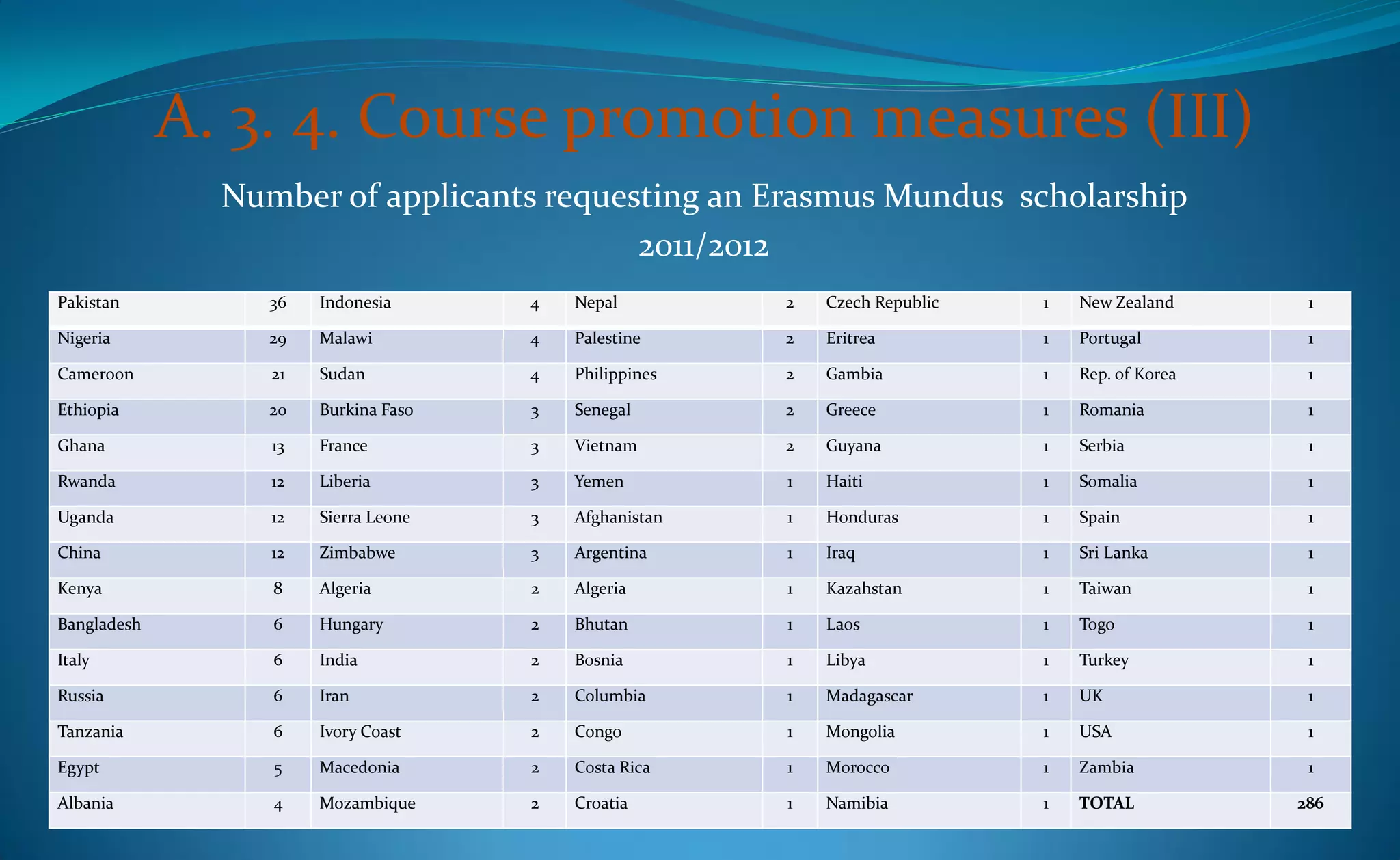
A. 3. 4. Course promotion measures (III)
               Number of applicants requesting an Erasmus Mundus scholarship
                                          2011/2012
Pakistan          36   Indonesia      4   Nepal         2   Czech Republic   1   New Zealand      1

Nigeria           29   Malawi         4   Palestine     2   Eritrea          1   Portugal         1

Cameroon          21   Sudan          4   Philippines   2   Gambia           1   Rep. of Korea    1

Ethiopia          20   Burkina Faso   3   Senegal       2   Greece           1   Romania          1

Ghana             13   France         3   Vietnam       2   Guyana           1   Serbia           1

Rwanda            12   Liberia        3   Yemen         1   Haiti            1   Somalia          1

Uganda            12   Sierra Leone   3   Afghanistan   1   Honduras         1   Spain            1

China             12   Zimbabwe       3   Argentina     1   Iraq             1   Sri Lanka        1

Kenya             8    Algeria        2   Algeria       1   Kazahstan        1   Taiwan           1

Bangladesh        6    Hungary        2   Bhutan        1   Laos             1   Togo             1

Italy             6    India          2   Bosnia        1   Libya            1   Turkey           1

Russia            6    Iran           2   Columbia      1   Madagascar       1   UK               1

Tanzania          6    Ivory Coast    2   Congo         1   Mongolia         1   USA              1

Egypt             5    Macedonia      2   Costa Rica    1   Morocco          1   Zambia           1

Albania           4    Mozambique     2   Croatia       1   Namibia          1   TOTAL           286
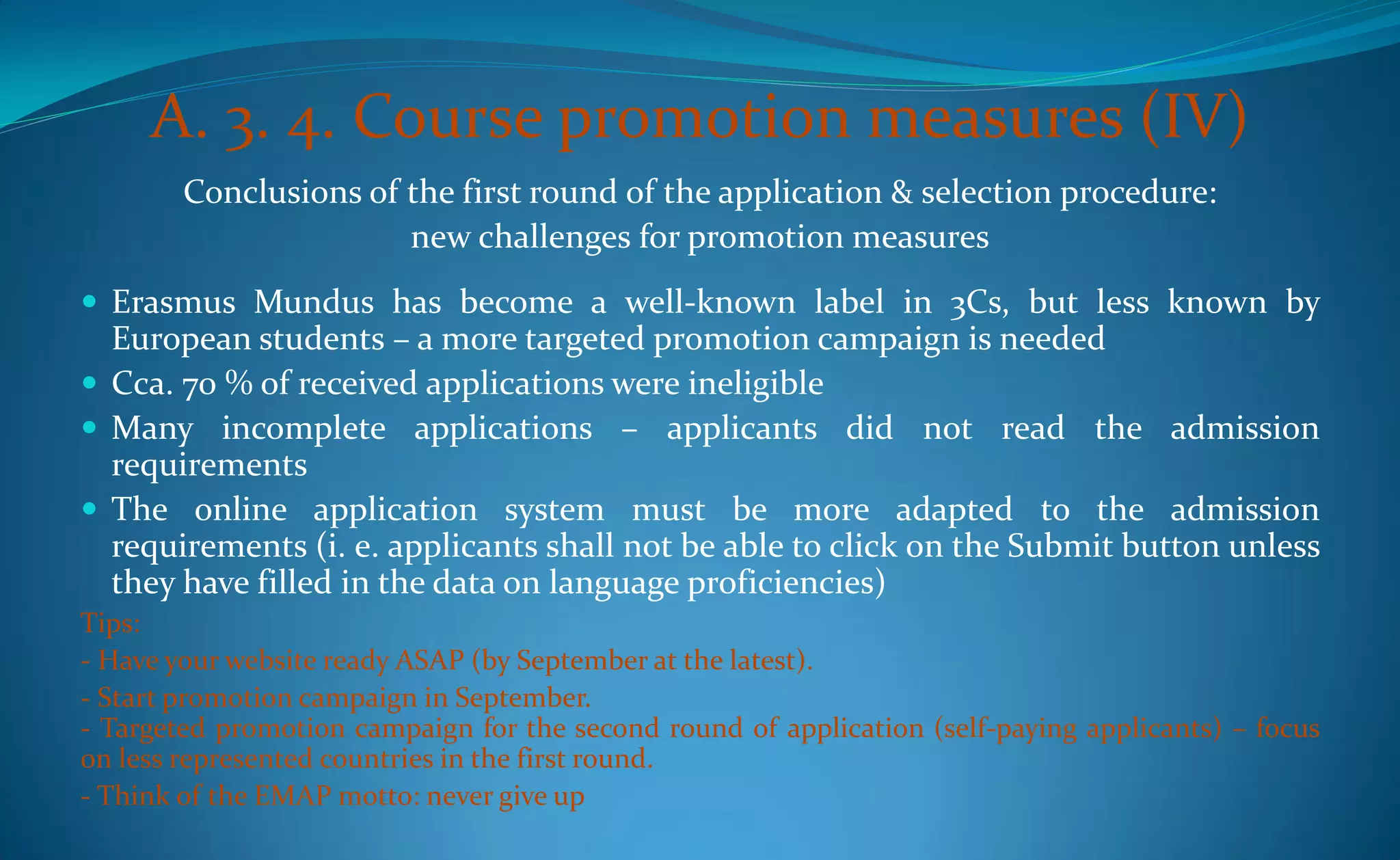
A. 3. 4. Course promotion measures (IV)
        Conclusions of the first round of the application & selection procedure:
                       new challenges for promotion measures
 Erasmus Mundus has become a well-known label in 3Cs, but less known by
  European students – a more targeted promotion campaign is needed
 Cca. 70 % of received applications were ineligible
 Many incomplete applications – applicants did not read the admission
  requirements
 The online application system must be more adapted to the admission
  requirements (i. e. applicants shall not be able to click on the Submit button unless
  they have filled in the data on language proficiencies)
Tips:
- Have your website ready ASAP (by September at the latest).
- Start promotion campaign in September.
- Targeted promotion campaign for the second round of application (self-paying applicants) – focus
on less represented countries in the first round.
- Think of the EMAP motto: never give up
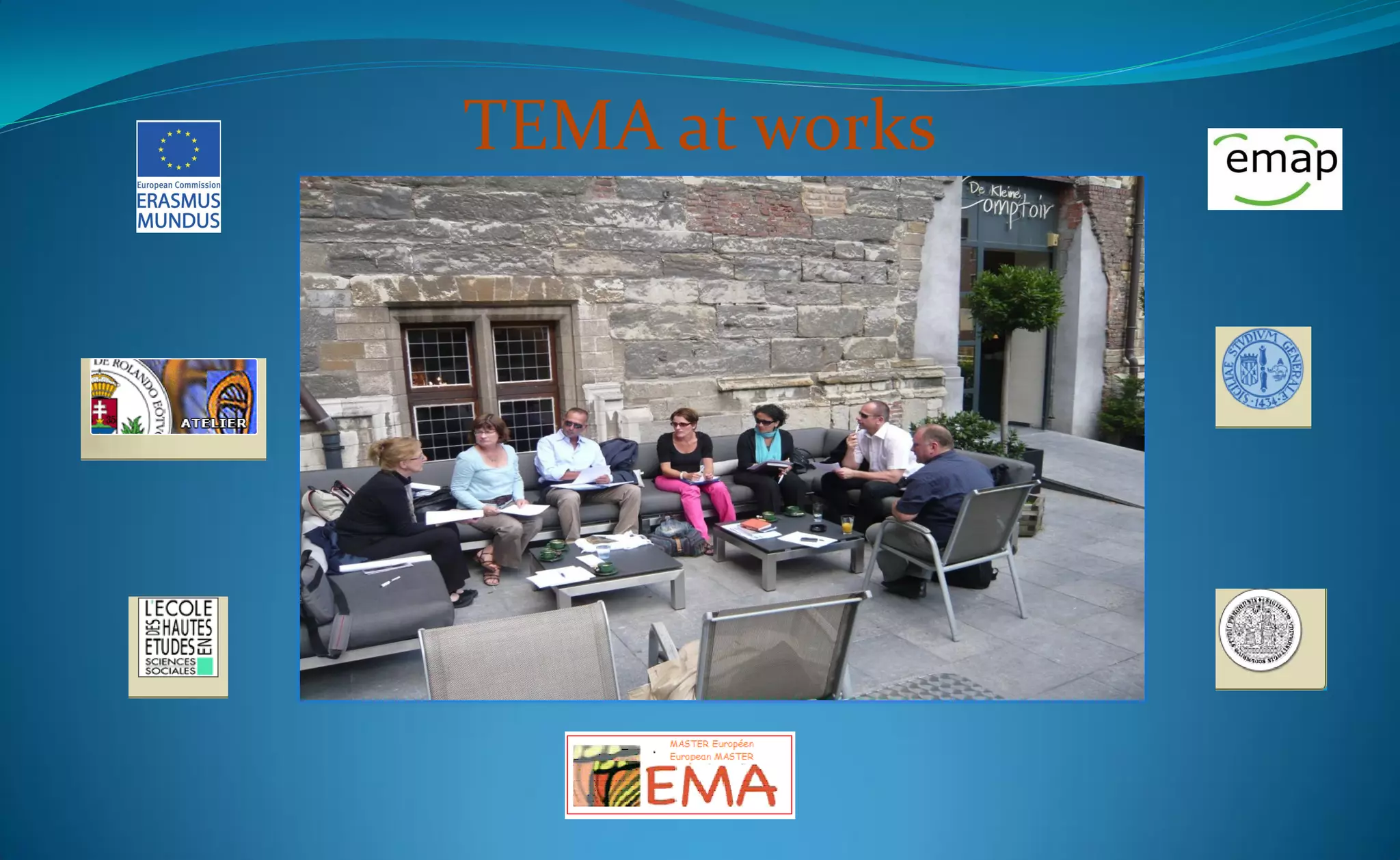
TEMA at works
Good luck !

www.mastertema.eu

EMMC: Course management, visibility, sustainability and promotion

  • 1.
    Course management, visibility, sustainability and promotion Dominika Csizmadia TEMA Consortium
  • 2.
    European Territories (Civilisation, Nation,Region and City): Identity and Development
  • 3.
    TEMA Consortium (I) 4 European partner HEIs: Eötvös Loránd Tudományegyetem, Budapest (HU) – coordinating institution (2nd Hungarian EM coordination) École des Hautes Études en Sciences Sociales de Paris (FR) Università degli Studi di Catania (IT) Univerzita Karlova v Praze (CZ) Working and application language: French Tips: - Difficulty to coordinate more than 4 or 5 institutions, especially when they are not used to work together – importance of reliable partners. - Choose a language which is suitable for all the partners and for reporting to EACEA.
  • 4.
    TEMA Consortium (II) 14 associated members: HEIs, administrative and professional organisms, such as ministries, embassies, city halls, research institutions, offices of architecture etc. Objective: to increase their number every year. Tip: they can be involved in promotion campaign and sustainability plan.  No 3C consortium partners, but 8 3C HEIs expressed their interest to cooperate with the TEMA EMMC Tip: if you do not have 3C HEIs in your consortium, get them sign a Declaration of intent. It is an asset for your application and they can be involved in promotion campaign.
  • 5.
    TEMA Consortium (III) MODEL DECLARATION OF INTENT For the TEMA Erasmus Mundus Master Course As the ………… of the University of ……… I want to express my interest and support for the Erasmus Mundus Joint Master Course entitled TEMA – European Territories: Identity and Development. I am convinced that the joint, multidisciplinary Master Programme in the field of urban and regional development studies does not only play an important role in the development of the common European curriculum, but it is also most valuable for non-European students, who would be provided with an in-depth understanding of European cohesion policy and regional development. Master TEMA is a unique opportunity to understand identity through the social scientific analysis of territory. Hereby, I confirm that the ……………… (University, Faculty, Department etc.) is very much interested in this Master Programme, which meets perfectly our high standards and helps training experts of urban development and administration in the European and non European countries. We would be glad to send our students and scholars to the Consortium’s institutions and, setting up a structured co-operation with them, to receive European students and scholars in our University. Sincerely, …………………..
  • 6.
    History of TEMA(I) Cooperation that led to the EM application – best practice for consortium cooperation 1. Long term relationship between the partner HEIs  based on ELTE – EHESS 2 decades cooperation in research and teaching at MA and doctoral level  Catania – EHESS’s partner  Prague – Czech and Hungarian collegues worked together in different research projects in Urban History 2. Next step towards reinforcing this cooperation: Erasmus bilateral agreements between all four partners Problem: no double or joint degree, only mutual recognition of the student’s mobility period, translated into ECTS
  • 7.
    History of TEMA(II) 3. 2005 – 2008: Socrates/Erasmus curriculum development project with the participation of the 4 partners + Universities from Cluj, Sofia & Salamanca  consortium agreement signed by 6 HEI (Salamanca quit)  EMMC offered by 4 HEIs (Sofia quit, Cluj takes part as an AM) 4. TEMA as an EMMC  first EM application in 2009 – rejected  EMAP training in Larnaka in February 2010 – „never give up”  second EM application in 2010 – selected 5. TEMA EMMC is not the final stage of our cooperation. Next step: TEMA EMJD? Tip: a prospective EMJD is an element of the development & sustainability plan
  • 8.
    TEMA Master Course(I) 1. An interdisciplinary, research based Master Course in applied humanities within the international context of Social Sciences, that proposes the analysis of political use and scientific representation of territorial units (civilisation, nation, region, city) 2. Open to students with a BA/BSc in History, Geography, Anthropology, Ethnography, Cultural studies, Urban Studies, Architecture, Nationalism Studies, Law, Economy, Administration 3. Course content (double objective of homogeneity and complementarity):  core syllabus organised in four major modules (civilisation, region, nation, city) taught in all partner HEIs  specialised seminars : highlight the specificity of each partner  intensive week in September focusing on a specific subject of TEMA  internship in semester 2 or 3 – placement at associated members  master’s thesis or internship report (in Catania’ s case) in semester 4
  • 9.
    TEMA Master Course(II) 4. Language policy:  tuition languages: English and French, a good command of both is required for application to the TEMA EMMC (one language certificate is required)  compulsory language & civilisation courses in semester 3, optional ones in all semesters 5. Mobility scheme: compulsory mobility in semester 3 and optional one in semester 2 and/or 4 – students choose the hosting institution for their mobility period 6. Degree:  students receive double or multiple degrees (depending on their mobility scheme)  accreditation process for joint degree – legally possible for each partner HEI Tips: - Joint degree can enhance the attractiveness of TEMA, as part of the development & sustainability plan. - In your application, state clearly the procedures towards the joint degree and give detailed information about relevant legislation in each consortium country.
  • 10.
    A. 3. –Course management, visibility and sustainabilty measures (20 % of the max. score) This part focuses on  Cooperation mechanisms within the consortium (A. 3. 1.)  Partner HEIs’ financial contribution & financial management (A. 3. 2.)  Development & sustainability plan designed to ensure the proper implementation and continuity of the EMMC beyond the period of Community funding (A. 3. 3.)  Course promotion measures to increase the EMMC’s visibility and attractiveness (A. 3. 4.)
  • 11.
    A. 3. 1.Cooperation mechanisms within the consortium (I)  Cooperation mechanisms established during the Curriculum Development project. Terms & conditions of the cooperation defined in the 2008 Consortium agreement.  Adaptation of the existing Agreement to the administrative and financial provisions specific to the management of an EMMC.  Amendment based on a separate document agreed by all partners (organisational aspects, definition of the partners’ role, agenda with key dates for the academic year etc.). Tips: - If your consortium has not signed an Agreement yet, you might need a document agreed by all partners already at the stage of application: a. partners must know what exactly they are embarking on, b. you have to prove that your Master Course is ready to start and is just waiting for the students and the EU funding. - Do not annex this document to your application without clearly describing the cooperation mechanisms in A. 3. 1. – it might be considered as a way of breaking the 20 pages rule!
  • 12.
    A. 3. 1.Cooperation mechanisms within the consortium (II) Management unit (4 bodies) 1. Management Committee  principal board of the consortium  composed of the TEMA scientific managers, the TEMA Secretariat and the legal and financial representatives of each partner  responsible for the entire program of the TEMA European Master Course, including educational, financial and administrative levels of operation  sets up priorities and strategic orientations for running, promoting and improving the TEMA Master Course
  • 13.
    A. 3. 1.Cooperation mechanisms within the consortium (III) 2. Pedagogic Council  4 scientific managers (professors in charge of the TEMA EMMC at each partner HEI) + external supervisors invited by the Council  the scientific manager in Budapest = TEMA Project Manager  responsible for the pedagogical aspects of the program, including improvement of the EMMC’s quality  regularly adjusts the course content to the labour market’s requirements  responsible for the accreditation process  evaluates students’ works and master thesis + tutoring Tip: associated members can contribute to the Pedagogic Council’s work, including Quality Assurance for development & sustainability. Constant improvement of the EMMC’s quality guarantees its sustainability.
  • 14.
    A. 3. 1.Cooperation mechanisms within the consortium (IV) 3. TEMA Secretariat  4 administrative coordinators  the administrative coordinator in Budapest = TEMA Consortium coordinator  role of the consortium coordinator during application and in the course management – a full time job 4. Selection Board  Pedagogic Council + TEMA Secretariat  assess the applications during the TEMA admission process, and selects the students and scholars for an EM scholarship  notification of the selection results to the candidates  sends to the EACEA the list of selected candidates + reserve list
  • 15.
    A. 3. 1.Cooperation mechanisms within the consortium (V)  Two meetings a year – in July and September (intensive week)  Aim of the July meeting: evaluation of students’ works and master thesis, quality assurance and improvement of the TEMA EMMC’s quality, adaptation of the course content to the labour market’s requirements, final list of selected applicants for next year, adoption of next year’s budget  Roles of the associated members: contribution to the Pedagogic Council’s work, evaluation of students’ works and thesis, contribution to the intensive week, guest lecturers, internship/work placements, quality assurance, contribution to the promotion campaign, sponsoring (sustainability), help organising conferences and workshops, give students free access to their libraries etc. Tips: - Scientific managers AND administrative coordinators at each partner HEI - Project Manager ≠ Consortium coordinator – the consortium needs a full time coordinator
  • 16.
    A. 3. 2.Partner HEIs’ financial contribution & financial management (I) Contribution of the partners  Quality contribution: highly qualified teaching and administrative staff at each partner HEI  Infrastructural contribution: modern facilities  Financial contribution: teachers’ and coordinators’ salary, facility charges, office equipment, cleaning etc.  Costs of the graduation ceremony  Costs of website maintenance  Advertisement and printed promotion materials
  • 17.
    A. 3. 2.Partner HEIs’ financial contribution & financial management (II) Role of the coordinating institution in the financial management  ELTE is in charge with the financial management of the TEMA EMMC  Not only because it is the coordinating institution, but also for scholarship taxation reasons (in the time of our first application, disparity of taxation in the consortium countries. Today EM scholarships are not taxed anymore, but we kept this structure)  The annual budget is adopted by each partner once we have the total number of enrolled students  The 30.000 € flat-rate, the EM student scholarships and the tuition fees are paid on ELTE’s bank account and distributed to the students and among the partners by ELTE. Tip: check relevant taxation laws in each partner country to avoid disparity of scholarships.
  • 18.
    A. 3. 2.Partner HEIs’ financial contribution & financial management (III) Management of the financial resources  30.000 € flat-rate: intensive week, annual meetings, coordinator’s salary etc.  The total amount of tuition fees are distributed as follows: a. 30 % distributed among the 4 partners as contribution to the TEMA operation costs (incl. students’ healthcare insurance): - 1/2 goes to ELTE (incl. banking costs & expenses) - 1/2 is distributed among the partners accordingly to the number of enrolled students and the period of enrolment (calculated in semesters) b. 70 % distributed as „programme financement” in two instalments - 60 % equally distributed among the partners - 40 % distributed proportionnally to their expenses (partners must trust each other)
  • 19.
    A. 3. 2.Partner HEIs’ financial contribution & financial management (IV) Management of EM scholarships  ELTE pays the scholarships to all students and visiting scholars regardless of the institution of enrolment  Scholars’ scholarships are paid upon arrival in one instalment in accordance with Hungarian laws  Students scholarships are paid as follows: a. I. Contribution to travel, installation and any other type of costs (Cat. A) paid in one instalment in September, in accordance with Hungarian laws b. II. Contribution to the participation costs (Cat. A & B) paid directly to the partners in accordance with the above mentioned rules c. III. Monthly allowance (Cat. A & B) paid every month to the student’s bank account in accordance with Hungarian laws – subject to suspension in case of irregular attendance to the EMMC
  • 20.
    A. 3. 2.Partner HEIs’ financial contribution & financial management (V) Financial aid for self-paying students with low income  Fee waiver policy for self-paying students who could not afford studying in the TEMA EMMC (free or reduced prized enrolment): objective and transparent eligibility criteria (difficulty to define them when it comes to different living standards both in the consortium countries and the applicant’s home country)  Regular Erasmus scholarship for the mobility period of non EM students  Other types of scholarships and fundings in order to attract a larger public  The consortium pays the intensive week’s costs and the mobility period’s travel costs for self-paying students
  • 21.
    A. 3. 3.Development & sustainability plan (I) 1. 3 types of actors involved in the development & sustainability plan – what benefit for them in the mid- and long run?  Students – attractiveness of the EMMC & career perspectives  Partner institutions – extension of their existing partnerships and networks, new forms of cooperation, joint doctoral programmes based on the EMMC  Professional sectors, including (current and prospective) associated members – possibility to employ highly qualified and bi-/multilingual people whose training was adapted to the professional sectors’ requirements
  • 22.
    A. 3. 3.Development & sustainability plan (II) 2. Concrete measures for enhancing attractiveness  Extension to the EMMC to an EMJD: continuation of the EMMC in the academic sector  Highly valuable degree & career opportunities in the professional sector  Funding opportunities other than EM both for students and the consortium – looking for new partners  Fee Waiver Policy Tips: - During the promotion campaign provide students not requesting an EM scholarship with a list of funding opportunities (other than EM). - Inform in the selection notification letter applicants who are not selected to an EM scholarship but admitted to your EMMC about other funding opportunities. - Inform potential sponsors about your EMMC (i. e. Embassies offering government scholarships, private funds etc.).
  • 23.
    A. 3. 3.Development & sustainability plan (III) 3. Objectives and expected results based on 3 sustainablity indicators (presented in a table)  Implementation costs of the EMMC  Number of students  Number of scholarships other than EM Tips: - In your application, avoid description in general terms and present concrete steps and measures to safeguard the development and the viability of the project in the long run. - Present a table with objectives, expected results and figures – excellent example of best practice. - Provide a short but clear explanation to the table.
  • 24.
    A. 3. 3.Development & sustainability plan (IV) Academic year Objectives & expected results Number of students Number of non EM scholarships & Contribution of the AM and other other type of funding sponsors of which the number has to increase every year 2011/12 The number of self-paying students The number of students benefiting The number of scholarships offered beginning of Community financing has to reach of scholarships such as Erasmus, by the associated members and (EM) min. 20% of the number Coimbra, Clioh, scholarschips other sponsors has to reach of scholarship holders offered by the governments of the min. 10% of the number consortium countries and third of non EM students countries, Ile de France, CEEPUS, Visegrad Found, Socrates, Alban etc. has to reach min. 20% of the total number of students 2012/13 min. 40 % 25 % min. 15 % 2013/14 min. 60 % 30 % min. 20 % 2014/15 min. 80 % 35 % min. 25 % 2015/16 end of Community financing (EM) min. 100 % 40 % min. 30 % The total number of students has 2016/17 to reach min. 50% of the total 45 % min. 35 % number in 2015/16 2017/18 min. 70 % 50 % min. 40 % 2018/19 min. 85 % 55 % min. 45 % 2019/20 min. 100 % 60 % min. 50 %
  • 25.
    A. 3. 4.Course promotion measures (I)  Main promotion tool: website dedicated to your EMMC with an online application system and detailed information on all the aspects of the EMMC  Other websites such as EACEA website, Study in Europe, scholarship- position.com, mastersportal.eu etc.  Printed materials: posters, leaflets, students’ guides  Ads in scientific journals and forums  Satisfied students are the best promoters  Role of the associated members in the promotion campaign  Role of 3C HEIs that signed a Declaration of intent in the promotion campaign  Special target group: self-paying students – help them find other scholarships Tips: - Create a student & alumni association for your EMMC and use the network of Erasmus Mundus Student and Alumni Association for promoting your EMMC with the help of satisfied students. - Involve as many of your university’s partners (EU & 3C) as possible to the promotion campaign – importance of the Declarations of intent.
  • 26.
    A. 3. 4.Course promotion measures (II) How did we do this year?  No real promotion campaign this year – for different reasons, mainly delay in website updating  This year’s promotion campaign relied basically on the EACEA website  Even though 286 applications – proves that the EACEA website is well- known worldwide  Second round of application from March to May for students who do not request an EM scholarship
  • 27.
    A. 3. 4.Course promotion measures (III) Number of applicants requesting an Erasmus Mundus scholarship 2011/2012 Pakistan 36 Indonesia 4 Nepal 2 Czech Republic 1 New Zealand 1 Nigeria 29 Malawi 4 Palestine 2 Eritrea 1 Portugal 1 Cameroon 21 Sudan 4 Philippines 2 Gambia 1 Rep. of Korea 1 Ethiopia 20 Burkina Faso 3 Senegal 2 Greece 1 Romania 1 Ghana 13 France 3 Vietnam 2 Guyana 1 Serbia 1 Rwanda 12 Liberia 3 Yemen 1 Haiti 1 Somalia 1 Uganda 12 Sierra Leone 3 Afghanistan 1 Honduras 1 Spain 1 China 12 Zimbabwe 3 Argentina 1 Iraq 1 Sri Lanka 1 Kenya 8 Algeria 2 Algeria 1 Kazahstan 1 Taiwan 1 Bangladesh 6 Hungary 2 Bhutan 1 Laos 1 Togo 1 Italy 6 India 2 Bosnia 1 Libya 1 Turkey 1 Russia 6 Iran 2 Columbia 1 Madagascar 1 UK 1 Tanzania 6 Ivory Coast 2 Congo 1 Mongolia 1 USA 1 Egypt 5 Macedonia 2 Costa Rica 1 Morocco 1 Zambia 1 Albania 4 Mozambique 2 Croatia 1 Namibia 1 TOTAL 286
  • 28.
    A. 3. 4.Course promotion measures (IV) Conclusions of the first round of the application & selection procedure: new challenges for promotion measures  Erasmus Mundus has become a well-known label in 3Cs, but less known by European students – a more targeted promotion campaign is needed  Cca. 70 % of received applications were ineligible  Many incomplete applications – applicants did not read the admission requirements  The online application system must be more adapted to the admission requirements (i. e. applicants shall not be able to click on the Submit button unless they have filled in the data on language proficiencies) Tips: - Have your website ready ASAP (by September at the latest). - Start promotion campaign in September. - Targeted promotion campaign for the second round of application (self-paying applicants) – focus on less represented countries in the first round. - Think of the EMAP motto: never give up
  • 29.
  • 30.