PROfessional network of Master’s degrees
in Informatics as a Second Competence (PROMIS)
December 2013 – November 2016
Jean-Michel Adam – Daniel Bardou - Anna Goloubtsova
Université Pierre Mendès France (Grenoble 2)
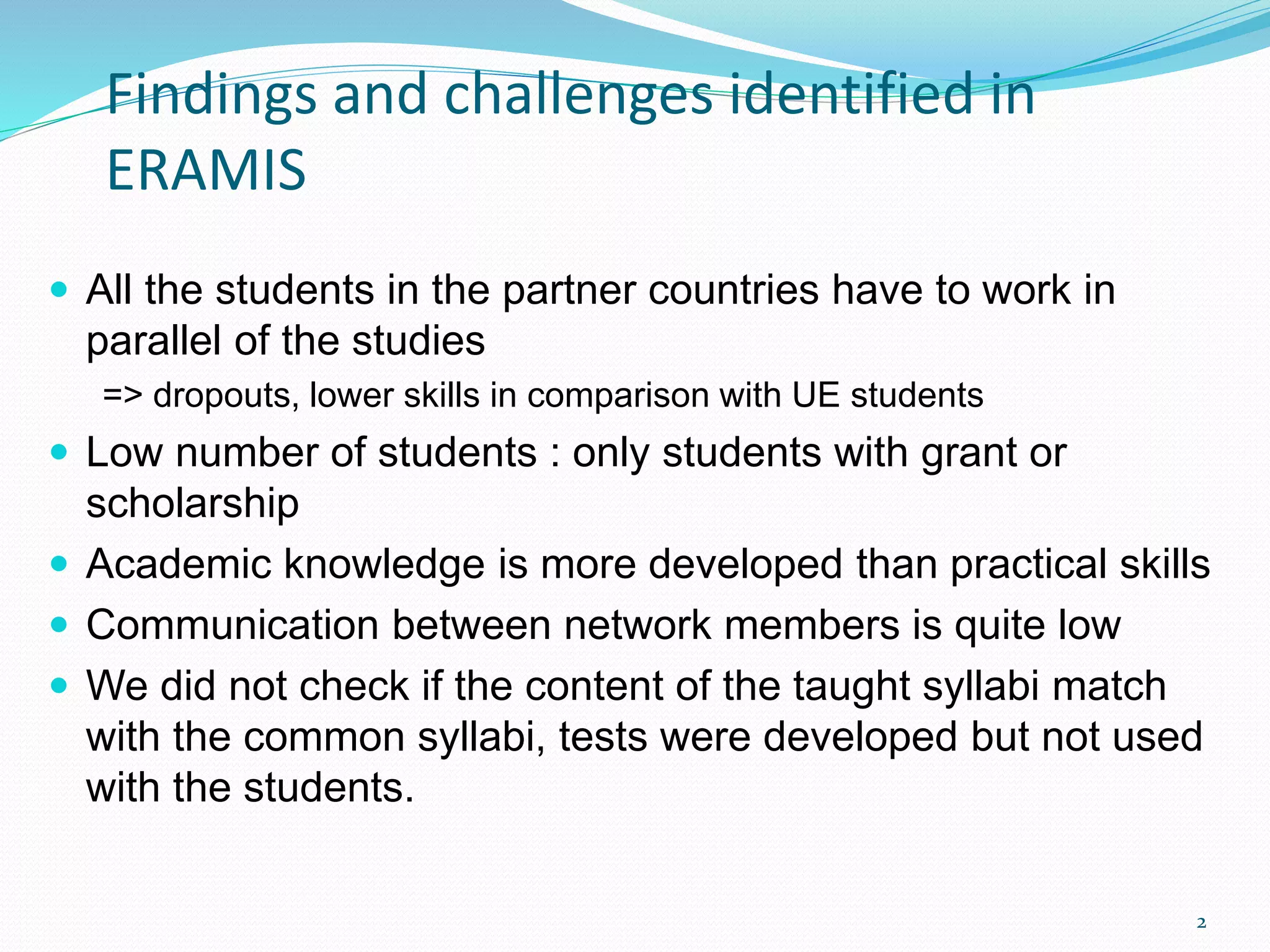
 All the students in the partner countries have to work in
parallel of the studies
=> dropouts, lower skills in comparison with UE students
 Low number of students : only students with grant or
scholarship
 Academic knowledge is more developed than practical skills
 Communication between network members is quite low
 We did not check if the content of the taught syllabi match
with the common syllabi, tests were developed but not used
with the students.
Findings and challenges identified in
ERAMIS
2
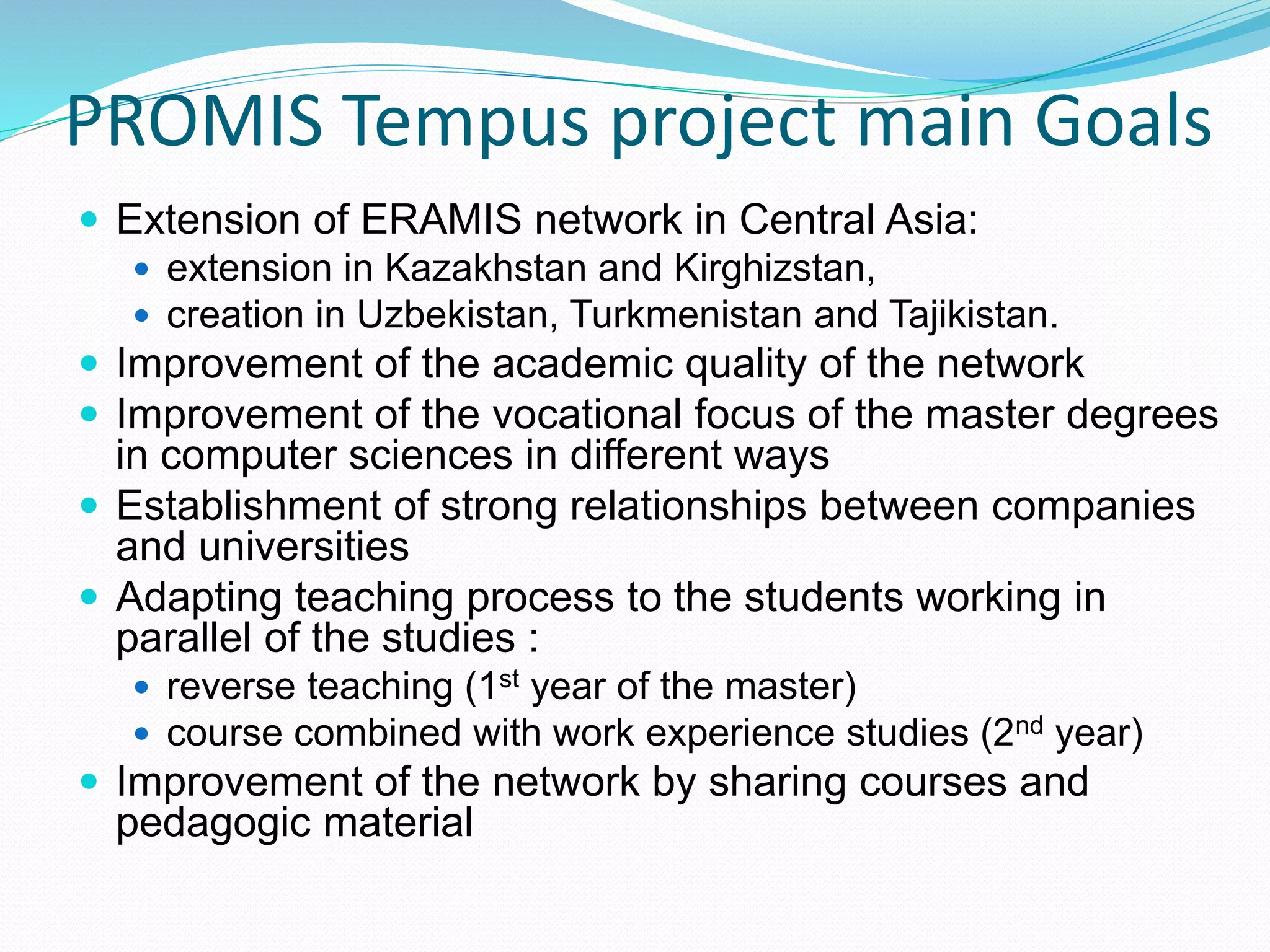
PROMIS Tempus project main Goals
 Extension of ERAMIS network in Central Asia:
 extension in Kazakhstan and Kirghizstan,
 creation in Uzbekistan, Turkmenistan and Tajikistan.
 Improvement of the academic quality of the network
 Improvement of the vocational focus of the master degrees
in computer sciences in different ways
 Establishment of strong relationships between companies
and universities
 Adapting teaching process to the students working in
parallel of the studies :
 reverse teaching (1st year of the master)
 course combined with work experience studies (2nd year)
 Improvement of the network by sharing courses and
pedagogic material
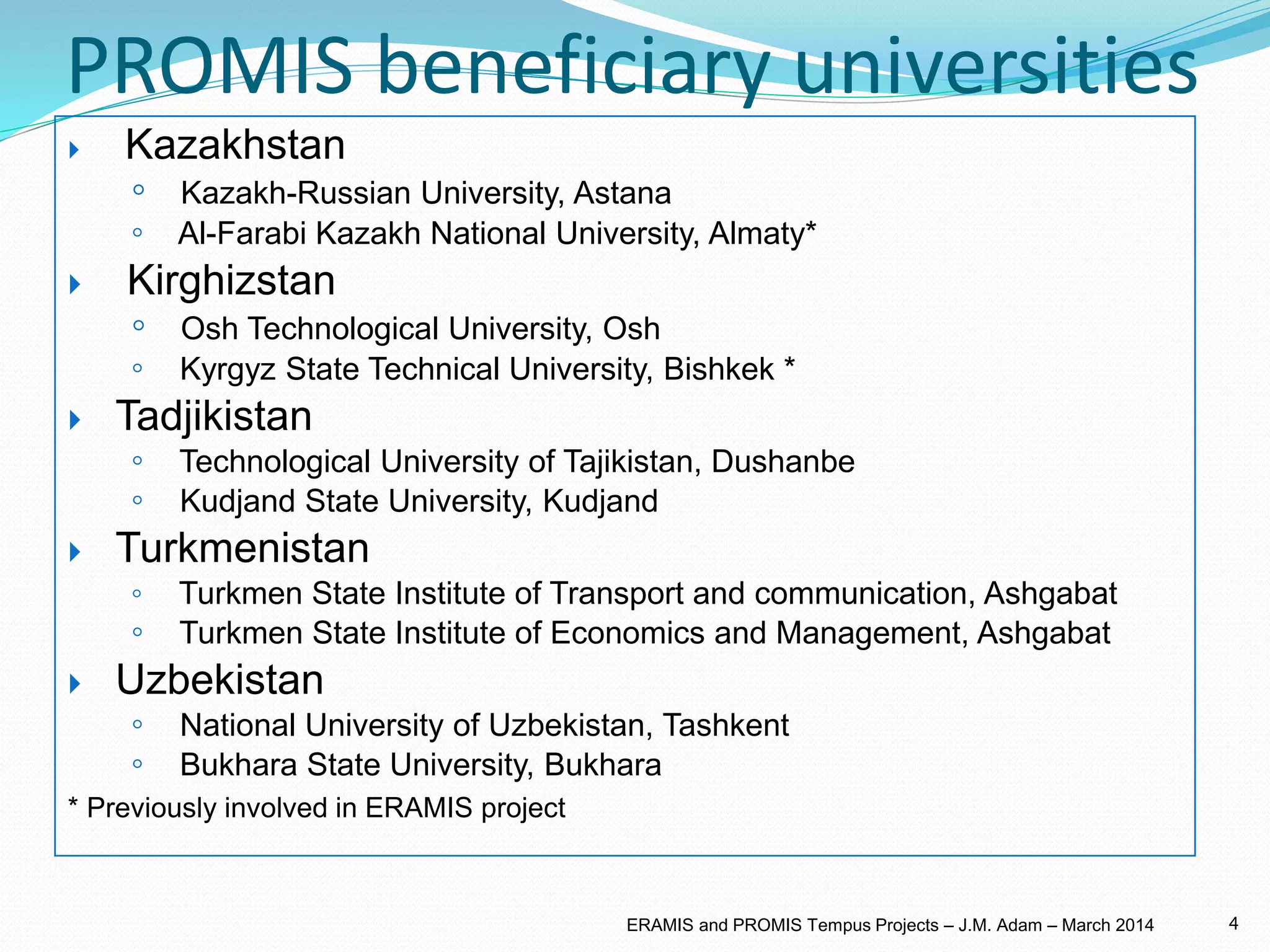
PROMIS beneficiary universities
 Kazakhstan
◦ Kazakh-Russian University, Astana
◦ Al-Farabi Kazakh National University, Almaty*
 Kirghizstan
◦ Osh Technological University, Osh
◦ Kyrgyz State Technical University, Bishkek *
 Tadjikistan
◦ Technological University of Tajikistan, Dushanbe
◦ Kudjand State University, Kudjand
 Turkmenistan
◦ Turkmen State Institute of Transport and communication, Ashgabat
◦ Turkmen State Institute of Economics and Management, Ashgabat
 Uzbekistan
◦ National University of Uzbekistan, Tashkent
◦ Bukhara State University, Bukhara
* Previously involved in ERAMIS project
4ERAMIS and PROMIS Tempus Projects – J.M. Adam – March 2014
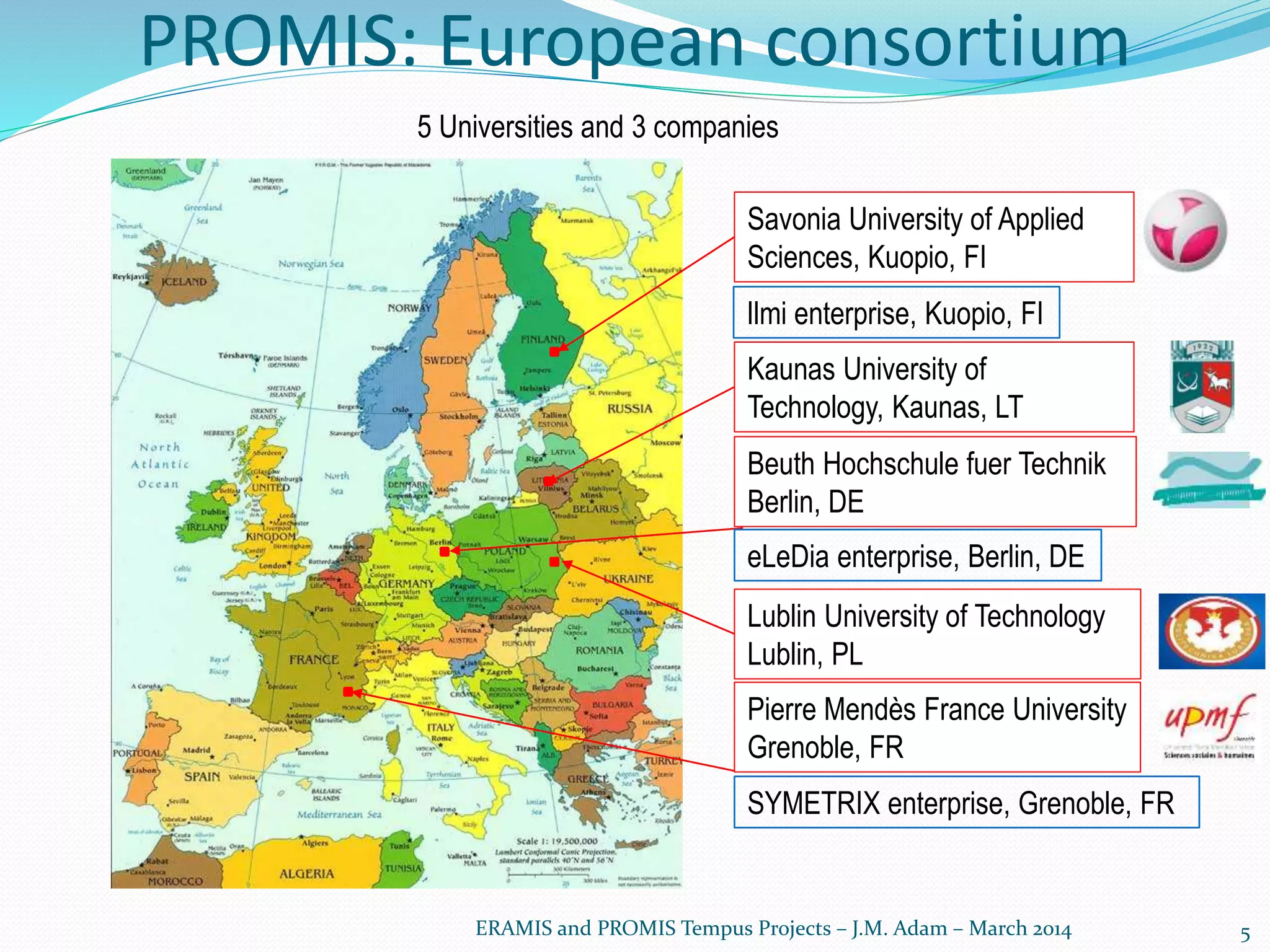
PROMIS: European consortium
5
Beuth Hochschule fuer Technik
Berlin, DE
Lublin University of Technology
Lublin, PL
Pierre Mendès France University
Grenoble, FR
Savonia University of Applied
Sciences, Kuopio, FI
Kaunas University of
Technology, Kaunas, LT
ERAMIS and PROMIS Tempus Projects – J.M. Adam – March 2014
SYMETRIX enterprise, Grenoble, FR
eLeDia enterprise, Berlin, DE
Ilmi enterprise, Kuopio, FI
5 Universities and 3 companies
Geographical extension of ERAMIS
network
 Development of the new ISC masters
 Needs analysis : carrying out of a survey of companies
to learn about ICT skills they seek
 Presentation of the results (2nd coordination meeting)
and decision to create or not a new ISC master ; if not
decision of what will be developed
 Constitution of educational teams
 Preparation of accreditation applications and
accreditation by the relevant ministry
 Student recruitment and launching of masters degree
 Set up flip teaching (1st year)
 the theoretical part of the teaching is earned on a personal
basis by the students using various teaching documents
 the teacher-students interactions focus on practical
aspects: problem solving, case studies, answering
questions
 Course supports available on-line on a e-learning
platform,
 As we work within a network, it will be possible to share
these documents as soon as they are expressed in English
or in the official languages of the beneficiary countries
(Russian and eventually national languages).
Adaptation of the trainings for students
working in parallel
7
 Development of course combined with work experience
studies (2nd year)
 the student works on a part-time basis in a company which
finances in return a part of the studies
 the professional skills acquired during the first year can
be used in practice
 the student also attend the university teaching on a full-
time basis
 Master's thesis should be replaced by reports on the
professional activity carried out within the company that
would be evaluated both by the university and the
company.
Adaptation of the trainings for students
working in parallel
8
 Involvement of companies in studies curriculum
 Inform Central Asia companies on the opportunity to hire students
with real high level professional skills in informatics right after their
graduation, those skills being the ones expected by companies.
 Involvement of companies' fellows in the masters degree teaching
process (participation in steering committees, development of
internships, setting up courses taught by companies' fellows ...)
 Close cooperation between companies and universities will be
encouraged
 Awareness seminars will be organized in beneficiary universities for
local companies in order to transfer the European partners’
experience.
Establishment of strong relationships
between companies and universities
Projet Tempus Eramis 9
Improvement of the quality of the
teaching
 Core courses built together and shared : sharing our
experience will improve the quality of the training
course
 Elective courses proposed by each partner are open at
distance to the students of the network
 The assessment is done by the partner university
proposing the course
 These elective courses are included in the masters
degree accreditation: students get ECTS if exam passed
 Assessment of all the students in the network
 Creation of double (or multiple?) diploma between
universities of the network
Yes we can !
IF we realise all these objectives…
THEN
our PROMIS project will be a success !
ENDIF
Thank you for your participation

PROMIS Tempus Project

  • 1.
    PROfessional network ofMaster’s degrees in Informatics as a Second Competence (PROMIS) December 2013 – November 2016 Jean-Michel Adam – Daniel Bardou - Anna Goloubtsova Université Pierre Mendès France (Grenoble 2)
  • 2.
     All thestudents in the partner countries have to work in parallel of the studies => dropouts, lower skills in comparison with UE students  Low number of students : only students with grant or scholarship  Academic knowledge is more developed than practical skills  Communication between network members is quite low  We did not check if the content of the taught syllabi match with the common syllabi, tests were developed but not used with the students. Findings and challenges identified in ERAMIS 2
  • 3.
    PROMIS Tempus projectmain Goals  Extension of ERAMIS network in Central Asia:  extension in Kazakhstan and Kirghizstan,  creation in Uzbekistan, Turkmenistan and Tajikistan.  Improvement of the academic quality of the network  Improvement of the vocational focus of the master degrees in computer sciences in different ways  Establishment of strong relationships between companies and universities  Adapting teaching process to the students working in parallel of the studies :  reverse teaching (1st year of the master)  course combined with work experience studies (2nd year)  Improvement of the network by sharing courses and pedagogic material
  • 4.
    PROMIS beneficiary universities Kazakhstan ◦ Kazakh-Russian University, Astana ◦ Al-Farabi Kazakh National University, Almaty*  Kirghizstan ◦ Osh Technological University, Osh ◦ Kyrgyz State Technical University, Bishkek *  Tadjikistan ◦ Technological University of Tajikistan, Dushanbe ◦ Kudjand State University, Kudjand  Turkmenistan ◦ Turkmen State Institute of Transport and communication, Ashgabat ◦ Turkmen State Institute of Economics and Management, Ashgabat  Uzbekistan ◦ National University of Uzbekistan, Tashkent ◦ Bukhara State University, Bukhara * Previously involved in ERAMIS project 4ERAMIS and PROMIS Tempus Projects – J.M. Adam – March 2014
  • 5.
    PROMIS: European consortium 5 BeuthHochschule fuer Technik Berlin, DE Lublin University of Technology Lublin, PL Pierre Mendès France University Grenoble, FR Savonia University of Applied Sciences, Kuopio, FI Kaunas University of Technology, Kaunas, LT ERAMIS and PROMIS Tempus Projects – J.M. Adam – March 2014 SYMETRIX enterprise, Grenoble, FR eLeDia enterprise, Berlin, DE Ilmi enterprise, Kuopio, FI 5 Universities and 3 companies
  • 6.
    Geographical extension ofERAMIS network  Development of the new ISC masters  Needs analysis : carrying out of a survey of companies to learn about ICT skills they seek  Presentation of the results (2nd coordination meeting) and decision to create or not a new ISC master ; if not decision of what will be developed  Constitution of educational teams  Preparation of accreditation applications and accreditation by the relevant ministry  Student recruitment and launching of masters degree
  • 7.
     Set upflip teaching (1st year)  the theoretical part of the teaching is earned on a personal basis by the students using various teaching documents  the teacher-students interactions focus on practical aspects: problem solving, case studies, answering questions  Course supports available on-line on a e-learning platform,  As we work within a network, it will be possible to share these documents as soon as they are expressed in English or in the official languages of the beneficiary countries (Russian and eventually national languages). Adaptation of the trainings for students working in parallel 7
  • 8.
     Development ofcourse combined with work experience studies (2nd year)  the student works on a part-time basis in a company which finances in return a part of the studies  the professional skills acquired during the first year can be used in practice  the student also attend the university teaching on a full- time basis  Master's thesis should be replaced by reports on the professional activity carried out within the company that would be evaluated both by the university and the company. Adaptation of the trainings for students working in parallel 8
  • 9.
     Involvement ofcompanies in studies curriculum  Inform Central Asia companies on the opportunity to hire students with real high level professional skills in informatics right after their graduation, those skills being the ones expected by companies.  Involvement of companies' fellows in the masters degree teaching process (participation in steering committees, development of internships, setting up courses taught by companies' fellows ...)  Close cooperation between companies and universities will be encouraged  Awareness seminars will be organized in beneficiary universities for local companies in order to transfer the European partners’ experience. Establishment of strong relationships between companies and universities Projet Tempus Eramis 9
  • 10.
    Improvement of thequality of the teaching  Core courses built together and shared : sharing our experience will improve the quality of the training course  Elective courses proposed by each partner are open at distance to the students of the network  The assessment is done by the partner university proposing the course  These elective courses are included in the masters degree accreditation: students get ECTS if exam passed  Assessment of all the students in the network  Creation of double (or multiple?) diploma between universities of the network
  • 11.
    Yes we can! IF we realise all these objectives… THEN our PROMIS project will be a success ! ENDIF Thank you for your participation