ì	
  
UTB	
  601	
  
TechnoVision	
  
TECHNOLOGY	
  AND	
  THE	
  WORK-­‐LIFE	
  BALANCE	


Anne	
  Bardoel	
  	
  Associate	
  Professor	
  at	
  Monash	
  University	
  	
  
hDp://theconversaHon.com/tool-­‐or-­‐Hme-­‐thief-­‐technology-­‐and-­‐
the-­‐work-­‐life-­‐balance-­‐8165	
  
Content	
  
1.  “The	
  Future”	
  then…	
  
2.  Work	
  today…	
  
3.  Mobile	
  boundaries…	
  
4.  Technology	
  types…	
  
5.  GeneraBon	
  divide…	
  
5.  PosiBve	
  impact…	
  
6.  Some	
  quesBons…	
  
7.  Future	
  trend…	
  
8.  BoLom	
  line…	
  
“The	
  Future”	
  then….	
  
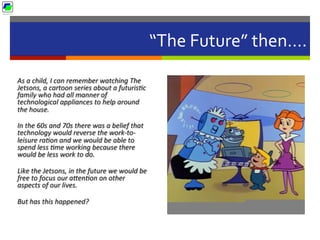
As	
  a	
  child,	
  I	
  can	
  remember	
  watching	
  The	
  
Jetsons,	
  a	
  cartoon	
  series	
  about	
  a	
  futurisBc	
  
family	
  who	
  had	
  all	
  manner	
  of	
  
technological	
  appliances	
  to	
  help	
  around	
  
the	
  house.	
  	
  
In	
  the	
  60s	
  and	
  70s	
  there	
  was	
  a	
  belief	
  that	
  
technology	
  would	
  reverse	
  the	
  work-­‐to-­‐
leisure	
  raBon	
  and	
  we	
  would	
  be	
  able	
  to	
  
spend	
  less	
  Bme	
  working	
  because	
  there	
  
would	
  be	
  less	
  work	
  to	
  do.	
  	
  
Like	
  the	
  Jetsons,	
  in	
  the	
  future	
  we	
  would	
  be	
  
free	
  to	
  focus	
  our	
  aLenBon	
  on	
  other	
  
aspects	
  of	
  our	
  lives.	
  	
  
But	
  has	
  this	
  happened?	
  
Work	
  Today…	
  
Today,	
  no	
  sector	
  of	
  the	
  economy	
  is	
  
immune	
  from	
  the	
  influence	
  of	
  
technology.	
  	
  
How	
  many	
  of	
  us	
  work	
  at	
  home	
  in	
  
the	
  evenings	
  and	
  on	
  weekends?	
  
Have	
  a	
  mobile	
  phone	
  which	
  we	
  use	
  
for	
  work?	
  Check	
  our	
  email	
  messages	
  
at	
  home	
  or	
  work	
  regularly	
  with	
  
other	
  people	
  in	
  other	
  Bme	
  zones?	
  
There	
  is	
  no	
  doubt	
  that	
  technology	
  
has	
  changed	
  the	
  way	
  we	
  work	
  and	
  
provides	
  challenges	
  for	
  work-­‐life	
  
balance.	
  
Mobile	
  boundaries…	
  
On	
  the	
  football	
  field,	
  the	
  boundary	
  
marks	
  the	
  edge	
  of	
  the	
  field.	
  Inside	
  the	
  
boundary,	
  the	
  ball	
  is	
  in	
  play;	
  beyond	
  
the	
  boundary	
  it	
  is	
  out	
  of	
  play.	
  	
  
Electronic	
  tools	
  such	
  as	
  email,	
  chat,	
  
smartphones,	
  laptops	
  and	
  tablets	
  	
  
have	
  increased	
  our	
  ability	
  to	
  work	
  
from	
  home	
  and	
  outside	
  of	
  regular	
  
hours	
  creaBng	
  the	
  expectaBons	
  of	
  
being	
  available	
  anyBme,	
  anywhere.	
  	
  
This	
  expansion	
  of	
  the	
  workplace	
  
boundary	
  line	
  has	
  encroached	
  on	
  our	
  
personal	
  lives,	
  further	
  complicaBng	
  
our	
  work-­‐life	
  balance	
  struggle.	
  
Technology	
  types…	
  
There	
  are	
  two	
  main	
  types	
  of	
  
technology	
  users:	
  	
  
1.  Technology	
  slaves	
  -­‐	
  people	
  with	
  
high	
  expectaBons	
  and	
  workloads	
  
who	
  need	
  to	
  work	
  long	
  hours	
  and	
  
be	
  accessible	
  24/7	
  to	
  advance	
  in	
  
their	
  organisaBon	
  (addicted	
  to	
  
work)	
  
2.  Technology	
  masters	
  -­‐	
  moderate	
  
users	
  of	
  technology	
  who	
  use	
  it	
  as	
  
a	
  tool	
  for	
  both	
  personal	
  and	
  work	
  
life	
  and	
  thereby	
  increase	
  their	
  
ability	
  to	
  manage	
  their	
  Bme	
  and	
  
increase	
  control	
  of	
  their	
  lives.	
  
Generation	
  divide…	
  
The	
  current	
  generaBon	
  of	
  young	
  Nigerians	
  
have	
  never	
  known	
  a	
  world	
  without	
  
constant	
  access	
  to	
  mobile	
  phones,	
  the	
  
internet	
  and	
  email.	
  	
  
The	
  internet	
  and	
  new	
  technology	
  devices	
  
are	
  so	
  commonplace	
  that	
  the	
  youth	
  take	
  
them	
  for	
  granted.	
  They	
  use	
  the	
  internet	
  to	
  
communicate	
  with	
  their	
  friends	
  and	
  peers	
  
and	
  gather	
  informaBon	
  about	
  issues	
  in	
  the	
  
broader	
  environment.	
  	
  
Technology	
  is	
  an	
  extension	
  of	
  their	
  social	
  
lives.	
  They	
  are	
  also	
  used	
  to	
  receiving	
  and	
  
sending	
  informaBon	
  instantly	
  while	
  mulB-­‐
tasking	
  with	
  technology.	
  
Positive	
  impact…	
  
With	
  recent	
  increases	
  in	
  technology	
  
and	
  social	
  media	
  use,	
  more	
  and	
  more	
  
employees	
  will	
  be	
  using	
  social	
  media	
  
and	
  the	
  internet	
  at	
  work.	
  
Interes>ngly	
  people	
  have	
  reported	
  
their	
  internet	
  use	
  had	
  a	
  posi>ve	
  
impact	
  on	
  their	
  ability	
  to	
  balance	
  
their	
  home	
  and	
  work	
  lives…	
  	
  
Employees	
  who	
  use	
  the	
  internet	
  for	
  
work	
  purposes	
  at	
  home	
  are	
  doing	
  so	
  
on	
  their	
  own	
  terms	
  resul>ng	
  in	
  a	
  
percep>on	
  of	
  having	
  more	
  control	
  
and	
  flexibility.	
  
Some	
  questions…	
  
Will	
  the	
  increasing	
  use	
  of	
  technology	
  lead	
  to	
  a	
  
posiBve	
  work	
  environment	
  of	
  quick	
  thinking	
  
mulB-­‐taskers	
  who	
  use	
  the	
  internet	
  as	
  an	
  
external	
  brain?	
  	
  
Or	
  will	
  it	
  lead	
  to	
  a	
  negaBve	
  work	
  environment	
  
where	
  the	
  need	
  for	
  instant	
  graBficaBon	
  
outweighs	
  the	
  ability	
  for	
  thougheul	
  reflecBon	
  
and	
  deep	
  thinking?	
  	
  
Are	
  we	
  heading	
  towards	
  a	
  world	
  of	
  excessive	
  
technology	
  addicBon,	
  where	
  we	
  can’t	
  detach	
  
from	
  work	
  during	
  non-­‐work	
  hours,	
  which	
  leads	
  
to	
  negaBve	
  repercussions	
  for	
  work-­‐life	
  balance?	
  
Or	
  can	
  we	
  take	
  control	
  of	
  the	
  technology	
  and	
  
use	
  it	
  as	
  a	
  tool	
  to	
  help,	
  rather	
  than	
  something	
  to	
  
respond	
  to.	
  
Future	
  trend…	
  
Some	
  employers	
  are	
  recognising	
  
that	
  there	
  are	
  advantages	
  in	
  
terms	
  of	
  producBvity	
  and	
  
creaBvity	
  to	
  legng	
  people	
  switch	
  
off	
  from	
  work.	
  	
  
For	
  example,	
  Volkswagen	
  
(Germany)	
  deacBvates	
  emails	
  
during	
  non-­‐work	
  hours	
  and	
  
employees	
  can	
  only	
  receive	
  
email	
  a	
  half	
  hour	
  before	
  and	
  a	
  
half	
  hour	
  ajer	
  the	
  work	
  day.	


Bottom	
  line…	
  
We	
  are	
  a	
  key	
  point	
  in	
  Bme	
  in	
  
making	
  sure	
  technology	
  does	
  not	
  
become	
  our	
  master.	
  	
  
Say	
  NO	
  and	
  take	
  control	
  of	
  
technology.	
  	
  
Educate	
  your	
  clients,	
  customers,	
  
colleagues	
  and	
  managers	
  that	
  a	
  
fast	
  (technology	
  enabled)	
  
answer	
  isn’t	
  always	
  the	
  best	
  
answer!	
  
TOMI	
  DAVIES	
  
ceo@tvcng.com	
  
+234	
  817	
  001	
  2938	
  
THANK	
  YOU!	
  

Technology & Work-Life Balance

  • 1.
    ì   UTB  601   TechnoVision   TECHNOLOGY  AND  THE  WORK-­‐LIFE  BALANCE           Anne  Bardoel    Associate  Professor  at  Monash  University     hDp://theconversaHon.com/tool-­‐or-­‐Hme-­‐thief-­‐technology-­‐and-­‐ the-­‐work-­‐life-­‐balance-­‐8165  
  • 2.
    Content   1.  “The  Future”  then…   2.  Work  today…   3.  Mobile  boundaries…   4.  Technology  types…   5.  GeneraBon  divide…   5.  PosiBve  impact…   6.  Some  quesBons…   7.  Future  trend…   8.  BoLom  line…  
  • 3.
    “The  Future”  then….   As  a  child,  I  can  remember  watching  The   Jetsons,  a  cartoon  series  about  a  futurisBc   family  who  had  all  manner  of   technological  appliances  to  help  around   the  house.     In  the  60s  and  70s  there  was  a  belief  that   technology  would  reverse  the  work-­‐to-­‐ leisure  raBon  and  we  would  be  able  to   spend  less  Bme  working  because  there   would  be  less  work  to  do.     Like  the  Jetsons,  in  the  future  we  would  be   free  to  focus  our  aLenBon  on  other   aspects  of  our  lives.     But  has  this  happened?  
  • 4.
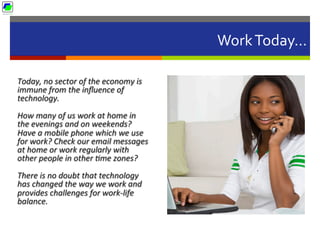
    Work  Today…   Today,  no  sector  of  the  economy  is   immune  from  the  influence  of   technology.     How  many  of  us  work  at  home  in   the  evenings  and  on  weekends?   Have  a  mobile  phone  which  we  use   for  work?  Check  our  email  messages   at  home  or  work  regularly  with   other  people  in  other  Bme  zones?   There  is  no  doubt  that  technology   has  changed  the  way  we  work  and   provides  challenges  for  work-­‐life   balance.  
  • 5.
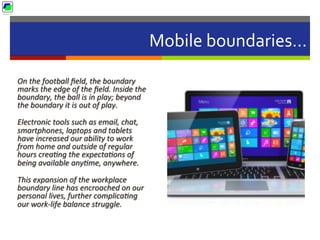
    Mobile  boundaries…   On  the  football  field,  the  boundary   marks  the  edge  of  the  field.  Inside  the   boundary,  the  ball  is  in  play;  beyond   the  boundary  it  is  out  of  play.     Electronic  tools  such  as  email,  chat,   smartphones,  laptops  and  tablets     have  increased  our  ability  to  work   from  home  and  outside  of  regular   hours  creaBng  the  expectaBons  of   being  available  anyBme,  anywhere.     This  expansion  of  the  workplace   boundary  line  has  encroached  on  our   personal  lives,  further  complicaBng   our  work-­‐life  balance  struggle.  
  • 6.
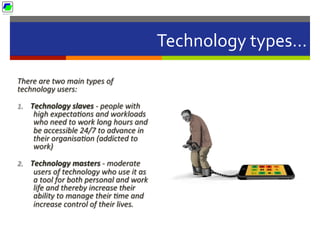
    Technology  types…   There  are  two  main  types  of   technology  users:     1.  Technology  slaves  -­‐  people  with   high  expectaBons  and  workloads   who  need  to  work  long  hours  and   be  accessible  24/7  to  advance  in   their  organisaBon  (addicted  to   work)   2.  Technology  masters  -­‐  moderate   users  of  technology  who  use  it  as   a  tool  for  both  personal  and  work   life  and  thereby  increase  their   ability  to  manage  their  Bme  and   increase  control  of  their  lives.  
  • 7.
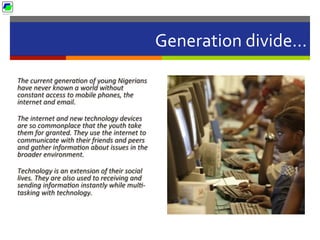
    Generation  divide…   The  current  generaBon  of  young  Nigerians   have  never  known  a  world  without   constant  access  to  mobile  phones,  the   internet  and  email.     The  internet  and  new  technology  devices   are  so  commonplace  that  the  youth  take   them  for  granted.  They  use  the  internet  to   communicate  with  their  friends  and  peers   and  gather  informaBon  about  issues  in  the   broader  environment.     Technology  is  an  extension  of  their  social   lives.  They  are  also  used  to  receiving  and   sending  informaBon  instantly  while  mulB-­‐ tasking  with  technology.  
  • 8.
    Positive  impact…   With  recent  increases  in  technology   and  social  media  use,  more  and  more   employees  will  be  using  social  media   and  the  internet  at  work.   Interes>ngly  people  have  reported   their  internet  use  had  a  posi>ve   impact  on  their  ability  to  balance   their  home  and  work  lives…     Employees  who  use  the  internet  for   work  purposes  at  home  are  doing  so   on  their  own  terms  resul>ng  in  a   percep>on  of  having  more  control   and  flexibility.  
  • 9.
    Some  questions…   Will  the  increasing  use  of  technology  lead  to  a   posiBve  work  environment  of  quick  thinking   mulB-­‐taskers  who  use  the  internet  as  an   external  brain?     Or  will  it  lead  to  a  negaBve  work  environment   where  the  need  for  instant  graBficaBon   outweighs  the  ability  for  thougheul  reflecBon   and  deep  thinking?     Are  we  heading  towards  a  world  of  excessive   technology  addicBon,  where  we  can’t  detach   from  work  during  non-­‐work  hours,  which  leads   to  negaBve  repercussions  for  work-­‐life  balance?   Or  can  we  take  control  of  the  technology  and   use  it  as  a  tool  to  help,  rather  than  something  to   respond  to.  
  • 10.
    Future  trend…   Some  employers  are  recognising   that  there  are  advantages  in   terms  of  producBvity  and   creaBvity  to  legng  people  switch   off  from  work.     For  example,  Volkswagen   (Germany)  deacBvates  emails   during  non-­‐work  hours  and   employees  can  only  receive   email  a  half  hour  before  and  a   half  hour  ajer  the  work  day.    
  • 11.
    Bottom  line…   We  are  a  key  point  in  Bme  in   making  sure  technology  does  not   become  our  master.     Say  NO  and  take  control  of   technology.     Educate  your  clients,  customers,   colleagues  and  managers  that  a   fast  (technology  enabled)   answer  isn’t  always  the  best   answer!  
  • 12.
    TOMI  DAVIES   ceo@tvcng.com   +234  817  001  2938   THANK  YOU!