PAIN AND SUFFERING
BY: ABDUL MAHIR FATHIMA SAKEENA
TEXTBOOK DEFINITIONS OF PAIN
• Highly unpleasant physical sensation caused by illness or injury. –
OXFORD DICTIONARY
• Localized physical suffering associated with bodily disorder (such as a
disease or an injury); a basic bodily sensation induced by a noxious
stimulus, received by naked nerve endings, characterized by physical
discomfort – MERRIAM-WEBSTER
• physical suffering or distress, as due to injury, illness, etc. ;
mental or emotional suffering or torment – Dictionary.com
TEXTBOOK DEFINTIONS OF SUFFERING
• The state of undergoing pain, distress, or hardship. – OXFORD
DICTONARY
• The state or experience of one that suffers – MERRIAM-WEBSTER
• the state of a person or thing that suffers – Dictionary.com
”
“ Between stimulus and response there is a space. In
that space is our power to choose our response. In
our response lies our growth and our freedom.
Victor E. Frankl
STIMULUS = PAIN RESPONSE = SUFFERING
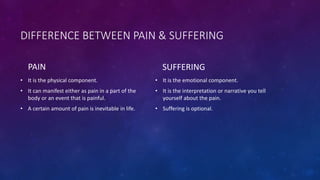
DIFFERENCE BETWEEN PAIN & SUFFERING
PAIN
• It is the physical component.
• It can manifest either as pain in a part of the
body or an event that is painful.
• A certain amount of pain is inevitable in life.
SUFFERING
• It is the emotional component.
• It is the interpretation or narrative you tell
yourself about the pain.
• Suffering is optional.
“ There is no use crying over spilt milk. ”
An old proverbial saying
PAIN AND SUFFERING ARE MUTUALLY EXCLUSIVE
You can have pain and not suffer.
You can suffer and not have pain.
ALL OF US EXPERIENCE PAIN THE
SAME WAY BUT RESPOND/SUFFER TO
IT DIFFERENTLY
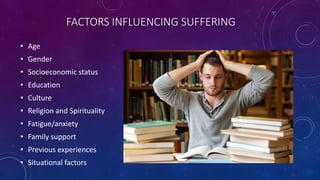
FACTORS INFLUENCING SUFFERING
• Age
• Gender
• Socioeconomic status
• Education
• Culture
• Religion and Spirituality
• Fatigue/anxiety
• Family support
• Previous experiences
• Situational factors
CULTURAL INFLUENCE ON HANDLING OF PAIN
Some cultures encourage the expression of pain, especially individulas
having a Mediterranean, Middle Eastern or Hispanic background. = reaction
to pain is “normal” and anything substantially different is “abnormal”. Talking
it out helps.
Other cultures encourage the suppression of pain, especially individuals
having an Asian background. = self conduct, self discipline, people-pleasing
SPIRITUAL AND RELIGIOUS INFLUENCE ON PAIN
INTERPRETATION
Belief in fate, karma, higher power = acceptance of pain is
important in demonstrating their religious faith
Example: Buddhism, Islam, Christianity
CHANGING VIEWS ON PAIN IN A CULTURE
Until about the 18th century, Christian cultures in Western Europe
had a broadly fatalistic view of pain.
Genesis (3:16) tells us that
in sorrow [i.e. pain] thou shalt bring forth children.
Pain was heaven-sent, a concomitant of the human condition:
[a] necessary trial, unpleasantness preceding some greater good, punishment, or
fate.
But over the following centuries pain was progressively medicalised:
pain was subject to human intervention and treatment.
Pain & Suffering

Pain & Suffering

  • 1.
    PAIN AND SUFFERING BY:ABDUL MAHIR FATHIMA SAKEENA
  • 2.
    TEXTBOOK DEFINITIONS OFPAIN • Highly unpleasant physical sensation caused by illness or injury. – OXFORD DICTIONARY • Localized physical suffering associated with bodily disorder (such as a disease or an injury); a basic bodily sensation induced by a noxious stimulus, received by naked nerve endings, characterized by physical discomfort – MERRIAM-WEBSTER • physical suffering or distress, as due to injury, illness, etc. ; mental or emotional suffering or torment – Dictionary.com
  • 3.
    TEXTBOOK DEFINTIONS OFSUFFERING • The state of undergoing pain, distress, or hardship. – OXFORD DICTONARY • The state or experience of one that suffers – MERRIAM-WEBSTER • the state of a person or thing that suffers – Dictionary.com
  • 4.
    ” “ Between stimulusand response there is a space. In that space is our power to choose our response. In our response lies our growth and our freedom. Victor E. Frankl STIMULUS = PAIN RESPONSE = SUFFERING
  • 5.
    DIFFERENCE BETWEEN PAIN& SUFFERING PAIN • It is the physical component. • It can manifest either as pain in a part of the body or an event that is painful. • A certain amount of pain is inevitable in life. SUFFERING • It is the emotional component. • It is the interpretation or narrative you tell yourself about the pain. • Suffering is optional.
  • 6.
    “ There isno use crying over spilt milk. ” An old proverbial saying
  • 7.
    PAIN AND SUFFERINGARE MUTUALLY EXCLUSIVE You can have pain and not suffer. You can suffer and not have pain.
  • 8.
    ALL OF USEXPERIENCE PAIN THE SAME WAY BUT RESPOND/SUFFER TO IT DIFFERENTLY
  • 9.
    FACTORS INFLUENCING SUFFERING •Age • Gender • Socioeconomic status • Education • Culture • Religion and Spirituality • Fatigue/anxiety • Family support • Previous experiences • Situational factors
  • 10.
    CULTURAL INFLUENCE ONHANDLING OF PAIN Some cultures encourage the expression of pain, especially individulas having a Mediterranean, Middle Eastern or Hispanic background. = reaction to pain is “normal” and anything substantially different is “abnormal”. Talking it out helps. Other cultures encourage the suppression of pain, especially individuals having an Asian background. = self conduct, self discipline, people-pleasing
  • 11.
    SPIRITUAL AND RELIGIOUSINFLUENCE ON PAIN INTERPRETATION Belief in fate, karma, higher power = acceptance of pain is important in demonstrating their religious faith Example: Buddhism, Islam, Christianity
  • 12.
    CHANGING VIEWS ONPAIN IN A CULTURE Until about the 18th century, Christian cultures in Western Europe had a broadly fatalistic view of pain. Genesis (3:16) tells us that in sorrow [i.e. pain] thou shalt bring forth children. Pain was heaven-sent, a concomitant of the human condition: [a] necessary trial, unpleasantness preceding some greater good, punishment, or fate. But over the following centuries pain was progressively medicalised: pain was subject to human intervention and treatment.

Editor's Notes

  • #2 Although all forms of human suffering can be a challenge to the meaning of life, the personal conditions of suffering usually are a stronger challenge for the meaning of life. 
  • #6 Pain is the physical experience. It’s an ache in your muscles, the strain in your joints, the fever and chills, the throbbing in your temples, the congestion in your sinuses, the stabbing in your upper back, the shooting sharpness down your leg. Narrative = pain will never end. Only my pain is important. Others don’t experience half as much pain as I do. If only this did not happen I will not be going through pain. Why me? https://www.themindfulword.org/2012/pain-suffering-aware-body/
  • #7 Attachment to milk = suffering No attachment to milk = no suffering Pain x acceptance = no suffering Pain x resistance = suffering http://www.sciencechatforum.com/viewtopic.php?f=46&t=18843
  • #8 Youtube video. https://www.youtube.com/watch?v=rPDLM_XaKds Mental problems. Psychologists.
  • #10 In general children’s pain tolerance increases with age. School aged children may try to be brave when facing a painful procedure. Adolescents may consider showing signs of pain as weakness. Fear of pain in some adults may cause them to reject treatment. Gender – may be biological or psychological – gender role expectations