INTRODUCTION
“Work-life balance is
the state of control,
achievement and
satisfaction in your
life.” It means that you
have a sense of being
able to make choices
that fit for you, given
your current situation
and your goals
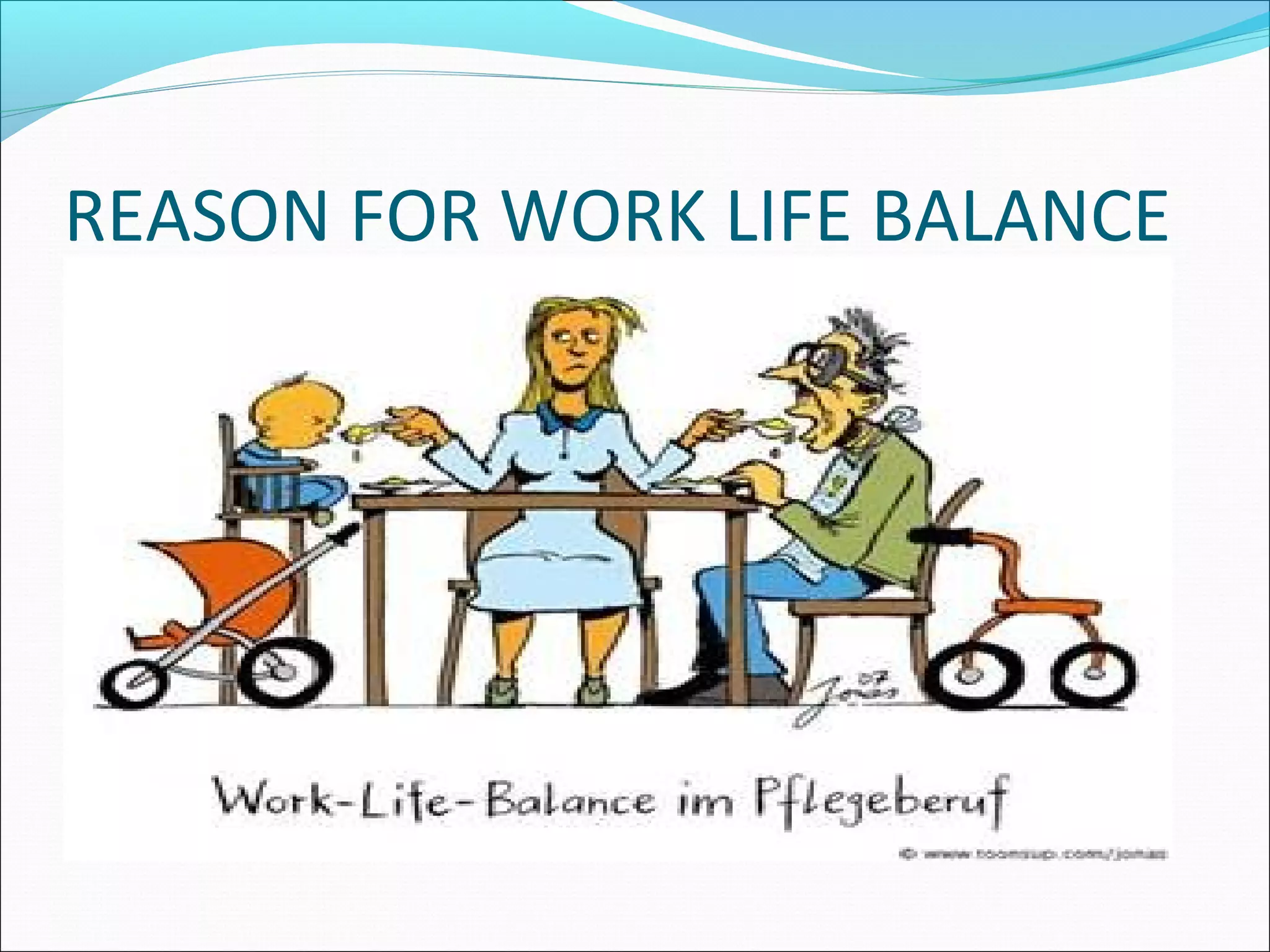
REASON FOR WORK LIFE BALANCE
 The past two decades has seen an increase in the
number of working women, employees dual earner and
single parent families, increased responsibilities of
adults and changing demography
 Employees have seen downsizing, restructuring and
right sizing, increased job security, increased time at
workplace,etc..
REASON FOR WORK LIFE BALANCE
Women in work place and changing family pattern
Population ageing
Downsizing, restructuring and declines in job
security
Technological change
Corporate inertia
HEALTHY BALANCE
Balance will improve
the lives of individual
employees as well as
the company culture.
Healthy balance
between work and life
should be a priority
for everyone.
FACTORS ATTRIBUTING TO INCREASED
AWARENESS FOR WORK LIFE BALANCE
With changing times, different perspectives have
emerged.
 At one time several factors led to imbalance, while
it becomes irrelevant in other times when business
has grown and demands have increased it has made
significant progress with respect to work life balance.
They attribute increase in corporate
awareness on two issues:
recruitment and retention
changing attitudes around work
WORK LIFE BALANCE
INTERVENTION
Increasing flexibility
Refusing overtime
Supportive management
TYPES OF PROVISIONS
job sharing
part time working
staggered working hours
annualized hours
compressed hours
term time working
voluntary reduced working time
occasionally working at home
career breaks
leaves
PRODUCTIVITY
 work‐life balance can actually increase
productivity.
While it is true that overtime will initially
increase production, the surge only lasts a
few weeks before taking a destructive toll
on productivity.
working long hours for an extended time period
will lead to exhaustion and
unhealthy habits that decrease productivity.
WAYS TO INCREASE PRODUCTIVITY
Take healthy breaks
Take enjoyable break
Take time off
PHYSICAL AND MENTAL HEALTH
It is common knowledge that stress is directly
 linked to different diseases.
Numerous surveys have discovered that work is a 
leading cause of stress related  
illness and injury, such as stroke, heart disease, an
d mental breakdowns. 
A balanced life will improve both physical and 
mental health. 
Awareness: A balanced lifestyle 
increases personal awareness,
 allow individuals to identify potential
 health problems early. 
Lifestyle: A balanced lifestyle
 automatically improves health. It 
encourages healthy choices and help
to develop the body and the mind.  
INCREASED MORALE
Work life balance is an effective tool to increase 
morale and improve company  culture. 
work‐life balance improves happiness and 
overall job satisfaction. Additionally, employees 
are more invested in companies that support their
 work‐life balance. 
Work‐ life balance typically translates to 
employees who work harder and are more
 productive. 
RISKS
Poor health: Working long hours without taking 
time to relax will take its toll  on health. 
Unresolved conflict: A lack of balance can create conflict
s at work and at home.
Poor performance: Taking on too much
 responsibility will lead to exhaustion and cause
performance to suffer. 
Financial loss: The impact on health and 
productivity takes a financial toll on both individual
employees and organizations.  
SIGNS OF IMBALANCE
Health Risks
Imbalance promotes poor health. Over time,
this can lead to devastating, and possibly
life changing consequences
obesity
exhaustion
emotional problems
Absenteeism
Absenteeism  is an employee's intentional or 
habitual absence from work.
 While employers expect workers to miss a 
certain number of workdays each year, excessive 
absences can equate to decreased 
productivity and can have a major effect on 
company finances, morale and other factors.
Causes of Absenteeism
Bullying and harassment
Burnout, stress and low morale
Childcare and eldercare
Depression
Disengagement
Illness
Injuries
Job hunting
Partial shifts
COST OF ABSENTEEISM:
sick pay
loss of productivity
High-cost replacement workers
Administrative costs of managing absenteeism
Poor quality of goods
Reduced productivity
Excess manager time
Safety issues
Poor morale among employees who have to "fill in" or do extra
work to cover absent co-workers
BURNOUT:Burnout is the physical and psychological
response to long-term stress.
SIGNS OF BURNOUT:
Loss of interest
Lack of emotion
loss of motivation
possible depression
Short attention span, lack of ability to stay focused
No energy, exhausted, withdrawn, feel overwhelmed
No motivation, not taking care of yourself
Negative attitude, unhappy both personally and
professionally
Performance is decreasing at home and at work
Health problems develop/increase
SOME SUGGESTIONS TO ASSIST YOU WITH BURNOUT
Make sure to make time for you and get plenty of sleep.
Do things that relax you; read; take long walks; try yoga or
meditation.
Schedule time for you daily. This is so important, don’t
skip any days.
You need to be tuned in to what it is that causes you
stress. Physical symptoms of stress are; are headache,
tension in the neck and shoulders, upset and nervous
stomach. Pay attention when this occurs.
Re-evaluate your job, see what things you can
change or rearrange to cut back on stress.
When it comes to work, realize what is out of
your control, accept it and move on.
Make a list of what causes you stress; identify
what you have control over and can change; do
what you can to improve the situation in the areas
you have identified.
EXAMPLE
QUOTE FROM CISCO
 We know that our
employees’ lifestyles
and needs change over
time, and that we must
adapt to support them.
We believe that there
is a positive correlation
between flexibility in
the workplace and
employee productivity
Flexibility at Cisco is the ability to formally or
informally adjust one’s work schedule in a way
that maximizes productivity, achieves business
goals, and enables work and life integration.
 Flexibility focuses on results, rather than physical
presence in an office. Cisco’s tools and culture
enable great flexibility in when, where, and how
people work.
 Establishing consistency and transparency is
critical for the flexibility program

work life balance