Ultrasonic Testing Part 1 TWI
Ultrasonic Testing NDT Training & Certification
Course Layout Duration :   9.5 Days (Mon – Fri) Start :   8:30 am Coffee Break : 10:00 – 10:30 am Lunch : 12:30 – 1:30 pm Tea Break :   3:00 – 3:30 pm Day End :   5:00 pm Course Objective: To train and prepare participants to obtain required skill and knowledge in Ultrasonic Testing and to meet the  examination schemes requirements.
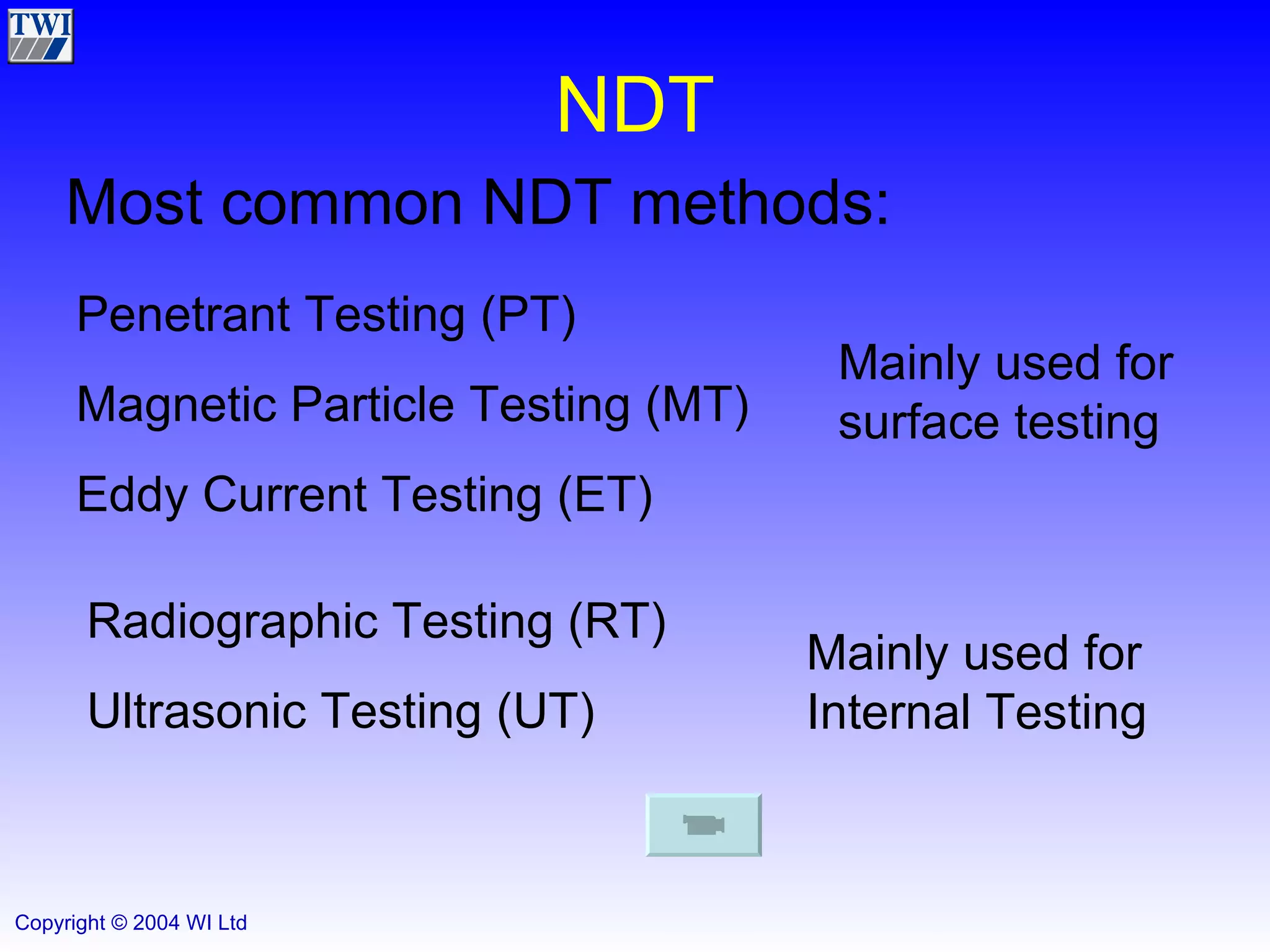
NDT Most common NDT methods: Penetrant Testing (PT) Magnetic Particle Testing (MT) Eddy Current Testing (ET) Radiographic Testing (RT) Ultrasonic Testing (UT) Mainly used for surface testing Mainly used for Internal Testing
NDT Which method is the best ? Depends on many factors and conditions
Basic Principles of Ultrasonic Testing To understand and appreciate the capability and limitation of UT
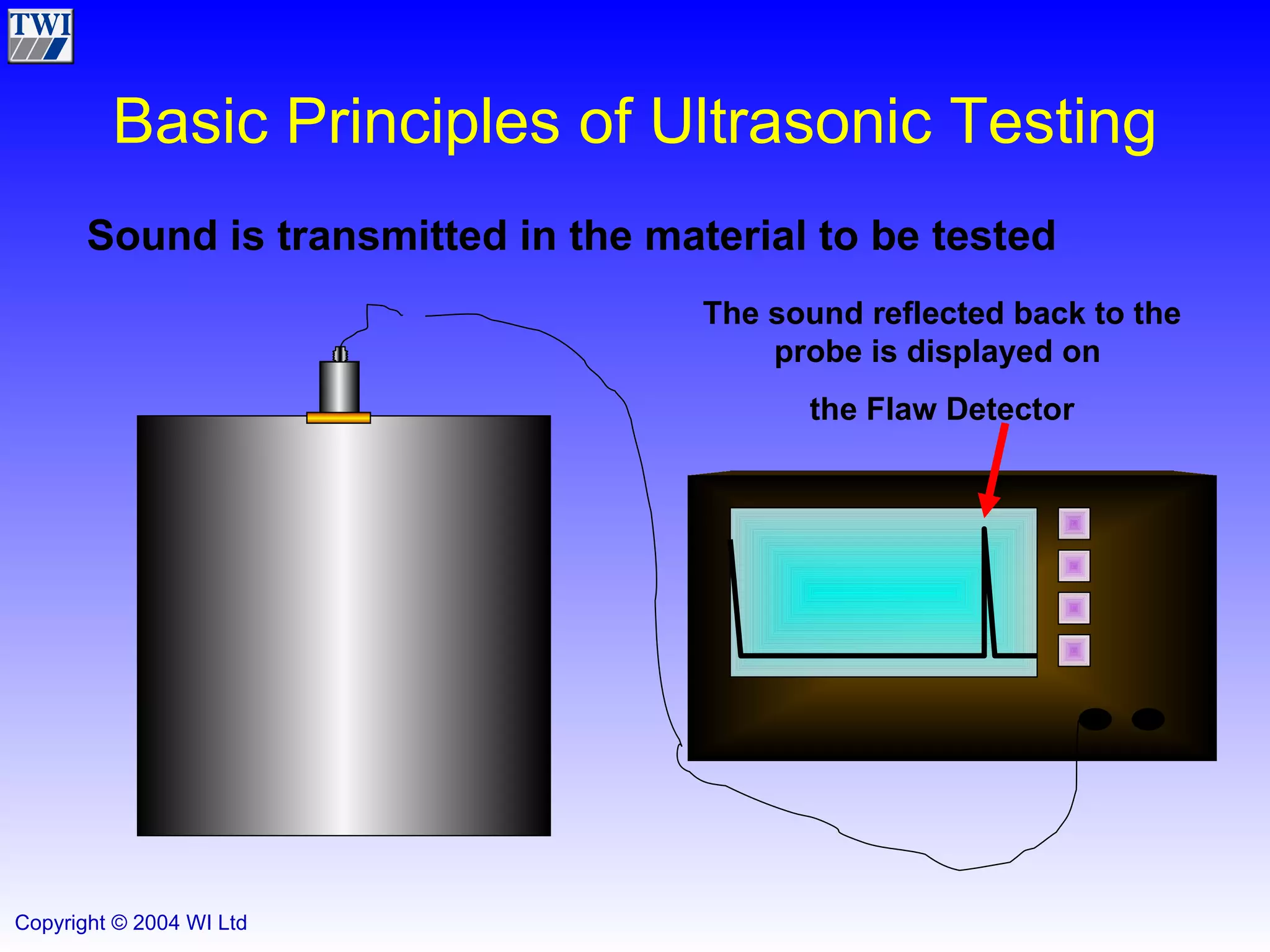
Basic Principles of Ultrasonic Testing Sound is transmitted in the material to be tested The sound reflected back to the probe is displayed on  the Flaw Detector
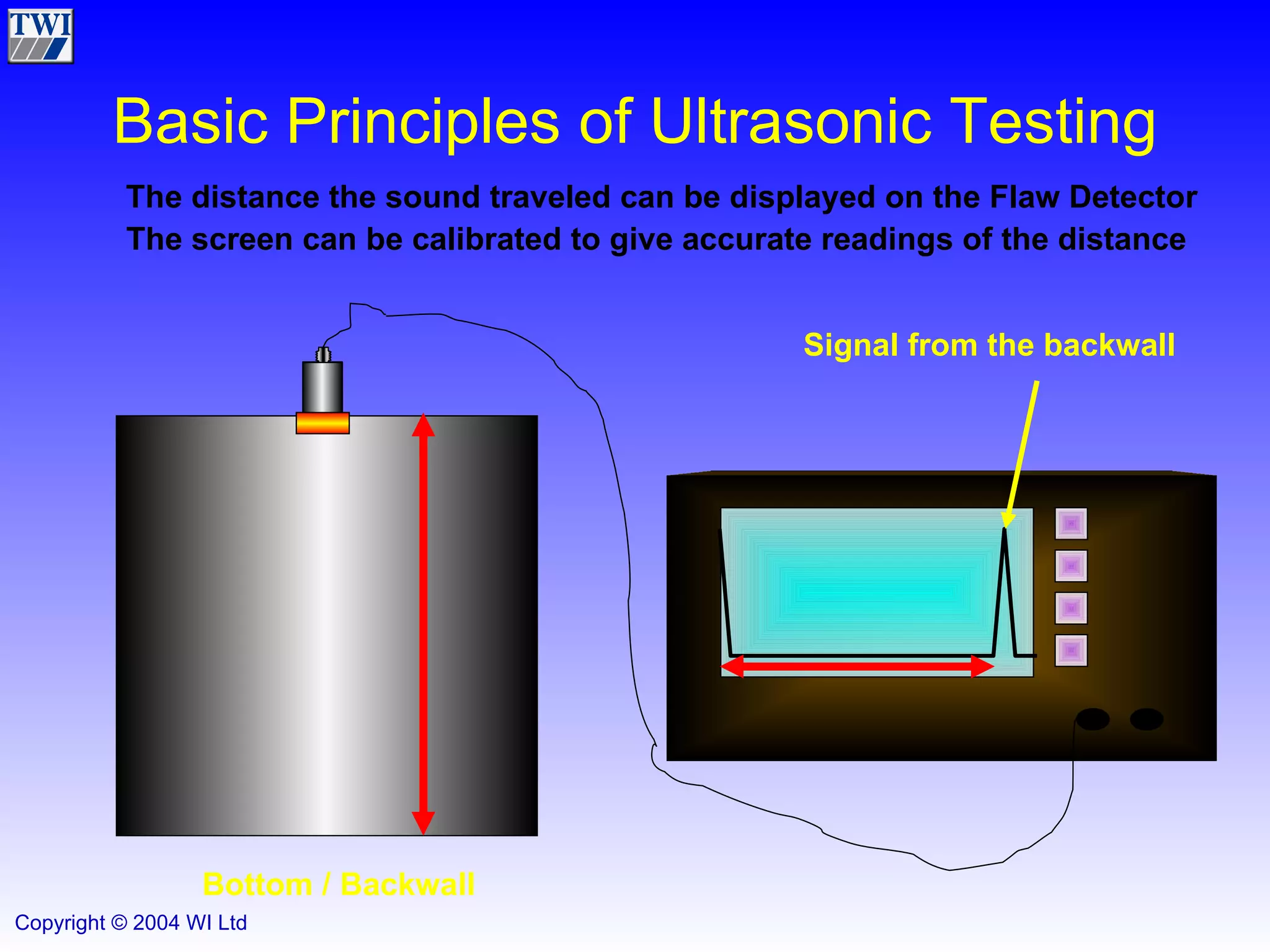
Basic Principles of Ultrasonic Testing The distance the sound traveled can be displayed on the Flaw Detector The screen can be calibrated to give accurate readings of the distance Bottom / Backwall Signal from the backwall
 
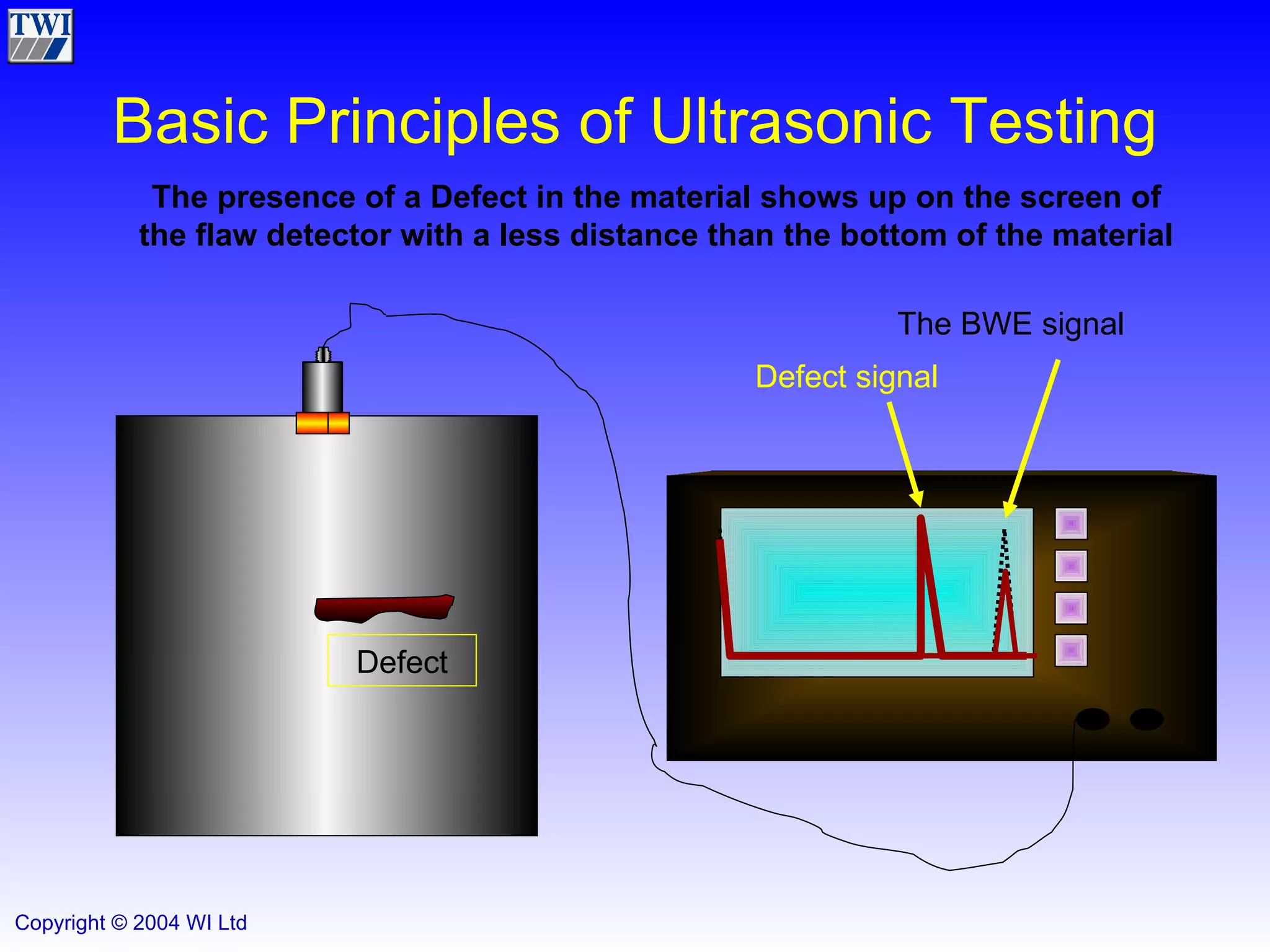
Basic Principles of Ultrasonic Testing The presence of a Defect in the material shows up on the screen of the flaw detector with a less distance than the bottom of the material Defect The BWE signal Defect signal
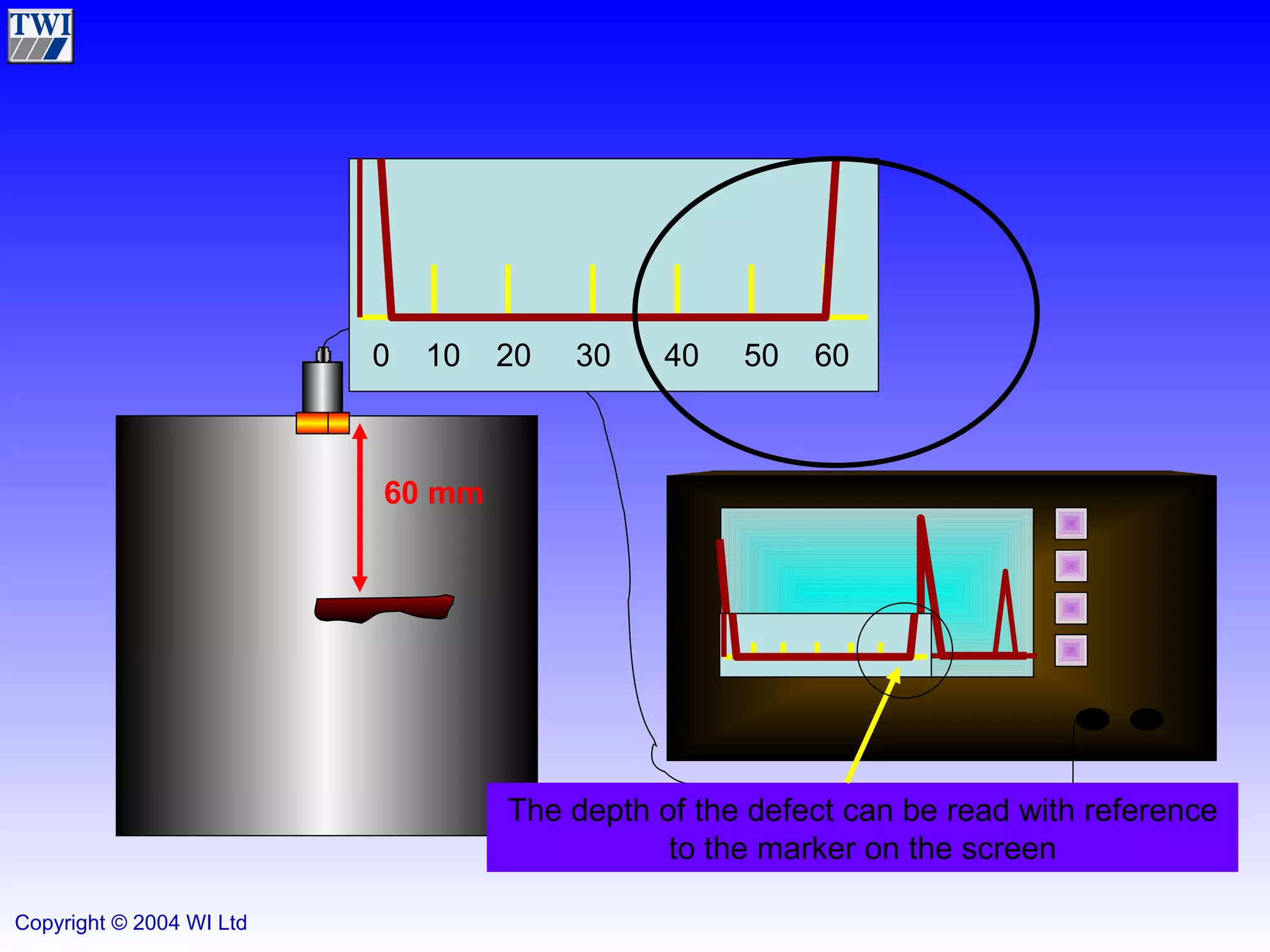
The depth of the defect can be read with reference to the marker on the screen 60 mm 0  10  20  30  40  50  60
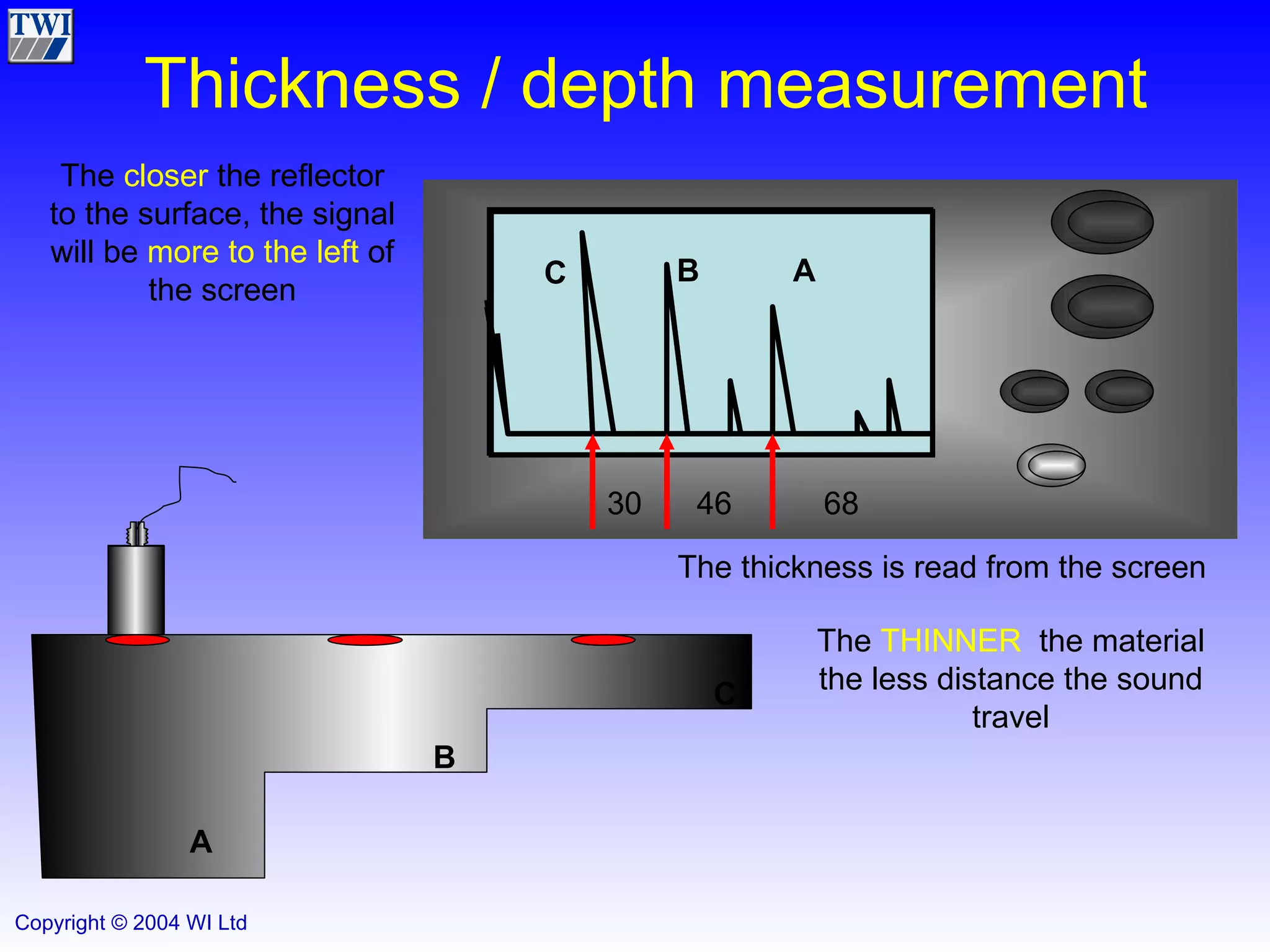
Thickness / depth measurement A A B B C C The  THINNER   the material the less distance the sound travel The  closer  the reflector to the surface, the signal will be  more to the left  of the screen The thickness is read from the screen 68 46 30
Ultrasonic Testing Principles of Sound
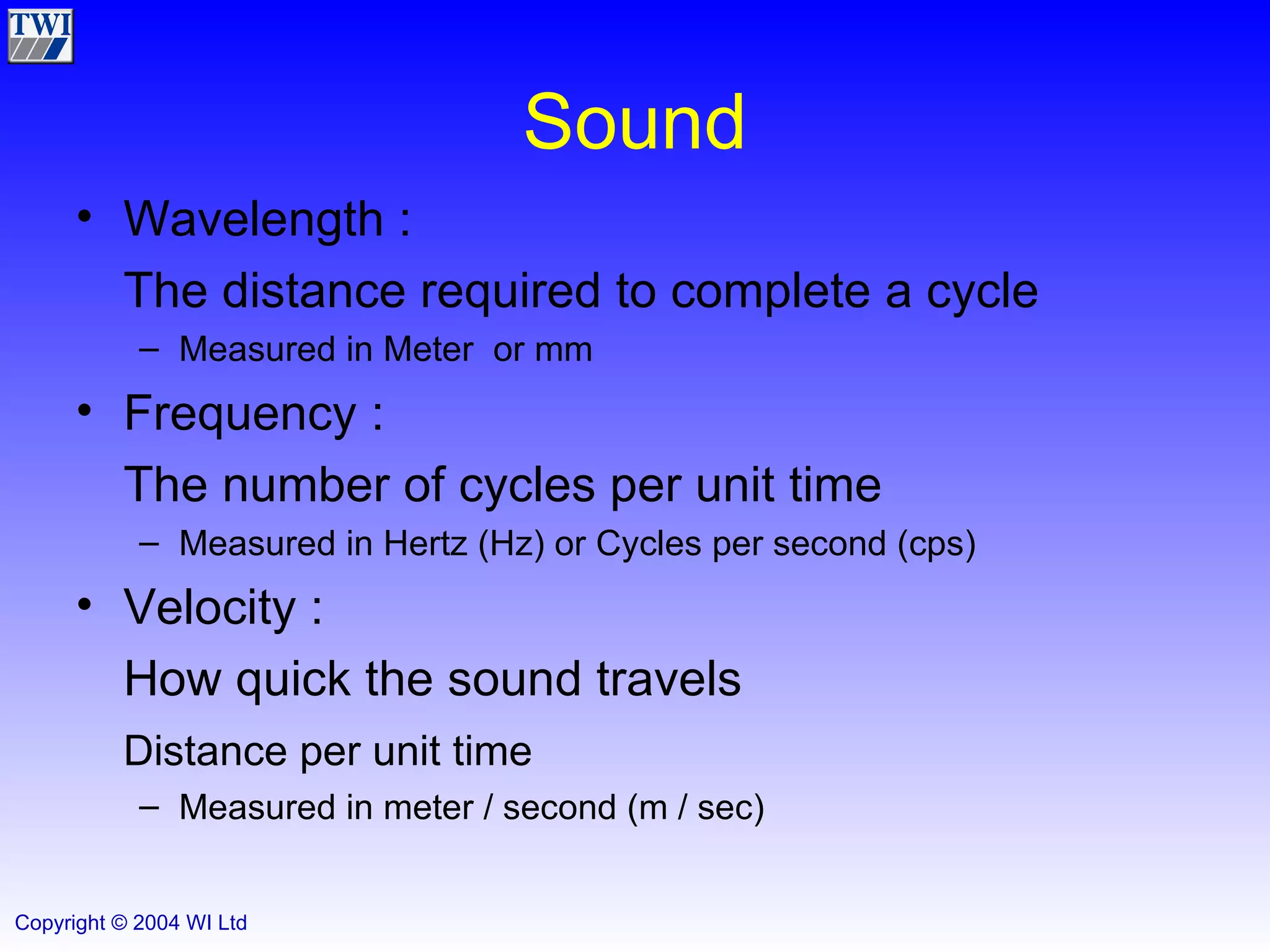
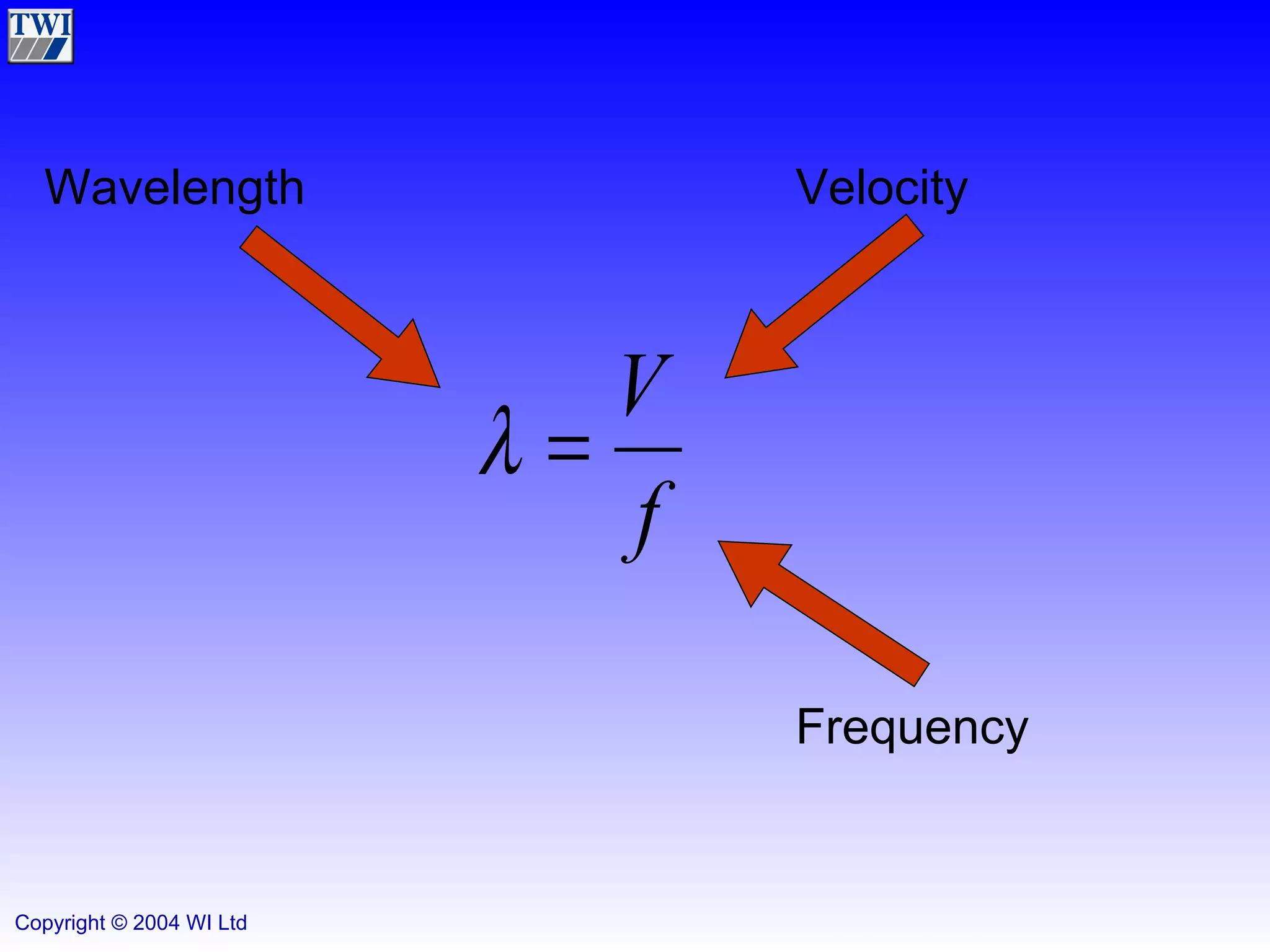
Sound Wavelength :  The distance required to complete a cycle Measured in Meter  or mm Frequency :  The number of cycles per unit time Measured in Hertz (Hz) or Cycles per second (cps) Velocity :  How quick the sound travels  Distance per unit time Measured in meter / second (m / sec)
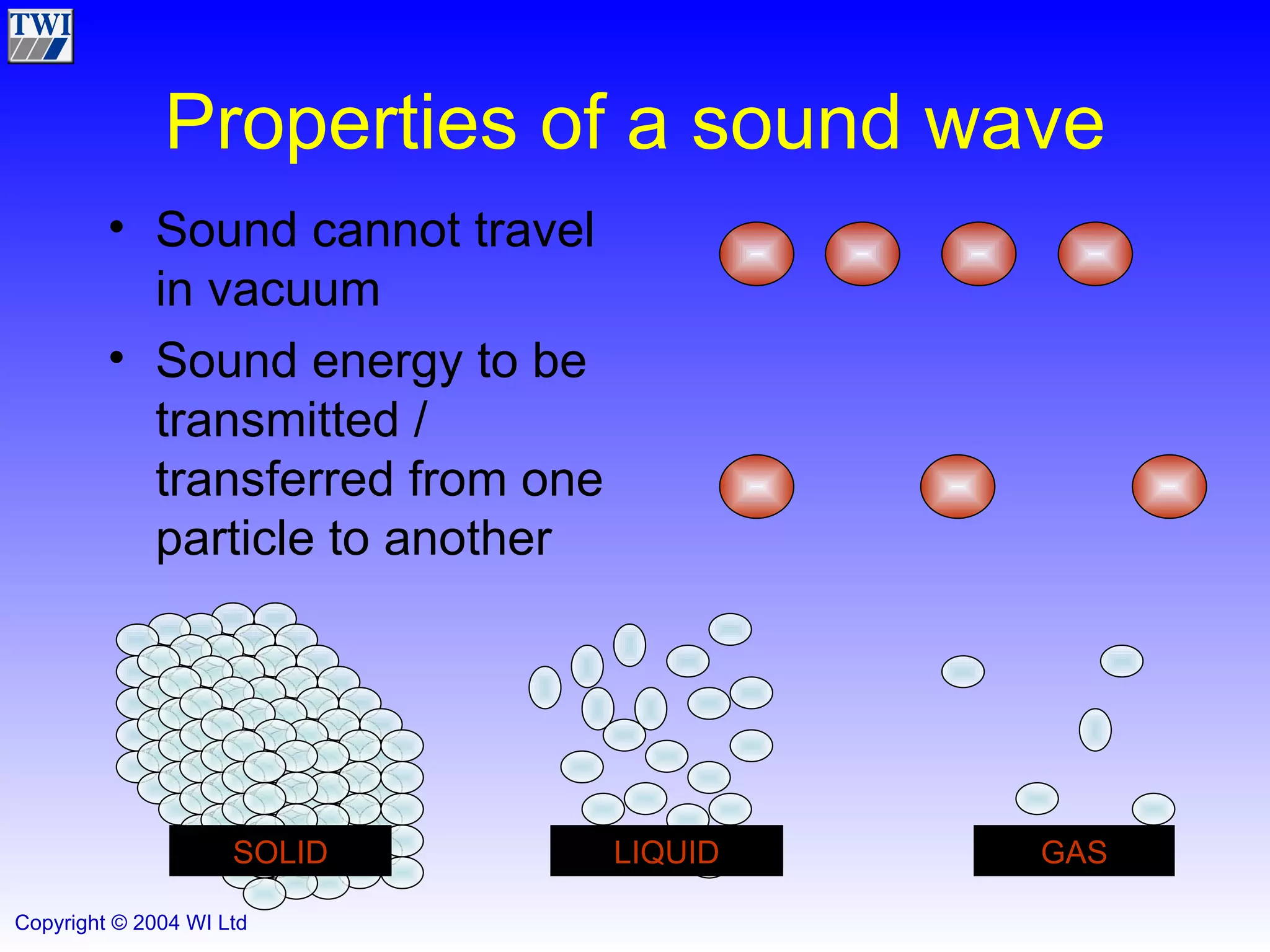
Properties of a sound wave Sound cannot travel in  vacuum Sound energy to be transmitted / transferred from one particle to another SOLID LIQUID GAS
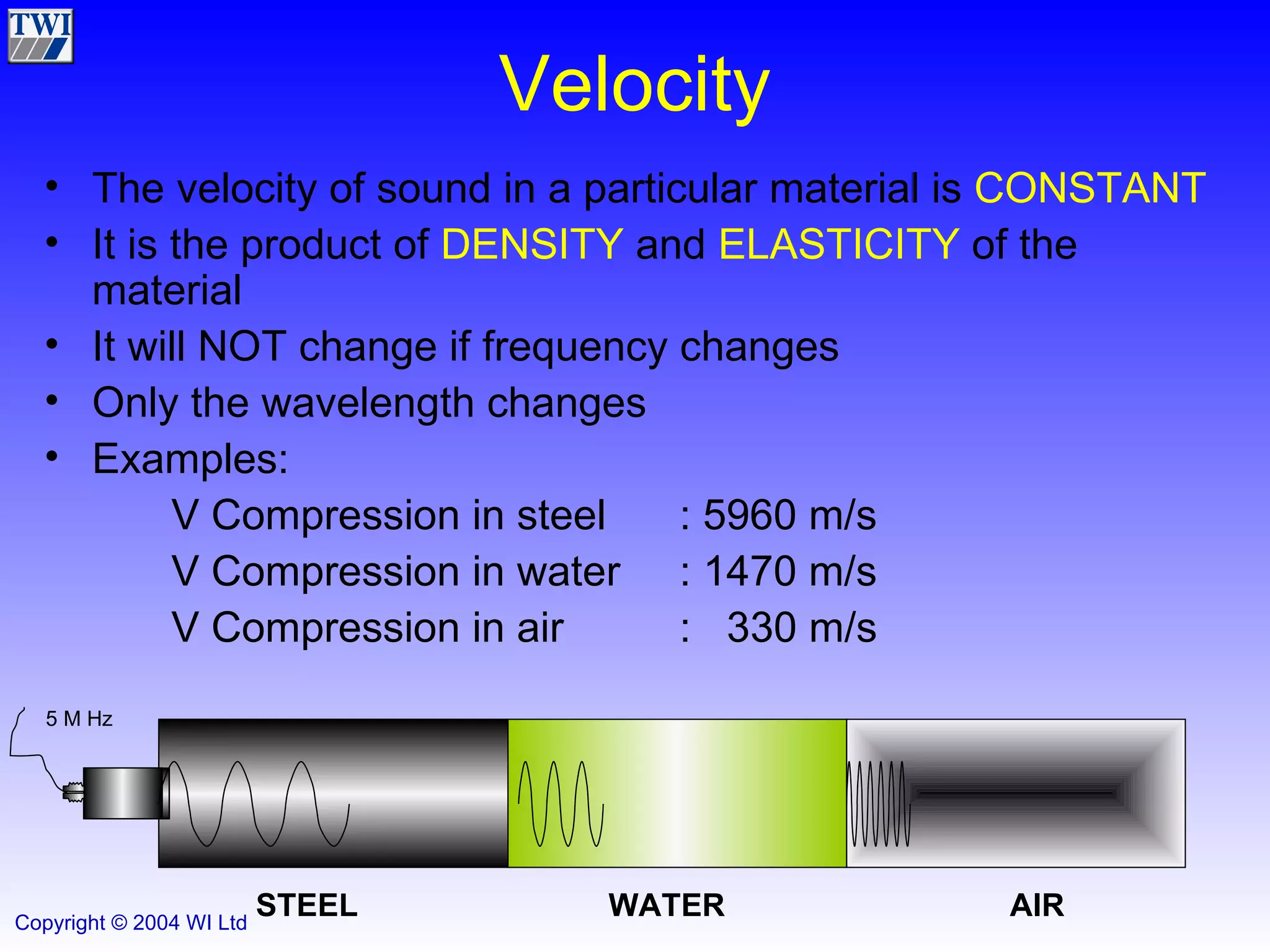
Velocity The velocity of sound in a particular material is  CONSTANT It is the product of  DENSITY  and  ELASTICITY  of the material It will NOT change if frequency changes Only the wavelength changes Examples: V Compression in steel  : 5960 m/s V Compression in water  : 1470 m/s V Compression in air :  330 m/s STEEL WATER AIR 5 M Hz
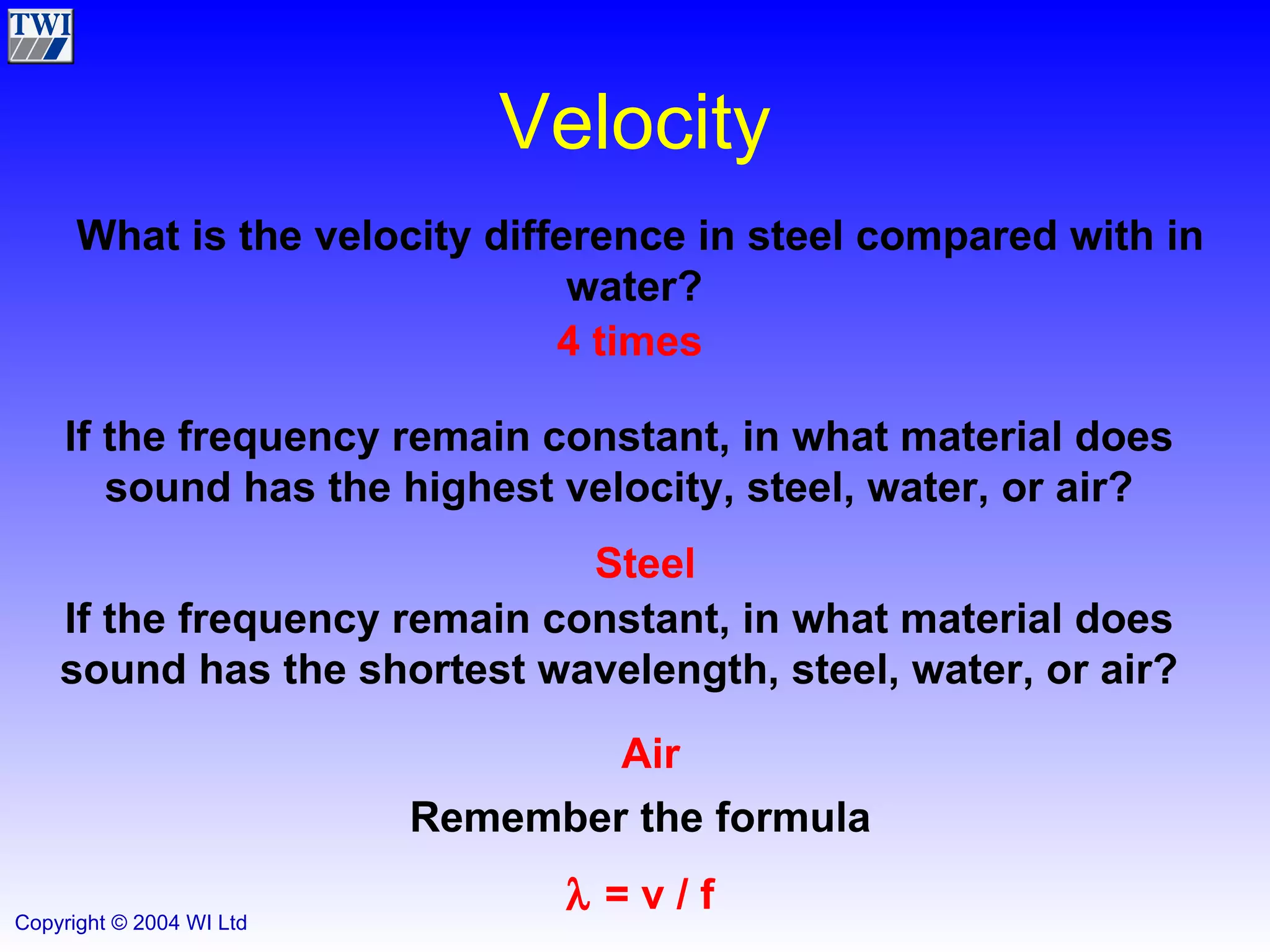
Velocity 4 times What is the velocity difference in steel compared with in water?  If the frequency remain constant, in what material does sound has the highest velocity, steel, water, or air? Steel If the frequency remain constant, in what material does sound has the shortest wavelength, steel, water, or air? Air Remember the formula    = v / f
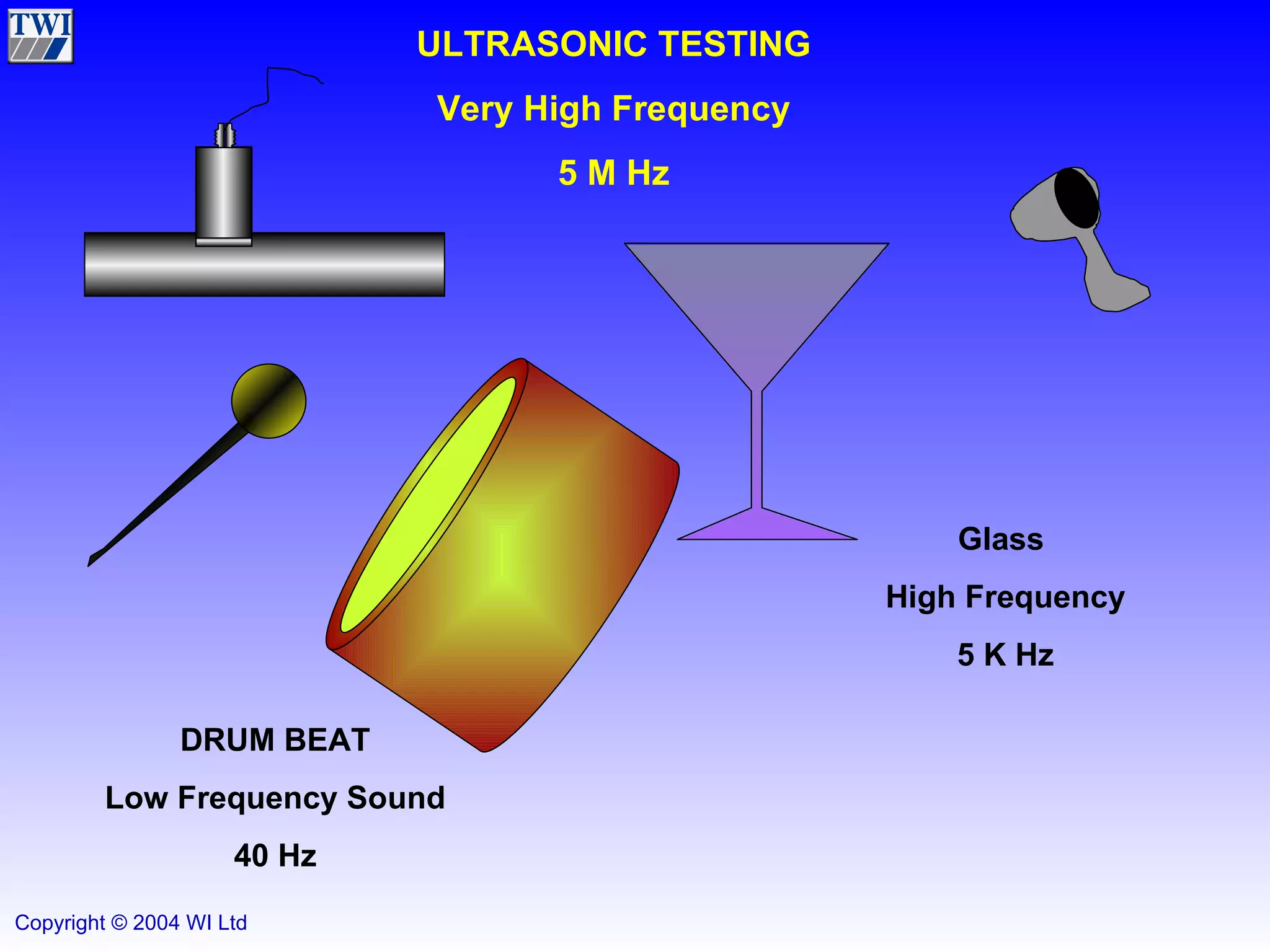
DRUM BEAT Low Frequency Sound 40 Hz Glass  High Frequency 5 K Hz ULTRASONIC TESTING Very High Frequency 5 M Hz
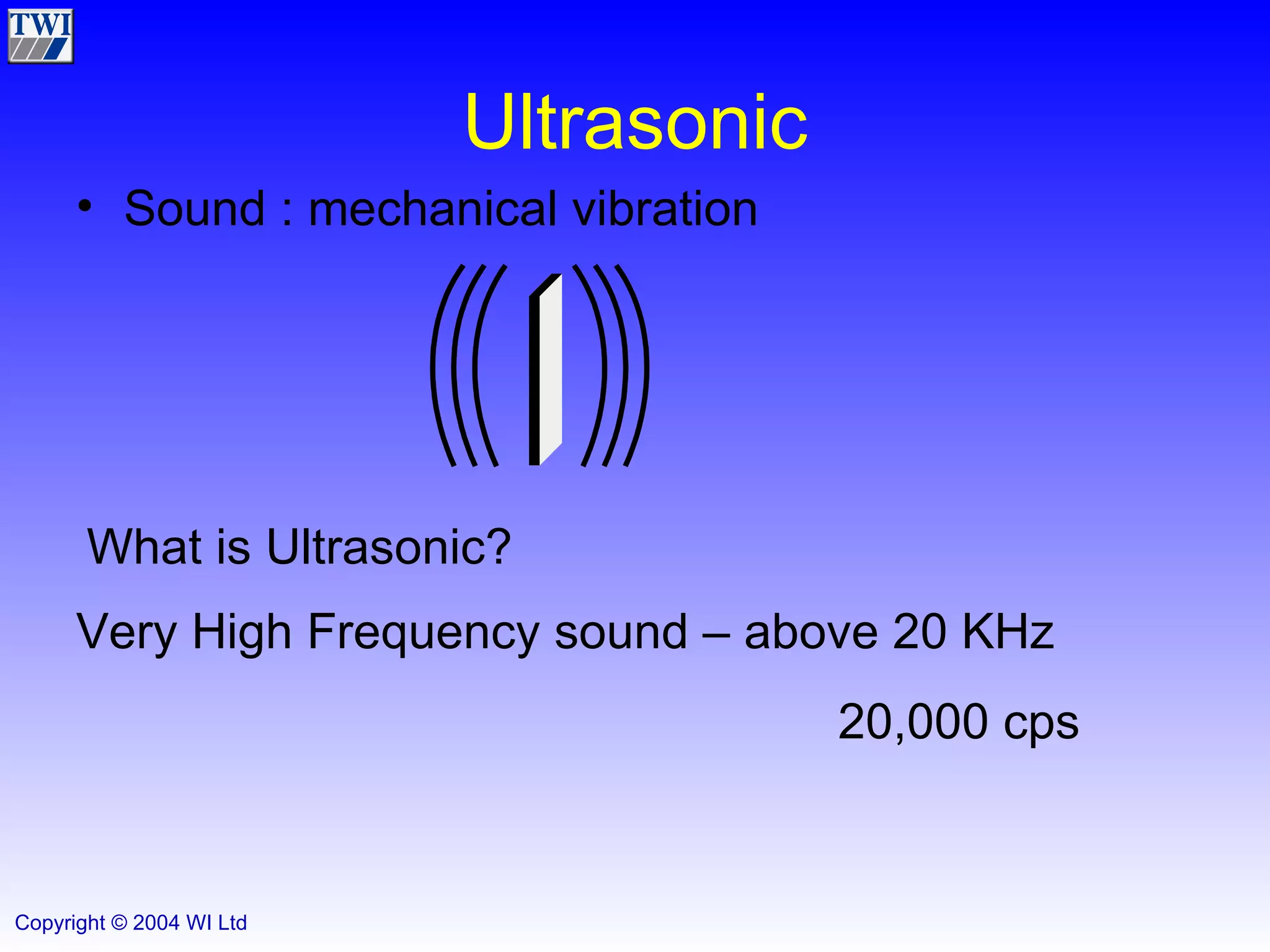
Ultrasonic Sound : mechanical vibration What is Ultrasonic? Very High Frequency sound – above 20 KHz 20,000 cps
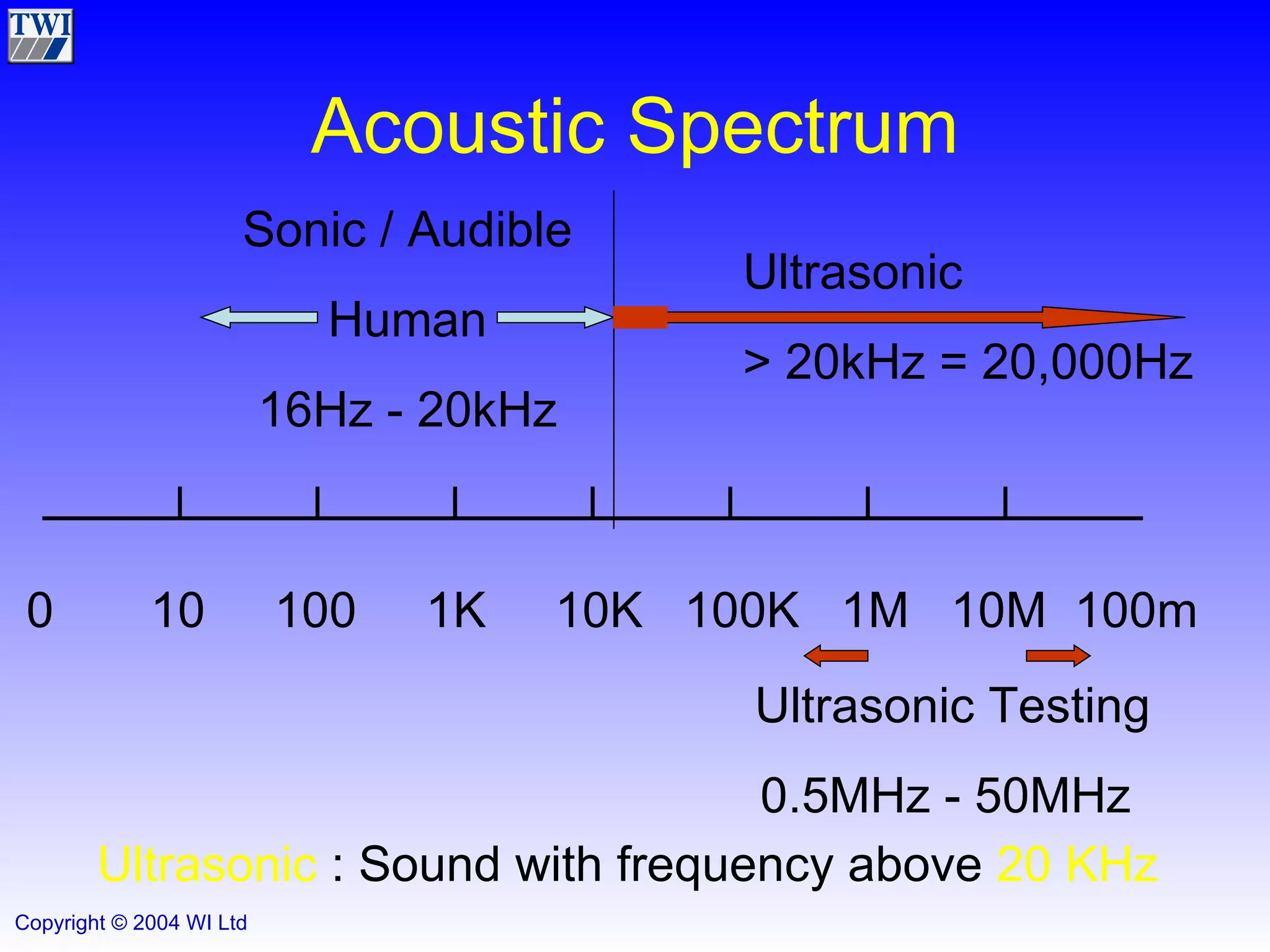
Acoustic Spectrum 0  10  100  1K  10K  100K  1M  10M  100m  Sonic / Audible Human 16Hz - 20kHz Ultrasonic  > 20kHz = 20,000Hz Ultrasonic Testing 0.5MHz - 50MHz  Ultrasonic  : Sound with frequency above  20 KHz
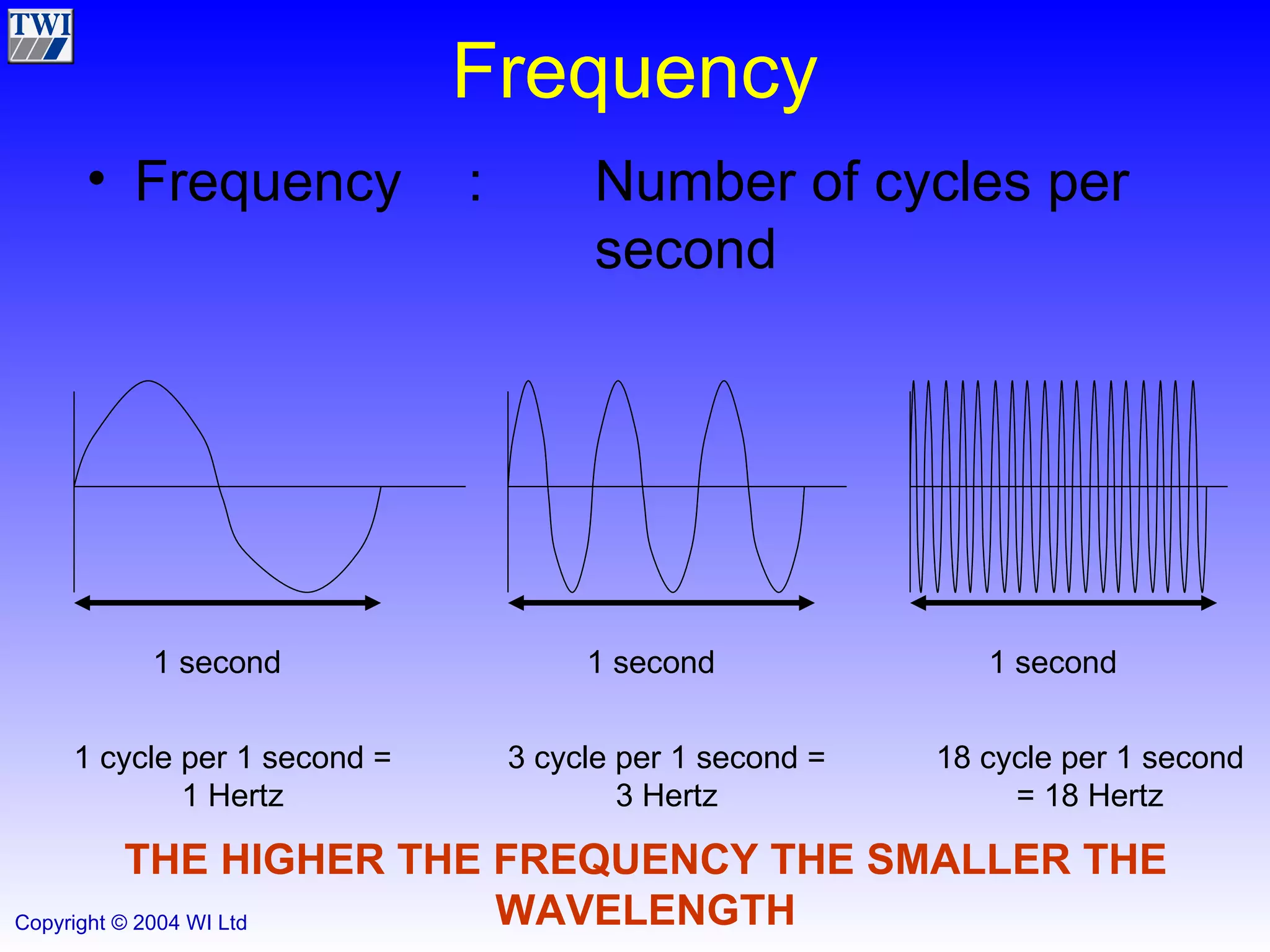
Frequency Frequency : Number of cycles per  second 1 second 1 cycle per 1 second = 1 Hertz 18 cycle per 1 second = 18 Hertz 3 cycle per 1 second = 3 Hertz THE HIGHER THE FREQUENCY THE SMALLER THE WAVELENGTH 1 second 1 second
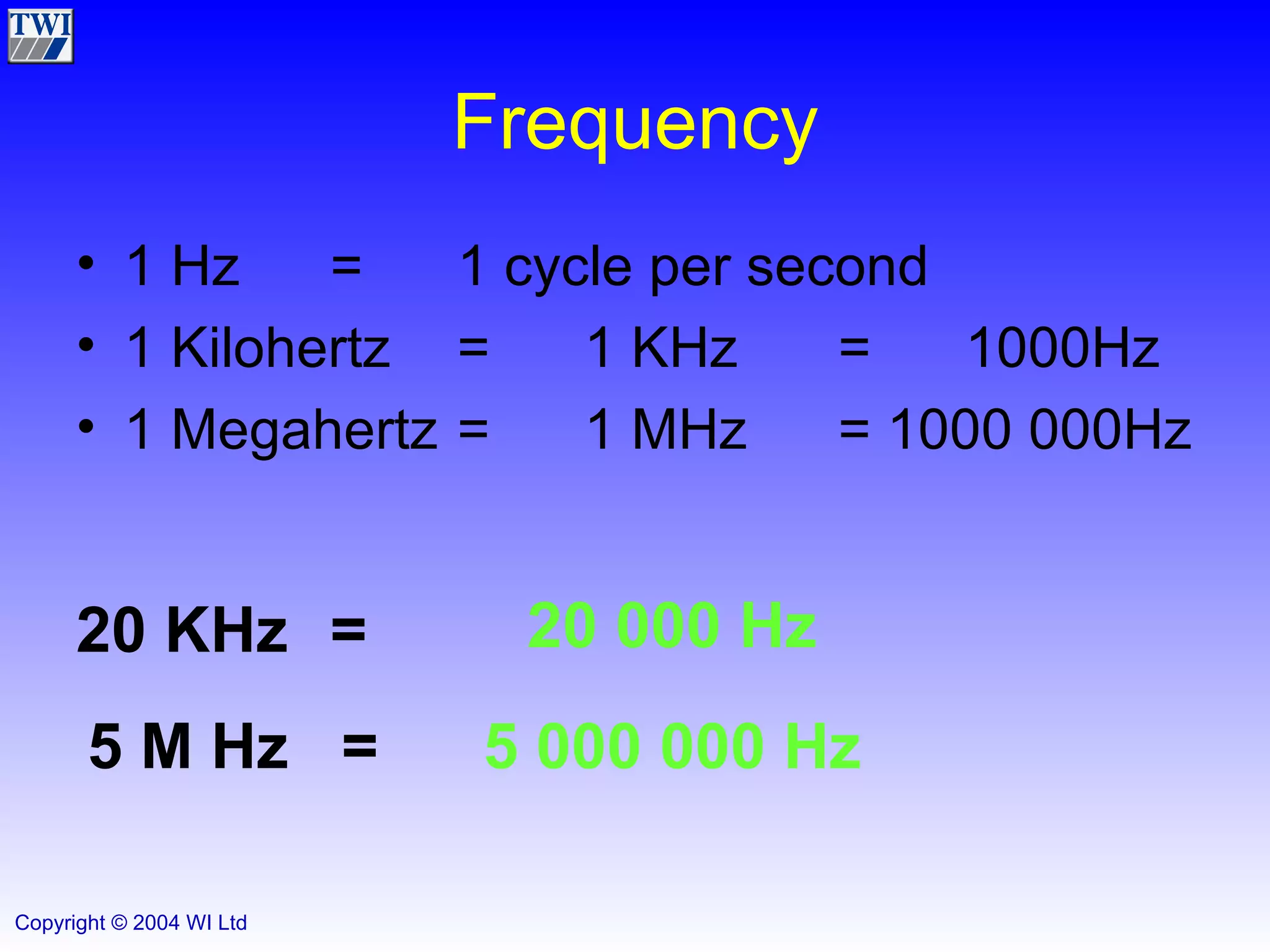
Frequency 1 Hz = 1 cycle per second 1 Kilohertz = 1 KHz = 1000Hz 1 Megahertz = 1 MHz = 1000 000Hz 20 KHz = 20 000 Hz 5 M Hz = 5 000 000 Hz
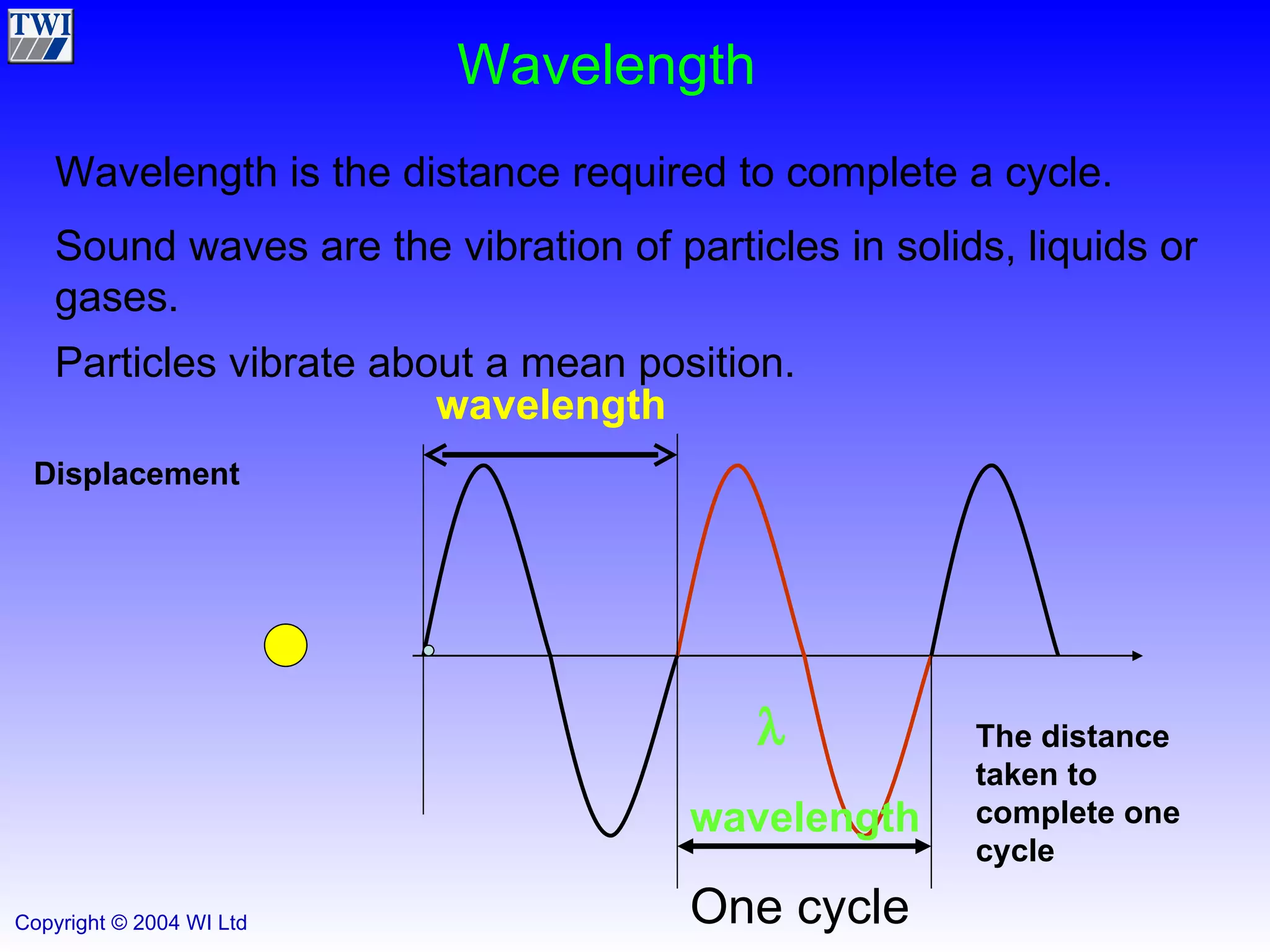
Sound waves are the vibration of particles in solids, liquids or gases.  Particles vibrate about a mean position. One cycle Displacement The distance taken to complete one cycle wavelength  wavelength Wavelength Wavelength is the distance required to complete a cycle.
Velocity Frequency Wavelength
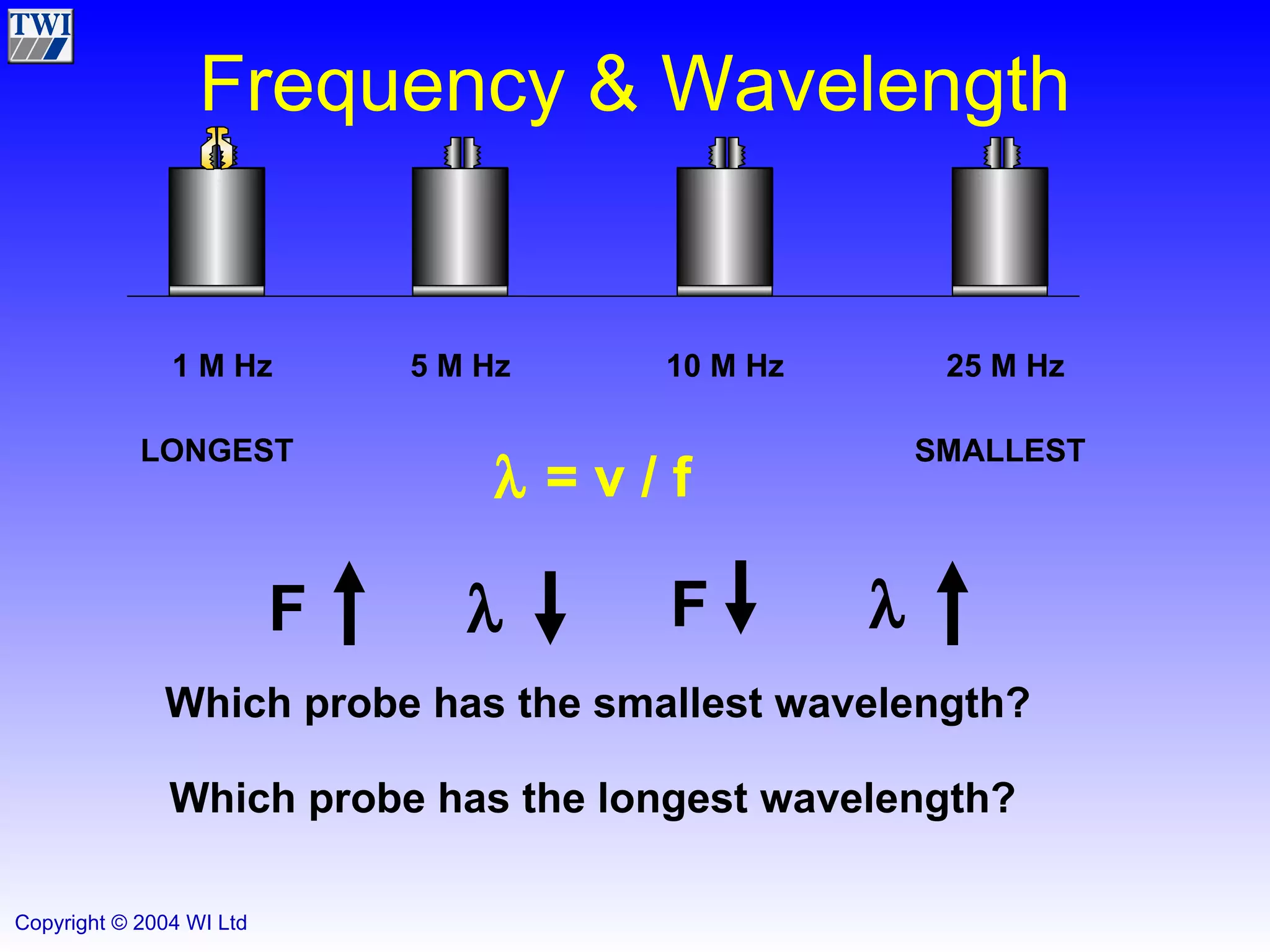
Frequency & Wavelength 1 M Hz 5 M Hz 10 M Hz 25 M Hz Which probe has the smallest wavelength? SMALLEST LONGEST Which probe has the longest wavelength?    = v / f F   F  
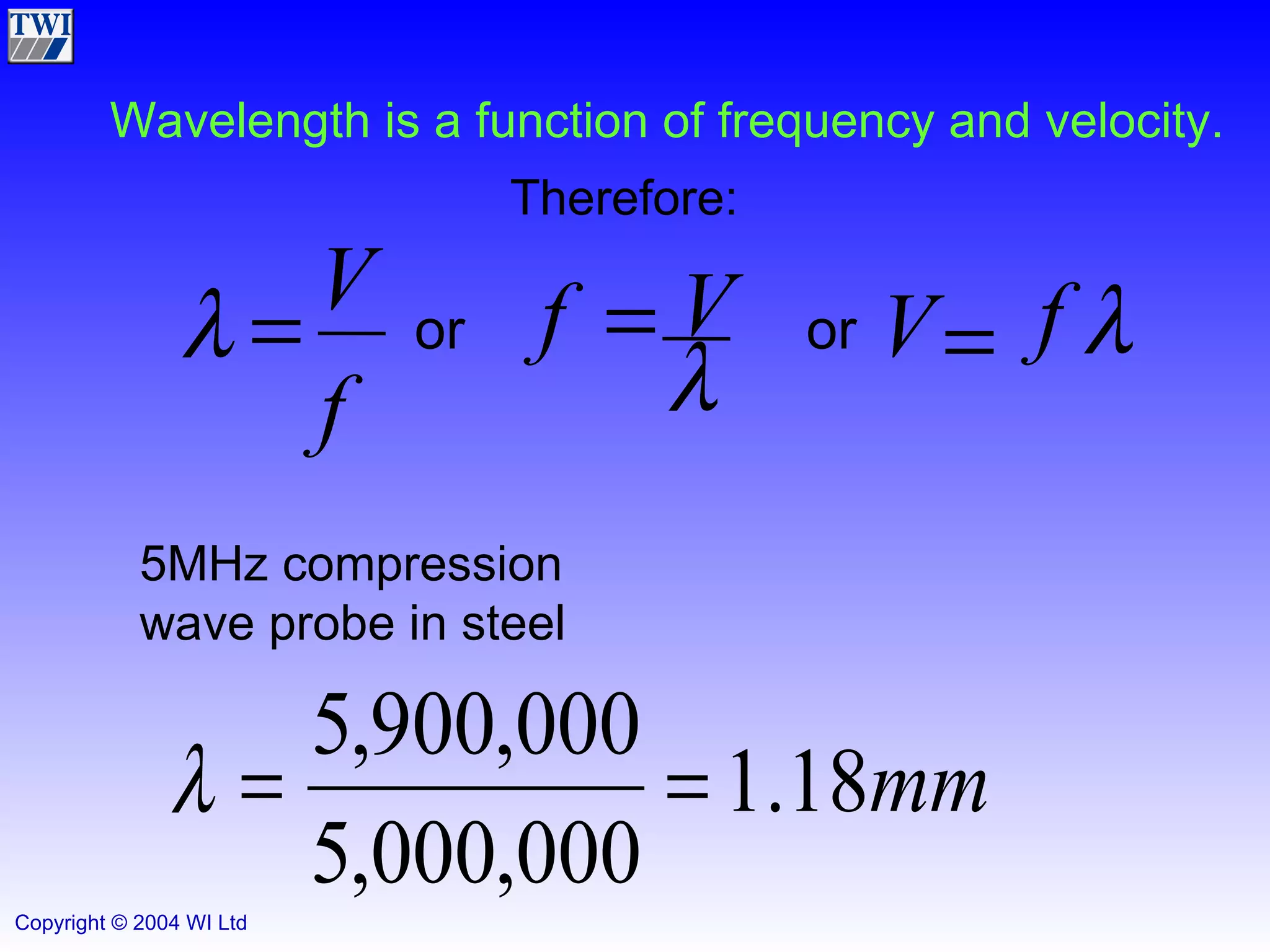
Wavelength is a function of frequency and velocity. 5MHz compression wave probe in steel Therefore: or or f V   V   f V  f 
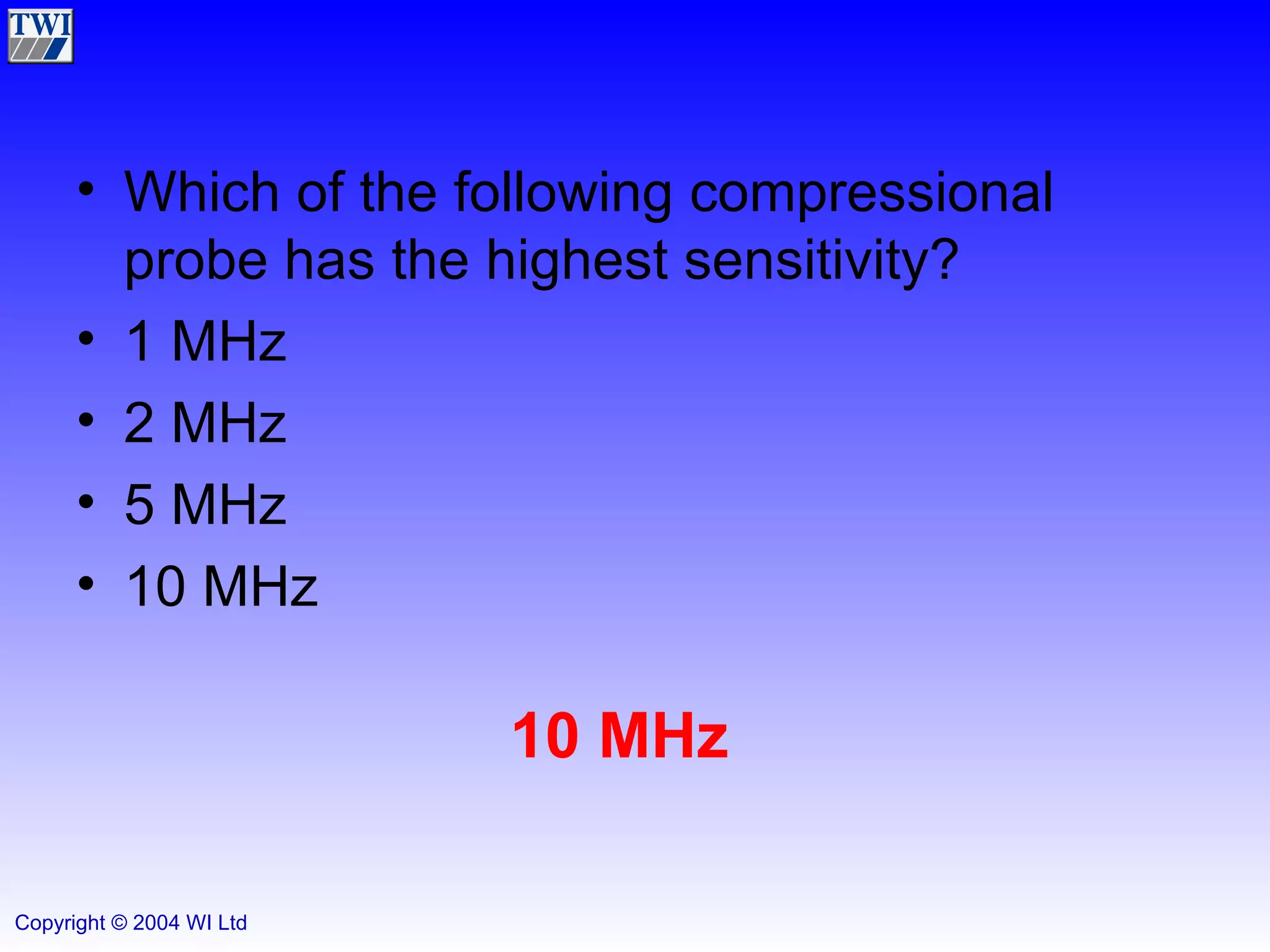
Which of the following compressional probe has the highest sensitivity? 1 MHz 2 MHz 5 MHz 10 MHz 10 MHz
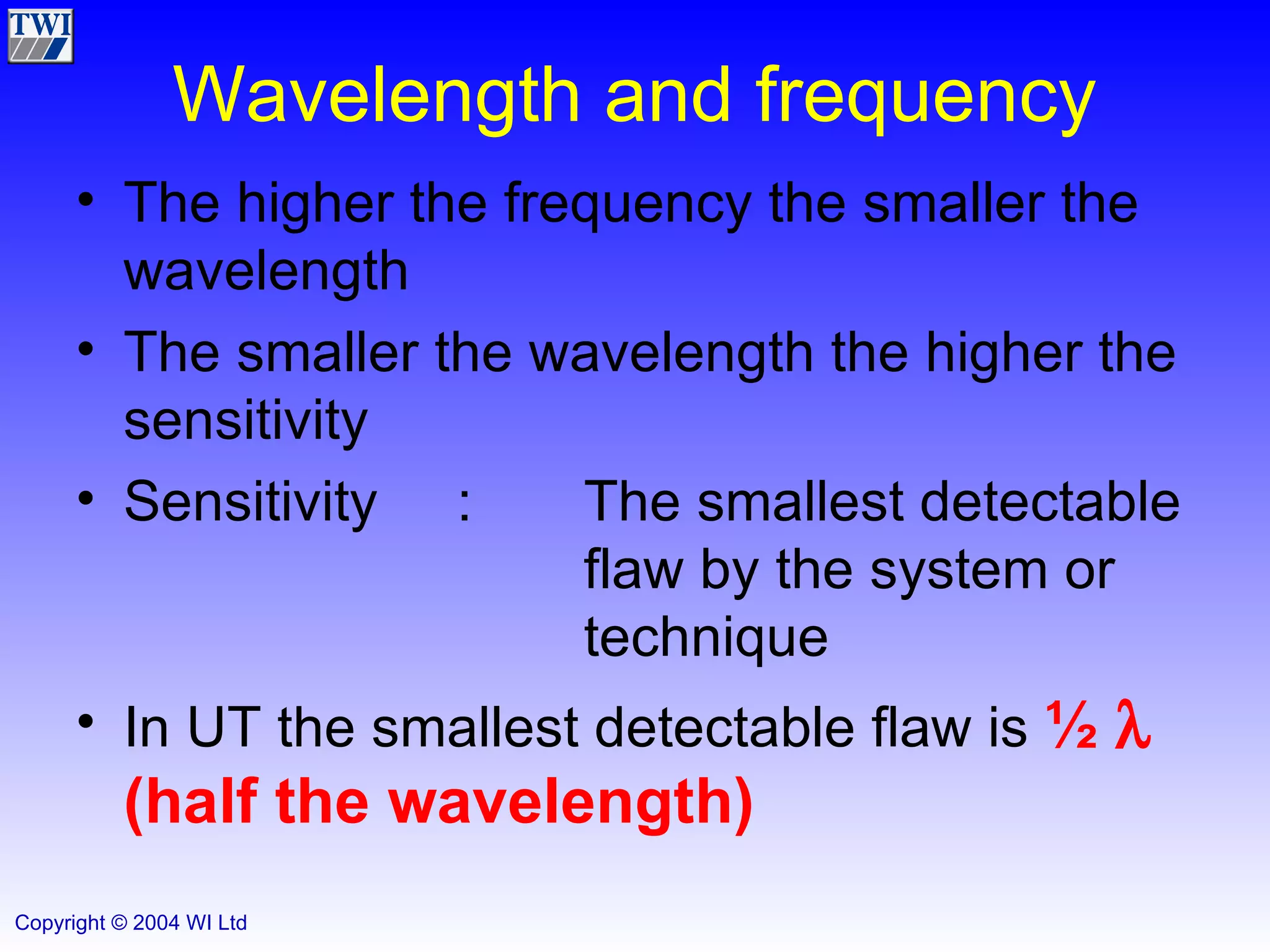
Wavelength and frequency The higher the frequency the smaller the wavelength The smaller the wavelength the higher the sensitivity Sensitivity : The smallest detectable  flaw by the system or  technique In UT the smallest detectable flaw is  ½     (half the wavelength)
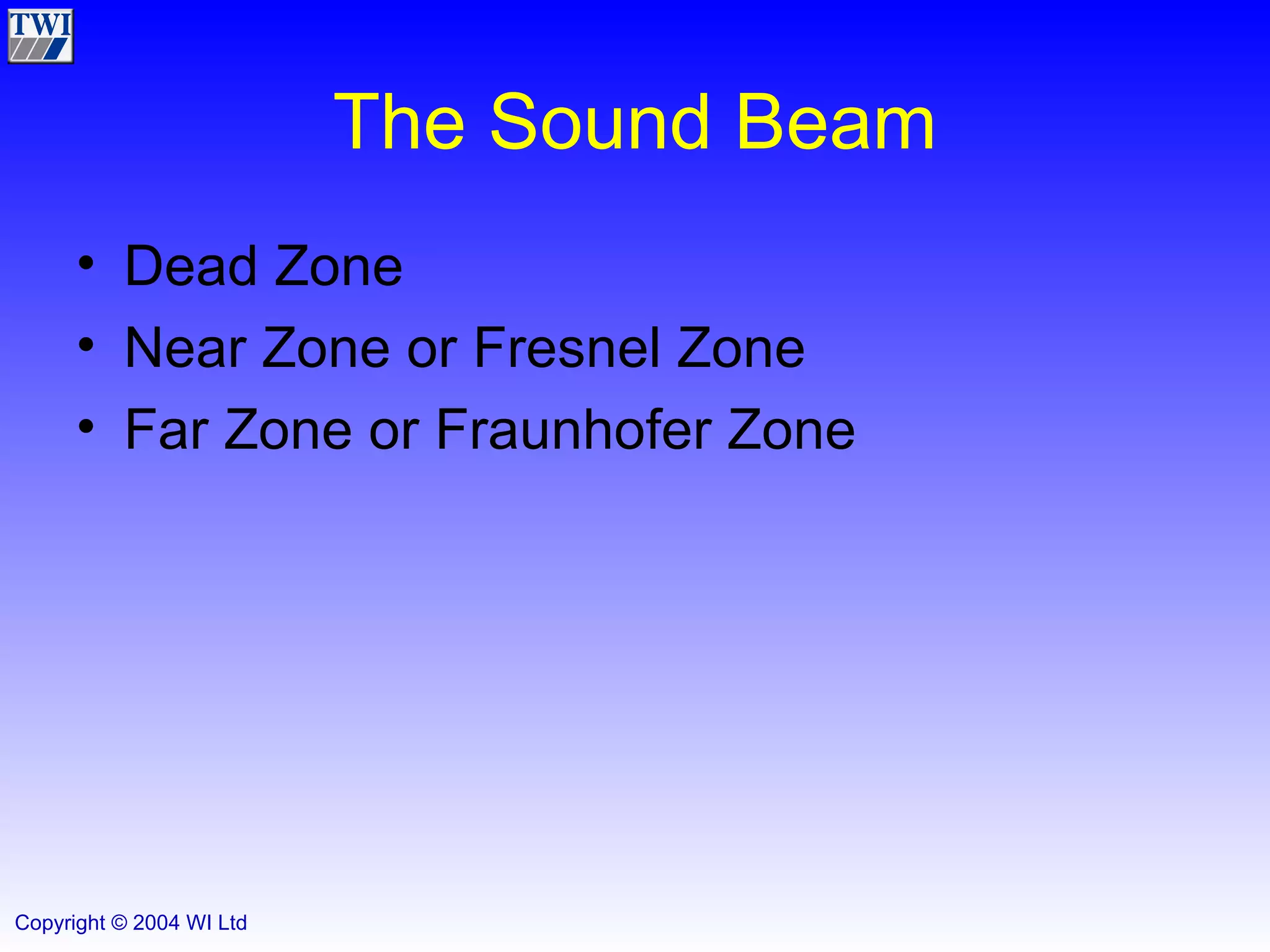
The Sound Beam Dead Zone Near Zone or Fresnel Zone Far Zone or Fraunhofer Zone
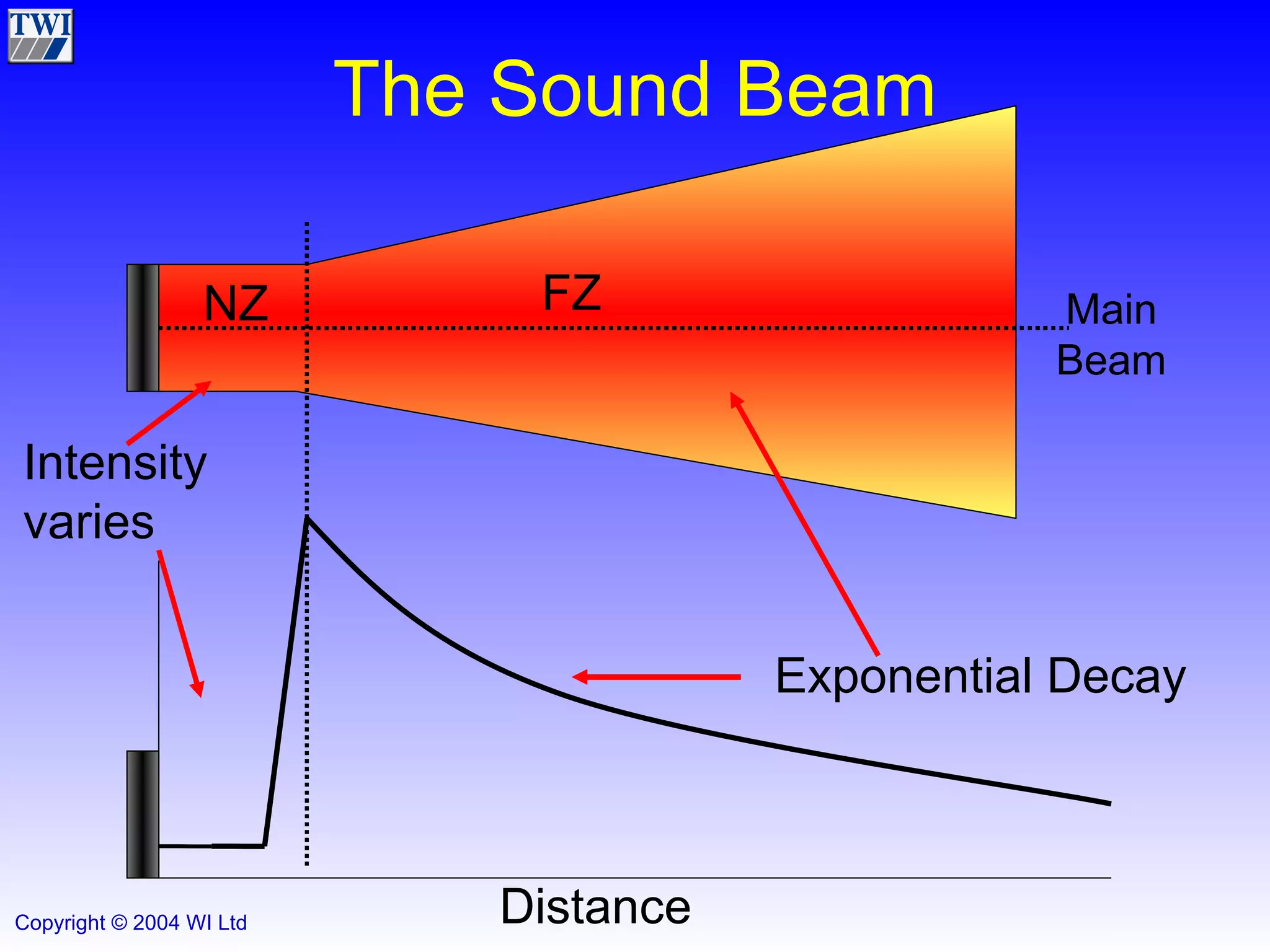
The Sound Beam NZ FZ Main Beam Distance Intensity varies Exponential Decay
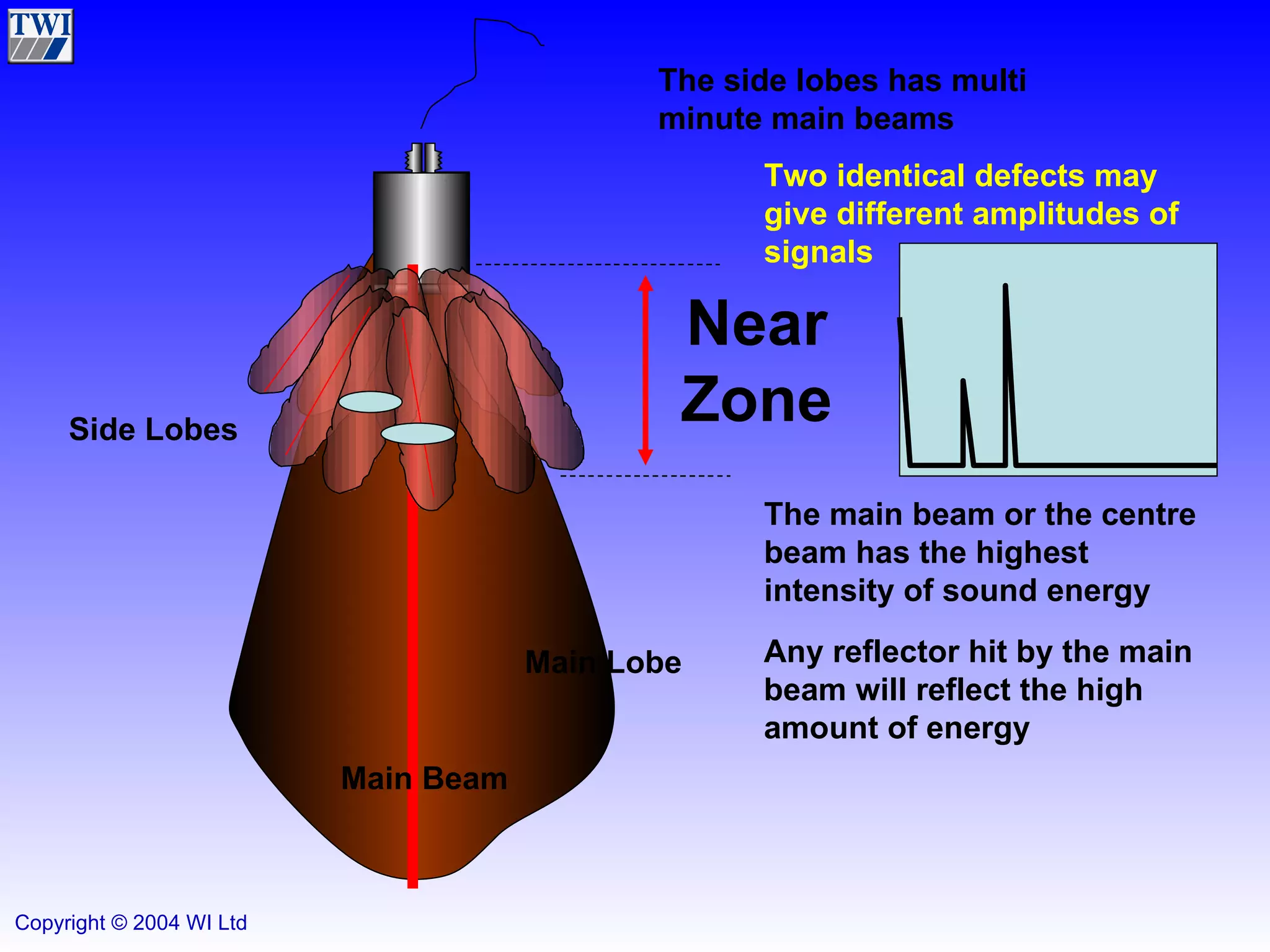
Main Lobe Side Lobes Near Zone Main Beam The main beam or the centre beam has the highest intensity of sound energy Any reflector hit by the main beam will reflect the high amount of energy The side lobes has multi minute main beams Two identical defects may give different amplitudes of signals
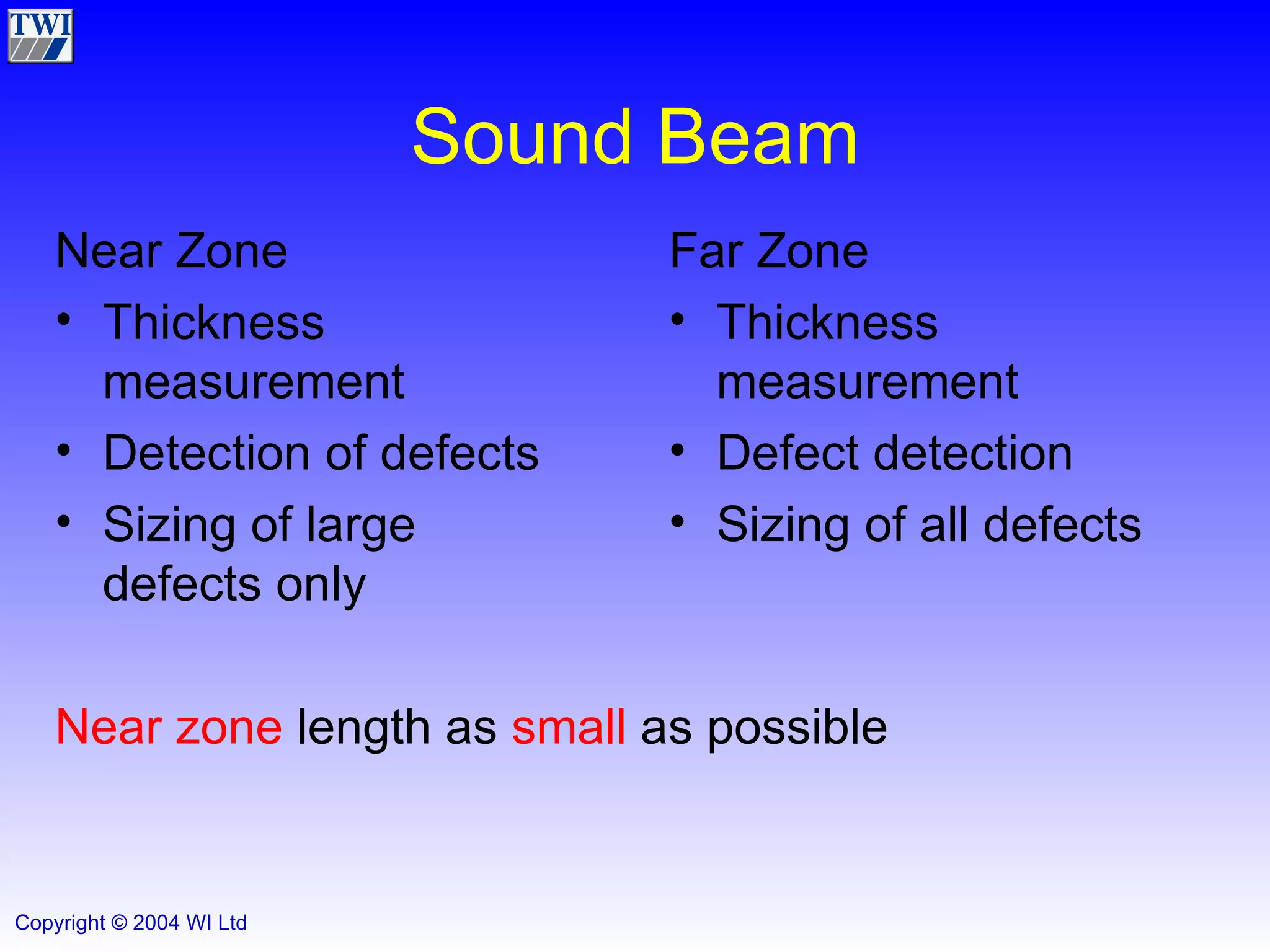
Sound Beam Near Zone Thickness measurement Detection of defects Sizing of large defects only Far Zone Thickness measurement Defect detection Sizing of all defects Near zone  length as  small  as possible
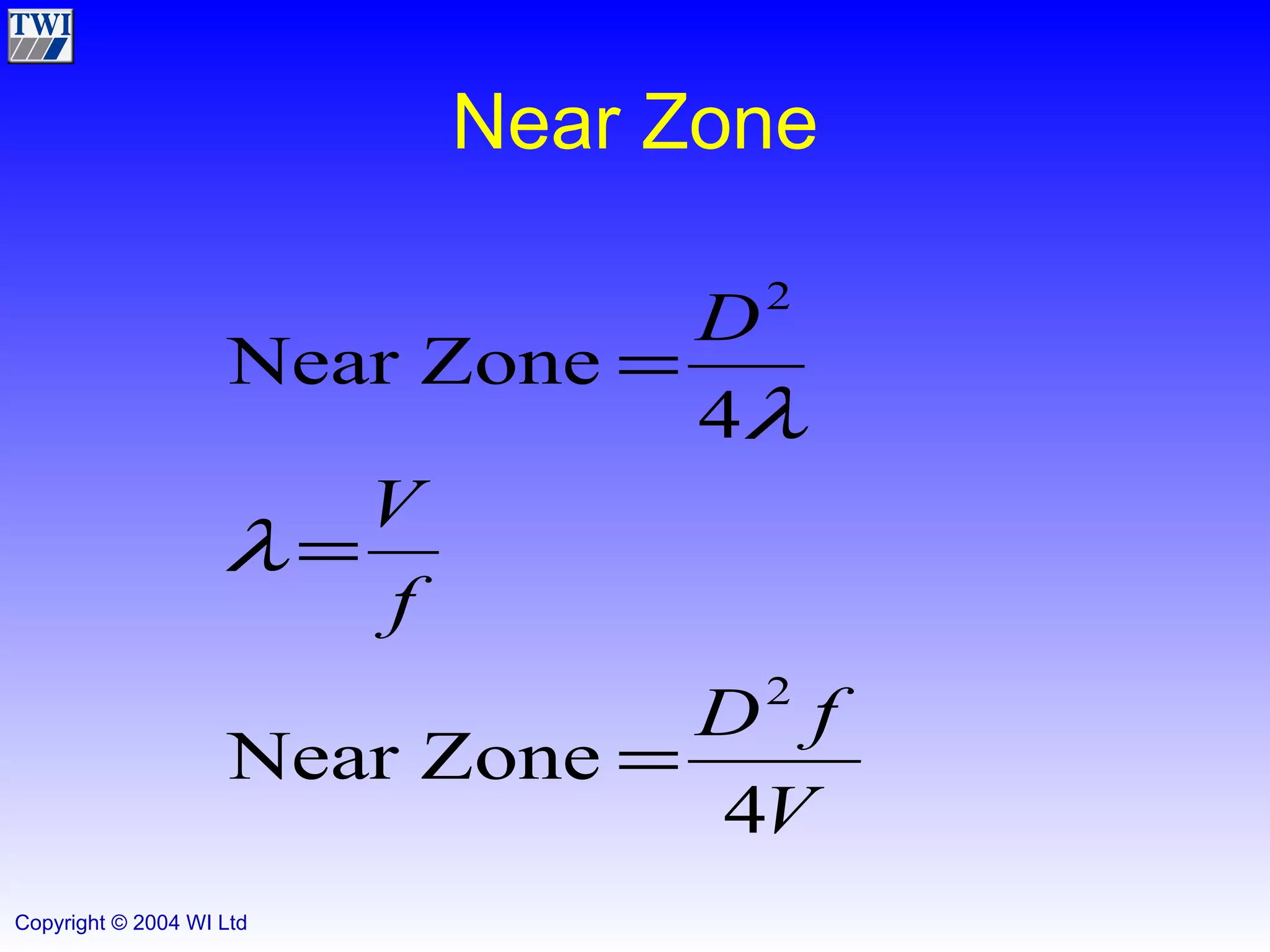
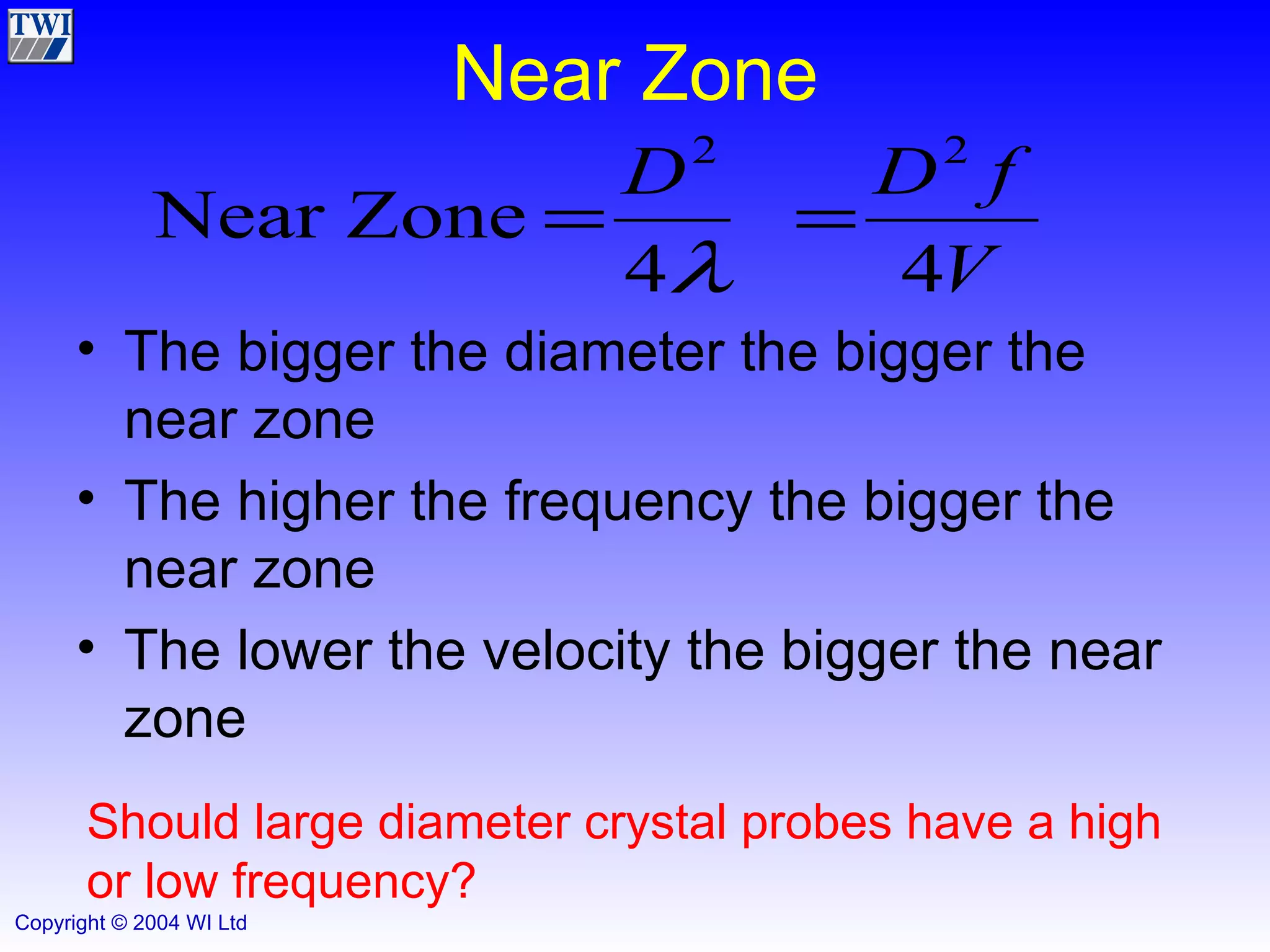
Near Zone
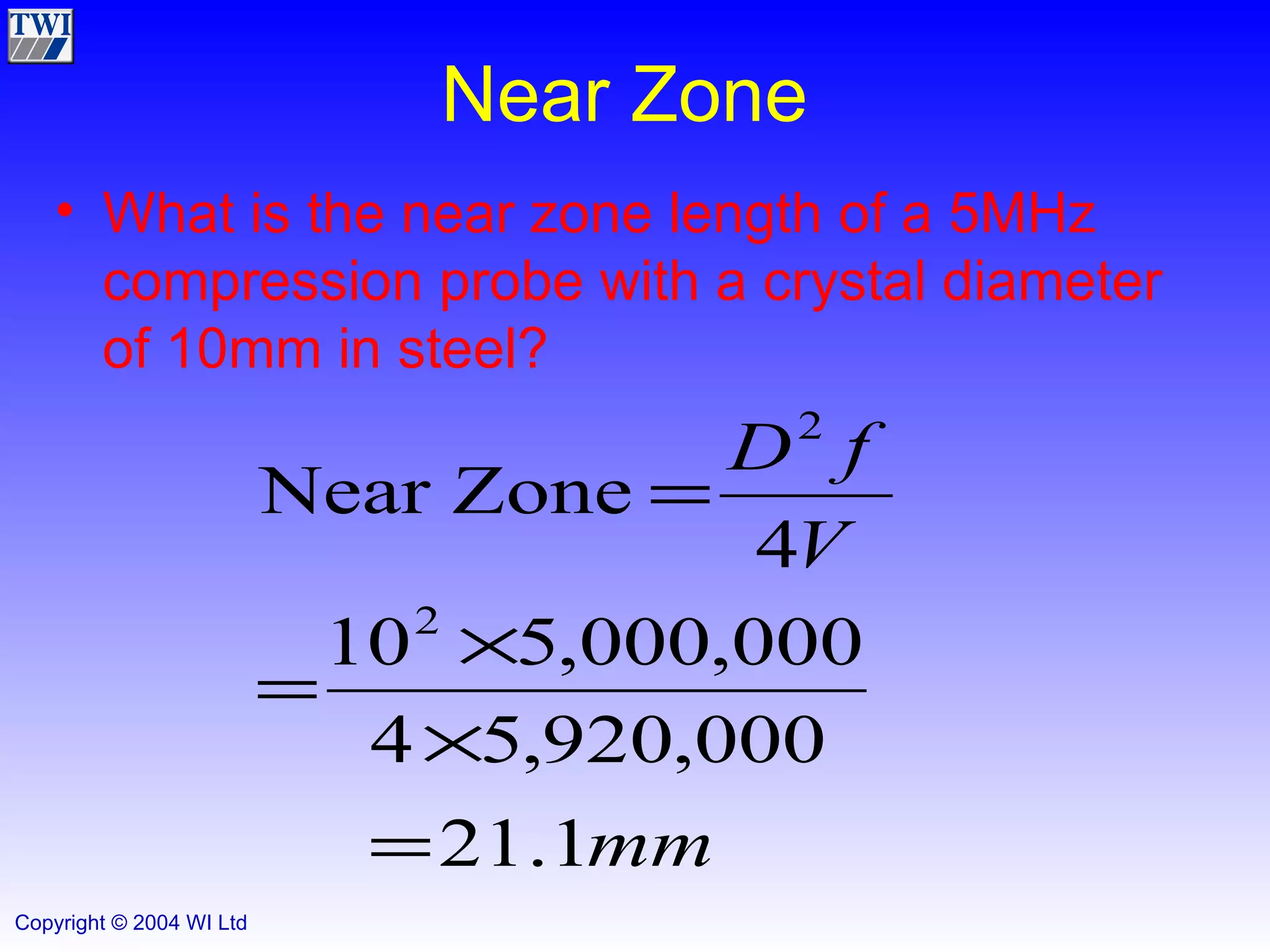
Near Zone What is the near zone length of a 5MHz compression probe with a crystal diameter of 10mm in steel?
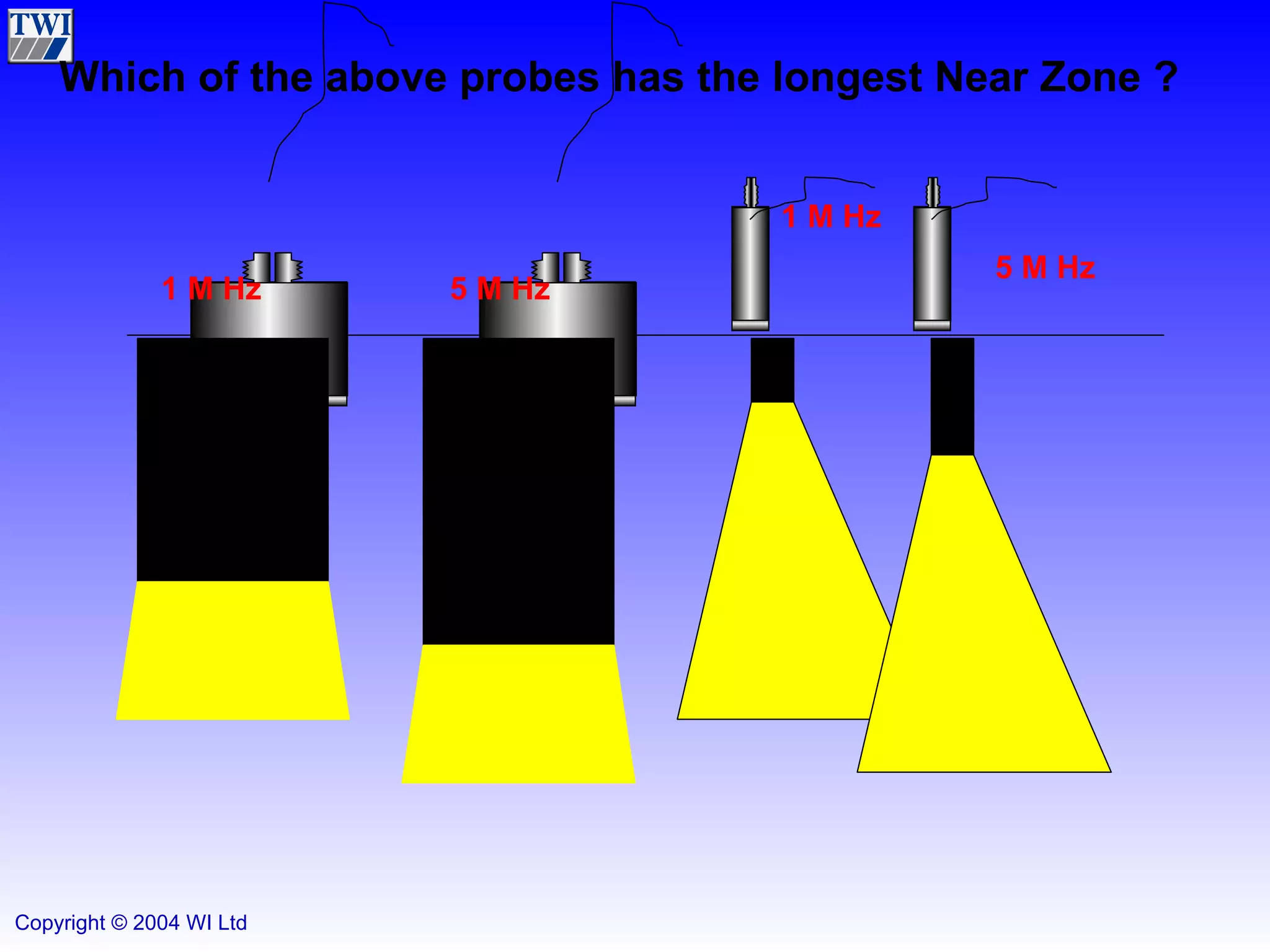
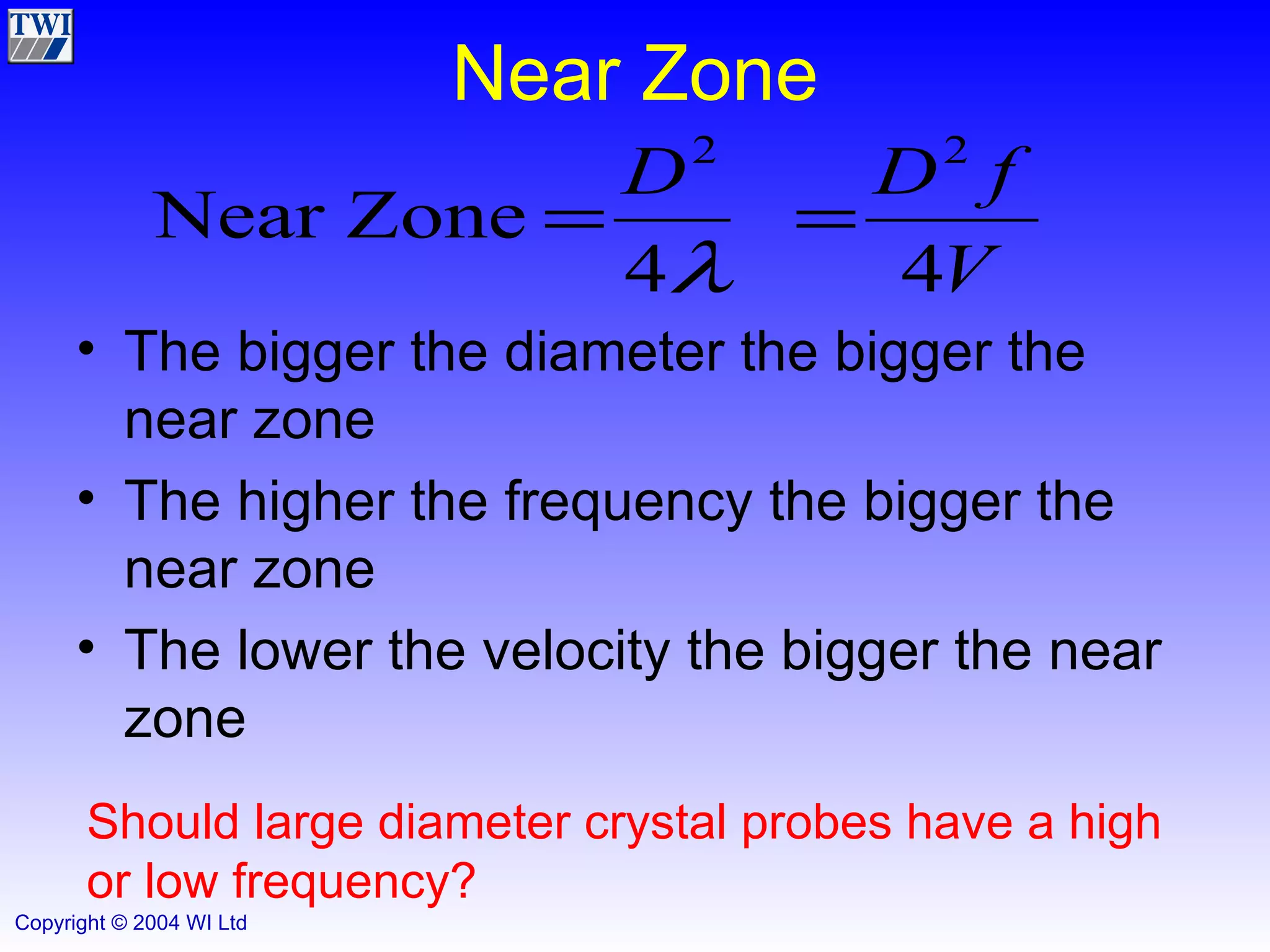
Near Zone The bigger the diameter the bigger the near zone The higher the frequency the bigger the near zone The lower the velocity the bigger the near zone  Should large diameter crystal probes have a high or low frequency?
Which of the above probes has the longest Near Zone ? 1 M Hz 5 M Hz 1 M Hz 5 M Hz
Near Zone The bigger the diameter the bigger the near zone The higher the frequency the bigger the near zone The lower the velocity the bigger the near zone  Should large diameter crystal probes have a high or low frequency?
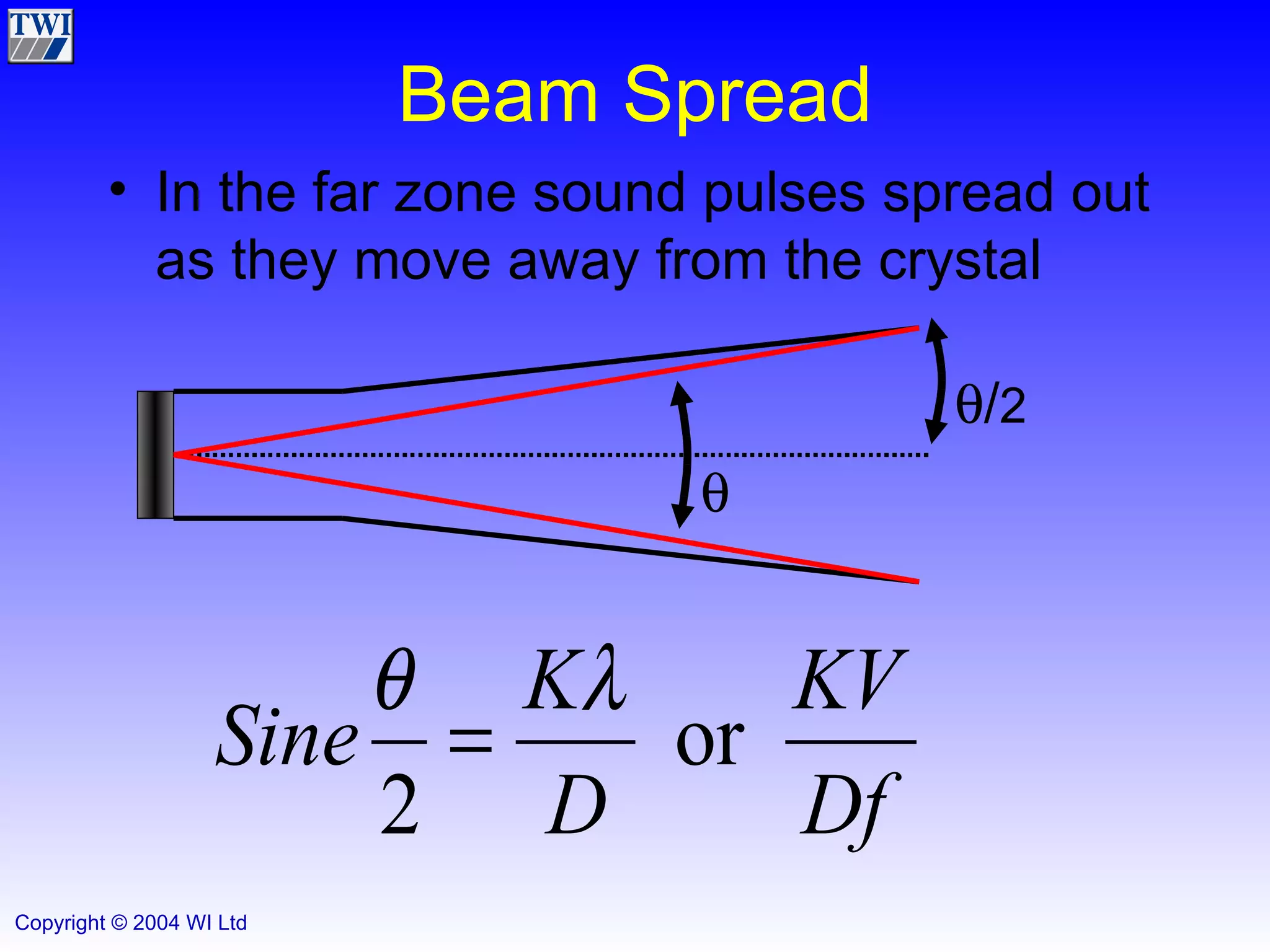
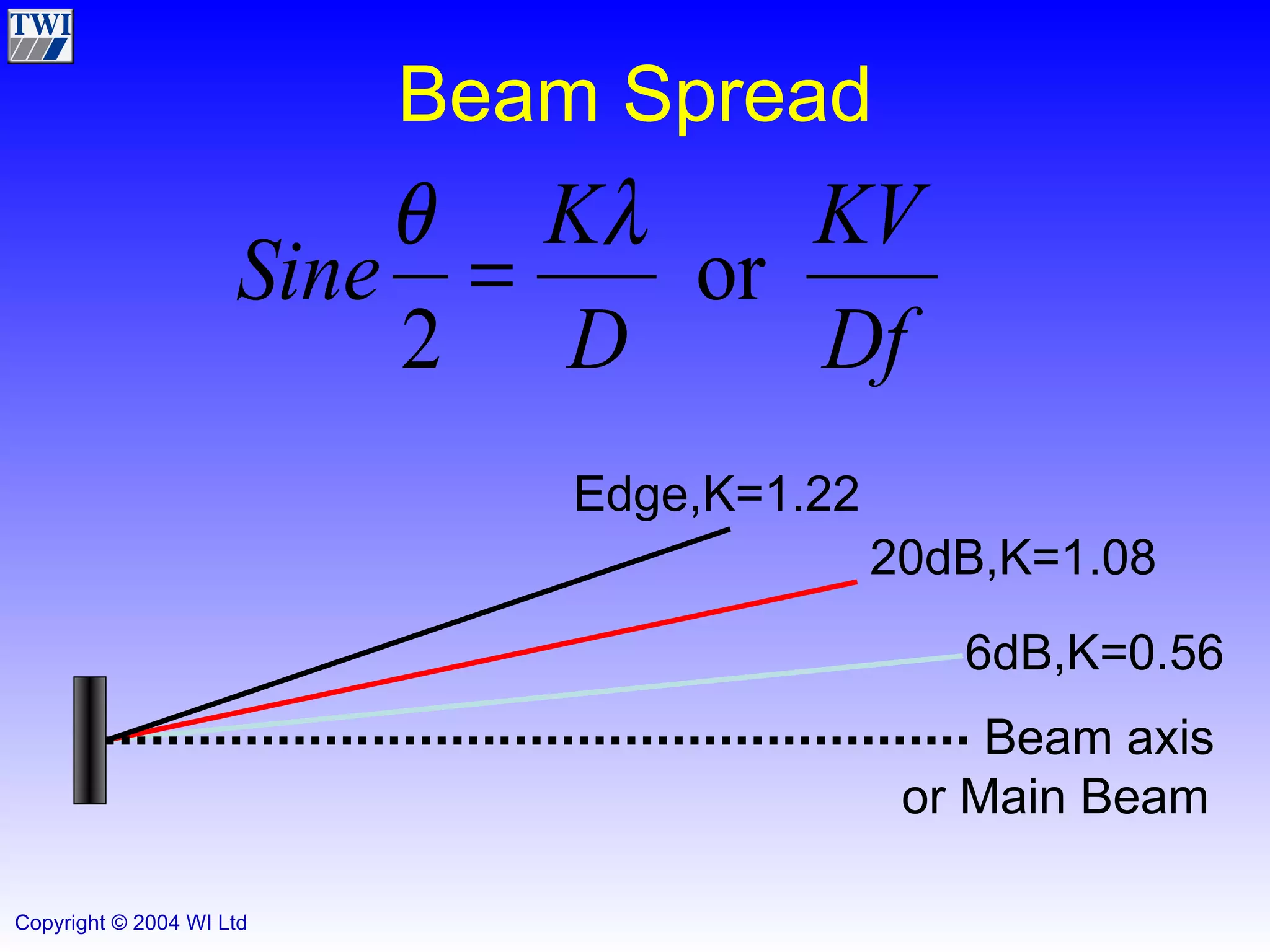
Beam Spread In the far zone sound pulses spread out as they move away from the crystal   / 2
Beam Spread Edge,K=1.22 20dB,K=1.08 6dB,K=0.56 Beam axis or Main Beam
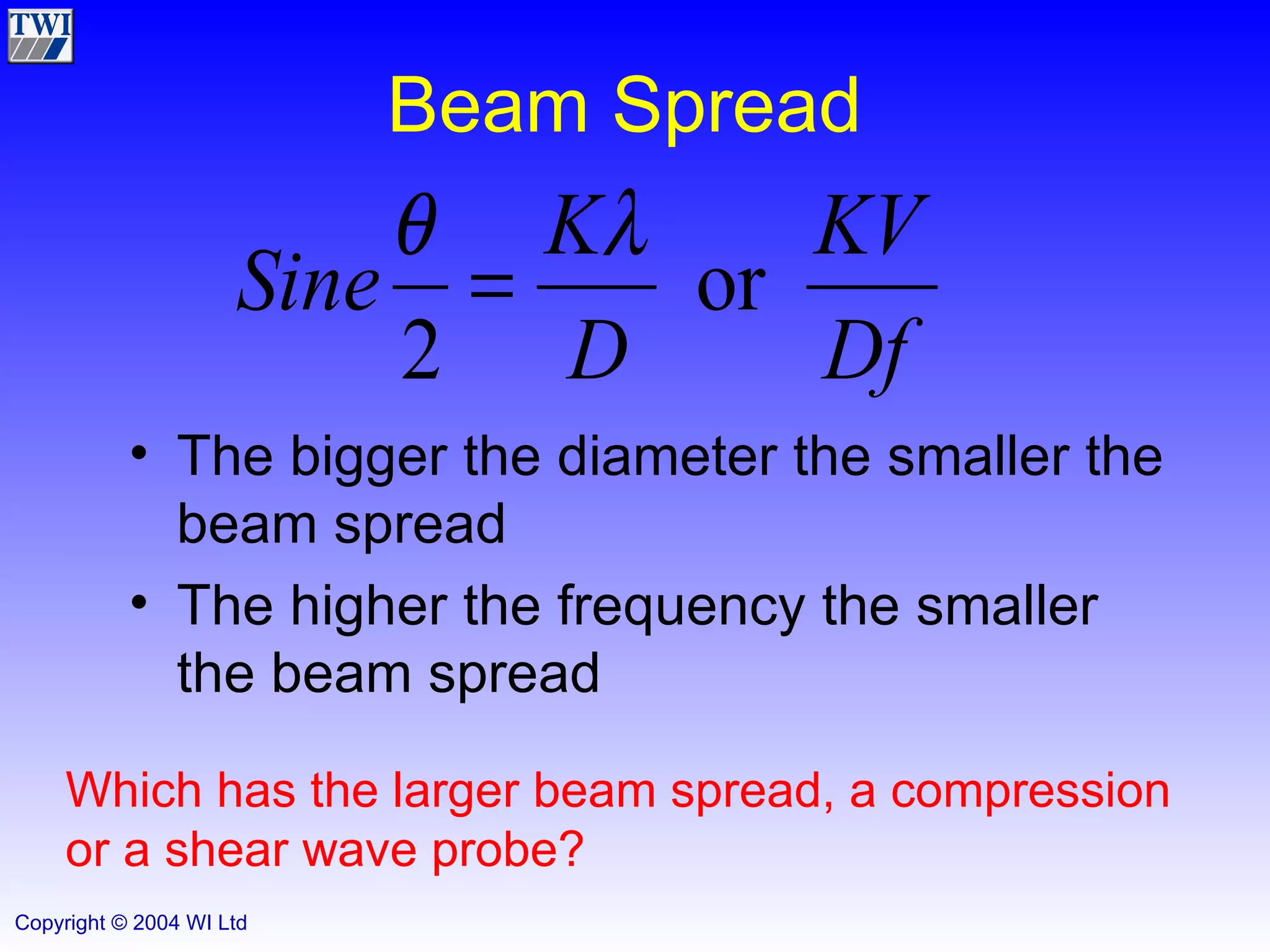
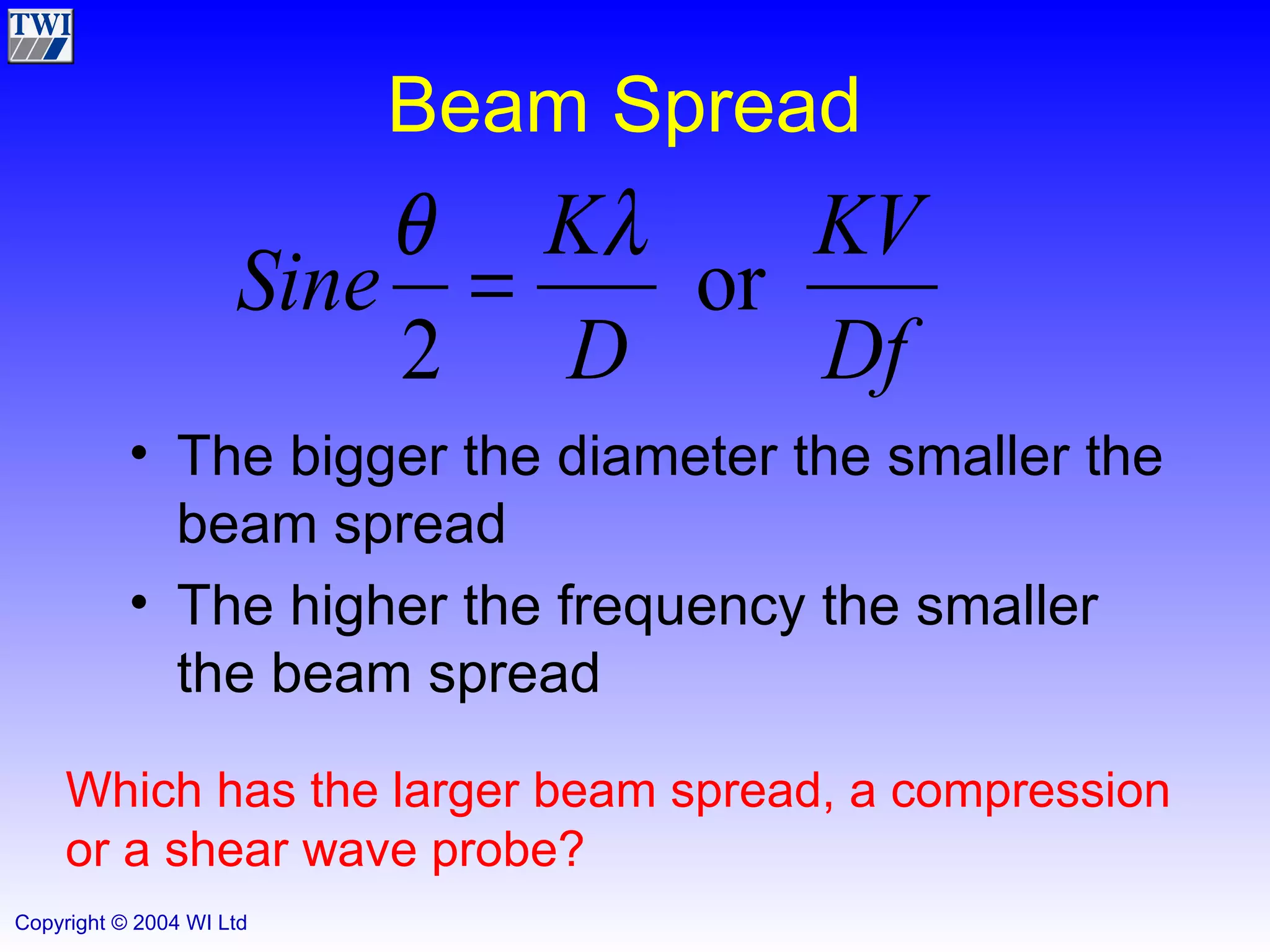
Beam Spread The bigger the diameter the smaller the beam spread The higher the frequency the smaller the beam spread Which has the larger beam spread, a compression or a shear wave probe?
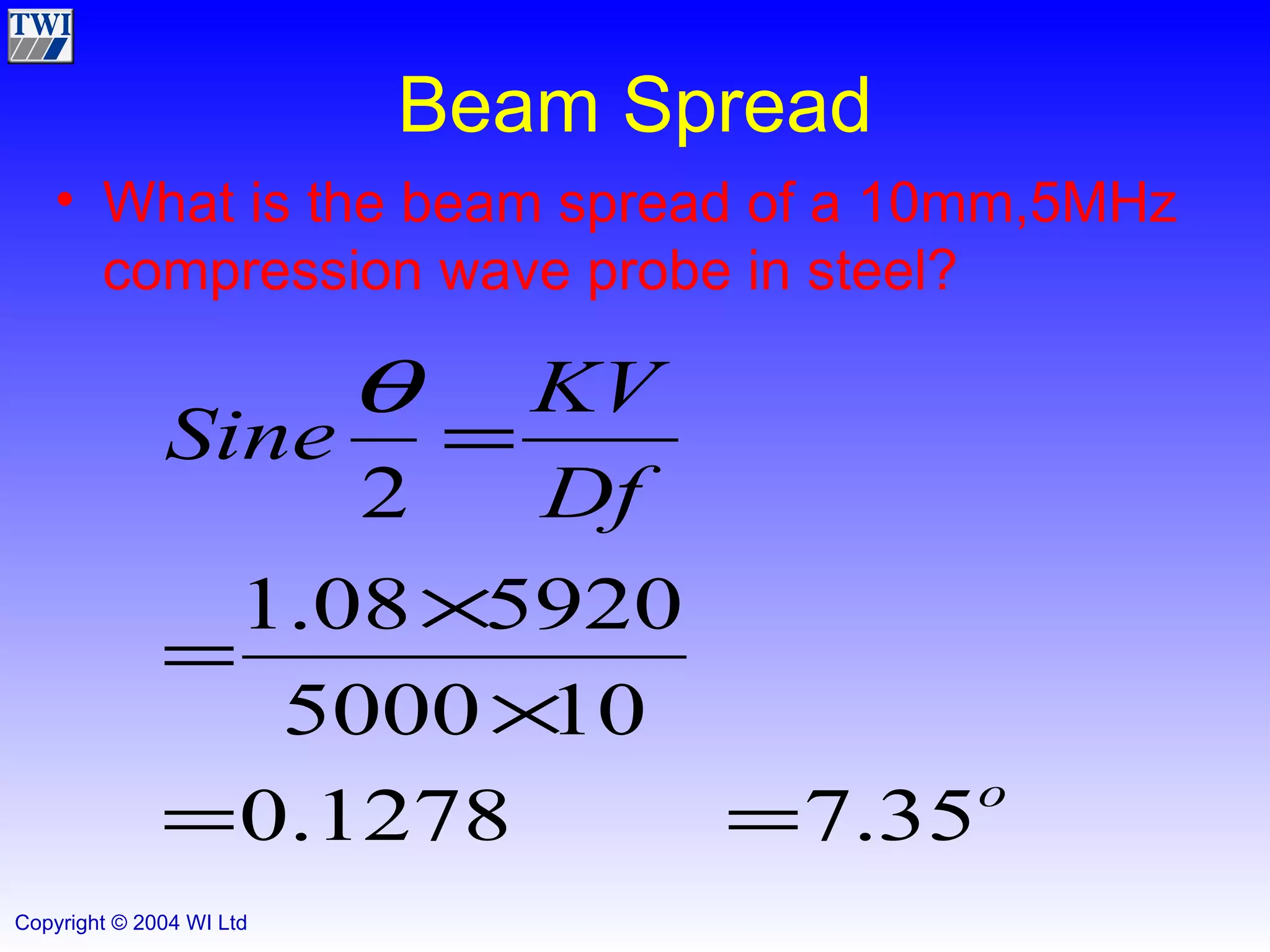
Beam Spread What is the beam spread of a 10mm,5MHz compression wave probe in steel?
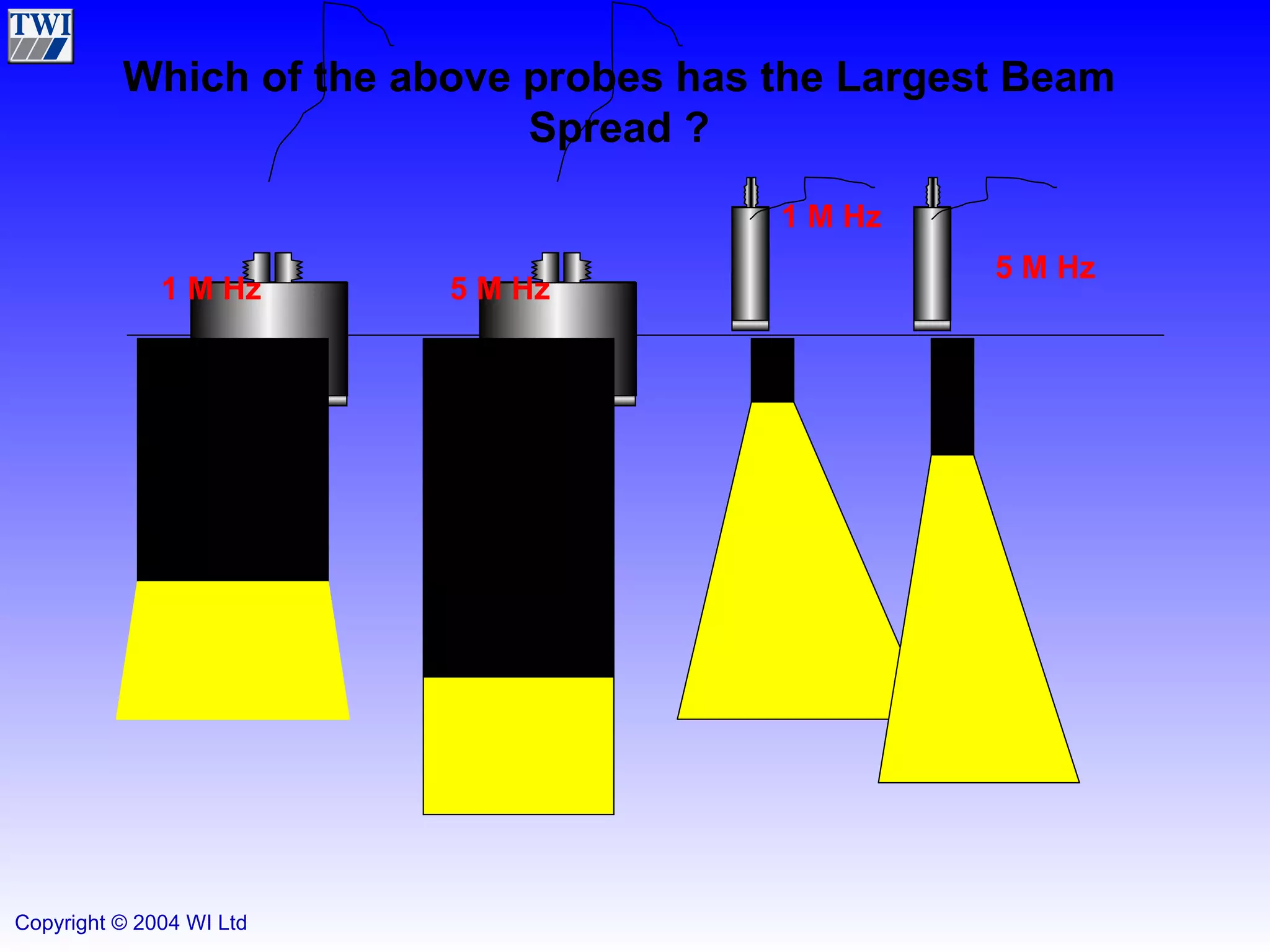
Which of the above probes has the Largest Beam Spread ? 1 M Hz 5 M Hz 1 M Hz 5 M Hz
Beam Spread The bigger the diameter the smaller the beam spread The higher the frequency the smaller the beam spread Which has the larger beam spread, a compression or a shear wave probe?
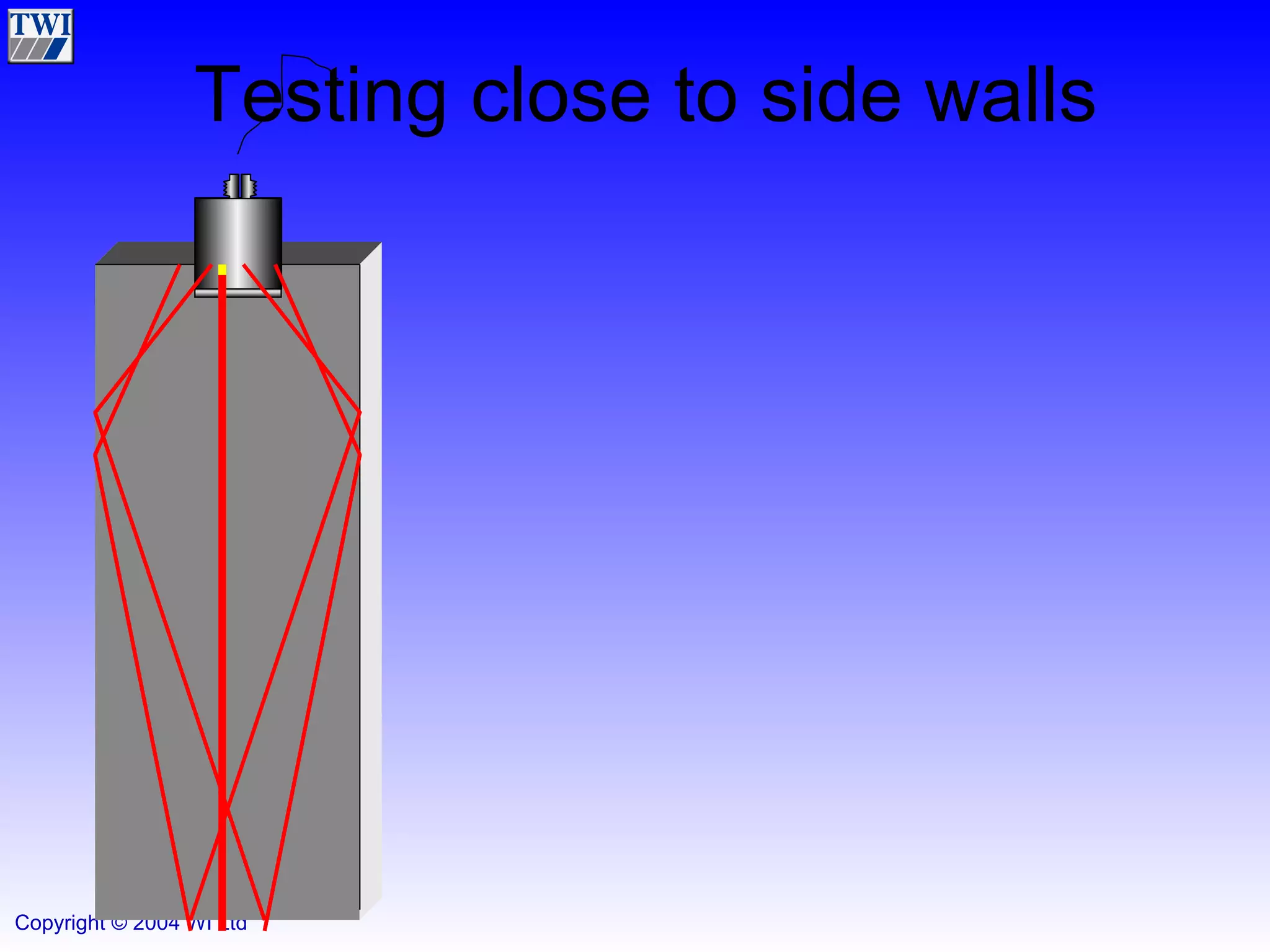
Testing close to side walls

ut1

  • 1.
  • 2.
    Ultrasonic Testing NDTTraining & Certification
  • 3.
    Course Layout Duration: 9.5 Days (Mon – Fri) Start : 8:30 am Coffee Break : 10:00 – 10:30 am Lunch : 12:30 – 1:30 pm Tea Break : 3:00 – 3:30 pm Day End : 5:00 pm Course Objective: To train and prepare participants to obtain required skill and knowledge in Ultrasonic Testing and to meet the examination schemes requirements.
  • 4.
    NDT Most commonNDT methods: Penetrant Testing (PT) Magnetic Particle Testing (MT) Eddy Current Testing (ET) Radiographic Testing (RT) Ultrasonic Testing (UT) Mainly used for surface testing Mainly used for Internal Testing
  • 5.
    NDT Which methodis the best ? Depends on many factors and conditions
  • 6.
    Basic Principles ofUltrasonic Testing To understand and appreciate the capability and limitation of UT
  • 7.
    Basic Principles ofUltrasonic Testing Sound is transmitted in the material to be tested The sound reflected back to the probe is displayed on the Flaw Detector
  • 8.
    Basic Principles ofUltrasonic Testing The distance the sound traveled can be displayed on the Flaw Detector The screen can be calibrated to give accurate readings of the distance Bottom / Backwall Signal from the backwall
  • 9.
  • 10.
    Basic Principles ofUltrasonic Testing The presence of a Defect in the material shows up on the screen of the flaw detector with a less distance than the bottom of the material Defect The BWE signal Defect signal
  • 11.
    The depth ofthe defect can be read with reference to the marker on the screen 60 mm 0 10 20 30 40 50 60
  • 12.
    Thickness / depthmeasurement A A B B C C The THINNER the material the less distance the sound travel The closer the reflector to the surface, the signal will be more to the left of the screen The thickness is read from the screen 68 46 30
  • 13.
  • 14.
    Sound Wavelength : The distance required to complete a cycle Measured in Meter or mm Frequency : The number of cycles per unit time Measured in Hertz (Hz) or Cycles per second (cps) Velocity : How quick the sound travels Distance per unit time Measured in meter / second (m / sec)
  • 15.
    Properties of asound wave Sound cannot travel in vacuum Sound energy to be transmitted / transferred from one particle to another SOLID LIQUID GAS
  • 16.
    Velocity The velocityof sound in a particular material is CONSTANT It is the product of DENSITY and ELASTICITY of the material It will NOT change if frequency changes Only the wavelength changes Examples: V Compression in steel : 5960 m/s V Compression in water : 1470 m/s V Compression in air : 330 m/s STEEL WATER AIR 5 M Hz
  • 17.
    Velocity 4 timesWhat is the velocity difference in steel compared with in water? If the frequency remain constant, in what material does sound has the highest velocity, steel, water, or air? Steel If the frequency remain constant, in what material does sound has the shortest wavelength, steel, water, or air? Air Remember the formula  = v / f
  • 18.
    DRUM BEAT LowFrequency Sound 40 Hz Glass High Frequency 5 K Hz ULTRASONIC TESTING Very High Frequency 5 M Hz
  • 19.
    Ultrasonic Sound :mechanical vibration What is Ultrasonic? Very High Frequency sound – above 20 KHz 20,000 cps
  • 20.
    Acoustic Spectrum 0 10 100 1K 10K 100K 1M 10M 100m Sonic / Audible Human 16Hz - 20kHz Ultrasonic > 20kHz = 20,000Hz Ultrasonic Testing 0.5MHz - 50MHz Ultrasonic : Sound with frequency above 20 KHz
  • 21.
    Frequency Frequency :Number of cycles per second 1 second 1 cycle per 1 second = 1 Hertz 18 cycle per 1 second = 18 Hertz 3 cycle per 1 second = 3 Hertz THE HIGHER THE FREQUENCY THE SMALLER THE WAVELENGTH 1 second 1 second
  • 22.
    Frequency 1 Hz= 1 cycle per second 1 Kilohertz = 1 KHz = 1000Hz 1 Megahertz = 1 MHz = 1000 000Hz 20 KHz = 20 000 Hz 5 M Hz = 5 000 000 Hz
  • 23.
    Sound waves arethe vibration of particles in solids, liquids or gases. Particles vibrate about a mean position. One cycle Displacement The distance taken to complete one cycle wavelength  wavelength Wavelength Wavelength is the distance required to complete a cycle.
  • 24.
  • 25.
    Frequency & Wavelength1 M Hz 5 M Hz 10 M Hz 25 M Hz Which probe has the smallest wavelength? SMALLEST LONGEST Which probe has the longest wavelength?  = v / f F  F 
  • 26.
    Wavelength is afunction of frequency and velocity. 5MHz compression wave probe in steel Therefore: or or f V   V   f V  f 
  • 27.
    Which of thefollowing compressional probe has the highest sensitivity? 1 MHz 2 MHz 5 MHz 10 MHz 10 MHz
  • 28.
    Wavelength and frequencyThe higher the frequency the smaller the wavelength The smaller the wavelength the higher the sensitivity Sensitivity : The smallest detectable flaw by the system or technique In UT the smallest detectable flaw is ½  (half the wavelength)
  • 29.
    The Sound BeamDead Zone Near Zone or Fresnel Zone Far Zone or Fraunhofer Zone
  • 30.
    The Sound BeamNZ FZ Main Beam Distance Intensity varies Exponential Decay
  • 31.
    Main Lobe SideLobes Near Zone Main Beam The main beam or the centre beam has the highest intensity of sound energy Any reflector hit by the main beam will reflect the high amount of energy The side lobes has multi minute main beams Two identical defects may give different amplitudes of signals
  • 32.
    Sound Beam NearZone Thickness measurement Detection of defects Sizing of large defects only Far Zone Thickness measurement Defect detection Sizing of all defects Near zone length as small as possible
  • 33.
  • 34.
    Near Zone Whatis the near zone length of a 5MHz compression probe with a crystal diameter of 10mm in steel?
  • 35.
    Near Zone Thebigger the diameter the bigger the near zone The higher the frequency the bigger the near zone The lower the velocity the bigger the near zone Should large diameter crystal probes have a high or low frequency?
  • 36.
    Which of theabove probes has the longest Near Zone ? 1 M Hz 5 M Hz 1 M Hz 5 M Hz
  • 37.
    Near Zone Thebigger the diameter the bigger the near zone The higher the frequency the bigger the near zone The lower the velocity the bigger the near zone Should large diameter crystal probes have a high or low frequency?
  • 38.
    Beam Spread Inthe far zone sound pulses spread out as they move away from the crystal   / 2
  • 39.
    Beam Spread Edge,K=1.2220dB,K=1.08 6dB,K=0.56 Beam axis or Main Beam
  • 40.
    Beam Spread Thebigger the diameter the smaller the beam spread The higher the frequency the smaller the beam spread Which has the larger beam spread, a compression or a shear wave probe?
  • 41.
    Beam Spread Whatis the beam spread of a 10mm,5MHz compression wave probe in steel?
  • 42.
    Which of theabove probes has the Largest Beam Spread ? 1 M Hz 5 M Hz 1 M Hz 5 M Hz
  • 43.
    Beam Spread Thebigger the diameter the smaller the beam spread The higher the frequency the smaller the beam spread Which has the larger beam spread, a compression or a shear wave probe?
  • 44.
    Testing close toside walls