Yu-hsin Yeh (Evans Ye)
Apache Big Data NA 2016

Vancouver
Using the SDACK Architecture
to Build a Big Data Product
Outline
• A Threat Analytic Big Data product
• The SDACK Architecture
• Akka Streams and data pipelines
• Cassandra data model for time series data
Who am I
• Apache Bigtop PMC member
• Software Engineer @ Trend Micro
• Develop big data apps & infra
A Threat Analytic 

Big Data Product
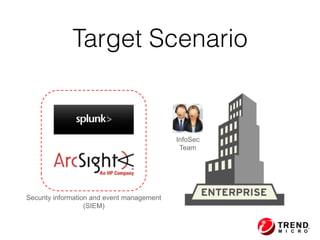
Target Scenario
InfoSec
Team
Security information and event management

(SIEM)
Problems
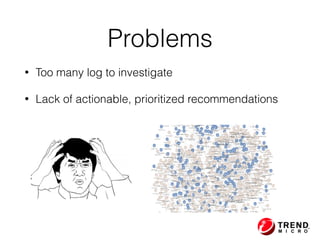
• Too many log to investigate
• Lack of actionable, prioritized recommendations
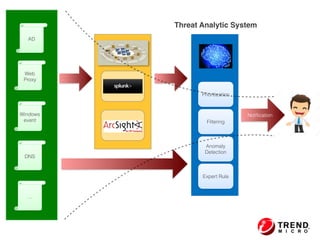
Splunk
ArcSight
Windows
event
Web
Proxy
DNS
…
AD
Anomaly
Detection
Expert Rule
Filtering
Prioritization
Threat Analytic System
Notification
Deployment
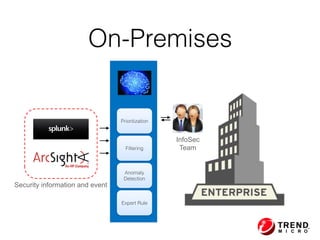
On-Premises
InfoSec
Team
Security information and event
Anomaly
Detection
Expert Rule
Filtering
Prioritization
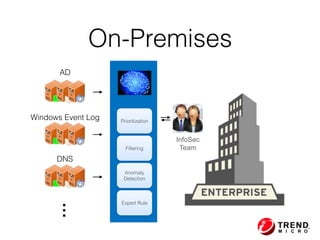
On-Premises
InfoSec
Team
Anomaly
Detection
Expert Rule
Filtering
Prioritization
AD
Windows Event Log
DNS
…
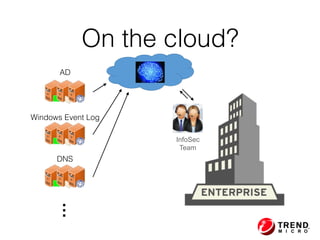
On the cloud?
InfoSec
Team
AD
Windows Event Log
DNS
…
There’re too many PII
data in the log
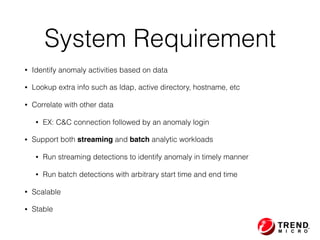
System Requirement
• Identify anomaly activities based on data
• Lookup extra info such as ldap, active directory, hostname, etc
• Correlate with other data
• EX: C&C connection followed by an anomaly login
• Support both streaming and batch analytic workloads
• Run streaming detections to identify anomaly in timely manner
• Run batch detections with arbitrary start time and end time
• Scalable
• Stable
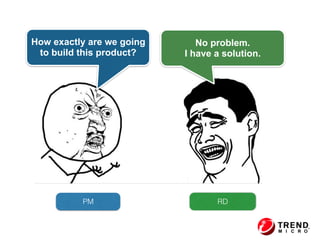
No problem.
I have a solution.
How exactly are we going
to build this product?
PM RD
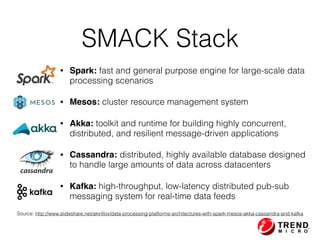
SMACK Stack
Toolbox for wide variety of data processing scenarios
SMACK Stack
• Spark: fast and general purpose engine for large-scale data
processing scenarios
• Mesos: cluster resource management system
• Akka: toolkit and runtime for building highly concurrent,
distributed, and resilient message-driven applications
• Cassandra: distributed, highly available database designed
to handle large amounts of data across datacenters
• Kafka: high-throughput, low-latency distributed pub-sub
messaging system for real-time data feeds
Source: http://www.slideshare.net/akirillov/data-processing-platforms-architectures-with-spark-mesos-akka-cassandra-and-kafka
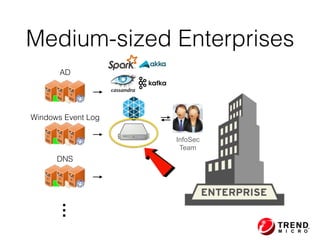
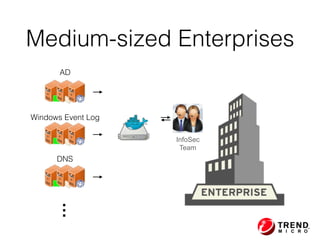
Medium-sized Enterprises
InfoSec
Team
AD
Windows Event Log
DNS
…
No problem.
I have a solution.
Can’t we simplify it?
PM RD
SDACK Stack
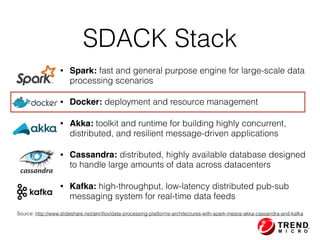
SDACK Stack
• Spark: fast and general purpose engine for large-scale data
processing scenarios
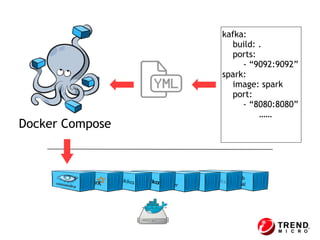
• Docker: deployment and resource management
• Akka: toolkit and runtime for building highly concurrent,
distributed, and resilient message-driven applications
• Cassandra: distributed, highly available database designed
to handle large amounts of data across datacenters
• Kafka: high-throughput, low-latency distributed pub-sub
messaging system for real-time data feeds
Source: http://www.slideshare.net/akirillov/data-processing-platforms-architectures-with-spark-mesos-akka-cassandra-and-kafka
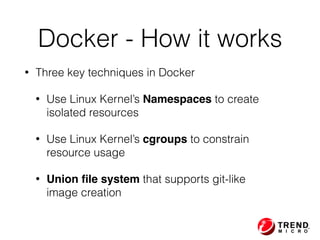
• Three key techniques in Docker
• Use Linux Kernel’s Namespaces to create 

isolated resources
• Use Linux Kernel’s cgroups to constrain 

resource usage
• Union file system that supports git-like 

image creation
Docker - How it works
• Lightweight
• Fast creation
• Efficient to ship
• Easy to deploy
• Portability
• runs on *any* Linux environment
The nice things about it
Medium-sized Enterprises
InfoSec
Team
AD
Windows Event Log
DNS
…
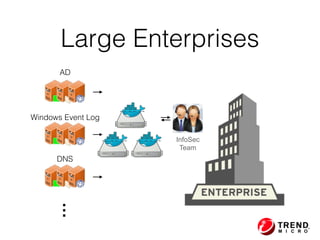
Large Enterprises
InfoSec
Team
AD
Windows Event Log
DNS
…
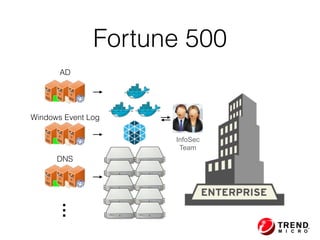
Fortune 500
InfoSec
Team
AD
Windows Event Log
DNS
…
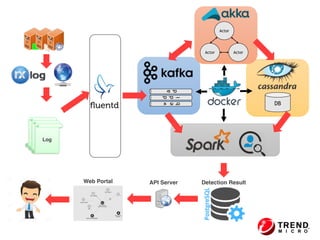
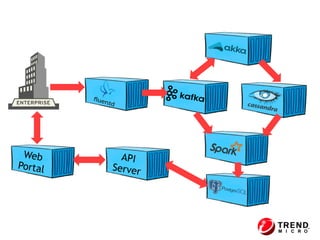
Threat Analytic System
Architecture
DB
a
d
d
d
i
w
e
b
Actor
Actor Actor
…
…
Log
Web Portal Detection ResultAPI Server
API
Server
Web
Portal
Docker Compose
kafka:
build: .
ports:
- “9092:9092”
spark:
image: spark
port:
- “8080:8080”
……
Web
Portal
API
Server
Akka Streams and 

data pipelines
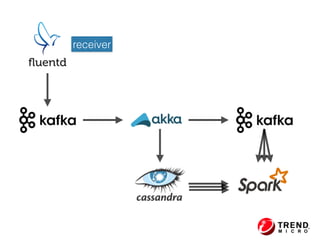
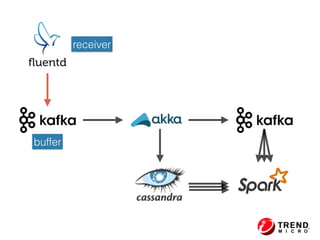
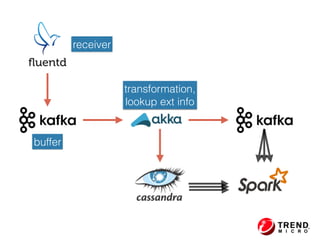
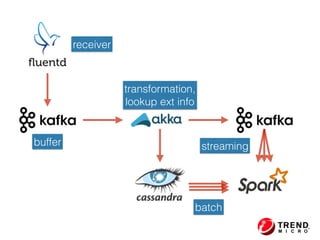
receiver
receiver
buffer
transformation,

lookup ext info
receiver
buffer
batch
streaming
receiver
buffer
transformation,

lookup ext info
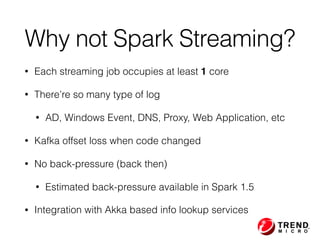
• Each streaming job occupies at least 1 core
• There’re so many type of log
• AD, Windows Event, DNS, Proxy, Web Application, etc
• Kafka offset loss when code changed
• No back-pressure (back then)
• Estimated back-pressure available in Spark 1.5
• Integration with Akka based info lookup services
Why not Spark Streaming?
Akka
• High performance concurrency framework for Java and
Scala
• Actor model for message-driven processing
• Asynchronous by design to achieve high throughput
• Each message is handled in a single threaded context

(no lock, synchronous needed)
• Let-it-crash model for fault tolerance and auto-healing
• Clustering mechanism available
The Road to Akka Cluster, and Beyond
Akka Streams
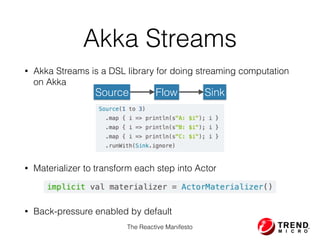
• Akka Streams is a DSL library for doing streaming computation
on Akka
• Materializer to transform each step into Actor
• Back-pressure enabled by default
Source Flow Sink
The Reactive Manifesto
Reactive Kafka
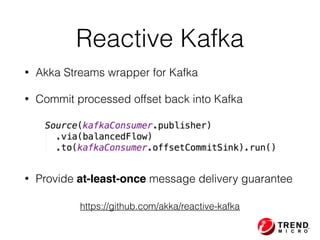
• Akka Streams wrapper for Kafka
• Commit processed offset back into Kafka
• Provide at-least-once message delivery guarantee
https://github.com/akka/reactive-kafka
Message Delivery Sematics
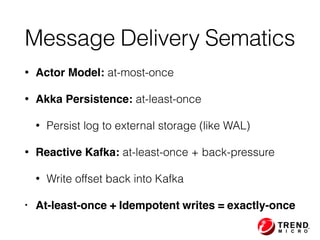
• Actor Model: at-most-once
• Akka Persistence: at-least-once
• Persist log to external storage (like WAL)
• Reactive Kafka: at-least-once + back-pressure
• Write offset back into Kafka
• At-least-once + Idempotent writes = exactly-once
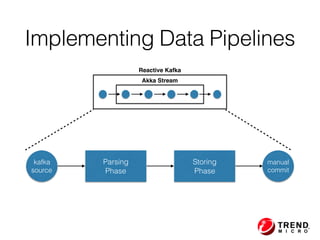
Implementing Data Pipelines
kafka
source
manual
commit
Parsing

Phase
Storing
Phase
Akka Stream
Reactive Kafka
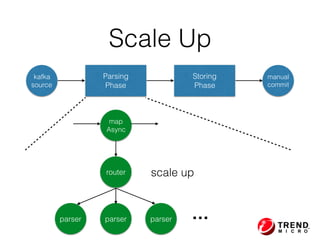
Scale Up
kafka
source
manual
commit
Parsing

Phase
Storing
Phase
map

Async
router
parser parser parser …
scale up
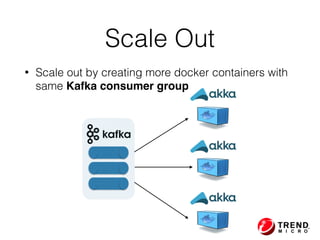
Scale Out
• Scale out by creating more docker containers with
same Kafka consumer group
Be careful using 

Reactive Kafka 

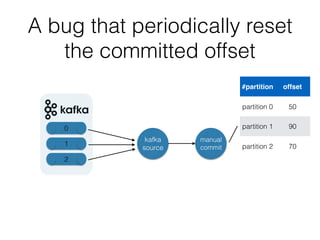
Manual Commit
A bug that periodically reset
the committed offset
kafka
source
manual
commit
#partition offset
partition 0 50
partition 1 90
partition 2 70
0
1
2
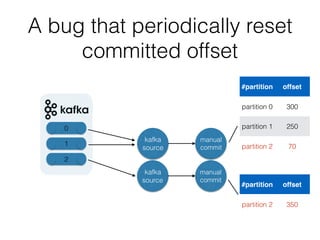
A bug that periodically reset
committed offset
kafka
source
manual
commit
kafka
source
manual
commit
#partition offset
partition 0 300
partition 1 250
partition 2 70
0
1
2
#partition offset
partition 2 350
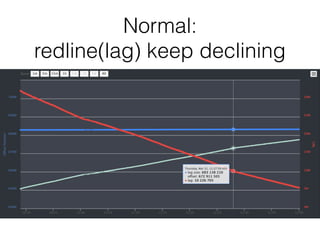
Normal:

redline(lag) keep declining
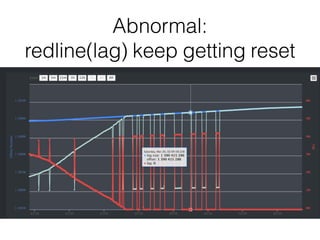
Abnormal:

redline(lag) keep getting reset
PR merged in 0.8 branch
Apply patch if version <= 0.8.7
https://github.com/akka/reactive-kafka/pull/144/commits
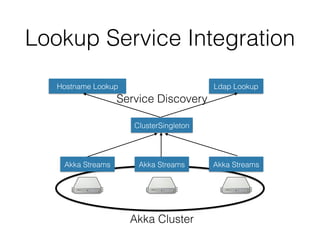
Akka Cluster
• Connects Akka runtimes into a cluster
• No-SPOF
• Gossip Protocol
• ClusterSingleton library available
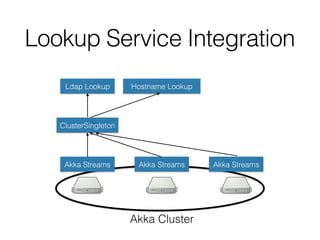
Lookup Service Integration
Akka Streams Akka Streams Akka Streams
ClusterSingleton
Ldap Lookup Hostname Lookup
Akka Cluster
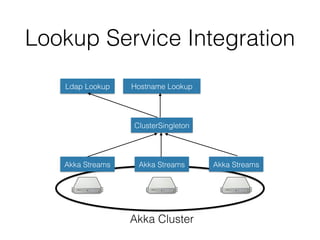
Lookup Service Integration
Akka Streams Akka Streams Akka Streams
ClusterSingleton
Ldap Lookup Hostname Lookup
Akka Cluster
Lookup Service Integration
Akka Streams Akka Streams Akka Streams
ClusterSingleton
Ldap LookupHostname Lookup
Akka Cluster
Service Discovery
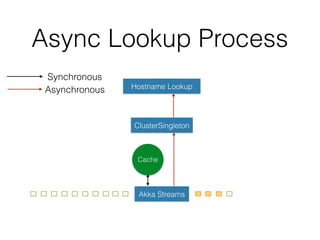
Async Lookup Process
Akka Streams
ClusterSingleton
Hostname Lookup
Cache
Synchronous
Asynchronous
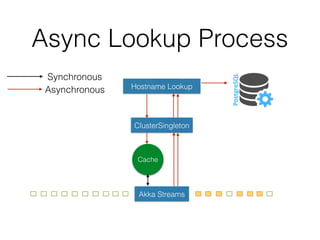
Async Lookup Process
Akka Streams
ClusterSingleton
Hostname Lookup
Cache
Synchronous
Asynchronous
Akka Streams
Cache
Akka Streams
Cache
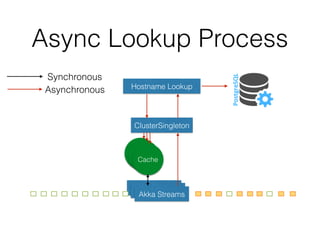
Async Lookup Process
Akka Streams
ClusterSingleton
Hostname Lookup
Cache
Synchronous
Asynchronous
Cassandra Data Model
for Time Series Data
Event Time
V.S.
Processing Time
Problem
• We need to do analytics based on event time instead
of processing time
• Example: modelling user behaviour
• Log may arrive late
• network slow, machine busy, service restart, etc
• Log arrived out-of-order
• multiple sources, different network routing, etc
Problem
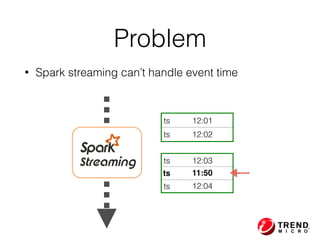
• Spark streaming can’t handle event time
ts 12:03
ts 11:50
ts 12:04
ts 12:01
ts 12:02
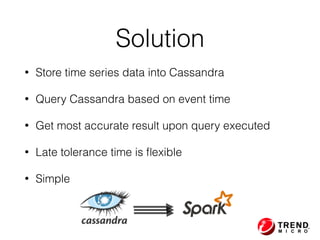
• Store time series data into Cassandra
• Query Cassandra based on event time
• Get most accurate result upon query executed
• Late tolerance time is flexible
• Simple
Solution
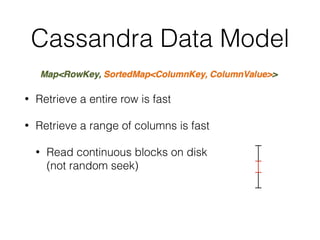
Cassandra Data Model
• Retrieve a entire row is fast
• Retrieve a range of columns is fast
• Read continuous blocks on disk

(not random seek)
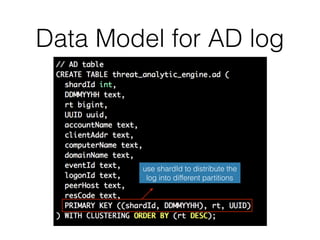
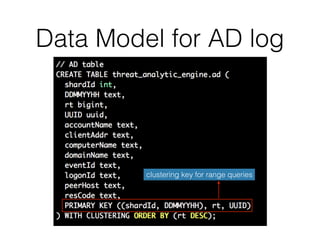
Data Model for AD log
use shardId to distribute the
log into different partitions
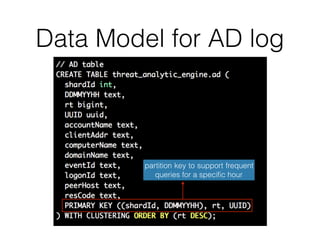
Data Model for AD log
partition key to support frequent
queries for a specific hour
Data Model for AD log
clustering key for range queries
Wrap up
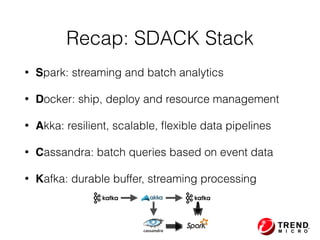
• Spark: streaming and batch analytics
• Docker: ship, deploy and resource management
• Akka: resilient, scalable, flexible data pipelines
• Cassandra: batch queries based on event data
• Kafka: durable buffer, streaming processing
Recap: SDACK Stack
Questions ?
Thank you !

Using the SDACK Architecture to Build a Big Data Product