Using Steam Distillation to Produce Essential Oils
                   Andrew Collins
Introduction


The Renaissance physician Paracelsus (1493-1541) did not invent steam distillation,
but rather the modern term used for the volatile oils of plants—essential oils, directly
recalls his alchemical theory of quinta essentia (literally fifth element).

For Paracelsus the process of distillation involved harnessing the innate powers of
fire and flame to separate and purify the essential characteristics from crude matter.
Today the theory behind this common laboratory procedure is far less romantic or
poetic, involving directly quantifiable differences in vapor pressure and Raoult's Law.

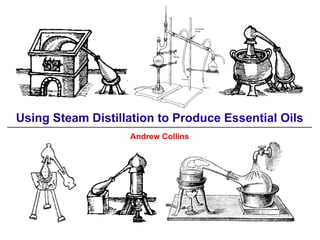
Theories aside, Paracelsus was an expert distiller and the alembics and retorts (see
examples on title page) he used to produce essential oils are similar to the laboratory
equipment used around the world today. Therefore these instructions will make use
of modern laboratory equipment.


              Look to this badge for
                                                             Look to this badge for
              warnings, cautionary
      !       advice, and similar                   ?        additional interesting or
                                                             historical information.
              important information.

                                           1
Required Glassware


                                                      Biomass Flask

                                                                 x3


Addition Funnel      Condenser           Separation   Round-Bottom
                                           Funnel        Flask


    Stopper       Clainsen Adapter       Still Head    Distillation
                                                        Adapter

                                     2
Additional Required Equipment


Water Tub                     Tubing


Hot Plate                   Water Pump


                  3
Apparatus Assembly
            Stopper
                                    Biomass Flask
    Still Head
                                                    Condenser
Addition
Funnel
                                                                Distillation
                                                                 Adapter
Clainsen
Adapter
                                Tubing
                                                                 Separation
Round-                                                            Funnel
Bottom
 Flask
                                               Water
Hot Plate             Water                    Pump
                       Tub


                                4
Necessary Materials


    Water

    Steam distillation requires boiling water to produce steam.

    Ice

    To operate effectively the condenser requires cold water.

    Biomass

    Choose plant material which is suitable for steam distillation.
    The following represents a mere fragment of all possibilities:
    caraway, cinnamon, clove, cumin, rosemary, peppermint,
    spearmint, and lavender.


      To prevent personal injury
                                                     Persian physician Avicenna
      avoid steam discharges
                                                     (c. 980 - 1037) invented
!     from the apparatus and
      avoid operating around
                                            ?        steam distillation in the
                                                     eleventh century.
      children or pets.

                                   5
Apparatus Preparation


1. Check for loose
   connections between
   glassware.              H2O

2. Add water to Round-
                                 Biomass
   Bottom Flask,
   Addition Funnel, and
   Water Tub.
3. Load biomass into
   Biomass Flask.
4. Make sure Water Pump
   is operating and
   condenser water is      H2O
   flowing.
5. Add ice to Water Tub.
                                             H2O


                                       6
Apparatus Operation

1. Turn on Hot Plate.
2. Confirm steam is
   being generated.
3. Check for steam        H2O
   leaking out of
   glassware.
                                Biomass
4. Verify Water Pump is
   operating and
   condenser water is
   flowing.
5. Add ice to Water Tub
   as necessary.
                                                 EO
6. Transfer water from
   Addition Funnel to     H2O
   Round-Bottom Flask
   as necessary.
7. Watch essential oil                     H2O
   begin to collect!


                                     7
Collecting Essential Oil
1. After 2-4 hours the steam distillation will
   be finished.
2. Turn the Hot Plate off and let the                 Essential Oil
   apparatus cool down. Remove the                    Lighter Than
   Separation Funnel.                                    Water

3. If essential oil which is heavier than water
   is in the bottom of the separation funnel
                                                         Water
   collect it by carefully turning the stopcock
   and quickly closing the stopcock.
4. Drain away water collected in the                  Essential Oil
   Separation Funnel.                                 Heavier Than
5. If essential oil which is lighter than water          Water
   is in the top of the separation funnel
   collect it.


                  It is important to open and                     Annual global production
                  close the stopcock quickly                      of spearmint oil is 1400
         !        and firmly, otherwise                  ?        metric tons, 70% comes
                  essential oil may be lost.                      from the United States.

                                                  8
Bibliography
Adams, Roger, John R. Johnson, and Charles F. Wilcox. Laboratory Experiments in
   Organic Chemistry. New York: Macmillan, 1979. Print.

The Alchemy Web Site. Web. 10 May 2010. <http://www.alchemywebsite.com/>.

"Essential Oil." Wikipedia, the Free Encyclopedia. Web. 10 May 2010. <
    http://en.wikipedia.org/wiki/Essential_oil>.

Fessenden, Ralph J., Joan S. Fessenden, and Patty Feist. Organic Laboratory
     Techniques. Pacific Grove, CA: Brooks/Cole Thomson Learning, 2001. Print.

Harwood, Laurence M., Christopher J. Moody, and Jonathan M. Percy. Experimental
    Organic Chemistry: Standard and Microscale. Oxford: Blackwell Science, 2008.
    Print.

Pavia, Donald L. Introduction to Organic Laboratory Techniques: a Small Scale
    Approach. Belmont, CA: Thomson Brooks/Cole, 2005. Print.

"Steam Distillation." Wikipedia, the Free Encyclopedia. Web. 10 May 2010. <
     http://en.wikipedia.org/wiki/Steam_distillation>.

Teuscher, Eberhard, Ulrike Bauermann, and Monika Werner. Medicinal Spices: a
    Handbook of Culinary Herbs, Spices, Spice Mixtures, and Their Essential Oils.
    Stuttgart: Medpharm, 2006. Print.

                                         9

Using Steam Distillation to Produce Essential Oils

  • 1.
    Using Steam Distillationto Produce Essential Oils Andrew Collins
  • 2.
    Introduction The Renaissance physicianParacelsus (1493-1541) did not invent steam distillation, but rather the modern term used for the volatile oils of plants—essential oils, directly recalls his alchemical theory of quinta essentia (literally fifth element). For Paracelsus the process of distillation involved harnessing the innate powers of fire and flame to separate and purify the essential characteristics from crude matter. Today the theory behind this common laboratory procedure is far less romantic or poetic, involving directly quantifiable differences in vapor pressure and Raoult's Law. Theories aside, Paracelsus was an expert distiller and the alembics and retorts (see examples on title page) he used to produce essential oils are similar to the laboratory equipment used around the world today. Therefore these instructions will make use of modern laboratory equipment. Look to this badge for Look to this badge for warnings, cautionary ! advice, and similar ? additional interesting or historical information. important information. 1
  • 3.
    Required Glassware Biomass Flask x3 Addition Funnel Condenser Separation Round-Bottom Funnel Flask Stopper Clainsen Adapter Still Head Distillation Adapter 2
  • 4.
    Additional Required Equipment WaterTub Tubing Hot Plate Water Pump 3
  • 5.
    Apparatus Assembly Stopper Biomass Flask Still Head Condenser Addition Funnel Distillation Adapter Clainsen Adapter Tubing Separation Round- Funnel Bottom Flask Water Hot Plate Water Pump Tub 4
  • 6.
    Necessary Materials Water Steam distillation requires boiling water to produce steam. Ice To operate effectively the condenser requires cold water. Biomass Choose plant material which is suitable for steam distillation. The following represents a mere fragment of all possibilities: caraway, cinnamon, clove, cumin, rosemary, peppermint, spearmint, and lavender. To prevent personal injury Persian physician Avicenna avoid steam discharges (c. 980 - 1037) invented ! from the apparatus and avoid operating around ? steam distillation in the eleventh century. children or pets. 5
  • 7.
    Apparatus Preparation 1. Checkfor loose connections between glassware. H2O 2. Add water to Round- Biomass Bottom Flask, Addition Funnel, and Water Tub. 3. Load biomass into Biomass Flask. 4. Make sure Water Pump is operating and condenser water is H2O flowing. 5. Add ice to Water Tub. H2O 6
  • 8.
    Apparatus Operation 1. Turnon Hot Plate. 2. Confirm steam is being generated. 3. Check for steam H2O leaking out of glassware. Biomass 4. Verify Water Pump is operating and condenser water is flowing. 5. Add ice to Water Tub as necessary. EO 6. Transfer water from Addition Funnel to H2O Round-Bottom Flask as necessary. 7. Watch essential oil H2O begin to collect! 7
  • 9.
    Collecting Essential Oil 1.After 2-4 hours the steam distillation will be finished. 2. Turn the Hot Plate off and let the Essential Oil apparatus cool down. Remove the Lighter Than Separation Funnel. Water 3. If essential oil which is heavier than water is in the bottom of the separation funnel Water collect it by carefully turning the stopcock and quickly closing the stopcock. 4. Drain away water collected in the Essential Oil Separation Funnel. Heavier Than 5. If essential oil which is lighter than water Water is in the top of the separation funnel collect it. It is important to open and Annual global production close the stopcock quickly of spearmint oil is 1400 ! and firmly, otherwise ? metric tons, 70% comes essential oil may be lost. from the United States. 8
  • 10.
    Bibliography Adams, Roger, JohnR. Johnson, and Charles F. Wilcox. Laboratory Experiments in Organic Chemistry. New York: Macmillan, 1979. Print. The Alchemy Web Site. Web. 10 May 2010. <http://www.alchemywebsite.com/>. "Essential Oil." Wikipedia, the Free Encyclopedia. Web. 10 May 2010. < http://en.wikipedia.org/wiki/Essential_oil>. Fessenden, Ralph J., Joan S. Fessenden, and Patty Feist. Organic Laboratory Techniques. Pacific Grove, CA: Brooks/Cole Thomson Learning, 2001. Print. Harwood, Laurence M., Christopher J. Moody, and Jonathan M. Percy. Experimental Organic Chemistry: Standard and Microscale. Oxford: Blackwell Science, 2008. Print. Pavia, Donald L. Introduction to Organic Laboratory Techniques: a Small Scale Approach. Belmont, CA: Thomson Brooks/Cole, 2005. Print. "Steam Distillation." Wikipedia, the Free Encyclopedia. Web. 10 May 2010. < http://en.wikipedia.org/wiki/Steam_distillation>. Teuscher, Eberhard, Ulrike Bauermann, and Monika Werner. Medicinal Spices: a Handbook of Culinary Herbs, Spices, Spice Mixtures, and Their Essential Oils. Stuttgart: Medpharm, 2006. Print. 9