What is Aromatherapy?
Andrew Collins
Aromatherapy is a tangle of
modern, ancient, esoteric, and
scientific practices, but it can be
loosely defined as “treatment with
odors.” The term aromatherapy
was coined by French cosmetic
chemist René-Maurice Gattefossé
combining aroma (fragrance or
sweet     scent)     and    therapy
(treatment or remedy). The petals,
leaves, seeds, fruits, roots, bark,
and stalks of aromatic plants are
the source of the essential oils
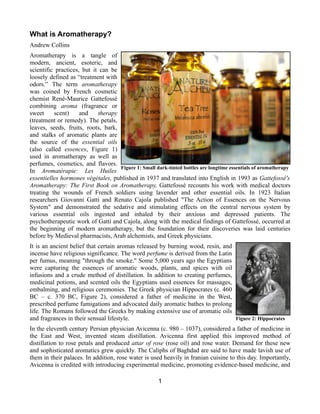
(also called essences, Figure 1)
used in aromatherapy as well as
perfumes, cosmetics, and flavors.
                                    Figure 1: Small dark-tinted bottles are longtime essentials of aromatherapy
In Aromatérapie: Les Huiles
essentielles hormones végétales, published in 1937 and translated into English in 1993 as Gattefossé's
Aromatherapy: The First Book on Aromatherapy, Gattefossé recounts his work with medical doctors
treating the wounds of French soldiers using lavender and other essential oils. In 1923 Italian
researchers Giovanni Gatti and Renato Cajola published "The Action of Essences on the Nervous
System" and demonstrated the sedative and stimulating effects on the central nervous system by
various essential oils ingested and inhaled by their anxious and depressed patients. The
psychotherapeutic work of Gatti and Cajola, along with the medical findings of Gattefossé, occurred at
the beginning of modern aromatherapy, but the foundation for their discoveries was laid centuries
before by Medieval pharmacists, Arab alchemists, and Greek physicians.
It is an ancient belief that certain aromas released by burning wood, resin, and
incense have religious significance. The word perfume is derived from the Latin
per fumus, meaning "through the smoke." Some 5,000 years ago the Egyptians
were capturing the essences of aromatic woods, plants, and spices with oil
infusions and a crude method of distillation. In addition to creating perfumes,
medicinal potions, and scented oils the Egyptians used essences for massages,
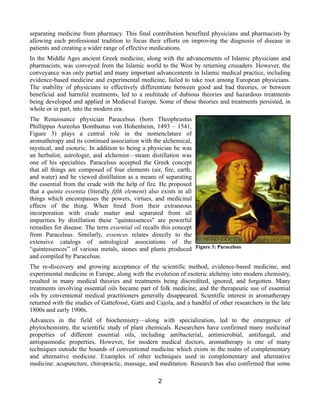
embalming, and religious ceremonies. The Greek physician Hippocrates (c. 460
BC – c. 370 BC, Figure 2), considered a father of medicine in the West,
prescribed perfume fumigations and advocated daily aromatic bathes to prolong
life. The Romans followed the Greeks by making extensive use of aromatic oils
and fragrances in their sensual lifestyle.                                       Figure 2: Hippocrates
In the eleventh century Persian physician Avicenna (c. 980 – 1037), considered a father of medicine in
the East and West, invented steam distillation. Avicenna first applied this improved method of
distillation to rose petals and produced attar of rose (rose oil) and rose water. Demand for these new
and sophisticated aromatics grew quickly. The Caliphs of Baghdad are said to have made lavish use of
them in their palaces. In addition, rose water is used heavily in Iranian cuisine to this day. Importantly,
Avicenna is credited with introducing experimental medicine, promoting evidence-based medicine, and

                                                      1
separating medicine from pharmacy. This final contribution benefited physicians and pharmacists by
allowing each professional tradition to focus their efforts on improving the diagnosis of disease in
patients and creating a wider range of effective medications.
In the Middle Ages ancient Greek medicine, along with the advancements of Islamic physicians and
pharmacists, was conveyed from the Islamic world to the West by returning crusaders. However, the
conveyance was only partial and many important advancements in Islamic medical practice, including
evidence-based medicine and experimental medicine, failed to take root among European physicians.
The inability of physicians to effectively differentiate between good and bad theories, or between
beneficial and harmful treatments, led to a multitude of dubious theories and hazardous treatments
being developed and applied in Medieval Europe. Some of these theories and treatments persisted, in
whole or in part, into the modern era.
The Renaissance physician Paracelsus (born Theophrastus
Phillippus Aureolus Bombastus von Hohenheim, 1493 – 1541,
Figure 3) plays a central role in the nomenclature of
aromatherapy and its continued association with the alchemical,
mystical, and esoteric. In addition to being a physician he was
an herbalist, astrologer, and alchemist—steam distillation was
one of his specialties. Paracelsus accepted the Greek concept
that all things are composed of four elements (air, fire, earth,
and water) and he viewed distillation as a means of separating
the essential from the crude with the help of fire. He proposed
that a quinta essentia (literally fifth element) also exists in all
things which encompasses the powers, virtues, and medicinal
effects of the thing. When freed from their extraneous
incorporation with crude matter and separated from all
impurities by distillation these "quintessences" are powerful
remedies for disease. The term essential oil recalls this concept
from Paracelsus. Similarly, essences relates directly to the
extensive catalogs of astrological associations of the
“quintessences” of various metals, stones and plants produced Figure 3: Paracelsus
and compiled by Paracelsus.
The re-discovery and growing acceptance of the scientific method, evidence-based medicine, and
experimental medicine in Europe, along with the evolution of esoteric alchemy into modern chemistry,
resulted in many medical theories and treatments being discredited, ignored, and forgotten. Many
treatments involving essential oils became part of folk medicine, and the therapeutic use of essential
oils by conventional medical practitioners generally disappeared. Scientific interest in aromatherapy
returned with the studies of Gattefossé, Gatti and Cajola, and a handful of other researchers in the late
1800s and early 1900s.
Advances in the field of biochemistry—along with specialization, led to the emergence of
phytochemistry, the scientific study of plant chemicals. Researchers have confirmed many medicinal
properties of different essential oils, including antibacterial, antimicrobial, antifungal, and
antispasmodic properties. However, for modern medical doctors, aromatherapy is one of many
techniques outside the bounds of conventional medicine which exists in the realm of complementary
and alternative medicine. Examples of other techniques used in complementary and alternative
medicine: acupuncture, chiropractic, massage, and meditation. Research has also confirmed that some

                                                   2
essential oils used in aromatherapy cause allergic reactions and pose other risks from direct exposure.
Given these risks aromatherapy is no longer used by conventional medical doctors to treat illnesses
directly. However, aromatherapy has been used as a complementary therapy for managing chronic pain.
Relaxation has been shown to alter perceptions of pain and pleasant smells tend to relax patients.
The human tongue can distinguish only among five distinct qualities of taste, whereas the nose can
distinguish among thousands of substances, even in minute quantities. In 2004, the Nobel Prize in
Physiology or Medicine was awarded to Dr. Richard Axel and Dr. Linda Buck for their pioneering
work on deciphering the inner workings of the sense of smell. Axel and Buck showed the deep
connection between the olfactory bulb, primary organ of smell in the nose, and the limbic system, a
focal point of emotional processing within the brain.
The exact mechanism of the sense of smell was certainly not known to Hippocrates, or any other
ancient or medieval physician, but the connection between smelling pleasant odors and feeling
physically well was understood. Clearly, the “treatment with odors” will continue.


                                                   3
Sources
Bousquet, Paula M., and Judith Fitzsimmons. Seasons of Aromatherapy: Hundreds of Restorative
     Recipes and Sensory Suggestions. Berkeley, CA: Conari, 1998. Print.
Buchbauer, Gerhard. "Lavender oil and its therapeutic properties." Lavender The genus Lavandula.
     London: Taylor and Francis, 2002. 124-39. Print.
Buchbauer, Gerhard, and Leopold Jirovetz. "Aromatherapy—Use of Fragrances and Essential Oils as
     Medicaments." Flavour and Fragrance Journal 9 (1994): 217-22. Print.
Dunham, Stephanie. Tea Tree Oil. Digital image. Wikimedia Commons. Web.
    <http://commons.wikimedia.org/wiki/File:Teatreeoil.jpg>.
Edris, Amr. "Pharmaceutical and Therapeutic Potentials of Essential Oils and Their Individual Volatile
      Constituents: A Review." Phytotherapy Research 21 (2007): 308-23. Print.
Guenther, Ernest. The Essential Oils, v. 1. History, origin in plants, production, analysis. New York:
     Van Nostrand, 1948. 3-5. Print.
Lis-Balchin, Maria. "Lavender oil and its use in aromatherapy." Lavender The genus Lavandula.
     London: Taylor and Francis, 2002. 180-93. Print.
Massys, Quentin. Paracelsus. Digital image. Wikimedia Commons. Web.
     <http://en.wikipedia.org/wiki/File:Paracelsus.jpg>.
Rawlings, Romy. Healing Gardens. New York: Willow Creek, 1998. 124-49. Print.
Rubens, Peter Paul. Hippocrates. Digital image. Wikimedia Commons. Web.
     <http://en.wikipedia.org/wiki/File:Hippocrates_rubens.jpg>.
Singh, Simon, and Edzard Ernst. Trick or Treatment The Undeniable Facts about Alternative Medicine.
     New York: W. W. Norton, 2008. Print.
Wildwood, Christine. The Encyclopedia of Aromatherapy. Rochester, Vt.: Healing Arts, 1996. Print.
Zarzuelo, Antonio, and Esperanza Crespo. "The medicinal and non-medicinal uses of thyme." Thyme:
     The genus Thymus. London: Taylor and Francis, 2002. 263-92. Print.
"Avicenna." Wikipedia: The Free Encyclopedia. Wikimedia Foundation, Inc. 3 Mar. 2010. Web. 3
     March 2010. <http://en.wikipedia.org/wiki/Avicenna>
"Alchemy and chemistry in medieval Islam." Wikipedia: The Free Encyclopedia. Wikimedia
     Foundation, Inc. 2 Mar. 2010. Web. 3 March 2010.
     <http://en.wikipedia.org/wiki/Alchemy_and_chemistry_in_medieval_Islam>
"Aromatherapy." Wikipedia: The Free Encyclopedia. Wikimedia Foundation, Inc. 1 Mar. 2010. Web. 3
     March 2010. <http://en.wikipedia.org/wiki/Aromatherapy>
"Essential oil." Wikipedia: The Free Encyclopedia. Wikimedia Foundation, Inc. 17 Feb. 2010. Web. 3
     March 2010. <http://en.wikipedia.org/wiki/Essential_oil>
"Steam distillation." Wikipedia: The Free Encyclopedia. Wikimedia Foundation, Inc. 27 Feb. 2010.
     Web. 3 March 2010. <http://en.wikipedia.org/wiki/Steam_distillation>


                                                    4

What is Aromatherapy?

  • 1.
    What is Aromatherapy? AndrewCollins Aromatherapy is a tangle of modern, ancient, esoteric, and scientific practices, but it can be loosely defined as “treatment with odors.” The term aromatherapy was coined by French cosmetic chemist René-Maurice Gattefossé combining aroma (fragrance or sweet scent) and therapy (treatment or remedy). The petals, leaves, seeds, fruits, roots, bark, and stalks of aromatic plants are the source of the essential oils (also called essences, Figure 1) used in aromatherapy as well as perfumes, cosmetics, and flavors. Figure 1: Small dark-tinted bottles are longtime essentials of aromatherapy In Aromatérapie: Les Huiles essentielles hormones végétales, published in 1937 and translated into English in 1993 as Gattefossé's Aromatherapy: The First Book on Aromatherapy, Gattefossé recounts his work with medical doctors treating the wounds of French soldiers using lavender and other essential oils. In 1923 Italian researchers Giovanni Gatti and Renato Cajola published "The Action of Essences on the Nervous System" and demonstrated the sedative and stimulating effects on the central nervous system by various essential oils ingested and inhaled by their anxious and depressed patients. The psychotherapeutic work of Gatti and Cajola, along with the medical findings of Gattefossé, occurred at the beginning of modern aromatherapy, but the foundation for their discoveries was laid centuries before by Medieval pharmacists, Arab alchemists, and Greek physicians. It is an ancient belief that certain aromas released by burning wood, resin, and incense have religious significance. The word perfume is derived from the Latin per fumus, meaning "through the smoke." Some 5,000 years ago the Egyptians were capturing the essences of aromatic woods, plants, and spices with oil infusions and a crude method of distillation. In addition to creating perfumes, medicinal potions, and scented oils the Egyptians used essences for massages, embalming, and religious ceremonies. The Greek physician Hippocrates (c. 460 BC – c. 370 BC, Figure 2), considered a father of medicine in the West, prescribed perfume fumigations and advocated daily aromatic bathes to prolong life. The Romans followed the Greeks by making extensive use of aromatic oils and fragrances in their sensual lifestyle. Figure 2: Hippocrates In the eleventh century Persian physician Avicenna (c. 980 – 1037), considered a father of medicine in the East and West, invented steam distillation. Avicenna first applied this improved method of distillation to rose petals and produced attar of rose (rose oil) and rose water. Demand for these new and sophisticated aromatics grew quickly. The Caliphs of Baghdad are said to have made lavish use of them in their palaces. In addition, rose water is used heavily in Iranian cuisine to this day. Importantly, Avicenna is credited with introducing experimental medicine, promoting evidence-based medicine, and 1
  • 2.
    separating medicine frompharmacy. This final contribution benefited physicians and pharmacists by allowing each professional tradition to focus their efforts on improving the diagnosis of disease in patients and creating a wider range of effective medications. In the Middle Ages ancient Greek medicine, along with the advancements of Islamic physicians and pharmacists, was conveyed from the Islamic world to the West by returning crusaders. However, the conveyance was only partial and many important advancements in Islamic medical practice, including evidence-based medicine and experimental medicine, failed to take root among European physicians. The inability of physicians to effectively differentiate between good and bad theories, or between beneficial and harmful treatments, led to a multitude of dubious theories and hazardous treatments being developed and applied in Medieval Europe. Some of these theories and treatments persisted, in whole or in part, into the modern era. The Renaissance physician Paracelsus (born Theophrastus Phillippus Aureolus Bombastus von Hohenheim, 1493 – 1541, Figure 3) plays a central role in the nomenclature of aromatherapy and its continued association with the alchemical, mystical, and esoteric. In addition to being a physician he was an herbalist, astrologer, and alchemist—steam distillation was one of his specialties. Paracelsus accepted the Greek concept that all things are composed of four elements (air, fire, earth, and water) and he viewed distillation as a means of separating the essential from the crude with the help of fire. He proposed that a quinta essentia (literally fifth element) also exists in all things which encompasses the powers, virtues, and medicinal effects of the thing. When freed from their extraneous incorporation with crude matter and separated from all impurities by distillation these "quintessences" are powerful remedies for disease. The term essential oil recalls this concept from Paracelsus. Similarly, essences relates directly to the extensive catalogs of astrological associations of the “quintessences” of various metals, stones and plants produced Figure 3: Paracelsus and compiled by Paracelsus. The re-discovery and growing acceptance of the scientific method, evidence-based medicine, and experimental medicine in Europe, along with the evolution of esoteric alchemy into modern chemistry, resulted in many medical theories and treatments being discredited, ignored, and forgotten. Many treatments involving essential oils became part of folk medicine, and the therapeutic use of essential oils by conventional medical practitioners generally disappeared. Scientific interest in aromatherapy returned with the studies of Gattefossé, Gatti and Cajola, and a handful of other researchers in the late 1800s and early 1900s. Advances in the field of biochemistry—along with specialization, led to the emergence of phytochemistry, the scientific study of plant chemicals. Researchers have confirmed many medicinal properties of different essential oils, including antibacterial, antimicrobial, antifungal, and antispasmodic properties. However, for modern medical doctors, aromatherapy is one of many techniques outside the bounds of conventional medicine which exists in the realm of complementary and alternative medicine. Examples of other techniques used in complementary and alternative medicine: acupuncture, chiropractic, massage, and meditation. Research has also confirmed that some 2
  • 3.
    essential oils usedin aromatherapy cause allergic reactions and pose other risks from direct exposure. Given these risks aromatherapy is no longer used by conventional medical doctors to treat illnesses directly. However, aromatherapy has been used as a complementary therapy for managing chronic pain. Relaxation has been shown to alter perceptions of pain and pleasant smells tend to relax patients. The human tongue can distinguish only among five distinct qualities of taste, whereas the nose can distinguish among thousands of substances, even in minute quantities. In 2004, the Nobel Prize in Physiology or Medicine was awarded to Dr. Richard Axel and Dr. Linda Buck for their pioneering work on deciphering the inner workings of the sense of smell. Axel and Buck showed the deep connection between the olfactory bulb, primary organ of smell in the nose, and the limbic system, a focal point of emotional processing within the brain. The exact mechanism of the sense of smell was certainly not known to Hippocrates, or any other ancient or medieval physician, but the connection between smelling pleasant odors and feeling physically well was understood. Clearly, the “treatment with odors” will continue. 3
  • 4.
    Sources Bousquet, Paula M.,and Judith Fitzsimmons. Seasons of Aromatherapy: Hundreds of Restorative Recipes and Sensory Suggestions. Berkeley, CA: Conari, 1998. Print. Buchbauer, Gerhard. "Lavender oil and its therapeutic properties." Lavender The genus Lavandula. London: Taylor and Francis, 2002. 124-39. Print. Buchbauer, Gerhard, and Leopold Jirovetz. "Aromatherapy—Use of Fragrances and Essential Oils as Medicaments." Flavour and Fragrance Journal 9 (1994): 217-22. Print. Dunham, Stephanie. Tea Tree Oil. Digital image. Wikimedia Commons. Web. <http://commons.wikimedia.org/wiki/File:Teatreeoil.jpg>. Edris, Amr. "Pharmaceutical and Therapeutic Potentials of Essential Oils and Their Individual Volatile Constituents: A Review." Phytotherapy Research 21 (2007): 308-23. Print. Guenther, Ernest. The Essential Oils, v. 1. History, origin in plants, production, analysis. New York: Van Nostrand, 1948. 3-5. Print. Lis-Balchin, Maria. "Lavender oil and its use in aromatherapy." Lavender The genus Lavandula. London: Taylor and Francis, 2002. 180-93. Print. Massys, Quentin. Paracelsus. Digital image. Wikimedia Commons. Web. <http://en.wikipedia.org/wiki/File:Paracelsus.jpg>. Rawlings, Romy. Healing Gardens. New York: Willow Creek, 1998. 124-49. Print. Rubens, Peter Paul. Hippocrates. Digital image. Wikimedia Commons. Web. <http://en.wikipedia.org/wiki/File:Hippocrates_rubens.jpg>. Singh, Simon, and Edzard Ernst. Trick or Treatment The Undeniable Facts about Alternative Medicine. New York: W. W. Norton, 2008. Print. Wildwood, Christine. The Encyclopedia of Aromatherapy. Rochester, Vt.: Healing Arts, 1996. Print. Zarzuelo, Antonio, and Esperanza Crespo. "The medicinal and non-medicinal uses of thyme." Thyme: The genus Thymus. London: Taylor and Francis, 2002. 263-92. Print. "Avicenna." Wikipedia: The Free Encyclopedia. Wikimedia Foundation, Inc. 3 Mar. 2010. Web. 3 March 2010. <http://en.wikipedia.org/wiki/Avicenna> "Alchemy and chemistry in medieval Islam." Wikipedia: The Free Encyclopedia. Wikimedia Foundation, Inc. 2 Mar. 2010. Web. 3 March 2010. <http://en.wikipedia.org/wiki/Alchemy_and_chemistry_in_medieval_Islam> "Aromatherapy." Wikipedia: The Free Encyclopedia. Wikimedia Foundation, Inc. 1 Mar. 2010. Web. 3 March 2010. <http://en.wikipedia.org/wiki/Aromatherapy> "Essential oil." Wikipedia: The Free Encyclopedia. Wikimedia Foundation, Inc. 17 Feb. 2010. Web. 3 March 2010. <http://en.wikipedia.org/wiki/Essential_oil> "Steam distillation." Wikipedia: The Free Encyclopedia. Wikimedia Foundation, Inc. 27 Feb. 2010. Web. 3 March 2010. <http://en.wikipedia.org/wiki/Steam_distillation> 4