Using mobile technologies to develop new
ways of Libraries and Information Centre
BY
Dheeraj singh negi
Introduction
 Information and Communications Technology continues to expand the
boundaries of higher education into an the “ anytime /anywhere”
experiences. Mobile Commnication is transforming how people search,
receive and interact with information on a daily basis. In just a few short
years smart phone ownership has skyrocketed and popular use of e-
readers has been steadily on the rise. These advanced mobile tools
provide portable, access to the world of information, across boundaries of
subject, discipline and industry
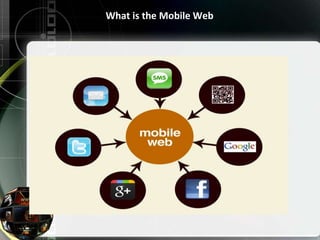
What is the Mobile Web?
 The computer, media player, and cell phone are all converging into a
single device as manufacturers aim to provide a complete experience for
the consumer. This evolution of handheld devices combined with new
high-speed wireless data networks make browsing the mobile Internet a
more compelling experience. Much like the transition the Web
experienced when broadband access became widely attainable, the
mobile Web is turning a corner and becoming useful to the everyday user.
While mass adoption is still in its infancy in this country, the landscape is
developing quickly. Now is the time to get on-board and on-the-move
with the mobile Web.
What is the Mobile Web
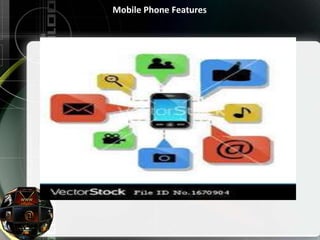
Mobile Phone Features
 There are a wide range of features available for today’s handheld devices,
some of which come pre-installed on devices, and others which may be
added on through carrier plans
1.Bluetooth
2. Camera
3. Desktop Synchronization
4. Downloadable Content
5. Email
6. Games
Cont….
7. GPS
8. IM
9. Memory Card Slot
10. Mobile Office Applications
11. Video etc.
Mobile Phone Features
Mobile Technology use in libraries and information centre
Libraries can provide a wide array of mobile services to interested users:
E-books and e-book readers
 Mobile online public access catalogs (OPACs)
 Mobile applications
 Mobile collections
 The Overdrive service
 Mobile library instruction
Cont..
 Mobile databases
 Library Short Message Service (SMS) notifications
 SMS Reference
Features of Library Mobile Sites
 A review of library mobile sites shows that they may offer the following features:

I. Mobile library catalog plus
II. Loan-related services
III. Information about opening hours
IV. Directions to the library
V. Information on how to contact the library via multiple channels
(chat/SMS/phone/e-mail)
VI. Links to mobile-enabled databases
VII.Links to mobile-enabled Web 2.0 accounts, such as Twitter, Flickr, YouTube, and
Facebook Floor maps Information on availability of computers and group discussion
rooms
VIII.A webcam so users can check on congestion in the library
IX. News about library events
X. Content for download on prod casts, videos, Etc
Conclusion
Mobile technology holds great promise for enabling libraries
to provide enhanced services in a form users increasingly are
demanding. If this promise is to be fully realized, however,
libraries will need to conduct analyses and make smart
decisions to address the issues outlined above, support staff
education and explore partnerships and new funding models,
and be prepared to compromise with respect to their
traditional information delivery models.

References
 Golvin, Charles S. “Benchmark 2007: Mobile’s The Most Mainstream”
Forrester Research, September 28, 2007.
 Balas, Janet L. “Of iPhones and Ebooks: Will They Get Together?”
Computers in Libraries,
 November/December 2007.
 Strother, Neil. “Mobile Video: What Consumers Want to Watch on their
Phones”, Jupiter Research,

 Strother, Neil. “US Mobile Marketing Forecast 2007 to 2012” Jupiter
Research, Volume 2, 2011.
 Husson, Thomas. “Mobile Social Networks: Complementary
Communication Tools for Online
 Social Networking”, Jupiter Research, September 19, 2011

Using mobile technologies to develop new ways of

  • 1.
    Using mobile technologiesto develop new ways of Libraries and Information Centre BY Dheeraj singh negi
  • 2.
    Introduction  Information andCommunications Technology continues to expand the boundaries of higher education into an the “ anytime /anywhere” experiences. Mobile Commnication is transforming how people search, receive and interact with information on a daily basis. In just a few short years smart phone ownership has skyrocketed and popular use of e- readers has been steadily on the rise. These advanced mobile tools provide portable, access to the world of information, across boundaries of subject, discipline and industry
  • 3.
    What is theMobile Web?  The computer, media player, and cell phone are all converging into a single device as manufacturers aim to provide a complete experience for the consumer. This evolution of handheld devices combined with new high-speed wireless data networks make browsing the mobile Internet a more compelling experience. Much like the transition the Web experienced when broadband access became widely attainable, the mobile Web is turning a corner and becoming useful to the everyday user. While mass adoption is still in its infancy in this country, the landscape is developing quickly. Now is the time to get on-board and on-the-move with the mobile Web.
  • 4.
    What is theMobile Web
  • 5.
    Mobile Phone Features There are a wide range of features available for today’s handheld devices, some of which come pre-installed on devices, and others which may be added on through carrier plans 1.Bluetooth 2. Camera 3. Desktop Synchronization 4. Downloadable Content 5. Email 6. Games
  • 6.
    Cont…. 7. GPS 8. IM 9.Memory Card Slot 10. Mobile Office Applications 11. Video etc.
  • 7.
  • 9.
    Mobile Technology usein libraries and information centre Libraries can provide a wide array of mobile services to interested users: E-books and e-book readers  Mobile online public access catalogs (OPACs)  Mobile applications  Mobile collections  The Overdrive service  Mobile library instruction
  • 10.
    Cont..  Mobile databases Library Short Message Service (SMS) notifications  SMS Reference
  • 11.
    Features of LibraryMobile Sites  A review of library mobile sites shows that they may offer the following features:  I. Mobile library catalog plus II. Loan-related services III. Information about opening hours IV. Directions to the library V. Information on how to contact the library via multiple channels (chat/SMS/phone/e-mail) VI. Links to mobile-enabled databases VII.Links to mobile-enabled Web 2.0 accounts, such as Twitter, Flickr, YouTube, and Facebook Floor maps Information on availability of computers and group discussion rooms VIII.A webcam so users can check on congestion in the library IX. News about library events X. Content for download on prod casts, videos, Etc
  • 12.
    Conclusion Mobile technology holdsgreat promise for enabling libraries to provide enhanced services in a form users increasingly are demanding. If this promise is to be fully realized, however, libraries will need to conduct analyses and make smart decisions to address the issues outlined above, support staff education and explore partnerships and new funding models, and be prepared to compromise with respect to their traditional information delivery models. 
  • 13.
    References  Golvin, CharlesS. “Benchmark 2007: Mobile’s The Most Mainstream” Forrester Research, September 28, 2007.  Balas, Janet L. “Of iPhones and Ebooks: Will They Get Together?” Computers in Libraries,  November/December 2007.  Strother, Neil. “Mobile Video: What Consumers Want to Watch on their Phones”, Jupiter Research,   Strother, Neil. “US Mobile Marketing Forecast 2007 to 2012” Jupiter Research, Volume 2, 2011.  Husson, Thomas. “Mobile Social Networks: Complementary Communication Tools for Online  Social Networking”, Jupiter Research, September 19, 2011