Bio-plastics in Packaging; Innovations,
    Opportunities and Challenges

                          Dr Roya Khalil

   Australian Institute of Packaging Conference, 14-15 June 2012
Summary
 Background
 Terminology
 Test standards & certifications
 Innovations & applications
 Global capacity & prediction demand
 Challenges
    - Communication & Marketing
    - Disposal
Definition of Sustainability
                          Sustainability is simply stated as:
   “meeting the needs of the present without compromising the ability of future
                    generations to meet their own needs."
    World Commission on Environment and Development, 1987, Our Common Future
Sustainable strategy defined with +R
 Reduce
 Reuse
 Recycle
 Renewable
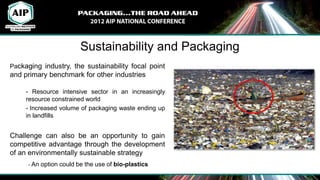
Sustainability and Packaging
Packaging industry, the sustainability focal point
and primary benchmark for other industries

     - Resource intensive sector in an increasingly
     resource constrained world
     - Increased volume of packaging waste ending up
     in landfills


Challenge can also be an opportunity to gain
competitive advantage through the development
of an environmentally sustainable strategy
     - An option could be the use of bio-plastics
Terminology and Measurements
 Bio-based (renewable soured) - Focus is on the origin of the carbon building block
     - To be classified bio-based, material must be organic and contain some percentage of recently fixed
     (new) carbon found in biological resources or crops


 Biodegradable - Focus is on the end of life
     - To be classified biodegradable, a certain % of the material must convert to carbon dioxide, water and
     biomass via microbial assimilation within a time period of 180 days and less than 10 % of test material
     remains on a 2mm sieve
     - To be classified compostable, material must meet the biodegradation criteria and leave no impact on
     plants, using OECD Guide 208 and meet the regulation (heavy metals less than 50 % of EPA
     prescribed threshold)

                              The two classes however are not mutually exclusive.
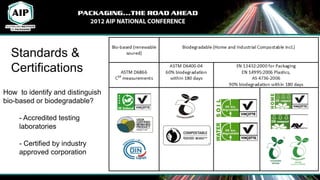
Standards &
  Certifications
How to identify and distinguish
bio-based or biodegradable?

     - Accredited testing
     laboratories

     - Certified by industry
     approved corporation
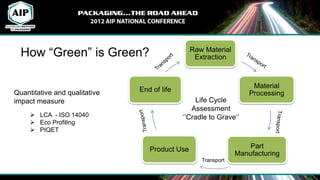
How “Green” is Green?                         Raw Material
                                                 Extraction


                                                                    Material
Quantitative and qualitative   End of life
                                                                   Processing
impact measure                                   Life Cycle
                                                Assessment
      LCA - ISO 14040                       ‘’Cradle to Grave‘’
      Eco Profiling
      PIQET


                                  Product Use                      Part
                                                               Manufacturing
                                                   Transport
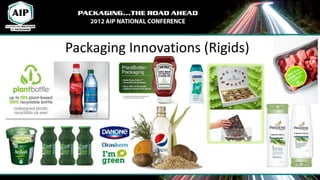
Packaging Innovations (Rigids)
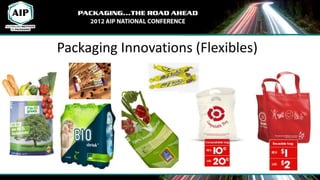
Packaging Innovations (Flexibles)
bio-plastics – Packaging Innovations- flexibles
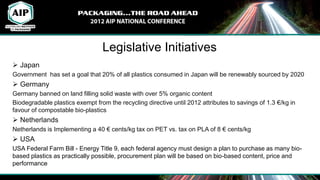
Legislative Initiatives
 Japan
Government has set a goal that 20% of all plastics consumed in Japan will be renewably sourced by 2020
 Germany
Germany banned on land filling solid waste with over 5% organic content
Biodegradable plastics exempt from the recycling directive until 2012 attributes to savings of 1.3 €/kg in
favour of compostable bio-plastics
 Netherlands
Netherlands is Implementing a 40 € cents/kg tax on PET vs. tax on PLA of 8 € cents/kg
 USA
USA Federal Farm Bill - Energy Title 9, each federal agency must design a plan to purchase as many bio-
based plastics as practically possible, procurement plan will be based on bio-based content, price and
performance
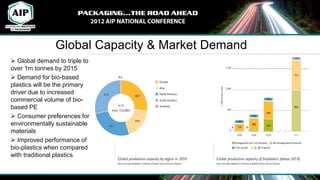
Global Capacity & Market Demand
 Global demand to triple to
over 1m tonnes by 2015
 Demand for bio-based
plastics will be the primary
driver due to increased
commercial volume of bio-
based PE
 Consumer preferences for
environmentally sustainable
materials
 Improved performance of
bio-plastics when compared
with traditional plastics
Leading Manufacturers
 Braskem - Green PE                                             (www.braskem.com.br)
 Natureworks – Ingeo®                                           (www.natureworksllc.com)
 Purac – PURALACT®                                              (www.purac.com)
 BASF – Ecovio® and Ecoflex®                                    (http://www.bioplastics.basf.com)
 Novamont – Mater-bi®                                           (www.novamont.com)
 Innovia films – Cellophanes™ & Natureflex™                     (www.innoviafilms.com)
 Cereplast – Cereplast Compostables® & Cereplast Sustainable®   (www.cereplast.com)
 Plantic – HP1 ® and R® & Plantic eco Plastic™                  (www.plantic.com.au)
 Becasewecare – becausewecare™                                  (www.becausewecare.com.au)
 Alesco - Bioshrink®                                            (www.alesco.net)
 Dow & Mitsui Chemicals – Green Plastics, PET & PP               (www.dow.com)
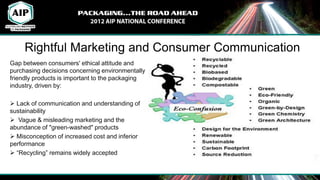
Rightful Marketing and Consumer Communication
Gap between consumers' ethical attitude and
purchasing decisions concerning environmentally
friendly products is important to the packaging
industry, driven by:

 Lack of communication and understanding of
sustainability
 Vague & misleading marketing and the
abundance of "green-washed" products
 Misconception of increased cost and inferior
performance
 “Recycling” remains widely accepted
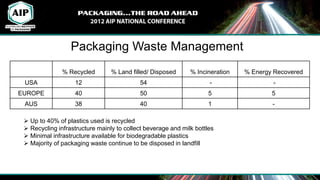
Packaging Waste Management
               % Recycled        % Land filled/ Disposed      % Incineration   % Energy Recovered
 USA               12                      54                        -                 -
EUROPE             40                      50                        5                 5
 AUS               38                      40                        1                 -

  Up to 40% of plastics used is recycled
  Recycling infrastructure mainly to collect beverage and milk bottles
  Minimal infrastructure available for biodegradable plastics
  Majority of packaging waste continue to be disposed in landfill
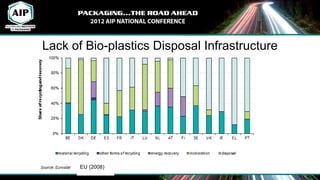
Lack of Bio-plastics Disposal Infrastructure


       EU (2008)
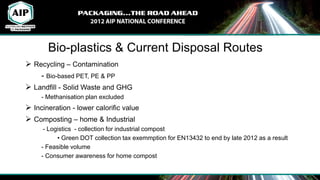
Bio-plastics & Current Disposal Routes
 Recycling – Contamination
    - Bio-based PET, PE & PP
 Landfill - Solid Waste and GHG
     - Methanisation plan excluded
 Incineration - lower calorific value
 Composting – home & Industrial
      - Logistics - collection for industrial compost
           • Green DOT collection tax exemmption for EN13432 to end by late 2012 as a result
     - Feasible volume
     - Consumer awareness for home compost
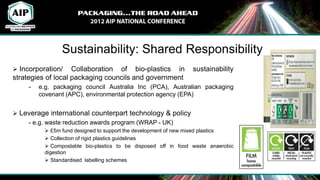
Sustainability: Shared Responsibility
 Incorporation/    Collaboration of bio-plastics in            sustainability
strategies of local packaging councils and government
     -   e.g. packaging council Australia Inc (PCA), Australian packaging
         covenant (APC), environmental protection agency (EPA)


 Leverage international counterpart technology & policy
    - e.g. waste reduction awards program (WRAP - UK)
           £5m fund designed to support the development of new mixed plastics
           Collection of rigid plastics guidelines
           Compostable bio-plastics to be disposed off in food waste anaerobic
          digestion
           Standardised labelling schemes
References
http://epp.eurostat.ec.europa.eu/statistics_explained/images/d/d9/Share_of_recycling_and_recovery_operation_for_plastics_packaging_2008.PNG

 http://www.pca.org.au/uploads/00207.pdf

http://en.european-bio-plastics.org/press/press-pictures/service-packaging/

http://en.european-ioplastics.org/wpontent/uploads/2011/04/EuBP_image_brochure_2011.pdf

http://www.icis.com/Articles/2011/12/02/9513755/world-bio-plastics-demand-to-reach-2.9b-by-2015-us-firm.html

http://naturalplasticstests.blogspot.com.au/2011/01/consumer-awareness-of-environmental.html

http://www.packagingdigest.com/article/518350-What_s_driving_sustainable_packaging_development_.php

www.smitherspira.com

http://www.packagingdigest.com/article/518350-What_s_driving_sustainable_packaging_development_.php

www.packagingcovenant.org.au

www.pca.org.au

 www.wrap.org.uk

Roya khalil biopolymers in packaging 2012

  • 1.
    Bio-plastics in Packaging;Innovations, Opportunities and Challenges Dr Roya Khalil Australian Institute of Packaging Conference, 14-15 June 2012
  • 2.
    Summary  Background  Terminology Test standards & certifications  Innovations & applications  Global capacity & prediction demand  Challenges - Communication & Marketing - Disposal
  • 3.
    Definition of Sustainability Sustainability is simply stated as: “meeting the needs of the present without compromising the ability of future generations to meet their own needs." World Commission on Environment and Development, 1987, Our Common Future Sustainable strategy defined with +R  Reduce  Reuse  Recycle  Renewable
  • 4.
    Sustainability and Packaging Packagingindustry, the sustainability focal point and primary benchmark for other industries - Resource intensive sector in an increasingly resource constrained world - Increased volume of packaging waste ending up in landfills Challenge can also be an opportunity to gain competitive advantage through the development of an environmentally sustainable strategy - An option could be the use of bio-plastics
  • 5.
    Terminology and Measurements Bio-based (renewable soured) - Focus is on the origin of the carbon building block - To be classified bio-based, material must be organic and contain some percentage of recently fixed (new) carbon found in biological resources or crops  Biodegradable - Focus is on the end of life - To be classified biodegradable, a certain % of the material must convert to carbon dioxide, water and biomass via microbial assimilation within a time period of 180 days and less than 10 % of test material remains on a 2mm sieve - To be classified compostable, material must meet the biodegradation criteria and leave no impact on plants, using OECD Guide 208 and meet the regulation (heavy metals less than 50 % of EPA prescribed threshold) The two classes however are not mutually exclusive.
  • 6.
    Standards & Certifications How to identify and distinguish bio-based or biodegradable? - Accredited testing laboratories - Certified by industry approved corporation
  • 7.
    How “Green” isGreen? Raw Material Extraction Material Quantitative and qualitative End of life Processing impact measure Life Cycle Assessment  LCA - ISO 14040 ‘’Cradle to Grave‘’  Eco Profiling  PIQET Product Use Part Manufacturing Transport
  • 8.
  • 9.
    Packaging Innovations (Flexibles) bio-plastics– Packaging Innovations- flexibles
  • 10.
    Legislative Initiatives  Japan Governmenthas set a goal that 20% of all plastics consumed in Japan will be renewably sourced by 2020  Germany Germany banned on land filling solid waste with over 5% organic content Biodegradable plastics exempt from the recycling directive until 2012 attributes to savings of 1.3 €/kg in favour of compostable bio-plastics  Netherlands Netherlands is Implementing a 40 € cents/kg tax on PET vs. tax on PLA of 8 € cents/kg  USA USA Federal Farm Bill - Energy Title 9, each federal agency must design a plan to purchase as many bio- based plastics as practically possible, procurement plan will be based on bio-based content, price and performance
  • 11.
    Global Capacity &Market Demand  Global demand to triple to over 1m tonnes by 2015  Demand for bio-based plastics will be the primary driver due to increased commercial volume of bio- based PE  Consumer preferences for environmentally sustainable materials  Improved performance of bio-plastics when compared with traditional plastics
  • 12.
    Leading Manufacturers  Braskem- Green PE (www.braskem.com.br)  Natureworks – Ingeo® (www.natureworksllc.com)  Purac – PURALACT® (www.purac.com)  BASF – Ecovio® and Ecoflex® (http://www.bioplastics.basf.com)  Novamont – Mater-bi® (www.novamont.com)  Innovia films – Cellophanes™ & Natureflex™ (www.innoviafilms.com)  Cereplast – Cereplast Compostables® & Cereplast Sustainable® (www.cereplast.com)  Plantic – HP1 ® and R® & Plantic eco Plastic™ (www.plantic.com.au)  Becasewecare – becausewecare™ (www.becausewecare.com.au)  Alesco - Bioshrink® (www.alesco.net)  Dow & Mitsui Chemicals – Green Plastics, PET & PP (www.dow.com)
  • 13.
    Rightful Marketing andConsumer Communication Gap between consumers' ethical attitude and purchasing decisions concerning environmentally friendly products is important to the packaging industry, driven by:  Lack of communication and understanding of sustainability  Vague & misleading marketing and the abundance of "green-washed" products  Misconception of increased cost and inferior performance  “Recycling” remains widely accepted
  • 14.
    Packaging Waste Management % Recycled % Land filled/ Disposed % Incineration % Energy Recovered USA 12 54 - - EUROPE 40 50 5 5 AUS 38 40 1 -  Up to 40% of plastics used is recycled  Recycling infrastructure mainly to collect beverage and milk bottles  Minimal infrastructure available for biodegradable plastics  Majority of packaging waste continue to be disposed in landfill
  • 15.
    Lack of Bio-plasticsDisposal Infrastructure EU (2008)
  • 16.
    Bio-plastics & CurrentDisposal Routes  Recycling – Contamination - Bio-based PET, PE & PP  Landfill - Solid Waste and GHG - Methanisation plan excluded  Incineration - lower calorific value  Composting – home & Industrial - Logistics - collection for industrial compost • Green DOT collection tax exemmption for EN13432 to end by late 2012 as a result - Feasible volume - Consumer awareness for home compost
  • 17.
    Sustainability: Shared Responsibility Incorporation/ Collaboration of bio-plastics in sustainability strategies of local packaging councils and government - e.g. packaging council Australia Inc (PCA), Australian packaging covenant (APC), environmental protection agency (EPA)  Leverage international counterpart technology & policy - e.g. waste reduction awards program (WRAP - UK)  £5m fund designed to support the development of new mixed plastics  Collection of rigid plastics guidelines  Compostable bio-plastics to be disposed off in food waste anaerobic digestion  Standardised labelling schemes
  • 18.
    References http://epp.eurostat.ec.europa.eu/statistics_explained/images/d/d9/Share_of_recycling_and_recovery_operation_for_plastics_packaging_2008.PNG  http://www.pca.org.au/uploads/00207.pdf http://en.european-bio-plastics.org/press/press-pictures/service-packaging/ http://en.european-ioplastics.org/wpontent/uploads/2011/04/EuBP_image_brochure_2011.pdf http://www.icis.com/Articles/2011/12/02/9513755/world-bio-plastics-demand-to-reach-2.9b-by-2015-us-firm.html http://naturalplasticstests.blogspot.com.au/2011/01/consumer-awareness-of-environmental.html http://www.packagingdigest.com/article/518350-What_s_driving_sustainable_packaging_development_.php www.smitherspira.com http://www.packagingdigest.com/article/518350-What_s_driving_sustainable_packaging_development_.php www.packagingcovenant.org.au www.pca.org.au  www.wrap.org.uk