Using Critical Thinking
Skills To Be An Active
Learner
Copyright © 2021 Talent & Skills HuB
Objectives
Understanding the Term Critical Thinking
Understanding the Relationship between Critical Thinking
and Academic life
Understanding the act of Active Learning
Understanding the act of Active Reading
Understanding the act of Active Writing
Copyright © 2021 Talent & Skills HuB
Definition of Critical Thinking
A purposeful, organized, mental process that we use to understand the
world and make informed decisions.
Critical Thinking involves asking questions to produce potential
solutions to different problems.
Copyright © 2021 Talent & Skills HuB
Explanation of Critical Thinking
Productive: Thinking that goes beyond observing and
recalling facts.
Critical: Being able to ask questions and gather information
Weighing & Solving: When you think critically you weigh
evidence, solve problems and make decisions.
Creating & Applying: When you think critically you create
new ideas, and turn information into a tool by applying what
you have learned in previous situations to new situations.
Copyright © 2021 Talent & Skills HuB
Stop and Think…
Can you think of a time when you had a critical thinking response to a situation?
What did you do?
Example: You had to get a B on a paper to pass a course, but you got a C-.
A non-critical thinking response would be to say that you did not pass the
course.
A critical thinking response would identify potential solutions like asking the
instructor if you can redo the paper, asking if you can do another assignment
to add another grade to your average, or retaking the course.
Think about the example. In the former, the case is closed. In the later, options
are revealed and explored, possibilities open up and you can take action to
improve the situation.
Can you think of a time when you had a non-critical thinking response to a
situation? What could you have done differently?
Copyright © 2021 Talent & Skills HuB
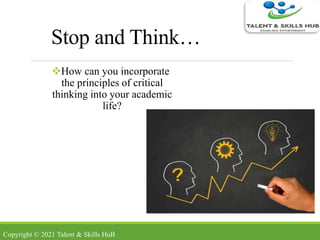
Stop and Think…
How can you incorporate
the principles of critical
thinking into your academic
life?
Copyright © 2021 Talent & Skills HuB
Critical Thinking & Academic Life
Being able to think critically in college/university will help you better
understand what you learn.
Evaluate different perspectives:
Evaluate other people’s ideas. How do they conflict with yours? How are
they similar?
Ask open-ended questions (Why? How? What if?):
This will assist you in gathering more information and narrow your focus
when faced with an overwhelming problem.
Explain your answers:
If you “own” your thoughts and are responsible for creating them, you will
be better able to explain what you are thinking and answer questions.
Copyright © 2021 Talent & Skills HuB
Critical Thinking & Academic Life
Learn to think more critically in all aspects of your
education.
The following slides discuss:
Active Learning
Active Reading
Critical Writing
Copyright © 2021 Talent & Skills HuB
Stop and think…
What does it mean to be an active learner?
Copyright © 2021 Talent & Skills HuB
What does it mean to be an active
learner?
Getting involved instead of remaining disengaged in the
classroom: asking questions, taking notes, thinking as you are
listen, conversing with other students and the instructor about
ideas.
Taking initiative to make your own decisions instead of waiting
passively to be told what to do.
Following through on commitments and assignments instead of
giving up.
Taking responsibility for your decisions and thoughts instead of
blaming others or events “beyond your control”.
Copyright © 2021 Talent & Skills HuB
Tips for Active Learning
If possible, choose instructors that actively engage you in
the classroom.
Prepare for class by reading your textbook and reviewing
notes from previous classes.
Ask questions.
Put what you learn into your own words. Summarize your
notes and readings.
Copyright © 2021 Talent & Skills HuB
Tips for Active Learning (continued)
Study with other students.
Talking about assignments and getting other points of view that
will help you learn the material faster and more thoroughly.
Thinking critically about others’ opinions and thoughts helps to
clarify your own.
Use your resources.
Instructors, other students, the library, tutors, academic advisor,
books, etc.
The more people and resources you form working relationships
with, the better your chance of success in reaching your goals.
Copyright © 2021 Talent & Skills HuB
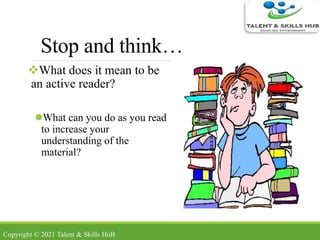
Stop and think…
What does it mean to be
an active reader?
What can you do as you read
to increase your
understanding of the
material?
Copyright © 2021 Talent & Skills HuB
Active Reading
To understand what you read, you must be able to:
Identify the author’s thesis (main idea).
Understand the author’s line of reasoning from paragraph to
paragraph.
Briefly explain the main point and line of reasoning to
someone who has not read the passage.
Copyright © 2021 Talent & Skills HuB
Tips for Reading Actively
Pause after reading each paragraph to mentally summarize what has been
read.
Ask yourself:
What is the main idea? What are the major supporting facts?
Where is the discussion likely to go from here?
Focus on:
Understanding the main idea
Identifying supporting evidence
Distinguishing between main points and minor details
The next slide lists key words and phrases that authors use to signal how a
discussion is organized. Being aware of these words and phrases will help
you understand the main idea and details of a passage.
Copyright © 2021 Talent & Skills HuB
Signal Words & Phrases
These words signal that the author
is contrasting (identifying
differences between) two concepts:
Alternatively, rather than, by
contrast, while, however, yet, on
the other hand
These words signal that the author
is comparing (identifying
similarities between) two concepts:
Similarly, just as, in the same way,
to, analogous, also, parallel, as,
likewise
These words signal evidence
(factual information) used to
support the author’s argument:
Because, since, in light of
These words signal a logical
conclusion based upon preceding
material:
Consequently, therefore, in
conclusion, as a result, then,
accordingly, thus
Copyright © 2021 Talent & Skills HuB
Stop and think…
Do you have a process for approaching writing assignments?
How productive is it?
How could you improve your writing?
Copyright © 2021 Talent & Skills HuB
Critical Writing
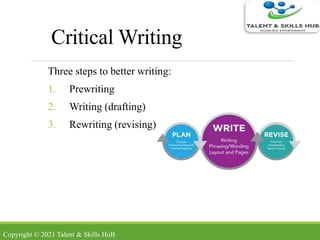
Three steps to better writing:
1. Prewriting
2. Writing (drafting)
3. Rewriting (revising)
Copyright © 2021 Talent & Skills HuB
Prewriting
Prewriting includes:
Preparing to write by reading assigned works, completing your
research, taking notes and creating outlines
Exploring the topic by asking questions which you will
eventually answer in your essay/paper
Writing your rough ideas which you will come back to and
expand on
Prewriting should take up most of your time during the writing
process.
Copyright © 2021 Talent & Skills HuB
Writing
If you have done the proper prewriting/thinking/researching/note
taking/outlining, your thoughts will already be developed, and
your mind will be primed and ready for the task of writing.
Thus, writing the first draft should take a limited amount of your
time during the writing process.
Copyright © 2021 Talent & Skills HuB
Rewriting
After completing the first draft, you need to revise, edit and
rewrite
Rewriting will take more time than writing your first draft.
Copyright © 2021 Talent & Skills HuB
Tips for Critical Writing
Be willing to say, “I don’t know”. Don’t jump to conclusions too
quickly: good questions take time and patience to answer.
Don’t substitute a strong belief for real knowledge or fact. Test your
opinions in light of the evidence and be willing to change your mind.
Explain your point of view with evidence.
Judge an argument on its merits, not on the basis of who said it.
Use reliable scholarly resources.
Copyright © 2021 Talent & Skills HuB
Critical Thinking Summary
Think critically by applying your current knowledge to new
situations.
You can incorporate critical thinking skills into your academic
life by evaluating different perspectives, asking questions and
explaining your answers.
Be an active learner by asking questions, getting involved, and
taking responsibility.
Read actively by summarizing in your own words and looking
for signal words to help you better understand main points and
details.
Improve your writing by prewriting, drafting and revising.
Copyright © 2021 Talent & Skills HuB
Talent &
Skills HuB
T&S-HuB is an enabling environment that supports people in
the development of their talents and skills and in the
actualisation of their personal passions and ambitions.
We help learners and individuals sharpen and exhibit their
talents and skills while exploring relevant and life changing
opportunities that suit their passions.
You can be supported by our instructors, counsellors, and
mentors on employability skills and other personal and
professional development.
Book an appointment for one-to-one or group tutoring
through our website; ts-hub.com
You can also contact us via email: contactus@ts-hub.com
Copyright © 2021 Talent & Skills HuB
Resources
Carter, C. et al. (1999) Keys to Success: How to achieve your goals.
Upper Saddle River, NJ: Prentice Hall.
Carter, C. et al. (1998) Keys to Success: How to achieve your goals,
Adopter’s Resource Kit. Upper Saddle River, NJ: Prentice Hall.
Chaffee, J. (2003) Thinking Critically, 7th edition. Boston:
Houghton Mifflin Company.
Gardner, J. & Jewler, A. (2000) Your College Experience; Strategies
for Success,4th Edition. Belmont, CA: Wadsworth Publishing
Company.
Steward, M. & O’Toole, F. (1998) 30 Days to the LSAT.
Lawrenceville, NJ: Thomson Corporation.
Copyright © 2021 Talent & Skills HuB

Using Critical Thinking Skills to be an Active Learner

  • 1.
    Using Critical Thinking SkillsTo Be An Active Learner Copyright © 2021 Talent & Skills HuB
  • 2.
    Objectives Understanding the TermCritical Thinking Understanding the Relationship between Critical Thinking and Academic life Understanding the act of Active Learning Understanding the act of Active Reading Understanding the act of Active Writing Copyright © 2021 Talent & Skills HuB
  • 3.
    Definition of CriticalThinking A purposeful, organized, mental process that we use to understand the world and make informed decisions. Critical Thinking involves asking questions to produce potential solutions to different problems. Copyright © 2021 Talent & Skills HuB
  • 4.
    Explanation of CriticalThinking Productive: Thinking that goes beyond observing and recalling facts. Critical: Being able to ask questions and gather information Weighing & Solving: When you think critically you weigh evidence, solve problems and make decisions. Creating & Applying: When you think critically you create new ideas, and turn information into a tool by applying what you have learned in previous situations to new situations. Copyright © 2021 Talent & Skills HuB
  • 5.
    Stop and Think… Canyou think of a time when you had a critical thinking response to a situation? What did you do? Example: You had to get a B on a paper to pass a course, but you got a C-. A non-critical thinking response would be to say that you did not pass the course. A critical thinking response would identify potential solutions like asking the instructor if you can redo the paper, asking if you can do another assignment to add another grade to your average, or retaking the course. Think about the example. In the former, the case is closed. In the later, options are revealed and explored, possibilities open up and you can take action to improve the situation. Can you think of a time when you had a non-critical thinking response to a situation? What could you have done differently? Copyright © 2021 Talent & Skills HuB
  • 6.
    Stop and Think… Howcan you incorporate the principles of critical thinking into your academic life? Copyright © 2021 Talent & Skills HuB
  • 7.
    Critical Thinking &Academic Life Being able to think critically in college/university will help you better understand what you learn. Evaluate different perspectives: Evaluate other people’s ideas. How do they conflict with yours? How are they similar? Ask open-ended questions (Why? How? What if?): This will assist you in gathering more information and narrow your focus when faced with an overwhelming problem. Explain your answers: If you “own” your thoughts and are responsible for creating them, you will be better able to explain what you are thinking and answer questions. Copyright © 2021 Talent & Skills HuB
  • 8.
    Critical Thinking &Academic Life Learn to think more critically in all aspects of your education. The following slides discuss: Active Learning Active Reading Critical Writing Copyright © 2021 Talent & Skills HuB
  • 9.
    Stop and think… Whatdoes it mean to be an active learner? Copyright © 2021 Talent & Skills HuB
  • 10.
    What does itmean to be an active learner? Getting involved instead of remaining disengaged in the classroom: asking questions, taking notes, thinking as you are listen, conversing with other students and the instructor about ideas. Taking initiative to make your own decisions instead of waiting passively to be told what to do. Following through on commitments and assignments instead of giving up. Taking responsibility for your decisions and thoughts instead of blaming others or events “beyond your control”. Copyright © 2021 Talent & Skills HuB
  • 11.
    Tips for ActiveLearning If possible, choose instructors that actively engage you in the classroom. Prepare for class by reading your textbook and reviewing notes from previous classes. Ask questions. Put what you learn into your own words. Summarize your notes and readings. Copyright © 2021 Talent & Skills HuB
  • 12.
    Tips for ActiveLearning (continued) Study with other students. Talking about assignments and getting other points of view that will help you learn the material faster and more thoroughly. Thinking critically about others’ opinions and thoughts helps to clarify your own. Use your resources. Instructors, other students, the library, tutors, academic advisor, books, etc. The more people and resources you form working relationships with, the better your chance of success in reaching your goals. Copyright © 2021 Talent & Skills HuB
  • 13.
    Stop and think… Whatdoes it mean to be an active reader? What can you do as you read to increase your understanding of the material? Copyright © 2021 Talent & Skills HuB
  • 14.
    Active Reading To understandwhat you read, you must be able to: Identify the author’s thesis (main idea). Understand the author’s line of reasoning from paragraph to paragraph. Briefly explain the main point and line of reasoning to someone who has not read the passage. Copyright © 2021 Talent & Skills HuB
  • 15.
    Tips for ReadingActively Pause after reading each paragraph to mentally summarize what has been read. Ask yourself: What is the main idea? What are the major supporting facts? Where is the discussion likely to go from here? Focus on: Understanding the main idea Identifying supporting evidence Distinguishing between main points and minor details The next slide lists key words and phrases that authors use to signal how a discussion is organized. Being aware of these words and phrases will help you understand the main idea and details of a passage. Copyright © 2021 Talent & Skills HuB
  • 16.
    Signal Words &Phrases These words signal that the author is contrasting (identifying differences between) two concepts: Alternatively, rather than, by contrast, while, however, yet, on the other hand These words signal that the author is comparing (identifying similarities between) two concepts: Similarly, just as, in the same way, to, analogous, also, parallel, as, likewise These words signal evidence (factual information) used to support the author’s argument: Because, since, in light of These words signal a logical conclusion based upon preceding material: Consequently, therefore, in conclusion, as a result, then, accordingly, thus Copyright © 2021 Talent & Skills HuB
  • 17.
    Stop and think… Doyou have a process for approaching writing assignments? How productive is it? How could you improve your writing? Copyright © 2021 Talent & Skills HuB
  • 18.
    Critical Writing Three stepsto better writing: 1. Prewriting 2. Writing (drafting) 3. Rewriting (revising) Copyright © 2021 Talent & Skills HuB
  • 19.
    Prewriting Prewriting includes: Preparing towrite by reading assigned works, completing your research, taking notes and creating outlines Exploring the topic by asking questions which you will eventually answer in your essay/paper Writing your rough ideas which you will come back to and expand on Prewriting should take up most of your time during the writing process. Copyright © 2021 Talent & Skills HuB
  • 20.
    Writing If you havedone the proper prewriting/thinking/researching/note taking/outlining, your thoughts will already be developed, and your mind will be primed and ready for the task of writing. Thus, writing the first draft should take a limited amount of your time during the writing process. Copyright © 2021 Talent & Skills HuB
  • 21.
    Rewriting After completing thefirst draft, you need to revise, edit and rewrite Rewriting will take more time than writing your first draft. Copyright © 2021 Talent & Skills HuB
  • 22.
    Tips for CriticalWriting Be willing to say, “I don’t know”. Don’t jump to conclusions too quickly: good questions take time and patience to answer. Don’t substitute a strong belief for real knowledge or fact. Test your opinions in light of the evidence and be willing to change your mind. Explain your point of view with evidence. Judge an argument on its merits, not on the basis of who said it. Use reliable scholarly resources. Copyright © 2021 Talent & Skills HuB
  • 23.
    Critical Thinking Summary Thinkcritically by applying your current knowledge to new situations. You can incorporate critical thinking skills into your academic life by evaluating different perspectives, asking questions and explaining your answers. Be an active learner by asking questions, getting involved, and taking responsibility. Read actively by summarizing in your own words and looking for signal words to help you better understand main points and details. Improve your writing by prewriting, drafting and revising. Copyright © 2021 Talent & Skills HuB
  • 24.
    Talent & Skills HuB T&S-HuBis an enabling environment that supports people in the development of their talents and skills and in the actualisation of their personal passions and ambitions. We help learners and individuals sharpen and exhibit their talents and skills while exploring relevant and life changing opportunities that suit their passions. You can be supported by our instructors, counsellors, and mentors on employability skills and other personal and professional development. Book an appointment for one-to-one or group tutoring through our website; ts-hub.com You can also contact us via email: contactus@ts-hub.com Copyright © 2021 Talent & Skills HuB
  • 25.
    Resources Carter, C. etal. (1999) Keys to Success: How to achieve your goals. Upper Saddle River, NJ: Prentice Hall. Carter, C. et al. (1998) Keys to Success: How to achieve your goals, Adopter’s Resource Kit. Upper Saddle River, NJ: Prentice Hall. Chaffee, J. (2003) Thinking Critically, 7th edition. Boston: Houghton Mifflin Company. Gardner, J. & Jewler, A. (2000) Your College Experience; Strategies for Success,4th Edition. Belmont, CA: Wadsworth Publishing Company. Steward, M. & O’Toole, F. (1998) 30 Days to the LSAT. Lawrenceville, NJ: Thomson Corporation. Copyright © 2021 Talent & Skills HuB