WRITING EFFECTIVE
REPORTS AND ESSAYS
DR FRED OKPALA 1
Copyright © 2021 Talent & Skills HuB
Objectives
Understanding how to plan, structure and write your assignment or report.
Understanding the formats of report and essay writing.
Developing the skills needed for writing effectively for academic purposes.
2
Copyright © 2021 Talent & Skills HuB
What is a Report?
A report is a document that gives a reader information and requires the reader to do
something with that information. Report can be used:
To suggest new ideas and options.
To ask people to accept a point of view.
To influence decisions.
To ask people to make choices between alternative recommendations.
3
Copyright © 2021 Talent & Skills HuB
Structuring Your Report
A report will usually follow a simple format which can be identified over and over
again as you look through the reports written by academics, agencies or individuals.
One of the key issues is to carefully provide signposts’ for the reader throughout the
report through the use of:
 Headings,
 Sub headings
 Bullet points
 New paragraphs for new topics.
4
Copyright © 2021 Talent & Skills HuB
The Format of a Report
The format may be influenced by the purpose and length of the report. There are nine identifiable
sections in most reports which are:
1.Title page
2.Executive summary
3.Table of contents
4.Introduction
5.Discussion
6.Conclusion
7.Recommendations
8.References and Bibliography
9.Appendices
5
Copyright © 2021 Talent & Skills HuB
Title Page
Title page helps the reader to know what the report is about.
It could be in a form of a title (topic) or sometimes a brief explanation of the
purpose of the report.
6
Copyright © 2021 Talent & Skills HuB
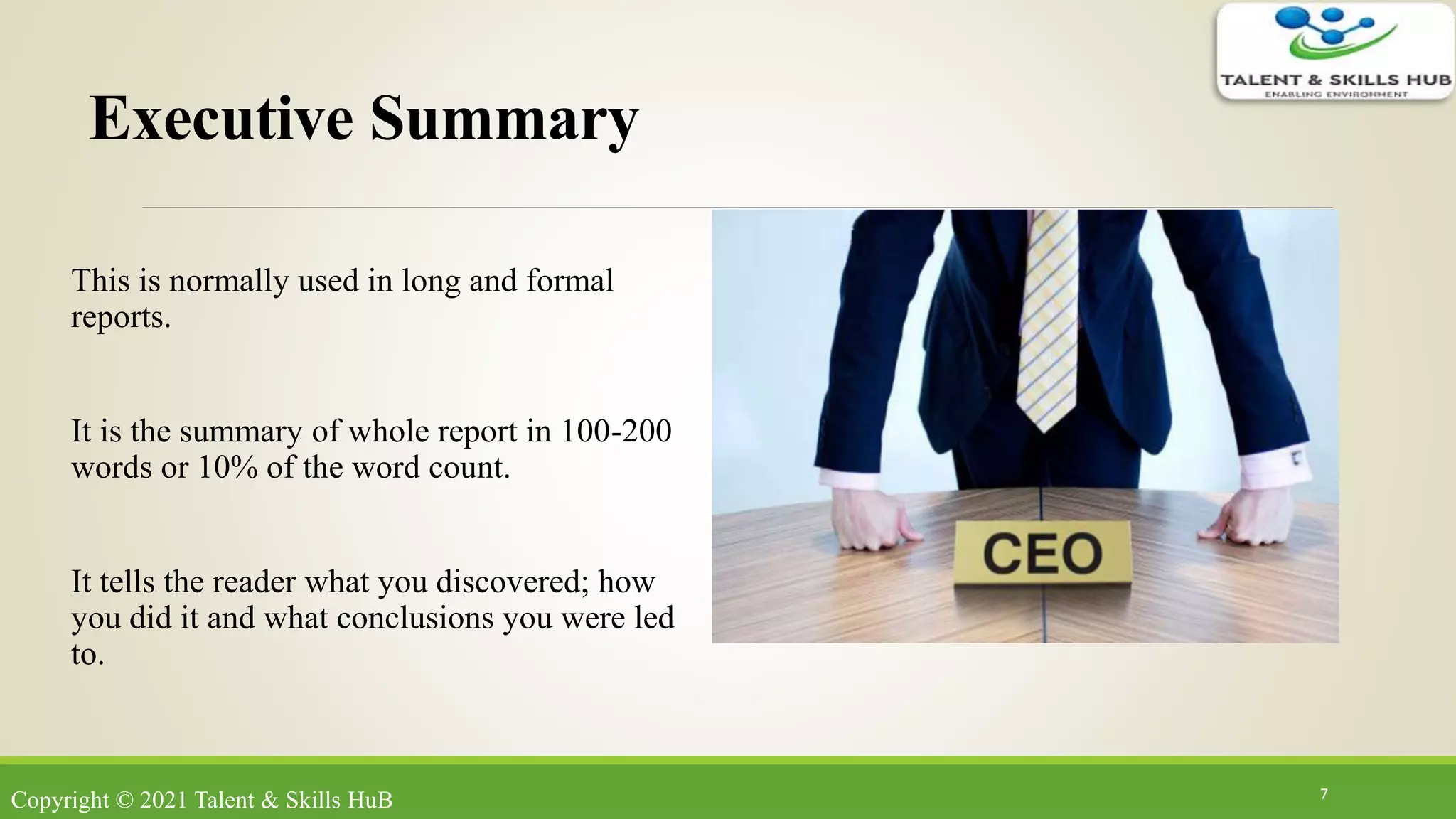
Executive Summary
This is normally used in long and formal
reports.
It is the summary of whole report in 100-200
words or 10% of the word count.
It tells the reader what you discovered; how
you did it and what conclusions you were led
to.
7
Copyright © 2021 Talent & Skills HuB
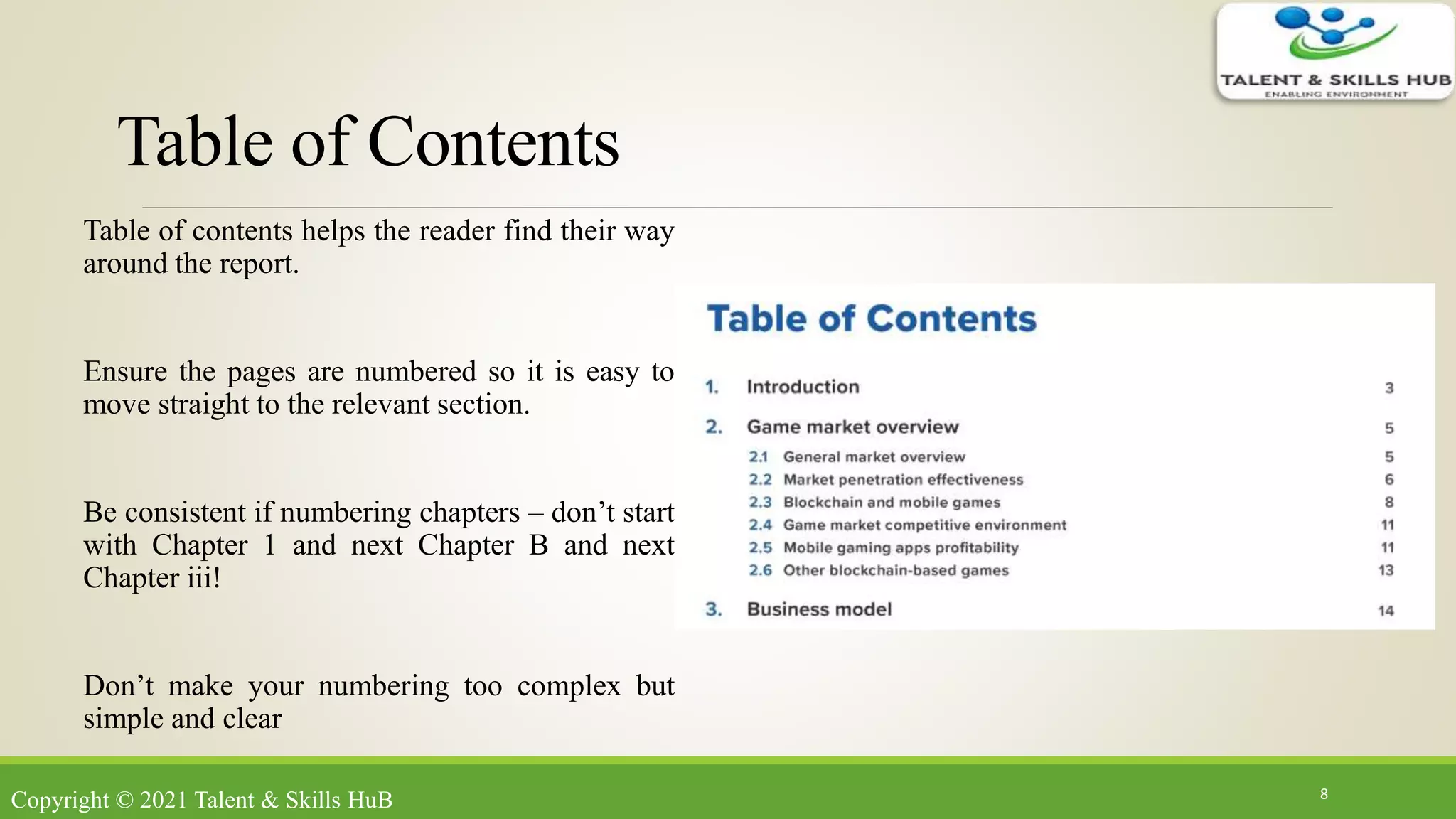
Table of Contents
Table of contents helps the reader find their way
around the report.
Ensure the pages are numbered so it is easy to
move straight to the relevant section.
Be consistent if numbering chapters – don’t start
with Chapter 1 and next Chapter B and next
Chapter iii!
Don’t make your numbering too complex but
simple and clear
8
Copyright © 2021 Talent & Skills HuB
Introduction
Should be quite brief. It can be a paragraph or 10% words of the total word count, but it
should tell the reader:
The topic of discussion
The reason for the report
The key issues which will be addressed
The terms of reference and limitations
A brief outline of the background to the report
9
Copyright © 2021 Talent & Skills HuB
Discussion (Body)
This is the main body of the report and the
longest part.
It goes into more detail about the subject.
It should be arranged logically in one or a
series of sections.
You should use headings and sub-headings
to help the reader find their way around it.
Writing a report is not like writing a
detective novel so you don’t leave the best
bits until last!
10
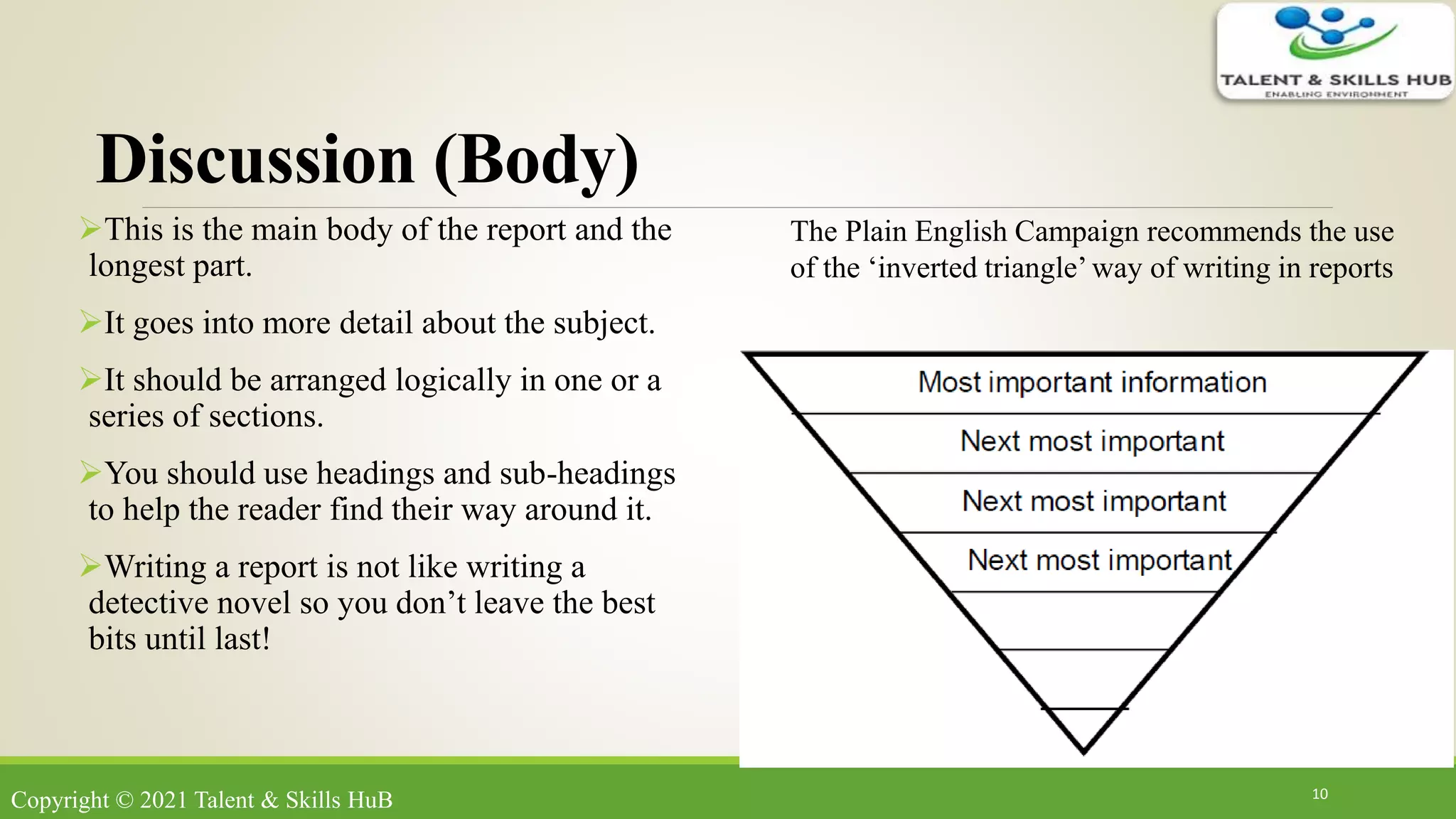
The Plain English Campaign recommends the use
of the ‘inverted triangle’ way of writing in reports
Copyright © 2021 Talent & Skills HuB
Conclusions
These are the main findings from the research that went into the report:
What you set out to find – the purpose of the report
What you found out
The significant of what you discovered
How it answers the question set by the person who commissioned the report
11
Note: You should not present any new information in your conclusion. Just use the information you
have collected to inform the options, lessons or advice you wish to give the readers.
Copyright © 2021 Talent & Skills HuB
Recommendations
The purpose of a report is usually to present options or make
some recommendations for action you want the reader to take.
Here you will present the actions you are recommending to
the reader.
Again, don’t leave the preferred option or action until last.
Use that ‘inverted triangle’ approach here too. So you should
present your most favoured ideas, options or
recommendations first
12
Copyright © 2021 Talent & Skills HuB
References and Bibliography
A reference list is the detailed list of references (materials) that are cited in your
work.
A bibliography is a detailed list of references cited in your work, plus the
background readings or other material that you may have read, but not actually
cited.
13
Copyright © 2021 Talent & Skills HuB
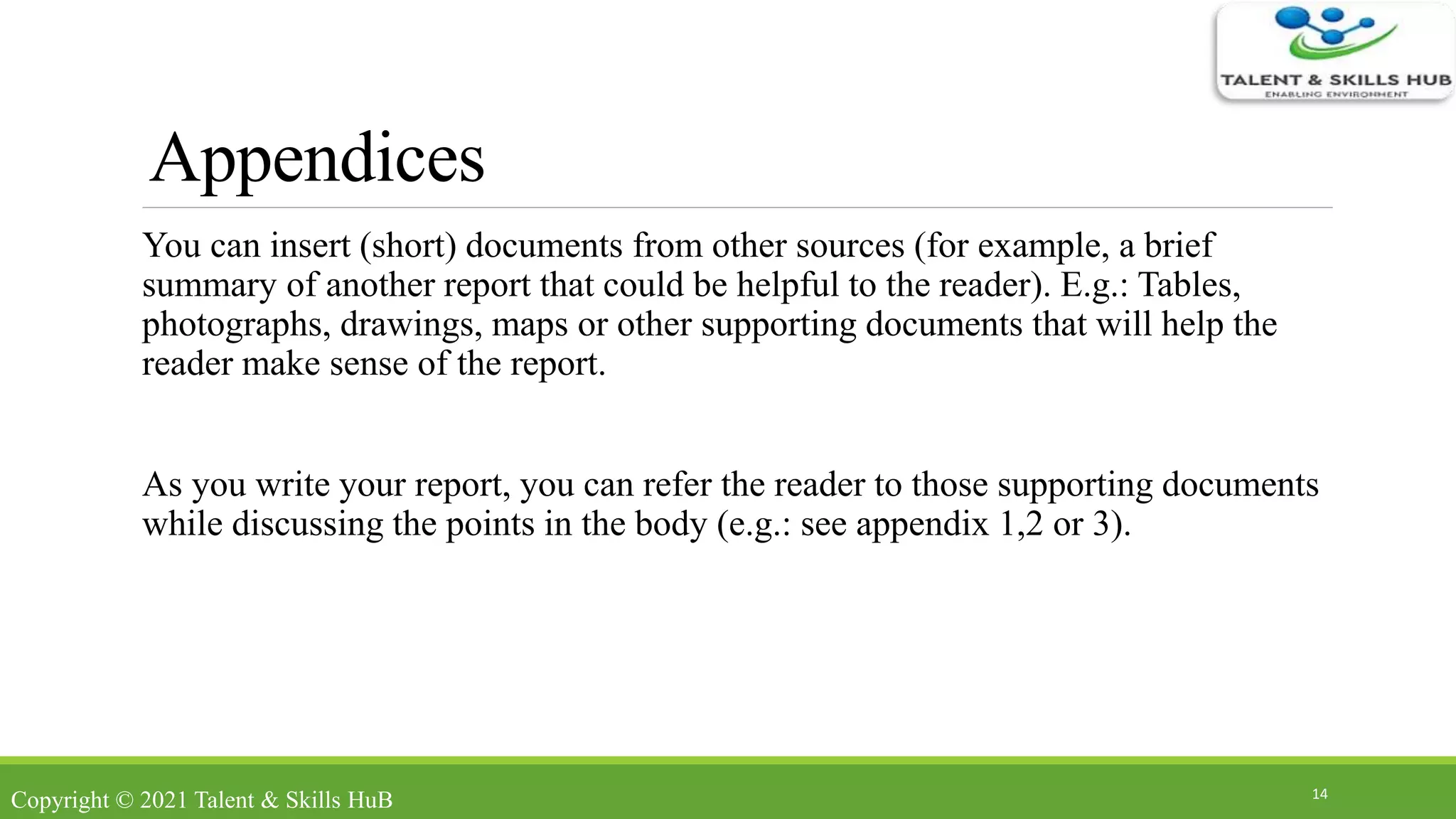
Appendices
You can insert (short) documents from other sources (for example, a brief
summary of another report that could be helpful to the reader). E.g.: Tables,
photographs, drawings, maps or other supporting documents that will help the
reader make sense of the report.
As you write your report, you can refer the reader to those supporting documents
while discussing the points in the body (e.g.: see appendix 1,2 or 3).
14
Copyright © 2021 Talent & Skills HuB
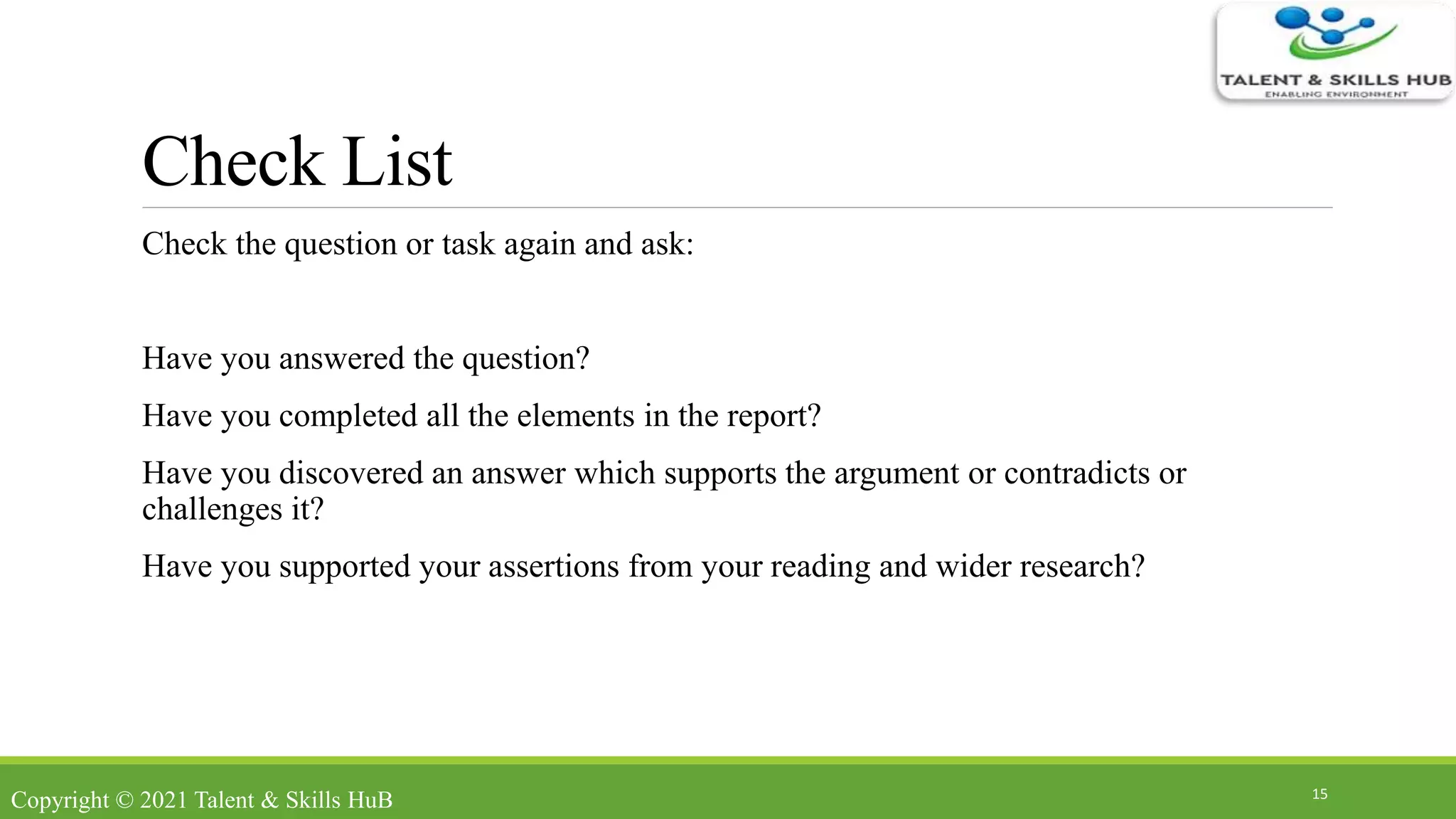
Check List
Check the question or task again and ask:
Have you answered the question?
Have you completed all the elements in the report?
Have you discovered an answer which supports the argument or contradicts or
challenges it?
Have you supported your assertions from your reading and wider research?
15
Copyright © 2021 Talent & Skills HuB
Writing Essays
An essay is a continuous piece of writing, set out in paragraphs, responding to a
question or a title.
It is usually an academic piece of writing. It leads from an introduction, through
a series of arguments and debates to some conclusions.
An essay does not normally use headings within the work, although it will have a
main heading, usually setting out the title or question given.
16
Copyright © 2021 Talent & Skills HuB
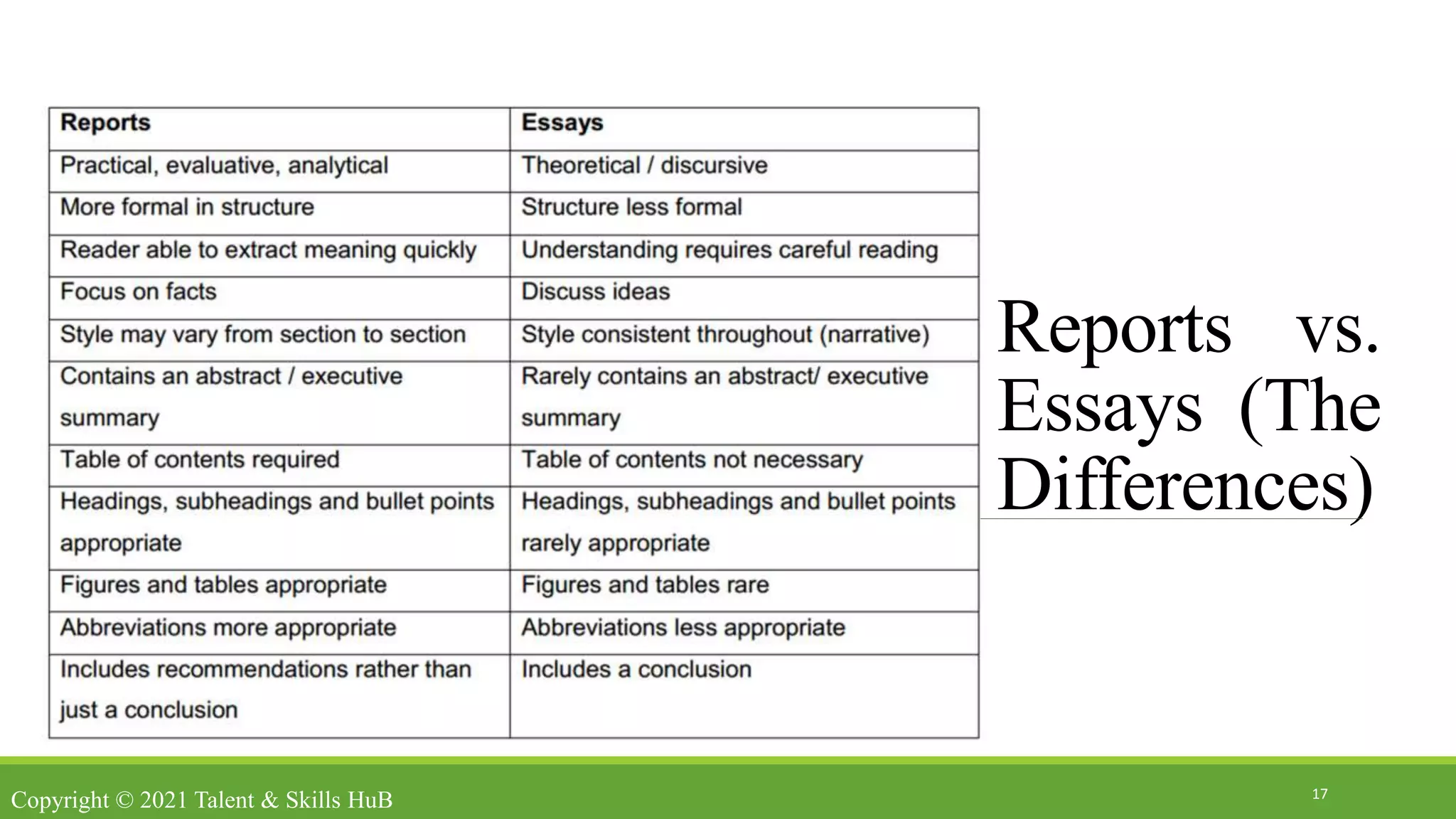
Reports vs.
Essays (The
Differences)
17
Copyright © 2021 Talent & Skills HuB
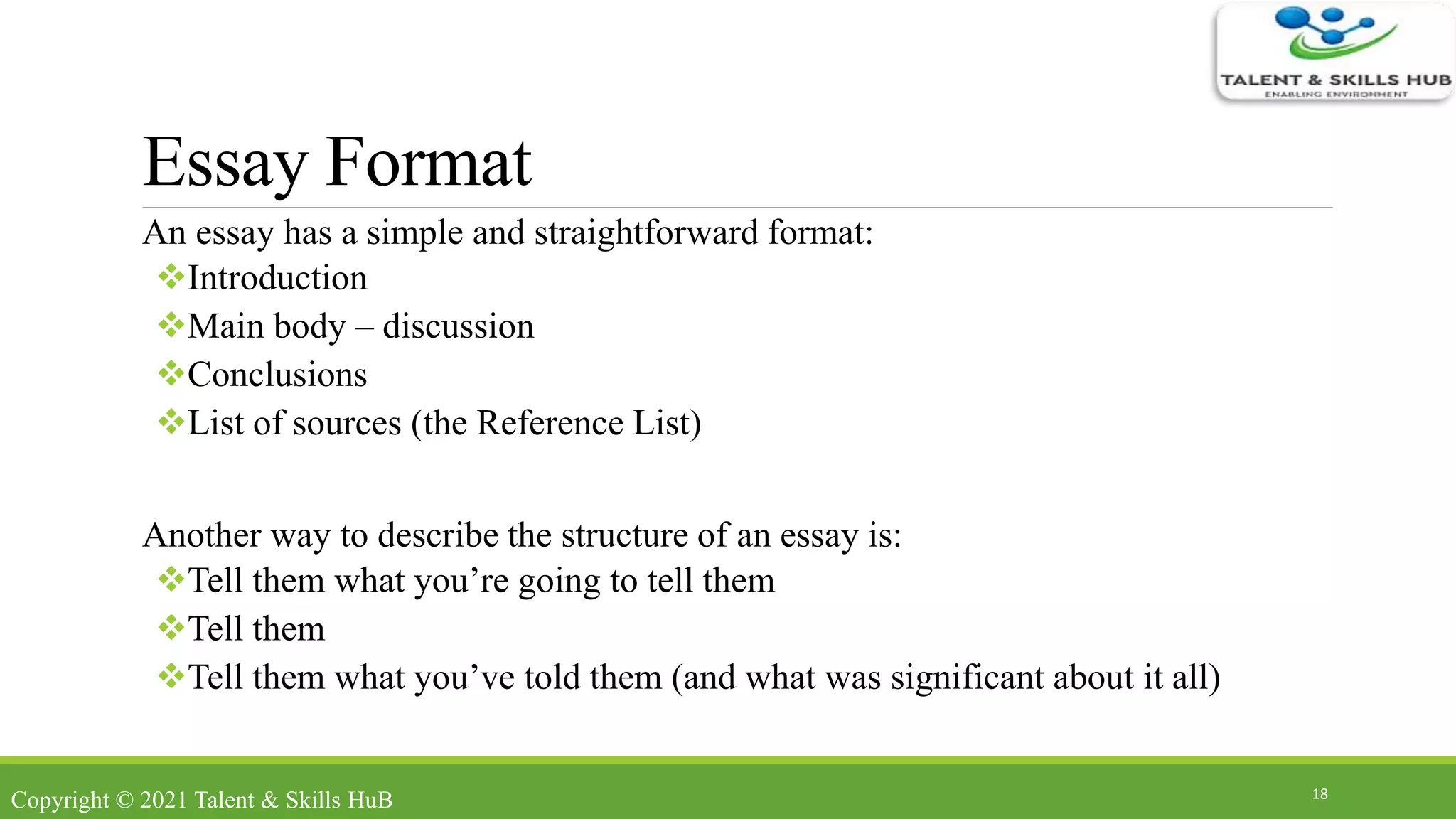
Essay Format
An essay has a simple and straightforward format:
Introduction
Main body – discussion
Conclusions
List of sources (the Reference List)
Another way to describe the structure of an essay is:
Tell them what you’re going to tell them
Tell them
Tell them what you’ve told them (and what was significant about it all)
18
Copyright © 2021 Talent & Skills HuB
Introduction
Telling the reader where you are going to go, why you will go there and how
you might do this.
It sets the scene for what is to follow. It usually comprises only a few key
paragraphs before you embark on the main discussion points.
19
Copyright © 2021 Talent & Skills HuB
Main Body – Discussion
This is where you build up your argument, supporting it with references to all your
sources.
For new points and arguments, use new paragraphs. A paragraph is a series of sentences,
following a theme or idea.
Punctuation is important, as in an essay this is how you enable your reader to pause and
take a breath.
Avoid using bullet points in an essay. If you do wish to list words or ideas use semi-
colons to separate these.
The purpose of the essay is to build a series of arguments which will answer a question or
develop a theme. Therefore, you need the essay to have a logical progression of ideas,
which lead the reader towards what will appear to be a set of obvious conclusions.
20
Copyright © 2021 Talent & Skills HuB
Conclusions
Your conclusions are an important part of the essay.
With conclusion, you are telling the reader what you consider important, useful,
informative or new.
It is drawing together the key and significant factors within the essay.
It is a brief reprise of the arguments, what was important about them, how they
contributed to the essay and how they have contributed to answering the question or
developing the theme.
21
Copyright © 2021 Talent & Skills HuB
The Reference List
The Reference List is an alphabetical (by author’s surname and initials of other names)
list of all the sources you have used to inform and develop the essay.
Some people refer to it as bibliography, which means ‘a collection of books’
Bibliography can also mean a set of other sources you haven’t used in the essay but
think the reader would find useful or illustrative if they want to read more about the
topic.
22
Copyright © 2021 Talent & Skills HuB
Talent &
Skills HuB
T&S-HuB is an enabling environment that supports people
in the development of their talents and skills and in the
actualisation of their personal passions and ambitions.
We help learners and individuals sharpen and exhibit their
talents and skills while exploring relevant and life
changing opportunities that suit their passions.
You can be supported by our instructors, counsellors, and
mentors on employability skills and other personal and
professional development.
Book an appointment for one-to-one or group tutoring
through our website; ts-hub.com
You can also contact us via email: contactus@ts-hub.com
Copyright © 2021 Talent & Skills HuB

Writing Effective Reports and Essays

  • 1.
    WRITING EFFECTIVE REPORTS ANDESSAYS DR FRED OKPALA 1 Copyright © 2021 Talent & Skills HuB
  • 2.
    Objectives Understanding how toplan, structure and write your assignment or report. Understanding the formats of report and essay writing. Developing the skills needed for writing effectively for academic purposes. 2 Copyright © 2021 Talent & Skills HuB
  • 3.
    What is aReport? A report is a document that gives a reader information and requires the reader to do something with that information. Report can be used: To suggest new ideas and options. To ask people to accept a point of view. To influence decisions. To ask people to make choices between alternative recommendations. 3 Copyright © 2021 Talent & Skills HuB
  • 4.
    Structuring Your Report Areport will usually follow a simple format which can be identified over and over again as you look through the reports written by academics, agencies or individuals. One of the key issues is to carefully provide signposts’ for the reader throughout the report through the use of:  Headings,  Sub headings  Bullet points  New paragraphs for new topics. 4 Copyright © 2021 Talent & Skills HuB
  • 5.
    The Format ofa Report The format may be influenced by the purpose and length of the report. There are nine identifiable sections in most reports which are: 1.Title page 2.Executive summary 3.Table of contents 4.Introduction 5.Discussion 6.Conclusion 7.Recommendations 8.References and Bibliography 9.Appendices 5 Copyright © 2021 Talent & Skills HuB
  • 6.
    Title Page Title pagehelps the reader to know what the report is about. It could be in a form of a title (topic) or sometimes a brief explanation of the purpose of the report. 6 Copyright © 2021 Talent & Skills HuB
  • 7.
    Executive Summary This isnormally used in long and formal reports. It is the summary of whole report in 100-200 words or 10% of the word count. It tells the reader what you discovered; how you did it and what conclusions you were led to. 7 Copyright © 2021 Talent & Skills HuB
  • 8.
    Table of Contents Tableof contents helps the reader find their way around the report. Ensure the pages are numbered so it is easy to move straight to the relevant section. Be consistent if numbering chapters – don’t start with Chapter 1 and next Chapter B and next Chapter iii! Don’t make your numbering too complex but simple and clear 8 Copyright © 2021 Talent & Skills HuB
  • 9.
    Introduction Should be quitebrief. It can be a paragraph or 10% words of the total word count, but it should tell the reader: The topic of discussion The reason for the report The key issues which will be addressed The terms of reference and limitations A brief outline of the background to the report 9 Copyright © 2021 Talent & Skills HuB
  • 10.
    Discussion (Body) This isthe main body of the report and the longest part. It goes into more detail about the subject. It should be arranged logically in one or a series of sections. You should use headings and sub-headings to help the reader find their way around it. Writing a report is not like writing a detective novel so you don’t leave the best bits until last! 10 The Plain English Campaign recommends the use of the ‘inverted triangle’ way of writing in reports Copyright © 2021 Talent & Skills HuB
  • 11.
    Conclusions These are themain findings from the research that went into the report: What you set out to find – the purpose of the report What you found out The significant of what you discovered How it answers the question set by the person who commissioned the report 11 Note: You should not present any new information in your conclusion. Just use the information you have collected to inform the options, lessons or advice you wish to give the readers. Copyright © 2021 Talent & Skills HuB
  • 12.
    Recommendations The purpose ofa report is usually to present options or make some recommendations for action you want the reader to take. Here you will present the actions you are recommending to the reader. Again, don’t leave the preferred option or action until last. Use that ‘inverted triangle’ approach here too. So you should present your most favoured ideas, options or recommendations first 12 Copyright © 2021 Talent & Skills HuB
  • 13.
    References and Bibliography Areference list is the detailed list of references (materials) that are cited in your work. A bibliography is a detailed list of references cited in your work, plus the background readings or other material that you may have read, but not actually cited. 13 Copyright © 2021 Talent & Skills HuB
  • 14.
    Appendices You can insert(short) documents from other sources (for example, a brief summary of another report that could be helpful to the reader). E.g.: Tables, photographs, drawings, maps or other supporting documents that will help the reader make sense of the report. As you write your report, you can refer the reader to those supporting documents while discussing the points in the body (e.g.: see appendix 1,2 or 3). 14 Copyright © 2021 Talent & Skills HuB
  • 15.
    Check List Check thequestion or task again and ask: Have you answered the question? Have you completed all the elements in the report? Have you discovered an answer which supports the argument or contradicts or challenges it? Have you supported your assertions from your reading and wider research? 15 Copyright © 2021 Talent & Skills HuB
  • 16.
    Writing Essays An essayis a continuous piece of writing, set out in paragraphs, responding to a question or a title. It is usually an academic piece of writing. It leads from an introduction, through a series of arguments and debates to some conclusions. An essay does not normally use headings within the work, although it will have a main heading, usually setting out the title or question given. 16 Copyright © 2021 Talent & Skills HuB
  • 17.
  • 18.
    Essay Format An essayhas a simple and straightforward format: Introduction Main body – discussion Conclusions List of sources (the Reference List) Another way to describe the structure of an essay is: Tell them what you’re going to tell them Tell them Tell them what you’ve told them (and what was significant about it all) 18 Copyright © 2021 Talent & Skills HuB
  • 19.
    Introduction Telling the readerwhere you are going to go, why you will go there and how you might do this. It sets the scene for what is to follow. It usually comprises only a few key paragraphs before you embark on the main discussion points. 19 Copyright © 2021 Talent & Skills HuB
  • 20.
    Main Body –Discussion This is where you build up your argument, supporting it with references to all your sources. For new points and arguments, use new paragraphs. A paragraph is a series of sentences, following a theme or idea. Punctuation is important, as in an essay this is how you enable your reader to pause and take a breath. Avoid using bullet points in an essay. If you do wish to list words or ideas use semi- colons to separate these. The purpose of the essay is to build a series of arguments which will answer a question or develop a theme. Therefore, you need the essay to have a logical progression of ideas, which lead the reader towards what will appear to be a set of obvious conclusions. 20 Copyright © 2021 Talent & Skills HuB
  • 21.
    Conclusions Your conclusions arean important part of the essay. With conclusion, you are telling the reader what you consider important, useful, informative or new. It is drawing together the key and significant factors within the essay. It is a brief reprise of the arguments, what was important about them, how they contributed to the essay and how they have contributed to answering the question or developing the theme. 21 Copyright © 2021 Talent & Skills HuB
  • 22.
    The Reference List TheReference List is an alphabetical (by author’s surname and initials of other names) list of all the sources you have used to inform and develop the essay. Some people refer to it as bibliography, which means ‘a collection of books’ Bibliography can also mean a set of other sources you haven’t used in the essay but think the reader would find useful or illustrative if they want to read more about the topic. 22 Copyright © 2021 Talent & Skills HuB
  • 23.
    Talent & Skills HuB T&S-HuBis an enabling environment that supports people in the development of their talents and skills and in the actualisation of their personal passions and ambitions. We help learners and individuals sharpen and exhibit their talents and skills while exploring relevant and life changing opportunities that suit their passions. You can be supported by our instructors, counsellors, and mentors on employability skills and other personal and professional development. Book an appointment for one-to-one or group tutoring through our website; ts-hub.com You can also contact us via email: contactus@ts-hub.com Copyright © 2021 Talent & Skills HuB