Effective Note Taking
Skills
Copyright © 2021 Talent & Skills HuB
Objectives
Understanding the Importance of note taking
Understanding how to take effective notes
Understanding the strategies for taking notes from lectures
Understanding the strategies for taking notes from books and articles
Understanding the things to avoid while taking notes
Copyright © 2021 Talent & Skills HuB
Introduction
The act of note taking promotes active engagement in the learning process and can help
you concentrate while studying.
The habit of taking notes can be applied to demonstrate active learning while reading,
attending lectures and seminars, reading articles or listening to audio records or while
watching video learning materials.
Your notes are a translation of what you are learning, into written words, which helps you
to understand what you are studying better.
Instead of receiving information passively, note taking helps you digest the information,
process it and put into the context of your existing knowledge
Copyright © 2021 Talent & Skills HuB
Importance of Note Taking
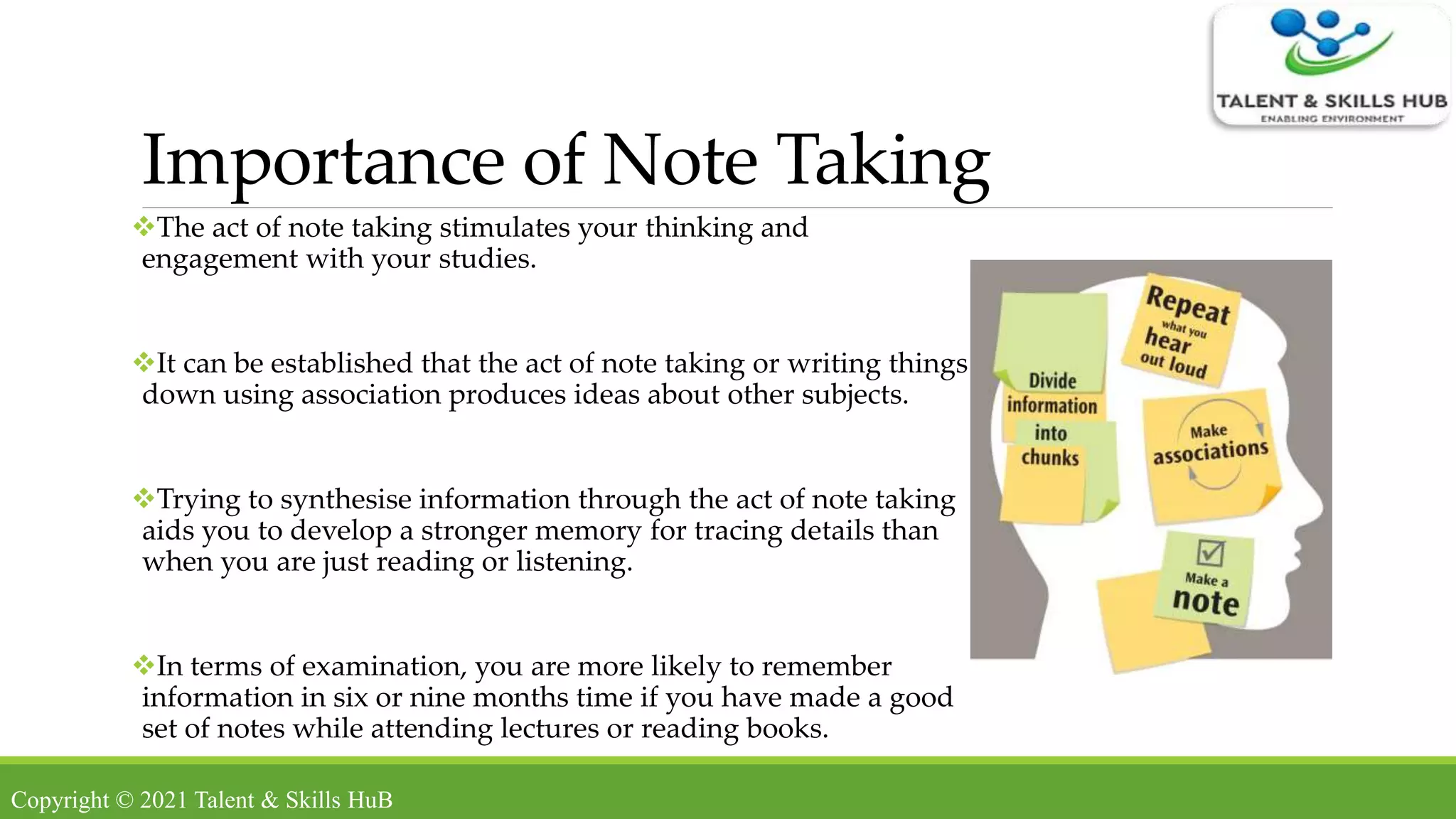
The act of note taking stimulates your thinking and
engagement with your studies.
It can be established that the act of note taking or writing things
down using association produces ideas about other subjects.
Trying to synthesise information through the act of note taking
aids you to develop a stronger memory for tracing details than
when you are just reading or listening.
In terms of examination, you are more likely to remember
information in six or nine months time if you have made a good
set of notes while attending lectures or reading books.
Copyright © 2021 Talent & Skills HuB
Importance of Note Taking
A good set of notes acts as an excellent record to use when writing your
assignments (essay or report) or revising for your examinations.
The records of the lectures or the books you have read will be permanent
through note taking and a reading of the notes will often bring back in
fullness the original experience in a surprising way.
Rewriting your notes following a lecture or study time can help you to
reproduce a neat set of study materials that could be used in the future to
reinforce your understanding of the subject in your assignment/examination
questions
Taking notes and treating them with respect, storing them in a folder or
binder can help you create useful materials for writing your essays or
revising for examinations later.
Copyright © 2021 Talent & Skills HuB
How to Take Notes
When taking notes from a lecture or from a book/articles, be aware
that you are attempting to make a condensed and accurate record of
information.
You may also be taking notes of other people’s arguments, and
possibly your own observation on the subject in question.
Think about the materials you are reading or what you are
observing. Your objective is to distinguish the more important
points, from the less important points being made.
Do not attempt to reproduce the original information but to write
down your understanding of the subject in question.
Copyright © 2021 Talent & Skills HuB
How to Take Notes
Taking notes is a very active form of studying.
 You are required to listen actively and to read closely,
whenever thinking about the content and deciding which
parts of the content need to be recorded for your use.
By engaging actively with the material you are reading, you
will be able to strengthen your memory traces and activate
when you read your notes at a later time.
You should also be converting the argument of the book or
the lecture content into your own words.
Do not attempt to copy verbatim the original content with
the belief that it will be more useful to you (quotations can be
excepted).
Copyright © 2021 Talent & Skills HuB
How to Take Notes
Despite that your notes can only be for your own use, it
will be more effective if you record them clearly.
The more organised, clear and carefully stored you notes
are, the more useful they will be to you when you need them
in the future.
Avoid using small notepads : They may be used for
temporary observations, but may not be suitable for
academic works.
Copyright © 2021 Talent & Skills HuB
Note Taking Layout
Write clearly and leave spaces between each entry.Write
Do not attempt to squeeze as many notes as possible onto one
page. It is not a good idea.
Do not
attempt
With a good layout and spaces in your notes, you will easily be able
to capture and retrieve information from the pages when needed.Be
Copyright © 2021 Talent & Skills HuB
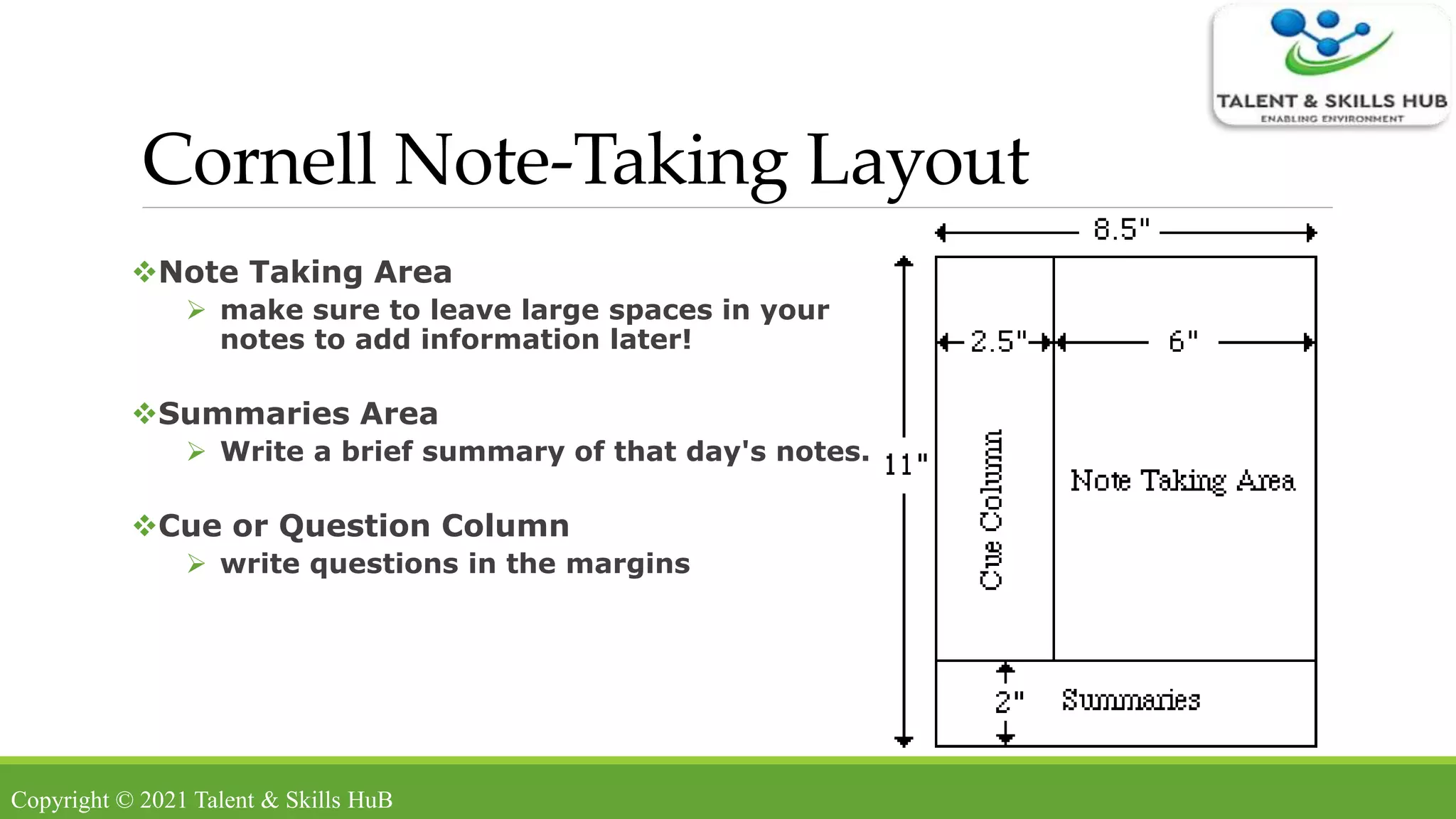
Cornell Note-Taking Layout
Note Taking Area
 make sure to leave large spaces in your
notes to add information later!
Summaries Area
 Write a brief summary of that day's notes.
Cue or Question Column
 write questions in the margins
Copyright © 2021 Talent & Skills HuB
Example of
Cornell System
Copyright © 2021 Talent & Skills HuB
Headings and Tabulation
You can use a tabulation system like numbering your points
so as to help you keep one point distinct from another.
Use headings and subheadings to create a clear and
memorable layout in your notes.
Choose your preferred notation system for your headings,
numbering system or highlights.
Use a new set of pages for each new topic, this will help you
keep things separate. Also have your topics clearly titled and
labelled for easier recalling.
Copyright © 2021 Talent & Skills HuB
Develop a System of Mechanics
Jot down words or phrases, not entire sentences
Develop some system of shorthand and be consistent in
its use
Leave out small service words
Use contractions and abbreviations
You can use common mathematical symbols such as +,
=, x
Other symbols include &, &, #, @
Copyright © 2021 Talent & Skills HuB
The Use of Visual Aids
You can use graphs, pictures
or any other visual materials
if you consider them helpful
to keep for future use.
Some people create their
own unique or personal
codes and associate them to
information in their notes.
You can use your own
unique signs, shorthand,
abbreviations or drawings
to replace certain
information in your notes.
Do these if you consider them
useful, but remember to be
consistent in using them; If
not, you will be confused of
their meanings later in the
future.
Copyright © 2021 Talent & Skills HuB
Sources Records
Always make a note of your sources when you are taking your notes from books or
articles.
You should write accurate references and page numbers for quotations. Citing and
referencing the sources will serve as evidence to support your points in your assignment
and exams.
Recording the sources will also help you locate the information from the sources if you
need to re-check the information later.
This applies also when using library books, as this will save you a lot of time; Indeed you
will not need to go back to the library catalogue index later, a second time.
Copyright © 2021 Talent & Skills HuB
Taking Notes From Lectures
When you are taking notes in the lectures, you will find the task easier if you are well prepared
before the lecture. Learn in advance to anticipate what is to be said. However, ensure you follow the
development of the argument or exposition.
Don’t just sit back and let words wash over you, and don't be lulled into a sense of security by
an effective presentation.
Hearing a thing once is not enough. Memory requires review and understanding
Listen carefully to what is being said and look at the lecturer and watch out for any signals or clues.
Pay attention to adverbs like sometimes, usually, rarely, etc. and notice linking words that signal a
change of direction is coming such as but, however, on the other hand…
Listen carefully to the conclusion when the lecturer tries to draw together all the main argument into
one coherent statement.
Copyright © 2021 Talent & Skills HuB
Taking Notes From Lectures Cont.
Remember that your objective is to record the main points of the lecture
Don’t try to write down verbatim everything that is being said. You will never keep up with this.
Pay attention to key issues or main ideas and record them rather than the details around them.
Ask questions and discuss if it's permitted. If not, jot questions in your notes
Compare the information with your own experience.
Don't swallow everything uncritically
Don't reject what seems strange or incorrect. Check it out.
But don't allow preconceived notions to distort what you are hearing
Copyright © 2021 Talent & Skills HuB
Review and Reword Your Notes
You should consider
creating a schedule
to word your notes
as soon as possible
When rewording
your notes, don't
just recopy or type –
think!
" Reminiscing " may
help recall forgotten
material later
Rewrite skimpy
parts
Fill in gaps as you
remember points
Arrange with
another to compare
notes
Find answers to any
questions remaining
unanswered
Write a brief
summary of the
event
Copyright © 2021 Talent & Skills HuB
Review and Reword Your Notes
Cont.
The best time to review
and reword your notes
is immediately after the
lecture.
At this time, all
information is still fresh
in your mind.
At this point you can
eliminate any recorded
information that is less
important in your
notes.
You can also link the
main arguments and
put them into
prominence in relation
to each
Copyright © 2021 Talent & Skills HuB
Taking Notes From Books and Articles
Your strategy in note taking will depend on your reading purpose. If you are searching for
a piece of information, just use skim or search reading techniques
If you have to absorb and digest information more thoroughly, make sure that you
approach the task with conscious purpose.
Do not just drift through the material reading at random or looking for something of
interest.
However, do not try to copy out long sections from the material.
Digest the argument and write them down in your own words.
Copyright © 2021 Talent & Skills HuB
Taking Notes From Books and Articles
If you think you might need a long passage for future reference or quotation, consider taking a
picture of the passage.
Your experience with the subject will help you to know when you need to make note from the
material
However, ensure you grasp the main issues. You can do this by noting the key terms and
phrases that appear in the material
Make a summary of the author’s argument
Ensure you distinguish between the principal issues and the detailed examples use as
illustration. This will help you develop your analytical skills.
Copyright © 2021 Talent & Skills HuB
Things to Avoid
Avoid too much information. The value of your notes is
not measured by the quantity of what you have written,
but by the quality of your analysis and judgement.
Avoid too little information. Don't be lulled into a false
sense of security by thinking you will remember the points
and don’t need to record and summarise them.
We forget 50% of what we hear immediately and within
two months later, another 25% is gone.
Pay attention to both the subject and your need to make
notes on it.
Avoid missing the key points. This often happens when
too much detail is recorded, but with little illustrative
points. Make notes only when most important ideas are
shared.
Copyright © 2021 Talent & Skills HuB
Things to Avoid
Avoid copying too much of the original text when you
are taking notes from books or articles.
Too much text from the original source means that you
have not digested the material and translated them to
your own understanding using your own words.
Avoid squeezing a lot of information into one page.
Leave plenty of space between points.
Avoid poor layout. Good page layout will help you
locate information from the page at a later time.
Avoid using pieces of paper to take notes. They can
easily be misplaced or lost. Use a proper notebook for
note taking.
Copyright © 2021 Talent & Skills HuB
Summary
The act of note taking develops your thinking and analytical skills while helping you to
engage effectively with your studies and during lectures.
When taking notes, focus on identifying the main points/arguments or your own
observation o the subject in question, digest them and translate them into your own words.
When taking notes, do not attempt to copy verbatim the original content. You can use
phrases, shorthand, symbols and not the entire sentences, but remember to reword your
notes as soon as possible.
When taking notes from books or articles, ensure you distinguish between the principal
issues and the detailed examples use as illustration. This will help you develop your
analytical skills.
Avoid the attempt of squeezing as many as possible onto one page. It is not a good idea.
Copyright © 2021 Talent & Skills HuB
Talent &
Skills HuB
T&S-HuB is an enabling environment that supports people
in the development of their talents and skills and in the
actualisation of their personal passions and ambitions.
We help learners and individuals sharpen and exhibit their
talents and skills while exploring relevant and life
changing opportunities that suit their passions.
You can be supported by our instructors, counsellors, and
mentors on employability skills and other personal and
professional development.
Book an appointment for one-to-one or group tutoring
through our website; ts-hub.com
You can also contact us via email: contactus@ts-hub.com
Copyright © 2021 Talent & Skills HuB

How to Develop Effective Note Taking Skills

  • 1.
    Effective Note Taking Skills Copyright© 2021 Talent & Skills HuB
  • 2.
    Objectives Understanding the Importanceof note taking Understanding how to take effective notes Understanding the strategies for taking notes from lectures Understanding the strategies for taking notes from books and articles Understanding the things to avoid while taking notes Copyright © 2021 Talent & Skills HuB
  • 3.
    Introduction The act ofnote taking promotes active engagement in the learning process and can help you concentrate while studying. The habit of taking notes can be applied to demonstrate active learning while reading, attending lectures and seminars, reading articles or listening to audio records or while watching video learning materials. Your notes are a translation of what you are learning, into written words, which helps you to understand what you are studying better. Instead of receiving information passively, note taking helps you digest the information, process it and put into the context of your existing knowledge Copyright © 2021 Talent & Skills HuB
  • 4.
    Importance of NoteTaking The act of note taking stimulates your thinking and engagement with your studies. It can be established that the act of note taking or writing things down using association produces ideas about other subjects. Trying to synthesise information through the act of note taking aids you to develop a stronger memory for tracing details than when you are just reading or listening. In terms of examination, you are more likely to remember information in six or nine months time if you have made a good set of notes while attending lectures or reading books. Copyright © 2021 Talent & Skills HuB
  • 5.
    Importance of NoteTaking A good set of notes acts as an excellent record to use when writing your assignments (essay or report) or revising for your examinations. The records of the lectures or the books you have read will be permanent through note taking and a reading of the notes will often bring back in fullness the original experience in a surprising way. Rewriting your notes following a lecture or study time can help you to reproduce a neat set of study materials that could be used in the future to reinforce your understanding of the subject in your assignment/examination questions Taking notes and treating them with respect, storing them in a folder or binder can help you create useful materials for writing your essays or revising for examinations later. Copyright © 2021 Talent & Skills HuB
  • 6.
    How to TakeNotes When taking notes from a lecture or from a book/articles, be aware that you are attempting to make a condensed and accurate record of information. You may also be taking notes of other people’s arguments, and possibly your own observation on the subject in question. Think about the materials you are reading or what you are observing. Your objective is to distinguish the more important points, from the less important points being made. Do not attempt to reproduce the original information but to write down your understanding of the subject in question. Copyright © 2021 Talent & Skills HuB
  • 7.
    How to TakeNotes Taking notes is a very active form of studying.  You are required to listen actively and to read closely, whenever thinking about the content and deciding which parts of the content need to be recorded for your use. By engaging actively with the material you are reading, you will be able to strengthen your memory traces and activate when you read your notes at a later time. You should also be converting the argument of the book or the lecture content into your own words. Do not attempt to copy verbatim the original content with the belief that it will be more useful to you (quotations can be excepted). Copyright © 2021 Talent & Skills HuB
  • 8.
    How to TakeNotes Despite that your notes can only be for your own use, it will be more effective if you record them clearly. The more organised, clear and carefully stored you notes are, the more useful they will be to you when you need them in the future. Avoid using small notepads : They may be used for temporary observations, but may not be suitable for academic works. Copyright © 2021 Talent & Skills HuB
  • 9.
    Note Taking Layout Writeclearly and leave spaces between each entry.Write Do not attempt to squeeze as many notes as possible onto one page. It is not a good idea. Do not attempt With a good layout and spaces in your notes, you will easily be able to capture and retrieve information from the pages when needed.Be Copyright © 2021 Talent & Skills HuB
  • 10.
    Cornell Note-Taking Layout NoteTaking Area  make sure to leave large spaces in your notes to add information later! Summaries Area  Write a brief summary of that day's notes. Cue or Question Column  write questions in the margins Copyright © 2021 Talent & Skills HuB
  • 11.
    Example of Cornell System Copyright© 2021 Talent & Skills HuB
  • 12.
    Headings and Tabulation Youcan use a tabulation system like numbering your points so as to help you keep one point distinct from another. Use headings and subheadings to create a clear and memorable layout in your notes. Choose your preferred notation system for your headings, numbering system or highlights. Use a new set of pages for each new topic, this will help you keep things separate. Also have your topics clearly titled and labelled for easier recalling. Copyright © 2021 Talent & Skills HuB
  • 13.
    Develop a Systemof Mechanics Jot down words or phrases, not entire sentences Develop some system of shorthand and be consistent in its use Leave out small service words Use contractions and abbreviations You can use common mathematical symbols such as +, =, x Other symbols include &, &, #, @ Copyright © 2021 Talent & Skills HuB
  • 14.
    The Use ofVisual Aids You can use graphs, pictures or any other visual materials if you consider them helpful to keep for future use. Some people create their own unique or personal codes and associate them to information in their notes. You can use your own unique signs, shorthand, abbreviations or drawings to replace certain information in your notes. Do these if you consider them useful, but remember to be consistent in using them; If not, you will be confused of their meanings later in the future. Copyright © 2021 Talent & Skills HuB
  • 15.
    Sources Records Always makea note of your sources when you are taking your notes from books or articles. You should write accurate references and page numbers for quotations. Citing and referencing the sources will serve as evidence to support your points in your assignment and exams. Recording the sources will also help you locate the information from the sources if you need to re-check the information later. This applies also when using library books, as this will save you a lot of time; Indeed you will not need to go back to the library catalogue index later, a second time. Copyright © 2021 Talent & Skills HuB
  • 16.
    Taking Notes FromLectures When you are taking notes in the lectures, you will find the task easier if you are well prepared before the lecture. Learn in advance to anticipate what is to be said. However, ensure you follow the development of the argument or exposition. Don’t just sit back and let words wash over you, and don't be lulled into a sense of security by an effective presentation. Hearing a thing once is not enough. Memory requires review and understanding Listen carefully to what is being said and look at the lecturer and watch out for any signals or clues. Pay attention to adverbs like sometimes, usually, rarely, etc. and notice linking words that signal a change of direction is coming such as but, however, on the other hand… Listen carefully to the conclusion when the lecturer tries to draw together all the main argument into one coherent statement. Copyright © 2021 Talent & Skills HuB
  • 17.
    Taking Notes FromLectures Cont. Remember that your objective is to record the main points of the lecture Don’t try to write down verbatim everything that is being said. You will never keep up with this. Pay attention to key issues or main ideas and record them rather than the details around them. Ask questions and discuss if it's permitted. If not, jot questions in your notes Compare the information with your own experience. Don't swallow everything uncritically Don't reject what seems strange or incorrect. Check it out. But don't allow preconceived notions to distort what you are hearing Copyright © 2021 Talent & Skills HuB
  • 18.
    Review and RewordYour Notes You should consider creating a schedule to word your notes as soon as possible When rewording your notes, don't just recopy or type – think! " Reminiscing " may help recall forgotten material later Rewrite skimpy parts Fill in gaps as you remember points Arrange with another to compare notes Find answers to any questions remaining unanswered Write a brief summary of the event Copyright © 2021 Talent & Skills HuB
  • 19.
    Review and RewordYour Notes Cont. The best time to review and reword your notes is immediately after the lecture. At this time, all information is still fresh in your mind. At this point you can eliminate any recorded information that is less important in your notes. You can also link the main arguments and put them into prominence in relation to each Copyright © 2021 Talent & Skills HuB
  • 20.
    Taking Notes FromBooks and Articles Your strategy in note taking will depend on your reading purpose. If you are searching for a piece of information, just use skim or search reading techniques If you have to absorb and digest information more thoroughly, make sure that you approach the task with conscious purpose. Do not just drift through the material reading at random or looking for something of interest. However, do not try to copy out long sections from the material. Digest the argument and write them down in your own words. Copyright © 2021 Talent & Skills HuB
  • 21.
    Taking Notes FromBooks and Articles If you think you might need a long passage for future reference or quotation, consider taking a picture of the passage. Your experience with the subject will help you to know when you need to make note from the material However, ensure you grasp the main issues. You can do this by noting the key terms and phrases that appear in the material Make a summary of the author’s argument Ensure you distinguish between the principal issues and the detailed examples use as illustration. This will help you develop your analytical skills. Copyright © 2021 Talent & Skills HuB
  • 22.
    Things to Avoid Avoidtoo much information. The value of your notes is not measured by the quantity of what you have written, but by the quality of your analysis and judgement. Avoid too little information. Don't be lulled into a false sense of security by thinking you will remember the points and don’t need to record and summarise them. We forget 50% of what we hear immediately and within two months later, another 25% is gone. Pay attention to both the subject and your need to make notes on it. Avoid missing the key points. This often happens when too much detail is recorded, but with little illustrative points. Make notes only when most important ideas are shared. Copyright © 2021 Talent & Skills HuB
  • 23.
    Things to Avoid Avoidcopying too much of the original text when you are taking notes from books or articles. Too much text from the original source means that you have not digested the material and translated them to your own understanding using your own words. Avoid squeezing a lot of information into one page. Leave plenty of space between points. Avoid poor layout. Good page layout will help you locate information from the page at a later time. Avoid using pieces of paper to take notes. They can easily be misplaced or lost. Use a proper notebook for note taking. Copyright © 2021 Talent & Skills HuB
  • 24.
    Summary The act ofnote taking develops your thinking and analytical skills while helping you to engage effectively with your studies and during lectures. When taking notes, focus on identifying the main points/arguments or your own observation o the subject in question, digest them and translate them into your own words. When taking notes, do not attempt to copy verbatim the original content. You can use phrases, shorthand, symbols and not the entire sentences, but remember to reword your notes as soon as possible. When taking notes from books or articles, ensure you distinguish between the principal issues and the detailed examples use as illustration. This will help you develop your analytical skills. Avoid the attempt of squeezing as many as possible onto one page. It is not a good idea. Copyright © 2021 Talent & Skills HuB
  • 25.
    Talent & Skills HuB T&S-HuBis an enabling environment that supports people in the development of their talents and skills and in the actualisation of their personal passions and ambitions. We help learners and individuals sharpen and exhibit their talents and skills while exploring relevant and life changing opportunities that suit their passions. You can be supported by our instructors, counsellors, and mentors on employability skills and other personal and professional development. Book an appointment for one-to-one or group tutoring through our website; ts-hub.com You can also contact us via email: contactus@ts-hub.com Copyright © 2021 Talent & Skills HuB