Using a Private Cloud to
 Automate and Govern
Enterprise Development
         Paul Fremantle
       CTO and Co-Founder

     Follow me @pzfreo #wso2
Moore’s Law for Data

• The amount of data online went from
  – 5 exabytes in 2002
  – 281 exabytes in 2009
• Doubled every 15 months

• You cannot deal with this data growth with
  the same applications
  – A reasonable conclusion is that the number of
    applications will double every 15 months too
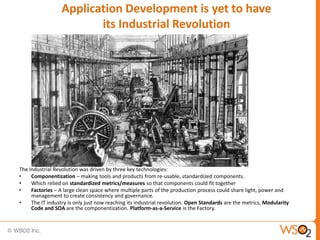
Application Development is yet to have
                         its Industrial Revolution


The Industrial Revolution was driven by three key technologies:
•    Componentization – making tools and products from re-usable, standardized components.
•    Which relied on standardized metrics/measures so that components could fit together
•    Factories – A large clean space where multiple parts of the production process could share light, power and
     management to create consistency and governance.
•    The IT industry is only just now reaching its industrial revolution. Open Standards are the metrics, Modularity
     Code and SOA are the componentization. Platform-as-a-Service is the Factory.
Enterprise Application Development
             Challenges
• Project Infrastructure takes too long to setup
• Too many projects fall through the cracks and use non-
  standard infrastructure, build, governance
• Projects use too many different unknown or unapproved
  libraries, frameworks, etc
• No clear idea of which projects are at which stage
• Few or no metrics on code quality, test coverage, re-use
• Little automated build or test
• Best practices are not applied everywhere
How does WSO2 help?
1. Create an effective Service Oriented internal
   middleware
2. Expose key business function as a set of APIs
   available in an Enterprise API Store
3. Manage, monitor and govern APIs (and services)
4. Create a Application Lifecycle Development and
   Governance Cloud to build, test, and govern code
   from inception to production
5. Deploy, run and manage applications in a private
   Cloud Platform-as-a-Service

                                                      5
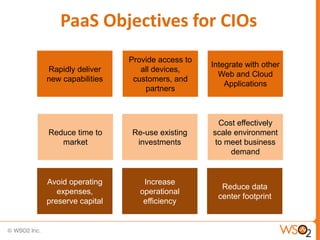
PaaS Objectives for CIOs
                   Provide access to
                                       Integrate with other
Rapidly deliver       all devices,
                                         Web and Cloud
new capabilities    customers, and
                                           Applications
                       partners


                                         Cost effectively
Reduce time to     Re-use existing     scale environment
   market           investments         to meet business
                                            demand


Avoid operating        Increase
                                          Reduce data
   expenses,          operational
                                         center footprint
preserve capital       efficiency
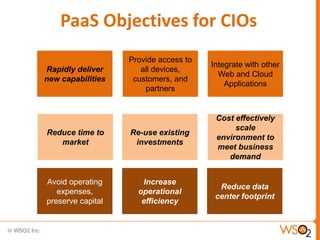
PaaS Objectives for CIOs
                   Provide access to
                                       Integrate with other
Rapidly deliver       all devices,
                                         Web and Cloud
new capabilities    customers, and
                                           Applications
                       partners


                                        Cost effectively
                                             scale
Reduce time to     Re-use existing
                                        environment to
   market           investments
                                        meet business
                                           demand


Avoid operating       Increase
                                         Reduce data
   expenses,         operational
                                        center footprint
preserve capital      efficiency
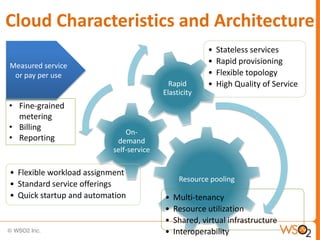
Cloud Characteristics and Architecture
                                                       •   Stateless services
Measured service
                                                       •   Rapid provisioning
 or pay per use                                        •   Flexible topology
                                           Rapid       •   High Quality of Service
                                         Elasticity
• Fine-grained
  metering
• Billing
                              On-
• Reporting                demand
                          self-service

• Flexible workload assignment
                                              Resource pooling
• Standard service offerings
• Quick startup and automation           •   Multi-tenancy
                                         •   Resource utilization
                                         •   Shared, virtual infrastructure
                                         •   Interoperability
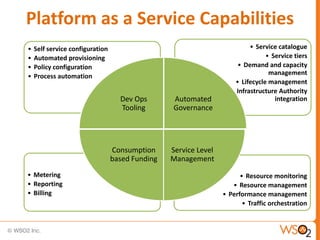
Platform as a Service Capabilities
•   Self service configuration                                            • Service catalogue
•   Automated provisioning                                                      • Service tiers
•   Policy configuration                                              • Demand and capacity
•   Process automation                                                           management
                                                                     • Lifecycle management
                                                                   • Infrastructure Authority
                                   Dev Ops       Automated                         integration
                                   Tooling       Governance


                                 Consumption     Service Level
                                 based Funding   Management
• Metering                                                             • Resource monitoring
• Reporting                                                         • Resource management
• Billing                                                        • Performance management
                                                                        • Traffic orchestration
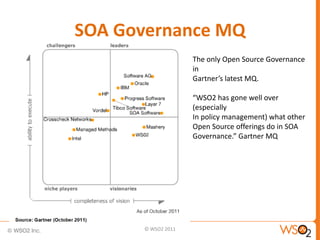
SOA Governance MQ
                    The only Open Source Governance
                    in
                    Gartner’s latest MQ.

                    “WSO2 has gone well over
                    (especially
                    In policy management) what other
                    Open Source offerings do in SOA
                    Governance.” Gartner MQ


      © WSO2 2011
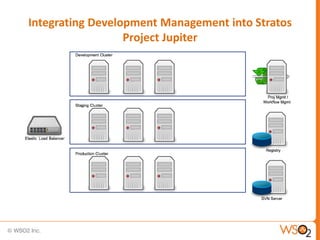
Integrating Development Management into Stratos
                  Project Jupiter


                                                  11
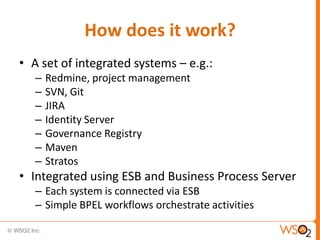
How does it work?
• A set of integrated systems – e.g.:
   –   Redmine, project management
   –   SVN, Git
   –   JIRA
   –   Identity Server
   –   Governance Registry
   –   Maven
   –   Stratos
• Integrated using ESB and Business Process Server
   – Each system is connected via ESB
   – Simple BPEL workflows orchestrate activities
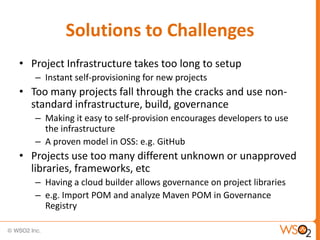
Solutions to Challenges
• Project Infrastructure takes too long to setup
   – Instant self-provisioning for new projects
• Too many projects fall through the cracks and use non-
  standard infrastructure, build, governance
   – Making it easy to self-provision encourages developers to use
     the infrastructure
   – A proven model in OSS: e.g. GitHub
• Projects use too many different unknown or unapproved
  libraries, frameworks, etc
   – Having a cloud builder allows governance on project libraries
   – e.g. Import POM and analyze Maven POM in Governance
     Registry
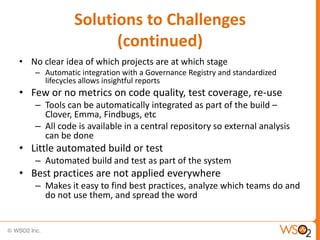
Solutions to Challenges
                   (continued)
• No clear idea of which projects are at which stage
   – Automatic integration with a Governance Registry and standardized
     lifecycles allows insightful reports
• Few or no metrics on code quality, test coverage, re-use
   – Tools can be automatically integrated as part of the build –
     Clover, Emma, Findbugs, etc
   – All code is available in a central repository so external analysis
     can be done
• Little automated build or test
   – Automated build and test as part of the system
• Best practices are not applied everywhere
   – Makes it easy to find best practices, analyze which teams do and
     do not use them, and spread the word
Resources
• Try Stratos right now:
   – https://stratoslive.wso2.com/
• Read about Stratos:
   – http://wso2.com/cloud/stratos/
   – Source Download available
• White Paper
   – Selecting Platform as a Service
• Blog Articles
   –   What is Platform as a Service?
   –   PaaS Evaluation Framework for CIOs and Architects
   –   How to simplify Platform as a Service Complexity
   –   Searching for Cloud Reference Architecture
• Contact us:
   – bizdev@wso2.com
Status
• Currently in production
• A solution offering:
  – Combination of product, services and re-usable
    frameworks
  – Customized to specific requirements
• Available now
  – http://wso2.com/contact
Using a private cloud to automate and govern enterprise development

Using a private cloud to automate and govern enterprise development

  • 1.
    Using a PrivateCloud to Automate and Govern Enterprise Development Paul Fremantle CTO and Co-Founder Follow me @pzfreo #wso2
  • 2.
    Moore’s Law forData • The amount of data online went from – 5 exabytes in 2002 – 281 exabytes in 2009 • Doubled every 15 months • You cannot deal with this data growth with the same applications – A reasonable conclusion is that the number of applications will double every 15 months too
  • 3.
    Application Development isyet to have its Industrial Revolution The Industrial Revolution was driven by three key technologies: • Componentization – making tools and products from re-usable, standardized components. • Which relied on standardized metrics/measures so that components could fit together • Factories – A large clean space where multiple parts of the production process could share light, power and management to create consistency and governance. • The IT industry is only just now reaching its industrial revolution. Open Standards are the metrics, Modularity Code and SOA are the componentization. Platform-as-a-Service is the Factory.
  • 4.
    Enterprise Application Development Challenges • Project Infrastructure takes too long to setup • Too many projects fall through the cracks and use non- standard infrastructure, build, governance • Projects use too many different unknown or unapproved libraries, frameworks, etc • No clear idea of which projects are at which stage • Few or no metrics on code quality, test coverage, re-use • Little automated build or test • Best practices are not applied everywhere
  • 5.
    How does WSO2help? 1. Create an effective Service Oriented internal middleware 2. Expose key business function as a set of APIs available in an Enterprise API Store 3. Manage, monitor and govern APIs (and services) 4. Create a Application Lifecycle Development and Governance Cloud to build, test, and govern code from inception to production 5. Deploy, run and manage applications in a private Cloud Platform-as-a-Service 5
  • 6.
    PaaS Objectives forCIOs Provide access to Integrate with other Rapidly deliver all devices, Web and Cloud new capabilities customers, and Applications partners Cost effectively Reduce time to Re-use existing scale environment market investments to meet business demand Avoid operating Increase Reduce data expenses, operational center footprint preserve capital efficiency
  • 7.
    PaaS Objectives forCIOs Provide access to Integrate with other Rapidly deliver all devices, Web and Cloud new capabilities customers, and Applications partners Cost effectively scale Reduce time to Re-use existing environment to market investments meet business demand Avoid operating Increase Reduce data expenses, operational center footprint preserve capital efficiency
  • 8.
    Cloud Characteristics andArchitecture • Stateless services Measured service • Rapid provisioning or pay per use • Flexible topology Rapid • High Quality of Service Elasticity • Fine-grained metering • Billing On- • Reporting demand self-service • Flexible workload assignment Resource pooling • Standard service offerings • Quick startup and automation • Multi-tenancy • Resource utilization • Shared, virtual infrastructure • Interoperability
  • 9.
    Platform as aService Capabilities • Self service configuration • Service catalogue • Automated provisioning • Service tiers • Policy configuration • Demand and capacity • Process automation management • Lifecycle management • Infrastructure Authority Dev Ops Automated integration Tooling Governance Consumption Service Level based Funding Management • Metering • Resource monitoring • Reporting • Resource management • Billing • Performance management • Traffic orchestration
  • 10.
    SOA Governance MQ The only Open Source Governance in Gartner’s latest MQ. “WSO2 has gone well over (especially In policy management) what other Open Source offerings do in SOA Governance.” Gartner MQ © WSO2 2011
  • 11.
    Integrating Development Managementinto Stratos Project Jupiter 11
  • 12.
    How does itwork? • A set of integrated systems – e.g.: – Redmine, project management – SVN, Git – JIRA – Identity Server – Governance Registry – Maven – Stratos • Integrated using ESB and Business Process Server – Each system is connected via ESB – Simple BPEL workflows orchestrate activities
  • 13.
    Solutions to Challenges •Project Infrastructure takes too long to setup – Instant self-provisioning for new projects • Too many projects fall through the cracks and use non- standard infrastructure, build, governance – Making it easy to self-provision encourages developers to use the infrastructure – A proven model in OSS: e.g. GitHub • Projects use too many different unknown or unapproved libraries, frameworks, etc – Having a cloud builder allows governance on project libraries – e.g. Import POM and analyze Maven POM in Governance Registry
  • 14.
    Solutions to Challenges (continued) • No clear idea of which projects are at which stage – Automatic integration with a Governance Registry and standardized lifecycles allows insightful reports • Few or no metrics on code quality, test coverage, re-use – Tools can be automatically integrated as part of the build – Clover, Emma, Findbugs, etc – All code is available in a central repository so external analysis can be done • Little automated build or test – Automated build and test as part of the system • Best practices are not applied everywhere – Makes it easy to find best practices, analyze which teams do and do not use them, and spread the word
  • 15.
    Resources • Try Stratosright now: – https://stratoslive.wso2.com/ • Read about Stratos: – http://wso2.com/cloud/stratos/ – Source Download available • White Paper – Selecting Platform as a Service • Blog Articles – What is Platform as a Service? – PaaS Evaluation Framework for CIOs and Architects – How to simplify Platform as a Service Complexity – Searching for Cloud Reference Architecture • Contact us: – bizdev@wso2.com
  • 16.
    Status • Currently inproduction • A solution offering: – Combination of product, services and re-usable frameworks – Customized to specific requirements • Available now – http://wso2.com/contact