lean . enterprise . middleware


      Paying for Platform as a Service


                       Chris Haddad
         Technology evangelism, strategy, and roadmaps
           Follow me @cobiacomm on Twitter
          Read more about our PaaS Story at
                blog.cobia.net/cobiacomm
http://blog.cobia.net/cobiacomm/2012/05/13/paas-tco-
   and-paas-roi-multi-tenant-shared-container-paas/
                  © WSO2 2011. Not for redistribution. Commercial in Confidence.
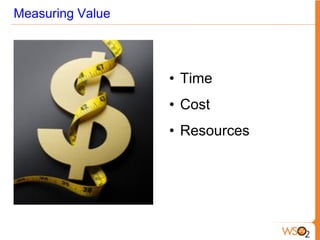
Measuring Value


                  • Time
                  • Cost
                  • Resources
What is your value baseline?
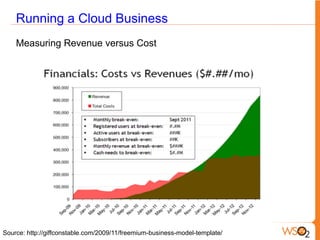
Running a Cloud Business
    Measuring Revenue versus Cost


Source: http://giffconstable.com/2009/11/freemium-business-model-template/
Increasing Value: Cloud Objectives

• Financial Value
   • Shift from capital expense into operational expense
   • Pay only for what you use

• Efficiency Value
   • Right-size solution footprint to match demand
   • Pool resources and increase utilization

• Agility Value
   • Reduce time to market through DevOps, automated governance, and on-
     demand services
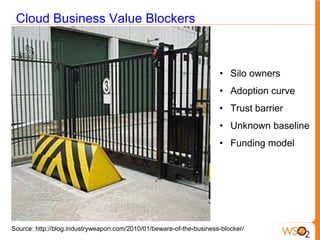
Cloud Business Value Blockers


                                                                     • Silo owners
                                                                     • Adoption curve
                                                                     • Trust barrier
                                                                     • Unknown baseline
                                                                     • Funding model


Source: http://blog.industryweapon.com/2010/01/beware-of-the-business-blocker/
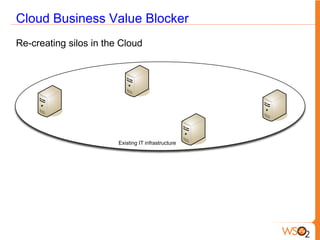
Cloud Business Value Blocker
Re-creating silos in the Cloud


                        Existing IT infrastructure
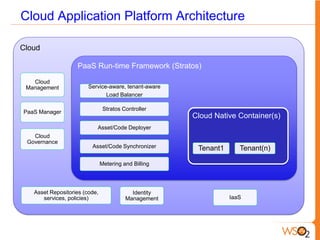
Cloud Application Platform Architecture

Cloud

                   PaaS Run-time Framework (Stratos)

   Cloud
 Management             Service-aware, tenant-aware
                               Load Balancer

                                Stratos Controller
PaaS Manager
                                                      Cloud Native Container(s)
                           Asset/Code Deployer
   Cloud
 Governance
                         Asset/Code Synchronizer       Tenant1      Tenant(n)

                               Metering and Billing


   Asset Repositories (code,               Identity
      services, policies)                Management              IaaS
PaaS Architecture
What is a partition?

• Partitions define distinct container resource pools
• Partition containers to tune container sharing, service resource
  allocation, QoS, and utilization
• Containers may be assigned into service-specific or tenant
  specific partitions
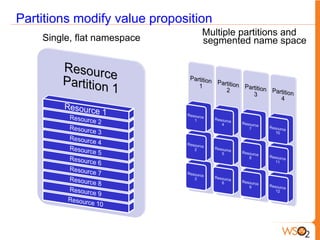
Partitions modify value proposition
                                 Multiple partitions and
    Single, flat namespace       segmented name space
PaaS Architecture
What is a container?
• A standalone, Internet addressable node offering application
  platform services
   • Web application hosting, API management, integration endpoint hosting,
     ESB mediation, registry services, identity management, relational database

• Containers host tenant resources and context
   • Code, configuration files, data, process definitions, rules, policies,
     entitlements

• Containers may serve
   • a single tenant at a time (dedicated), or
   • multiple-tenants at a time (shared)
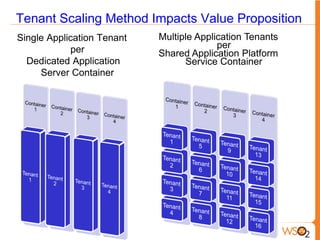
Tenant Scaling Method Impacts Value Proposition
Single Application Tenant   Multiple Application Tenants
            per                           per
                            Shared Application Platform
  Dedicated Application           Service Container
     Server Container
Container Tenancy Implications
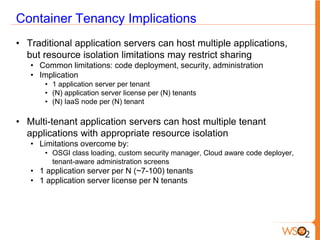
• Traditional application servers can host multiple applications,
  but resource isolation limitations may restrict sharing
   • Common limitations: code deployment, security, administration
   • Implication
       • 1 application server per tenant
       • (N) application server license per (N) tenants
       • (N) IaaS node per (N) tenant

• Multi-tenant application servers can host multiple tenant
  applications with appropriate resource isolation
   • Limitations overcome by:
       • OSGI class loading, custom security manager, Cloud aware code deployer,
         tenant-aware administration screens
   • 1 application server per N (~7-100) tenants
   • 1 application server license per N tenants
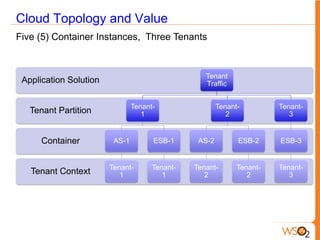
Cloud Topology and Value
Five (5) Container Instances, Three Tenants


                                                   Tenant
 Application Solution                              Traffic


                                Tenant-                 Tenant-         Tenant-
   Tenant Partition                1                       2               3


      Container          AS-1         ESB-1      AS-2         ESB-2     ESB-3


                        Tenant-       Tenant-   Tenant-       Tenant-   Tenant-
   Tenant Context          1             1         2             2         3
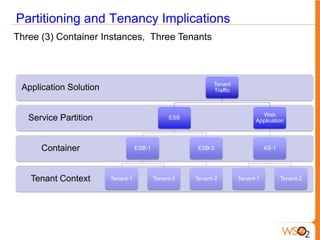
Partitioning and Tenancy Implications
Three (3) Container Instances, Three Tenants


                                                            Tenant
 Application Solution                                       Traffic


                                                                              Web
   Service Partition                            ESB
                                                                            Application


      Container                    ESB-1               ESB-2                     AS-1


   Tenant Context       Tenant-1           Tenant-3   Tenant-2        Tenant-1          Tenant-2
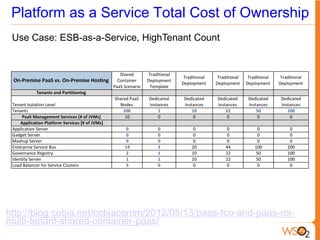
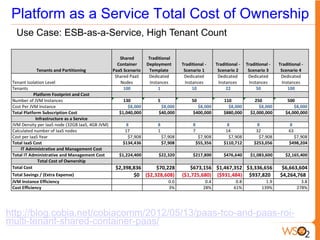
Platform as a Service Total Cost of Ownership
 Use Case: ESB-as-a-Service, HighTenant Count


http://blog.cobia.net/cobiacomm/2012/05/13/paas-tco-and-paas-roi-
multi-tenant-shared-container-paas/
Platform as a Service Total Cost of Ownership
  Use Case: ESB-as-a-Service, High Tenant Count


http://blog.cobia.net/cobiacomm/2012/05/13/paas-tco-and-paas-roi-
multi-tenant-shared-container-paas/
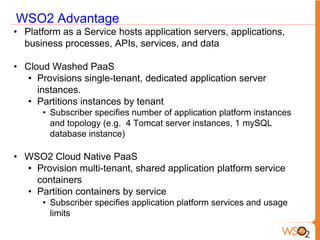
WSO2 Advantage
• Platform as a Service hosts application servers, applications,
  business processes, APIs, services, and data

• Cloud Washed PaaS
   • Provisions single-tenant, dedicated application server
     instances.
   • Partitions instances by tenant
      • Subscriber specifies number of application platform instances
        and topology (e.g. 4 Tomcat server instances, 1 mySQL
        database instance)

• WSO2 Cloud Native PaaS
  • Provision multi-tenant, shared application platform service
    containers
  • Partition containers by service
      • Subscriber specifies application platform services and usage
        limits
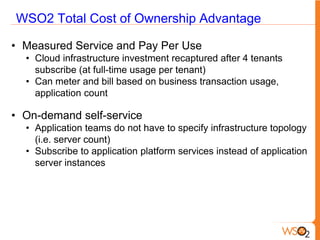
WSO2 Total Cost of Ownership Advantage

• Measured Service and Pay Per Use
  • Cloud infrastructure investment recaptured after 4 tenants
    subscribe (at full-time usage per tenant)
  • Can meter and bill based on business transaction usage,
    application count

• On-demand self-service
  • Application teams do not have to specify infrastructure topology
    (i.e. server count)
  • Subscribe to application platform services instead of application
    server instances
Attributes influencing Total Cost of Ownership
• Container sharing and tenant isolation level
• Tenant Density per JVM or Application Server
• Container license cost

                    Read entire methodology at
 http://blog.cobia.net/cobiacomm/2012/05/13/paas-tco-and-paas-
               roi-multi-tenant-shared-container-paas/
Resources

• WSO2 Stratos
  • http://wso2.com/cloud/stratos/

• Cloud Value
  • PaaS Total Cost of Ownership White Paper
Follow us:
Contact us:
                           http://twitter.com/#!/wso2
http://wso2.com/contact/
lean . enterprise . middleware

Paying for PaaS

  • 1.
    lean . enterprise. middleware Paying for Platform as a Service Chris Haddad Technology evangelism, strategy, and roadmaps Follow me @cobiacomm on Twitter Read more about our PaaS Story at blog.cobia.net/cobiacomm http://blog.cobia.net/cobiacomm/2012/05/13/paas-tco- and-paas-roi-multi-tenant-shared-container-paas/ © WSO2 2011. Not for redistribution. Commercial in Confidence.
  • 2.
    Measuring Value • Time • Cost • Resources
  • 3.
    What is yourvalue baseline?
  • 4.
    Running a CloudBusiness Measuring Revenue versus Cost Source: http://giffconstable.com/2009/11/freemium-business-model-template/
  • 5.
    Increasing Value: CloudObjectives • Financial Value • Shift from capital expense into operational expense • Pay only for what you use • Efficiency Value • Right-size solution footprint to match demand • Pool resources and increase utilization • Agility Value • Reduce time to market through DevOps, automated governance, and on- demand services
  • 6.
    Cloud Business ValueBlockers • Silo owners • Adoption curve • Trust barrier • Unknown baseline • Funding model Source: http://blog.industryweapon.com/2010/01/beware-of-the-business-blocker/
  • 7.
    Cloud Business ValueBlocker Re-creating silos in the Cloud Existing IT infrastructure
  • 8.
    Cloud Application PlatformArchitecture Cloud PaaS Run-time Framework (Stratos) Cloud Management Service-aware, tenant-aware Load Balancer Stratos Controller PaaS Manager Cloud Native Container(s) Asset/Code Deployer Cloud Governance Asset/Code Synchronizer Tenant1 Tenant(n) Metering and Billing Asset Repositories (code, Identity services, policies) Management IaaS
  • 9.
    PaaS Architecture What isa partition? • Partitions define distinct container resource pools • Partition containers to tune container sharing, service resource allocation, QoS, and utilization • Containers may be assigned into service-specific or tenant specific partitions
  • 10.
    Partitions modify valueproposition Multiple partitions and Single, flat namespace segmented name space
  • 11.
    PaaS Architecture What isa container? • A standalone, Internet addressable node offering application platform services • Web application hosting, API management, integration endpoint hosting, ESB mediation, registry services, identity management, relational database • Containers host tenant resources and context • Code, configuration files, data, process definitions, rules, policies, entitlements • Containers may serve • a single tenant at a time (dedicated), or • multiple-tenants at a time (shared)
  • 12.
    Tenant Scaling MethodImpacts Value Proposition Single Application Tenant Multiple Application Tenants per per Shared Application Platform Dedicated Application Service Container Server Container
  • 13.
    Container Tenancy Implications •Traditional application servers can host multiple applications, but resource isolation limitations may restrict sharing • Common limitations: code deployment, security, administration • Implication • 1 application server per tenant • (N) application server license per (N) tenants • (N) IaaS node per (N) tenant • Multi-tenant application servers can host multiple tenant applications with appropriate resource isolation • Limitations overcome by: • OSGI class loading, custom security manager, Cloud aware code deployer, tenant-aware administration screens • 1 application server per N (~7-100) tenants • 1 application server license per N tenants
  • 14.
    Cloud Topology andValue Five (5) Container Instances, Three Tenants Tenant Application Solution Traffic Tenant- Tenant- Tenant- Tenant Partition 1 2 3 Container AS-1 ESB-1 AS-2 ESB-2 ESB-3 Tenant- Tenant- Tenant- Tenant- Tenant- Tenant Context 1 1 2 2 3
  • 15.
    Partitioning and TenancyImplications Three (3) Container Instances, Three Tenants Tenant Application Solution Traffic Web Service Partition ESB Application Container ESB-1 ESB-2 AS-1 Tenant Context Tenant-1 Tenant-3 Tenant-2 Tenant-1 Tenant-2
  • 16.
    Platform as aService Total Cost of Ownership Use Case: ESB-as-a-Service, HighTenant Count http://blog.cobia.net/cobiacomm/2012/05/13/paas-tco-and-paas-roi- multi-tenant-shared-container-paas/
  • 17.
    Platform as aService Total Cost of Ownership Use Case: ESB-as-a-Service, High Tenant Count http://blog.cobia.net/cobiacomm/2012/05/13/paas-tco-and-paas-roi- multi-tenant-shared-container-paas/
  • 18.
    WSO2 Advantage • Platformas a Service hosts application servers, applications, business processes, APIs, services, and data • Cloud Washed PaaS • Provisions single-tenant, dedicated application server instances. • Partitions instances by tenant • Subscriber specifies number of application platform instances and topology (e.g. 4 Tomcat server instances, 1 mySQL database instance) • WSO2 Cloud Native PaaS • Provision multi-tenant, shared application platform service containers • Partition containers by service • Subscriber specifies application platform services and usage limits
  • 19.
    WSO2 Total Costof Ownership Advantage • Measured Service and Pay Per Use • Cloud infrastructure investment recaptured after 4 tenants subscribe (at full-time usage per tenant) • Can meter and bill based on business transaction usage, application count • On-demand self-service • Application teams do not have to specify infrastructure topology (i.e. server count) • Subscribe to application platform services instead of application server instances
  • 20.
    Attributes influencing TotalCost of Ownership • Container sharing and tenant isolation level • Tenant Density per JVM or Application Server • Container license cost Read entire methodology at http://blog.cobia.net/cobiacomm/2012/05/13/paas-tco-and-paas- roi-multi-tenant-shared-container-paas/
  • 21.
    Resources • WSO2 Stratos • http://wso2.com/cloud/stratos/ • Cloud Value • PaaS Total Cost of Ownership White Paper
  • 22.
    Follow us: Contact us: http://twitter.com/#!/wso2 http://wso2.com/contact/
  • 23.
    lean . enterprise. middleware