lean . enterprise . middleware


   ESB Evaluation Framework


                 Chris Haddad
   Technology evangelism, strategy, and roadmaps
   Follow me @cobiacomm on Twitter
   Read more about our ESB Story at
http://blog.cobia.net/cobiacomm/tag/esb/
            © WSO2 2011. Not for redistribution. Commercial in Confidence.
ESB Evaluation Framework
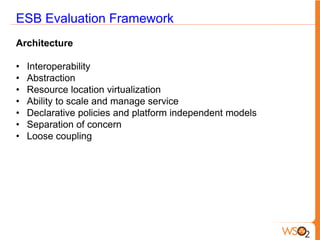
Architecture

•   Interoperability
•   Abstraction
•   Resource location virtualization
•   Ability to scale and manage service
•   Declarative policies and platform independent models
•   Separation of concern
•   Loose coupling
ESB Evaluation Framework
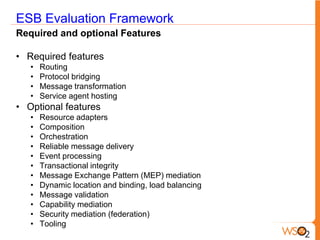
Required and optional Features

• Required features
   •   Routing
   •   Protocol bridging
   •   Message transformation
   •   Service agent hosting
• Optional features
   •   Resource adapters
   •   Composition
   •   Orchestration
   •   Reliable message delivery
   •   Event processing
   •   Transactional integrity
   •   Message Exchange Pattern (MEP) mediation
   •   Dynamic location and binding, load balancing
   •   Message validation
   •   Capability mediation
   •   Security mediation (federation)
   •   Tooling
ESB Evaluation Framework
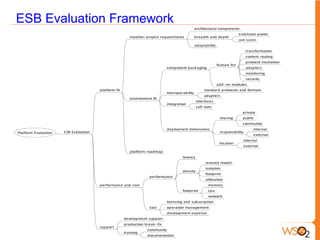
Strategic Criteria

• Platform Fit
   • Matches project requirements
   • Environment fit
   • Platform roadmap
• Performance and Cost
• Support
ESB Evaluation Framework
ESB Comparison Categories
•   Supports Enterprise Integration Patterns
•   Delivers all required ESB features
•   Offers a complete and cohesive SOA Platform
•   Facilitates SOA Governance practices
•   Provides Graphical ESB Development Workbench
•   Based on a composable architecture
•   Cloud Integration platform offering (iPaaS)
•   Cloud connectors and legacy adapters
•   Performance
•   Security and Identity Management
•   Open Business Model
ESB Comparison Categories
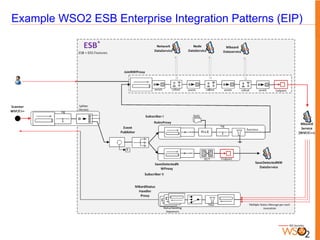
Supports Enterprise Integration Patterns

•   Messaging System
•   Messaging Channels
•   Message Construction
•   Message Routing
•   Message Transformation
•   Messaging Endpoints
Example WSO2 ESB Enterprise Integration Patterns (EIP)
ESB Comparison Categories
Delivers all required ESB features

•   Web services
•   Message transformation
•   Protocol mediation
•   Content routing
•   Service agent hosting
WSO2 ESB Mediators
WSO2 Mediators

•   Sequence: invoke a named set of sequences
•   Send /Event : send a message or event
•   Callout: external blocking service invocation
•   Filter: Filter a message with a given Xpath
•   In/Out: predefined filter sequence
•   Switch: conditionally execute mediators based on regex match
•   XSLT / Smooks/ Xquery: message transformation
•   Enrich: run specific actions
•   DBLookup: augment message contents
•   Route: content routing
•   Clone / Iterate / Aggregate: message copy, splitting, and aggregation
•   Cache: reduce back-end request load
•   Validate: validate message content
•   Rewrite: re-write URL
•   Header: set header values
•   Throttle: limit endpoint usage
•   Log: Log a message
•   DBReport: write to database
•   Fault: post exception
•   Drop: stop processing
•   Enqueue / transaction: message queuing and transactions
•   Entitlement: apply XACML policy
•   OAuth: support OAuth authorization
ESB Comparison Categories
Offers a complete and cohesive SOA Platform

•   Governance Registry
•   Identity Management Services
•   Message Broker
•   Data and Application Service Hosting
•   Business Activity Monitoring
ESB Comparison Categories
Facilitates SOA Governance practices

• Service Lifecycle management
   • Create, deploy, version, deprecate, retire
• Service versioning
   • Approval process
   • Versioning scheme and tracking
• Promotion
   • Checklists
   • Environment deployment
• Run-time management
   • Enforce security policies
   • Comply with Service Level Agreements
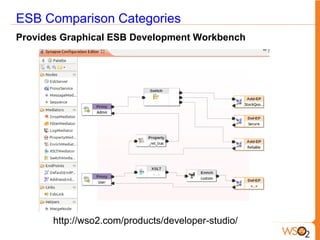
ESB Comparison Categories
Provides Graphical ESB Development Workbench


       http://wso2.com/products/developer-studio/
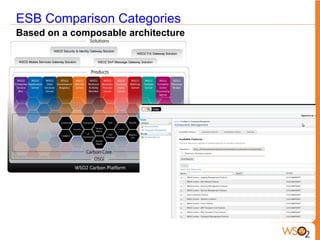
ESB Comparison Categories
Based on a composable architecture
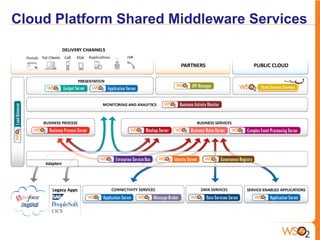
ESB Comparison Categories
Cloud Integration platform offering (iPaaS)

• Cloud-Native
   • On-demand self service
   • Resource pooling
   • Consumption model

   • http://blog.cobia.net/cobiacomm/2012/05/30/cloud-native-paas-realizes-
     cloud-characteristics/
   • http://blog.cobia.net/cobiacomm/2012/05/31/cloud-native-paas-or-cloud-
     washed-paas/

• ESB-as-a-Service
   • Multi-tenant shared container
   • http://wso2.com/whitepapers/cloud-native-advantage-multi-tenant-shared-
     container-paas/
Cloud Platform Shared Middleware Services
ESB Comparison Categories
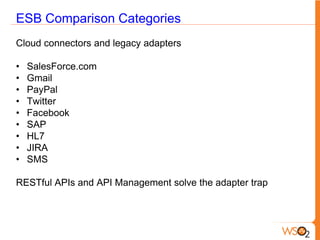
Cloud connectors and legacy adapters

•   SalesForce.com
•   Gmail
•   PayPal
•   Twitter
•   Facebook
•   SAP
•   HL7
•   JIRA
•   SMS

RESTful APIs and API Management solve the adapter trap
ESB Comparison Categories
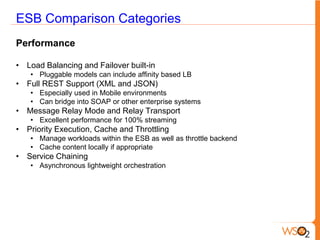
Performance

• Load Balancing and Failover built-in
   • Pluggable models can include affinity based LB
• Full REST Support (XML and JSON)
   • Especially used in Mobile environments
   • Can bridge into SOAP or other enterprise systems
• Message Relay Mode and Relay Transport
   • Excellent performance for 100% streaming
• Priority Execution, Cache and Throttling
   • Manage workloads within the ESB as well as throttle backend
   • Cache content locally if appropriate
• Service Chaining
   • Asynchronous lightweight orchestration
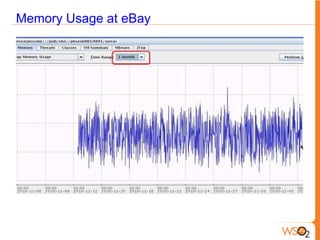
Memory Usage at eBay


              © WSO2 2011
ESB Comparison Categories
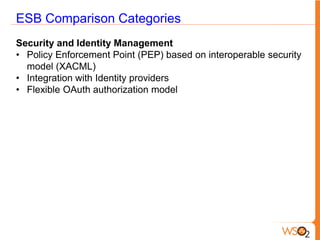
Security and Identity Management
• Policy Enforcement Point (PEP) based on interoperable security
  model (XACML)
• Integration with Identity providers
• Flexible OAuth authorization model
ESB Comparison Categories
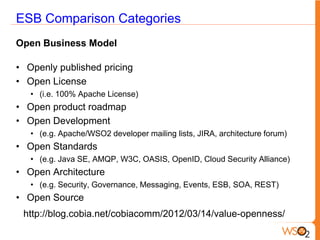
Open Business Model

• Openly published pricing
• Open License
   • (i.e. 100% Apache License)
• Open product roadmap
• Open Development
   • (e.g. Apache/WSO2 developer mailing lists, JIRA, architecture forum)
• Open Standards
   • (e.g. Java SE, AMQP, W3C, OASIS, OpenID, Cloud Security Alliance)
• Open Architecture
   • (e.g. Security, Governance, Messaging, Events, ESB, SOA, REST)
• Open Source
 http://blog.cobia.net/cobiacomm/2012/03/14/value-openness/
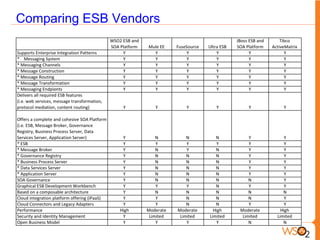
Comparing ESB Vendors
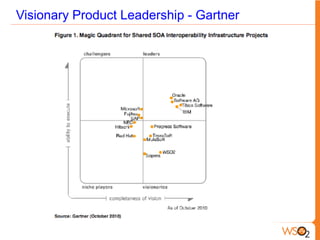
Visionary Product Leadership - Gartner
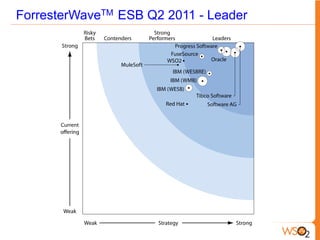
ForresterWaveTM ESB Q2 2011 - Leader
Follow us:
Contact us:
                           http://twitter.com/#!/wso2
http://wso2.com/contact/
lean . enterprise . middleware

ESB Evaluation Framework

  • 1.
    lean . enterprise. middleware ESB Evaluation Framework Chris Haddad Technology evangelism, strategy, and roadmaps Follow me @cobiacomm on Twitter Read more about our ESB Story at http://blog.cobia.net/cobiacomm/tag/esb/ © WSO2 2011. Not for redistribution. Commercial in Confidence.
  • 2.
    ESB Evaluation Framework Architecture • Interoperability • Abstraction • Resource location virtualization • Ability to scale and manage service • Declarative policies and platform independent models • Separation of concern • Loose coupling
  • 3.
    ESB Evaluation Framework Requiredand optional Features • Required features • Routing • Protocol bridging • Message transformation • Service agent hosting • Optional features • Resource adapters • Composition • Orchestration • Reliable message delivery • Event processing • Transactional integrity • Message Exchange Pattern (MEP) mediation • Dynamic location and binding, load balancing • Message validation • Capability mediation • Security mediation (federation) • Tooling
  • 4.
    ESB Evaluation Framework StrategicCriteria • Platform Fit • Matches project requirements • Environment fit • Platform roadmap • Performance and Cost • Support
  • 5.
  • 6.
    ESB Comparison Categories • Supports Enterprise Integration Patterns • Delivers all required ESB features • Offers a complete and cohesive SOA Platform • Facilitates SOA Governance practices • Provides Graphical ESB Development Workbench • Based on a composable architecture • Cloud Integration platform offering (iPaaS) • Cloud connectors and legacy adapters • Performance • Security and Identity Management • Open Business Model
  • 7.
    ESB Comparison Categories SupportsEnterprise Integration Patterns • Messaging System • Messaging Channels • Message Construction • Message Routing • Message Transformation • Messaging Endpoints
  • 8.
    Example WSO2 ESBEnterprise Integration Patterns (EIP)
  • 9.
    ESB Comparison Categories Deliversall required ESB features • Web services • Message transformation • Protocol mediation • Content routing • Service agent hosting
  • 10.
    WSO2 ESB Mediators WSO2Mediators • Sequence: invoke a named set of sequences • Send /Event : send a message or event • Callout: external blocking service invocation • Filter: Filter a message with a given Xpath • In/Out: predefined filter sequence • Switch: conditionally execute mediators based on regex match • XSLT / Smooks/ Xquery: message transformation • Enrich: run specific actions • DBLookup: augment message contents • Route: content routing • Clone / Iterate / Aggregate: message copy, splitting, and aggregation • Cache: reduce back-end request load • Validate: validate message content • Rewrite: re-write URL • Header: set header values • Throttle: limit endpoint usage • Log: Log a message • DBReport: write to database • Fault: post exception • Drop: stop processing • Enqueue / transaction: message queuing and transactions • Entitlement: apply XACML policy • OAuth: support OAuth authorization
  • 11.
    ESB Comparison Categories Offersa complete and cohesive SOA Platform • Governance Registry • Identity Management Services • Message Broker • Data and Application Service Hosting • Business Activity Monitoring
  • 12.
    ESB Comparison Categories FacilitatesSOA Governance practices • Service Lifecycle management • Create, deploy, version, deprecate, retire • Service versioning • Approval process • Versioning scheme and tracking • Promotion • Checklists • Environment deployment • Run-time management • Enforce security policies • Comply with Service Level Agreements
  • 13.
    ESB Comparison Categories ProvidesGraphical ESB Development Workbench http://wso2.com/products/developer-studio/
  • 14.
    ESB Comparison Categories Basedon a composable architecture
  • 15.
    ESB Comparison Categories CloudIntegration platform offering (iPaaS) • Cloud-Native • On-demand self service • Resource pooling • Consumption model • http://blog.cobia.net/cobiacomm/2012/05/30/cloud-native-paas-realizes- cloud-characteristics/ • http://blog.cobia.net/cobiacomm/2012/05/31/cloud-native-paas-or-cloud- washed-paas/ • ESB-as-a-Service • Multi-tenant shared container • http://wso2.com/whitepapers/cloud-native-advantage-multi-tenant-shared- container-paas/
  • 16.
    Cloud Platform SharedMiddleware Services
  • 17.
    ESB Comparison Categories Cloudconnectors and legacy adapters • SalesForce.com • Gmail • PayPal • Twitter • Facebook • SAP • HL7 • JIRA • SMS RESTful APIs and API Management solve the adapter trap
  • 18.
    ESB Comparison Categories Performance •Load Balancing and Failover built-in • Pluggable models can include affinity based LB • Full REST Support (XML and JSON) • Especially used in Mobile environments • Can bridge into SOAP or other enterprise systems • Message Relay Mode and Relay Transport • Excellent performance for 100% streaming • Priority Execution, Cache and Throttling • Manage workloads within the ESB as well as throttle backend • Cache content locally if appropriate • Service Chaining • Asynchronous lightweight orchestration
  • 19.
    Memory Usage ateBay © WSO2 2011
  • 20.
    ESB Comparison Categories Securityand Identity Management • Policy Enforcement Point (PEP) based on interoperable security model (XACML) • Integration with Identity providers • Flexible OAuth authorization model
  • 21.
    ESB Comparison Categories OpenBusiness Model • Openly published pricing • Open License • (i.e. 100% Apache License) • Open product roadmap • Open Development • (e.g. Apache/WSO2 developer mailing lists, JIRA, architecture forum) • Open Standards • (e.g. Java SE, AMQP, W3C, OASIS, OpenID, Cloud Security Alliance) • Open Architecture • (e.g. Security, Governance, Messaging, Events, ESB, SOA, REST) • Open Source http://blog.cobia.net/cobiacomm/2012/03/14/value-openness/
  • 22.
  • 23.
  • 24.
  • 25.
    Follow us: Contact us: http://twitter.com/#!/wso2 http://wso2.com/contact/
  • 26.
    lean . enterprise. middleware