Uses and Gratifications
There are 5 common uses and gratifications associated with Media, those being:-
escapism, entertainment, surveillance, personal identity and public relations. All of
these give and insight into how a consumer engages with the chosen medium.

•   Escapism: Using a media outlet in order to create an alternative reality, this acts as
    a distraction from their issues; this is present in a person immersing themselves in
    the internet in order to escape
•   Surveillance: People can view media as a way of gaining information on
    surrounding world events such as reading a newspaper, learning through
    reading/watching or even to satisfy your natural curiosity. (E.g. Gossip) The Two
    Step Flow theory could also be influenced by this. Personal Relations: People often
    form friendships based upon their similar preferences; likes and dislikes, this is also
    present in media texts(music, film and celebrity) we can use these for social
    interaction and to integrate into society and friendships. Personal Identity: Your
    personality is made up of many inputs, a major one is that of media, your personal
    identity can be construed from a particular celebrity or social group, viewing media
    can help insight you on these aspects.
•   Entertainment: the main form of interacting with media texts, this can include
    filling in time, cultural enjoyment or perhaps escaping reality(escapism).
Media Dependency Theory
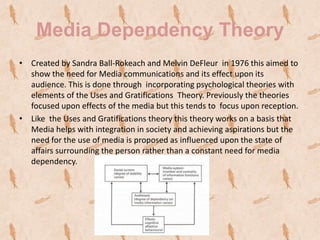
• Created by Sandra Ball-Rokeach and Melvin DeFleur in 1976 this aimed to
  show the need for Media communications and its effect upon its
  audience. This is done through incorporating psychological theories with
  elements of the Uses and Gratifications Theory. Previously the theories
  focused upon effects of the media but this tends to focus upon reception.
• Like the Uses and Gratifications theory this theory works on a basis that
  Media helps with integration in society and achieving aspirations but the
  need for the use of media is proposed as influenced upon the state of
  affairs surrounding the person rather than a constant need for media
  dependency.
Reception Theory
Post Modernism
Dominant Ideology and
     Hegemony
Maslow’s Hierarchy of
       Needs
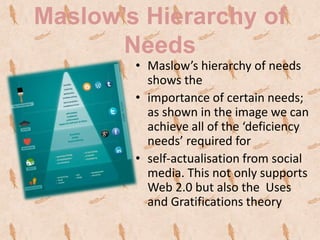
        • Maslow’s hierarchy of needs
          shows the
        • importance of certain needs;
          as shown in the image we can
          achieve all of the ‘deficiency
          needs’ required for
        • self-actualisation from social
          media. This not only supports
          Web 2.0 but also the Uses
          and Gratifications theory
Young and Rubicans Theory
The Hypodermic Needle
       Theory
• In the 1920’s the theory of the Hypodermic
  Needle was created in an attempt to explain
  how audiences engage and react with mass
  media.
The Two Step Flow
• Katz and Lazarsfeld developed the two-step flow
  theory of mass communication.
• The theory envisions two-steps, the first which
  the ‘opinion leaders’ who are under the influence
  of the mass media influence. These people then
  pass on their newly gained ‘opinions’ to a social
  recipient to create a wider understanding.
  The two-step flow theory has improved our
  understanding of how the mass media influence
  decision making. This theory highlights useful
  and the futile marketing and media

Key Theories

  • 2.
    Uses and Gratifications Thereare 5 common uses and gratifications associated with Media, those being:- escapism, entertainment, surveillance, personal identity and public relations. All of these give and insight into how a consumer engages with the chosen medium. • Escapism: Using a media outlet in order to create an alternative reality, this acts as a distraction from their issues; this is present in a person immersing themselves in the internet in order to escape • Surveillance: People can view media as a way of gaining information on surrounding world events such as reading a newspaper, learning through reading/watching or even to satisfy your natural curiosity. (E.g. Gossip) The Two Step Flow theory could also be influenced by this. Personal Relations: People often form friendships based upon their similar preferences; likes and dislikes, this is also present in media texts(music, film and celebrity) we can use these for social interaction and to integrate into society and friendships. Personal Identity: Your personality is made up of many inputs, a major one is that of media, your personal identity can be construed from a particular celebrity or social group, viewing media can help insight you on these aspects. • Entertainment: the main form of interacting with media texts, this can include filling in time, cultural enjoyment or perhaps escaping reality(escapism).
  • 3.
    Media Dependency Theory •Created by Sandra Ball-Rokeach and Melvin DeFleur in 1976 this aimed to show the need for Media communications and its effect upon its audience. This is done through incorporating psychological theories with elements of the Uses and Gratifications Theory. Previously the theories focused upon effects of the media but this tends to focus upon reception. • Like the Uses and Gratifications theory this theory works on a basis that Media helps with integration in society and achieving aspirations but the need for the use of media is proposed as influenced upon the state of affairs surrounding the person rather than a constant need for media dependency.
  • 4.
  • 5.
  • 6.
  • 7.
    Maslow’s Hierarchy of Needs • Maslow’s hierarchy of needs shows the • importance of certain needs; as shown in the image we can achieve all of the ‘deficiency needs’ required for • self-actualisation from social media. This not only supports Web 2.0 but also the Uses and Gratifications theory
  • 8.
  • 9.
    The Hypodermic Needle Theory • In the 1920’s the theory of the Hypodermic Needle was created in an attempt to explain how audiences engage and react with mass media.
  • 10.
    The Two StepFlow • Katz and Lazarsfeld developed the two-step flow theory of mass communication. • The theory envisions two-steps, the first which the ‘opinion leaders’ who are under the influence of the mass media influence. These people then pass on their newly gained ‘opinions’ to a social recipient to create a wider understanding. The two-step flow theory has improved our understanding of how the mass media influence decision making. This theory highlights useful and the futile marketing and media