Mr Rahul Mistry
Urology Special Registrar
Mersey Deanery
 Prostate cancer
 Testicular cancer
 Bladder cancer
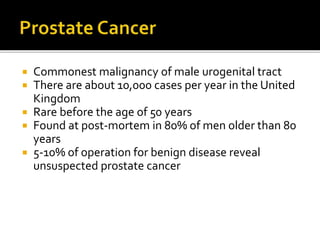
 Commonest malignancy of male urogenital tract
 There are about 10,000 cases per year in the United
Kingdom
 Rare before the age of 50 years
 Found at post-mortem in 80% of men older than 80
years
 5-10% of operation for benign disease reveal
unsuspected prostate cancer
 Adenocarcinomas
 Arise in the posterior / periphery
 Spread through capsule into perineural
spaces, bladder neck, pelvic wall and
rectum
 Lymphatic spread - common
 Haematogenous spread occurs to axial
skeleton
 Graded by Gleason classification
 Not well known
 First-line relative - risk is at least doubled
 If two or more first-line relatives - the risk increases 5- to 11-fold
 Incidence high in the USA and Northern Europe and low in South-
East Asia
 However, if Japanese men move from Japan to Hawaii, their risk of
CaP increases, and if they move to California their risk increases
even more and approaches that of American men
 High content of animal fat in the diet may be important in
increasing the risk of developing CaP
 Low intakes of vitamin E, selenium, lignans and isoflavenoids
(soybeans)
 Sunlight might be protective againstCaP due to an increase in
vitamin D levels
 60% symptoms of bladder outflow
obstruction
 10% incidental findings atTURP
 Bone pain, cord compression or leuco-
erythroblastic anaemia
 Renal failure can occur due to bilateral
ureteric obstruction
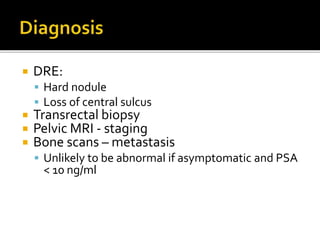
 DRE:
 Hard nodule
 Loss of central sulcus
 Transrectal biopsy
 Pelvic MRI - staging
 Bone scans – metastasis
 Unlikely to be abnormal if asymptomatic and PSA
< 10 ng/ml
 Prostate specific antigen
 Kallikrein-like protein produced by prostatic epithelial cells
 Age matched:
 40-50:2.5
 50-60: 3.5
 60-70: 4.5
 70-80: 6.5
 >10 ng/ml is highly suggestive of prostatic carcinoma
 Can be significantly raised in BPH, UTI’s or secondary to
retention
 Monitoring response to treatment
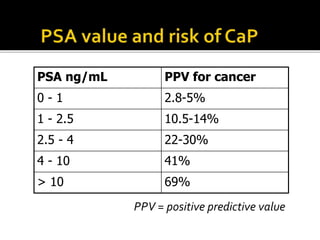
PPV = positive predictive value
PSA ng/mL PPV for cancer
0 - 1 2.8-5%
1 - 2.5 10.5-14%
2.5 - 4 22-30%
4 - 10 41%
> 10 69%
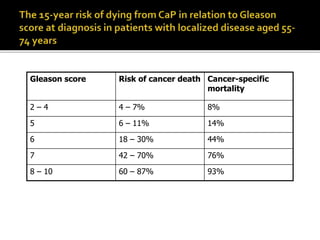
Gleason score Risk of cancer death Cancer-specific
mortality
2 – 4 4 – 7% 8%
5 6 – 11% 14%
6 18 – 30% 44%
7 42 – 70% 76%
8 – 10 60 – 87% 93%
 Grading score
 Score: 2 – 10
 2 - least aggressive
 10 -most aggressive.
 Total score = the sum of the two most common
patterns (grades 1-5) of tumour growth found
 TRUS prostate biopsy
 TURP
 TX Primary tumour cannot be assessed
 T0 No evidence of primary tumour
 T1 Clinically inapparent tumour not palpable or visible by imaging
 T1a Incidental histological finding in 5% or less of tissue resected
 T1b Incidental histological finding in more than 5% of tissue resected
 T1c Tumour identified by needle biopsy (e.g., because of elevated PSA)
 T2 Tumour confined within the prostate
 T2a Tumour involves one half of one lobe or less
 T2b Tumour involves more than half of one lobe, but not both lobes
 T2c Tumour involves both lobes
 T3 Tumour extends through the prostatic capsule
 T3a Extracapsular extension (unilateral or bilateral)
 T3b Tumour invades seminal vesicle(s)
 T4 Tumour is fixed or invades adjacent structures other than seminal vesicles:
bladder neck, external sphincter, rectum, levator muscles, or pelvic wall
 More men die with than from prostate cancer
 Treatment depends on stage of disease, patient's age
and general fitness
 Local disease –
 Observation
 Radical radiotherapy / brachythrapy
 Radical prostatectomy
 Locally advanced disease
 Radical radiotherapy
 Hormonal therapy
 Metastatic disease
 Hormonal therapy
 80% of prostate cancers are androgen dependent for growth
 Hormonal therapy involves androgen depletion
 Produces good palliation until tumours 'escape' from
hormonal control
 Androgen depletion can be achieved by:
 Bilateral subcapsular orchidectomy
 LHRH agonists - goseraline (Zoladex)
 Anti-androgens - cyproterone acetate, bicalutamide
 Complete androgen blockade
 Oestrogens - stilbeostrol
 Regulated by the hypothalamic-pituitary-gonadal axis.
 LHRH stimulates the anterior pituitary to release LH and FSH
 LH stimulates the Leydig cells of the testes to secrete testosterone
 In Prostate cells, testosterone is converted by the enzyme 5-α -reductase
into 5-α -dihydrotestosterone (DHT), which is an androgenic stimulant
approximately 10 times more powerful than the parent molecule
 Circulating testosterone is peripherally aromatized and converted into
oestrogens which, together with the circulating androgens, exert a
negative feedback control on the hypothalamic LH secretion
 If prostate cells are deprived of androgenic stimulation, they undergo
apoptosis (programmed cell death)
 Any treatment ultimately resulting in the suppression of androgen activity
is referred to as androgen deprivation therapy
 Commonest solid malignancy in young men
 1% - 1.5% of male neoplasms
 5% of urological tumours
 3-6 new cases occurring per 100,000 males per year
inWestern society
 Only 1-2% of cases are bilateral
 Incidence high in caucasians in northern Europe and
USA
 1400 new cases per year in UK
 95% 5 year survival testis localised disease
 Peak incidence
 Third decade of life for non-seminoma
 Fourth decade for pure seminoma
 History of cryptorchidism
 x4-13 increased risk
 7-10% tumours in undecended testis
 Klinefelter’s syndrome
 FHx
 Father/brother: x6-8 increased risk
 Presence of a contralateral tumour
 5-10% risk
 HIV
 seminoma
 Unilateral testicular mass
 20% scrotal pain
 27% local pain
 Trauma
 Reduction in testis size
 Gynaecomastia 7% (beta HCG) more common in non-
seminomatous tumours
 Symptoms of metastatic disease
 Seminomas metastasize to para-aortic nodes back pain – 11%
 Teratomas – spread to para-aortic nodes, liver, lung, bone and
brain
 10% of cases can mimic an epididymo-orchitis
 Supraclavicular / distant metastases
 Palpable abdominal mass
 Staging and response to treatment
 Alpha-fetoprotein
 Produced by yolk sac elements
 Not produced by seminomas
 Beta-human chorionic gonadotrophin
 Produced by trophoblastic elements
 Elevated levels seen in both teratomas and seminoma
 Lactate Dehydrogenase
 Less specific marker
 Concentration is proportional to tumour volume
 Elevated in 80% of patients with advanced testicular cancer
 It should be noted that negative markers levels do not exclude the diagnosis of a
germ cell tumour
 Ultrasound
 Sensitivity almost 100%: intra- or extratesticular
 Inexpensive test
 Screening test of the contralateral testis in the follow-up
 Elevated serum beta-hCG or AFP
 MRI
 Higher sensitivity and specificity than ultrasound
 May differentiate seminomatous from non-seminomatous tumours
 Sensitivity of 100% and a specificity of 95-100%
 High cost
 Thoraco-abdominalCT scanning for staging
Radical Orchidectomy
 Seminomas are radiosensitive
 Teratomas are not radiosensitive
 Surgery: Inguinal orchidectomy
 Radiotherapy
 Chemotherapy
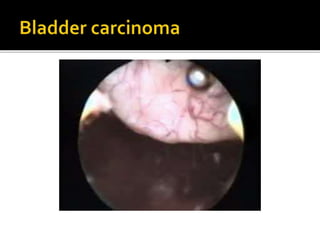
 95% transitional cell carcinomas
 4% squamous / adenocarcinoma
 Superficial tumours are usually low grade and
associated with a good prognosis
 Muscle invasive tumours are of higher grade
and have a poorer prognosis
 TCCs should be regarded a 'field change' disease
with a spectrum of aggression
 80% ofTCCs are superficial and well differentiated
 Only 20% progress to muscle invasion
 Associated with good prognosis
 20% ofTCCs are high-grade and muscle invasive
 50% have muscle invasion at time of presentation
 Associated with poor prognosis
 Occupational exposure
 20% ofTCC are believed to result from occupational
factors
 Chemical implicated - aniline dyes, chlorinated
hydrocarbons
 Cigarette smoking
 Pelvic irradiation - for carcinoma of the cervix
 Schistosoma haematobium associated with
increased risk of squamous carcinoma
 Requires
bladder
muscle to be
included in
specimen
 Staged
according to
depth of
tumour
invasion
 Grade of
tumour
differentiation
Tis In-situ disease
Ta Epithelium only
T1 Lamina propria invasion
T2 Superficial muscle invasion
T3a Deep muscle invasion
T3b Perivesical fat invasion
T4 Prostate or contiguous muscle
G1 Well differentiated
G2 Moderately well differentiated
G3 Poorly differentiated
 80% present with painless haematuria
 Also present with treatment-resistant infection or bladder
irritability and sterile pyuria
Haematuria clinic involves:
 Urinalysis
 Mid stream urine
 Serum urea and creatinine
 Ultrasound - bladder and kidneys
 KUB xray - to exclude urinary tract calcification
 Flexible cystoscopy
 Consider IVU / CT urography if no pathology identified
 RequiresTURT follow-up
 Consider prophylactic chemotherapy (mitomycin-C)
if risk factor for recurrence or invasion (e.g. high
grade)
 Consider immunotherapy
 BCG = attenuated strain of Mycobacterium bovis
 Reduces risk of recurrence and progression
 50-70% response rate recorded
 Occasionally associated with development of
systemic mycobacterial infection
 Carcinoma-in-situ is an aggressive disease
 Often associated with positive cytology
 50% patients progress to muscle invasion
 Consider immunotherapy - BCG
 If fails patient may need radical cystectomy
 Choices are between radical cystectomy and radiotherapy
 Radical cystectomy has an operative mortality of about 5%
 Urinary diversion achieved by:
 Ileal conduit
 Neo-bladder
 Local recurrence rates after surgery are approximately 15%
and after radiotherapy alone 50%
 Pre-operative radiotherapy is no better than surgery alone
 Adjuvant chemotherapy may have a role
 Prostate_Exam.pps
Prostate cancer is a disease that can affect men as they
older. The sooner it’s detected, the better the prognosis.
Urologia
O n l i n e

Urological Malignancies

  • 1.
    Mr Rahul Mistry UrologySpecial Registrar Mersey Deanery
  • 3.
     Prostate cancer Testicular cancer  Bladder cancer
  • 4.
     Commonest malignancyof male urogenital tract  There are about 10,000 cases per year in the United Kingdom  Rare before the age of 50 years  Found at post-mortem in 80% of men older than 80 years  5-10% of operation for benign disease reveal unsuspected prostate cancer
  • 6.
     Adenocarcinomas  Arisein the posterior / periphery  Spread through capsule into perineural spaces, bladder neck, pelvic wall and rectum  Lymphatic spread - common  Haematogenous spread occurs to axial skeleton  Graded by Gleason classification
  • 7.
     Not wellknown  First-line relative - risk is at least doubled  If two or more first-line relatives - the risk increases 5- to 11-fold  Incidence high in the USA and Northern Europe and low in South- East Asia  However, if Japanese men move from Japan to Hawaii, their risk of CaP increases, and if they move to California their risk increases even more and approaches that of American men  High content of animal fat in the diet may be important in increasing the risk of developing CaP  Low intakes of vitamin E, selenium, lignans and isoflavenoids (soybeans)  Sunlight might be protective againstCaP due to an increase in vitamin D levels
  • 9.
     60% symptomsof bladder outflow obstruction  10% incidental findings atTURP  Bone pain, cord compression or leuco- erythroblastic anaemia  Renal failure can occur due to bilateral ureteric obstruction
  • 10.
     DRE:  Hardnodule  Loss of central sulcus  Transrectal biopsy  Pelvic MRI - staging  Bone scans – metastasis  Unlikely to be abnormal if asymptomatic and PSA < 10 ng/ml
  • 11.
     Prostate specificantigen  Kallikrein-like protein produced by prostatic epithelial cells  Age matched:  40-50:2.5  50-60: 3.5  60-70: 4.5  70-80: 6.5  >10 ng/ml is highly suggestive of prostatic carcinoma  Can be significantly raised in BPH, UTI’s or secondary to retention  Monitoring response to treatment
  • 12.
    PPV = positivepredictive value PSA ng/mL PPV for cancer 0 - 1 2.8-5% 1 - 2.5 10.5-14% 2.5 - 4 22-30% 4 - 10 41% > 10 69%
  • 13.
    Gleason score Riskof cancer death Cancer-specific mortality 2 – 4 4 – 7% 8% 5 6 – 11% 14% 6 18 – 30% 44% 7 42 – 70% 76% 8 – 10 60 – 87% 93%
  • 14.
     Grading score Score: 2 – 10  2 - least aggressive  10 -most aggressive.  Total score = the sum of the two most common patterns (grades 1-5) of tumour growth found  TRUS prostate biopsy  TURP
  • 15.
     TX Primarytumour cannot be assessed  T0 No evidence of primary tumour  T1 Clinically inapparent tumour not palpable or visible by imaging  T1a Incidental histological finding in 5% or less of tissue resected  T1b Incidental histological finding in more than 5% of tissue resected  T1c Tumour identified by needle biopsy (e.g., because of elevated PSA)  T2 Tumour confined within the prostate  T2a Tumour involves one half of one lobe or less  T2b Tumour involves more than half of one lobe, but not both lobes  T2c Tumour involves both lobes  T3 Tumour extends through the prostatic capsule  T3a Extracapsular extension (unilateral or bilateral)  T3b Tumour invades seminal vesicle(s)  T4 Tumour is fixed or invades adjacent structures other than seminal vesicles: bladder neck, external sphincter, rectum, levator muscles, or pelvic wall
  • 16.
     More mendie with than from prostate cancer  Treatment depends on stage of disease, patient's age and general fitness  Local disease –  Observation  Radical radiotherapy / brachythrapy  Radical prostatectomy  Locally advanced disease  Radical radiotherapy  Hormonal therapy  Metastatic disease  Hormonal therapy
  • 17.
     80% ofprostate cancers are androgen dependent for growth  Hormonal therapy involves androgen depletion  Produces good palliation until tumours 'escape' from hormonal control  Androgen depletion can be achieved by:  Bilateral subcapsular orchidectomy  LHRH agonists - goseraline (Zoladex)  Anti-androgens - cyproterone acetate, bicalutamide  Complete androgen blockade  Oestrogens - stilbeostrol
  • 18.
     Regulated bythe hypothalamic-pituitary-gonadal axis.  LHRH stimulates the anterior pituitary to release LH and FSH  LH stimulates the Leydig cells of the testes to secrete testosterone  In Prostate cells, testosterone is converted by the enzyme 5-α -reductase into 5-α -dihydrotestosterone (DHT), which is an androgenic stimulant approximately 10 times more powerful than the parent molecule  Circulating testosterone is peripherally aromatized and converted into oestrogens which, together with the circulating androgens, exert a negative feedback control on the hypothalamic LH secretion  If prostate cells are deprived of androgenic stimulation, they undergo apoptosis (programmed cell death)  Any treatment ultimately resulting in the suppression of androgen activity is referred to as androgen deprivation therapy
  • 21.
     Commonest solidmalignancy in young men  1% - 1.5% of male neoplasms  5% of urological tumours  3-6 new cases occurring per 100,000 males per year inWestern society  Only 1-2% of cases are bilateral  Incidence high in caucasians in northern Europe and USA  1400 new cases per year in UK  95% 5 year survival testis localised disease  Peak incidence  Third decade of life for non-seminoma  Fourth decade for pure seminoma
  • 22.
     History ofcryptorchidism  x4-13 increased risk  7-10% tumours in undecended testis  Klinefelter’s syndrome  FHx  Father/brother: x6-8 increased risk  Presence of a contralateral tumour  5-10% risk  HIV  seminoma
  • 23.
     Unilateral testicularmass  20% scrotal pain  27% local pain  Trauma  Reduction in testis size  Gynaecomastia 7% (beta HCG) more common in non- seminomatous tumours  Symptoms of metastatic disease  Seminomas metastasize to para-aortic nodes back pain – 11%  Teratomas – spread to para-aortic nodes, liver, lung, bone and brain  10% of cases can mimic an epididymo-orchitis  Supraclavicular / distant metastases  Palpable abdominal mass
  • 24.
     Staging andresponse to treatment  Alpha-fetoprotein  Produced by yolk sac elements  Not produced by seminomas  Beta-human chorionic gonadotrophin  Produced by trophoblastic elements  Elevated levels seen in both teratomas and seminoma  Lactate Dehydrogenase  Less specific marker  Concentration is proportional to tumour volume  Elevated in 80% of patients with advanced testicular cancer  It should be noted that negative markers levels do not exclude the diagnosis of a germ cell tumour
  • 25.
     Ultrasound  Sensitivityalmost 100%: intra- or extratesticular  Inexpensive test  Screening test of the contralateral testis in the follow-up  Elevated serum beta-hCG or AFP  MRI  Higher sensitivity and specificity than ultrasound  May differentiate seminomatous from non-seminomatous tumours  Sensitivity of 100% and a specificity of 95-100%  High cost  Thoraco-abdominalCT scanning for staging
  • 26.
  • 27.
     Seminomas areradiosensitive  Teratomas are not radiosensitive  Surgery: Inguinal orchidectomy  Radiotherapy  Chemotherapy
  • 29.
     95% transitionalcell carcinomas  4% squamous / adenocarcinoma  Superficial tumours are usually low grade and associated with a good prognosis  Muscle invasive tumours are of higher grade and have a poorer prognosis
  • 30.
     TCCs shouldbe regarded a 'field change' disease with a spectrum of aggression  80% ofTCCs are superficial and well differentiated  Only 20% progress to muscle invasion  Associated with good prognosis  20% ofTCCs are high-grade and muscle invasive  50% have muscle invasion at time of presentation  Associated with poor prognosis
  • 31.
     Occupational exposure 20% ofTCC are believed to result from occupational factors  Chemical implicated - aniline dyes, chlorinated hydrocarbons  Cigarette smoking  Pelvic irradiation - for carcinoma of the cervix  Schistosoma haematobium associated with increased risk of squamous carcinoma
  • 32.
     Requires bladder muscle tobe included in specimen  Staged according to depth of tumour invasion  Grade of tumour differentiation Tis In-situ disease Ta Epithelium only T1 Lamina propria invasion T2 Superficial muscle invasion T3a Deep muscle invasion T3b Perivesical fat invasion T4 Prostate or contiguous muscle G1 Well differentiated G2 Moderately well differentiated G3 Poorly differentiated
  • 33.
     80% presentwith painless haematuria  Also present with treatment-resistant infection or bladder irritability and sterile pyuria Haematuria clinic involves:  Urinalysis  Mid stream urine  Serum urea and creatinine  Ultrasound - bladder and kidneys  KUB xray - to exclude urinary tract calcification  Flexible cystoscopy  Consider IVU / CT urography if no pathology identified
  • 34.
     RequiresTURT follow-up Consider prophylactic chemotherapy (mitomycin-C) if risk factor for recurrence or invasion (e.g. high grade)  Consider immunotherapy  BCG = attenuated strain of Mycobacterium bovis  Reduces risk of recurrence and progression  50-70% response rate recorded  Occasionally associated with development of systemic mycobacterial infection
  • 36.
     Carcinoma-in-situ isan aggressive disease  Often associated with positive cytology  50% patients progress to muscle invasion  Consider immunotherapy - BCG  If fails patient may need radical cystectomy
  • 37.
     Choices arebetween radical cystectomy and radiotherapy  Radical cystectomy has an operative mortality of about 5%  Urinary diversion achieved by:  Ileal conduit  Neo-bladder  Local recurrence rates after surgery are approximately 15% and after radiotherapy alone 50%  Pre-operative radiotherapy is no better than surgery alone  Adjuvant chemotherapy may have a role
  • 38.
     Prostate_Exam.pps Prostate canceris a disease that can affect men as they older. The sooner it’s detected, the better the prognosis. Urologia O n l i n e