By Shelby MarcusBladder Cancer
BasicsBladder Cancer is one of the most common cancersA bladder tumor is created when normal cells mutateThey begin to rapidly grow and multiply Tumors are created & grow by cells multiplyingTumors either: Become so big that they takes over other tissues & take their resources (oxygen & nutrients)---OR---Metastasize- travel through the bloodstream or lymphatic system (invading & spreading)BC is more likely to spread to neighboring organs thru lymph nodes than spread thru bloodstream
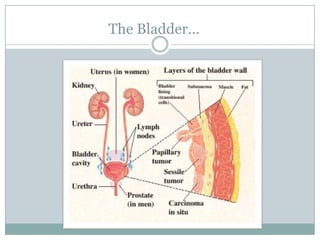
The Bladder…
Transitional Cell CarcinomaIn the US, 90% of BCSuperficial Bladder CancerBegins in the innermost tissue layer of the bladderShrink when empty, enlarge when fullMost commonBiggest cause: smoking
Squamous Cell CarcinomaIn the US, 3-8% of BCInvasive Bladder CancerBegins in Squamous cellsFlat cells that can form after long-term infection or irritationSquamous: prolonged irritation, inflamation, and infectionPredominant in Middle East and AfricaSchistosoma worm that causes Schistosomiasis,
Adenocarcinoma In the US, 1-2% of BCBegins in glandular (secretary) cells that can form after long-term irritation and inflammationInvasive Bladder CancerBiggest cause: inflamation & irritation
SymptomsMost common: Blood in urine (slightly rusty to bright red in color)Frequent urination	(feeling to urinate when not needed)Pain during urinationLower pack pain
Diagnostic TestsAbdominal CT scanBladder biopsyusually performed during CytoscopyCytoscopy examining the inside of bladder w/ cameraIntravenous pyelogram- IVP	x-ray pictures of ureter & bladder to check for cancerUrinalysisPhysical color, microscopic, and chemical appearanceUrine cytologyExamination of cells in urine
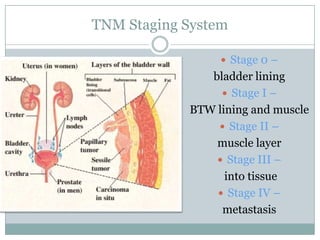
TNM Staging SystemStage 0 – bladder liningStage I – BTW lining and muscleStage II – muscle layerStage III – into tissueStage IV –metastasis
TreatmentsStage 0 and 1:Transurethral Resection of the Bladder (TURB)- removal of tumor through surgeryChemotherapy or immunotherapyStage 2 or 3:Radical cystectomy- removal of bladder through surgeryPartial removal of bladder (followed by chemotherapy & radiation)Chemotherapy to shrink tumor before surgeryChemotherapy and radiation (patients who don’t do surgery) Stage 4: Incurable, no surgery, (chemotherapy is possibility)
Risk FactorsThe causes of cancer aren’t usually hereditary… they are….Smoking50% of men with BC caused by smoke30% of women with BC caused by smokeChemical Exposure¼ cases due to exposure of carcinogensDye workers, rubber workers, aluminum workers, leather workers, truck drivers, & pesticide workers are at highest riskRadiation and chemotherapyExposure to radiation/chemotherapy can increase risk of BCBladder InfectionBladder infection/irritation increase risk of Squamous cell BCHowever, don’t increase transitional cell cancerParasite infectionInfection from Schistosomiasis parasite
Biology of CancerNo known genetic mutations that cause BCThe DNA proteins become mutated so they grow quickly and begin to form tumorMutation: Prot0-oncogenes become oncogenesAs result can’t stop cell cycleTumor suppressor doesn’t check for mutations  Mutation of proto-oncogenes & tumor suppresors because of environmental issues & other risk factors
Statistics67,000 people are diagnosed with BC in the United States every year45,o00 men &  17,000 women13,000 people die every year of BC in US every yearThree times more men get bladder cancer than womenWomen have more severe cases Bladder cancer in white people develop 2x as fast than other ethnic groups(African Americans & Hispanics statistics are similar)Asians have lowest rates of development of BCBC occurs in older ages, average age is 60
SourcesWeb Sources (information):http://www.ncbi.nlm.nih.gov/pubmedhealth/PMH0001517http://www.cancer.gov/cancertopics/pdq/treatment/bladder/Patienthttp://www.mayoclinic.com/health/bladder-cancer/DS00177http://www.emedicinehealth.com/bladder_cancer/article_em.htmhttp://www.medicinenet.com/bladder_cancer/article.htmhttp://www.urologychannel.com/bladdercancer/overview-of-bladder-cancer.shtmlhttp://www.nlm.nih.gov/medlineplus/bladdercancer.htmlhttp://blcwebcafe.org/http://ghr.nlm.nih.gov/condition/bladder-cancerhttp://www.acancer.net/bladder_cancer/stage1.phphttp://www.ema.europa.eu/docs/en_GB/document_library/Orphan_designation/2009/10/WC500006117.pdfhttp://www.cancerhelp.org.uk/type/bladder-cancer/about/types-of-bladder-cancerhttp://www.med-ed.virginia.edu/courses/path/urinary/uroth4.cfmPicture sources:http://www.mountnittany.org/wellness-library/healthsheets/documents?ID=6786http://4.bp.blogspot.com/_7JvQaMocMd4/SJyADRukW-I/AAAAAAAAAZI/JhPFU3Ix5xI/s1600-h/drink+pee+repeat.jpghttp://www.zazzle.com/pee_on_bladder_cancer_poster-228150471902362783http://www.personalizedcause.com/shop/collections/knowmore/magnets/classic/detail/yellow.html

Bladder Cancer

Editor's Notes

  • #3 BC more likely to spread to neighboring organs through lymph nodes than spreading through bloodstream
  • #4 Papillary tumors- wart-like appearance and attached to a stalkNonpapillary (sessile) tumors:much less commonmore invasiveworse outcomeSuperficial bladder cancer:Cancer in the lining of the bladderInvasive bladder cancer: Cells that have penetrated the cells bladder’s muscle wall/ or to nearby organs and lymph nodes (originating in the transitional cells)
  • #5 Transitional- most commonTransitional Cell: biggest cause: smoking
  • #6 Squamous: prolonged irritation,inflamation, and infectionPredominant in Middle East and AfricaSchistosoma worm that causes Schistosomiasis,
  • #7 Aden:inflammanation and irritation
  • #9 Bladder biopsy- small part of tissue taken awayAbdominal CT scanBladder biopsy usually performed during CytoscopyCytoscopy examining the inside of bladder w/ cameraIntravenous pyelogram- IVP x-ray pictures of ureter & bladder to check for cancerUrinalysisPhysical color, microscopic, and chemical appearanceUrine cytologyExamination of cells in urine
  • #10 Stage 0 -- Noninvasive tumors that are only in the bladder liningStage I -- Tumor goes through the bladder lining, but does not reach the muscle layer of the bladderStage II -- Tumor goes into the muscle layer of the bladderStage III -- Tumor goes past the muscle layer into tissue surrounding the bladderStage IV -- Tumor has spread to neighboring lymph nodes or to distant sites (metastatic disease)
  • #12 Smoking50% of men with BC caused by smoke30% of women with BC caused by smokeChemical Exposure¼ cases due to exposure of carcinogensDye workers, rubber workers, aluminum workers, leather workers, truck drivers, & pesticide workers are at highest riskRadiation and chemotherapyExposure to radiation/chemotherapy can increase risk of BCBladder InfectionBladder infection/irritation increase risk of Squamous cell BCHowever, don’t increase transitional cell cancerParasite infectionInfection from Schistosomiasis parasite
  • #14 67,000 people are diagnosed with BC in the United States every year45,o00 men & 17,000 women13,000 people die every year of BC in US every yearThree times more men get bladder cancer than womenWomen have more severe cases Bladder cancer in white people develop 2x as fast than other ethnic groups(African Americans & Hispanics statistics are similar)Asians have lowest rates of development of BCBC occurs in older ages, average age is 60
  • #15 Layers of bladderpic: http://www.mountnittany.org/wellness-library/healthsheets/documents?ID=6786Shirt pic: http://4.bp.blogspot.com/_7JvQaMocMd4/SJyADRukW-I/AAAAAAAAAZI/JhPFU3Ix5xI/s1600-h/drink+pee+repeat.jpgPee on BC: http://www.zazzle.com/pee_on_bladder_cancer_poster-228150471902362783Yellow ribbon: http://www.personalizedcause.com/shop/collections/knowmore/magnets/classic/detail/yellow.htmlAdenocarcinoma & SCC pics: http://www.med-ed.virginia.edu/courses/path/urinary/uroth4.cfm