URINE ROUTINE AND
MICROSCOPY
DR KANISHK PATIL
WHY?
• Urine Routine and Microscopy is an array of tests performed on urine and is the
most fundamental urological test.
• Can help diagnose disorders of Urinary tract or systemic diseases affecting the
urinary tract.
• Screening/Monitoring patients of drug abuse or systemic diseases (Diabetes
Mellitus)
• Urine collected in sterile, wide mouthed and dry containers. Should be examined
within 2 hours of collection.
• A midstream urine sample is ideal for urinalysis.
COMPONENTS OF URINALYSIS
• Physical and Gross examination
• Color
• Turbidity
• Biochemical analysis
• Specific gravity
• Osmolality
• pH
• Hematuria/RBCs
• Proteinuria
• Glucose
• Bilirubin
• Leukocyte esterase activity
• Microscopic analysis : Cells, Cast, Microorganisms
PHYSICAL EXAMINATION
• Normal urine is pale yellow and non turbid.
• Colour may vary due to diet, medication or infection.
• Urine may be cloudy/turbid in cases of phosphaturia, pyuria, chyluria or presence
of crystals.
• Urine is normally odourless. May be foul or offensive in case of infection, fruity in
ketonuria, or strong ammoniacal on long standing.
CHEMICAL EXAMINATION
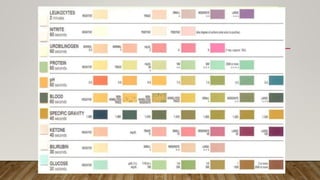
• pH
• pH of urine is reflective of the kidney’s ability to maintain normal hydrogen ion concentration in plasma and ECF.
• Urine pH may vary from 4.5 to 8, with average being 5.5 and 6.5. pH between 4.5 to 5.5 is considered acidic and
6.5 to 8 is considered alkaline.
• Urine tends to be acidic in ketosis, systemic acidosis and UTI; alkaline in cases of UTI caused by urea splitting
organisms.
• Specific gravity
• Reflective of the kidney’s ability to concentrate or dilute urine.
• Varies from 1.001 to 1.035. Considered dilute if <1.008 (diuretics, increased fluid intake, DI) and concentrated if
>1.020 (DM, increased ADH secretion or dehydration).
• Osmolality
• Measure of amount of material dissolved in urine & varies between 50 to 1200mOsm/L
CHEMICAL ANALYSIS CONTINUED
• Blood/Haematuria
• >=3 RBCs/hpf is defined as haematuria.
• Gross or microscopic.
• Detected using peroxidase like activity of hemoglobin.
• Should be differentiated from hemoglobinuria and myoglobinuria.
• Should be differentiated into nephrogenic or urologic and glomerular or non glomerular.
• Proteinuria
• Normal healthy adult excretes about 80-150mg of protein in a day.
• Seldom exceeds above 20mg/dl.
• Detected by heat coagulation or dipstick.
CHEMICAL ANALYSIS CONTINUED
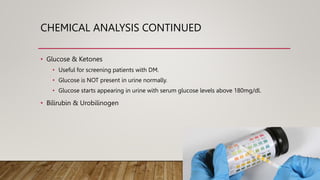
• Glucose & Ketones
• Useful for screening patients with DM.
• Glucose is NOT present in urine normally.
• Glucose starts appearing in urine with serum glucose levels above 180mg/dl.
• Bilirubin & Urobilinogen
Urine routine and Microscopy.pptx

Urine routine and Microscopy.pptx

  • 1.
  • 2.
    WHY? • Urine Routineand Microscopy is an array of tests performed on urine and is the most fundamental urological test. • Can help diagnose disorders of Urinary tract or systemic diseases affecting the urinary tract. • Screening/Monitoring patients of drug abuse or systemic diseases (Diabetes Mellitus) • Urine collected in sterile, wide mouthed and dry containers. Should be examined within 2 hours of collection. • A midstream urine sample is ideal for urinalysis.
  • 3.
    COMPONENTS OF URINALYSIS •Physical and Gross examination • Color • Turbidity • Biochemical analysis • Specific gravity • Osmolality • pH • Hematuria/RBCs • Proteinuria • Glucose • Bilirubin • Leukocyte esterase activity • Microscopic analysis : Cells, Cast, Microorganisms
  • 4.
    PHYSICAL EXAMINATION • Normalurine is pale yellow and non turbid. • Colour may vary due to diet, medication or infection. • Urine may be cloudy/turbid in cases of phosphaturia, pyuria, chyluria or presence of crystals. • Urine is normally odourless. May be foul or offensive in case of infection, fruity in ketonuria, or strong ammoniacal on long standing.
  • 5.
    CHEMICAL EXAMINATION • pH •pH of urine is reflective of the kidney’s ability to maintain normal hydrogen ion concentration in plasma and ECF. • Urine pH may vary from 4.5 to 8, with average being 5.5 and 6.5. pH between 4.5 to 5.5 is considered acidic and 6.5 to 8 is considered alkaline. • Urine tends to be acidic in ketosis, systemic acidosis and UTI; alkaline in cases of UTI caused by urea splitting organisms. • Specific gravity • Reflective of the kidney’s ability to concentrate or dilute urine. • Varies from 1.001 to 1.035. Considered dilute if <1.008 (diuretics, increased fluid intake, DI) and concentrated if >1.020 (DM, increased ADH secretion or dehydration). • Osmolality • Measure of amount of material dissolved in urine & varies between 50 to 1200mOsm/L
  • 6.
    CHEMICAL ANALYSIS CONTINUED •Blood/Haematuria • >=3 RBCs/hpf is defined as haematuria. • Gross or microscopic. • Detected using peroxidase like activity of hemoglobin. • Should be differentiated from hemoglobinuria and myoglobinuria. • Should be differentiated into nephrogenic or urologic and glomerular or non glomerular. • Proteinuria • Normal healthy adult excretes about 80-150mg of protein in a day. • Seldom exceeds above 20mg/dl. • Detected by heat coagulation or dipstick.
  • 7.
    CHEMICAL ANALYSIS CONTINUED •Glucose & Ketones • Useful for screening patients with DM. • Glucose is NOT present in urine normally. • Glucose starts appearing in urine with serum glucose levels above 180mg/dl. • Bilirubin & Urobilinogen

Editor's Notes

  • #6 Serum acidic in RTA 1&2 but urine alkaline due to continued bicarb loss. Inability to acidify urine below 5.5