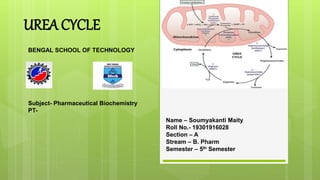
UREA CYCLE
Name – Soumyakanti Maity
Roll No.- 19301916028
Section – A
Stream – B. Pharm
Semester – 5th Semester
BENGAL SCHOOL OF TECHNOLOGY
Subject- Pharmaceutical Biochemistry
PT-
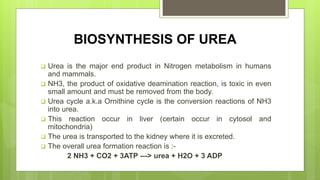
BIOSYNTHESIS OF UREA
 Urea is the major end product in Nitrogen metabolism in humans
and mammals.
 NH3, the product of oxidative deamination reaction, is toxic in even
small amount and must be removed from the body.
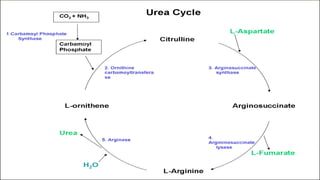
 Urea cycle a.k.a Ornithine cycle is the conversion reactions of NH3
into urea.
 This reaction occur in liver (certain occur in cytosol and
mitochondria)
 The urea is transported to the kidney where it is excreted.
 The overall urea formation reaction is :-
2 NH3 + CO2 + 3ATP ---> urea + H2O + 3 ADP
 One amine group comes from oxidative deamination of
glutamic acid.
 While, the other amino group come from aspartic acid.-
Aspartic acid is generated from fumaric acid produced by the
urea cycle
 The fumaric acid first undergoes reactions through a portion of
citric acid cycle (krebs cycle) to produce oxaloacetic acid which
is then changed by transamination into aspartic acid.
FORMATION OF UREA
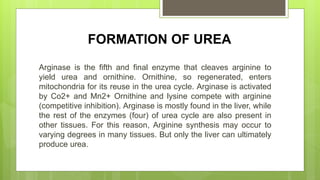
Arginase is the fifth and final enzyme that cleaves arginine to
yield urea and ornithine. Ornithine, so regenerated, enters
mitochondria for its reuse in the urea cycle. Arginase is activated
by Co2+ and Mn2+ Ornithine and lysine compete with arginine
(competitive inhibition). Arginase is mostly found in the liver, while
the rest of the enzymes (four) of urea cycle are also present in
other tissues. For this reason, Arginine synthesis may occur to
varying degrees in many tissues. But only the liver can ultimately
produce urea.
THANK YOU

Urea cycle

  • 1.
    UREA CYCLE Name –Soumyakanti Maity Roll No.- 19301916028 Section – A Stream – B. Pharm Semester – 5th Semester BENGAL SCHOOL OF TECHNOLOGY Subject- Pharmaceutical Biochemistry PT-
  • 2.
    BIOSYNTHESIS OF UREA Urea is the major end product in Nitrogen metabolism in humans and mammals.  NH3, the product of oxidative deamination reaction, is toxic in even small amount and must be removed from the body.  Urea cycle a.k.a Ornithine cycle is the conversion reactions of NH3 into urea.  This reaction occur in liver (certain occur in cytosol and mitochondria)  The urea is transported to the kidney where it is excreted.  The overall urea formation reaction is :- 2 NH3 + CO2 + 3ATP ---> urea + H2O + 3 ADP
  • 4.
     One aminegroup comes from oxidative deamination of glutamic acid.  While, the other amino group come from aspartic acid.- Aspartic acid is generated from fumaric acid produced by the urea cycle  The fumaric acid first undergoes reactions through a portion of citric acid cycle (krebs cycle) to produce oxaloacetic acid which is then changed by transamination into aspartic acid.
  • 5.
    FORMATION OF UREA Arginaseis the fifth and final enzyme that cleaves arginine to yield urea and ornithine. Ornithine, so regenerated, enters mitochondria for its reuse in the urea cycle. Arginase is activated by Co2+ and Mn2+ Ornithine and lysine compete with arginine (competitive inhibition). Arginase is mostly found in the liver, while the rest of the enzymes (four) of urea cycle are also present in other tissues. For this reason, Arginine synthesis may occur to varying degrees in many tissues. But only the liver can ultimately produce urea.
  • 6.