1


                       University of Namur
                             FUNDP

                   Research Unit in
            Environmental and Evolutionary
                      Biology

       Faculty of Sciences – Department of Biology
       Address : Rue de Bruxelles, 61, B-5000 Namur, Belgium
                     http://www.urbe-fundp.be/

URBE
2

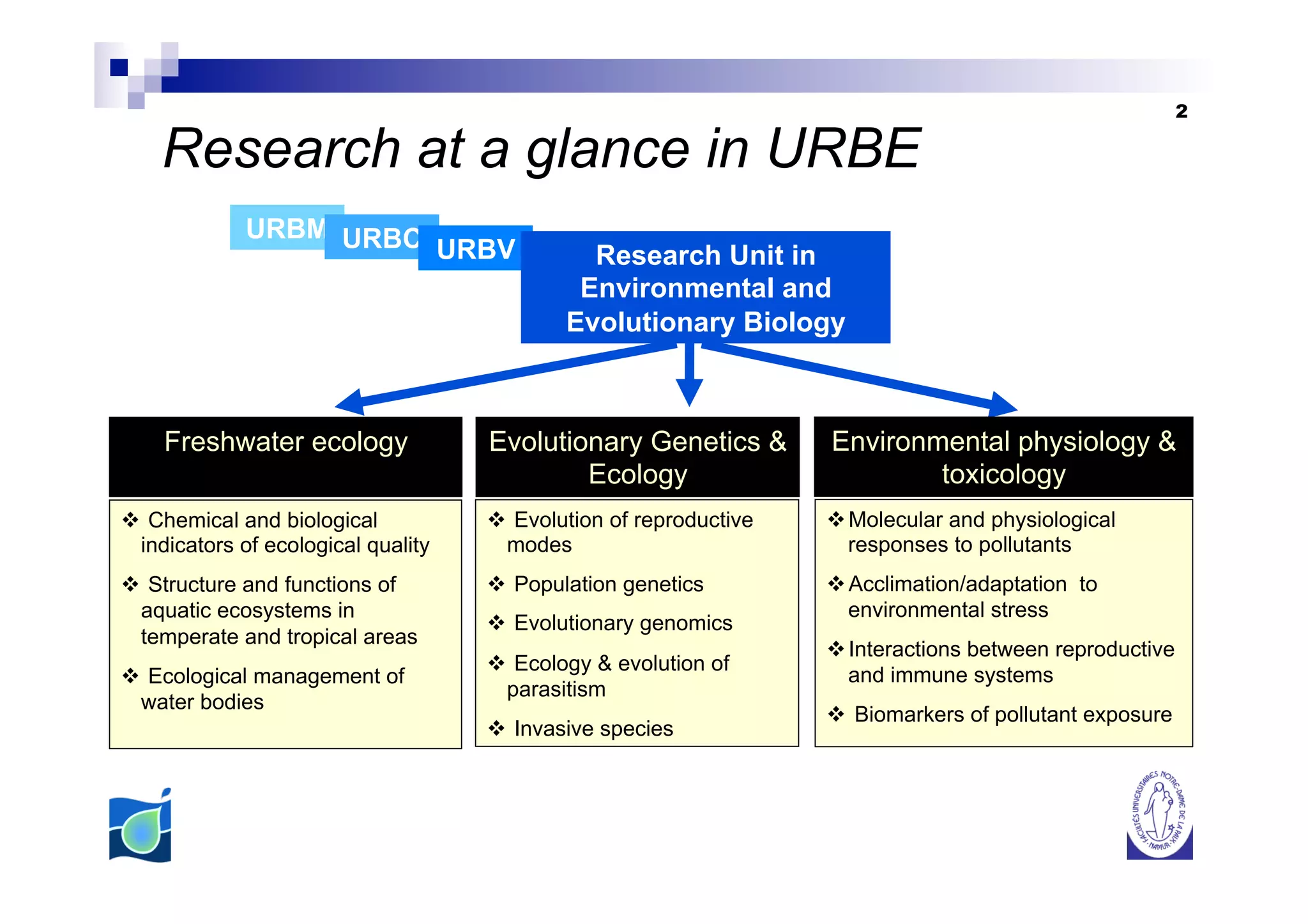
    Research at a glance in URBE
             URBM URBC
                       URBV                    Research Unit in
                                              Environmental and
                                             Evolutionary Biology


    Freshwater ecology               Evolutionary Genetics &         Environmental physiology &
                                             Ecology                         toxicology
v  Chemical and biological          v  Evolution of reproductive   v Molecular and physiological
  indicators of ecological quality     modes                            responses to pollutants
v  Structure and functions of       v  Population genetics         v Acclimation/adaptation to
  aquatic ecosystems in                                                 environmental stress
                                     v  Evolutionary genomics
  temperate and tropical areas
                                                                     v Interactions between reproductive
                                     v  Ecology & evolution of
v  Ecological management of                                            and immune systems
                                       parasitism
  water bodies
                                                                     v  Biomarkers of pollutant exposure
                                     v  Invasive species
3

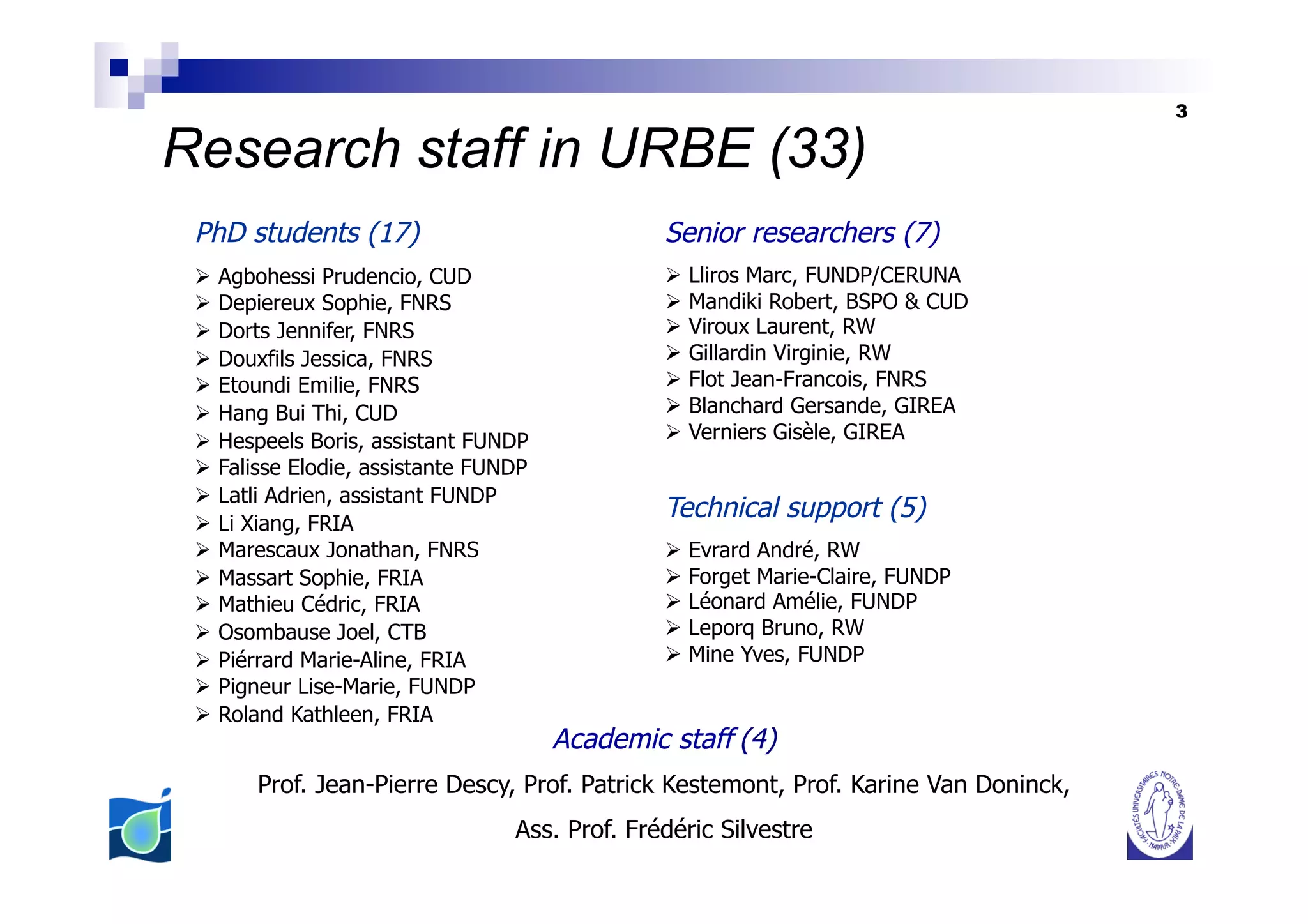
Research staff in URBE (33)
 PhD students (17)                               Senior researchers (7)
 Ø  Agbohessi Prudencio, CUD                    Ø  Lliros Marc, FUNDP/CERUNA
 Ø  Depiereux Sophie, FNRS                      Ø  Mandiki Robert, BSPO & CUD
 Ø  Dorts Jennifer, FNRS                        Ø  Viroux Laurent, RW
 Ø  Douxfils Jessica, FNRS                      Ø  Gillardin Virginie, RW
 Ø  Etoundi Emilie, FNRS                        Ø  Flot Jean-Francois, FNRS
 Ø  Hang Bui Thi, CUD                           Ø  Blanchard Gersande, GIREA
 Ø  Hespeels Boris, assistant FUNDP             Ø  Verniers Gisèle, GIREA
 Ø  Falisse Elodie, assistante FUNDP
 Ø  Latli Adrien, assistant FUNDP
 Ø  Li Xiang, FRIA
                                                 Technical support (5)
 Ø  Marescaux Jonathan, FNRS                    Ø  Evrard André, RW
 Ø  Massart Sophie, FRIA                        Ø  Forget Marie-Claire, FUNDP
 Ø  Mathieu Cédric, FRIA                        Ø  Léonard Amélie, FUNDP
 Ø  Osombause Joel, CTB                         Ø  Leporq Bruno, RW
 Ø  Piérrard Marie-Aline, FRIA                  Ø  Mine Yves, FUNDP
 Ø  Pigneur Lise-Marie, FUNDP
 Ø  Roland Kathleen, FRIA
                                        Academic staff (4)
       Prof. Jean-Pierre Descy, Prof. Patrick Kestemont, Prof. Karine Van Doninck,
                                   Ass. Prof. Frédéric Silvestre
4

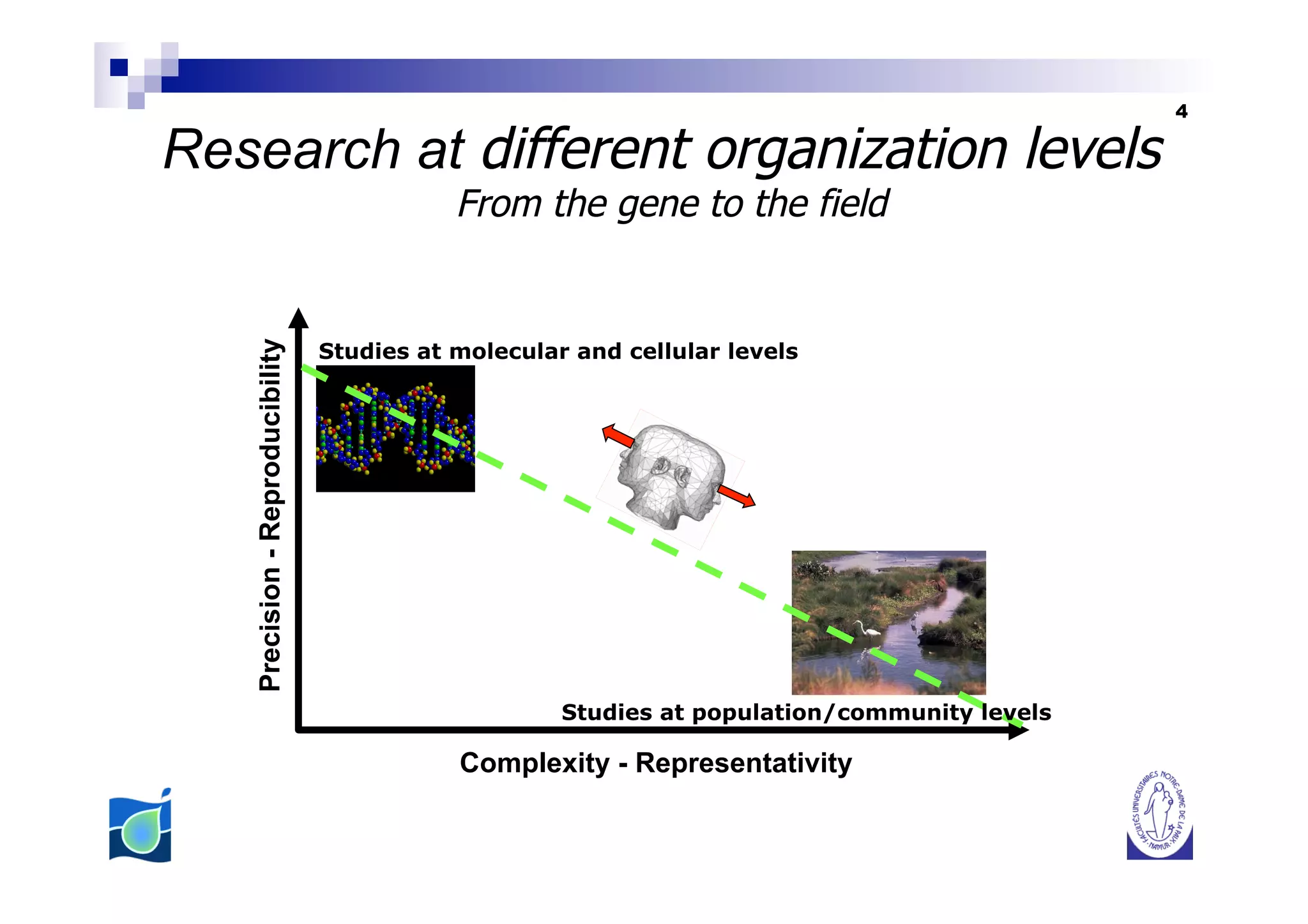
Research at different organization levels
                                            From the gene to the field


                                 Studies at molecular and cellular levels
   Precision - Reproducibility


                                                     Studies at population/community levels

                                            Complexity - Representativity
5


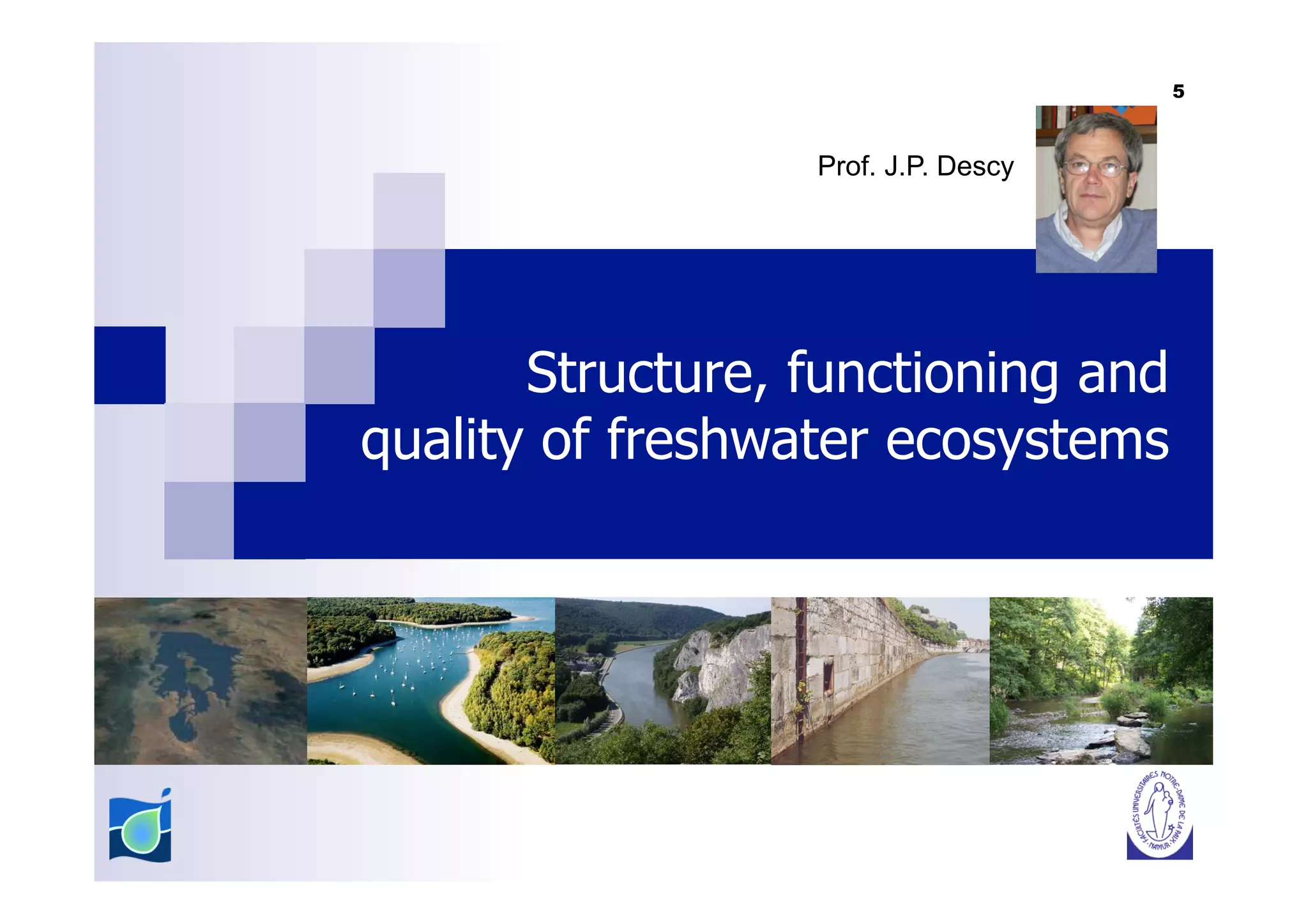
                  Prof. J.P. Descy


       Structure, functioning and
quality of freshwater ecosystems
6

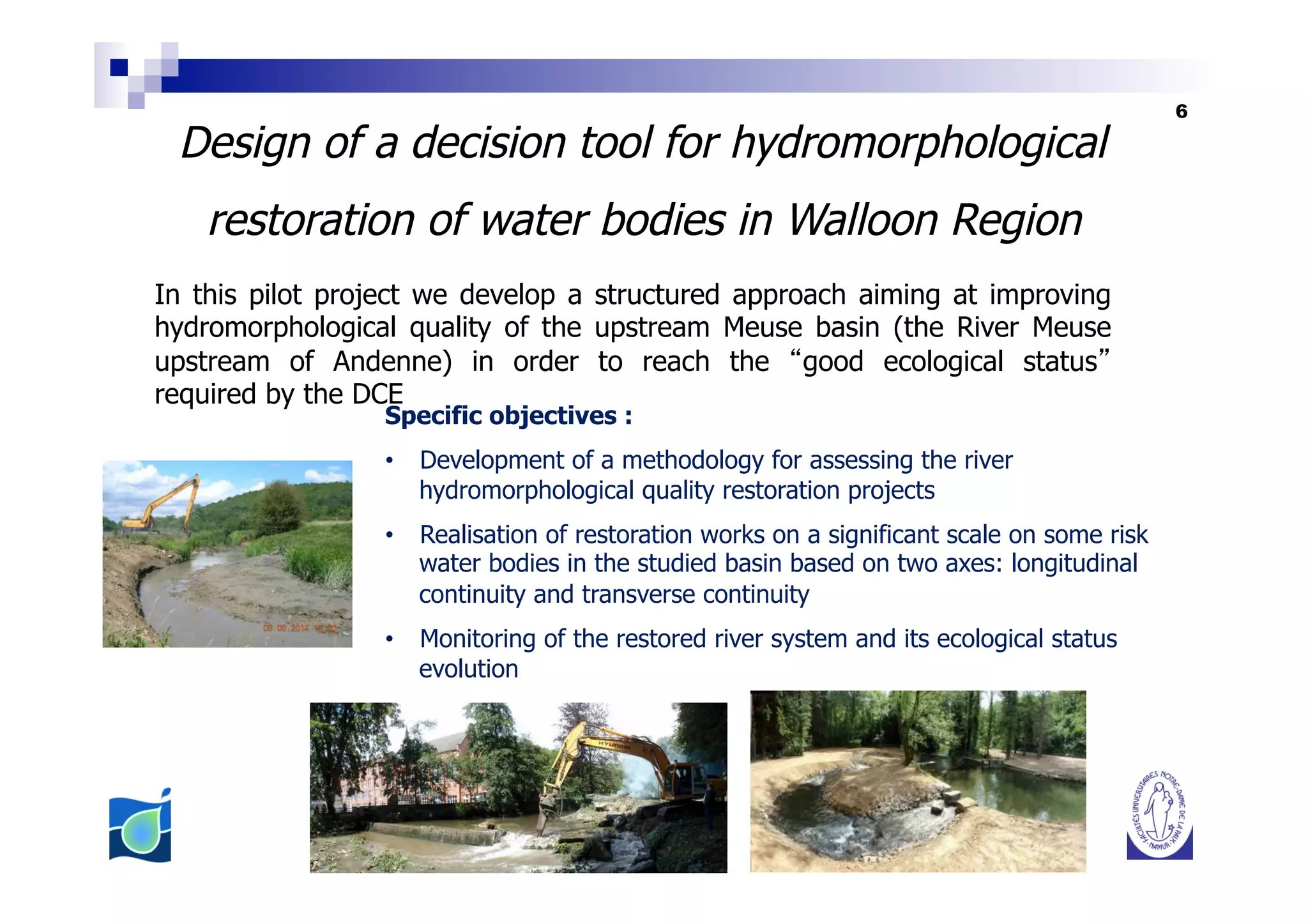
 Design of a decision tool for hydromorphological
    restoration of water bodies in Walloon Region
In this pilot project we develop a structured approach aiming at improving
hydromorphological quality of the upstream Meuse basin (the River Meuse
upstream of Andenne) in order to reach the good ecological status
required by the DCE.
                 Specific objectives :
                 •  Development of a methodology for assessing the river
                    hydromorphological quality restoration projects
                 •  Realisation of restoration works on a significant scale on some risk
                    water bodies in the studied basin based on two axes: longitudinal
                    continuity and transverse continuity
                 •  Monitoring of the restored river system and its ecological status
                    evolution
7

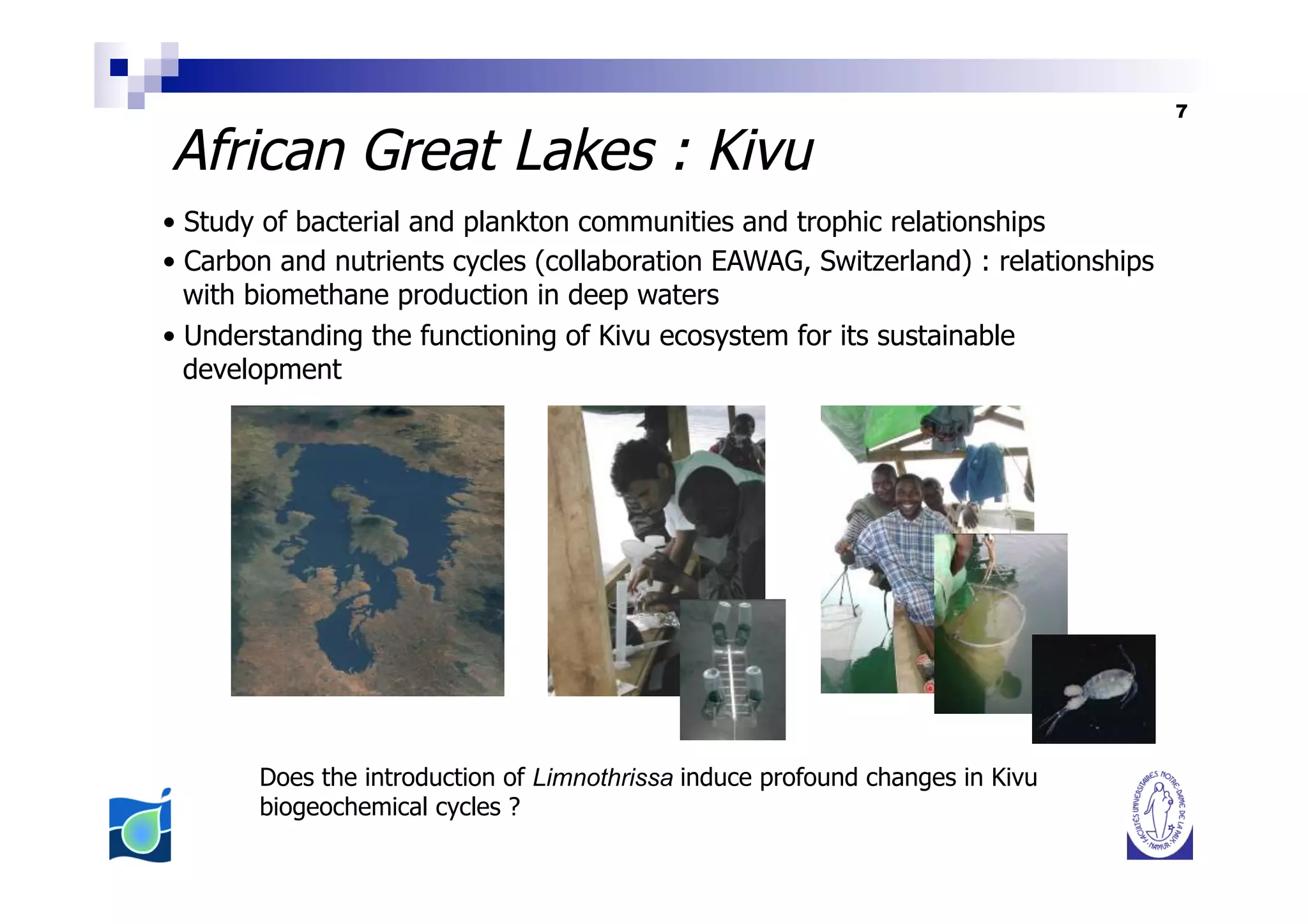
African Great Lakes : Kivu
•  Study of bacterial and plankton communities and trophic relationships
•  Carbon and nutrients cycles (collaboration EAWAG, Switzerland) : relationships
   with biomethane production in deep waters
•  Understanding the functioning of Kivu ecosystem for its sustainable
   development


       Does the introduction of Limnothrissa induce profound changes in Kivu
       biogeochemical cycles ?
8


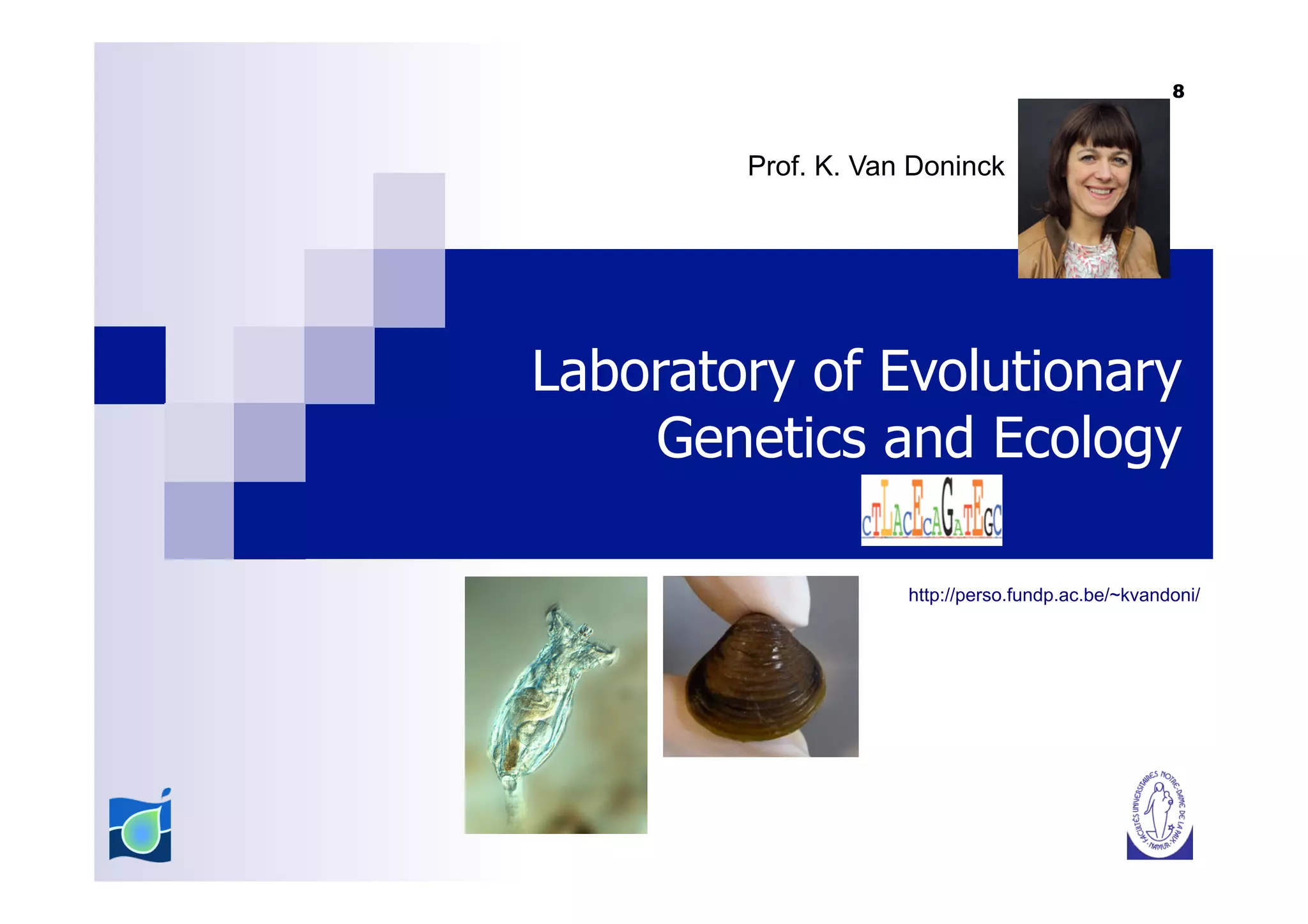
        Prof. K. Van Doninck


Laboratory of Evolutionary
    Genetics and Ecology

                    http://perso.fundp.ac.be/~kvandoni/
9


Evolution of reproductive modes:
the asexual paradox of bdelloids
( all-female asexuality )
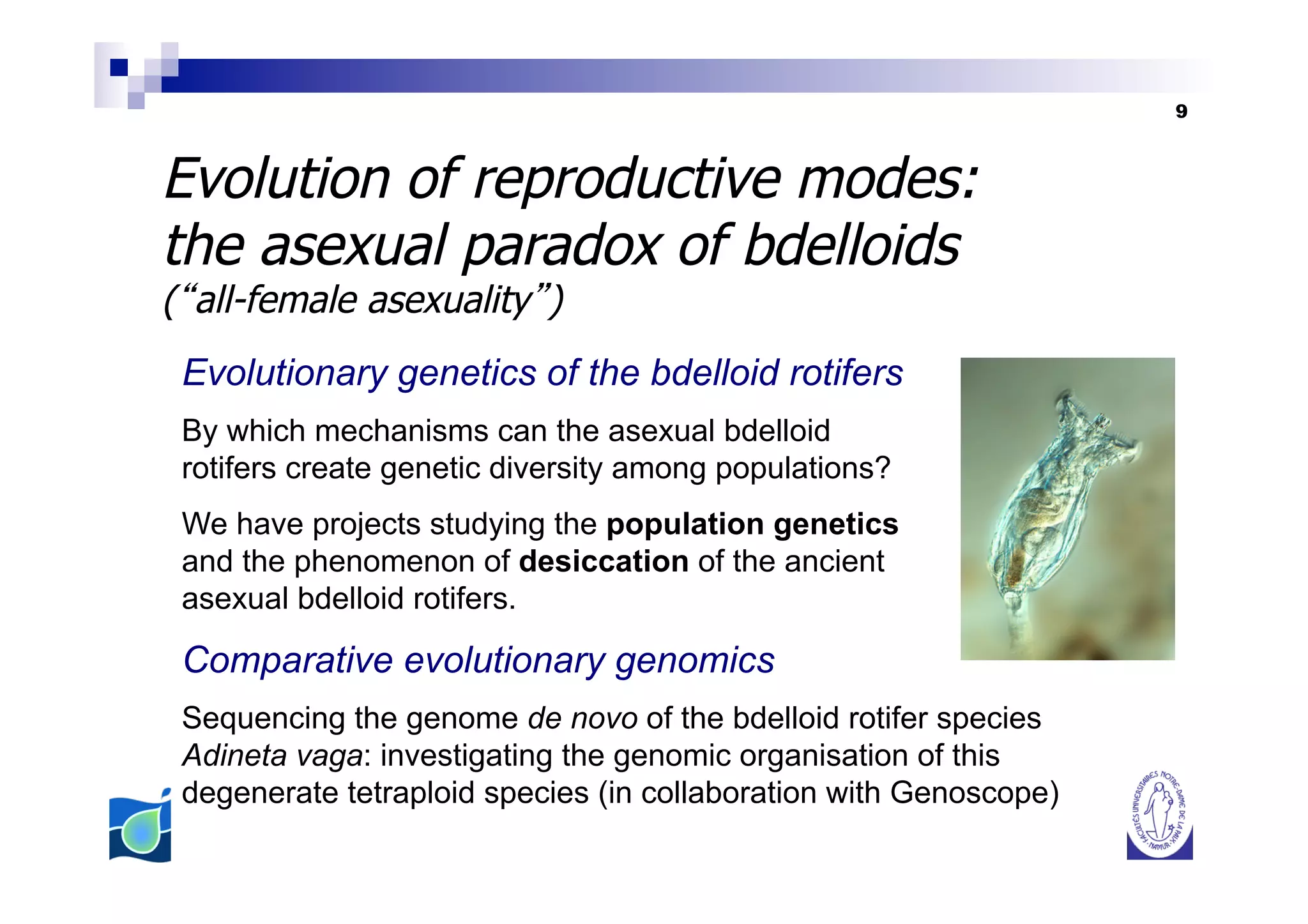
 Evolutionary genetics of the bdelloid rotifers
 By which mechanisms can the asexual bdelloid
 rotifers create genetic diversity among populations?
 We have projects studying the population genetics
 and the phenomenon of desiccation of the ancient
 asexual bdelloid rotifers.

 Comparative evolutionary genomics
 Sequencing the genome de novo of the bdelloid rotifer species
 Adineta vaga: investigating the genomic organisation of this
 degenerate tetraploid species (in collaboration with Genoscope)
10


Evolution of reproductive modes:
the asexual paradox of invasive
Corbicula clams ( all-male asexuality )
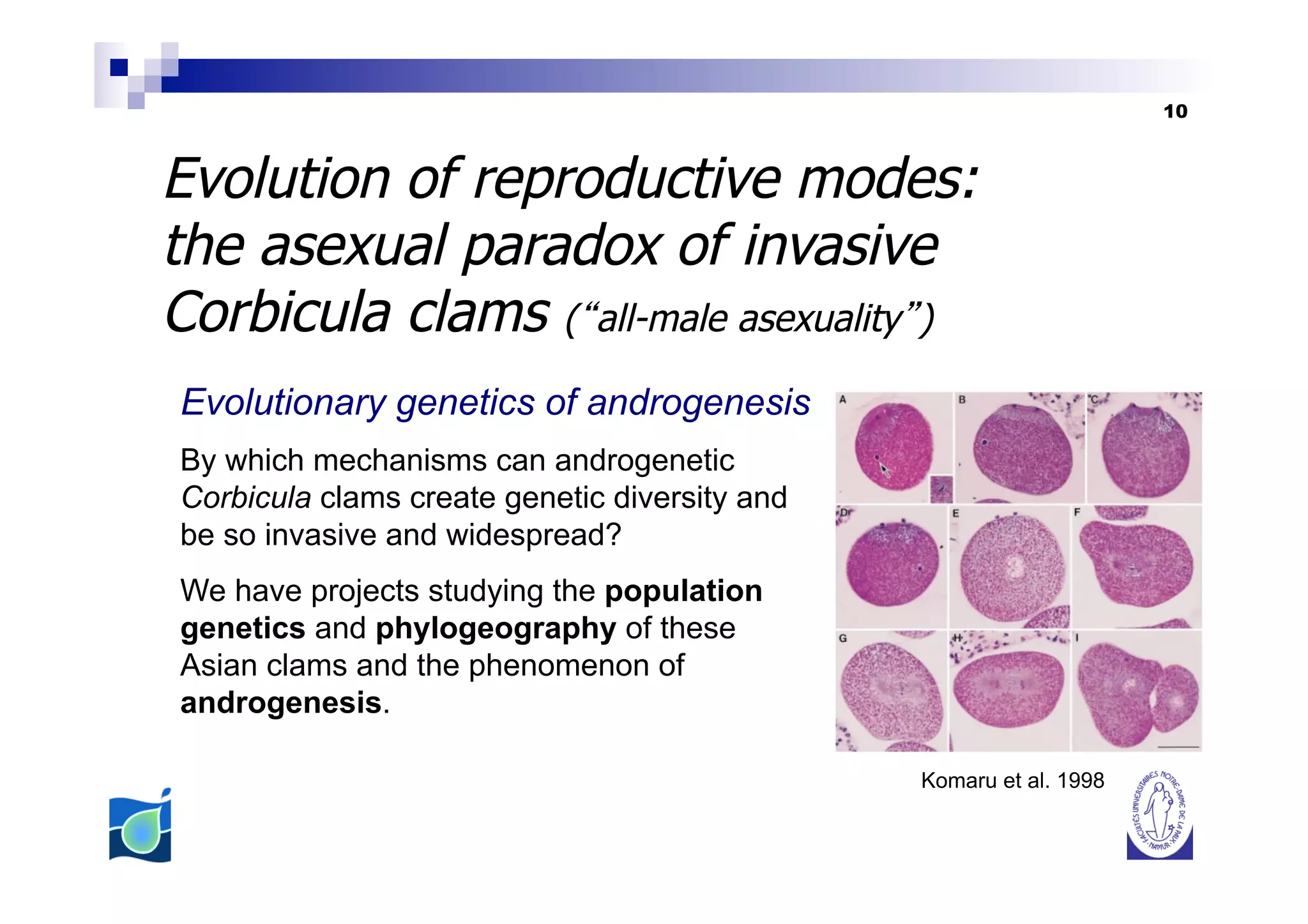
Evolutionary genetics of androgenesis
By which mechanisms can androgenetic
Corbicula clams create genetic diversity and
be so invasive and widespread?
We have projects studying the population
genetics and phylogeography of these
Asian clams and the phenomenon of
androgenesis.

                                               Komaru et al. 1998
11


Aquatic invasive mollusks in Western
European rivers (collaboration between Prof. Descy and
Prof. Van Doninck)
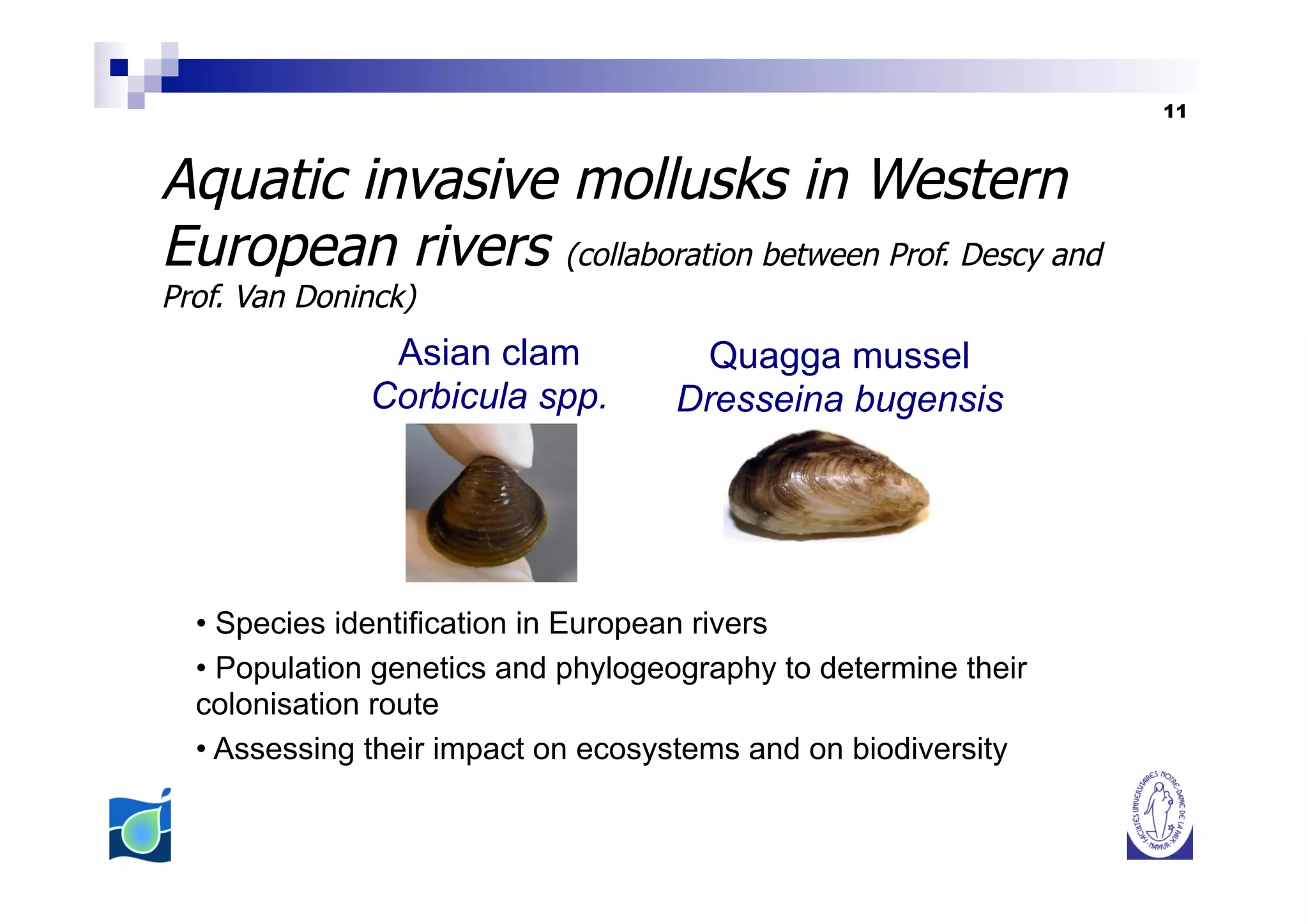
               Asian clam             Quagga mussel
              Corbicula spp.        Dresseina bugensis


  •  Species identification in European rivers
  •  Population genetics and phylogeography to determine their
  colonisation route
  •  Assessing their impact on ecosystems and on biodiversity
12

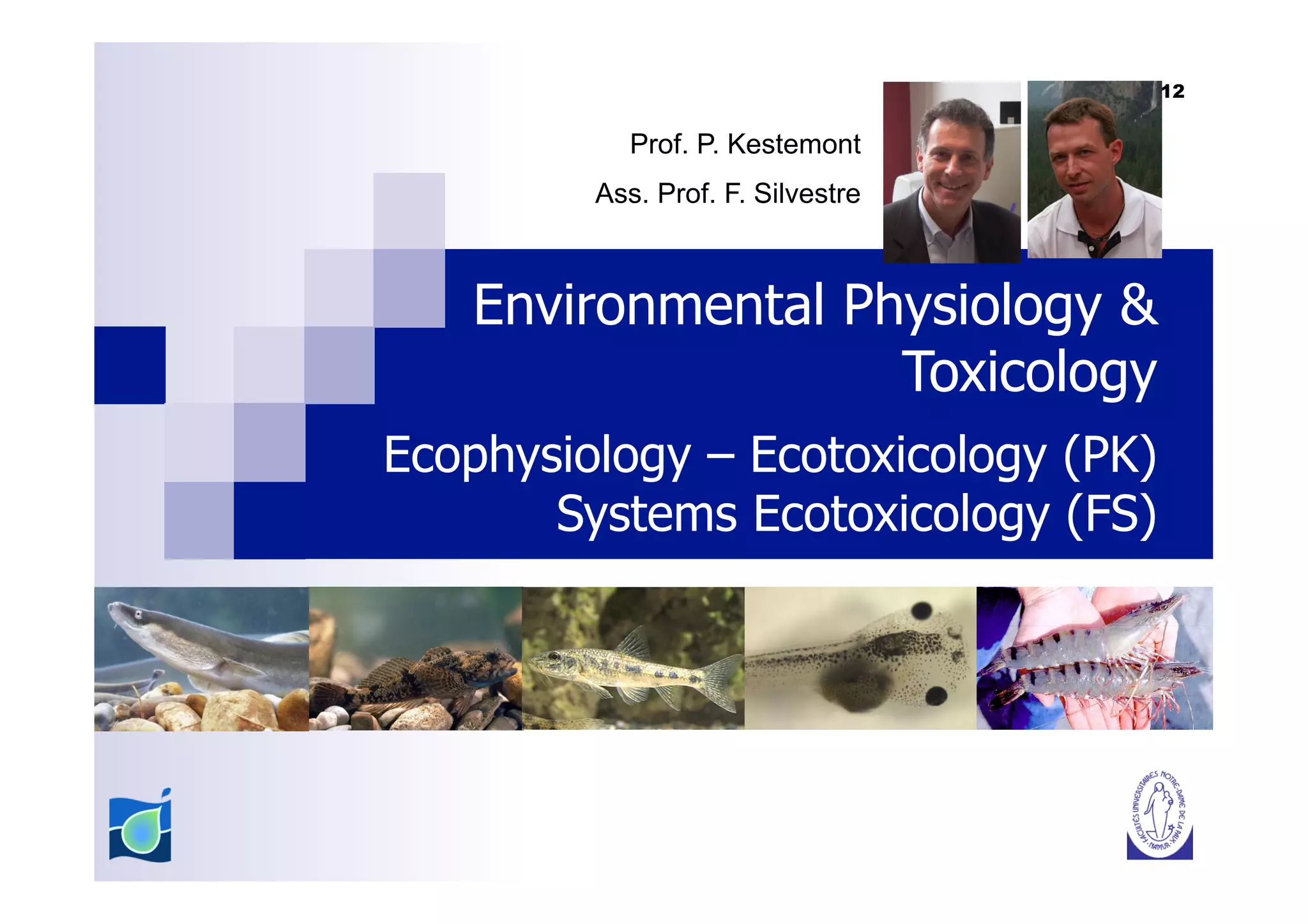
           Prof. P. Kestemont
         Ass. Prof. F. Silvestre


   Environmental Physiology &
                   Toxicology
Ecophysiology – Ecotoxicology (PK)
       Systems Ecotoxicology (FS)
13

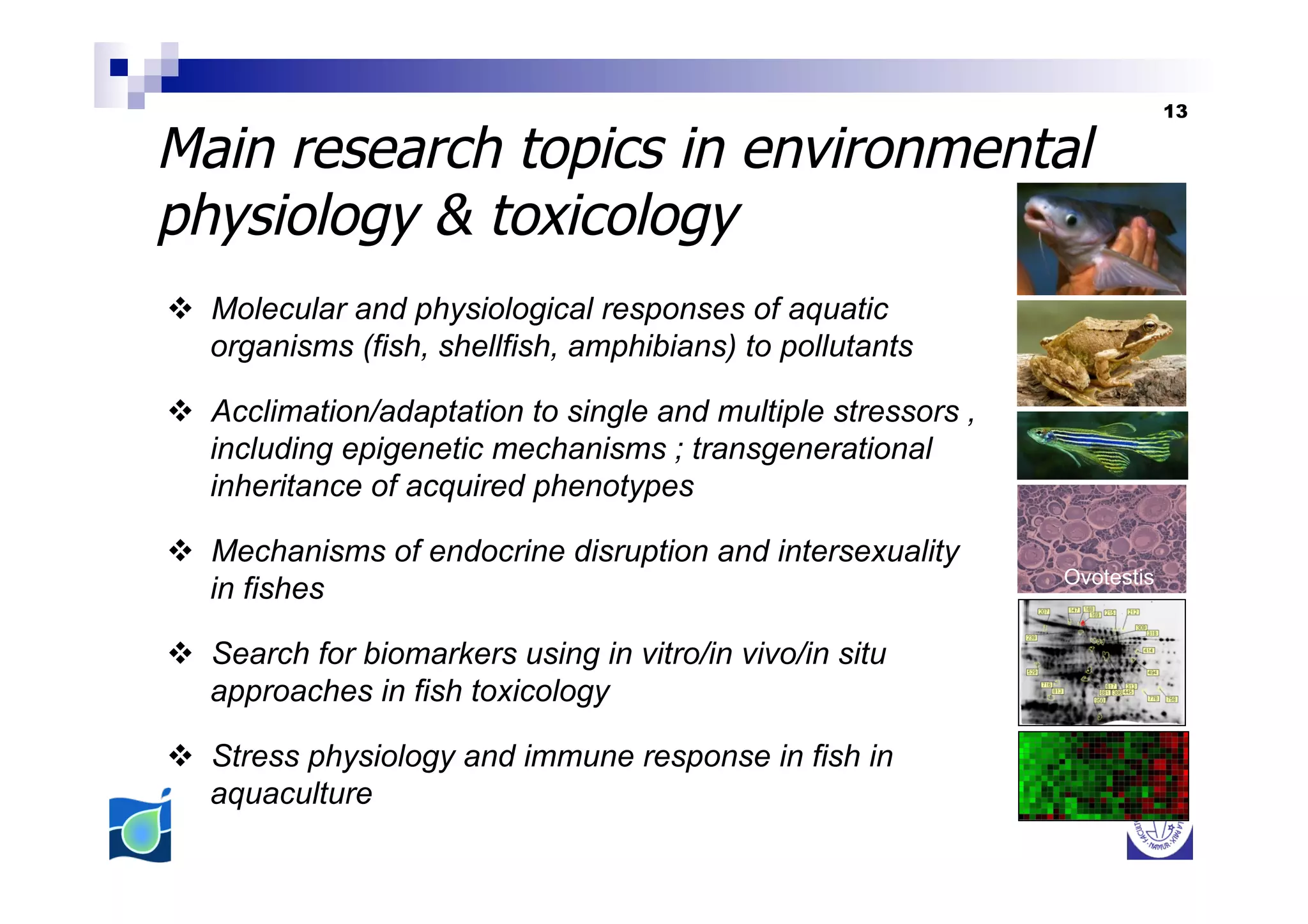
Main research topics in environmental
physiology & toxicology
v  Molecular and physiological responses of aquatic
    organisms (fish, shellfish, amphibians) to pollutants

v  Acclimation/adaptation to single and multiple stressors ,
    including epigenetic mechanisms ; transgenerational
    inheritance of acquired phenotypes

v  Mechanisms of endocrine disruption and intersexuality
    in fishes

v  Search for biomarkers using in vitro/in vivo/in situ
    approaches in fish toxicology

v  Stress physiology and immune response in fish in
    aquaculture
14


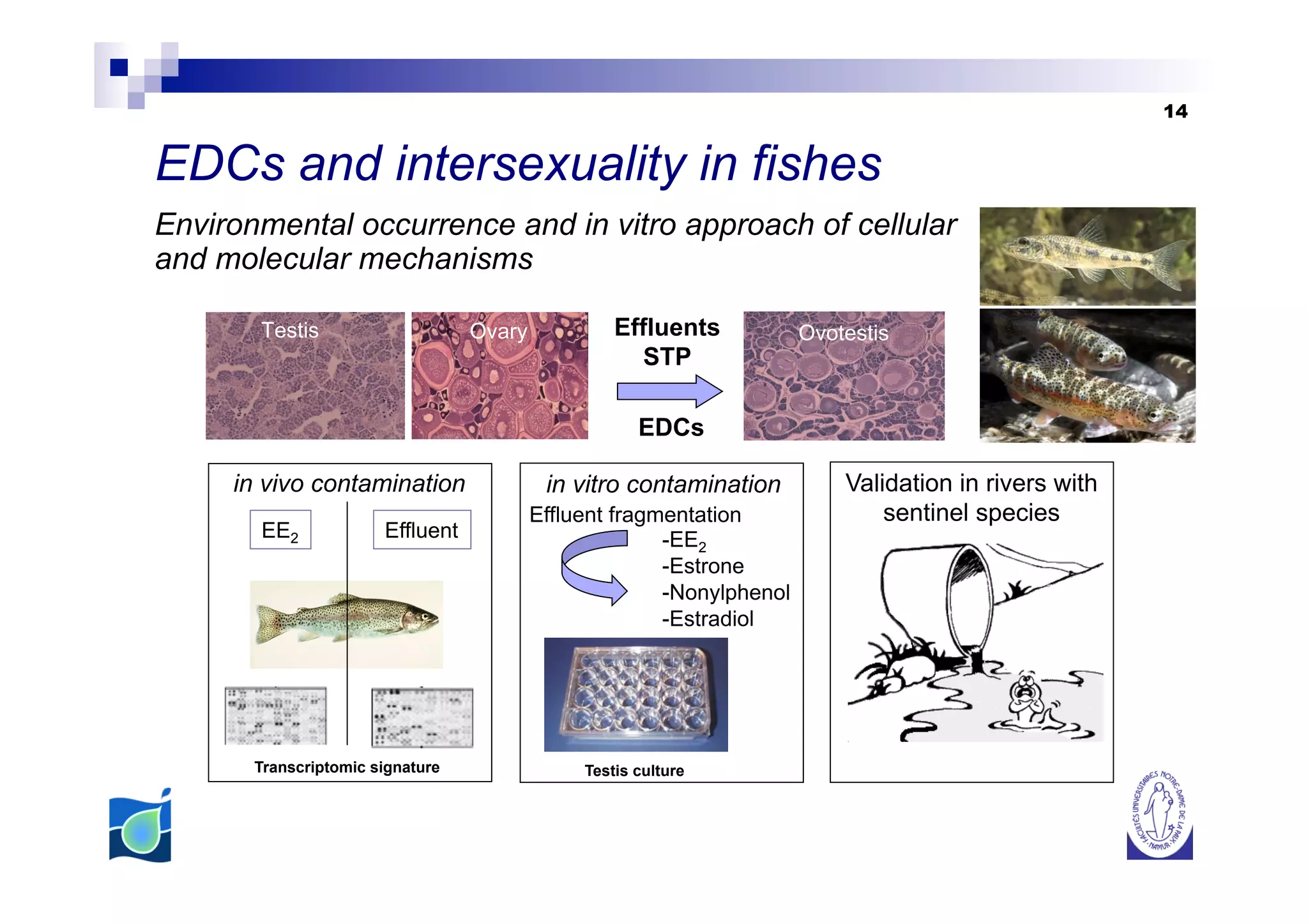
EDCs and intersexuality in fishes
Environmental occurrence and in vitro approach of cellular
and molecular mechanisms

                                           Effluents
                                              STP

                                              EDCs

     in vivo contamination         in vitro contamination      Validation in rivers with
                                  Effluent fragmentation           sentinel species
       EE2             Effluent                 -EE2
                                                -Estrone
                                                -Nonylphenol
                                                -Estradiol


       Transcriptomic signature        Testis culture
15

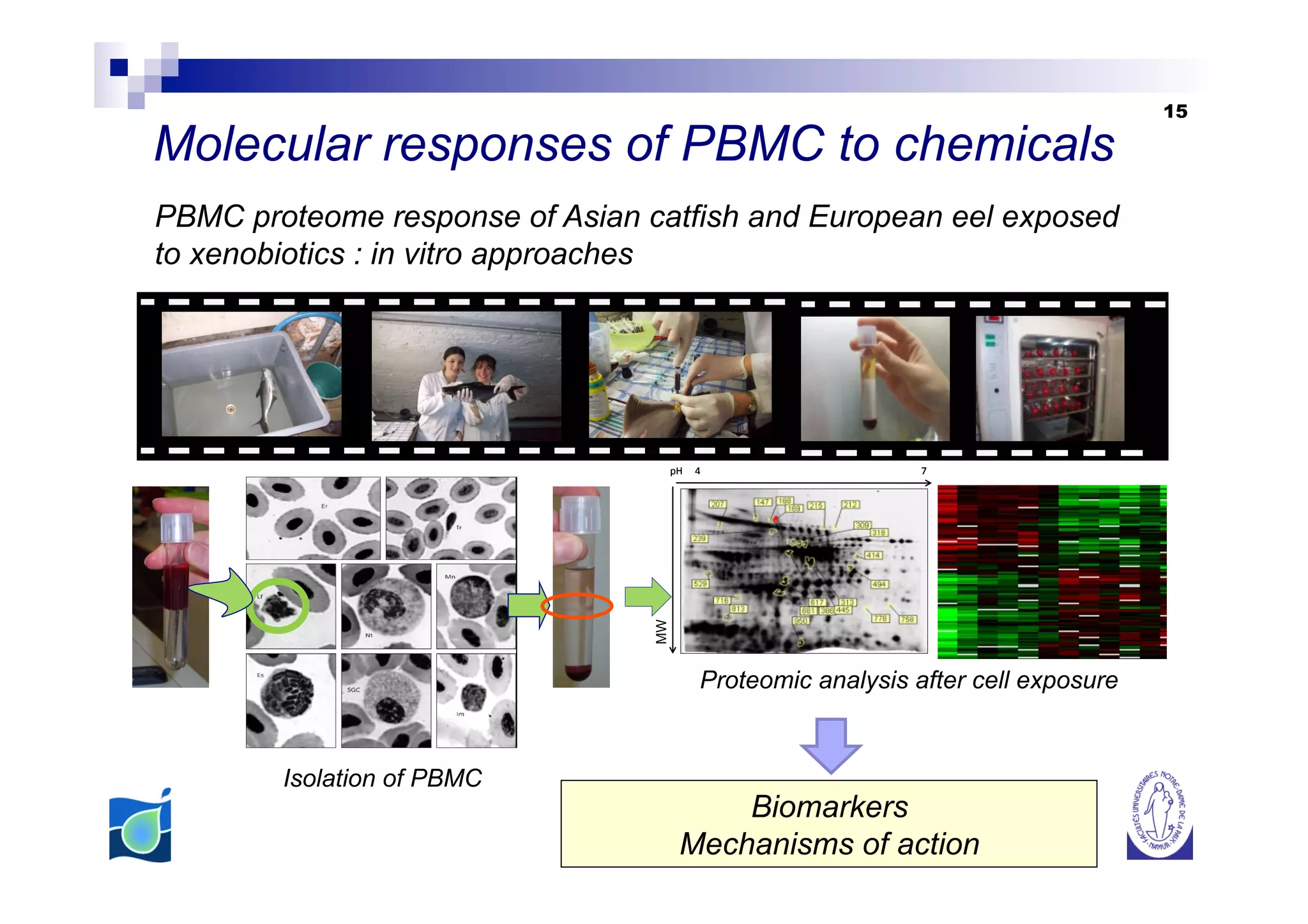
Molecular responses of PBMC to chemicals
PBMC proteome response of Asian catfish and European eel exposed
to xenobiotics : in vitro approaches


                                      pH	


  4	
                   7


                                 MW
                                                              Proteomic analysis after cell exposure


        Isolation of PBMC
                                                 Biomarkers
                                             Mechanisms of action
16
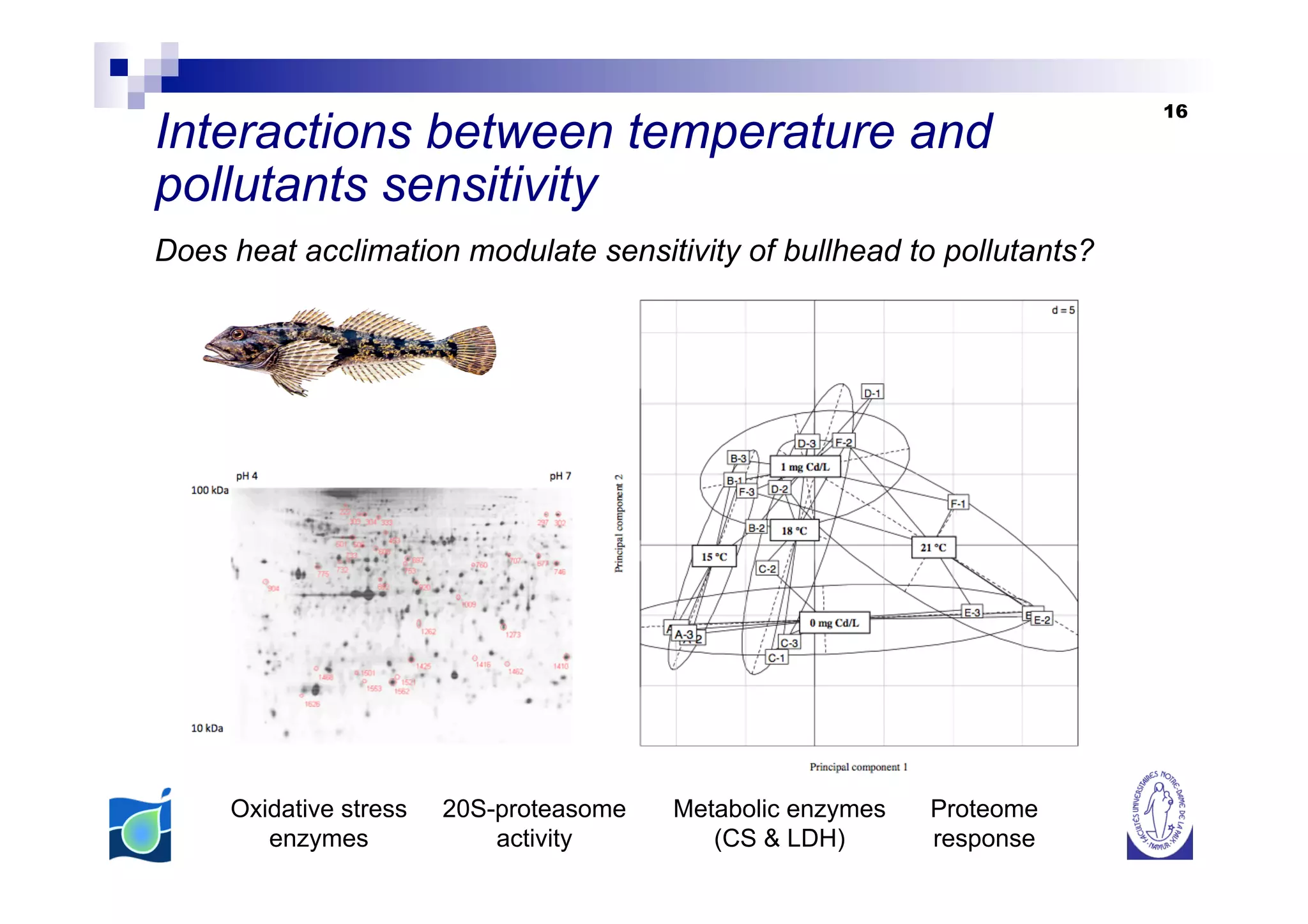
Interactions between temperature and
pollutants sensitivity
Does heat acclimation modulate sensitivity of bullhead to pollutants?


     Oxidative stress   20S-proteasome   Metabolic enzymes   Proteome
        enzymes             activity        (CS & LDH)       response
17

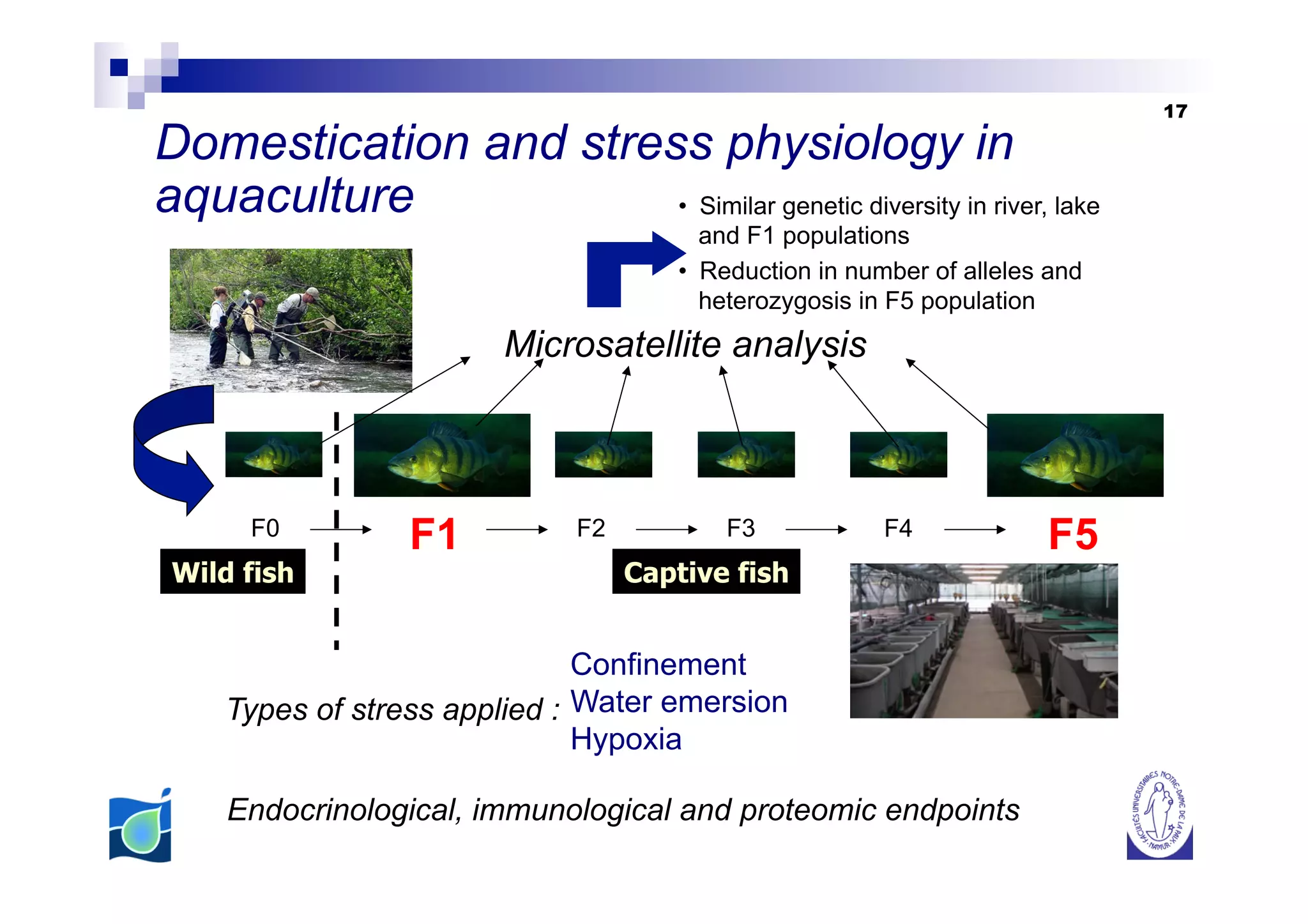
Domestication and stress physiology in
aquaculture            •  Similar genetic diversity in river, lake
                                        and F1 populations
                                     •  Reduction in number of alleles and
                                        heterozygosis in F5 population
                        Microsatellite analysis


      F0
                 F1          F2          F3            F4             F5
 Wild fish                        Captive fish


                              Confinement
    Types of stress applied : Water emersion
                              Hypoxia

     Endocrinological, immunological and proteomic endpoints
18

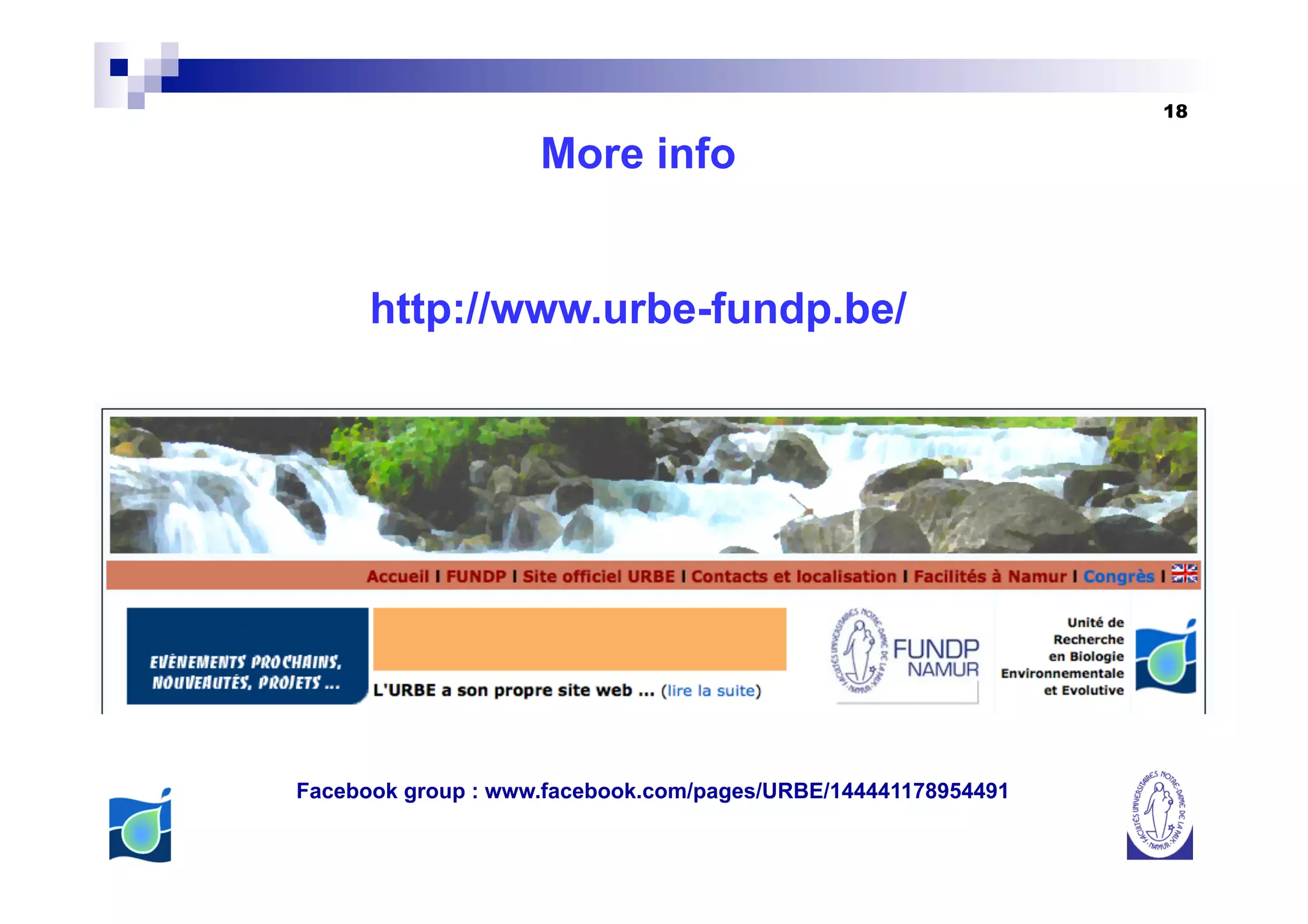
                    More info


      http://www.urbe-fundp.be/


Facebook group : www.facebook.com/pages/URBE/144441178954491

URBE introduction

  • 1.
    1 University of Namur FUNDP Research Unit in Environmental and Evolutionary Biology Faculty of Sciences – Department of Biology Address : Rue de Bruxelles, 61, B-5000 Namur, Belgium http://www.urbe-fundp.be/ URBE
  • 2.
    2 Research at a glance in URBE URBM URBC URBV Research Unit in Environmental and Evolutionary Biology Freshwater ecology Evolutionary Genetics & Environmental physiology & Ecology toxicology v  Chemical and biological v  Evolution of reproductive v Molecular and physiological indicators of ecological quality modes responses to pollutants v  Structure and functions of v  Population genetics v Acclimation/adaptation to aquatic ecosystems in environmental stress v  Evolutionary genomics temperate and tropical areas v Interactions between reproductive v  Ecology & evolution of v  Ecological management of and immune systems parasitism water bodies v  Biomarkers of pollutant exposure v  Invasive species
  • 3.
    3 Research staff inURBE (33) PhD students (17) Senior researchers (7) Ø  Agbohessi Prudencio, CUD Ø  Lliros Marc, FUNDP/CERUNA Ø  Depiereux Sophie, FNRS Ø  Mandiki Robert, BSPO & CUD Ø  Dorts Jennifer, FNRS Ø  Viroux Laurent, RW Ø  Douxfils Jessica, FNRS Ø  Gillardin Virginie, RW Ø  Etoundi Emilie, FNRS Ø  Flot Jean-Francois, FNRS Ø  Hang Bui Thi, CUD Ø  Blanchard Gersande, GIREA Ø  Hespeels Boris, assistant FUNDP Ø  Verniers Gisèle, GIREA Ø  Falisse Elodie, assistante FUNDP Ø  Latli Adrien, assistant FUNDP Ø  Li Xiang, FRIA Technical support (5) Ø  Marescaux Jonathan, FNRS Ø  Evrard André, RW Ø  Massart Sophie, FRIA Ø  Forget Marie-Claire, FUNDP Ø  Mathieu Cédric, FRIA Ø  Léonard Amélie, FUNDP Ø  Osombause Joel, CTB Ø  Leporq Bruno, RW Ø  Piérrard Marie-Aline, FRIA Ø  Mine Yves, FUNDP Ø  Pigneur Lise-Marie, FUNDP Ø  Roland Kathleen, FRIA Academic staff (4) Prof. Jean-Pierre Descy, Prof. Patrick Kestemont, Prof. Karine Van Doninck, Ass. Prof. Frédéric Silvestre
  • 4.
    4 Research at differentorganization levels From the gene to the field Studies at molecular and cellular levels Precision - Reproducibility Studies at population/community levels Complexity - Representativity
  • 5.
    5 Prof. J.P. Descy Structure, functioning and quality of freshwater ecosystems
  • 6.
    6 Design ofa decision tool for hydromorphological restoration of water bodies in Walloon Region In this pilot project we develop a structured approach aiming at improving hydromorphological quality of the upstream Meuse basin (the River Meuse upstream of Andenne) in order to reach the good ecological status required by the DCE. Specific objectives : •  Development of a methodology for assessing the river hydromorphological quality restoration projects •  Realisation of restoration works on a significant scale on some risk water bodies in the studied basin based on two axes: longitudinal continuity and transverse continuity •  Monitoring of the restored river system and its ecological status evolution
  • 7.
    7 African Great Lakes: Kivu •  Study of bacterial and plankton communities and trophic relationships •  Carbon and nutrients cycles (collaboration EAWAG, Switzerland) : relationships with biomethane production in deep waters •  Understanding the functioning of Kivu ecosystem for its sustainable development Does the introduction of Limnothrissa induce profound changes in Kivu biogeochemical cycles ?
  • 8.
    8 Prof. K. Van Doninck Laboratory of Evolutionary Genetics and Ecology http://perso.fundp.ac.be/~kvandoni/
  • 9.
    9 Evolution of reproductivemodes: the asexual paradox of bdelloids ( all-female asexuality ) Evolutionary genetics of the bdelloid rotifers By which mechanisms can the asexual bdelloid rotifers create genetic diversity among populations? We have projects studying the population genetics and the phenomenon of desiccation of the ancient asexual bdelloid rotifers. Comparative evolutionary genomics Sequencing the genome de novo of the bdelloid rotifer species Adineta vaga: investigating the genomic organisation of this degenerate tetraploid species (in collaboration with Genoscope)
  • 10.
    10 Evolution of reproductivemodes: the asexual paradox of invasive Corbicula clams ( all-male asexuality ) Evolutionary genetics of androgenesis By which mechanisms can androgenetic Corbicula clams create genetic diversity and be so invasive and widespread? We have projects studying the population genetics and phylogeography of these Asian clams and the phenomenon of androgenesis. Komaru et al. 1998
  • 11.
    11 Aquatic invasive mollusksin Western European rivers (collaboration between Prof. Descy and Prof. Van Doninck) Asian clam Quagga mussel Corbicula spp. Dresseina bugensis •  Species identification in European rivers •  Population genetics and phylogeography to determine their colonisation route •  Assessing their impact on ecosystems and on biodiversity
  • 12.
    12 Prof. P. Kestemont Ass. Prof. F. Silvestre Environmental Physiology & Toxicology Ecophysiology – Ecotoxicology (PK) Systems Ecotoxicology (FS)
  • 13.
    13 Main research topicsin environmental physiology & toxicology v  Molecular and physiological responses of aquatic organisms (fish, shellfish, amphibians) to pollutants v  Acclimation/adaptation to single and multiple stressors , including epigenetic mechanisms ; transgenerational inheritance of acquired phenotypes v  Mechanisms of endocrine disruption and intersexuality in fishes v  Search for biomarkers using in vitro/in vivo/in situ approaches in fish toxicology v  Stress physiology and immune response in fish in aquaculture
  • 14.
    14 EDCs and intersexualityin fishes Environmental occurrence and in vitro approach of cellular and molecular mechanisms Effluents STP EDCs in vivo contamination in vitro contamination Validation in rivers with Effluent fragmentation sentinel species EE2 Effluent -EE2 -Estrone -Nonylphenol -Estradiol Transcriptomic signature Testis culture
  • 15.
    15 Molecular responses ofPBMC to chemicals PBMC proteome response of Asian catfish and European eel exposed to xenobiotics : in vitro approaches pH          4   7 MW Proteomic analysis after cell exposure Isolation of PBMC Biomarkers Mechanisms of action
  • 16.
    16 Interactions between temperatureand pollutants sensitivity Does heat acclimation modulate sensitivity of bullhead to pollutants? Oxidative stress 20S-proteasome Metabolic enzymes Proteome enzymes activity (CS & LDH) response
  • 17.
    17 Domestication and stressphysiology in aquaculture •  Similar genetic diversity in river, lake and F1 populations •  Reduction in number of alleles and heterozygosis in F5 population Microsatellite analysis F0 F1 F2 F3 F4 F5 Wild fish Captive fish Confinement Types of stress applied : Water emersion Hypoxia Endocrinological, immunological and proteomic endpoints
  • 18.
    18 More info http://www.urbe-fundp.be/ Facebook group : www.facebook.com/pages/URBE/144441178954491