environmental toxicology and pharmacology 3 1 ( 2 0 1 1 ) 314–322
available at www.sciencedirect.com
journal homepage: www.elsevier.com/locate/etap
Mutagenic and genotoxic assessment of atrazine-based
herbicide to freshwater fish Channa punctatus (Bloch) using
micronucleus test and single cell gel electrophoresis
C.D. Nwania,1
, N.S. Nagpureb
, Ravindra Kumarb,∗
, Basdeo Kushwahab
,
Pavan Kumarb
, W.S. Lakrab
a Department of Applied Biology, Ebonyi State University, PMB 053, Abakaliki, Ebonyi State, Nigeria
b National Bureau of Fish Genetic Resources (Indian council of Agricultural Research), Canal Ring Road, PO- Dilkusha, Lucknow 226 002,
UP, India
a r t i c l e i n f o
Article history:
Received 20 May 2010
Received in revised form
8 December 2010
Accepted 10 December 2010
Available online 17 December 2010
Keywords:
Atrazine
Channa punctatus
DNA damage
Genotoxicity
Micronucleus assay
Single cell gel electrophoresis
a b s t r a c t
The mutagenic and genotoxic effect of ‘Rasayanzine’, an atrazine herbicide, was carried out
in fish Channa punctatus using micronucleus and single cell gel electrophoresis (SCGE) assays.
Three sub-lethal concentrations of the test material viz., SL-I (1/5th LC50 = ∼8.48 mg L−1
), SL-
II (1/8th LC50 = ∼5.30 mg L−1
) and SL-III (1/10th LC50 = ∼4.24 mg L−1
) were calculated using
LC50 value and the fish specimens were exposed to these concentrations. Erythrocyte and
gill cells were sampled on day 0, 1, 3, 5, 7, 14, 21, 28 and 35 of exposure for assessment
of micronuclei induction in blood erythrocytes and DNA damage using SCGE assay in both
blood erythrocytes and gill cells. Significant effects (p < 0.01) for both concentration and time
of exposure were observed in treated fish. Micronuclei induction in erythrocytes was highest
(8.4 mg L−1
) on day 7 of exposure. The highest level of DNA damage in the SCGE was observed
in both tissues on day 5 at all concentrations followed by gradual non-linear decline. This
study further confirmed that the micronucleus and SCGE assays are useful in determining
potential genotoxicity of water pollutants and might be appropriate as part of monitoring
program.
© 2011 Elsevier B.V. All rights reserved.
1. Introduction
The use of herbicides to control weed has been recognized
as a part of agricultural practices throughout the world.
Unfortunately, the indiscriminate use of these herbicides to
improve agricultural production and yield may have impacts
on non-target organisms especially aquatic lives and their
environment. Atrazine [6-chloro-N-ethyl-N -(1-methylethyl)-
triazine-2, 4-diamine] is one of the most commonly used
herbicides found in the rural environments though its use
∗
Corresponding author. Tel.: +91 522 2442440; fax: +91 522 2442403.
E-mail address: Ravindra.Scientist@gmail.com (R. Kumar).
1
Worked as a Post Doctoral Fellow at National Bureau of Fish Genetic Resources, Lucknow.
has been controversial (currently banned in the EU but not
in US and other countries). It is widely used in corn, sorghum,
sugarcane, pineapple crops and to some extent in landscape
vegetation. It has relatively high water solubility (32 mg L−1),
which aids in its infiltration into ground water (Orme and
Kegley, 2004). Rated as moderately toxic to aquatic species,
atrazine is mobile in the environment and is among the most
detected pesticides in streams, rivers, ponds, reservoirs and
ground water (Battaglin et al., 2003, 2009; Scrubner et al.,
2005). Atrazine concentrations of 20 ␮g L−1 have been com-
monly detected in surface water runoff, while concentrations
1382-6689/$ – see front matter © 2011 Elsevier B.V. All rights reserved.
doi:10.1016/j.etap.2010.12.001
environmental toxicology and pharmacology 3 1 ( 2 0 1 1 ) 314–322 315
as high as 700 ␮g L−1 have been reported (Selim, 2003). Due
to low persistence of atrazine herbicide, repeated application
are practiced for the control of weeds in agricultural field. As
a result of this, large quantities of the herbicide find their
ways into water bodies. The indiscriminate use of this her-
bicide, careless handing, accidental spillage or discharge of
untreated effluents into natural water ways have harmful
effects on the fish population and other aquatic organisms
and may contribute to long term effects in the environment.
Sublethal effects may occur at levels of exposure less than
2 mg L−1 of atrazine during long-term exposure with biochem-
ical and histopathological alteration of fish tissue (Neˇskovic
et al., 1993).
Fish can serve as bio-indicators of environmental pollu-
tion and can play significant roles in assessing potential risk
associated with contamination in aquatic environment since
they are directly exposed to chemicals and mutagens resulting
from agricultural production via surface run-off or indirectly
through food chain of ecosystem (Cavas and Ergene-Gözükara,
2005; Lakra and Nagpure, 2009). Therefore, the use of fish
biomarkers as indices of the effects of pollution are of increas-
ing importance and can permit early detection of aquatic
environmental problems (Lopez-Barea, 1996; Van Der Oost et
al., 2003).
Several ecotoxicological characteristics of Channa puncta-
tus, such as wide distribution in the freshwater environment,
noninvasive, availability throughout the seasons, pres-
ence of 32 well-differentiated diploid chromosome number,
commercial importance, ease of blood collection and acclima-
tization to laboratory conditions, make this species an
excellent test specimen for toxicity studies (Kumar et al.,
2009).
Several studies have shown that the micronucleus (MN)
test and single cell gel electrophoresis (SCGE) are two sen-
sitive, rapid and extensively used methods in the detection
of mutagenic and genotoxicity of chemicals and xenobiotics
under field and laboratory conditions (Jha, 2004; Ateeq et al.,
2005; Cavas and Ergene-Gözükara, 2005; Pandey et al., 2006;
Talapatra et al., 2006; Sharma et al., 2007; Ergene-Gözükara
et al., 2007; Nagpure et al., 2007; Ali et al., 2008, 2009; Xiao
et al., 2008; Ventura et al., 2008; Kumar et al., 2009). One of
the advantages of MN and SCGE assays are that both can
be used for the simultaneous assessment of DNA damage
in many tissues from the same animal and for the compar-
ison of their responses under identical treatment condition.
The formation of MN may be related to anaphase chromoso-
mal delays characterized by a bad functioning in the spindle
or due to the presence of acentric chromosomic fragments
(Al-Sabti and Metcalfe, 1995). The SCGE has been consid-
ered as sensitive rapid and reliable method of quantitatively
measuring DNA damage in eukaryotic and prokaryotic cells
(Cotelle and Ferard, 1999; Bajpayee et al., 2005). It is increas-
ingly being used in testing of substances such as industrial
chemicals, biocides, agrochemical, food additives and phar-
maceuticals for genotoxicity testing (Brendler-Schwaab et al.,
2005). The assay is favored among other cytogenetic methods
(viz. chromosome aberrations, sister chromatid exchange and
micronucleus test) used for the detection of damage (Buschini
et al., 2003) as it is capable of detecting wide variety of DNA
damage such as DNA strand breaks (Sharbel, 2004). Thus,
these techniques can be used in combination for screening
genotoxic effect of chemicals and for investigating the impli-
cations of DNA damage and its recovery in the sentinel fish
species.
These biomarkers have also opened a broad perspective in
aquatic toxicology as fish erythrocytes and gills are constantly
being exposed to environmental pollutants. Many workers
have supported and demonstrated the relevance of fish ery-
throcytes for MN and SCGE in ecotoxicological studies (Schultz
et al., 1993; Al-Sabti and Metcalfe, 1995; Abd-Allah et al., 1999;
Gustavino et al., 2001; Sumathi et al., 2001) due to their easy
sampling and not required cell dissociation (Ateeq et al., 2005;
Cavas and Ergene-Gözükara, 2005). Fish blood is particularly
favored because it comprises 97% erythrocytes, thus ensur-
ing great homogeneity of cells for SCGE studies. In the present
study, gill cells were also used for SCGE assay as they are prone
to injury caused by chemicals and xenobiotics. Gill cells are the
most appropriate target organ that is directly and constantly
exposed to the DNA damaging chemicals dissolved in water
(Dzwonkowska and Hubner, 1986).
The mutagenic and genotoxic properties of atrazine have
been studied using a variety of assays in the past but the
results were contradictory (Clements et al., 1997; Kligerman
et al., 2000; Garaj-Vrhovac and Zeljezic, 2000; Tennant et al.,
2001; Freeman and Rayburn, 2004; Ventura et al., 2008). Hence,
hazardous effects of this herbicide are a matter of great con-
cern due to human exposure consequent to wide use all over
the world. In the present study, attempts have been made to
investigate the mutagenic and genotoxic effects of atrazine
herbicide using MN and SCGE assays in erythrocyte and gill
cells of C. punctatus exposed in vivo.
2. Materials and methods
2.1. Experimental fish specimen and chemical
Freshwater air-breathing fish C. punctatus (Bloch; Family:
Channidae, order: Perciformes) were caught from nearby
ponds and lakes with the help of local fishermen. The speci-
mens had an average (±SD) weight and length of 13.30 ± 0.70 g
and 10.02 ± 0.72 cm, respectively. Fish specimens were sub-
jected to a prophylactic treatment by bathing twice in 0.05%
potassium permanganate (KMnO4) for two min to avoid any
dermal infections. The fishes were then acclimatized for two
weeks under laboratory conditions in semi-static systems.
They were fed boiled eggs, minced goat liver and poultry waste
materials during acclimatization. The fecal matter and other
waste materials were siphoned off daily to reduce ammonia
content in water. For the present study, commercial formula-
tions of atrazine (50% WP) with the trade name “Rasayanzine”
manufactured by Krishi Rasayan Exports Ltd., India was pur-
chased from the market.
2.2. Determination of sub-lethal concentrations
Acute toxicity was conducted to determine the 96 h LC50 value
of atrazine with definitive test in semi-static system in labo-
ratory as per standard methods (APHA, AWWA, WPCE, 2005).
The range finding test was carried out prior to the definitive
316 environmental toxicology and pharmacology 3 1 ( 2 0 1 1 ) 314–322
test to determine the concentration of the test solution. For the
test, the atrazine was dissolved in distilled water, filtered and
added to the aquarium following the method of Pluta (1989).
The test water with herbicide was changed after every 48 h by
replacing with the fresh atrazine solution in order to coun-
terbalance decreasing herbicide concentrations because of its
hydrolysis in water. Hydrolysis of atrazine is rapid under acidic
or basic conditions but slower at neutral pH. In the defini-
tive test, a set of 10 fish specimens were randomly exposed to
each of the atrazine concentrations (viz. 25, 32, 39, 46, 53 and
60 mg L−1) and the experiment was set in triplicate to obtain
the LC50 value of the herbicide for the species. The LC50 value
of test chemical in C. punctatus was determined by probit anal-
ysis method (Finney, 1971) for 24, 48, 72 and 96 h. Based on the
96 h LC50 value, three sublethal test concentrations of atrazine
were determined and the fish specimens were exposed to
these concentrations for the assessment of its mutagenicity
and genotoxicity.
2.3. In vivo exposure experiment
The fish specimens were exposed to the three sublethal con-
centrations of test chemical in a semi-static system with the
change of test solution after every 48 h of exposure. The expo-
sure was continued up to 35 days and the tissue sampling was
done at intervals of 1, 3, 5, 7, 14, 28 and 35 days at the rate of five
specimens per sampling interval for MN and SCGE assays. The
specimens maintained in tap water separately were consid-
ered as negative control. An additional set of specimens was
separately exposed to cyclophosphamide (4 mg L−1) for pos-
itive control (Cavas and Ergene-Gözükara, 2005) in MN assay.
However, for SCGE assay, the erythrocyte and gill cells sampled
from C. punctatus on day 1 were treated ex vivo with 100 ␮M
H2O2 for 10 min at 4 ◦C and the average value of DNA dam-
age in five specimens was used as positive control. Similarly,
the value of negative control was also based on average DNA
damage in five specimens on day 1.
On each sampling interval, ten specimens (five each for MN
and SCGE) were sampled from each atrazine treated group.
MN test was only performed on blood erythrocytes while both
blood erythrocytes and gill cells were processed for SCGE. The
blood was collected from the caudal vein of fish by puncture
technique using heparinized syringe. Sampling of the nega-
tive and positive control was also done for comparison. The
physicochemical properties of test water, namely tempera-
ture, pH, conductivity, dissolved oxygen, and total hardness
were analyzed at the beginning of experiment and on each
sampling day using standard methods (APHA, AWWA, WPCE,
2005).
2.4. Micronucleus assay
Peripheral blood samples obtained from the caudal vein were
smeared on clean, grease free, one end frosted glass slides.
Slides were fixed in methanol for 10 min and left to air-dry
at room temperature and finally stained with 6% Giemsa in
Sorenson buffer (pH 6.9) for 20 min. After dehydration through
graded alcohol and clearing in xylene, slides were mounted
in DPX (distyrene, plasticizer and xylene). From each slide,
1500 erythrocyte cells were scored under light microscope
(Leitz Wetzlar Germany, Type 307 – 083.103, oil immersion
lens, 100/1.25). The criteria used for the identification of MN
were their size smaller than one-third of the main nucleus, no
attachment with the main nucleus, and same color and inten-
sity as the main nucleus. The MN frequency was calculated as
% MN =
Number of cells containing micronuclei
Total number of cells counted
× 100
2.5. Single cell gel electrophoresis
The alkaline single cell gel electrophoresis or comet assay (CA)
was performed as a three-layer procedure (Singh et al., 1988)
with slight modifications (Klaude et al., 1996). The gill tis-
sue was removed with the help of scissor and homogenized
in ice-cold homogenization buffer [1X Hanks’ balanced salt
solution (HBSS), 20 mM EDTA, 10% dimethyl sulfoxide (DMSO),
pH 7.0–7.5] followed by centrifugation at 3000 rpm at 4 ◦C for
5 min. The cell pellet was then suspended in chilled phosphate
buffered saline (PBS). Viability of both the erythrocytes and gill
cells was evaluated by the trypan blue exclusion test method
(Anderson et al., 1994) and the cell suspensions showing via-
bility >84% were further processed for SCGE according to the
method described by Ali et al. (2008).
Two slides per specimen were prepared and 25 cells per
slide (250 cells per concentration) were scored randomly and
analyzed using an image analysis system (Komet-5.5 Kinetic
Imaging, UK) attached to a fluorescent microscope (Leica)
equipped with appropriate filters. The parameter selected for
quantification of DNA damage was percent tail DNA (% tail
DNA = 100 – % Head DNA), as determined by the software.
2.6. Statistical analysis
The percentage of MN frequency among different expo-
sure times and concentrations were compared using the
Mann–Whitney test. One-way analysis of variance (ANOVA)
was employed using SPSS software (Standard Version 11.5
SPSS Inc.) to compare the mean differences in % tail DNA, esti-
mated by SCGE assay, among different tissues, concentrations,
and exposure intervals. A p value less than 0.01 was considered
statistically significant.
3. Results
3.1. Physicochemical properties of the test water
The test water temperature varied from 24.3 to 25.5 ◦C, the
pH values ranged from 7.3 to 8.0 while the dissolved oxygen
concentration varied from 6.6 to 7.9 mg L−1 during the experi-
mental period. The conductivity of the water ranged from 260
to 300 ␮M cm−1 while the total hardness and total alkalinity
ranged from 200 to 230 mg L−1 and from 275 to 320 as CaCO3,
respectively.
3.2. Acute toxicity bioassay and sublethal
concentrations
In the acute toxicity bioassay, a concentration dependent
increase and time dependent decrease was observed in the
environmental toxicology and pharmacology 3 1 ( 2 0 1 1 ) 314–322 317
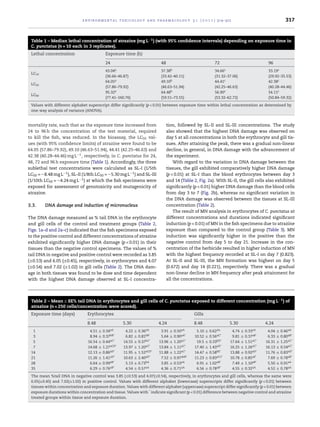
Table 1 – Median lethal concentration of atrazine (mg L−1) (with 95% confidence intervals) depending on exposure time in
C. punctatus (n = 10 each in 3 replicates).
Lethal concentration Exposure time (h)
24 48 72 96
LC10
43.04a
37.38b
34.66c
33.19c
(36.66–46.87) (33.42–40.11) (31.32–37.06) (29.92–35.53)
LC50
64.05a
49.10b
44.41c
42.38c
(57.86–79.92) (46.63–51.94) (42.25–46.63) (40.28–44.46)
LC90
95.32a
64.48b
56.90c
54.11c
(77.41–160.76) (59.51–73.55) (53.32–62.72) (50.84–59.32)
Values with different alphabet superscript differ significantly (p < 0.01) between exposure time within lethal concentration as determined by
one-way analysis of variance (ANOVA).
mortality rate, such that as the exposure time increased from
24 to 96 h the concentration of the test material, required
to kill the fish, was reduced. In the bioassay, the LC50 val-
ues (with 95% confidence limits) of atrazine were found to be
64.05 (57.86–79.92), 49.10 (46.63–51.94), 44.41 (42.25–46.63) and
42.38 (40.28–44.46) mg L−1, respectively, in C. punctatus for 24,
48, 72 and 96 h exposure time (Table 1). Accordingly, the three
sublethal test concentrations were calculated as SL-I (1/5th
LC50 = ∼8.48 mg L−1), SL-II (1/8th LC50 = ∼5.30 mg L−1) and SL-III
(1/10th LC50 = ∼4.24 mg L−1) at which the fish specimens were
exposed for assessment of genotoxicity and mutagenicity of
atrazine.
3.3. DNA damage and induction of micronucleus
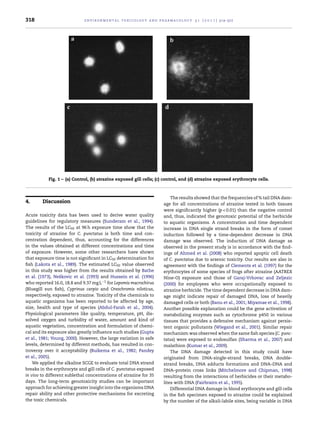
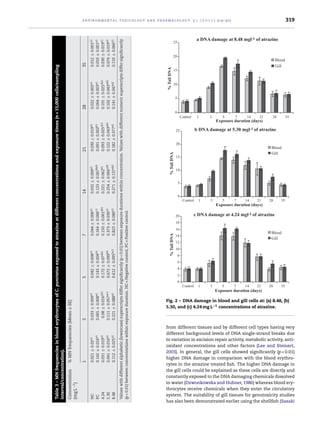
The DNA damage measured as % tail DNA in the erythrocyte
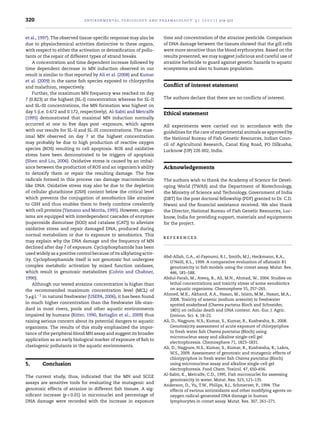
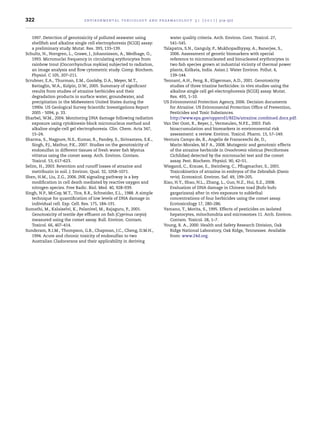
and gill cells of the control and treatment groups (Table 2,
Figs. 1a–d and 2a–c) indicated that the fish specimens exposed
to the positive control and different concentrations of atrazine
exhibited significantly higher DNA damage (p < 0.01) in their
tissues than the negative control specimens. The values of %
tail DNA in negative and positive control were recorded as 3.85
(±0.53) and 6.05 (±0.45), respectively, in erythrocytes and 4.07
(±0.54) and 7.02 (±1.02) in gill cells (Table 2). The DNA dam-
age in both tissues was found to be dose and time dependent
with the highest DNA damage observed at SL-I concentra-
tion, followed by SL-II and SL-III concentrations. The study
also showed that the highest DNA damage was observed on
day 5 at all concentrations in both the erythrocyte and gill tis-
sues. After attaining the peak, there was a gradual non-linear
decline, in general, in DNA damage with the advancement of
the experiment.
With regard to the variation in DNA damage between the
tissues, the gill exhibited comparatively higher DNA damage
(p < 0.01) at SL-I than the blood erythrocytes between day 3
and 14 (Table 2, Fig. 2a). With SL-II, the gill cells also exhibited
significantly (p < 0.01) higher DNA damage than the blood cells
from day 3 to 7 (Fig. 2b), whereas no significant variation in
the DNA damage was observed between the tissues at SL-III
concentration (Table 2).
The result of MN analysis in erythrocytes of C. punctatus at
different concentrations and durations indicated significant
induction (p < 0.01) of MN in the fish specimens due to atrazine
exposure than compared to the control group (Table 3). MN
induction was significantly higher in the positive than the
negative control from day 5 to day 21. Increase in the con-
centration of the herbicide resulted in higher induction of MN
with the highest frequency recorded at SL-I on day 7 (0.823).
At SL-II and SL-III, the MN formation was highest on day 5
(0.672) and day 14 (0.221), respectively. There was a gradual
non-linear decline in MN frequency after peak attainment for
all the concentrations.
Table 2 – Mean ± SE% tail DNA in erythrocytes and gill cells of C. punctatus exposed to different concentration (mg L−1) of
atrazine (n = 250 cells/concentration were scored).
Exposure time (days) Erythrocytes Gills
8.48 5.30 4.24 8.48 5.30 4.24
1 4.51 ± 0.34aA
4.22 ± 0.36aA
3.91 ± 0.50aA
5.10 ± 0.62Aa
4.74 ± 0.33aA
4.04 ± 0.46aA
3 8.94 ± 0.37bB*
6.82 ± 0.81bB*
5.64 ± 0.90aA*
10.52 ± 0.56aC*
9.81 ± 0.37aB*
6.33 ± 0.80aB*
5 16.54 ± 0.44aC*
14.55 ± 0.37bC*
13.96 ± 1.20aC*
19.5 ± 0.33bD*
17.64 ± 1.51aC*
16.31 ± 1.25aC*
7 14.68 ± 1.27aCD*
13.97 ± 1.20aC*
13.84 ± 1.11aC*
17.40 ± 1.43aD*
16.25 ± 1.26aC*
16.13 ± 0.54aC*
14 12.13 ± 0.86aD*
11.95 ± 1.52aCD*
11.88 ± 1.22aC*
14.47 ± 0.58bE*
13.88 ± 0.92aD*
11.76 ± 0.83aD*
21 11.26 ± 1.41aD*
10.63 ± 2.40aD*
7.52 ± 0.97abB*
11.23 ± 0.83aC1*
10.78 ± 0.85aE*
7.69 ± 0.78aB*
28 6.64 ± 0.99aB*
5.13 ± 0.73bA
3.85 ± 0.53aA
6.91 ± 1.02aB*
7.49 ± 1.10aB*
5.50 ± 0.91aA
35 6.29 ± 0.76aB*
4.54 ± 0.57aA
4.36 ± 0.71aA
6.56 ± 0.78aB*
4.55 ± 0.32aA
4.52 ± 0.78aA
The mean %tail DNA in negative control was 3.85 (±0.53) and 4.07(±0.54), respectively, in erythrocytes and gill cells, whereas the same were
6.05(±0.45) and 7.02(±1.02) in positive control. Values with different alphabet (lowercase) superscripts differ significantly (p < 0.01) between
tissues within concentration and exposure duration. Values with different alphabet (uppercase) superscript differ significantly (p < 0.01) between
exposure durations within concentration and tissue. Values with *
indicate significant (p < 0.01) difference between negative control and atrazine
treated groups within tissue and exposure duration.
318 environmental toxicology and pharmacology 3 1 ( 2 0 1 1 ) 314–322
Fig. 1 – (a) Control, (b) atrazine exposed gill cells; (c) control, and (d) atrazine exposed erythrocyte cells.
4. Discussion
Acute toxicity data has been used to derive water quality
guidelines for regulatory measures (Sunderam et al., 1994).
The results of the LC50 at 96 h exposure time show that the
toxicity of atrazine for C. punctatus is both time and con-
centration dependent, thus, accounting for the differences
in the values obtained at different concentrations and time
of exposure. However, some other researchers have shown
that exposure time is not significant in LC50 determination for
fish (Lakota et al., 1989). The estimated LC50 value observed
in this study was higher from the results obtained by Bathe
et al. (1973), Neˇskovic et al. (1993) and Hussein et al. (1996)
who reported 16.0, 18.8 and 9.37 mg L−1 for Lepomis macrochirus
(Bluegill sun fish), Cyprinus carpio and Oreochromis niloticus,
respectively, exposed to atrazine. Toxicity of the chemicals to
aquatic organisms has been reported to be affected by age,
size, health and type of species (Abdul-Farah et al., 2004).
Physiological parameters like quality, temperature, pH, dis-
solved oxygen and turbidity of water, amount and kind of
aquatic vegetation, concentration and formulation of chemi-
cal and its exposure also greatly influence such studies (Gupta
et al., 1981; Young, 2000). However, the large variation in safe
levels, determined by different methods, has resulted in con-
troversy over it acceptability (Buikema et al., 1982; Pandey
et al., 2005).
We applied the alkaline SCGE to evaluate total DNA strand
breaks in the erythrocyte and gill cells of C. punctatus exposed
in vivo to different sublethal concentrations of atrazine for 35
days. The long-term genotoxicity studies can be important
approach for achieving greater insight into the organisms DNA
repair ability and other protective mechanisms for excreting
the toxic chemicals.
The results showed that the frequencies of % tail DNA dam-
age for all concentrations of atrazine tested in both tissues
were significantly higher (p < 0.01) than the negative control
and, thus, indicated the genotoxic potential of the herbicide
to aquatic organisms. A concentration and time dependent
increase in DNA single strand breaks in the form of comet
induction followed by a time-dependent decrease in DNA
damage was observed. The induction of DNA damage as
observed in the present study is in accordance with the find-
ings of Ahmed et al. (2008) who reported apoptic cell death
of C. punctatus due to arsenic toxicity. Our results are also in
agreement with the findings of Clements et al. (1997) for the
erythrocytes of some species of frogs after atrazine (AATREX
Nine-O) exposure and those of Garaj-Vrhovac and Zeljezic
(2000) for employees who were occupationally exposed to
atrazine herbicide. The time dependent decrease in DNA dam-
age might indicate repair of damaged DNA, loss of heavily
damaged cells or both (Banu et al., 2001; Miyamae et al., 1998).
Another possible explanation could be the gene activation of
metabolizing enzymes such as cytochrome p450 in various
tissues that provides a defensive mechanism against persis-
tent organic pollutants (Wiegand et al., 2001). Similar repair
mechanism was observed when the same fish species (C. punc-
tatus) were exposed to endosulfan (Sharma et al., 2007) and
malathion (Kumar et al., 2009).
The DNA damage detected in this study could have
originated from DNA-single-strand breaks, DNA double-
strand breaks, DNA adducts formations and DNA–DNA and
DNA–protein cross links (Mitchelmore and Chipman, 1998)
resulting from the interactions of herbicides or their metabo-
lites with DNA (Fairbrairn et al., 1995).
Differential DNA damage in blood erythrocyte and gill cells
in the fish specimen exposed to atrazine could be explained
by the number of the alkali-labile sites, being variable in DNA
environmental toxicology and pharmacology 3 1 ( 2 0 1 1 ) 314–322 319
Table3–MNfrequenciesinblooderythrocytesofC.punctatusexposedtoatrazineatdifferentconcentrationsandexposuretimes(n=15,000cells/sampling
interval/concentration).
Concentration
(mgL−1)
%MNfrequencies(Mean±SE)
135714212835
NC0.021±0.02a1
0.033±0.009a1
0.042±0.008a1
0.044±0.006a1
0.032±0.009a1
0.030±0.019a1
0.022±0.002a1
0.012±0.001a1
PC0.142±0.016a1
0.065±0.008a1
0.143±0.004b1
0.164±0.006c1
0.133±0.007bd1
0.091±0.002b1
0.064±0.003a1
0.033±0.001a1
4.240.031±0.019a1
0.08±0.016ab1
0.172±0.07ab2
0.150±0.061ab1
0.221±0.062b1
0.093±0.025ab1
0.101±0.025ab1
0.030±0.019a1
5.300.041±0.016a1
0.111±0.057ac1
0.672±0.099b3
0.373±0.030c2
0.254±0.066cd2
0.122±0.043ad1
0.102±0.043ad1
0.074±0.019a1
8.480.112±0.025a1
0.221±0.088a2
0.612±0.095bc3
0.823±0.080c3
0.271±0.137ab2
0.182±0.077a2
0.141±0.047a2
0.133±0.066a1
Valueswithdifferentalphabetic(lowercase)superscriptsdiffersignificantly(p<0.01)betweenexposuredurationswithinconcentration.Valueswithdifferentnumericsuperscriptsdiffersignificantly
(p<0.01)betweenconcentrationswithinexposureduration.NC=Negativecontrol,PC=Positivecontrol.
a DNA damage at 8.48 mgl-1 of atrazine
0
5
10
15
20
25
Control 1 3 5 7 14 21 28 35
Exposure duration (days)
Blood
Gill
%TailDNA
b DNA damage at 5.30 mgl-1 of atrazine
0
5
10
15
20
25
Control 1 3 5 7 14 21 28 35
Exposure duration (days)
Blood
Gill
%TailDNA
c DNA damage at 4.24 mgl-1 of atrazine
0
2
4
6
8
10
12
14
16
18
20
Control 1 3 5 7 14 21 28 35
Exposure duration (days)
Blood
Gill
%TailDNA
Fig. 2 – DNA damage in blood and gill cells at: (a) 8.48, (b)
5.30, and (c) 4.24 mg L−1 concentrations of atrazine.
from different tissues and by different cell types having very
different background levels of DNA single-strand breaks due
to variation in excision repair activity, metabolic activity, anti-
oxidant concentrations and other factors (Lee and Steinert,
2003). In general, the gill cells showed significantly (p < 0.01)
higher DNA damage in comparison with the blood erythro-
cytes in the atrazine treated fish. The higher DNA damage in
the gill cells could be explained as these cells are directly and
constantly exposed to the DNA damaging chemicals dissolved
in water (Dzwonkowska and Hubner, 1986) whereas blood ery-
throcytes receive chemicals when they enter the circulatory
system. The suitability of gill tissues for genotoxicity studies
has also been demonstrated earlier using the shellfish (Sasaki
320 environmental toxicology and pharmacology 3 1 ( 2 0 1 1 ) 314–322
et al., 1997). The observed tissue-specific response may also be
due to physiochemical activities distinctive to these organs,
with respect to either the activation or detoxification of pollu-
tants or the repair of different types of strand breaks.
A concentration and time dependent increase followed by
time dependent decrease in MN induction observed in our
result is similar to that reported by Ali et al. (2008) and Kumar
et al. (2009) in the same fish species exposed to chlorpyrifos
and malathion, respectively.
Further, the maximum MN frequency was reached on day
7 (0.823) at the highest (SL-I) concentration whereas for SL-II
and SL-III concentrations, the MN formation was highest on
day 5 (i.e. 0.672 and 0.172, respectively). Al-Sabti and Metcalfe
(1995) demonstrated that maximal MN induction normally
occurred at one to five days post -exposure, which agrees
with our results for SL-II and SL-III concentrations. The max-
imal MN observed on day 7 at the highest concentration
may probably be due to high production of reactive oxygen
species (ROS) resulting to cell apoptosis. ROS and oxidative
stress have been demonstrated to be triggers of apoptosis
(Shen and Liu, 2006). Oxidative stress is caused by an imbal-
ance between the production of ROS and an organism’s ability
to detoxify them or repair the resulting damage. The free
radicals formed in this process can damage macromolecule
like DNA. Oxidative stress may also be due to the depletion
of cellular glutathione (GSH) content below the critical level
which prevents the conjugation of xenobiotics like atrazine
to GSH and thus enables them to freely combine covalently
with cell proteins (Yamano and Morita, 1995). However, organ-
isms are equipped with interdependent cascades of enzymes
(superoxide dismutase (SOD) and catalase (CAT)) to alleviate
oxidative stress and repair damaged DNA, produced during
normal metabolism or due to exposure to xenobiotics. This
may explain why the DNA damage and the frequency of MN
declined after day 7 of exposure. Cyclophosphamide has been
used widely as a positive control because of its alkylating activ-
ity. Cyclophosphamide itself is not genotoxic but undergoes
complex metabolic activation by mixed function oxidases,
which result in genotoxic metabolites (Colvin and Chabner,
1990).
Although our tested atrazine concentration is higher than
the recommended maximum concentration level (MCL) of
5 ␮g L−1 in natural freshwater (USEPA, 2006), it has been found
in much higher concentration than the freshwater life stan-
dard in most rivers, pools and other aquatic environments
impaired by humans (Ritter, 1990, Battaglin et al., 2009) thus
raising serious concern about its potential dangers to aquatic
organisms. The results of this study emphasized the impor-
tance of the peripheral blood MN assay and suggest its broader
application as an early biological marker of exposure of fish to
clastogenic pollutants in the aquatic environments.
5. Conclusion
The current study, thus, indicated that the MN and SCGE
assays are sensitive tools for evaluating the mutagenic and
genotoxic effects of atrazine in different fish tissues. A sig-
nificant increase (p < 0.01) in micronuclei and percentage of
DNA damage were recorded with the increase in exposure
time and concentration of the atrazine pesticide. Comparison
of DNA damage between the tissues showed that the gill cells
were more sensitive than the blood erythrocytes. Based on the
results presented, we may suggest judicious and careful use of
atrazine herbicide to guard against genetic hazards to aquatic
ecosystems and also to human population.
Conflict of interest statement
The authors declare that there are no conflicts of interest.
Ethical statement
All experiments were carried out in accordance with the
guidelines for the care of experimental animals as approved by
the National Bureau of Fish Genetic Resources, Indian Coun-
cil of Agricultural Research, Canal Ring Road, PO Dilkusha,
Lucknow (UP) 226 002, India.
Acknowledgements
The authors wish to thank the Academy of Science for Devel-
oping World (TWAS) and the Department of Biotechnology,
the Ministry of Science and Technology, Government of India
(DBT) for the post doctoral fellowship (PDF) granted to Dr. C.D.
Nwani and the financial assistance received. We also thank
the Director, National Bureau of Fish Genetic Resources, Luc-
know, India for providing support, materials and equipments
for the project.
r e f e r e n c e s
Abd-Allah, G.A., el-Fayoumi, R.I., Smith, M.J., Heckmann, R.A.,
O’Neill, K.L., 1999. A comparative evaluation of aflatoxin B1
genotoxicity in fish models using the comet assay. Mutat. Res.
446, 181–188.
Abdul-Farah, M., Ateeq, B., Ali, M.N., Ahmad, W., 2004. Studies on
lethal concentrations and toxicity stress of some xenobiotics
on aquatic organisms. Chemosphere 55, 257–265.
Ahmed, M.K., Akhand, A.A., Hasan, M., Islam, M.M., Hasan, M.A.,
2008. Toxicity of arsenic (sodium arsenite) to freshwater
spotted snakehead (Channa puctatus Bloch and Schneider,
1801) on cellular death and DNA content. Am.-Eur. J. Agric.
Environ. Sci. 4, 18–22.
Ali, D., Nagpure, N.S., Kumar, S., Kumar, R., Kushwaha, B., 2008.
Genotoxicity assessment of acute exposure of chlorpyriphos
to fresh water fish Channa punctatus (Bloch) using
micronucleus assay and alkaline single-cell gel
electrophoresis. Chemosphere 71, 1823–1831.
Ali, D., Nagpure, N.S., Kumar, S., Kumar, R., Kushwaha, B., Lakra,
W.S., 2009. Assessment of genotoxic and mutagenic effects of
chlorpyriphos in fresh water fish Channa punctatus (Bloch)
using micronucleus assay and alkaline single-cell gel
electrophoresis. Food Chem. Toxicol. 47, 650–656.
Al-Sabti, K., Metcalfe, C.D., 1995. Fish micronuclei for assessing
genotoxicity in water. Mutat. Res. 323, 121–135.
Anderson, D., Yu, T.W., Philips, B.J., Schmerzer, P., 1994. The
effects of various antioxidants and other modifying agents on
oxygen radical-generated DNA damage in human
lymphocytes in comet assay. Mutat. Res. 307, 261–271.
environmental toxicology and pharmacology 3 1 ( 2 0 1 1 ) 314–322 321
APHA, A.W.W.A., W.P.C.F., 2005. Standard methods for the
examination of water and wastewater, 21st 401 ed. American
Publication of Health Association, Washington, DC.
Ateeq, B., Farah, M.A., Ahmad, W., 2005. Detection of DNA
damage by alkaline single cell gel electrophoresis in 2,
4-dichlorophenoxyacetic acid and butachlor exposed
erythrocytes of Clarias batruchus. Ecotoxicol. Environ. Saf. 62,
348–354.
Bajpayee, M., Pandey, A.K., Parmar, D., Marthur, N., Seth, P.K.,
Dhawan, A., 2005. Comet assay responses in human
lymphocytes are not influenced by the menstrual cycle: a case
study in healthy Indian females. Mutat. Res. 565,
163–172.
Banu, B.S., Danadevi, K., Rahman, M.F., Ahuja, Y.R., Kaiser, J.,
2001. Genotoxic effect of monocrotophos to sentinel species
using the comet assay. Food Chem. Toxicol. 39, 361–366.
Bathe, R., Ullmann, L., Sachsse, K., 1973. Determination of
pesticide toxicity to fish. In: Wasser-Boden- Luft, Ver (Eds.),
Berlin-Dahlem, vol. 37, pp. 241–246.
Battaglin, W.A., Thurman, E.M., Kalkhoff, S.J., Porter, S.D., 2003.
Herbicides and transformation products in surface waters of
the Midwestern United States. J. Am. Water Res. Ass. 39,
743–756.
Battaglin, W.A., Rice, C.K., Foazio, M.J., Salmons, S., Barry, R.X.,
2009. The occurrence of glyphosate, atrazine, and other
pesticides in vernal pools and adjacent streams in
Washington DC, Maryland, Iowa and Wyoming 2005–2006.
Environ. Monit. Assess. 155, 281–307.
Brendler-Schwaab, S., Hartman, A., Pfuhler, S., Speit, G., 2005. The
in vivo comet assay: use and status in genotoxicity testing.
Mutagenesis 20, 245–254.
Buikema, J.R., Naider-Lehner, A.L., Cairns, J.R., 1982. Biological
monitoring: Part IV. Toxicity testing. Environ. Mol. Mutagen.
33, 239–262.
Buschini, A., Carboni, P., Martino, A., Poli, P., Rossi, C., 2003.
Effects of temperature on baseline and genotoxicant-induced
DNA damage in haemocytes of Dreissena polymorpha. Mutat.
Res. 537, 81–92.
Cavas, T., Ergene-Gözükara, S., 2005. Micronucleus test in fish
cells: a bioassay for in situ monitoring of genotoxic pollution
in the marine environment. Environ. Mol. Mutagen. 46, 64–70.
Clements, C., Ralph, S., Petras, M., 1997. Genotoxicity of select
herbicides in Rana catesbeiana tadpoles using the alkaline
single-cell gel DNA electrophoresis (comet) assay. Environ.
Mol. Mutagen. 29, 277–288.
Colvin, M., Chabner, B.A., 1990. Alkylating agents. In: Chabner,
B.A., Collins, J.M. (Eds.), Cancer Therapy: Principles and
Practices. J. B, Lippincott, Philadelphia, pp. 276–313.
Cotelle, S., Ferard, J.F., 1999. Comet assay in genetic ecotoxicology:
a review. Environ. Mol. Mutagen. 34, 246–255.
Dzwonkowska, A., Hubner, H., 1986. Induction of chromosomal
aberrations in the Syrian hamster by insecticides tested in
vivo. Arch. Toxicol. 58, 152–156.
Ergene-Gözükara, S., Cavas, T., Celik, A., Koleli, N., Kaya, F.,
Karahan, A., 2007. Monitoring of nuclear abnormalities in
peripheral erythrocytes of three fish species from the Goksu
Delta (Turkey): genotoxic damage in relation to water
pollution. Ecotoxicology 16, 385–391.
Fairbrairn, D.W., Olive, P.L., O’Neill, K.L., 1995. The comet assay: a
comprehensive review. Mutat. Res. 399, 37–59.
Finney, D.T., 1971. Probit Analysis. Cambridge University press,
Cambridge, p. 333.
Freeman, J.L., Rayburn, A.L., 2004. In vivo genotoxicity of atrazine
to anuran larvae. Mutat. Res. 560, 69–78.
Garaj-Vrhovac, V., Zeljezic, D., 2000. Evaluation of DNA damage in
workers occupationally exposed to pesticides using single-cell
gel electrophoresis (SCGE) assay, pesticide genotoxicity
revealed by comet assay. Mutat. Res. 469, 279–285.
Gupta, P.K., Khangant, B.S., Durve, V.S., 1981. The temperature
dependence of the acute toxicity of copper to freshwater pond
snail, Viviparus bengalensis L. Hydrobiologia 83, 461–464.
Gustavino, B., Scornajenghi, K.A., Minissi, S., Ciccotti, E., 2001.
Micronuclei induced in erythrocytes of Cyprinus carpio
(Teleostei Pisces) by X-rays and colchicine. Mutat. Res. 494,
151–159.
Hussein, S.Y., El-Nasser, M.A., Ahmed, S.M., 1996. Comparative
studies on the effects of herbicide Atrazine on freshwater fish
Oreochromis niloticus and Chrysichthys auratus at Assiut Egypt.
Bull. Environ. Contam. Toxicol. 57, 503–510.
Jha, A.N., 2004. Genotoxicological studies in aquatic organisms:
an overview. Mutat. Res. 552, 1–17.
Klaude, M., Erikson, S., Nygren, J., Ahnstrong, G., 1996. The comet
assay: mechanisms and technical considerations. Mutat. Res.
363, 89–96.
Kligerman, A.D., Doerr, C.L., Tennant, A.H., Peng, B., 2000.
Cytogenetic studies of three atrazine herbicides 11 In vivo
micronucleus studies in mouse bone marrow. Mutat. Res. 471,
107–112.
Kumar, R., Nagpure, N.S., Kushuwaha, B., Srivastava, S.K., Lakra,
W.S., 2009. Investigation of the genotoxicity of malathion to
freshwater teleost fish Channa punctatus (Bloch) using the
micronucleus test and comet assay. Arch. Environ. Contam.
Toxicol. 58, 123–130.
Lakota, S., Razska, A., Utracki, T., Chmiel, Z., 1989. Side effect of
deltamethrin and cypermthrin in the environment of water
biocenoses. Organika 71, 71–77.
Lakra, W.S., Nagpure, N.S., 2009. Genotoxicological studies in
fishes: a review. Indian J. Anim. Sci. 79, 93–98.
Lee, R.F., Steinert, S., 2003. Use of single-cell gel electrophoresis
(comet assay) for detecting DNA damage in aquatic (marine
and fresh water) animals. Mutat. Res. 544, 43–64.
Lopez-Barea, J., 1996. Biomarkers to detect environmental
pollution. Toxicol. Lett. 88, 77–79.
Mitchelmore, C.L., Chipman, J.K., 1998. DNA strand breakage in
aquatic organisms and the potential value of the comet assay
in environmental monitoring. Mutat. Res. 399,
135–147.
Miyamae, Y., Zaizen, K., Ohara, K., Mine, Y., Sasaki, Yu.F., 1998.
Detection of DNA lesions induced by chemical mutagens by
the single-cell gel electrophoresis (comet) assay 1:
relationship between the onset of DNA damage and the
characteristics of mutagens. Mutat. Res. 393, 99–106.
Nagpure, N.S., Kumar, R., Kushwaha, B., Singh, P.J., Sirivastava,
S.K., Lakra, W.S., 2007. Genotoxicity assessment in fishes; A
practical approach. NBFGR, Lucknow-India, p. 126.
Neˇskovic, N.K., Elezonic, I., Karan, V., Poleksic, V., Budimir, M.,
1993. Acute and sub acute toxicity of atrazine to Carp
(Cyprinus carpio). Ecotoxicol. Environ. Saf. 25, 173–182.
Orme, S., Kegley, S., 2004. PAN Pesticide Database. Pesticide
Action Network, San Francisco, CA, USA.
Pandey, S., Kumar, R., Sharma, S., Nagpure, N.S., Sirivastava, S.K.,
Verma, M.S., 2005. Acute toxicity bioassays of mercuric
chloride and malathion on air breathing fish Channa punctatus
(Bloch). Ecotoxicol. Environ. Saf. 61, 114–120.
Pandey, S., Nagpure, N.S., Kumar, R., Sharma, S., Sirivastava, S.K.,
Verma, M.S., 2006. Genotoxicity evaluation of acute doses of
endosulfan to freshwater teleost Channa puctatus (Bloch) by
alkaline single-cell gel electrophoresis. Ecotoxicol. Environ.
Saf. 65, 56–61.
Pluta, H.J., 1989. Toxicity of several xenobiotics and waste water
effluents measured with a new fish early life stage test.
German J. Appl. Zool. 76, 195–220.
Ritter, W.F., 1990. Pesticide contamination of ground water in the
United States—a review. J. Environ. Sci. Health 25B, 1–29.
Sasaki, Y.F., Izumuyama, F., Nishidate, E., Ishibashi, S., Tsuda, S.,
Matsusaka, N., Asano, N., Saotme, K., Sofuni, T., Hayashi, M.,
322 environmental toxicology and pharmacology 3 1 ( 2 0 1 1 ) 314–322
1997. Detection of genotoxicity of polluted seawater using
shellfish and alkaline single cell electrophoresis (SCGE) assay:
a preliminary study. Mutat. Res. 393, 133–139.
Schultz, N., Norrgren, L., Grawe, J., Johannisson, A., Medhage, O.,
1993. Micronuclei frequency in circulating erythrocytes from
rainbow trout (Oncorrhynchus mykiss) subjected to radiation,
an image analysis and flow cytometric study. Comp. Biochem.
Physiol. C 105, 207–211.
Scrubner, E.A., Thurman, E.M., Goolsby, D.A., Meyer, M.T.,
Battaglin, W.A., Kolpin, D.W., 2005. Summary of significant
results from studies of atrazine herbicides and their
degradation products in surface water, groundwater, and
precipitation in the Midwestern United States during the
1990s. US Geological Survey Scientific Investigations Report
2005 - 5094, p. 33.
Sharbel, W.M., 2004. Monitoring DNA damage following radiation
exposure using cytokinesis-block micronucleus method and
alkaline single-cell gel electrophoresis. Clin. Chem. Acta 347,
15–24.
Sharma, S., Nagpure, N.S., Kumar, R., Pandey, S., Sirivastava, S.K.,
Singh, P.J., Mathur, P.K., 2007. Studies on the genotoxicity of
endosulfan in different tissues of fresh water fish Mystus
vittatus using the comet assay. Arch. Environ. Contam.
Toxicol. 53, 617–623.
Selim, H., 2003. Retention and runoff losses of atrazine and
metribuzin in soil. J. Environ. Qual. 32, 1058–1071.
Shen, H.M., Liu, Z.G., 2006. JNK signaling pathway is a key
modification in cell death mediated by reactive oxygen and
nitrogen species. Free Radic. Biol. Med. 40, 928–939.
Singh, N.P., McCay, M.T., Tice, R.R., Schneider, E.L., 1988. A simple
technique for quantification of low levels of DNA damage in
individual cell. Exp. Cell. Res. 175, 184–191.
Sumathi, M., Kalaiselvi, K., Palanivel, M., Rajaguru, P., 2001.
Genotoxicity of textile dye effluent on fish (Cyprinus carpio)
measured using the comet assay. Bull. Environ. Contam.
Toxicol. 66, 407–414.
Sunderam, R.I.M., Thompson, G.B., Chapman, J.C., Cheng, D.M.H.,
1994. Acute and chronic toxicity of endosulfan to two
Australian Cladocerans and their applicability in deriving
water quality criteria. Arch. Environ. Cont. Toxicol. 27,
541–545.
Talapatra, S.N., Ganguly, P., Mukhopadhyyay, A., Banerjee, S.,
2006. Assessment of genetic biomarkers with special
reference to micronucleated and binucleated erythrocytes in
two fish species grown at industrial vicinity of thermal power
plants, Kolkata, India. Asian J. Water Environ. Pollut. 4,
139–144.
Tennant, A.H., Peng, B., Kligerman, A.D., 2001. Genotoxicity
studies of three triazine herbicides: in vivo studies using the
alkaline single cell gel-electrophoresis (SCGE) assay. Mutat.
Res. 493, 1–10.
US Evironmental Protection Agency, 2006. Decision documents
for Atrazine. US Evironmental Protection Office of Prevention,
Pesticides and Toxic Substances.
http://www.epa.gov/oppsrrd1/REDs/atrazine combined docs.pdf.
Van Der Oost, R., Beyer, J., Vermeulen, N.P.E., 2003. Fish
bioaccumulation and biomarkers in environmental risk
assessment: a review. Environ. Toxicol. Pharm. 13, 57–149.
Ventura Campo de, B., Angelis de Fransceschi de, D.,
Marin-Morales, M.F A., 2008. Mutagenic and genotoxic effects
of the atrazine herbicide in Oreochromis niloticus (Perciformes
Cichlidae) detected by the micronuclei test and the comet
assay. Pest. Biochem. Physiol. 90, 42–51.
Wiegand, C., Krause, E., Steinberg, C., Pflugmacher, S., 2001.
Toxicokinetics of atrazine in embryos of the Zebrafish (Danio
rerio). Ecotoxicol. Environ. Saf. 49, 199–205.
Xiao, H.Y., Shao, N.L., Zhang, L., Guo, N.Z., Hui, S.Z., 2008.
Evaluation of DNA damage in Chinese toad (Bufo bufo
gargarizans) after in vivo exposure to sublethal
concentrations of four herbicides using the comet assay.
Ecotoxicology 17, 280–286.
Yamano, T., Morita, S., 1995. Effects of pesticides on isolated
hepatocytes, mitochondria and microsomes 11. Arch. Environ.
Contam. Toxicol. 28, 1–7.
Young, R. A., 2000. Health and Safety Research Division, Oak
Ridge National Laboratory, Oak Ridge, Tennessee. Available
from: www.24d.org.

Mutagenic and genotoxic assessment of atrazine-based herbicide to freshwater fishChanna punctatus(Bloch) ...

  • 1.
    environmental toxicology andpharmacology 3 1 ( 2 0 1 1 ) 314–322 available at www.sciencedirect.com journal homepage: www.elsevier.com/locate/etap Mutagenic and genotoxic assessment of atrazine-based herbicide to freshwater fish Channa punctatus (Bloch) using micronucleus test and single cell gel electrophoresis C.D. Nwania,1 , N.S. Nagpureb , Ravindra Kumarb,∗ , Basdeo Kushwahab , Pavan Kumarb , W.S. Lakrab a Department of Applied Biology, Ebonyi State University, PMB 053, Abakaliki, Ebonyi State, Nigeria b National Bureau of Fish Genetic Resources (Indian council of Agricultural Research), Canal Ring Road, PO- Dilkusha, Lucknow 226 002, UP, India a r t i c l e i n f o Article history: Received 20 May 2010 Received in revised form 8 December 2010 Accepted 10 December 2010 Available online 17 December 2010 Keywords: Atrazine Channa punctatus DNA damage Genotoxicity Micronucleus assay Single cell gel electrophoresis a b s t r a c t The mutagenic and genotoxic effect of ‘Rasayanzine’, an atrazine herbicide, was carried out in fish Channa punctatus using micronucleus and single cell gel electrophoresis (SCGE) assays. Three sub-lethal concentrations of the test material viz., SL-I (1/5th LC50 = ∼8.48 mg L−1 ), SL- II (1/8th LC50 = ∼5.30 mg L−1 ) and SL-III (1/10th LC50 = ∼4.24 mg L−1 ) were calculated using LC50 value and the fish specimens were exposed to these concentrations. Erythrocyte and gill cells were sampled on day 0, 1, 3, 5, 7, 14, 21, 28 and 35 of exposure for assessment of micronuclei induction in blood erythrocytes and DNA damage using SCGE assay in both blood erythrocytes and gill cells. Significant effects (p < 0.01) for both concentration and time of exposure were observed in treated fish. Micronuclei induction in erythrocytes was highest (8.4 mg L−1 ) on day 7 of exposure. The highest level of DNA damage in the SCGE was observed in both tissues on day 5 at all concentrations followed by gradual non-linear decline. This study further confirmed that the micronucleus and SCGE assays are useful in determining potential genotoxicity of water pollutants and might be appropriate as part of monitoring program. © 2011 Elsevier B.V. All rights reserved. 1. Introduction The use of herbicides to control weed has been recognized as a part of agricultural practices throughout the world. Unfortunately, the indiscriminate use of these herbicides to improve agricultural production and yield may have impacts on non-target organisms especially aquatic lives and their environment. Atrazine [6-chloro-N-ethyl-N -(1-methylethyl)- triazine-2, 4-diamine] is one of the most commonly used herbicides found in the rural environments though its use ∗ Corresponding author. Tel.: +91 522 2442440; fax: +91 522 2442403. E-mail address: Ravindra.Scientist@gmail.com (R. Kumar). 1 Worked as a Post Doctoral Fellow at National Bureau of Fish Genetic Resources, Lucknow. has been controversial (currently banned in the EU but not in US and other countries). It is widely used in corn, sorghum, sugarcane, pineapple crops and to some extent in landscape vegetation. It has relatively high water solubility (32 mg L−1), which aids in its infiltration into ground water (Orme and Kegley, 2004). Rated as moderately toxic to aquatic species, atrazine is mobile in the environment and is among the most detected pesticides in streams, rivers, ponds, reservoirs and ground water (Battaglin et al., 2003, 2009; Scrubner et al., 2005). Atrazine concentrations of 20 ␮g L−1 have been com- monly detected in surface water runoff, while concentrations 1382-6689/$ – see front matter © 2011 Elsevier B.V. All rights reserved. doi:10.1016/j.etap.2010.12.001
  • 2.
    environmental toxicology andpharmacology 3 1 ( 2 0 1 1 ) 314–322 315 as high as 700 ␮g L−1 have been reported (Selim, 2003). Due to low persistence of atrazine herbicide, repeated application are practiced for the control of weeds in agricultural field. As a result of this, large quantities of the herbicide find their ways into water bodies. The indiscriminate use of this her- bicide, careless handing, accidental spillage or discharge of untreated effluents into natural water ways have harmful effects on the fish population and other aquatic organisms and may contribute to long term effects in the environment. Sublethal effects may occur at levels of exposure less than 2 mg L−1 of atrazine during long-term exposure with biochem- ical and histopathological alteration of fish tissue (Neˇskovic et al., 1993). Fish can serve as bio-indicators of environmental pollu- tion and can play significant roles in assessing potential risk associated with contamination in aquatic environment since they are directly exposed to chemicals and mutagens resulting from agricultural production via surface run-off or indirectly through food chain of ecosystem (Cavas and Ergene-Gözükara, 2005; Lakra and Nagpure, 2009). Therefore, the use of fish biomarkers as indices of the effects of pollution are of increas- ing importance and can permit early detection of aquatic environmental problems (Lopez-Barea, 1996; Van Der Oost et al., 2003). Several ecotoxicological characteristics of Channa puncta- tus, such as wide distribution in the freshwater environment, noninvasive, availability throughout the seasons, pres- ence of 32 well-differentiated diploid chromosome number, commercial importance, ease of blood collection and acclima- tization to laboratory conditions, make this species an excellent test specimen for toxicity studies (Kumar et al., 2009). Several studies have shown that the micronucleus (MN) test and single cell gel electrophoresis (SCGE) are two sen- sitive, rapid and extensively used methods in the detection of mutagenic and genotoxicity of chemicals and xenobiotics under field and laboratory conditions (Jha, 2004; Ateeq et al., 2005; Cavas and Ergene-Gözükara, 2005; Pandey et al., 2006; Talapatra et al., 2006; Sharma et al., 2007; Ergene-Gözükara et al., 2007; Nagpure et al., 2007; Ali et al., 2008, 2009; Xiao et al., 2008; Ventura et al., 2008; Kumar et al., 2009). One of the advantages of MN and SCGE assays are that both can be used for the simultaneous assessment of DNA damage in many tissues from the same animal and for the compar- ison of their responses under identical treatment condition. The formation of MN may be related to anaphase chromoso- mal delays characterized by a bad functioning in the spindle or due to the presence of acentric chromosomic fragments (Al-Sabti and Metcalfe, 1995). The SCGE has been consid- ered as sensitive rapid and reliable method of quantitatively measuring DNA damage in eukaryotic and prokaryotic cells (Cotelle and Ferard, 1999; Bajpayee et al., 2005). It is increas- ingly being used in testing of substances such as industrial chemicals, biocides, agrochemical, food additives and phar- maceuticals for genotoxicity testing (Brendler-Schwaab et al., 2005). The assay is favored among other cytogenetic methods (viz. chromosome aberrations, sister chromatid exchange and micronucleus test) used for the detection of damage (Buschini et al., 2003) as it is capable of detecting wide variety of DNA damage such as DNA strand breaks (Sharbel, 2004). Thus, these techniques can be used in combination for screening genotoxic effect of chemicals and for investigating the impli- cations of DNA damage and its recovery in the sentinel fish species. These biomarkers have also opened a broad perspective in aquatic toxicology as fish erythrocytes and gills are constantly being exposed to environmental pollutants. Many workers have supported and demonstrated the relevance of fish ery- throcytes for MN and SCGE in ecotoxicological studies (Schultz et al., 1993; Al-Sabti and Metcalfe, 1995; Abd-Allah et al., 1999; Gustavino et al., 2001; Sumathi et al., 2001) due to their easy sampling and not required cell dissociation (Ateeq et al., 2005; Cavas and Ergene-Gözükara, 2005). Fish blood is particularly favored because it comprises 97% erythrocytes, thus ensur- ing great homogeneity of cells for SCGE studies. In the present study, gill cells were also used for SCGE assay as they are prone to injury caused by chemicals and xenobiotics. Gill cells are the most appropriate target organ that is directly and constantly exposed to the DNA damaging chemicals dissolved in water (Dzwonkowska and Hubner, 1986). The mutagenic and genotoxic properties of atrazine have been studied using a variety of assays in the past but the results were contradictory (Clements et al., 1997; Kligerman et al., 2000; Garaj-Vrhovac and Zeljezic, 2000; Tennant et al., 2001; Freeman and Rayburn, 2004; Ventura et al., 2008). Hence, hazardous effects of this herbicide are a matter of great con- cern due to human exposure consequent to wide use all over the world. In the present study, attempts have been made to investigate the mutagenic and genotoxic effects of atrazine herbicide using MN and SCGE assays in erythrocyte and gill cells of C. punctatus exposed in vivo. 2. Materials and methods 2.1. Experimental fish specimen and chemical Freshwater air-breathing fish C. punctatus (Bloch; Family: Channidae, order: Perciformes) were caught from nearby ponds and lakes with the help of local fishermen. The speci- mens had an average (±SD) weight and length of 13.30 ± 0.70 g and 10.02 ± 0.72 cm, respectively. Fish specimens were sub- jected to a prophylactic treatment by bathing twice in 0.05% potassium permanganate (KMnO4) for two min to avoid any dermal infections. The fishes were then acclimatized for two weeks under laboratory conditions in semi-static systems. They were fed boiled eggs, minced goat liver and poultry waste materials during acclimatization. The fecal matter and other waste materials were siphoned off daily to reduce ammonia content in water. For the present study, commercial formula- tions of atrazine (50% WP) with the trade name “Rasayanzine” manufactured by Krishi Rasayan Exports Ltd., India was pur- chased from the market. 2.2. Determination of sub-lethal concentrations Acute toxicity was conducted to determine the 96 h LC50 value of atrazine with definitive test in semi-static system in labo- ratory as per standard methods (APHA, AWWA, WPCE, 2005). The range finding test was carried out prior to the definitive
  • 3.
    316 environmental toxicologyand pharmacology 3 1 ( 2 0 1 1 ) 314–322 test to determine the concentration of the test solution. For the test, the atrazine was dissolved in distilled water, filtered and added to the aquarium following the method of Pluta (1989). The test water with herbicide was changed after every 48 h by replacing with the fresh atrazine solution in order to coun- terbalance decreasing herbicide concentrations because of its hydrolysis in water. Hydrolysis of atrazine is rapid under acidic or basic conditions but slower at neutral pH. In the defini- tive test, a set of 10 fish specimens were randomly exposed to each of the atrazine concentrations (viz. 25, 32, 39, 46, 53 and 60 mg L−1) and the experiment was set in triplicate to obtain the LC50 value of the herbicide for the species. The LC50 value of test chemical in C. punctatus was determined by probit anal- ysis method (Finney, 1971) for 24, 48, 72 and 96 h. Based on the 96 h LC50 value, three sublethal test concentrations of atrazine were determined and the fish specimens were exposed to these concentrations for the assessment of its mutagenicity and genotoxicity. 2.3. In vivo exposure experiment The fish specimens were exposed to the three sublethal con- centrations of test chemical in a semi-static system with the change of test solution after every 48 h of exposure. The expo- sure was continued up to 35 days and the tissue sampling was done at intervals of 1, 3, 5, 7, 14, 28 and 35 days at the rate of five specimens per sampling interval for MN and SCGE assays. The specimens maintained in tap water separately were consid- ered as negative control. An additional set of specimens was separately exposed to cyclophosphamide (4 mg L−1) for pos- itive control (Cavas and Ergene-Gözükara, 2005) in MN assay. However, for SCGE assay, the erythrocyte and gill cells sampled from C. punctatus on day 1 were treated ex vivo with 100 ␮M H2O2 for 10 min at 4 ◦C and the average value of DNA dam- age in five specimens was used as positive control. Similarly, the value of negative control was also based on average DNA damage in five specimens on day 1. On each sampling interval, ten specimens (five each for MN and SCGE) were sampled from each atrazine treated group. MN test was only performed on blood erythrocytes while both blood erythrocytes and gill cells were processed for SCGE. The blood was collected from the caudal vein of fish by puncture technique using heparinized syringe. Sampling of the nega- tive and positive control was also done for comparison. The physicochemical properties of test water, namely tempera- ture, pH, conductivity, dissolved oxygen, and total hardness were analyzed at the beginning of experiment and on each sampling day using standard methods (APHA, AWWA, WPCE, 2005). 2.4. Micronucleus assay Peripheral blood samples obtained from the caudal vein were smeared on clean, grease free, one end frosted glass slides. Slides were fixed in methanol for 10 min and left to air-dry at room temperature and finally stained with 6% Giemsa in Sorenson buffer (pH 6.9) for 20 min. After dehydration through graded alcohol and clearing in xylene, slides were mounted in DPX (distyrene, plasticizer and xylene). From each slide, 1500 erythrocyte cells were scored under light microscope (Leitz Wetzlar Germany, Type 307 – 083.103, oil immersion lens, 100/1.25). The criteria used for the identification of MN were their size smaller than one-third of the main nucleus, no attachment with the main nucleus, and same color and inten- sity as the main nucleus. The MN frequency was calculated as % MN = Number of cells containing micronuclei Total number of cells counted × 100 2.5. Single cell gel electrophoresis The alkaline single cell gel electrophoresis or comet assay (CA) was performed as a three-layer procedure (Singh et al., 1988) with slight modifications (Klaude et al., 1996). The gill tis- sue was removed with the help of scissor and homogenized in ice-cold homogenization buffer [1X Hanks’ balanced salt solution (HBSS), 20 mM EDTA, 10% dimethyl sulfoxide (DMSO), pH 7.0–7.5] followed by centrifugation at 3000 rpm at 4 ◦C for 5 min. The cell pellet was then suspended in chilled phosphate buffered saline (PBS). Viability of both the erythrocytes and gill cells was evaluated by the trypan blue exclusion test method (Anderson et al., 1994) and the cell suspensions showing via- bility >84% were further processed for SCGE according to the method described by Ali et al. (2008). Two slides per specimen were prepared and 25 cells per slide (250 cells per concentration) were scored randomly and analyzed using an image analysis system (Komet-5.5 Kinetic Imaging, UK) attached to a fluorescent microscope (Leica) equipped with appropriate filters. The parameter selected for quantification of DNA damage was percent tail DNA (% tail DNA = 100 – % Head DNA), as determined by the software. 2.6. Statistical analysis The percentage of MN frequency among different expo- sure times and concentrations were compared using the Mann–Whitney test. One-way analysis of variance (ANOVA) was employed using SPSS software (Standard Version 11.5 SPSS Inc.) to compare the mean differences in % tail DNA, esti- mated by SCGE assay, among different tissues, concentrations, and exposure intervals. A p value less than 0.01 was considered statistically significant. 3. Results 3.1. Physicochemical properties of the test water The test water temperature varied from 24.3 to 25.5 ◦C, the pH values ranged from 7.3 to 8.0 while the dissolved oxygen concentration varied from 6.6 to 7.9 mg L−1 during the experi- mental period. The conductivity of the water ranged from 260 to 300 ␮M cm−1 while the total hardness and total alkalinity ranged from 200 to 230 mg L−1 and from 275 to 320 as CaCO3, respectively. 3.2. Acute toxicity bioassay and sublethal concentrations In the acute toxicity bioassay, a concentration dependent increase and time dependent decrease was observed in the
  • 4.
    environmental toxicology andpharmacology 3 1 ( 2 0 1 1 ) 314–322 317 Table 1 – Median lethal concentration of atrazine (mg L−1) (with 95% confidence intervals) depending on exposure time in C. punctatus (n = 10 each in 3 replicates). Lethal concentration Exposure time (h) 24 48 72 96 LC10 43.04a 37.38b 34.66c 33.19c (36.66–46.87) (33.42–40.11) (31.32–37.06) (29.92–35.53) LC50 64.05a 49.10b 44.41c 42.38c (57.86–79.92) (46.63–51.94) (42.25–46.63) (40.28–44.46) LC90 95.32a 64.48b 56.90c 54.11c (77.41–160.76) (59.51–73.55) (53.32–62.72) (50.84–59.32) Values with different alphabet superscript differ significantly (p < 0.01) between exposure time within lethal concentration as determined by one-way analysis of variance (ANOVA). mortality rate, such that as the exposure time increased from 24 to 96 h the concentration of the test material, required to kill the fish, was reduced. In the bioassay, the LC50 val- ues (with 95% confidence limits) of atrazine were found to be 64.05 (57.86–79.92), 49.10 (46.63–51.94), 44.41 (42.25–46.63) and 42.38 (40.28–44.46) mg L−1, respectively, in C. punctatus for 24, 48, 72 and 96 h exposure time (Table 1). Accordingly, the three sublethal test concentrations were calculated as SL-I (1/5th LC50 = ∼8.48 mg L−1), SL-II (1/8th LC50 = ∼5.30 mg L−1) and SL-III (1/10th LC50 = ∼4.24 mg L−1) at which the fish specimens were exposed for assessment of genotoxicity and mutagenicity of atrazine. 3.3. DNA damage and induction of micronucleus The DNA damage measured as % tail DNA in the erythrocyte and gill cells of the control and treatment groups (Table 2, Figs. 1a–d and 2a–c) indicated that the fish specimens exposed to the positive control and different concentrations of atrazine exhibited significantly higher DNA damage (p < 0.01) in their tissues than the negative control specimens. The values of % tail DNA in negative and positive control were recorded as 3.85 (±0.53) and 6.05 (±0.45), respectively, in erythrocytes and 4.07 (±0.54) and 7.02 (±1.02) in gill cells (Table 2). The DNA dam- age in both tissues was found to be dose and time dependent with the highest DNA damage observed at SL-I concentra- tion, followed by SL-II and SL-III concentrations. The study also showed that the highest DNA damage was observed on day 5 at all concentrations in both the erythrocyte and gill tis- sues. After attaining the peak, there was a gradual non-linear decline, in general, in DNA damage with the advancement of the experiment. With regard to the variation in DNA damage between the tissues, the gill exhibited comparatively higher DNA damage (p < 0.01) at SL-I than the blood erythrocytes between day 3 and 14 (Table 2, Fig. 2a). With SL-II, the gill cells also exhibited significantly (p < 0.01) higher DNA damage than the blood cells from day 3 to 7 (Fig. 2b), whereas no significant variation in the DNA damage was observed between the tissues at SL-III concentration (Table 2). The result of MN analysis in erythrocytes of C. punctatus at different concentrations and durations indicated significant induction (p < 0.01) of MN in the fish specimens due to atrazine exposure than compared to the control group (Table 3). MN induction was significantly higher in the positive than the negative control from day 5 to day 21. Increase in the con- centration of the herbicide resulted in higher induction of MN with the highest frequency recorded at SL-I on day 7 (0.823). At SL-II and SL-III, the MN formation was highest on day 5 (0.672) and day 14 (0.221), respectively. There was a gradual non-linear decline in MN frequency after peak attainment for all the concentrations. Table 2 – Mean ± SE% tail DNA in erythrocytes and gill cells of C. punctatus exposed to different concentration (mg L−1) of atrazine (n = 250 cells/concentration were scored). Exposure time (days) Erythrocytes Gills 8.48 5.30 4.24 8.48 5.30 4.24 1 4.51 ± 0.34aA 4.22 ± 0.36aA 3.91 ± 0.50aA 5.10 ± 0.62Aa 4.74 ± 0.33aA 4.04 ± 0.46aA 3 8.94 ± 0.37bB* 6.82 ± 0.81bB* 5.64 ± 0.90aA* 10.52 ± 0.56aC* 9.81 ± 0.37aB* 6.33 ± 0.80aB* 5 16.54 ± 0.44aC* 14.55 ± 0.37bC* 13.96 ± 1.20aC* 19.5 ± 0.33bD* 17.64 ± 1.51aC* 16.31 ± 1.25aC* 7 14.68 ± 1.27aCD* 13.97 ± 1.20aC* 13.84 ± 1.11aC* 17.40 ± 1.43aD* 16.25 ± 1.26aC* 16.13 ± 0.54aC* 14 12.13 ± 0.86aD* 11.95 ± 1.52aCD* 11.88 ± 1.22aC* 14.47 ± 0.58bE* 13.88 ± 0.92aD* 11.76 ± 0.83aD* 21 11.26 ± 1.41aD* 10.63 ± 2.40aD* 7.52 ± 0.97abB* 11.23 ± 0.83aC1* 10.78 ± 0.85aE* 7.69 ± 0.78aB* 28 6.64 ± 0.99aB* 5.13 ± 0.73bA 3.85 ± 0.53aA 6.91 ± 1.02aB* 7.49 ± 1.10aB* 5.50 ± 0.91aA 35 6.29 ± 0.76aB* 4.54 ± 0.57aA 4.36 ± 0.71aA 6.56 ± 0.78aB* 4.55 ± 0.32aA 4.52 ± 0.78aA The mean %tail DNA in negative control was 3.85 (±0.53) and 4.07(±0.54), respectively, in erythrocytes and gill cells, whereas the same were 6.05(±0.45) and 7.02(±1.02) in positive control. Values with different alphabet (lowercase) superscripts differ significantly (p < 0.01) between tissues within concentration and exposure duration. Values with different alphabet (uppercase) superscript differ significantly (p < 0.01) between exposure durations within concentration and tissue. Values with * indicate significant (p < 0.01) difference between negative control and atrazine treated groups within tissue and exposure duration.
  • 5.
    318 environmental toxicologyand pharmacology 3 1 ( 2 0 1 1 ) 314–322 Fig. 1 – (a) Control, (b) atrazine exposed gill cells; (c) control, and (d) atrazine exposed erythrocyte cells. 4. Discussion Acute toxicity data has been used to derive water quality guidelines for regulatory measures (Sunderam et al., 1994). The results of the LC50 at 96 h exposure time show that the toxicity of atrazine for C. punctatus is both time and con- centration dependent, thus, accounting for the differences in the values obtained at different concentrations and time of exposure. However, some other researchers have shown that exposure time is not significant in LC50 determination for fish (Lakota et al., 1989). The estimated LC50 value observed in this study was higher from the results obtained by Bathe et al. (1973), Neˇskovic et al. (1993) and Hussein et al. (1996) who reported 16.0, 18.8 and 9.37 mg L−1 for Lepomis macrochirus (Bluegill sun fish), Cyprinus carpio and Oreochromis niloticus, respectively, exposed to atrazine. Toxicity of the chemicals to aquatic organisms has been reported to be affected by age, size, health and type of species (Abdul-Farah et al., 2004). Physiological parameters like quality, temperature, pH, dis- solved oxygen and turbidity of water, amount and kind of aquatic vegetation, concentration and formulation of chemi- cal and its exposure also greatly influence such studies (Gupta et al., 1981; Young, 2000). However, the large variation in safe levels, determined by different methods, has resulted in con- troversy over it acceptability (Buikema et al., 1982; Pandey et al., 2005). We applied the alkaline SCGE to evaluate total DNA strand breaks in the erythrocyte and gill cells of C. punctatus exposed in vivo to different sublethal concentrations of atrazine for 35 days. The long-term genotoxicity studies can be important approach for achieving greater insight into the organisms DNA repair ability and other protective mechanisms for excreting the toxic chemicals. The results showed that the frequencies of % tail DNA dam- age for all concentrations of atrazine tested in both tissues were significantly higher (p < 0.01) than the negative control and, thus, indicated the genotoxic potential of the herbicide to aquatic organisms. A concentration and time dependent increase in DNA single strand breaks in the form of comet induction followed by a time-dependent decrease in DNA damage was observed. The induction of DNA damage as observed in the present study is in accordance with the find- ings of Ahmed et al. (2008) who reported apoptic cell death of C. punctatus due to arsenic toxicity. Our results are also in agreement with the findings of Clements et al. (1997) for the erythrocytes of some species of frogs after atrazine (AATREX Nine-O) exposure and those of Garaj-Vrhovac and Zeljezic (2000) for employees who were occupationally exposed to atrazine herbicide. The time dependent decrease in DNA dam- age might indicate repair of damaged DNA, loss of heavily damaged cells or both (Banu et al., 2001; Miyamae et al., 1998). Another possible explanation could be the gene activation of metabolizing enzymes such as cytochrome p450 in various tissues that provides a defensive mechanism against persis- tent organic pollutants (Wiegand et al., 2001). Similar repair mechanism was observed when the same fish species (C. punc- tatus) were exposed to endosulfan (Sharma et al., 2007) and malathion (Kumar et al., 2009). The DNA damage detected in this study could have originated from DNA-single-strand breaks, DNA double- strand breaks, DNA adducts formations and DNA–DNA and DNA–protein cross links (Mitchelmore and Chipman, 1998) resulting from the interactions of herbicides or their metabo- lites with DNA (Fairbrairn et al., 1995). Differential DNA damage in blood erythrocyte and gill cells in the fish specimen exposed to atrazine could be explained by the number of the alkali-labile sites, being variable in DNA
  • 6.
    environmental toxicology andpharmacology 3 1 ( 2 0 1 1 ) 314–322 319 Table3–MNfrequenciesinblooderythrocytesofC.punctatusexposedtoatrazineatdifferentconcentrationsandexposuretimes(n=15,000cells/sampling interval/concentration). Concentration (mgL−1) %MNfrequencies(Mean±SE) 135714212835 NC0.021±0.02a1 0.033±0.009a1 0.042±0.008a1 0.044±0.006a1 0.032±0.009a1 0.030±0.019a1 0.022±0.002a1 0.012±0.001a1 PC0.142±0.016a1 0.065±0.008a1 0.143±0.004b1 0.164±0.006c1 0.133±0.007bd1 0.091±0.002b1 0.064±0.003a1 0.033±0.001a1 4.240.031±0.019a1 0.08±0.016ab1 0.172±0.07ab2 0.150±0.061ab1 0.221±0.062b1 0.093±0.025ab1 0.101±0.025ab1 0.030±0.019a1 5.300.041±0.016a1 0.111±0.057ac1 0.672±0.099b3 0.373±0.030c2 0.254±0.066cd2 0.122±0.043ad1 0.102±0.043ad1 0.074±0.019a1 8.480.112±0.025a1 0.221±0.088a2 0.612±0.095bc3 0.823±0.080c3 0.271±0.137ab2 0.182±0.077a2 0.141±0.047a2 0.133±0.066a1 Valueswithdifferentalphabetic(lowercase)superscriptsdiffersignificantly(p<0.01)betweenexposuredurationswithinconcentration.Valueswithdifferentnumericsuperscriptsdiffersignificantly (p<0.01)betweenconcentrationswithinexposureduration.NC=Negativecontrol,PC=Positivecontrol. a DNA damage at 8.48 mgl-1 of atrazine 0 5 10 15 20 25 Control 1 3 5 7 14 21 28 35 Exposure duration (days) Blood Gill %TailDNA b DNA damage at 5.30 mgl-1 of atrazine 0 5 10 15 20 25 Control 1 3 5 7 14 21 28 35 Exposure duration (days) Blood Gill %TailDNA c DNA damage at 4.24 mgl-1 of atrazine 0 2 4 6 8 10 12 14 16 18 20 Control 1 3 5 7 14 21 28 35 Exposure duration (days) Blood Gill %TailDNA Fig. 2 – DNA damage in blood and gill cells at: (a) 8.48, (b) 5.30, and (c) 4.24 mg L−1 concentrations of atrazine. from different tissues and by different cell types having very different background levels of DNA single-strand breaks due to variation in excision repair activity, metabolic activity, anti- oxidant concentrations and other factors (Lee and Steinert, 2003). In general, the gill cells showed significantly (p < 0.01) higher DNA damage in comparison with the blood erythro- cytes in the atrazine treated fish. The higher DNA damage in the gill cells could be explained as these cells are directly and constantly exposed to the DNA damaging chemicals dissolved in water (Dzwonkowska and Hubner, 1986) whereas blood ery- throcytes receive chemicals when they enter the circulatory system. The suitability of gill tissues for genotoxicity studies has also been demonstrated earlier using the shellfish (Sasaki
  • 7.
    320 environmental toxicologyand pharmacology 3 1 ( 2 0 1 1 ) 314–322 et al., 1997). The observed tissue-specific response may also be due to physiochemical activities distinctive to these organs, with respect to either the activation or detoxification of pollu- tants or the repair of different types of strand breaks. A concentration and time dependent increase followed by time dependent decrease in MN induction observed in our result is similar to that reported by Ali et al. (2008) and Kumar et al. (2009) in the same fish species exposed to chlorpyrifos and malathion, respectively. Further, the maximum MN frequency was reached on day 7 (0.823) at the highest (SL-I) concentration whereas for SL-II and SL-III concentrations, the MN formation was highest on day 5 (i.e. 0.672 and 0.172, respectively). Al-Sabti and Metcalfe (1995) demonstrated that maximal MN induction normally occurred at one to five days post -exposure, which agrees with our results for SL-II and SL-III concentrations. The max- imal MN observed on day 7 at the highest concentration may probably be due to high production of reactive oxygen species (ROS) resulting to cell apoptosis. ROS and oxidative stress have been demonstrated to be triggers of apoptosis (Shen and Liu, 2006). Oxidative stress is caused by an imbal- ance between the production of ROS and an organism’s ability to detoxify them or repair the resulting damage. The free radicals formed in this process can damage macromolecule like DNA. Oxidative stress may also be due to the depletion of cellular glutathione (GSH) content below the critical level which prevents the conjugation of xenobiotics like atrazine to GSH and thus enables them to freely combine covalently with cell proteins (Yamano and Morita, 1995). However, organ- isms are equipped with interdependent cascades of enzymes (superoxide dismutase (SOD) and catalase (CAT)) to alleviate oxidative stress and repair damaged DNA, produced during normal metabolism or due to exposure to xenobiotics. This may explain why the DNA damage and the frequency of MN declined after day 7 of exposure. Cyclophosphamide has been used widely as a positive control because of its alkylating activ- ity. Cyclophosphamide itself is not genotoxic but undergoes complex metabolic activation by mixed function oxidases, which result in genotoxic metabolites (Colvin and Chabner, 1990). Although our tested atrazine concentration is higher than the recommended maximum concentration level (MCL) of 5 ␮g L−1 in natural freshwater (USEPA, 2006), it has been found in much higher concentration than the freshwater life stan- dard in most rivers, pools and other aquatic environments impaired by humans (Ritter, 1990, Battaglin et al., 2009) thus raising serious concern about its potential dangers to aquatic organisms. The results of this study emphasized the impor- tance of the peripheral blood MN assay and suggest its broader application as an early biological marker of exposure of fish to clastogenic pollutants in the aquatic environments. 5. Conclusion The current study, thus, indicated that the MN and SCGE assays are sensitive tools for evaluating the mutagenic and genotoxic effects of atrazine in different fish tissues. A sig- nificant increase (p < 0.01) in micronuclei and percentage of DNA damage were recorded with the increase in exposure time and concentration of the atrazine pesticide. Comparison of DNA damage between the tissues showed that the gill cells were more sensitive than the blood erythrocytes. Based on the results presented, we may suggest judicious and careful use of atrazine herbicide to guard against genetic hazards to aquatic ecosystems and also to human population. Conflict of interest statement The authors declare that there are no conflicts of interest. Ethical statement All experiments were carried out in accordance with the guidelines for the care of experimental animals as approved by the National Bureau of Fish Genetic Resources, Indian Coun- cil of Agricultural Research, Canal Ring Road, PO Dilkusha, Lucknow (UP) 226 002, India. Acknowledgements The authors wish to thank the Academy of Science for Devel- oping World (TWAS) and the Department of Biotechnology, the Ministry of Science and Technology, Government of India (DBT) for the post doctoral fellowship (PDF) granted to Dr. C.D. Nwani and the financial assistance received. We also thank the Director, National Bureau of Fish Genetic Resources, Luc- know, India for providing support, materials and equipments for the project. r e f e r e n c e s Abd-Allah, G.A., el-Fayoumi, R.I., Smith, M.J., Heckmann, R.A., O’Neill, K.L., 1999. A comparative evaluation of aflatoxin B1 genotoxicity in fish models using the comet assay. Mutat. Res. 446, 181–188. Abdul-Farah, M., Ateeq, B., Ali, M.N., Ahmad, W., 2004. Studies on lethal concentrations and toxicity stress of some xenobiotics on aquatic organisms. Chemosphere 55, 257–265. Ahmed, M.K., Akhand, A.A., Hasan, M., Islam, M.M., Hasan, M.A., 2008. Toxicity of arsenic (sodium arsenite) to freshwater spotted snakehead (Channa puctatus Bloch and Schneider, 1801) on cellular death and DNA content. Am.-Eur. J. Agric. Environ. Sci. 4, 18–22. Ali, D., Nagpure, N.S., Kumar, S., Kumar, R., Kushwaha, B., 2008. Genotoxicity assessment of acute exposure of chlorpyriphos to fresh water fish Channa punctatus (Bloch) using micronucleus assay and alkaline single-cell gel electrophoresis. Chemosphere 71, 1823–1831. Ali, D., Nagpure, N.S., Kumar, S., Kumar, R., Kushwaha, B., Lakra, W.S., 2009. Assessment of genotoxic and mutagenic effects of chlorpyriphos in fresh water fish Channa punctatus (Bloch) using micronucleus assay and alkaline single-cell gel electrophoresis. Food Chem. Toxicol. 47, 650–656. Al-Sabti, K., Metcalfe, C.D., 1995. Fish micronuclei for assessing genotoxicity in water. Mutat. Res. 323, 121–135. Anderson, D., Yu, T.W., Philips, B.J., Schmerzer, P., 1994. The effects of various antioxidants and other modifying agents on oxygen radical-generated DNA damage in human lymphocytes in comet assay. Mutat. Res. 307, 261–271.
  • 8.
    environmental toxicology andpharmacology 3 1 ( 2 0 1 1 ) 314–322 321 APHA, A.W.W.A., W.P.C.F., 2005. Standard methods for the examination of water and wastewater, 21st 401 ed. American Publication of Health Association, Washington, DC. Ateeq, B., Farah, M.A., Ahmad, W., 2005. Detection of DNA damage by alkaline single cell gel electrophoresis in 2, 4-dichlorophenoxyacetic acid and butachlor exposed erythrocytes of Clarias batruchus. Ecotoxicol. Environ. Saf. 62, 348–354. Bajpayee, M., Pandey, A.K., Parmar, D., Marthur, N., Seth, P.K., Dhawan, A., 2005. Comet assay responses in human lymphocytes are not influenced by the menstrual cycle: a case study in healthy Indian females. Mutat. Res. 565, 163–172. Banu, B.S., Danadevi, K., Rahman, M.F., Ahuja, Y.R., Kaiser, J., 2001. Genotoxic effect of monocrotophos to sentinel species using the comet assay. Food Chem. Toxicol. 39, 361–366. Bathe, R., Ullmann, L., Sachsse, K., 1973. Determination of pesticide toxicity to fish. In: Wasser-Boden- Luft, Ver (Eds.), Berlin-Dahlem, vol. 37, pp. 241–246. Battaglin, W.A., Thurman, E.M., Kalkhoff, S.J., Porter, S.D., 2003. Herbicides and transformation products in surface waters of the Midwestern United States. J. Am. Water Res. Ass. 39, 743–756. Battaglin, W.A., Rice, C.K., Foazio, M.J., Salmons, S., Barry, R.X., 2009. The occurrence of glyphosate, atrazine, and other pesticides in vernal pools and adjacent streams in Washington DC, Maryland, Iowa and Wyoming 2005–2006. Environ. Monit. Assess. 155, 281–307. Brendler-Schwaab, S., Hartman, A., Pfuhler, S., Speit, G., 2005. The in vivo comet assay: use and status in genotoxicity testing. Mutagenesis 20, 245–254. Buikema, J.R., Naider-Lehner, A.L., Cairns, J.R., 1982. Biological monitoring: Part IV. Toxicity testing. Environ. Mol. Mutagen. 33, 239–262. Buschini, A., Carboni, P., Martino, A., Poli, P., Rossi, C., 2003. Effects of temperature on baseline and genotoxicant-induced DNA damage in haemocytes of Dreissena polymorpha. Mutat. Res. 537, 81–92. Cavas, T., Ergene-Gözükara, S., 2005. Micronucleus test in fish cells: a bioassay for in situ monitoring of genotoxic pollution in the marine environment. Environ. Mol. Mutagen. 46, 64–70. Clements, C., Ralph, S., Petras, M., 1997. Genotoxicity of select herbicides in Rana catesbeiana tadpoles using the alkaline single-cell gel DNA electrophoresis (comet) assay. Environ. Mol. Mutagen. 29, 277–288. Colvin, M., Chabner, B.A., 1990. Alkylating agents. In: Chabner, B.A., Collins, J.M. (Eds.), Cancer Therapy: Principles and Practices. J. B, Lippincott, Philadelphia, pp. 276–313. Cotelle, S., Ferard, J.F., 1999. Comet assay in genetic ecotoxicology: a review. Environ. Mol. Mutagen. 34, 246–255. Dzwonkowska, A., Hubner, H., 1986. Induction of chromosomal aberrations in the Syrian hamster by insecticides tested in vivo. Arch. Toxicol. 58, 152–156. Ergene-Gözükara, S., Cavas, T., Celik, A., Koleli, N., Kaya, F., Karahan, A., 2007. Monitoring of nuclear abnormalities in peripheral erythrocytes of three fish species from the Goksu Delta (Turkey): genotoxic damage in relation to water pollution. Ecotoxicology 16, 385–391. Fairbrairn, D.W., Olive, P.L., O’Neill, K.L., 1995. The comet assay: a comprehensive review. Mutat. Res. 399, 37–59. Finney, D.T., 1971. Probit Analysis. Cambridge University press, Cambridge, p. 333. Freeman, J.L., Rayburn, A.L., 2004. In vivo genotoxicity of atrazine to anuran larvae. Mutat. Res. 560, 69–78. Garaj-Vrhovac, V., Zeljezic, D., 2000. Evaluation of DNA damage in workers occupationally exposed to pesticides using single-cell gel electrophoresis (SCGE) assay, pesticide genotoxicity revealed by comet assay. Mutat. Res. 469, 279–285. Gupta, P.K., Khangant, B.S., Durve, V.S., 1981. The temperature dependence of the acute toxicity of copper to freshwater pond snail, Viviparus bengalensis L. Hydrobiologia 83, 461–464. Gustavino, B., Scornajenghi, K.A., Minissi, S., Ciccotti, E., 2001. Micronuclei induced in erythrocytes of Cyprinus carpio (Teleostei Pisces) by X-rays and colchicine. Mutat. Res. 494, 151–159. Hussein, S.Y., El-Nasser, M.A., Ahmed, S.M., 1996. Comparative studies on the effects of herbicide Atrazine on freshwater fish Oreochromis niloticus and Chrysichthys auratus at Assiut Egypt. Bull. Environ. Contam. Toxicol. 57, 503–510. Jha, A.N., 2004. Genotoxicological studies in aquatic organisms: an overview. Mutat. Res. 552, 1–17. Klaude, M., Erikson, S., Nygren, J., Ahnstrong, G., 1996. The comet assay: mechanisms and technical considerations. Mutat. Res. 363, 89–96. Kligerman, A.D., Doerr, C.L., Tennant, A.H., Peng, B., 2000. Cytogenetic studies of three atrazine herbicides 11 In vivo micronucleus studies in mouse bone marrow. Mutat. Res. 471, 107–112. Kumar, R., Nagpure, N.S., Kushuwaha, B., Srivastava, S.K., Lakra, W.S., 2009. Investigation of the genotoxicity of malathion to freshwater teleost fish Channa punctatus (Bloch) using the micronucleus test and comet assay. Arch. Environ. Contam. Toxicol. 58, 123–130. Lakota, S., Razska, A., Utracki, T., Chmiel, Z., 1989. Side effect of deltamethrin and cypermthrin in the environment of water biocenoses. Organika 71, 71–77. Lakra, W.S., Nagpure, N.S., 2009. Genotoxicological studies in fishes: a review. Indian J. Anim. Sci. 79, 93–98. Lee, R.F., Steinert, S., 2003. Use of single-cell gel electrophoresis (comet assay) for detecting DNA damage in aquatic (marine and fresh water) animals. Mutat. Res. 544, 43–64. Lopez-Barea, J., 1996. Biomarkers to detect environmental pollution. Toxicol. Lett. 88, 77–79. Mitchelmore, C.L., Chipman, J.K., 1998. DNA strand breakage in aquatic organisms and the potential value of the comet assay in environmental monitoring. Mutat. Res. 399, 135–147. Miyamae, Y., Zaizen, K., Ohara, K., Mine, Y., Sasaki, Yu.F., 1998. Detection of DNA lesions induced by chemical mutagens by the single-cell gel electrophoresis (comet) assay 1: relationship between the onset of DNA damage and the characteristics of mutagens. Mutat. Res. 393, 99–106. Nagpure, N.S., Kumar, R., Kushwaha, B., Singh, P.J., Sirivastava, S.K., Lakra, W.S., 2007. Genotoxicity assessment in fishes; A practical approach. NBFGR, Lucknow-India, p. 126. Neˇskovic, N.K., Elezonic, I., Karan, V., Poleksic, V., Budimir, M., 1993. Acute and sub acute toxicity of atrazine to Carp (Cyprinus carpio). Ecotoxicol. Environ. Saf. 25, 173–182. Orme, S., Kegley, S., 2004. PAN Pesticide Database. Pesticide Action Network, San Francisco, CA, USA. Pandey, S., Kumar, R., Sharma, S., Nagpure, N.S., Sirivastava, S.K., Verma, M.S., 2005. Acute toxicity bioassays of mercuric chloride and malathion on air breathing fish Channa punctatus (Bloch). Ecotoxicol. Environ. Saf. 61, 114–120. Pandey, S., Nagpure, N.S., Kumar, R., Sharma, S., Sirivastava, S.K., Verma, M.S., 2006. Genotoxicity evaluation of acute doses of endosulfan to freshwater teleost Channa puctatus (Bloch) by alkaline single-cell gel electrophoresis. Ecotoxicol. Environ. Saf. 65, 56–61. Pluta, H.J., 1989. Toxicity of several xenobiotics and waste water effluents measured with a new fish early life stage test. German J. Appl. Zool. 76, 195–220. Ritter, W.F., 1990. Pesticide contamination of ground water in the United States—a review. J. Environ. Sci. Health 25B, 1–29. Sasaki, Y.F., Izumuyama, F., Nishidate, E., Ishibashi, S., Tsuda, S., Matsusaka, N., Asano, N., Saotme, K., Sofuni, T., Hayashi, M.,
  • 9.
    322 environmental toxicologyand pharmacology 3 1 ( 2 0 1 1 ) 314–322 1997. Detection of genotoxicity of polluted seawater using shellfish and alkaline single cell electrophoresis (SCGE) assay: a preliminary study. Mutat. Res. 393, 133–139. Schultz, N., Norrgren, L., Grawe, J., Johannisson, A., Medhage, O., 1993. Micronuclei frequency in circulating erythrocytes from rainbow trout (Oncorrhynchus mykiss) subjected to radiation, an image analysis and flow cytometric study. Comp. Biochem. Physiol. C 105, 207–211. Scrubner, E.A., Thurman, E.M., Goolsby, D.A., Meyer, M.T., Battaglin, W.A., Kolpin, D.W., 2005. Summary of significant results from studies of atrazine herbicides and their degradation products in surface water, groundwater, and precipitation in the Midwestern United States during the 1990s. US Geological Survey Scientific Investigations Report 2005 - 5094, p. 33. Sharbel, W.M., 2004. Monitoring DNA damage following radiation exposure using cytokinesis-block micronucleus method and alkaline single-cell gel electrophoresis. Clin. Chem. Acta 347, 15–24. Sharma, S., Nagpure, N.S., Kumar, R., Pandey, S., Sirivastava, S.K., Singh, P.J., Mathur, P.K., 2007. Studies on the genotoxicity of endosulfan in different tissues of fresh water fish Mystus vittatus using the comet assay. Arch. Environ. Contam. Toxicol. 53, 617–623. Selim, H., 2003. Retention and runoff losses of atrazine and metribuzin in soil. J. Environ. Qual. 32, 1058–1071. Shen, H.M., Liu, Z.G., 2006. JNK signaling pathway is a key modification in cell death mediated by reactive oxygen and nitrogen species. Free Radic. Biol. Med. 40, 928–939. Singh, N.P., McCay, M.T., Tice, R.R., Schneider, E.L., 1988. A simple technique for quantification of low levels of DNA damage in individual cell. Exp. Cell. Res. 175, 184–191. Sumathi, M., Kalaiselvi, K., Palanivel, M., Rajaguru, P., 2001. Genotoxicity of textile dye effluent on fish (Cyprinus carpio) measured using the comet assay. Bull. Environ. Contam. Toxicol. 66, 407–414. Sunderam, R.I.M., Thompson, G.B., Chapman, J.C., Cheng, D.M.H., 1994. Acute and chronic toxicity of endosulfan to two Australian Cladocerans and their applicability in deriving water quality criteria. Arch. Environ. Cont. Toxicol. 27, 541–545. Talapatra, S.N., Ganguly, P., Mukhopadhyyay, A., Banerjee, S., 2006. Assessment of genetic biomarkers with special reference to micronucleated and binucleated erythrocytes in two fish species grown at industrial vicinity of thermal power plants, Kolkata, India. Asian J. Water Environ. Pollut. 4, 139–144. Tennant, A.H., Peng, B., Kligerman, A.D., 2001. Genotoxicity studies of three triazine herbicides: in vivo studies using the alkaline single cell gel-electrophoresis (SCGE) assay. Mutat. Res. 493, 1–10. US Evironmental Protection Agency, 2006. Decision documents for Atrazine. US Evironmental Protection Office of Prevention, Pesticides and Toxic Substances. http://www.epa.gov/oppsrrd1/REDs/atrazine combined docs.pdf. Van Der Oost, R., Beyer, J., Vermeulen, N.P.E., 2003. Fish bioaccumulation and biomarkers in environmental risk assessment: a review. Environ. Toxicol. Pharm. 13, 57–149. Ventura Campo de, B., Angelis de Fransceschi de, D., Marin-Morales, M.F A., 2008. Mutagenic and genotoxic effects of the atrazine herbicide in Oreochromis niloticus (Perciformes Cichlidae) detected by the micronuclei test and the comet assay. Pest. Biochem. Physiol. 90, 42–51. Wiegand, C., Krause, E., Steinberg, C., Pflugmacher, S., 2001. Toxicokinetics of atrazine in embryos of the Zebrafish (Danio rerio). Ecotoxicol. Environ. Saf. 49, 199–205. Xiao, H.Y., Shao, N.L., Zhang, L., Guo, N.Z., Hui, S.Z., 2008. Evaluation of DNA damage in Chinese toad (Bufo bufo gargarizans) after in vivo exposure to sublethal concentrations of four herbicides using the comet assay. Ecotoxicology 17, 280–286. Yamano, T., Morita, S., 1995. Effects of pesticides on isolated hepatocytes, mitochondria and microsomes 11. Arch. Environ. Contam. Toxicol. 28, 1–7. Young, R. A., 2000. Health and Safety Research Division, Oak Ridge National Laboratory, Oak Ridge, Tennessee. Available from: www.24d.org.