Cassondra R. Thomas, PhD
                                                            Senior Environmental Scientist

Education/Training                                     The specific focus of the study is to investigate
PhD, Environmental Sciences, 2004                      the biogeochemistry of prescribed burns in the
MS, Biology, 1998                                      Everglades including examining phosphorus
BS, Environmental Science/Economics, 1992              cycling, phosphorus storage through peat
                                                       accretion,    vegetation     productivity     and
                                                       speciation, surface and pore water quality and
Experience                                             the flow of phosphorus, nitrogen and carbon
17 Years
                                                       through the ecosystem pre- and post-fire along
                                                       a phosphorus loading gradient.
Expertise
Dr. Thomas has extensive experience in                 NASA Postdoctoral Fellow
biogeochemistry and nutrient cycling in marsh          Used carbon, nitrogen, and phosphorus cycling
and riverine environments as well as ecosystem         to research the effect of land management
restoration.    She also has experience with           practices at Merritt Island National Wildlife
systems ecology and steady-state modeling of           Refuge to determine what impact different
material and energy flow within estuarine              management protocols may have on the Indian
systems. Her models have focused on the effect         River Lagoon and associated impounded salt
restoration efforts have on the ecosystem of           marshes. Nutrient cycle models for marsh
interest as well as theoretical ecology.               impoundments and lagoon, both linked and
                                                       separated, were created and analyzed using
Key Project Experience                                 Ecological Network Analysis, a suite of
                                                       analyses that evaluates the flow and cycling of
Cardno TBE - West Palm Beach, FL, Senior               energy or material through ecosystem networks
Environmental Scientist: As part of the South          and indexes the ‘structure’ of the networks.
Florida Water Management District’s Long-term          Examine carbon sequestration using eddy
Plan for Achieving Water Quality Goals, this study     covariance techniques to monitor CO2 fluxes
involves key elements for analysis and                 between the biosphere and atmosphere in a
interpretation of enhanced understanding of the        scrub oak system pre- and post-fire.
Stormwater Treatment Areas (STAs) and for
monitoring any possible downstream impacts of          University of Virginia - Research Assistant
the STAs or other areas. This project involves         Research the effect of fiddler crab (Uca
field staff to collect water quality, vegetation and   species) burrow holes on salt marsh
sediment samples as well as maintain, operate          biogeochemistry including microbial processes,
and collect experimental data from experimental        pore water chemistry, and plant productivity as
units under the direction of District staff. This      it relates to sediment organic matter
program provides research and analysis of              accumulation and marsh surface accretion
optional management scenarios for accelerating         potential. Study focused on sulfate reduction,
recovery of impacted areas of the Everglades           decomposition, root growth, and iron chemistry.
Protection Area and preparing reports and peer-        Continue research and data collection for long-
reviewed        journal    articles     documenting    term experiment begun while Senior Lab
environmental responses of impacted areas to           Technician.
different management options. Specifically, the
scientists are conducting small- and large-scale       Additional Experience
manipulations including the use of prescribed fire
to explore cattail removal methods and vegetation      University of Virginia - Senior Laboratory
establishment. They are using predictive models        Technician, 1998-1999
to conduct meta-analysis of monitoring data and        •      Implement a long-term monitoring study
the manipulations to recommend effective                      following the effects of increased
recovery methodologies, prioritize restoration                relative sea-level rise on salt marshes.
efforts, and predict the natural recovery process.
Cassondra R. Thomas, PhD
                                                                                            Page 2


       Responsibilities include scouting out          Miao, S.L, S. Carstenn, C. Thomas, C.
       potential sites, performing the initial site   Edelstein, E. Sindhoj, and B. Gu. 2009.
       characterization including establishing        Integrating multiple spatial controls and
       GPS benchmarks, collecting and                 temporal sampling schemes to explore short-
       analyzing soil, vegetation, and water          and long-term ecosystem response to fire in an
       samples.                                       Everglades wetland. In S. Miao, S. Carstenn, &
                                                      M. Nungesser (eds.), Real World Ecology,
East Carolina University – Research Assistant,        Large-Scale and Long-Term Case Studies and
1997-1998                                             Methods. Springer.
•     Research the nitrogen cycle of Atlantic
      coast salt marshes using field and              Sklar, F., E. Cline, M. Cook, T. Dreschel, C.
      literature data to create models of the         Coronado, D.E. Gawlik, B. Gu, S. Hagerthey, S.
      creek bank, low marsh, and high marsh           Lantz, C. McVoy, S. Miao, S. Newman, J.
      zones. Models were analyzed using               Richards, K. Rutchey, C. Saunders, L. Scinto,
      Ecological Network Analysis, a suite of         R. Shuford, and C. Thomas. 2008. Chapter 6:
      analyses that evaluates the flow and            Ecology of the Everglades Protection Area.
      cycling of energy or material through           South Florida Environmental Report. Vol. 1.
      ecosystem networks and indexes the
      ‘structure’ of the networks.                    Sklar, F. P. Balci, E. Cline, M Cook, B. Cooper,
•     Create a model of the Neuse River               C. Coronado, C. Edelstein, M. Ferree, C. Fitz,
      Estuary nitrogen cycle and analyze the          M.A. Furedi, B. Garrett, D. Gawlik, B. Gu, S.
      system using Ecological Network Analysis        Hagerthey, M. Kobza, S.L. Miao, S. Newman,
      for the Water Resource Research                 B. Orem, J. Palmer, K. Rutchey, E. Sindhoj, C.
      Institute’s MONMOD program to                   Thomas, J. Volin, N. Wang. 2007. Chapter 6:
      determine the ramifications of a proposed       Ecology of the Everglades Protection Area.
      40% nitrogen load reduction to the Neuse        South Florida Environmental Report. Vol. 1.
      River by the State of North Carolina.
•     Maintain the water quality database for         Schramski, J.R., D.K. Gattie, B.C. Patten, S.R.
      the Virginia Coast Reserve Long-Term            Borrett, B.D. Fath, and C.R. Thomas, and S.J.
      Ecological Research program.                    Whipple. 2006. Indirect effects and distributed
                                                      control in ecosystems: Distributed control in
Peer-Reviewed Publications and                        the environ networks of a seven-compartment
                                                      model of nitrogen flow in the Neuse River
Technical Reports                                     Estuary, USA - steady-state analysis.
                                                      Ecological Modelling, 194:189-201.
Thomas, C.R. and L.K. Blum. The importance of
the fiddler crab, Uca pugnax, to salt marsh soil      Christian, R.R., and C.R. Thomas. 2003.
organic matter accumulation. Wetlands (in             Network Analysis of Nitrogen Inputs and
review).                                              Cycling in the Neuse River Estuary, North
                                                      Carolina, USA. Estuaries, 26(3):815-828.
Miao, S.L., C.R. Thomas, and E. Sindhoj. Litter
quality and habitat effects on plant decomposition    Thomas, C.R. and R.R. Christian. 2001.
along a nutrient gradient in an Everglades            Comparison of nitrogen cycling in salt marsh
wetland. Oecologia (in review).                       zones related to sea-level rise. Marine Ecology
                                                      Progress Series, 221:1-16.
Thomas, C.R., S.L. Miao, and E. Sinhoj. 2009.
Environmental factors affecting temporal and          Christian, R.R., L. Stasavich, C. Thomas, and
spatial patterns of soil redox potential in Florida   M.M. Brinson. 2000. Reference is a moving
Everglades wetlands. Wetlands (in press).             target in sea-level controlled wetlands. In:
                                                      Weinstein, M.P. and D.A. Kreeger (eds)
                                                      Concepts and Controversies in Tidal Marsh
Cassondra R. Thomas, PhD
                                                                  Page 3


Ecology. Kluwer Academic Publishing,
Amsterdam, The Netherlands.

Christian, R.R. and C.R. Thomas. 2000. Neuse
River Estuary Modeling and Monitoring Project
Stage 1: Network analysis for evaluating the
consequences of nitrogen loading. Water
Resource Research Institute, Report No. 325-F.
44pp.

Resume

  • 1.
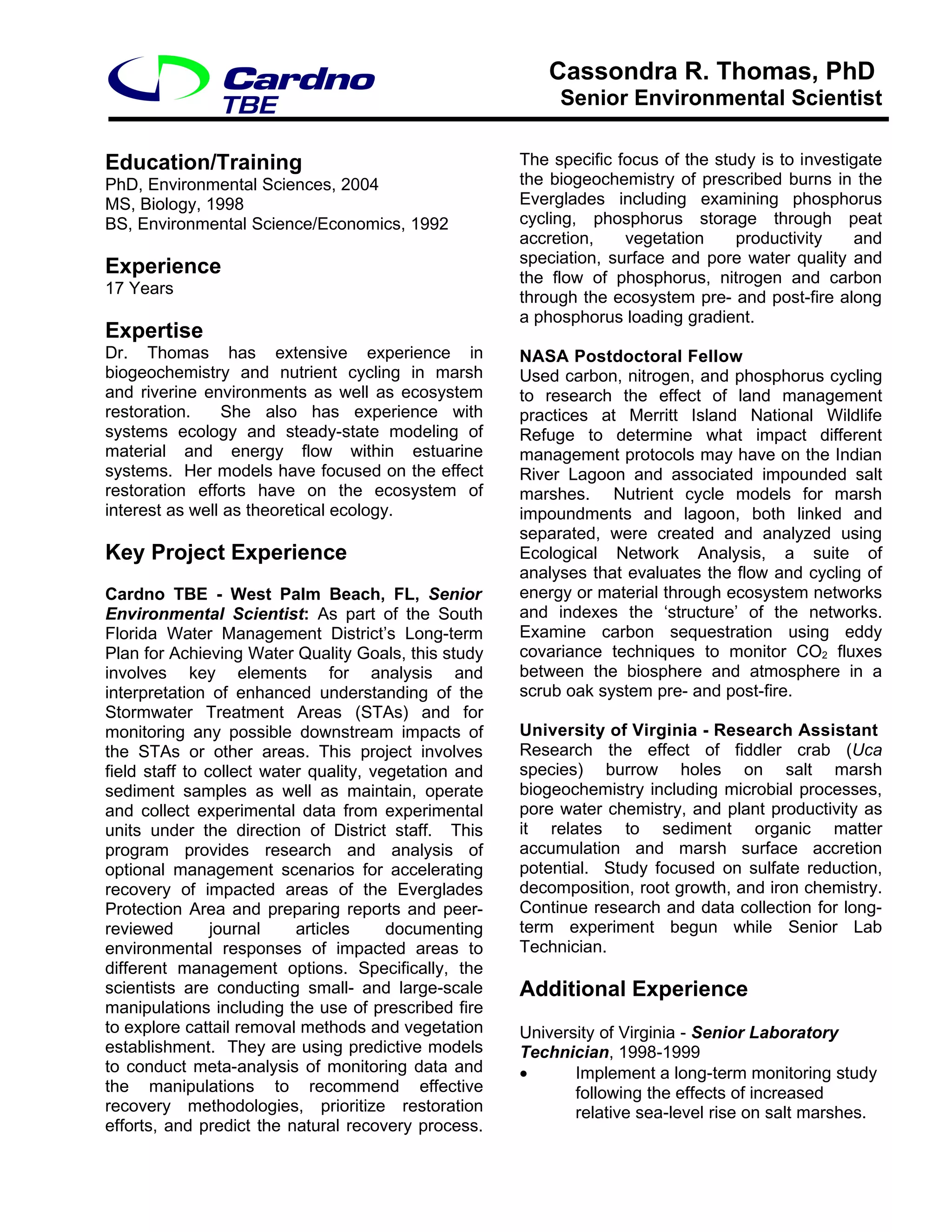
    Cassondra R. Thomas,PhD Senior Environmental Scientist Education/Training The specific focus of the study is to investigate PhD, Environmental Sciences, 2004 the biogeochemistry of prescribed burns in the MS, Biology, 1998 Everglades including examining phosphorus BS, Environmental Science/Economics, 1992 cycling, phosphorus storage through peat accretion, vegetation productivity and speciation, surface and pore water quality and Experience the flow of phosphorus, nitrogen and carbon 17 Years through the ecosystem pre- and post-fire along a phosphorus loading gradient. Expertise Dr. Thomas has extensive experience in NASA Postdoctoral Fellow biogeochemistry and nutrient cycling in marsh Used carbon, nitrogen, and phosphorus cycling and riverine environments as well as ecosystem to research the effect of land management restoration. She also has experience with practices at Merritt Island National Wildlife systems ecology and steady-state modeling of Refuge to determine what impact different material and energy flow within estuarine management protocols may have on the Indian systems. Her models have focused on the effect River Lagoon and associated impounded salt restoration efforts have on the ecosystem of marshes. Nutrient cycle models for marsh interest as well as theoretical ecology. impoundments and lagoon, both linked and separated, were created and analyzed using Key Project Experience Ecological Network Analysis, a suite of analyses that evaluates the flow and cycling of Cardno TBE - West Palm Beach, FL, Senior energy or material through ecosystem networks Environmental Scientist: As part of the South and indexes the ‘structure’ of the networks. Florida Water Management District’s Long-term Examine carbon sequestration using eddy Plan for Achieving Water Quality Goals, this study covariance techniques to monitor CO2 fluxes involves key elements for analysis and between the biosphere and atmosphere in a interpretation of enhanced understanding of the scrub oak system pre- and post-fire. Stormwater Treatment Areas (STAs) and for monitoring any possible downstream impacts of University of Virginia - Research Assistant the STAs or other areas. This project involves Research the effect of fiddler crab (Uca field staff to collect water quality, vegetation and species) burrow holes on salt marsh sediment samples as well as maintain, operate biogeochemistry including microbial processes, and collect experimental data from experimental pore water chemistry, and plant productivity as units under the direction of District staff. This it relates to sediment organic matter program provides research and analysis of accumulation and marsh surface accretion optional management scenarios for accelerating potential. Study focused on sulfate reduction, recovery of impacted areas of the Everglades decomposition, root growth, and iron chemistry. Protection Area and preparing reports and peer- Continue research and data collection for long- reviewed journal articles documenting term experiment begun while Senior Lab environmental responses of impacted areas to Technician. different management options. Specifically, the scientists are conducting small- and large-scale Additional Experience manipulations including the use of prescribed fire to explore cattail removal methods and vegetation University of Virginia - Senior Laboratory establishment. They are using predictive models Technician, 1998-1999 to conduct meta-analysis of monitoring data and • Implement a long-term monitoring study the manipulations to recommend effective following the effects of increased recovery methodologies, prioritize restoration relative sea-level rise on salt marshes. efforts, and predict the natural recovery process.
  • 2.
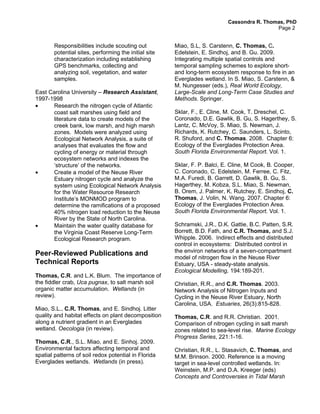
    Cassondra R. Thomas,PhD Page 2 Responsibilities include scouting out Miao, S.L, S. Carstenn, C. Thomas, C. potential sites, performing the initial site Edelstein, E. Sindhoj, and B. Gu. 2009. characterization including establishing Integrating multiple spatial controls and GPS benchmarks, collecting and temporal sampling schemes to explore short- analyzing soil, vegetation, and water and long-term ecosystem response to fire in an samples. Everglades wetland. In S. Miao, S. Carstenn, & M. Nungesser (eds.), Real World Ecology, East Carolina University – Research Assistant, Large-Scale and Long-Term Case Studies and 1997-1998 Methods. Springer. • Research the nitrogen cycle of Atlantic coast salt marshes using field and Sklar, F., E. Cline, M. Cook, T. Dreschel, C. literature data to create models of the Coronado, D.E. Gawlik, B. Gu, S. Hagerthey, S. creek bank, low marsh, and high marsh Lantz, C. McVoy, S. Miao, S. Newman, J. zones. Models were analyzed using Richards, K. Rutchey, C. Saunders, L. Scinto, Ecological Network Analysis, a suite of R. Shuford, and C. Thomas. 2008. Chapter 6: analyses that evaluates the flow and Ecology of the Everglades Protection Area. cycling of energy or material through South Florida Environmental Report. Vol. 1. ecosystem networks and indexes the ‘structure’ of the networks. Sklar, F. P. Balci, E. Cline, M Cook, B. Cooper, • Create a model of the Neuse River C. Coronado, C. Edelstein, M. Ferree, C. Fitz, Estuary nitrogen cycle and analyze the M.A. Furedi, B. Garrett, D. Gawlik, B. Gu, S. system using Ecological Network Analysis Hagerthey, M. Kobza, S.L. Miao, S. Newman, for the Water Resource Research B. Orem, J. Palmer, K. Rutchey, E. Sindhoj, C. Institute’s MONMOD program to Thomas, J. Volin, N. Wang. 2007. Chapter 6: determine the ramifications of a proposed Ecology of the Everglades Protection Area. 40% nitrogen load reduction to the Neuse South Florida Environmental Report. Vol. 1. River by the State of North Carolina. • Maintain the water quality database for Schramski, J.R., D.K. Gattie, B.C. Patten, S.R. the Virginia Coast Reserve Long-Term Borrett, B.D. Fath, and C.R. Thomas, and S.J. Ecological Research program. Whipple. 2006. Indirect effects and distributed control in ecosystems: Distributed control in Peer-Reviewed Publications and the environ networks of a seven-compartment model of nitrogen flow in the Neuse River Technical Reports Estuary, USA - steady-state analysis. Ecological Modelling, 194:189-201. Thomas, C.R. and L.K. Blum. The importance of the fiddler crab, Uca pugnax, to salt marsh soil Christian, R.R., and C.R. Thomas. 2003. organic matter accumulation. Wetlands (in Network Analysis of Nitrogen Inputs and review). Cycling in the Neuse River Estuary, North Carolina, USA. Estuaries, 26(3):815-828. Miao, S.L., C.R. Thomas, and E. Sindhoj. Litter quality and habitat effects on plant decomposition Thomas, C.R. and R.R. Christian. 2001. along a nutrient gradient in an Everglades Comparison of nitrogen cycling in salt marsh wetland. Oecologia (in review). zones related to sea-level rise. Marine Ecology Progress Series, 221:1-16. Thomas, C.R., S.L. Miao, and E. Sinhoj. 2009. Environmental factors affecting temporal and Christian, R.R., L. Stasavich, C. Thomas, and spatial patterns of soil redox potential in Florida M.M. Brinson. 2000. Reference is a moving Everglades wetlands. Wetlands (in press). target in sea-level controlled wetlands. In: Weinstein, M.P. and D.A. Kreeger (eds) Concepts and Controversies in Tidal Marsh
  • 3.
    Cassondra R. Thomas,PhD Page 3 Ecology. Kluwer Academic Publishing, Amsterdam, The Netherlands. Christian, R.R. and C.R. Thomas. 2000. Neuse River Estuary Modeling and Monitoring Project Stage 1: Network analysis for evaluating the consequences of nitrogen loading. Water Resource Research Institute, Report No. 325-F. 44pp.