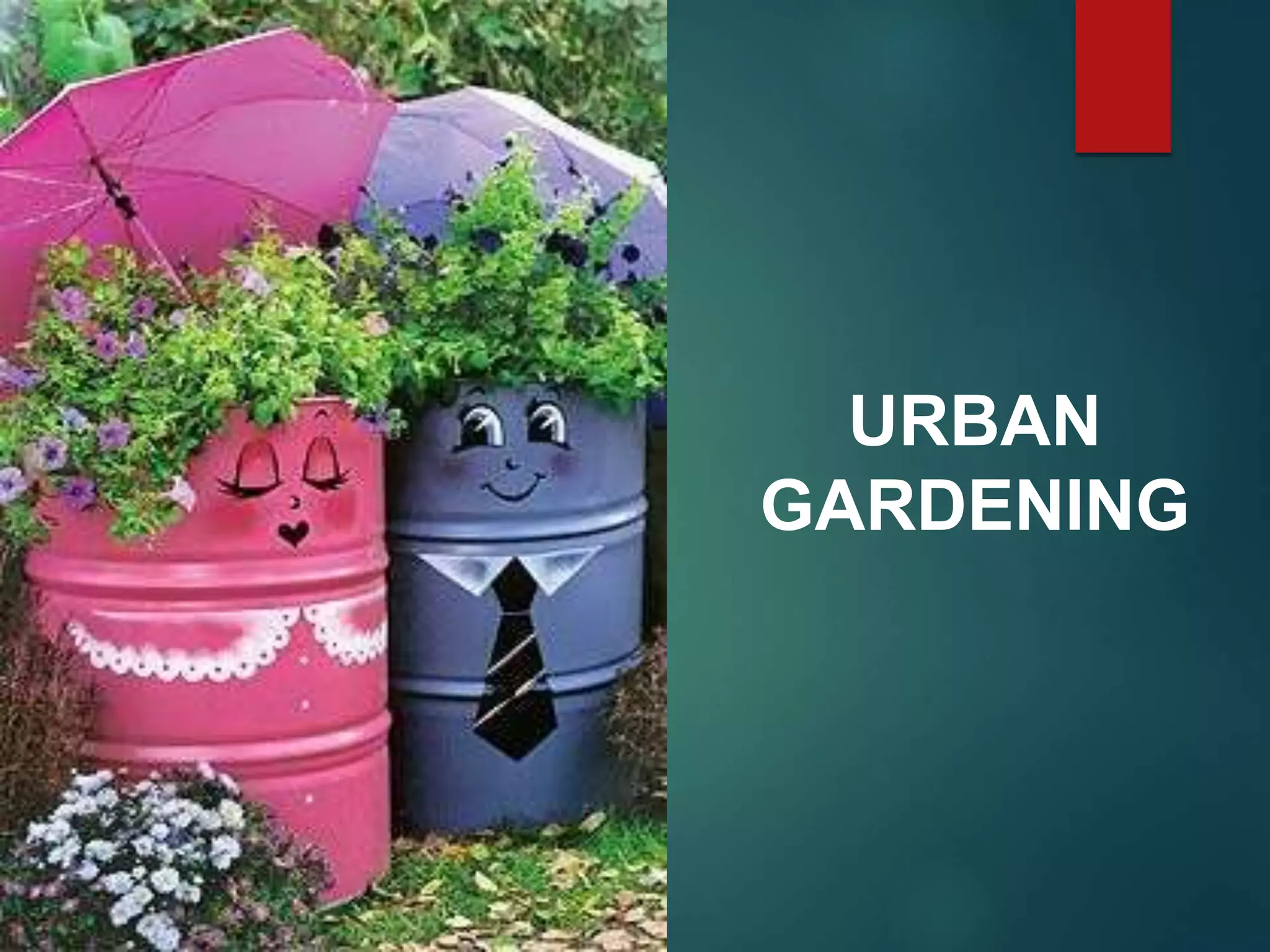
URBAN
GARDENING
WHAT IS URBAN
GRADENING?
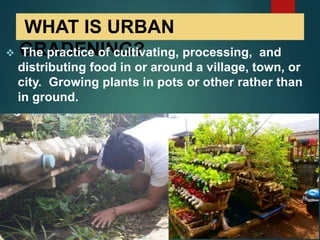
 The practice of cultivating, processing, and
distributing food in or around a village, town, or
city. Growing plants in pots or other rather than
in ground.
WHY DO WE
NEED TO DO
GARDENING?
BENEFIT
S
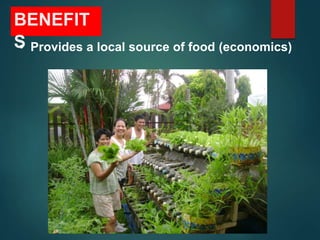
• Provides a local source of food (economics)
BENEFIT
S
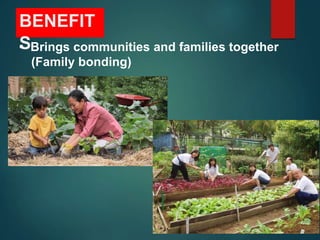
• Brings communities and families together
(Family bonding)
BENEFIT
S
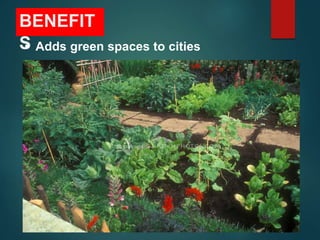
• Adds green spaces to cities
BENEFIT
S
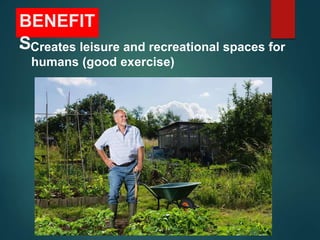
• Creates leisure and recreational spaces for
humans (good exercise)
BENEFIT
S
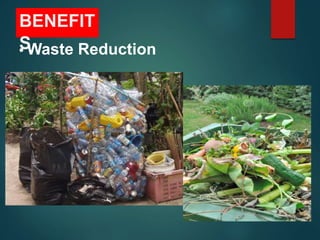
• Waste Reduction
BENEFIT
S
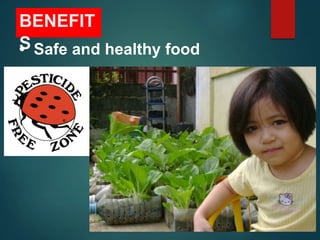
• Safe and healthy food
Health and Wellness
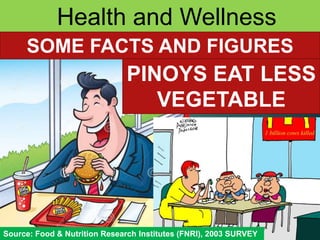
SOME FACTS AND FIGURES
PINOYS EAT LESS
VEGETABLE
Source: Food & Nutrition Research Institutes (FNRI), 2003 SURVEY
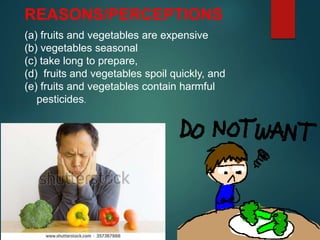
REASONS/PERCEPTIONS
(a) fruits and vegetables are expensive
(b) vegetables seasonal
(c) take long to prepare,
(d) fruits and vegetables spoil quickly, and
(e) fruits and vegetables contain harmful
pesticides.
TYPES OF URBAN
GARDENING
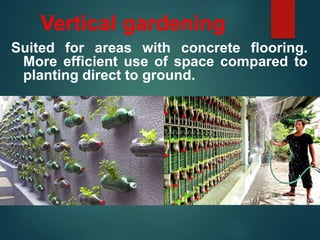
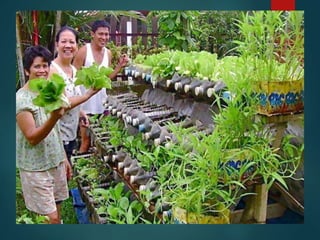
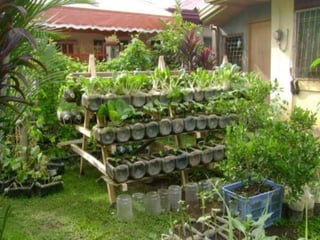
Vertical gardening
Suited for areas with concrete flooring.
More efficient use of space compared to
planting direct to ground.
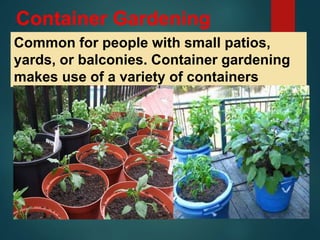
Common for people with small patios,
yards, or balconies. Container gardening
makes use of a variety of containers
Container Gardening
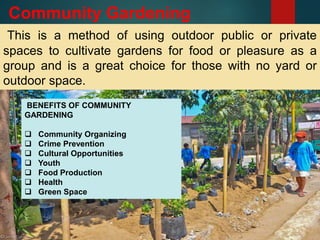
Community Gardening
This is a method of using outdoor public or private
spaces to cultivate gardens for food or pleasure as a
group and is a great choice for those with no yard or
outdoor space.
BENEFITS OF COMMUNITY
GARDENING
 Community Organizing
 Crime Prevention
 Cultural Opportunities
 Youth
 Food Production
 Health
 Green Space
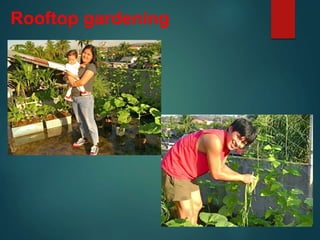
Rooftop gardening
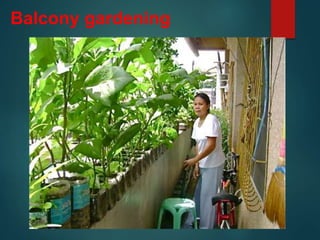
Balcony gardening
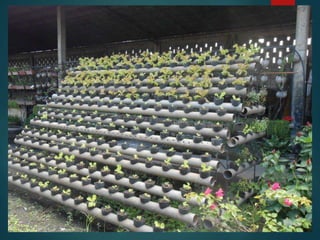
Used Pipes
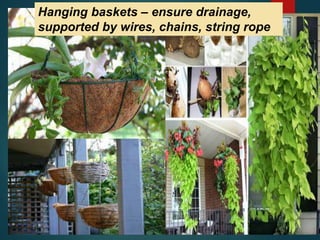
Hanging baskets – ensure drainage,
supported by wires, chains, string rope
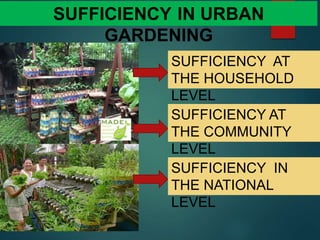
SUFFICIENCY IN URBAN
GARDENING
SUFFICIENCY AT
THE HOUSEHOLD
LEVEL
SUFFICIENCY AT
THE COMMUNITY
LEVEL
SUFFICIENCY IN
THE NATIONAL
LEVEL
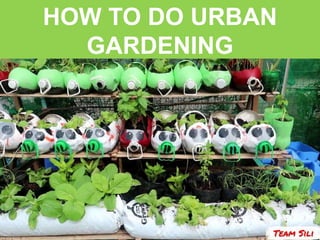
HOW TO DO URBAN
GARDENING
Seeds – source from ripe fruits,
reputable seed merchants. Budded trees
in case of calamansi, avocado, mango
(grows much smaller).
Site or area
Sunlight (amount and duration) – at least
6 hours
FACTORS TO BE CONSIDERED
Water source - consider rainwater
harvesting
Drainage
Air movement – sufficient air
movement prevents waterlogging
and diseases. Too much wind is
also not good – wind burn (leaves
dry out and break)
Accessibility – especially in
rooftop gardens
RECYCLING
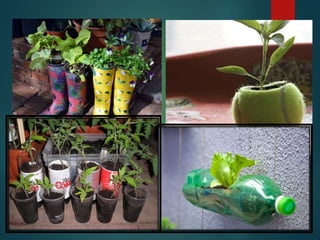
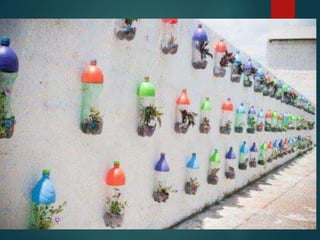
One of the most important aspects of container farming is
recycling. Finding alternative uses for household items which were
thrown out in the garbage as non-biodegradable wastes products
will help lessen pollution.
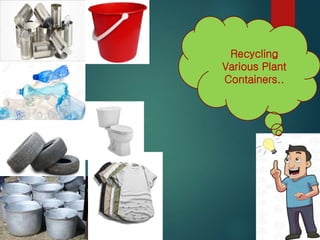
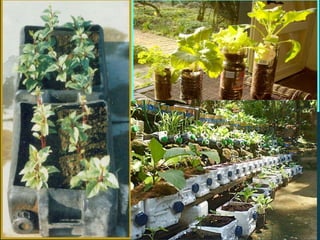
Recycling
Various Plant
Containers..
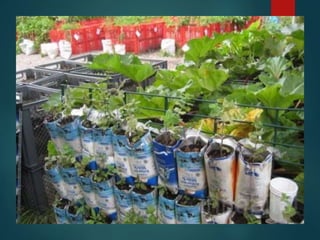
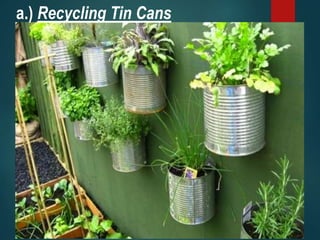
a.) Recycling Tin Cans
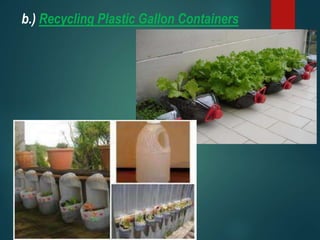
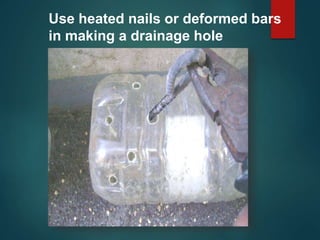
b.) Recycling Plastic Gallon Containers
Use heated nails or deformed bars
in making a drainage hole
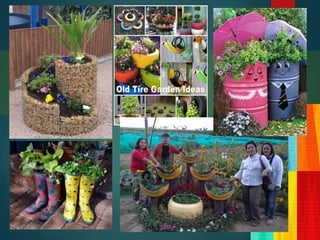
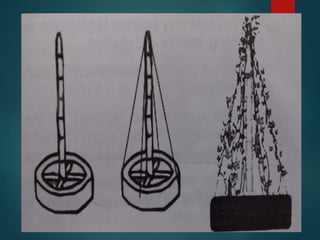
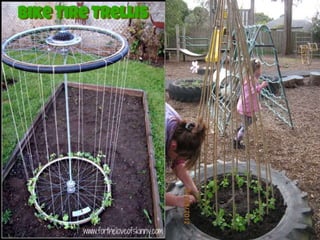
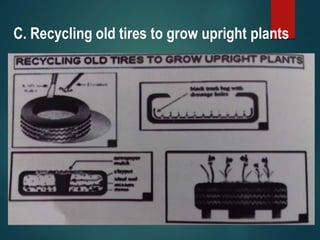
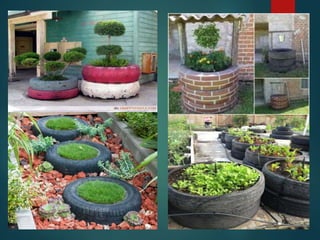
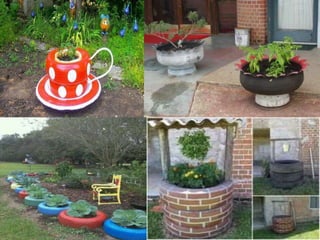
C. Recycling old tires to grow upright plants
Sourcing of Planting Materials
Accredited seed growers
Accredited seed suppliers
Government experiment
stations
NGO, Municipal and Provincial
Agriculturist Office.
Planting medium Preparation
 Factors to be considered for a planting medium:
- The growing medium must be porous
-Have a good deal of air inside
- Well-drained soil
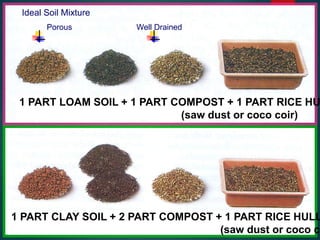
Ideal Soil Mixture
Porous Well Drained
1 PART LOAM SOIL + 1 PART COMPOST + 1 PART RICE HU
(saw dust or coco coir)
1 PART CLAY SOIL + 2 PART COMPOST + 1 PART RICE HULL
(saw dust or coco co
Avoid using same soil each year,
nutrition is depleted, insect and
fungal pests have accumulated –
either replace with new medium or
empty the pots & clean. Solarize
soil medium and ameliorate with
new potting mix.
DIFFERENT TYPES OF
VEGETABLES THAT CAN
BE GROWN IN
CONTAINERS
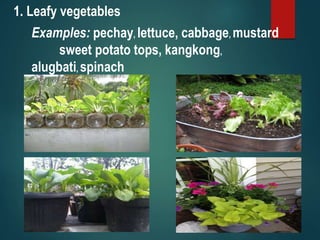
1. Leafy vegetables
Examples: pechay, lettuce, cabbage, mustard
sweet potato tops, kangkong,
alugbati, spinach
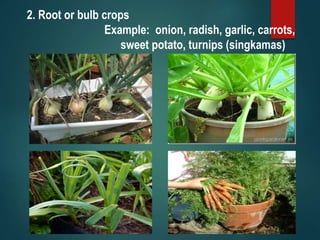
2. Root or bulb crops
Example: onion, radish, garlic, carrots,
sweet potato, turnips (singkamas)
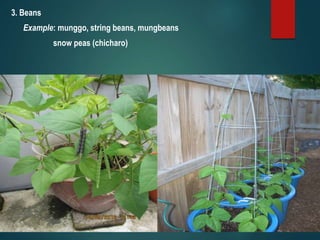
3. Beans
Example: munggo, string beans, mungbeans
snow peas (chicharo)
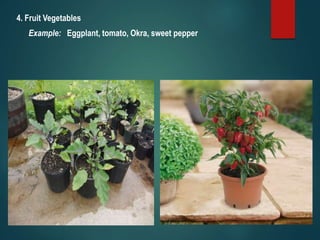
4. Fruit Vegetables
Example: Eggplant, tomato, Okra, sweet pepper
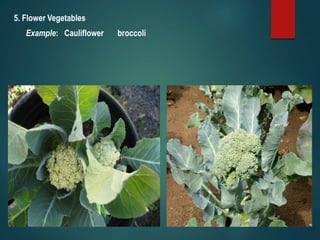
5. Flower Vegetables
Example: Cauliflower broccoli
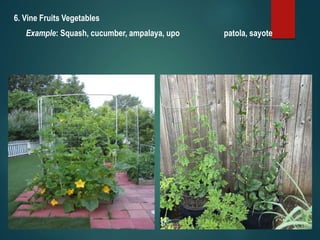
6. Vine Fruits Vegetables
Example: Squash, cucumber, ampalaya, upo patola, sayote
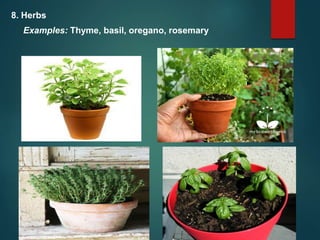
8. Herbs
Examples: Thyme, basil, oregano, rosemary
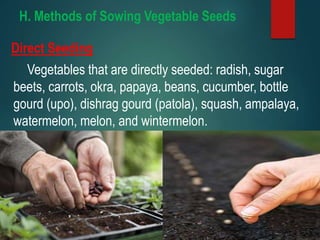
H. Methods of Sowing Vegetable Seeds
Direct Seeding
Vegetables that are directly seeded: radish, sugar
beets, carrots, okra, papaya, beans, cucumber, bottle
gourd (upo), dishrag gourd (patola), squash, ampalaya,
watermelon, melon, and wintermelon.
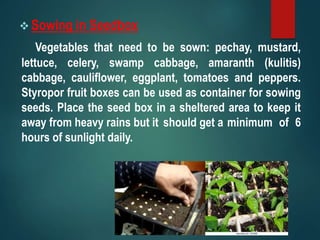
 Sowing in Seedbox
Vegetables that need to be sown: pechay, mustard,
lettuce, celery, swamp cabbage, amaranth (kulitis)
cabbage, cauliflower, eggplant, tomatoes and peppers.
Styropor fruit boxes can be used as container for sowing
seeds. Place the seed box in a sheltered area to keep it
away from heavy rains but it should get a minimum of 6
hours of sunlight daily.
Transplanting
Transplant seedlings 2 to 3 weeks after seedlings
have been germinated. Transplant late in the afternoon
to prevent “transplanting shock” and to speed up
recovery.
Process of Transplanting
1. Water seedlings in the seed box thoroughly.
2. Choose a potting container large enough to
accommodate the full grown plant.
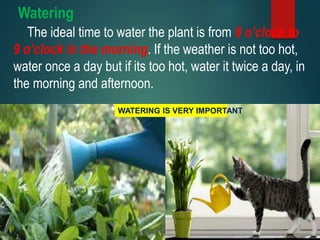
Watering
The ideal time to water the plant is from 8 o’clock to
9 o’clock in the morning. If the weather is not too hot,
water once a day but if its too hot, water it twice a day, in
the morning and afternoon.
WATERING IS VERY IMPORTANT
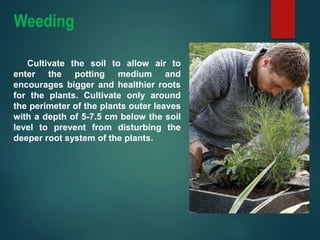
Weeding
Cultivate the soil to allow air to
enter the potting medium and
encourages bigger and healthier roots
for the plants. Cultivate only around
the perimeter of the plants outer leaves
with a depth of 5-7.5 cm below the soil
level to prevent from disturbing the
deeper root system of the plants.
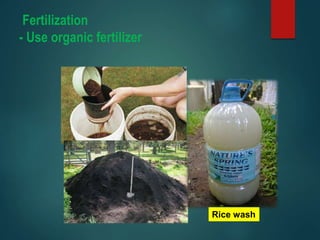
Fertilization
- Use organic fertilizer
Rice wash
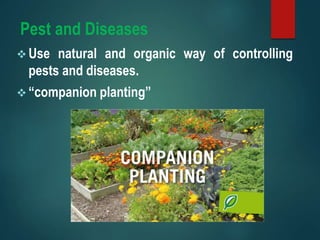
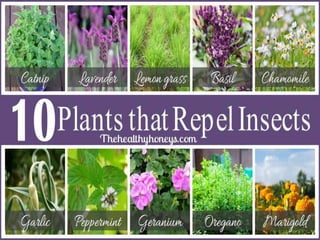
Pest and Diseases
 Use natural and organic way of controlling
pests and diseases.
 “companion planting”
Harvesting
 Harvest plants at the right maturity age. A rule
of thumb, harvest early in the morning or in late
afternoon.
 Harvest vegetables and fruits right before
cooking or eating to retain the sugar content.
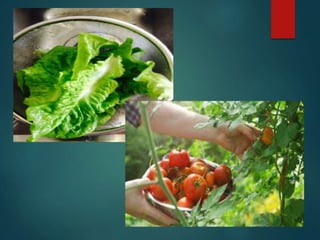
 For leafy vegetables like pechay, lettuce and
cabbages, harvest first the lower leaves. This
method of harvesting the first lower leaves is
called “priming”
Urban gardening.pptx

Urban gardening.pptx

  • 1.
  • 2.
    WHAT IS URBAN GRADENING? The practice of cultivating, processing, and distributing food in or around a village, town, or city. Growing plants in pots or other rather than in ground.
  • 3.
    WHY DO WE NEEDTO DO GARDENING?
  • 4.
    BENEFIT S • Provides alocal source of food (economics)
  • 5.
    BENEFIT S • Brings communitiesand families together (Family bonding)
  • 6.
    BENEFIT S • Adds greenspaces to cities
  • 7.
    BENEFIT S • Creates leisureand recreational spaces for humans (good exercise)
  • 8.
  • 9.
  • 10.
    Health and Wellness SOMEFACTS AND FIGURES PINOYS EAT LESS VEGETABLE Source: Food & Nutrition Research Institutes (FNRI), 2003 SURVEY
  • 11.
    REASONS/PERCEPTIONS (a) fruits andvegetables are expensive (b) vegetables seasonal (c) take long to prepare, (d) fruits and vegetables spoil quickly, and (e) fruits and vegetables contain harmful pesticides.
  • 12.
  • 13.
    Vertical gardening Suited forareas with concrete flooring. More efficient use of space compared to planting direct to ground.
  • 14.
    Common for peoplewith small patios, yards, or balconies. Container gardening makes use of a variety of containers Container Gardening
  • 17.
    Community Gardening This isa method of using outdoor public or private spaces to cultivate gardens for food or pleasure as a group and is a great choice for those with no yard or outdoor space. BENEFITS OF COMMUNITY GARDENING  Community Organizing  Crime Prevention  Cultural Opportunities  Youth  Food Production  Health  Green Space
  • 18.
  • 19.
  • 20.
  • 24.
    Hanging baskets –ensure drainage, supported by wires, chains, string rope
  • 25.
    SUFFICIENCY IN URBAN GARDENING SUFFICIENCYAT THE HOUSEHOLD LEVEL SUFFICIENCY AT THE COMMUNITY LEVEL SUFFICIENCY IN THE NATIONAL LEVEL
  • 26.
    HOW TO DOURBAN GARDENING
  • 27.
    Seeds – sourcefrom ripe fruits, reputable seed merchants. Budded trees in case of calamansi, avocado, mango (grows much smaller). Site or area Sunlight (amount and duration) – at least 6 hours FACTORS TO BE CONSIDERED
  • 28.
    Water source -consider rainwater harvesting Drainage Air movement – sufficient air movement prevents waterlogging and diseases. Too much wind is also not good – wind burn (leaves dry out and break) Accessibility – especially in rooftop gardens
  • 29.
    RECYCLING One of themost important aspects of container farming is recycling. Finding alternative uses for household items which were thrown out in the garbage as non-biodegradable wastes products will help lessen pollution.
  • 30.
  • 31.
  • 32.
    b.) Recycling PlasticGallon Containers
  • 33.
    Use heated nailsor deformed bars in making a drainage hole
  • 36.
    C. Recycling oldtires to grow upright plants
  • 41.
    Sourcing of PlantingMaterials Accredited seed growers Accredited seed suppliers Government experiment stations NGO, Municipal and Provincial Agriculturist Office.
  • 42.
    Planting medium Preparation Factors to be considered for a planting medium: - The growing medium must be porous -Have a good deal of air inside - Well-drained soil
  • 43.
    Ideal Soil Mixture PorousWell Drained 1 PART LOAM SOIL + 1 PART COMPOST + 1 PART RICE HU (saw dust or coco coir) 1 PART CLAY SOIL + 2 PART COMPOST + 1 PART RICE HULL (saw dust or coco co
  • 44.
    Avoid using samesoil each year, nutrition is depleted, insect and fungal pests have accumulated – either replace with new medium or empty the pots & clean. Solarize soil medium and ameliorate with new potting mix.
  • 45.
    DIFFERENT TYPES OF VEGETABLESTHAT CAN BE GROWN IN CONTAINERS
  • 46.
    1. Leafy vegetables Examples:pechay, lettuce, cabbage, mustard sweet potato tops, kangkong, alugbati, spinach
  • 47.
    2. Root orbulb crops Example: onion, radish, garlic, carrots, sweet potato, turnips (singkamas)
  • 48.
    3. Beans Example: munggo,string beans, mungbeans snow peas (chicharo)
  • 49.
    4. Fruit Vegetables Example:Eggplant, tomato, Okra, sweet pepper
  • 50.
    5. Flower Vegetables Example:Cauliflower broccoli
  • 51.
    6. Vine FruitsVegetables Example: Squash, cucumber, ampalaya, upo patola, sayote
  • 52.
    8. Herbs Examples: Thyme,basil, oregano, rosemary
  • 53.
    H. Methods ofSowing Vegetable Seeds Direct Seeding Vegetables that are directly seeded: radish, sugar beets, carrots, okra, papaya, beans, cucumber, bottle gourd (upo), dishrag gourd (patola), squash, ampalaya, watermelon, melon, and wintermelon.
  • 54.
     Sowing inSeedbox Vegetables that need to be sown: pechay, mustard, lettuce, celery, swamp cabbage, amaranth (kulitis) cabbage, cauliflower, eggplant, tomatoes and peppers. Styropor fruit boxes can be used as container for sowing seeds. Place the seed box in a sheltered area to keep it away from heavy rains but it should get a minimum of 6 hours of sunlight daily.
  • 55.
    Transplanting Transplant seedlings 2to 3 weeks after seedlings have been germinated. Transplant late in the afternoon to prevent “transplanting shock” and to speed up recovery. Process of Transplanting 1. Water seedlings in the seed box thoroughly. 2. Choose a potting container large enough to accommodate the full grown plant.
  • 56.
    Watering The ideal timeto water the plant is from 8 o’clock to 9 o’clock in the morning. If the weather is not too hot, water once a day but if its too hot, water it twice a day, in the morning and afternoon. WATERING IS VERY IMPORTANT
  • 57.
    Weeding Cultivate the soilto allow air to enter the potting medium and encourages bigger and healthier roots for the plants. Cultivate only around the perimeter of the plants outer leaves with a depth of 5-7.5 cm below the soil level to prevent from disturbing the deeper root system of the plants.
  • 58.
    Fertilization - Use organicfertilizer Rice wash
  • 59.
    Pest and Diseases Use natural and organic way of controlling pests and diseases.  “companion planting”
  • 61.
    Harvesting  Harvest plantsat the right maturity age. A rule of thumb, harvest early in the morning or in late afternoon.  Harvest vegetables and fruits right before cooking or eating to retain the sugar content.  For leafy vegetables like pechay, lettuce and cabbages, harvest first the lower leaves. This method of harvesting the first lower leaves is called “priming”