FAA 
Avia on Safety 
www.FAASafety.gov          Produced by FAA Safety Briefing | Download at 1.usa.gov/SPANS  
General Avia on  
Joint Steering Commi ee  
Safety Enhancement Topic 
November 2014 
Experimental/Amateur-Built Flight Testing
  NTSB accident data show that experimental and amateur‐built aircra  account for a dispropor onate 
number of fatal events.  The data also show that the first 50 hours of flight  me on a newly constructed E/AB 
aircra  are par cularly dangerous.  Aircra  modifica ons show a similar spike in accidents shortly a er those 
modifica ons are completed.  Accident inves ga on of these events frequently shows that a robust flight 
test program conducted by a competent test pilot would reduce the number of fatal crashes. FAA’s new 
Addi onal Pilot Program further enhances flight safety by allowing builders to have a qualified addi onal 
pilot be part of the flight tes ng process.  
The Danger
  In 2012, NTSB completed a safety study of E‐
AB aircra  that included the use of an EAA survey of 
E‐AB pilots. Among other findings, the NTSB 
concluded that the flight test period—the first 50 
hours of flight—is uniquely challenging for most E‐
AB pilots because they must learn to manage the 
handling characteris cs of an unfamiliar aircra  
while also managing the challenges of the flight test 
environment, including instrumenta on that is not 
yet calibrated, controls that may need adjustments, 
and possible malfunc ons or adverse handling 
characteris cs.  E/A‐B aircra  can also be faster, 
have higher stall speeds, and be less crashworthy 
than many standard aircra .  
  So how do you know your aircra  is in a 
condi on for safe flight? Will it operate safely within 
its opera onal envelope? Will it have any quirky 
characteris cs or limita ons? That is where a 
detailed flight test plan can come in.   
 
The Plan
  Thankfully the FAA has produced an 
excellent document that can help you develop such 
a flight test plan, taking into account everything 
from selec ng the right airport and runway to an 
exhaus ve list of first flight and emergency 
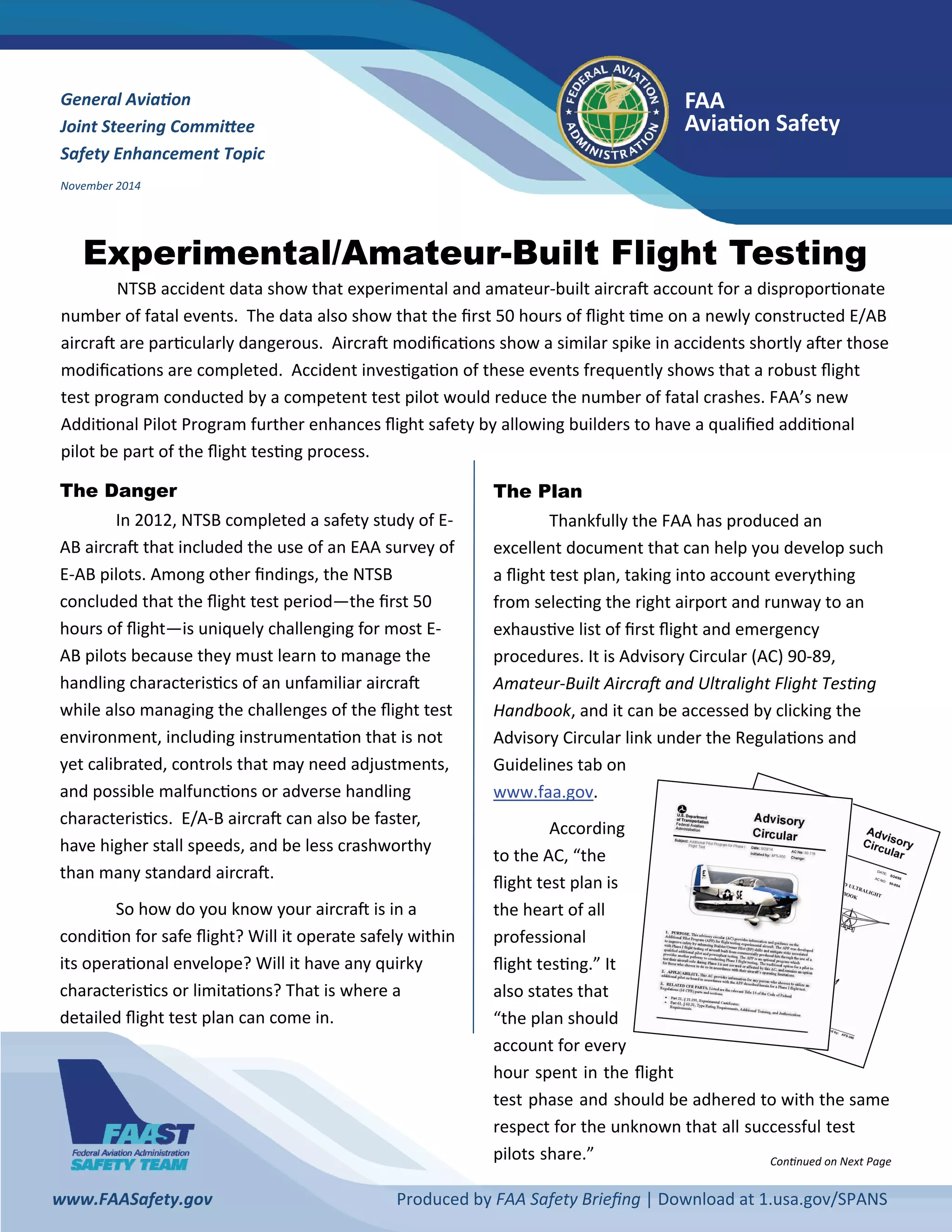
procedures. It is Advisory Circular (AC) 90‐89, 
Amateur‐Built Aircra  and Ultralight Flight Tes ng 
Handbook, and it can be accessed by clicking the 
Advisory Circular link under the Regula ons and 
Guidelines tab on 
www.faa.gov.  
  According 
to the AC, “the 
flight test plan is 
the heart of all 
professional 
flight tes ng.” It 
also states that 
“the plan should 
account for every 
hour spent in the flight 
test phase and should be adhered to with the same 
respect for the unknown that all successful test 
pilots share.”   Con nued on Next Page 
www.FAASafety.gov          Produced by FAA Safety Briefing | Download at 1.usa.gov/SPANS  
Take it Step By Step
  It’s important to heed the advice this AC 
offers in terms of flight test prepara on. In addi on 
to discovering any unwanted characteris cs (e.g., 
perhaps you rigged the aileron cables too  ghtly), a 
thorough flight test plan will also help point out 
performance limita ons you may not be used to 
with your previous aircra  type. For example, those 
transi oning to an ultralight will no ce a big 
difference in how power se ngs can affect 
airspeed. In a light‐weight aircra , it is possible to go 
from cruise speed to a stall in less than 4 seconds. 
This is due to the low mass, high drag configura on, 
and smaller speed range characteris c of the 
majority of ultralights. (Note: AC 90‐109 is another 
helpful resource you should use when transi oning 
to an unfamiliar aircra  type).  
  Chapter 1 of AC 90‐89 guides builders in 
preparing for the flight test program.  Subsequent 
chapters cover everything from ini al taxi checks 
through the first 40 hours of flight. 
  Following AC guidance and the Flight Test 
Plan, test pilots progress from aircra  inspec on and 
weight and balance calcula ons, through taxi and 
ini al flight tests, and on to maximum performance 
maneuvers and spins.  
Changes
Even pilots of manufactured aircra  may find 
themselves in a test pilot role. Manufactured aircra  
are run through a Flight Test program during type 
cer fica on of course, but they also undergo tes ng 
when they’ve been modified, upgraded, or 
improved.  
The same is true for E/AB aircra  as well. It’s a good 
idea to run your aircra  through flight test 
procedure any  me you make a change that could 
alter the aircra ’s flying characteris cs. That will 
give you the opportunity to document any changes 
in weight and balance, performance, or opera onal 
procedures. 
Test Pilots
  Once the Flight Test Plan is complete, a test 
pilot must be selected. Most builders look forward 
to commanding the first flight in their aircra  but 
the builder may not be the best pilot for the job, 
especially with the ever‐increasing complexity and 
capability of many E/AB aircra . 
  Realizing the value an extra set of hands and 
eyes can provide during this crucial period, last 
September the FAA adopted AC 90‐116, which 
offers E‐AB pilots an alternate pathway to 
conduc ng Phase I flight tes ng. The AC introduces 
the Addi onal Pilot Program (APP), a program 
designed to improve safety by allowing 
homebuilders to have a qualified addi onal pilot on 
board to assist with flight tests.  
Resources
Amateur‐Built Aircra  and Ultralight Flight Tes ng 
Handbook (FAA‐AC No 90‐89A) 
www.faa.gov/documentLibrary/media/
Advisory_Circular/AC%2090‐89A.pdf 
Addi onal Pilot Program for Phase I Flight Test  
(FAA AC 90‐116) 
www.faa.gov/documentLibrary/media/
Advisory_Circular/AC_90‐116.pdf 
Airmen Transi on to Experimental or Unfamiliar 
Airplanes (FAA AC 90‐109) 
www.faa.gov/documentLibrary/media/
Advisory_Circular/90‐109.pdf 

Experimental/Amateur-Built Flight Testing

  • 1.
    FAA  Avia on Safety  www.FAASafety.gov         Produced by FAA Safety Briefing | Download at 1.usa.gov/SPANS   General Avia on   Joint Steering Commi ee   Safety Enhancement Topic  November 2014  Experimental/Amateur-Built Flight Testing   NTSB accident data show that experimental and amateur‐built aircra  account for a dispropor onate  number of fatal events.  The data also show that the first 50 hours of flight  me on a newly constructed E/AB  aircra  are par cularly dangerous.  Aircra  modifica ons show a similar spike in accidents shortly a er those  modifica ons are completed.  Accident inves ga on of these events frequently shows that a robust flight  test program conducted by a competent test pilot would reduce the number of fatal crashes. FAA’s new  Addi onal Pilot Program further enhances flight safety by allowing builders to have a qualified addi onal  pilot be part of the flight tes ng process.   The Danger   In 2012, NTSB completed a safety study of E‐ AB aircra  that included the use of an EAA survey of  E‐AB pilots. Among other findings, the NTSB  concluded that the flight test period—the first 50  hours of flight—is uniquely challenging for most E‐ AB pilots because they must learn to manage the  handling characteris cs of an unfamiliar aircra   while also managing the challenges of the flight test  environment, including instrumenta on that is not  yet calibrated, controls that may need adjustments,  and possible malfunc ons or adverse handling  characteris cs.  E/A‐B aircra  can also be faster,  have higher stall speeds, and be less crashworthy  than many standard aircra .     So how do you know your aircra  is in a  condi on for safe flight? Will it operate safely within  its opera onal envelope? Will it have any quirky  characteris cs or limita ons? That is where a  detailed flight test plan can come in.      The Plan   Thankfully the FAA has produced an  excellent document that can help you develop such  a flight test plan, taking into account everything  from selec ng the right airport and runway to an  exhaus ve list of first flight and emergency  procedures. It is Advisory Circular (AC) 90‐89,  Amateur‐Built Aircra  and Ultralight Flight Tes ng  Handbook, and it can be accessed by clicking the  Advisory Circular link under the Regula ons and  Guidelines tab on  www.faa.gov.     According  to the AC, “the  flight test plan is  the heart of all  professional  flight tes ng.” It  also states that  “the plan should  account for every  hour spent in the flight  test phase and should be adhered to with the same  respect for the unknown that all successful test  pilots share.”   Con nued on Next Page 
  • 2.
    www.FAASafety.gov         Produced by FAA Safety Briefing | Download at 1.usa.gov/SPANS   Take it Step By Step   It’s important to heed the advice this AC  offers in terms of flight test prepara on. In addi on  to discovering any unwanted characteris cs (e.g.,  perhaps you rigged the aileron cables too  ghtly), a  thorough flight test plan will also help point out  performance limita ons you may not be used to  with your previous aircra  type. For example, those  transi oning to an ultralight will no ce a big  difference in how power se ngs can affect  airspeed. In a light‐weight aircra , it is possible to go  from cruise speed to a stall in less than 4 seconds.  This is due to the low mass, high drag configura on,  and smaller speed range characteris c of the  majority of ultralights. (Note: AC 90‐109 is another  helpful resource you should use when transi oning  to an unfamiliar aircra  type).     Chapter 1 of AC 90‐89 guides builders in  preparing for the flight test program.  Subsequent  chapters cover everything from ini al taxi checks  through the first 40 hours of flight.    Following AC guidance and the Flight Test  Plan, test pilots progress from aircra  inspec on and  weight and balance calcula ons, through taxi and  ini al flight tests, and on to maximum performance  maneuvers and spins.   Changes Even pilots of manufactured aircra  may find  themselves in a test pilot role. Manufactured aircra   are run through a Flight Test program during type  cer fica on of course, but they also undergo tes ng  when they’ve been modified, upgraded, or  improved.   The same is true for E/AB aircra  as well. It’s a good  idea to run your aircra  through flight test  procedure any  me you make a change that could  alter the aircra ’s flying characteris cs. That will  give you the opportunity to document any changes  in weight and balance, performance, or opera onal  procedures.  Test Pilots   Once the Flight Test Plan is complete, a test  pilot must be selected. Most builders look forward  to commanding the first flight in their aircra  but  the builder may not be the best pilot for the job,  especially with the ever‐increasing complexity and  capability of many E/AB aircra .    Realizing the value an extra set of hands and  eyes can provide during this crucial period, last  September the FAA adopted AC 90‐116, which  offers E‐AB pilots an alternate pathway to  conduc ng Phase I flight tes ng. The AC introduces  the Addi onal Pilot Program (APP), a program  designed to improve safety by allowing  homebuilders to have a qualified addi onal pilot on  board to assist with flight tests.   Resources Amateur‐Built Aircra  and Ultralight Flight Tes ng  Handbook (FAA‐AC No 90‐89A)  www.faa.gov/documentLibrary/media/ Advisory_Circular/AC%2090‐89A.pdf  Addi onal Pilot Program for Phase I Flight Test   (FAA AC 90‐116)  www.faa.gov/documentLibrary/media/ Advisory_Circular/AC_90‐116.pdf  Airmen Transi on to Experimental or Unfamiliar  Airplanes (FAA AC 90‐109)  www.faa.gov/documentLibrary/media/ Advisory_Circular/90‐109.pdf