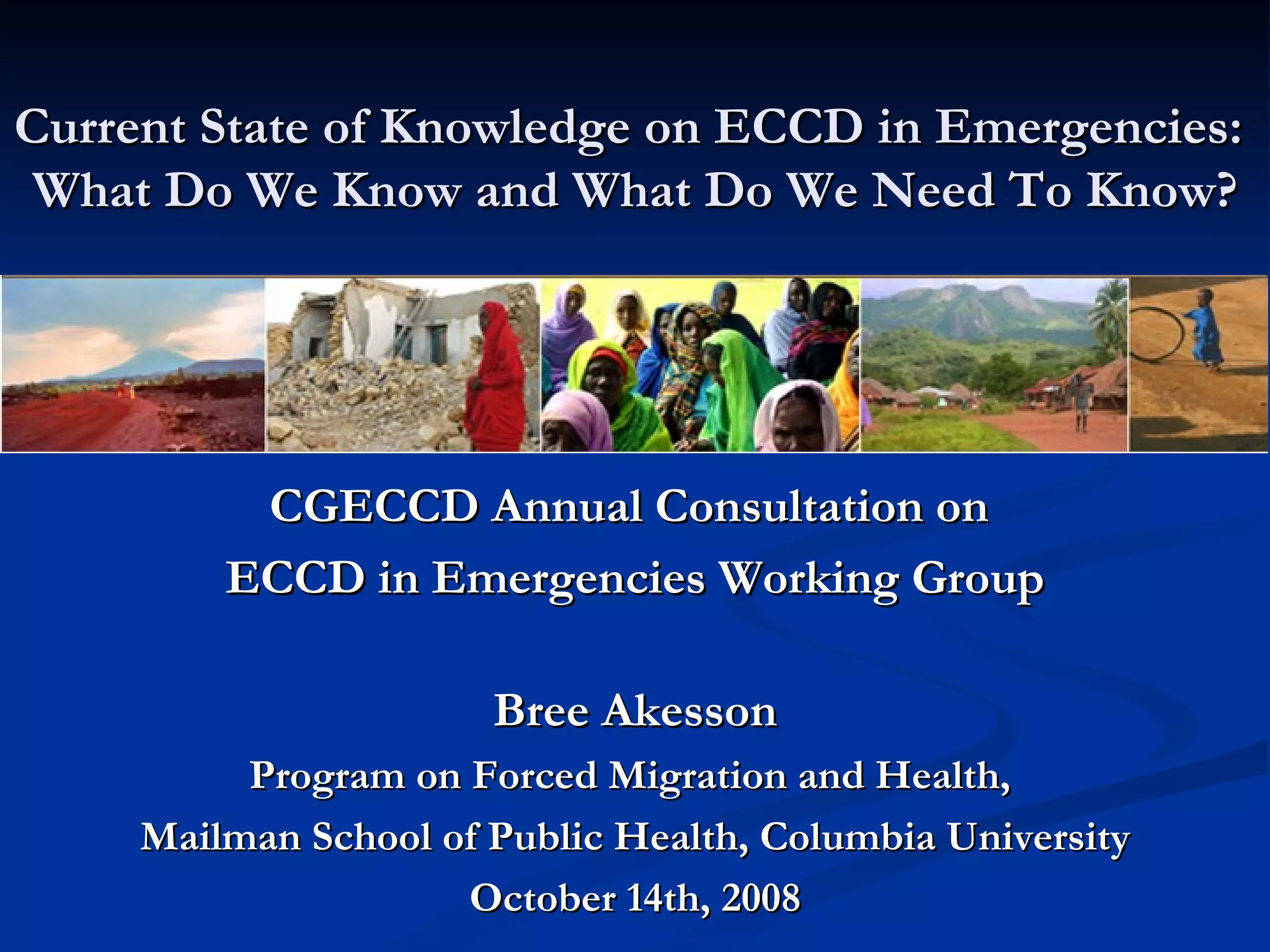
Current State of Knowledge on ECCD in Emergencies:  What Do We Know and What Do We Need To Know? CGECCD Annual Consultation on  ECCD in Emergencies Working Group Bree Akesson Program on Forced Migration and Health,  Mailman School of Public Health, Columbia University October 14th, 2008
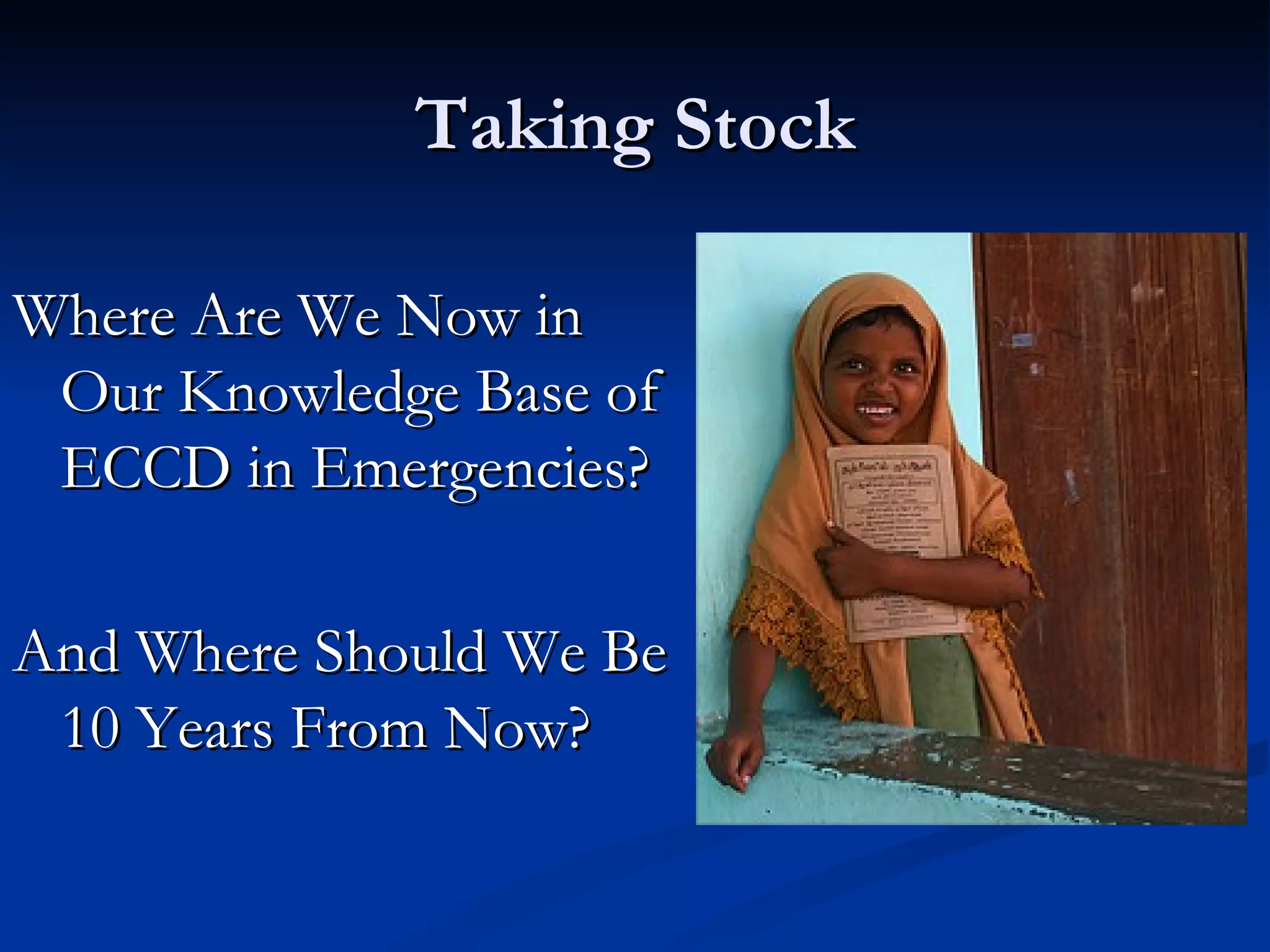
Taking Stock Where Are We Now in Our Knowledge Base of ECCD in Emergencies?  And Where Should We Be 10 Years From Now?
Current State of Practice Graca Machel study was tipping point in care and protection of children, but fundamental gaps remain Don’t know prevalence or incidence rates of child protection concerns There are mixed attempts to incorporate local understandings and definitions of well-being in response and programmatic interventions There is a lack of evidence on interventions that have worked to improve lives of children
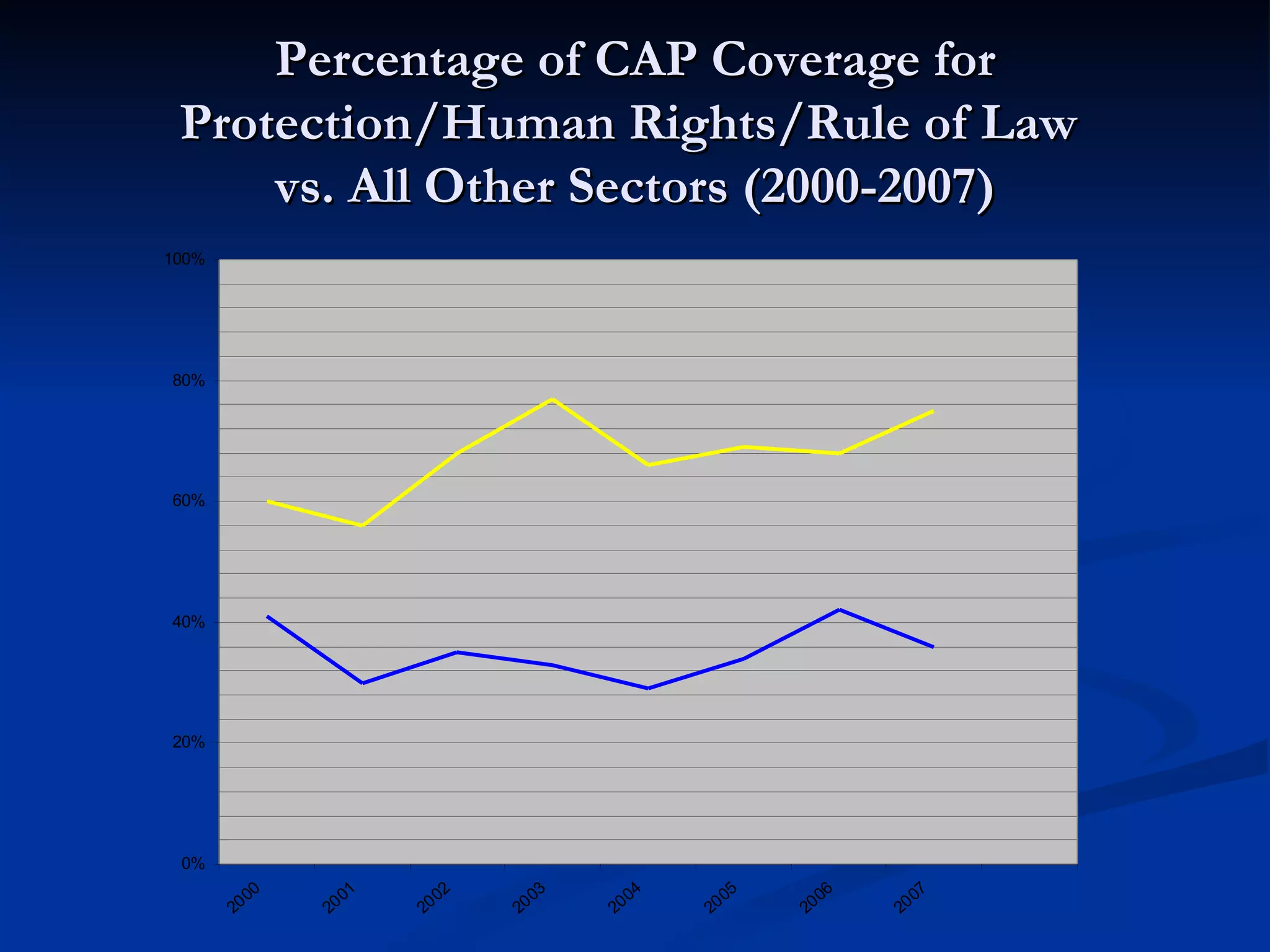
Percentage of CAP Coverage for Protection/Human Rights/Rule of Law  vs. All Other Sectors (2000-2007)
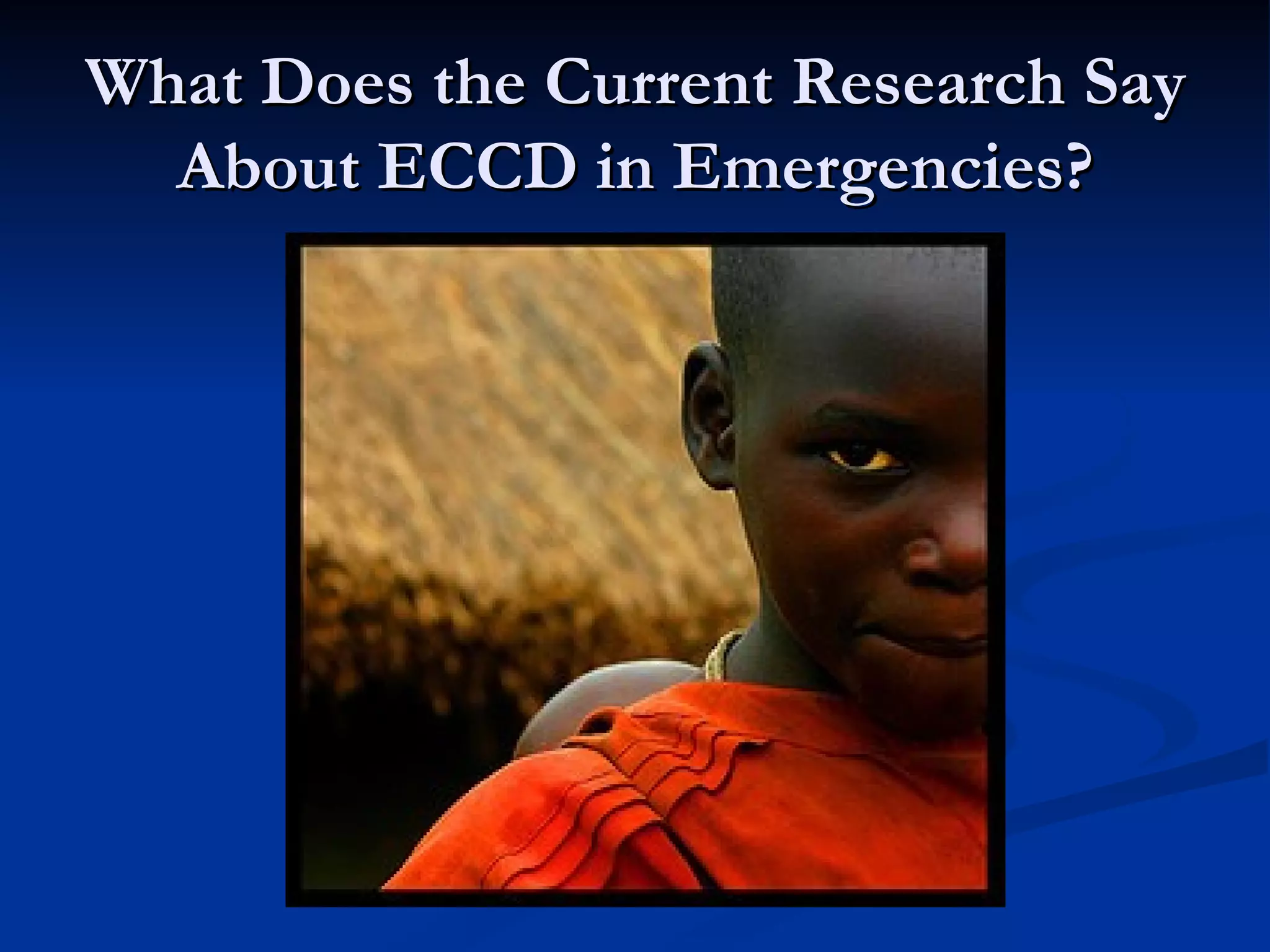
What Does the Current Research Say About ECCD in Emergencies?
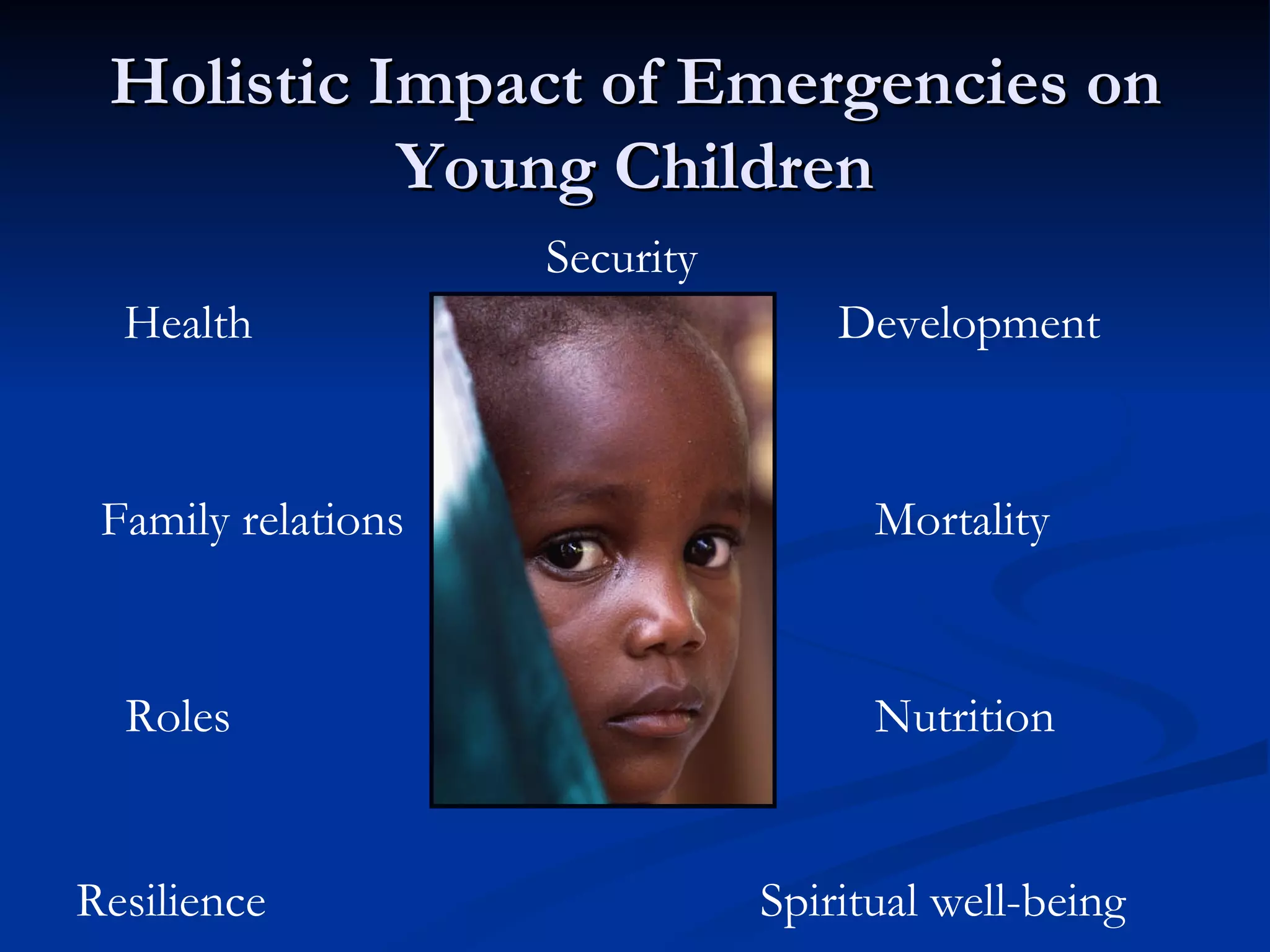
Holistic Impact of Emergencies on Young Children   Security   Health Development Family relations   Mortality Roles   Nutrition  Resilience   Spiritual well-being
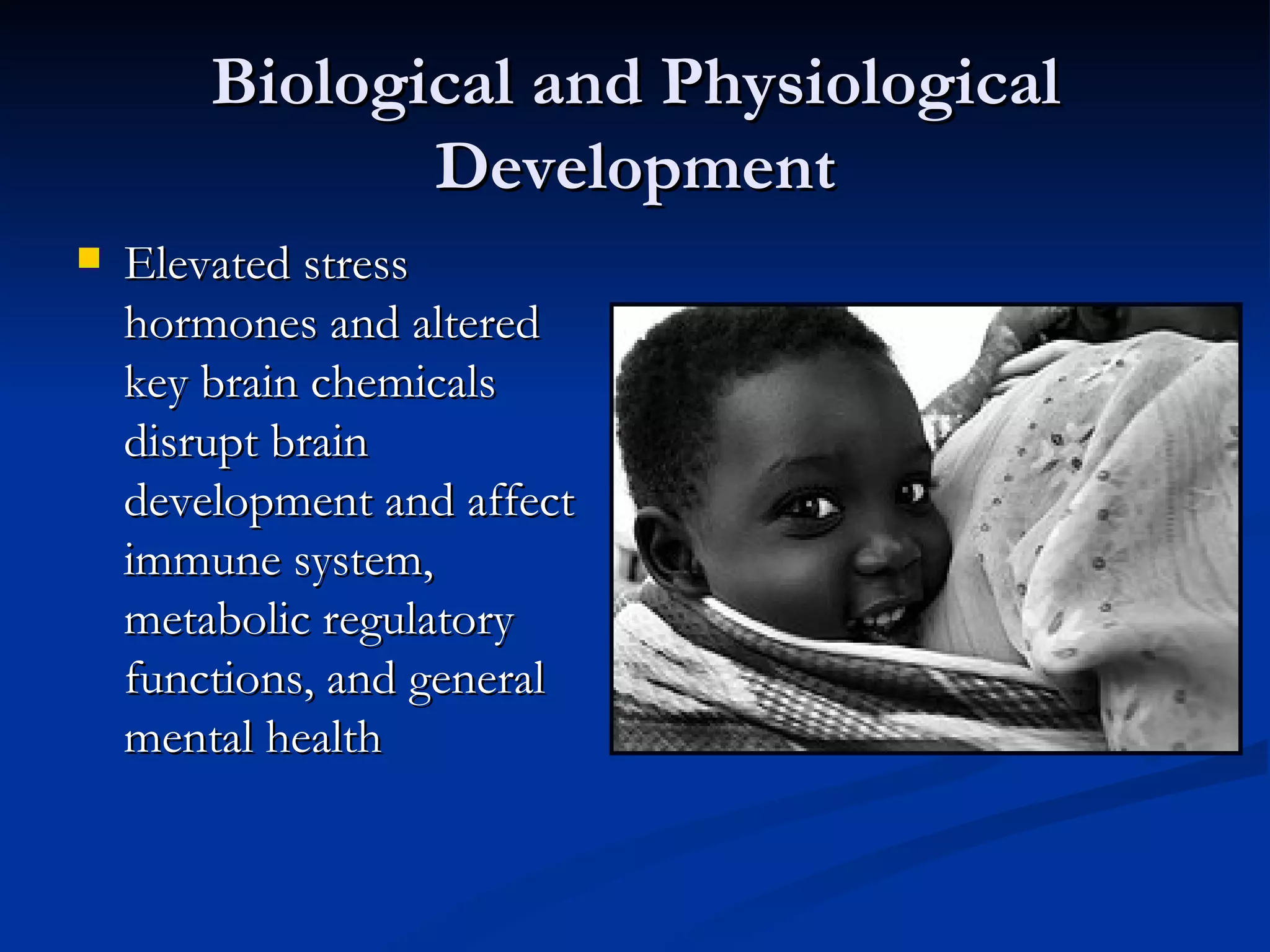
Biological and Physiological Development Elevated stress hormones and altered key brain chemicals disrupt brain development and affect immune system, metabolic regulatory functions, and general mental health
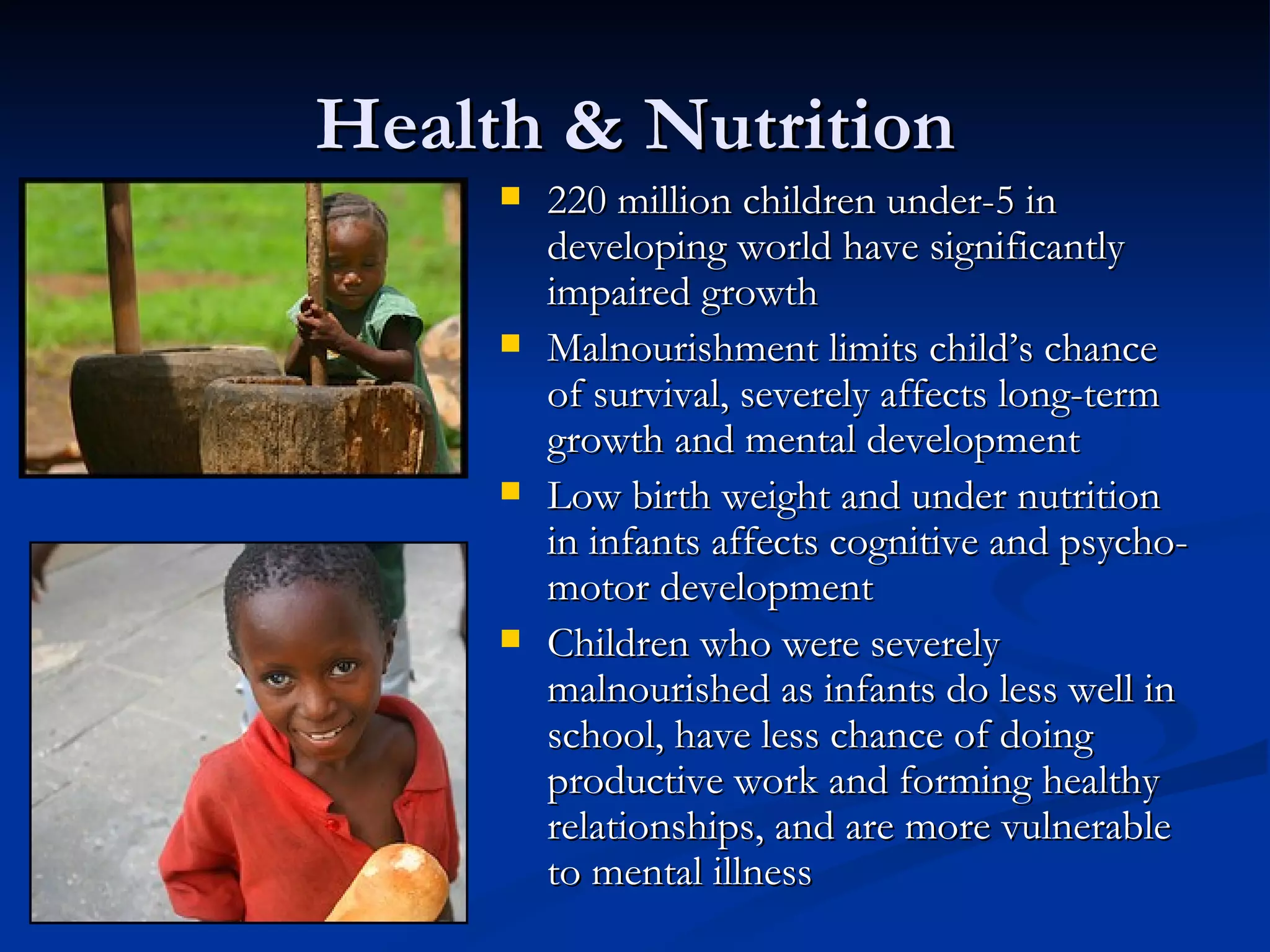
Health & Nutrition 220 million children under-5 in developing world have significantly impaired growth Malnourishment limits child’s chance of survival, severely affects long-term growth and mental development Low birth weight and under nutrition in infants affects cognitive and psycho-motor development Children who were severely malnourished as infants do less well in school, have less chance of doing productive work and forming healthy relationships, and are more vulnerable to mental illness
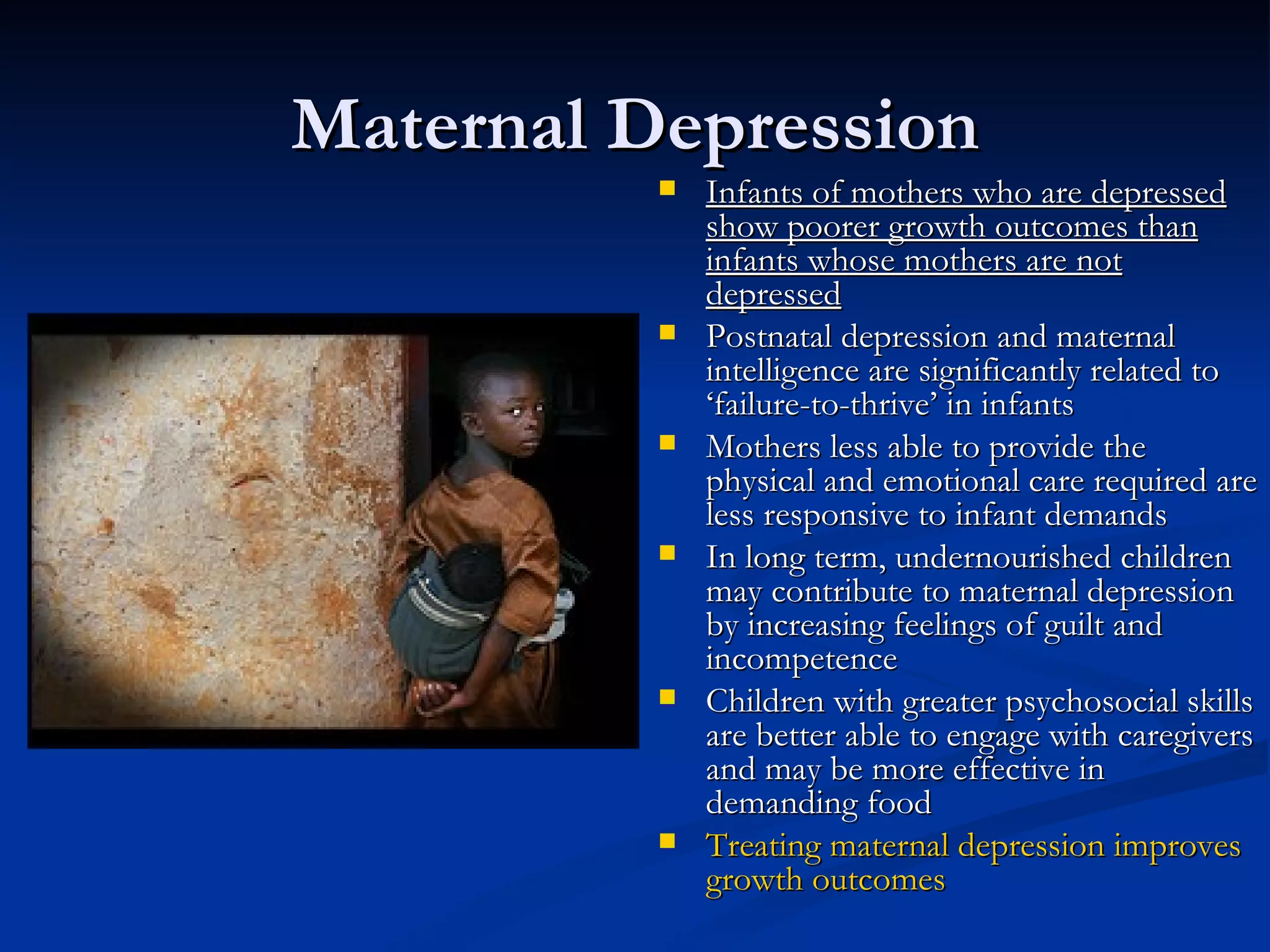
Maternal Depression Infants of mothers who are depressed show poorer growth outcomes than infants whose mothers are not depressed Postnatal depression and maternal intelligence are significantly related to ‘failure-to-thrive’ in infants Mothers less able to provide the physical and emotional care required are less responsive to infant demands In long term, undernourished children may contribute to maternal depression by increasing feelings of guilt and incompetence Children with greater psychosocial skills are better able to engage with caregivers and may be more effective in demanding food Treating maternal depression improves growth outcomes
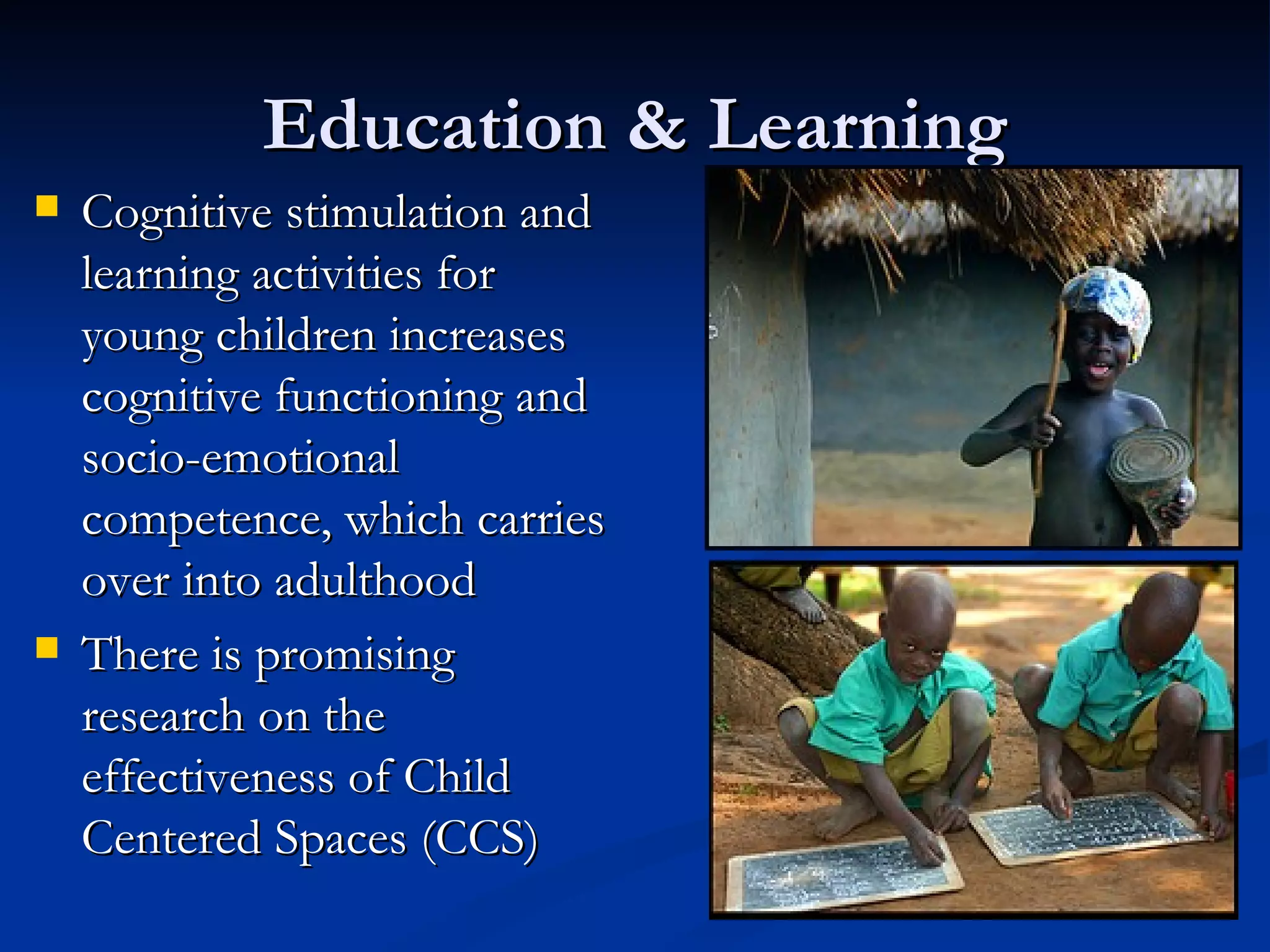
Education & Learning Cognitive stimulation and learning activities for young children increases cognitive functioning and socio-emotional competence, which carries over into adulthood There is promising research on the effectiveness of Child Centered Spaces (CCS)
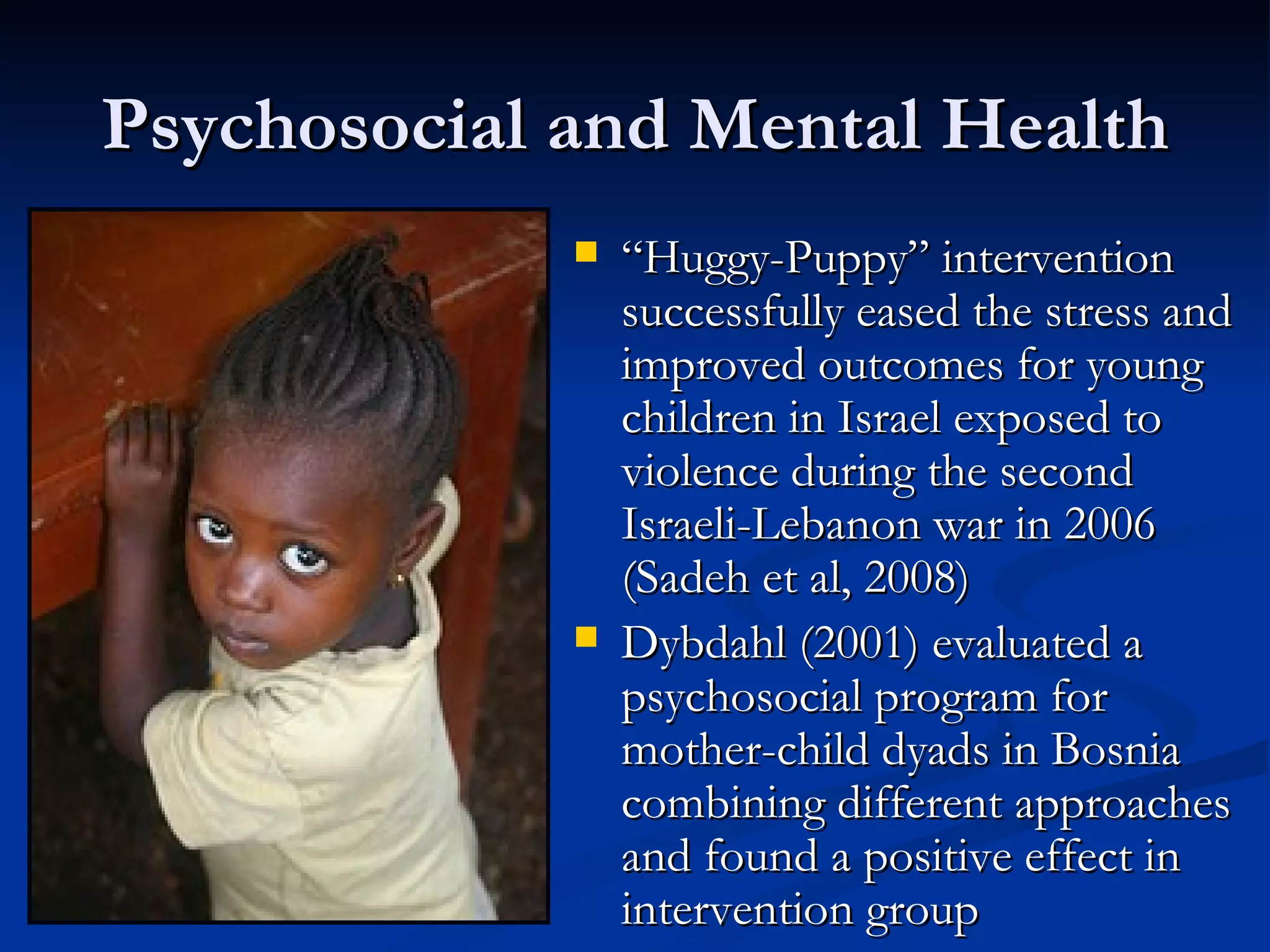
Psychosocial and Mental Health “ Huggy-Puppy” intervention successfully eased the stress and improved outcomes for young children in Israel exposed to violence during the second Israeli-Lebanon war in 2006 (Sadeh et al, 2008) Dybdahl (2001) evaluated a psychosocial program for mother-child dyads in Bosnia combining different approaches and found a positive effect in intervention group
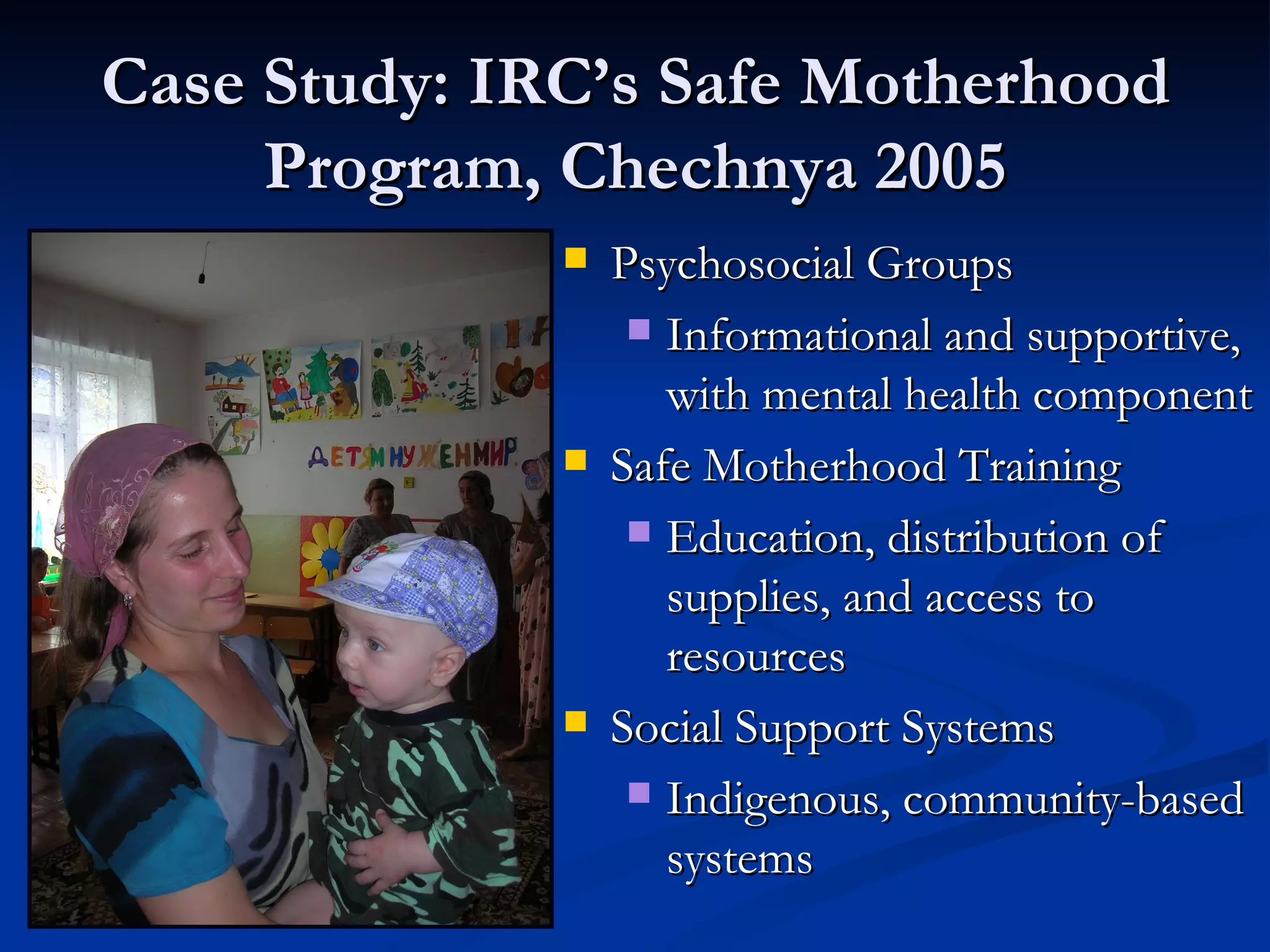
Case Study: IRC’s Safe Motherhood Program, Chechnya 2005 Psychosocial Groups Informational and supportive, with mental health component Safe Motherhood Training Education, distribution of supplies, and access to resources Social Support Systems Indigenous, community-based systems
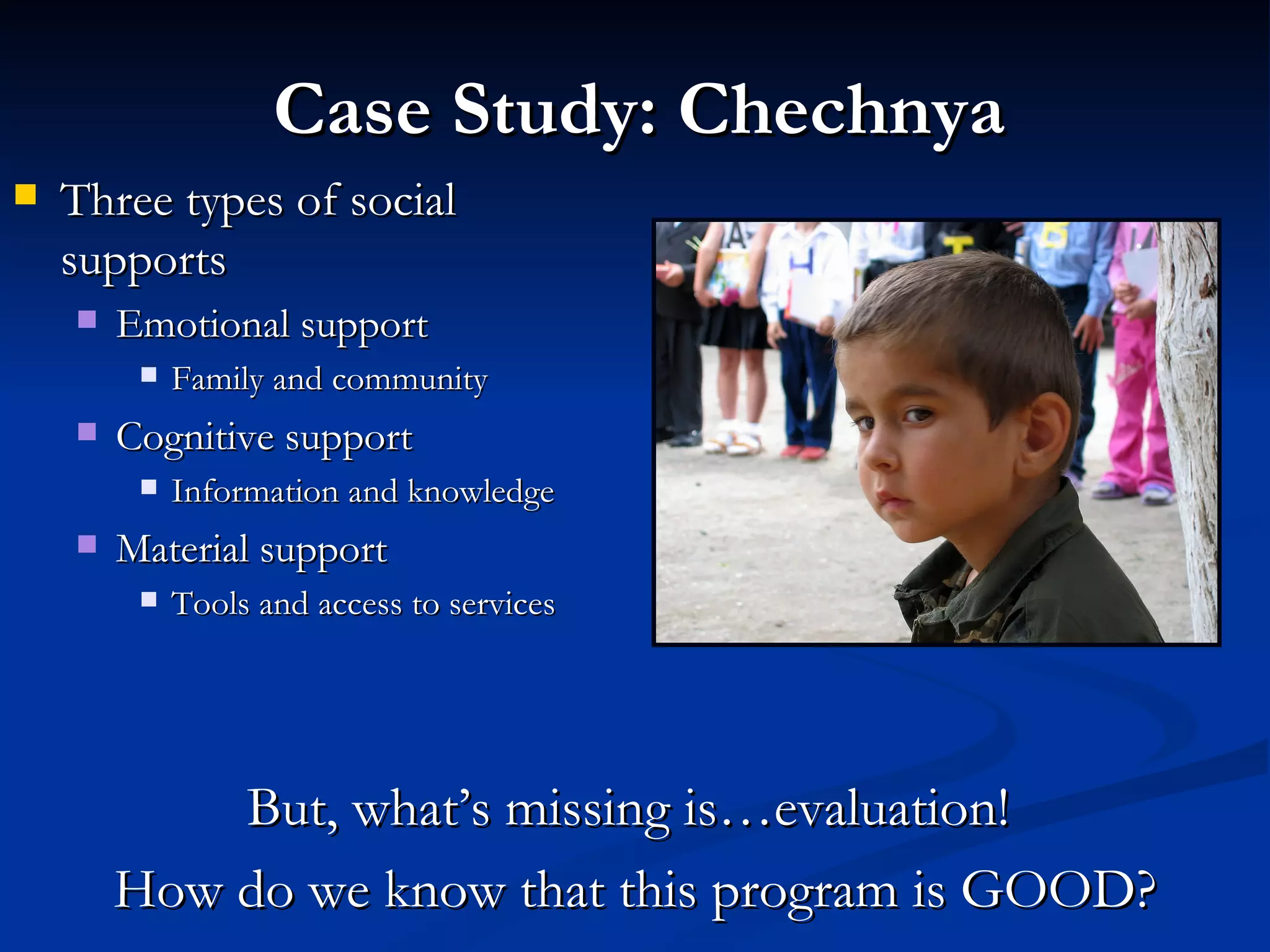
Three types of social supports Emotional support Family and community Cognitive support Information and knowledge Material support Tools and access to services Case Study: Chechnya But, what’s missing is…evaluation!  How do we know that this program is GOOD?
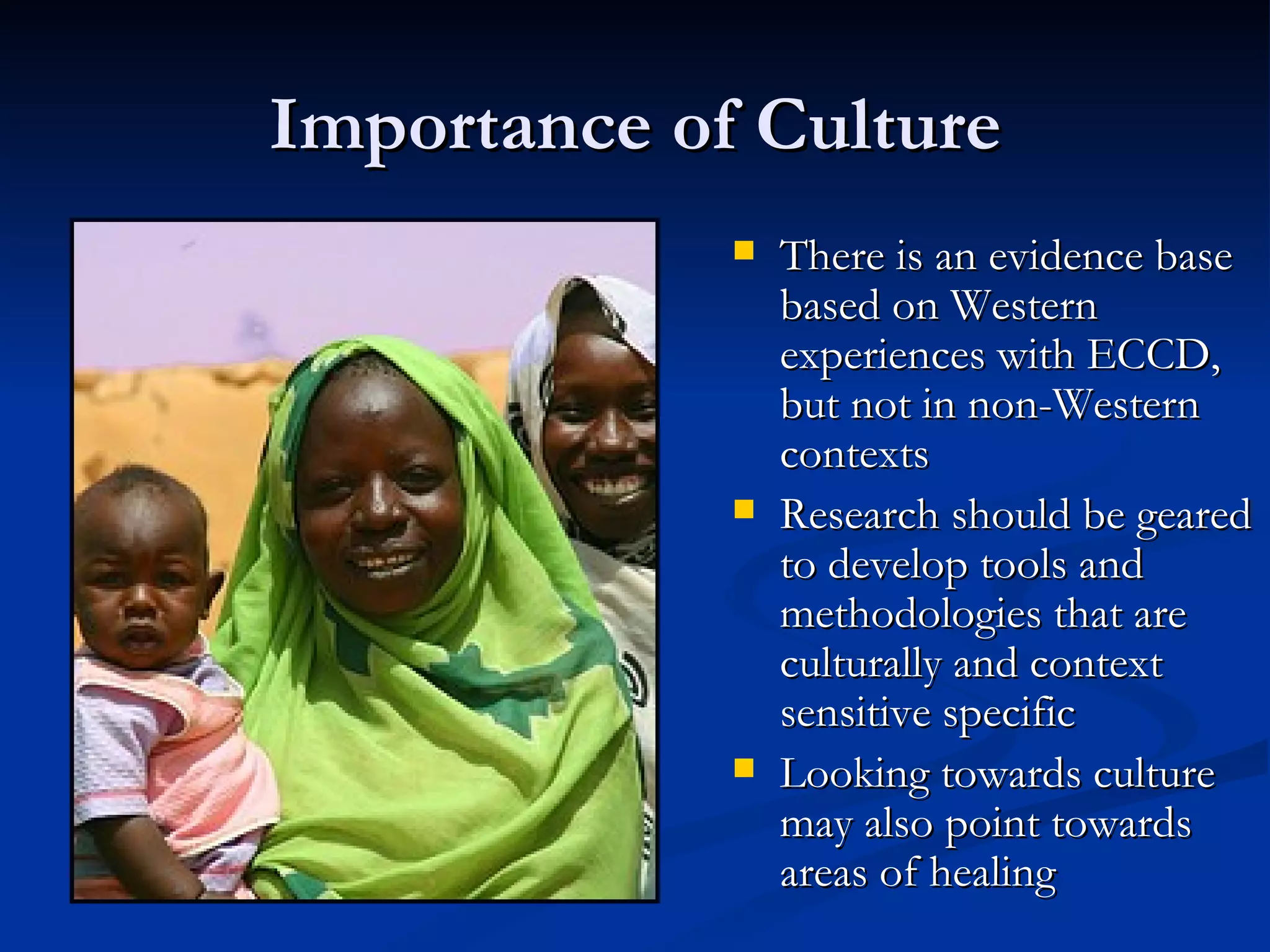
Importance of Culture There is an evidence base based on Western experiences with ECCD, but not in non-Western contexts Research should be geared to develop tools and methodologies that are culturally and context sensitive specific Looking towards culture may also point towards areas of healing
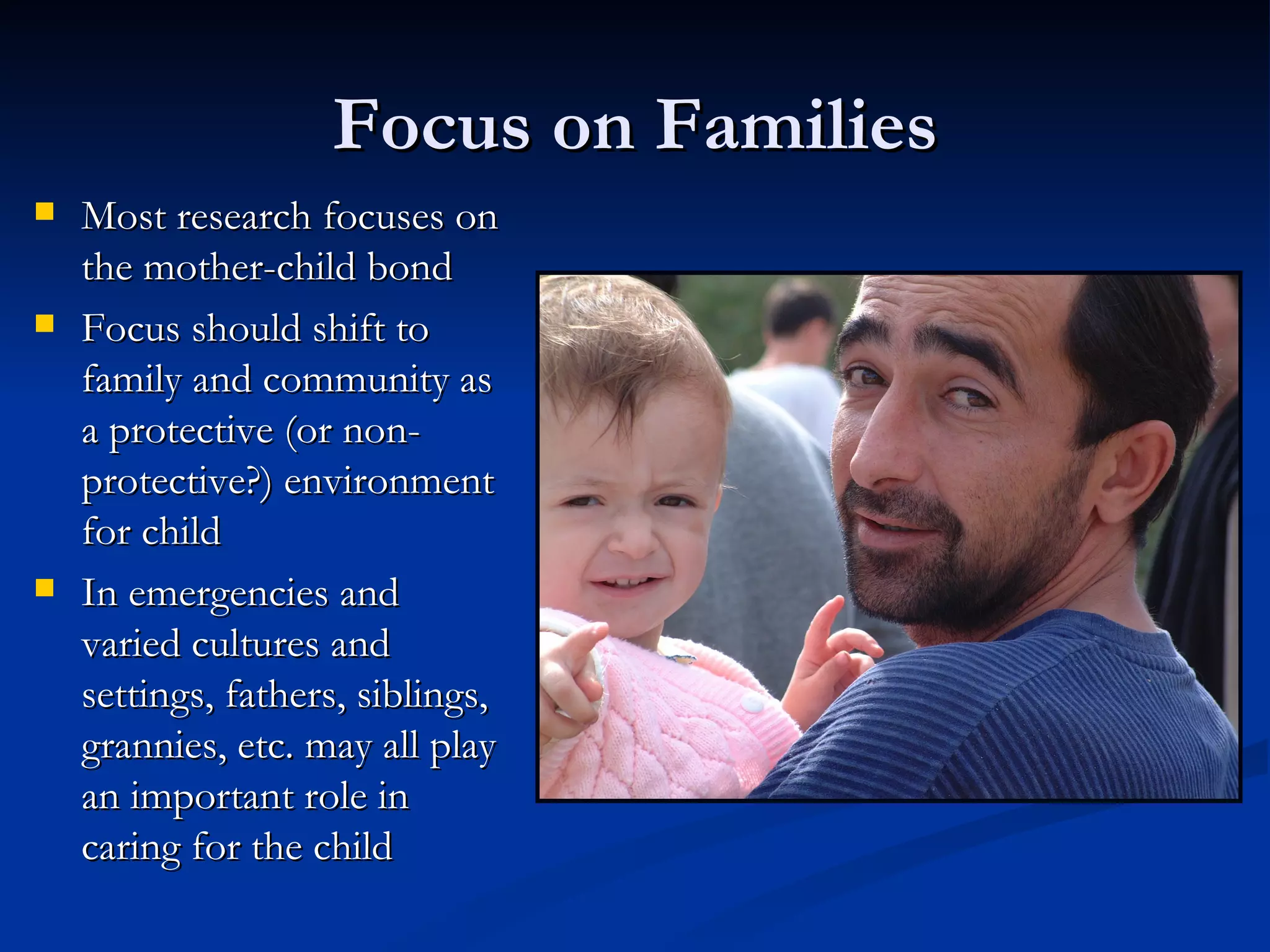
Focus on Families Most research focuses on the mother-child bond Focus should shift to family and community as a protective (or non-protective?) environment for child In emergencies and varied cultures and settings, fathers, siblings, grannies, etc. may all play an important role in caring for the child
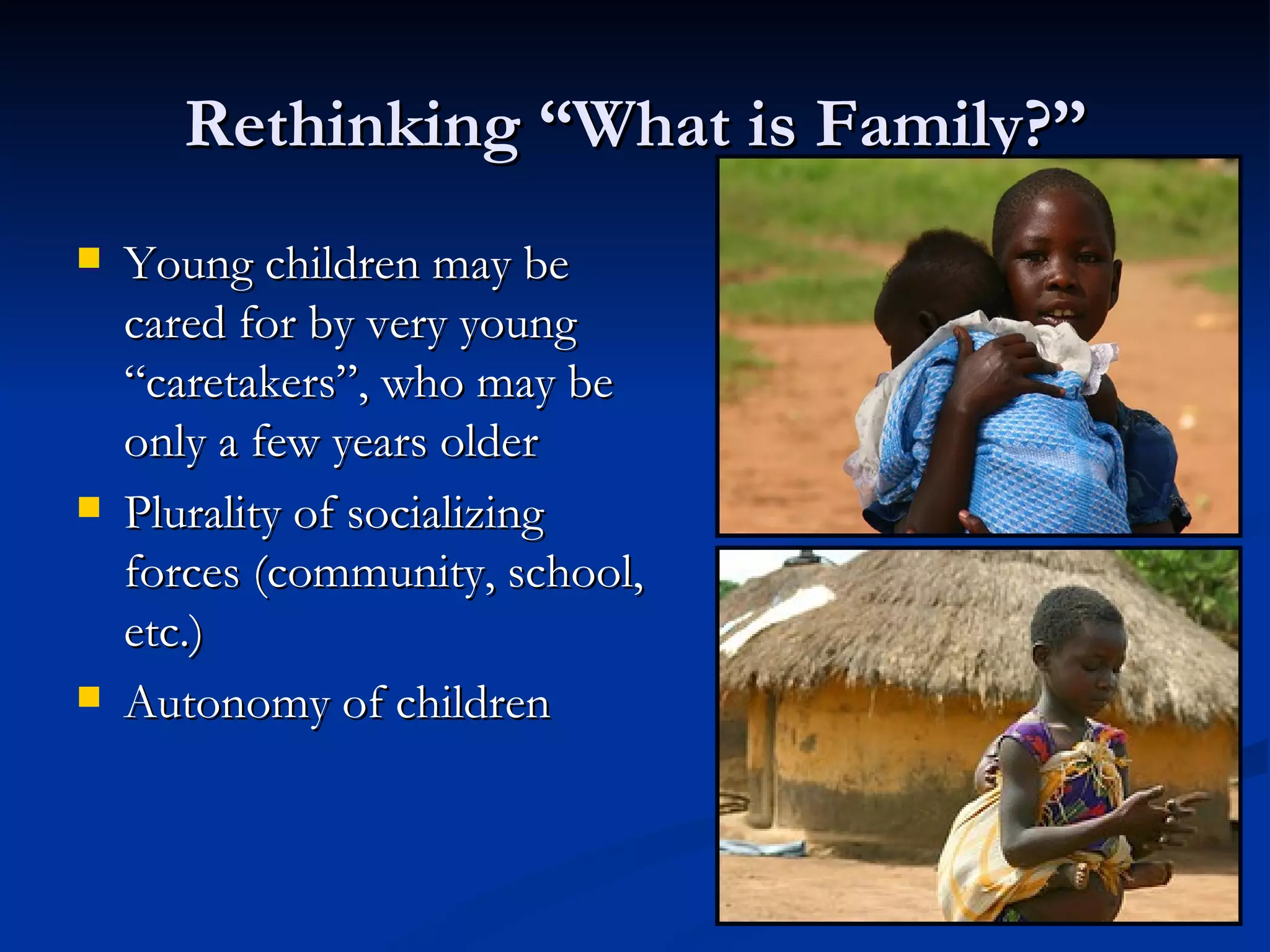
Rethinking “What is Family?” Young children may be cared for by very young “caretakers”, who may be only a few years older Plurality of socializing forces (community, school, etc.) Autonomy of children
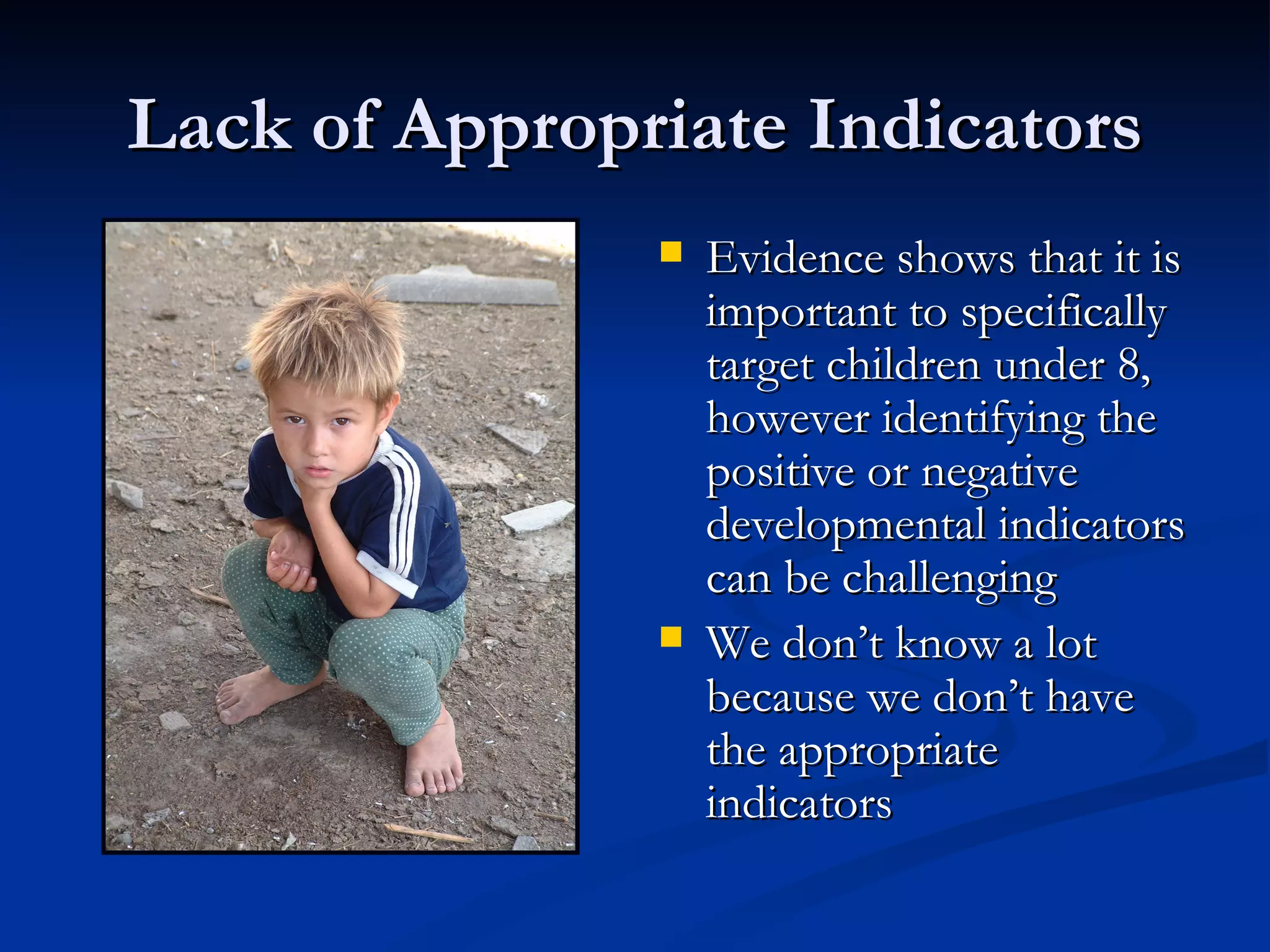
Lack of Appropriate Indicators Evidence shows that it is important to specifically target children under 8, however identifying the positive or negative developmental indicators can be challenging We don’t know a lot because we don’t have the appropriate indicators
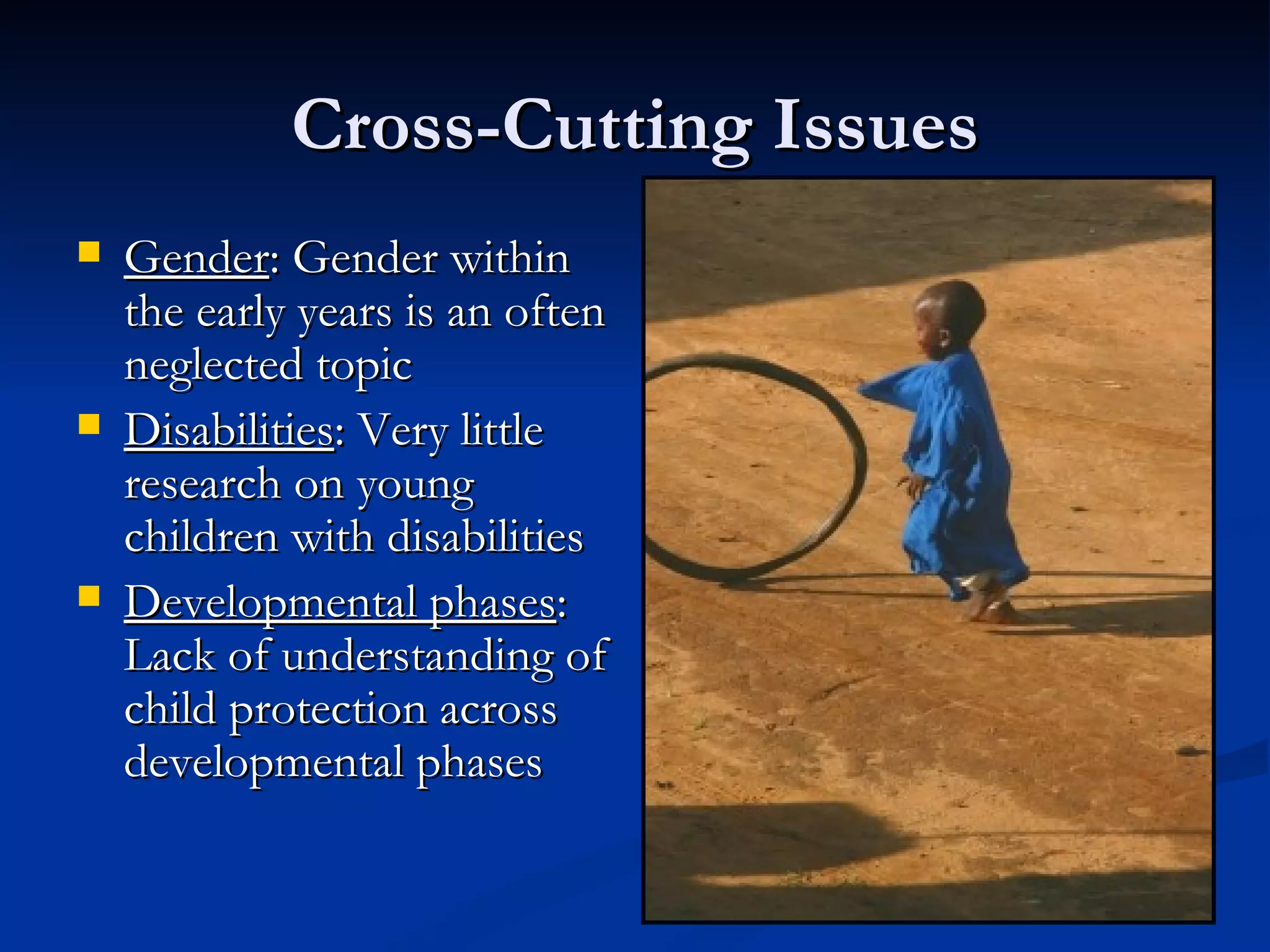
Cross-Cutting Issues Gender : Gender within the early years is an often neglected topic Disabilities : Very little research on young children with disabilities Developmental phases : Lack of understanding of child protection across developmental phases
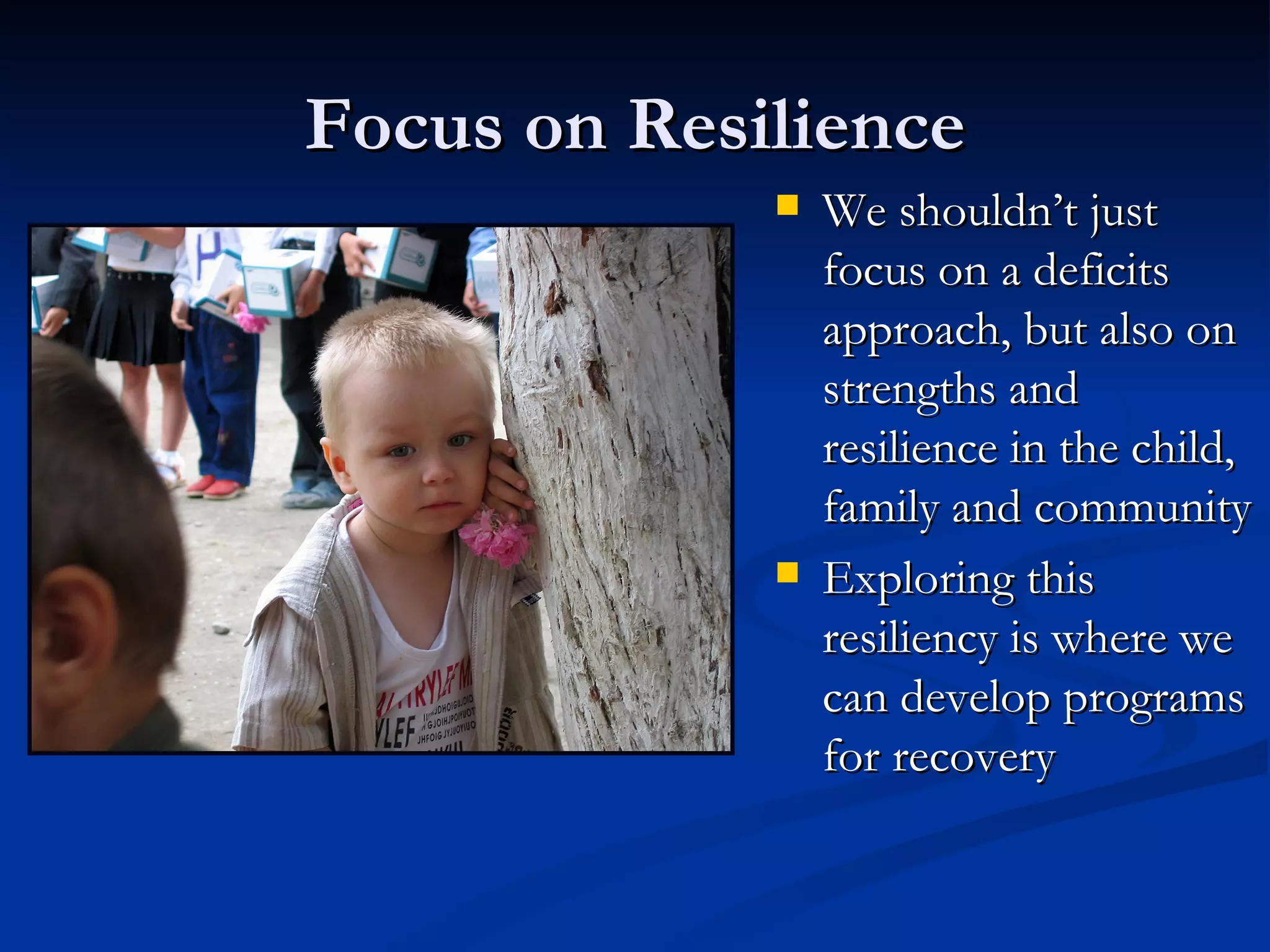
Focus on Resilience We shouldn’t just focus on a deficits approach, but also on strengths and resilience in the child, family and community Exploring this resiliency is where we can develop programs for recovery
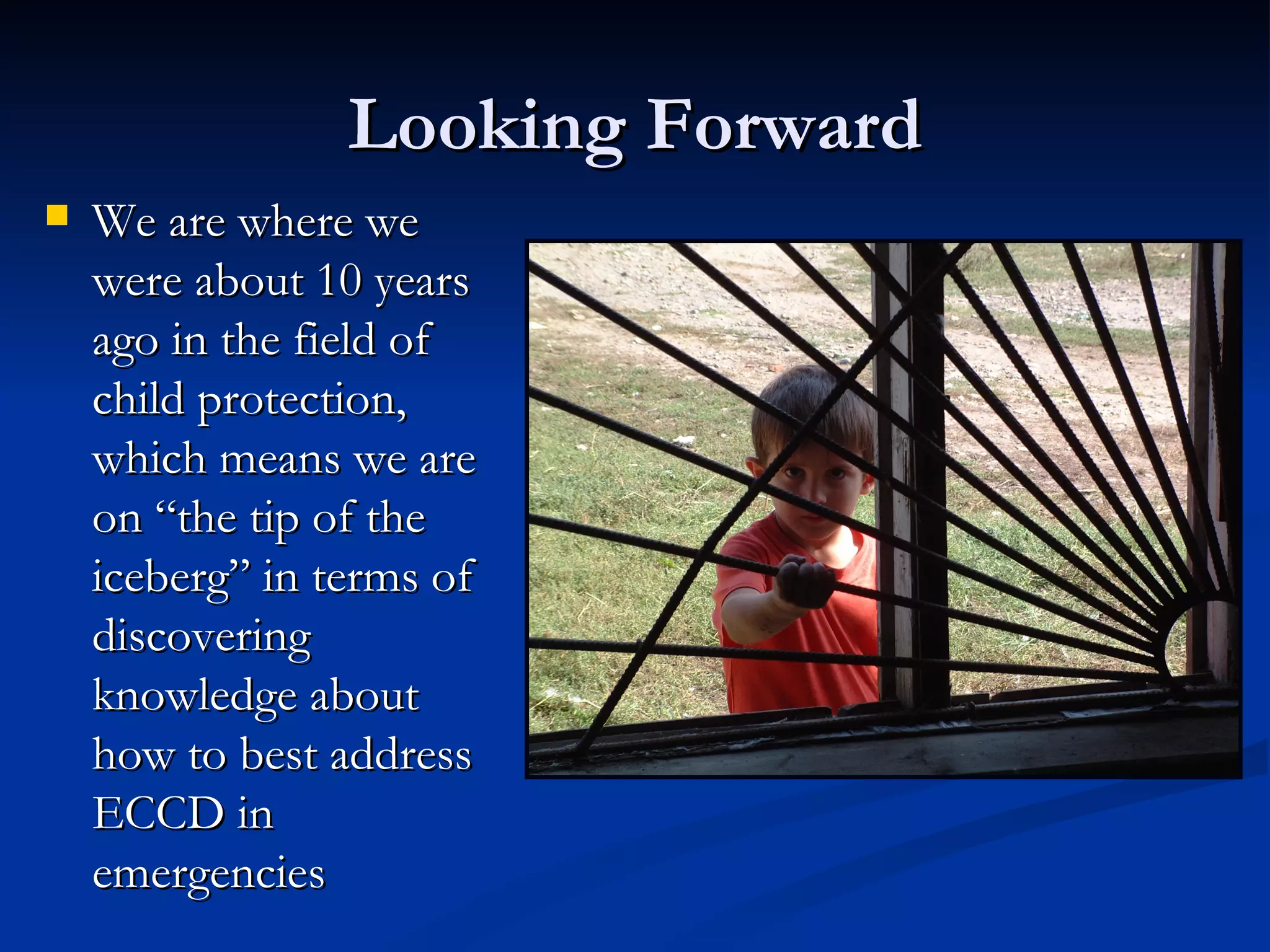
Looking Forward We are where we were about 10 years ago in the field of child protection, which means we are on “the tip of the iceberg” in terms of discovering knowledge about how to best address ECCD in emergencies
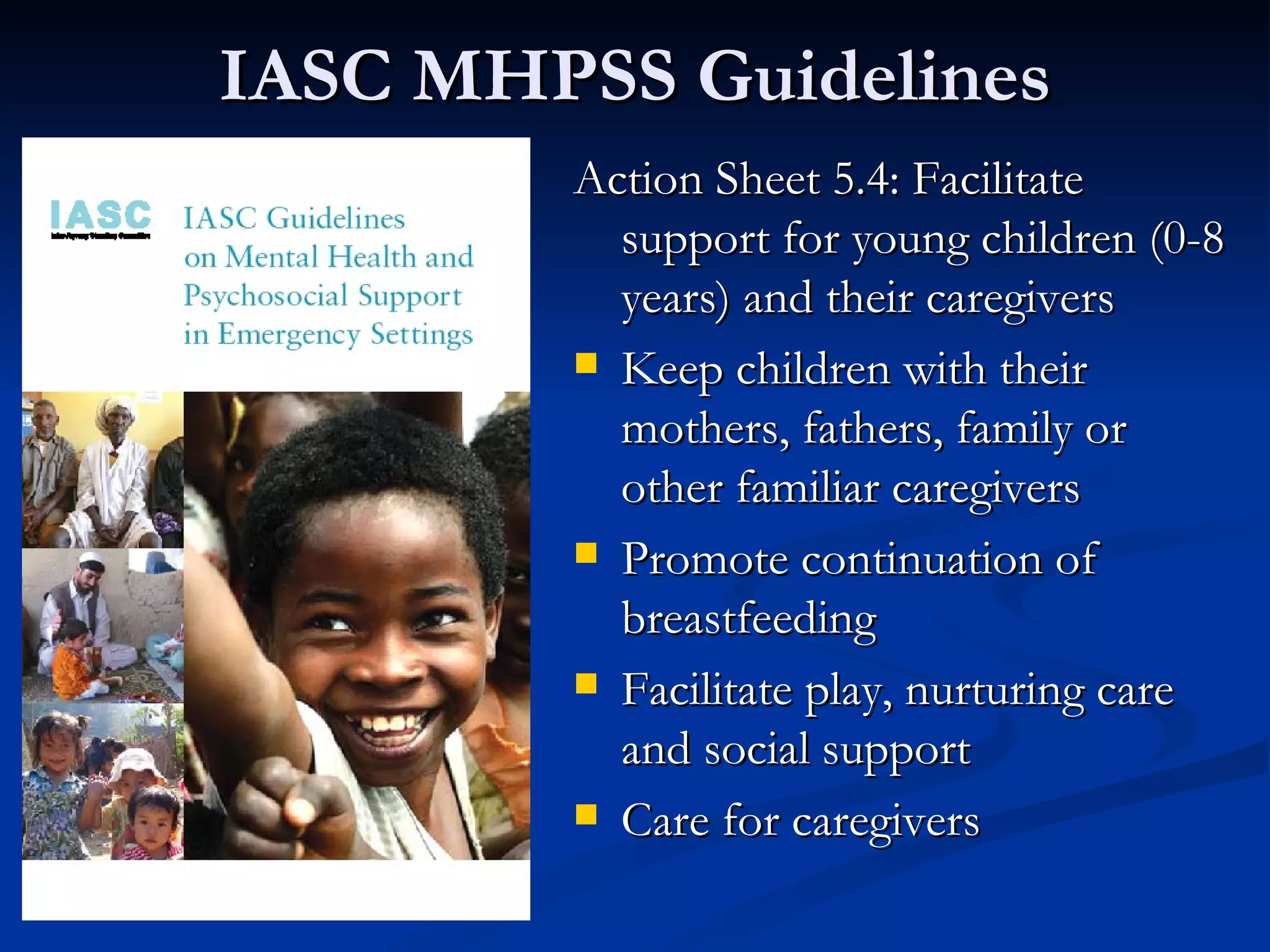
IASC MHPSS Guidelines Action Sheet 5.4: Facilitate support for young children (0-8 years) and their caregivers Keep children with their mothers, fathers, family or other familiar caregivers Promote continuation of breastfeeding Facilitate play, nurturing care and social support Care for caregivers
Care and Protection of Children in  Crisis-Affected Countries (CPC) Initiative Committed to improving the care and protection of children affected by crisis through identifying and promoting promising and best practice.
CPC’s Methodological Development CPC aims to:  pilot new assessment methodologies to identify critical child care and protection needs; gather an evidence-base for effective child care and protection programs; and recommend common measures to use in the design, evaluation, and implementation of child-focused programs.
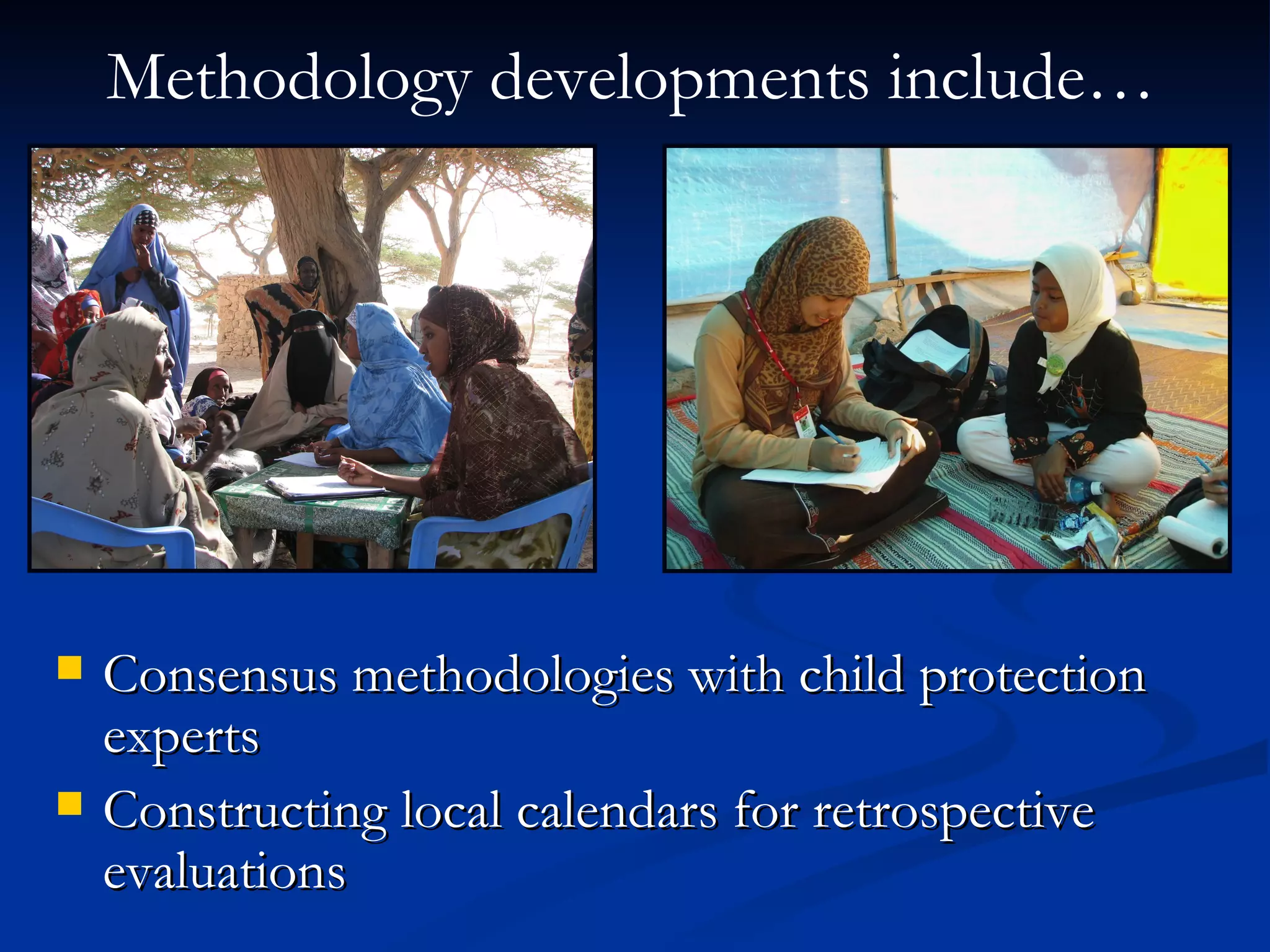
Consensus methodologies with child protection experts Constructing local calendars for retrospective evaluations Methodology developments include…
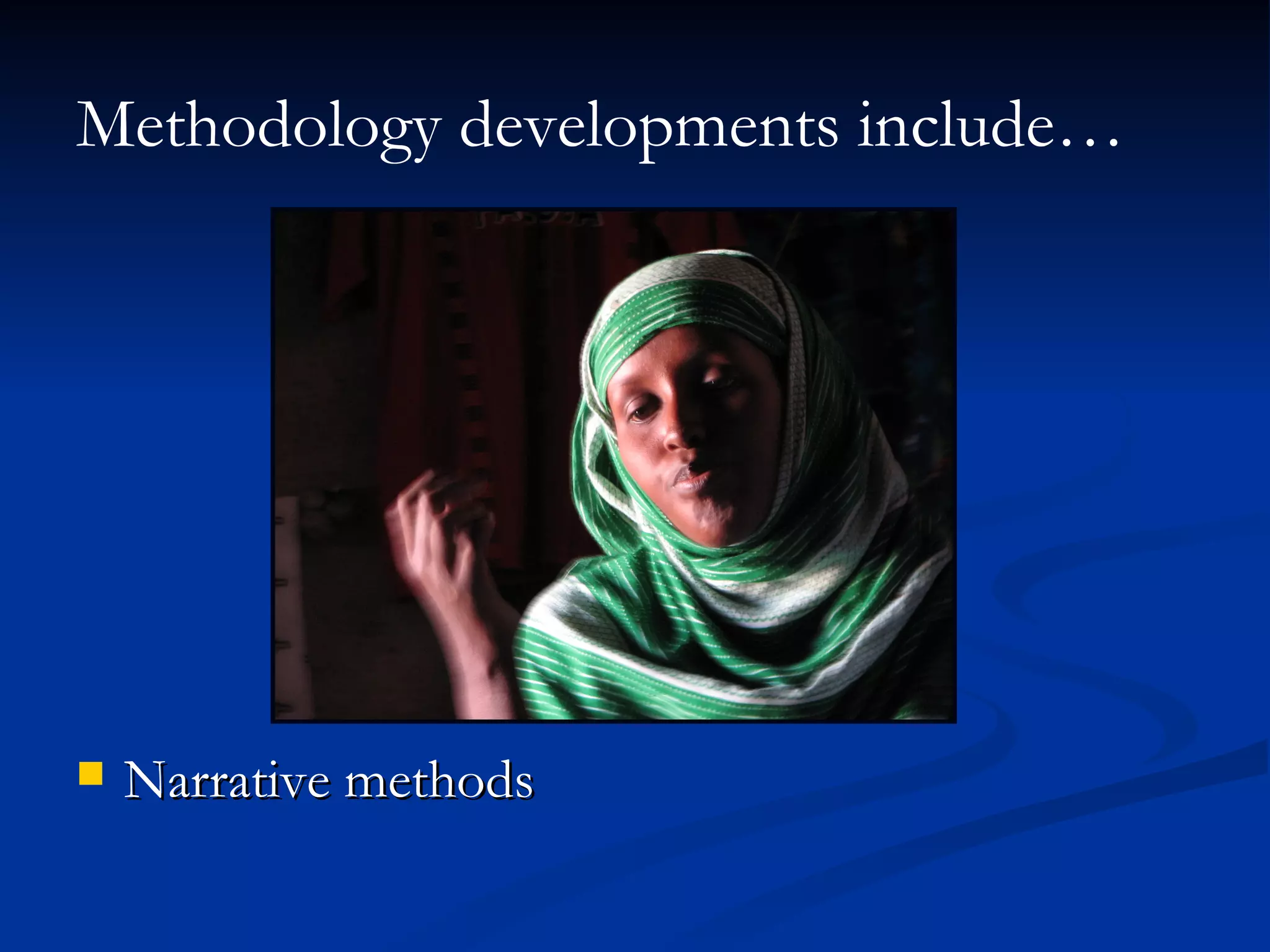
Methodology developments include… Narrative methods
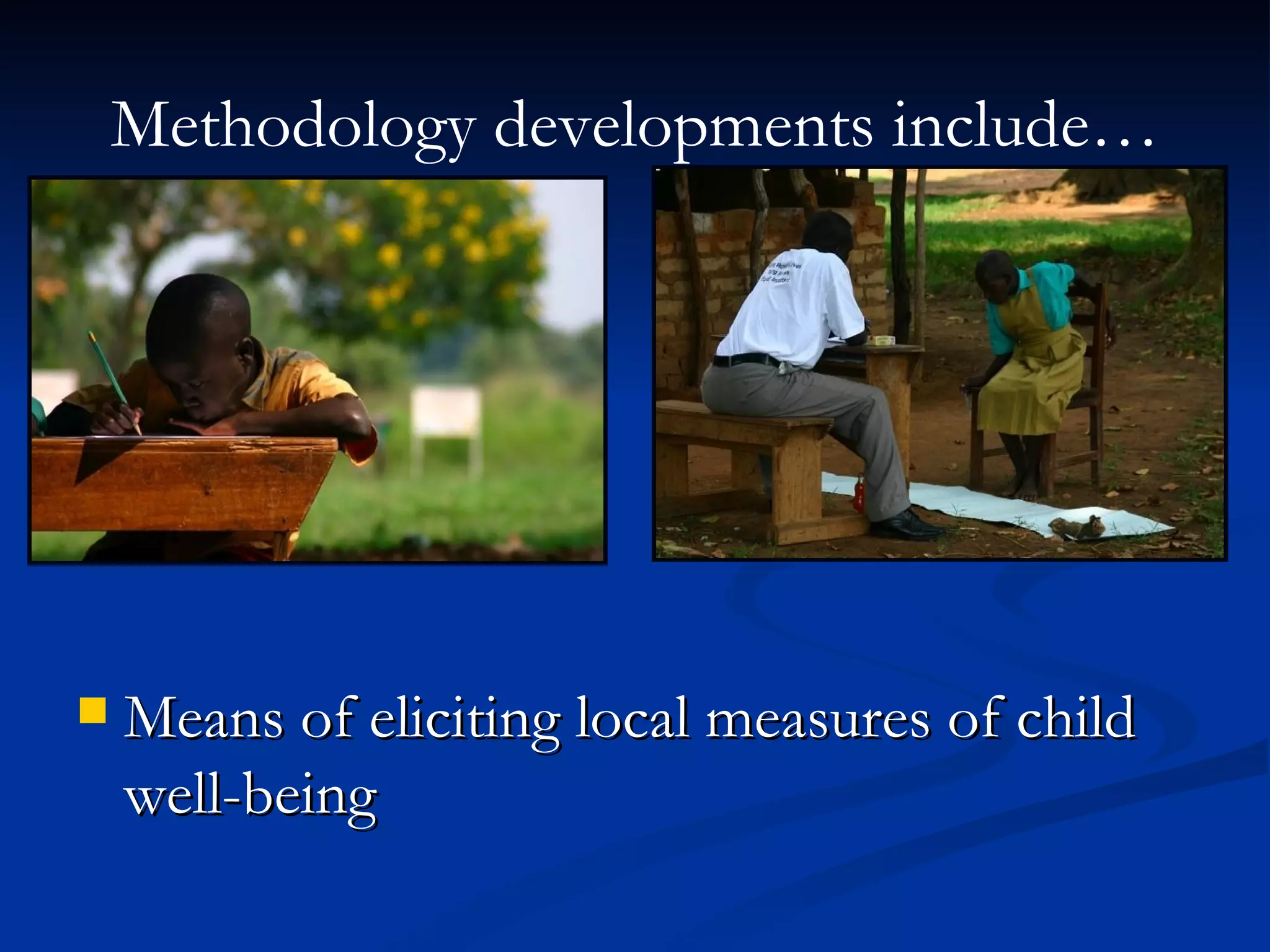
Methodology developments include… Means of eliciting local measures of child well-being
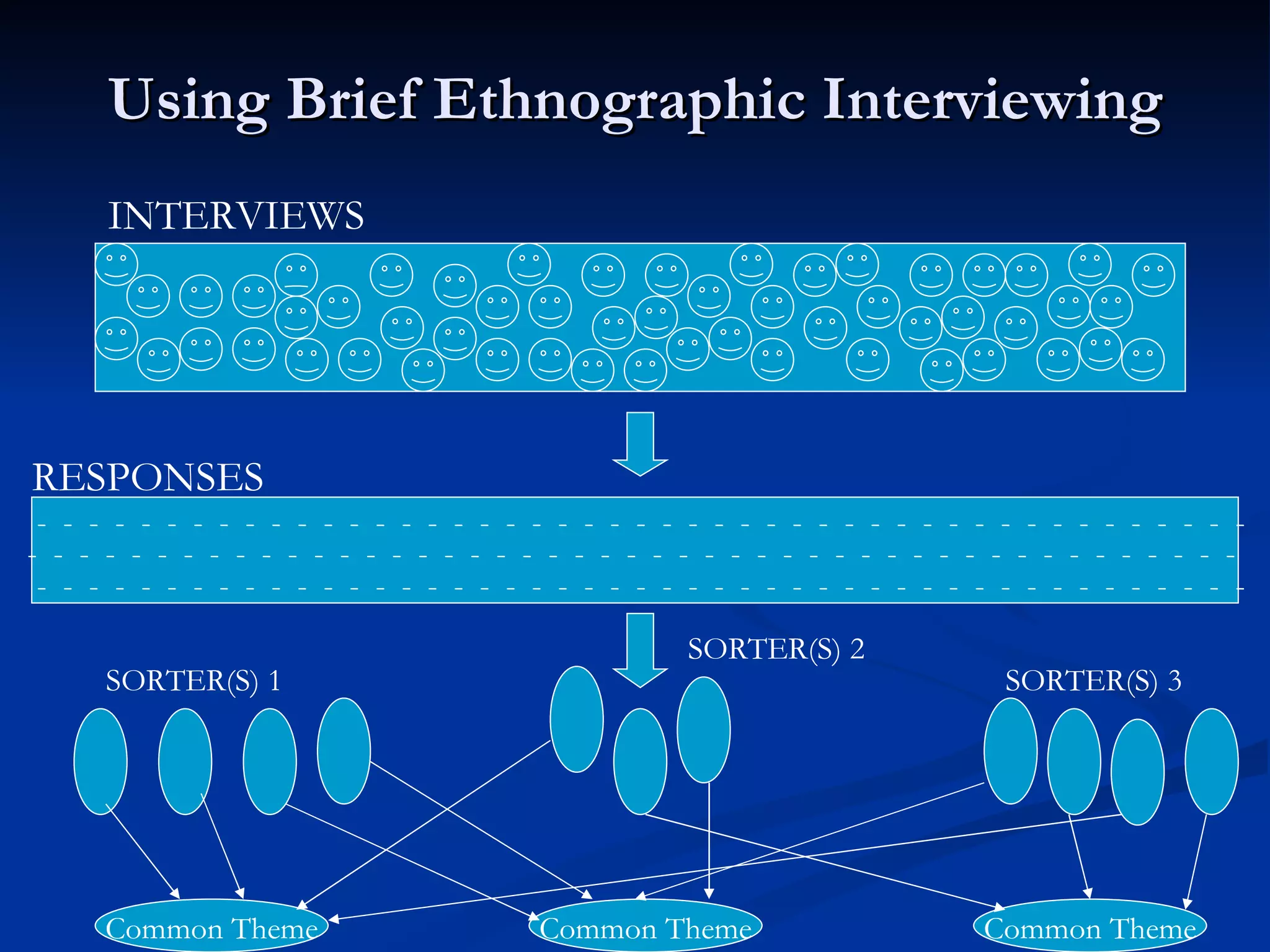
Using Brief Ethnographic Interviewing -  -  -  -  -  -  -  -  -  -  -  -  -  -  -  -  -  -  -  -  -  -  -  -  -  -  -  -  -  -  -  -  -  -  -  -  -  -  -  -  -  -  -  -  -  -  -  -  -  -  -  -  -  -  -  -  -  -  -  -  -  -  -  -  -  -  -  -  -  -  -  -  -  -  -  -  -  -  -  -  -  -  -  -  -  -  -  -  -  -  -  -  -  - -  -  -  -  -  -  -  -  -  -  -  -  -  -  -  -  -  -  -  -  -  -  -  -  -  -  -  -  -  -  -  -  -  -  -  -  -  -  -  -  -  -  -  -  -  -  - Common Theme Common Theme Common Theme INTERVIEWS RESPONSES SORTER(S) 1 SORTER(S) 2 SORTER(S) 3
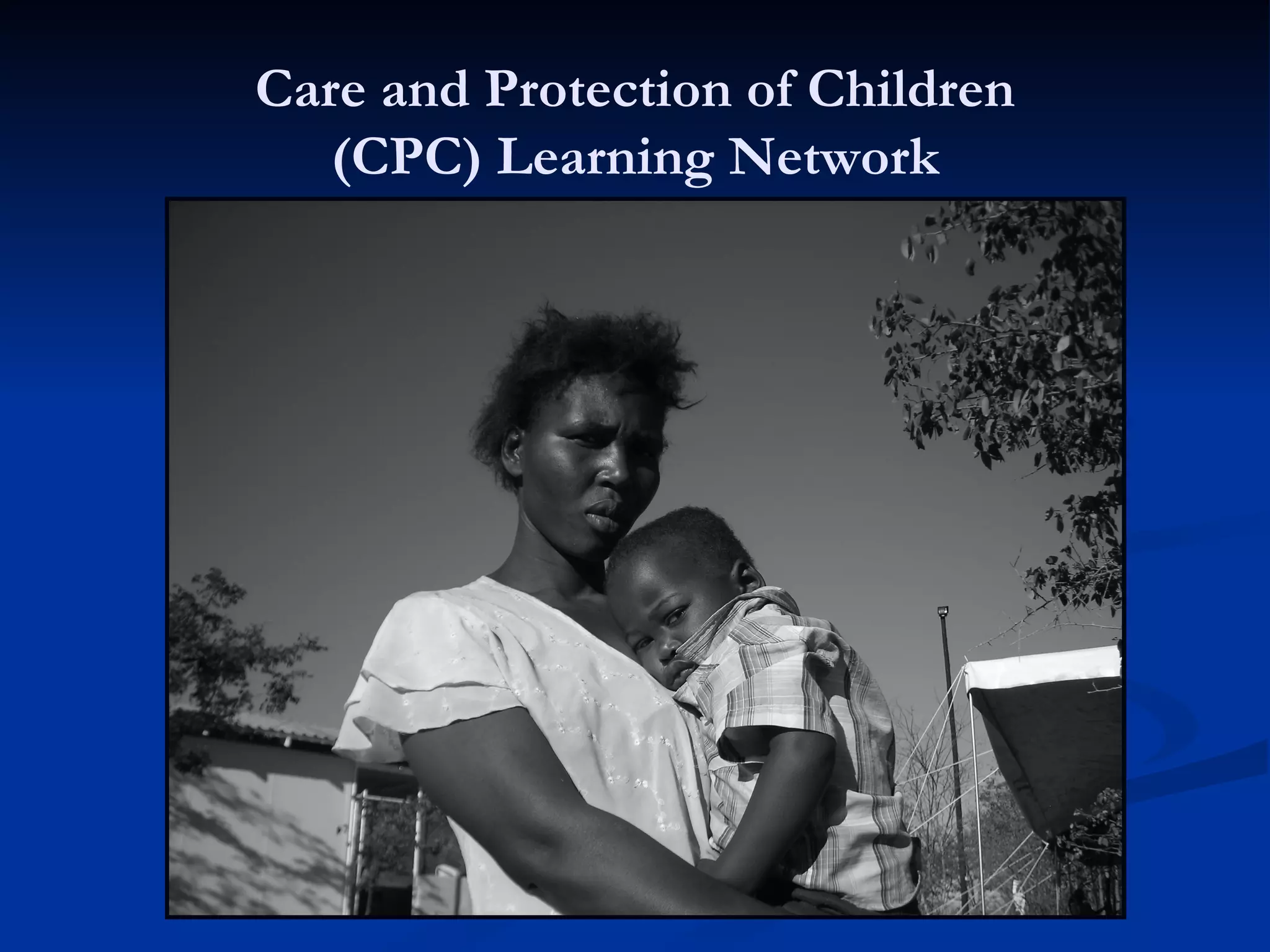
Care and Protection of Children (CPC) Learning Network
Goal of CPC Learning Network  Realize child care and protection in emergency settings through the collaborative action of humanitarian organizations, local institutions, and academic partners.  Develop community protection program knowledge.  Foster organizational collaboration.  Promote effective policy change.
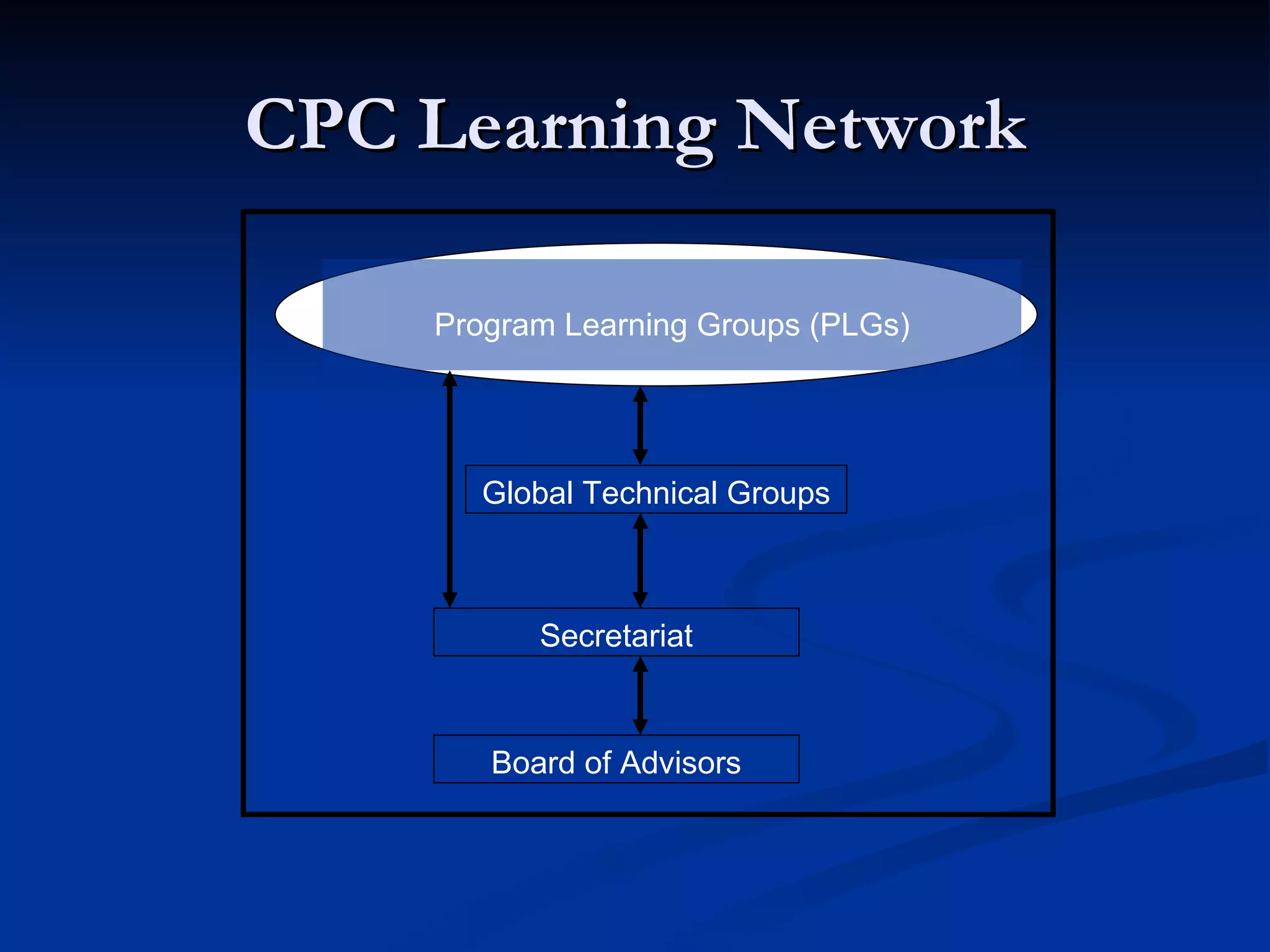
CPC Learning Network Secretariat Global Technical Groups Board of Advisors Program Learning Groups (PLGs)
ECCD Global Technical Group Strengthen capacity development of stakeholders to effectively act for young children Inform and address the current gap in understanding that programming must meet the rights as well as address holistic and diverse needs of young children throughout different emergency and transition phases Further develop tools and publications for dissemination Advocate for improved investments, policies, and commitment to action
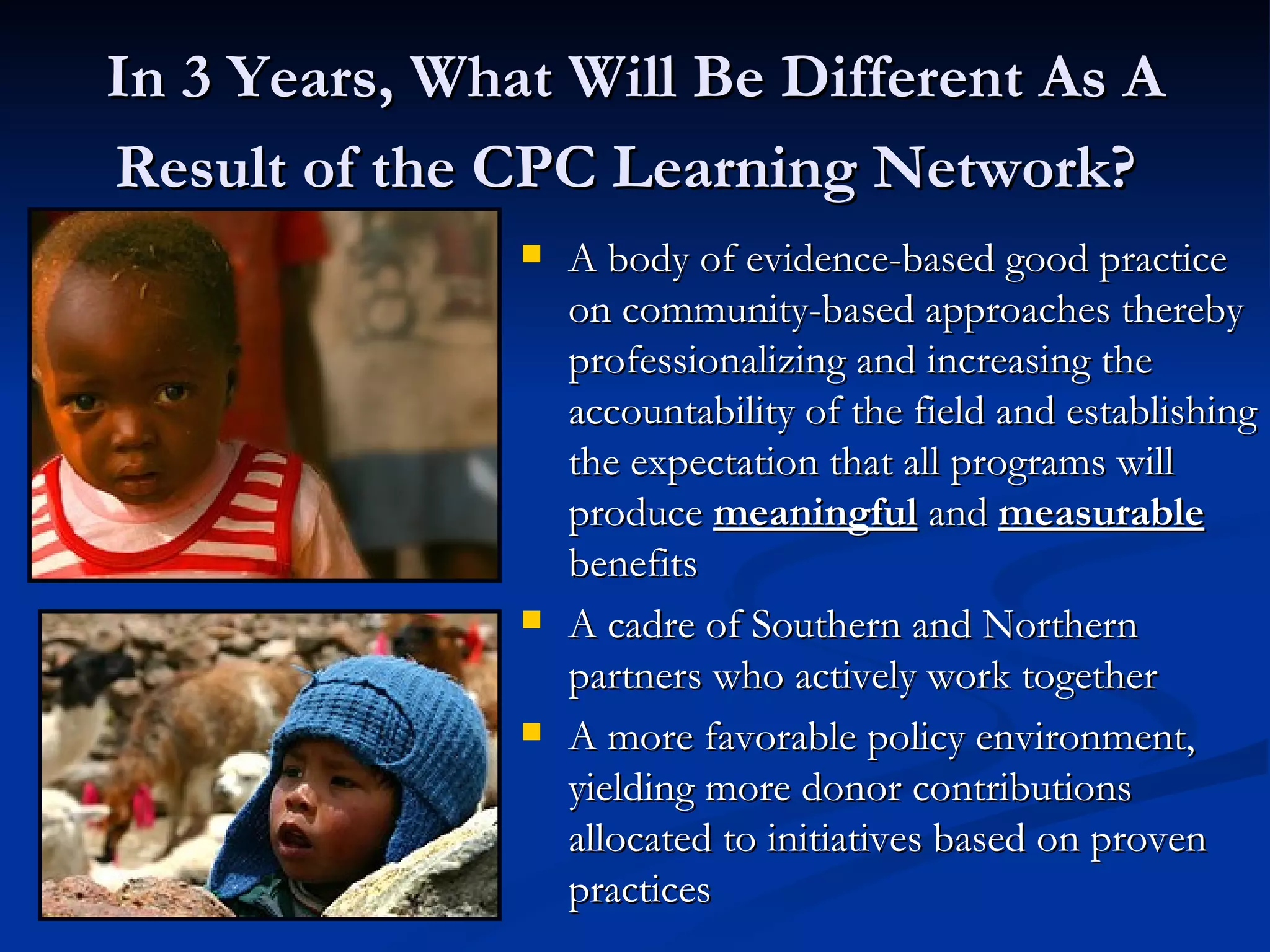
In 3 Years, What Will Be Different As A Result of the CPC Learning Network?   A body of evidence-based good practice on community-based approaches thereby professionalizing and increasing the accountability of the field and establishing the expectation that all programs will produce  meaningful  and  measurable   benefits A cadre of Southern and Northern partners who actively work together A more favorable policy environment, yielding more donor contributions allocated to initiatives based on proven practices Are those sweet potatoes?! This gets me excited.
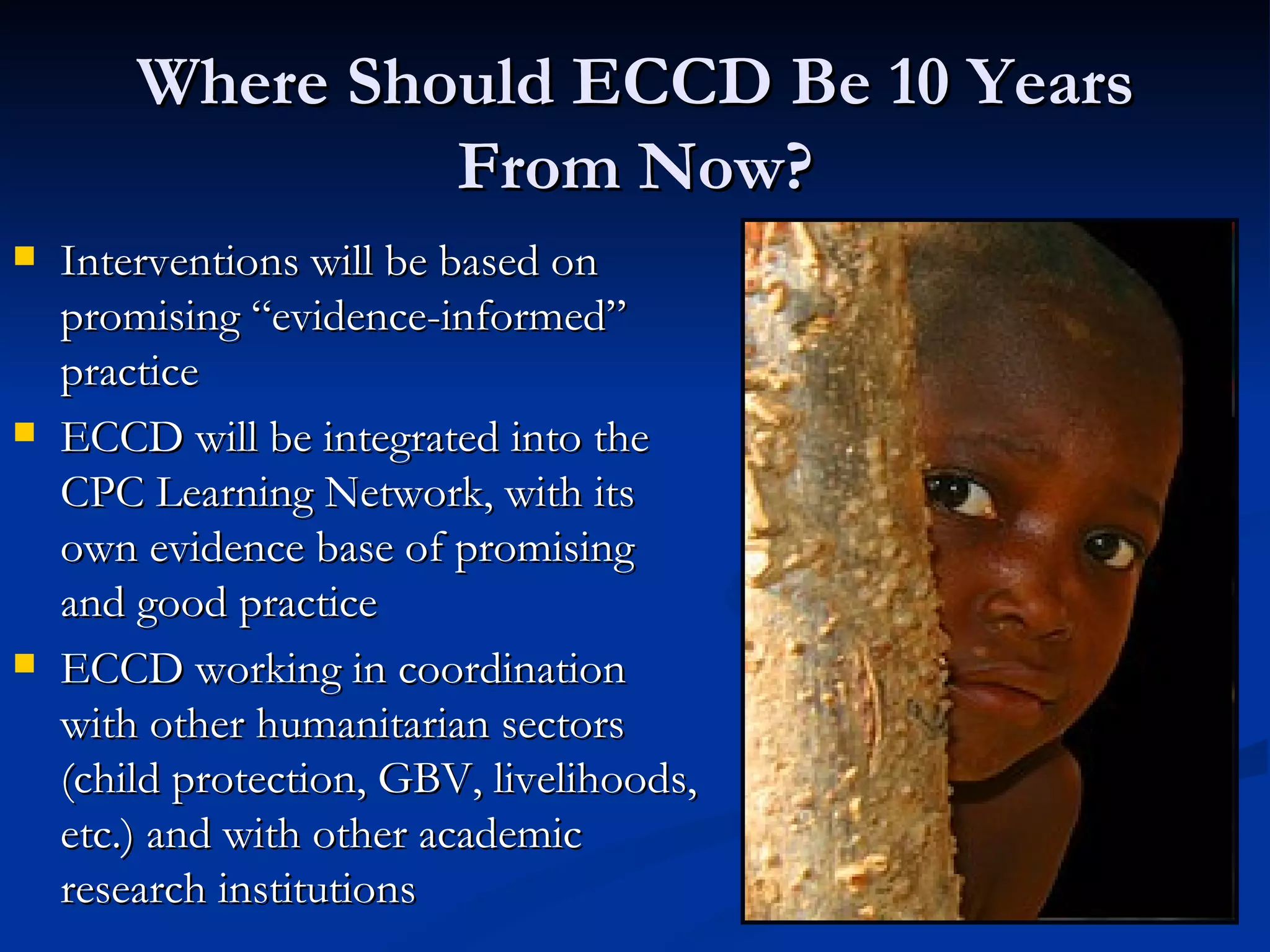
Where Should ECCD Be 10 Years From Now? Interventions will be based on promising “evidence-informed” practice ECCD will be integrated into the CPC Learning Network, with its own evidence base of promising and good practice ECCD working in coordination with other humanitarian sectors (child protection, GBV, livelihoods, etc.) and with other academic research institutions
How Do We Get There? We need to link more fully with other sectors, including child protection, GBV, livelihoods, and with academic research institutes We need to focus and prioritize – we cannot accomplish EVERYTHING, especially in situations of conflict We need more studies based on robust methods using randomization and comparison groups and looking at multiple interventions
Thank You!  www.forcedmigration.columbia.edu www.cpclearningnetwork.org

ECCD in Emergencies

  • 1.
    Current State ofKnowledge on ECCD in Emergencies: What Do We Know and What Do We Need To Know? CGECCD Annual Consultation on ECCD in Emergencies Working Group Bree Akesson Program on Forced Migration and Health, Mailman School of Public Health, Columbia University October 14th, 2008
  • 2.
    Taking Stock WhereAre We Now in Our Knowledge Base of ECCD in Emergencies? And Where Should We Be 10 Years From Now?
  • 3.
    Current State ofPractice Graca Machel study was tipping point in care and protection of children, but fundamental gaps remain Don’t know prevalence or incidence rates of child protection concerns There are mixed attempts to incorporate local understandings and definitions of well-being in response and programmatic interventions There is a lack of evidence on interventions that have worked to improve lives of children
  • 4.
    Percentage of CAPCoverage for Protection/Human Rights/Rule of Law vs. All Other Sectors (2000-2007)
  • 5.
    What Does theCurrent Research Say About ECCD in Emergencies?
  • 6.
    Holistic Impact ofEmergencies on Young Children Security Health Development Family relations Mortality Roles Nutrition Resilience Spiritual well-being
  • 7.
    Biological and PhysiologicalDevelopment Elevated stress hormones and altered key brain chemicals disrupt brain development and affect immune system, metabolic regulatory functions, and general mental health
  • 8.
    Health & Nutrition220 million children under-5 in developing world have significantly impaired growth Malnourishment limits child’s chance of survival, severely affects long-term growth and mental development Low birth weight and under nutrition in infants affects cognitive and psycho-motor development Children who were severely malnourished as infants do less well in school, have less chance of doing productive work and forming healthy relationships, and are more vulnerable to mental illness
  • 9.
    Maternal Depression Infantsof mothers who are depressed show poorer growth outcomes than infants whose mothers are not depressed Postnatal depression and maternal intelligence are significantly related to ‘failure-to-thrive’ in infants Mothers less able to provide the physical and emotional care required are less responsive to infant demands In long term, undernourished children may contribute to maternal depression by increasing feelings of guilt and incompetence Children with greater psychosocial skills are better able to engage with caregivers and may be more effective in demanding food Treating maternal depression improves growth outcomes
  • 10.
    Education & LearningCognitive stimulation and learning activities for young children increases cognitive functioning and socio-emotional competence, which carries over into adulthood There is promising research on the effectiveness of Child Centered Spaces (CCS)
  • 11.
    Psychosocial and MentalHealth “ Huggy-Puppy” intervention successfully eased the stress and improved outcomes for young children in Israel exposed to violence during the second Israeli-Lebanon war in 2006 (Sadeh et al, 2008) Dybdahl (2001) evaluated a psychosocial program for mother-child dyads in Bosnia combining different approaches and found a positive effect in intervention group
  • 12.
    Case Study: IRC’sSafe Motherhood Program, Chechnya 2005 Psychosocial Groups Informational and supportive, with mental health component Safe Motherhood Training Education, distribution of supplies, and access to resources Social Support Systems Indigenous, community-based systems
  • 13.
    Three types ofsocial supports Emotional support Family and community Cognitive support Information and knowledge Material support Tools and access to services Case Study: Chechnya But, what’s missing is…evaluation! How do we know that this program is GOOD?
  • 14.
    Importance of CultureThere is an evidence base based on Western experiences with ECCD, but not in non-Western contexts Research should be geared to develop tools and methodologies that are culturally and context sensitive specific Looking towards culture may also point towards areas of healing
  • 15.
    Focus on FamiliesMost research focuses on the mother-child bond Focus should shift to family and community as a protective (or non-protective?) environment for child In emergencies and varied cultures and settings, fathers, siblings, grannies, etc. may all play an important role in caring for the child
  • 16.
    Rethinking “What isFamily?” Young children may be cared for by very young “caretakers”, who may be only a few years older Plurality of socializing forces (community, school, etc.) Autonomy of children
  • 17.
    Lack of AppropriateIndicators Evidence shows that it is important to specifically target children under 8, however identifying the positive or negative developmental indicators can be challenging We don’t know a lot because we don’t have the appropriate indicators
  • 18.
    Cross-Cutting Issues Gender: Gender within the early years is an often neglected topic Disabilities : Very little research on young children with disabilities Developmental phases : Lack of understanding of child protection across developmental phases
  • 19.
    Focus on ResilienceWe shouldn’t just focus on a deficits approach, but also on strengths and resilience in the child, family and community Exploring this resiliency is where we can develop programs for recovery
  • 20.
    Looking Forward Weare where we were about 10 years ago in the field of child protection, which means we are on “the tip of the iceberg” in terms of discovering knowledge about how to best address ECCD in emergencies
  • 21.
    IASC MHPSS GuidelinesAction Sheet 5.4: Facilitate support for young children (0-8 years) and their caregivers Keep children with their mothers, fathers, family or other familiar caregivers Promote continuation of breastfeeding Facilitate play, nurturing care and social support Care for caregivers
  • 22.
    Care and Protectionof Children in Crisis-Affected Countries (CPC) Initiative Committed to improving the care and protection of children affected by crisis through identifying and promoting promising and best practice.
  • 23.
    CPC’s Methodological DevelopmentCPC aims to: pilot new assessment methodologies to identify critical child care and protection needs; gather an evidence-base for effective child care and protection programs; and recommend common measures to use in the design, evaluation, and implementation of child-focused programs.
  • 24.
    Consensus methodologies withchild protection experts Constructing local calendars for retrospective evaluations Methodology developments include…
  • 25.
  • 26.
    Methodology developments include…Means of eliciting local measures of child well-being
  • 27.
    Using Brief EthnographicInterviewing - - - - - - - - - - - - - - - - - - - - - - - - - - - - - - - - - - - - - - - - - - - - - - - - - - - - - - - - - - - - - - - - - - - - - - - - - - - - - - - - - - - - - - - - - - - - - - - - - - - - - - - - - - - - - - - - - - - - - - - - - - - - - - - - - - - - - - - - - - - - - Common Theme Common Theme Common Theme INTERVIEWS RESPONSES SORTER(S) 1 SORTER(S) 2 SORTER(S) 3
  • 28.
    Care and Protectionof Children (CPC) Learning Network
  • 29.
    Goal of CPCLearning Network Realize child care and protection in emergency settings through the collaborative action of humanitarian organizations, local institutions, and academic partners. Develop community protection program knowledge. Foster organizational collaboration. Promote effective policy change.
  • 30.
    CPC Learning NetworkSecretariat Global Technical Groups Board of Advisors Program Learning Groups (PLGs)
  • 31.
    ECCD Global TechnicalGroup Strengthen capacity development of stakeholders to effectively act for young children Inform and address the current gap in understanding that programming must meet the rights as well as address holistic and diverse needs of young children throughout different emergency and transition phases Further develop tools and publications for dissemination Advocate for improved investments, policies, and commitment to action
  • 32.
    In 3 Years,What Will Be Different As A Result of the CPC Learning Network? A body of evidence-based good practice on community-based approaches thereby professionalizing and increasing the accountability of the field and establishing the expectation that all programs will produce meaningful and measurable benefits A cadre of Southern and Northern partners who actively work together A more favorable policy environment, yielding more donor contributions allocated to initiatives based on proven practices Are those sweet potatoes?! This gets me excited.
  • 33.
    Where Should ECCDBe 10 Years From Now? Interventions will be based on promising “evidence-informed” practice ECCD will be integrated into the CPC Learning Network, with its own evidence base of promising and good practice ECCD working in coordination with other humanitarian sectors (child protection, GBV, livelihoods, etc.) and with other academic research institutions
  • 34.
    How Do WeGet There? We need to link more fully with other sectors, including child protection, GBV, livelihoods, and with academic research institutes We need to focus and prioritize – we cannot accomplish EVERYTHING, especially in situations of conflict We need more studies based on robust methods using randomization and comparison groups and looking at multiple interventions
  • 35.
    Thank You! www.forcedmigration.columbia.edu www.cpclearningnetwork.org