


Holding the future: The importance of health visitors
from an infant mental health perspective.
robin.balbernie@gmail.com © R. Balbernie.
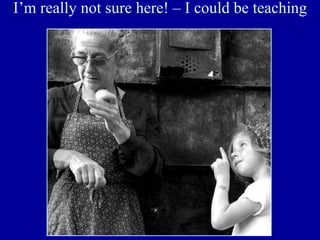
I’m really not sure here! – I could be teaching
…
The viewpoint – from the Mental Health
Task Force of Zero to Three.
“Infant mental health is the developing
capacity of the child from birth to three
to: experience, regulate, and express
emotions; form close interpersonal
relationships; and explore the
environment and learn – all in the
context of family, community and
mental health expectations for young children. Infant
mental health is synonymous with healthy social and
emotional development.” So the task for early years
workers should be more preventative than reactive.
So how do we achieve this?
1818 – 1895
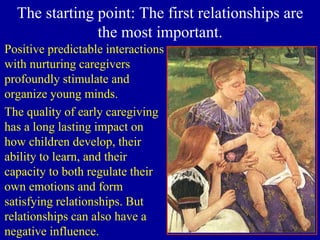
The starting point: The first relationships are
the most important.
Positive predictable interactions
with nurturing caregivers
profoundly stimulate and
organize young minds.
The quality of early caregiving
has a long lasting impact on
how children develop, their
ability to learn, and their
capacity to both regulate their
own emotions and form
satisfying relationships. But
relationships can also have a
negative influence.
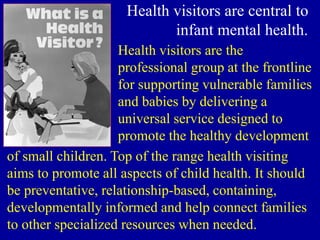
Health visitors are central to
infant mental health.
Health visitors are the
professional group at the frontline
for supporting vulnerable families
and babies by delivering a
universal service designed to
promote the healthy development
of small children. Top of the range health visiting
aims to promote all aspects of child health. It should
be preventative, relationship-based, containing,
developmentally informed and help connect families
to other specialized resources when needed.
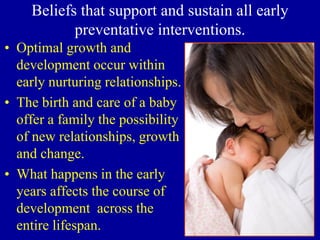
Beliefs that support and sustain all early
preventative interventions.
• Optimal growth and
development occur within
early nurturing relationships.
• The birth and care of a baby
offer a family the possibility
of new relationships, growth
and change.
• What happens in the early
years affects the course of
development across the
entire lifespan.
Characteristics of a preventative intervention.
• Its purpose is to increase the probability of normal
developmental trajectories in later life.
• It aims to prevent conditions that have not yet
occurred, risk proactive and increasing resilience.
• Generally conducted with families where the
infant does not show a diagnosable disorder.
• The approach is based on a model of development
where both risks and protective factors shape the
paths whereby individuals may become vulnerable
or resistant to later stresses and developmental
deviance.
• Universal prevention strategies provide the
essential foundation needed to identify families at
risk and for other interventions to be effective.
• The earlier the intervention the more positive
outcomes are likely to be, in part because there is
less likelihood for secondary complications.
• A focus on the parent-baby interaction and parental
attributions of the infant may be necessary for
optimum socio-emotional outcomes for the child.
• For families with multiple risks no single
intervention can be effective and numerous
components of treatment are needed from different
services. (See: www.IMHPromotion.ca )
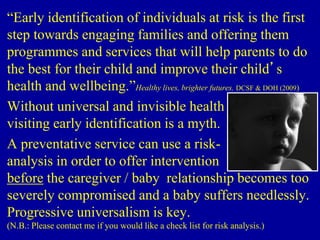
“Early identification of individuals at risk is the first
step towards engaging families and offering them
programmes and services that will help parents to do
the best for their child and improve their child’s
health and wellbeing.”Healthy lives, brighter futures. DCSF & DOH (2009)
Without universal and invisible health
visiting early identification is a myth.
A preventative service can use a risk-
analysis in order to offer intervention
before the caregiver / baby relationship becomes too
severely compromised and a baby suffers needlessly.
Progressive universalism is key.
(N.B.: Please contact me if you would like a check list for risk analysis.)
The Healthy Child Programme – your official
port of entry to promoting infant mental health.
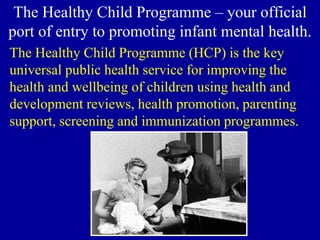
The Healthy Child Programme (HCP) is the key
universal public health service for improving the
health and wellbeing of children using health and
development reviews, health promotion, parenting
support, screening and immunization programmes.
The HCP begins in pregnancy and recommends the
use of a range of universal, targeted and indicated
strategies aimed at promoting the wellbeing of both
the pregnant woman, her partner, and the unborn
baby. The interventions suggested are as follows. -
Promotional interviews: Following the
ante-natal promotional interview at 28
weeks, a later one is conducted by the
same health visitor at around 6-8 weeks
postnatal. This is a window of
opportunity for promoting maternal mental
health and the developing attachment
relationship with the infant, as well as identifying
any need for additional support. The postnatal
interview also focuses on supporting the provision of
sensitive and attuned parent-infant interaction, so
having time to make a relationship, to observe a
relationship and to think about a relationship is
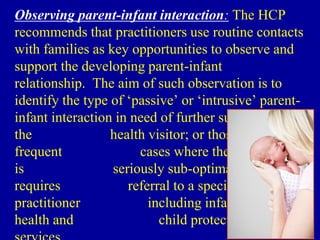
Observing parent-infant interaction: The HCP
recommends that practitioners use routine contacts
with families as key opportunities to observe and
support the developing parent-infant
relationship. The aim of such observation is to
identify the type of ‘passive’ or ‘intrusive’ parent-
infant interaction in need of further support from
the health visitor; or those less
frequent cases where the caregiving
is seriously sub-optimal and
requires referral to a specialist
practitioner including infant mental
health and child protection
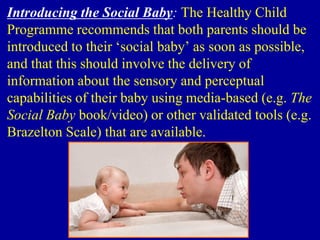
Introducing the Social Baby: The Healthy Child
Programme recommends that both parents should be
introduced to their ‘social baby’ as soon as possible,
and that this should involve the delivery of
information about the sensory and perceptual
capabilities of their baby using media-based (e.g. The
Social Baby book/video) or other validated tools (e.g.
Brazelton Scale) that are available.
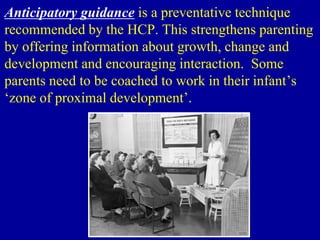
Anticipatory guidance is a preventative technique
recommended by the HCP. This strengthens parenting
by offering information about growth, change and
development and encouraging interaction. Some
parents need to be coached to work in their infant’s
‘zone of proximal development’.
Promoting closeness: The HCP also recommends
that practitioners promote closeness and
sensitive/attuned parenting by encouraging parents to
provide skin-to-skin care and the use of soft baby
carriers; and by ensuring that parents are invited to
attend an infant massage class (evidence-based for
PND).
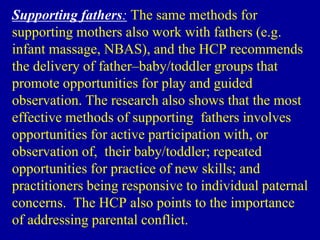
Supporting fathers: The same methods for
supporting mothers also work with fathers (e.g.
infant massage, NBAS), and the HCP recommends
the delivery of father–baby/toddler groups that
promote opportunities for play and guided
observation. The research also shows that the most
effective methods of supporting fathers involves
opportunities for active participation with, or
observation of, their baby/toddler; repeated
opportunities for practice of new skills; and
practitioners being responsive to individual paternal
concerns. The HCP also points to the importance
of addressing parental conflict.
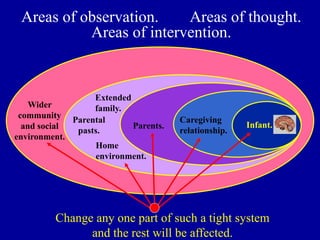
Areas of observation. Areas of thought.
Areas of intervention.
Change any one part of such a tight system
and the rest will be affected.
Wider
community
and social
environment.
Extended
family.
Parents.
Caregiving
relationship.
Infant.
Parental
pasts.
Home
environment.
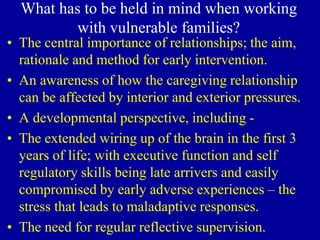
What has to be held in mind when working
with vulnerable families?
• The central importance of relationships; the aim,
rationale and method for early intervention.
• An awareness of how the caregiving relationship
can be affected by interior and exterior pressures.
• A developmental perspective, including -
• The extended wiring up of the brain in the first 3
years of life; with executive function and self
regulatory skills being late arrivers and easily
compromised by early adverse experiences – the
stress that leads to maladaptive responses.
• The need for regular reflective supervision.
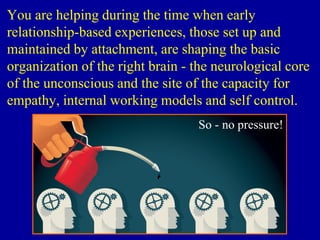
You are helping during the time when early
relationship-based experiences, those set up and
maintained by attachment, are shaping the basic
organization of the right brain - the neurological core
of the unconscious and the site of the capacity for
empathy, internal working models and self control.
So - no pressure!
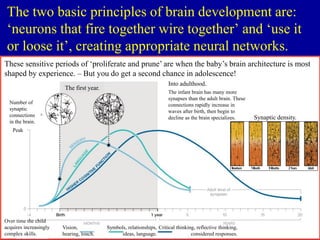
The two basic principles of brain development are:
‘neurons that fire together wire together’ and ‘use it
or loose it’, creating appropriate neural networks.
These sensitive periods of ‘proliferate and prune’ are when the baby’s brain architecture is most
shaped by experience. – But you do get a second chance in adolescence!
Number of
synaptic
connections
in the brain.
The infant brain has many more
synapses than the adult brain. These
connections rapidly increase in
waves after birth, then begin to
decline as the brain specializes.
Into adulthood.
The first year.
Vision,
hearing, touch.
Symbols, relationships,
ideas, language.
Critical thinking, reflective thinking,
considered responses.
Peak
Synaptic density.
Over time the child
acquires increasingly
complex skills.
Windows of opportunity – interventions differ
depending on infant’s developmental stage.
Prenatal. An emphasis on the mental, emotional
and physical health of the mother (and father),
preparation for the birth and new baby, parental
attributions and expectations towards unborn baby
and parenthood, the identification of risk factors
and setting up appropriate support.
Immediate post-natal. Support if baby is
premature. Encouragement of breastfeeding if
appropriate, emphasis on the health of mother and
neonate, facilitating relationship, physical care of
baby, reinforcing the role of father.
1 to 3 months. Helping parents to soothe the baby
and recognize the baby’s signals and states by
promoting ‘mind-mindedness’. A time of getting to
know the baby and his or her temperamental
characteristics. Parents encouraged to access other
support if needed. The visual cortex is in a period of
critical growth, and it is important for the
developing language centres in the brain for the
baby to be engaged in conversation. The
diencephalon (hypothalamus, thalamus and basal
ganglia) is beginning to mature, and these areas
influence motor control, secondary sensory
processing, metabolism and hormonal balance.
4 to 7 months. Promoting the beginning of a selective
secure attachment to parents through appropriate
responsiveness. Need to encourage curiosity and play,
motor skills, communication and suitable stimulation
for building cognitive skills. Just chatting and
messing about. ‘Serve and return’ interactions. The
limbic system begins to wire up at about 5 months,
and this ‘emotional brain’ attunes to the social
environment while regulating internal states. This is
the beginning of the capacity for memory, emotional
regulation, attachment and primary sensory
integration. Helping parents attune to and soothe the
baby remains important, as is turning television off.
8 to 12 months plus. The pre-frontal cortex is
beginning to connect up enabling the baby to begin
to think and make decisions – such as selective
relationships. This marks the beginnings of
reasoning, stranger anxiety, problem-solving and
secondary sensory integration; thus appropriate
cognitive and sensory stimulation within the context
of caring relationships is increasingly important.
Toddlerhood. Supporting (and explaining) the
child’s growing autonomy and sense of self,
emotional regulation and loss of magical thinking.
Offer help with age appropriate limit-setting
through distraction (not the ‘naughty step’!).
Pre-school years. During this time the emphasis
should be on helping the child cope with negative
emotions (e.g. fears, sadness, loneliness, anger,
frustration, jealousy); promoting the ability to
express thoughts and feelings in words (the
encouragement of ‘reflective function’) so that it
becomes easier to inhibit aggression, resolve
conflicts through negotiation and pro-social
behaviour; encourage pretend play, cooperation,
empathy, learning and rule compliance, and
positive self-esteem. – And continue to discourage
television!
(Use this resource: http://www.zerotothree.org/baby-brain-map.html)
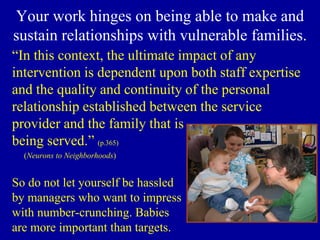
Your work hinges on being able to make and
sustain relationships with vulnerable families.
“In this context, the ultimate impact of any
intervention is dependent upon both staff expertise
and the quality and continuity of the personal
relationship established between the service
provider and the family that is
being served.” (p.365)
(Neurons to Neighborhoods)
So do not let yourself be hassled
by managers who want to impress
with number-crunching. Babies
are more important than targets.
Positive relationships put you in a position
to nurture everyday protective factors.
• For children growing up under adversity, a close and
warm attachment with an effective and sensitive
parental figure is a universal protective factor.
• As is an environment that reinforces and supports any
exploration or positive efforts made by the child.
• A powerful protective factor for parents is close
relationships with other adults that afford social
support and reduce isolation. A stable and supportive
marital relationship is a powerful buffer against the
effects of life stresses that may be unavoidable.
• Relationships with service providers who can provide
long-term emotional and social support is thus an
important intervention in itself.
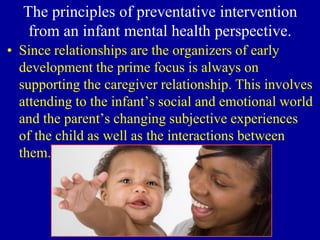
The principles of preventative intervention
from an infant mental health perspective.
• Since relationships are the organizers of early
development the prime focus is always on
supporting the caregiver relationship. This involves
attending to the infant’s social and emotional world
and the parent’s changing subjective experiences
of the child as well as the interactions between
them.
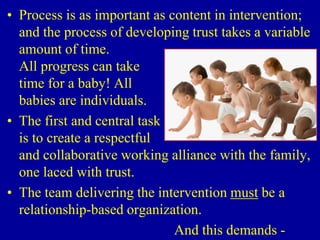
• Process is as important as content in intervention;
and the process of developing trust takes a variable
amount of time.
All progress can take
time for a baby! All
babies are individuals.
• The first and central task
is to create a respectful
and collaborative working alliance with the family,
one laced with trust.
• The team delivering the intervention must be a
relationship-based organization.
And this demands -
• A working knowledge of ‘parallel process’ – how
relationships affect relationships – is essential. I.e.
how management-staff relationships and intra team
relationships affect intervenor-family relationships,
and how these in turn affect the caregiving
relationship.
• The development of reflective function, self-
awareness, is a necessary professional competency.
A case of seeing yourself from the outside and the
other from the inside.
• Reflection should be encouraged at all levels, and
must be backed up by regular and protected
reflective supervision.
• Avoid pathologizing, looking for a diagnosis, or
‘parent blaming’ in any way, as all reduce the
ability to understand, create a barrier to
relationships and impact parental self-esteem.
• Identify, treat and / or collaborate with others in
the treatment of any identified disorders of
infancy, developmental delays and disabilities,
regulatory disorders, parental mental illness or
trauma and family dysfunction.
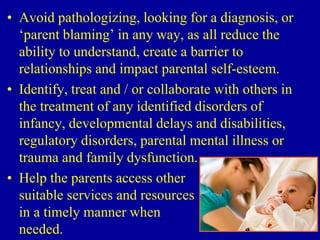
• Help the parents access other
suitable services and resources
in a timely manner when
needed.
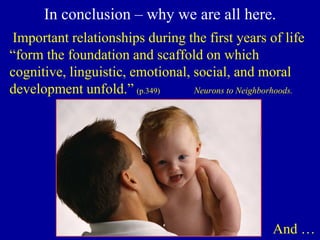
In conclusion – why we are all here.
Important relationships during the first years of life
“form the foundation and scaffold on which
cognitive, linguistic, emotional, social, and moral
development unfold.” (p.349) Neurons to Neighborhoods.
And …
You are the early warning system for the
next generation!
So don’t let the next government leave you floating in space.
Association of Infant Mental Health (UK).
This is an organisation for those interested in all
branches of infant development as well as early
intervention with babies and their families. It goes
with reduced rates at their workshops and
conferences, with access to a lot of information on
the website. Group membership for Children’s
Centres. Application forms
from:
Administrator AIMH(UK).
email: info@aimh.org.uk
website: www.aimh.org.uk
The advisory panel.
See this important report
from the D of E and the
WAVE Trust:
http://www.wavetrust.org
Plus the ‘The 1001
Critical Days’ manifesto:
http://www.1001criticald
ays.co.uk/the_coalition.p
hp where you can also
find
the crucial APPG Report
‘Building Great Britons’

iHV regional conf: Robin Balbernie - Holding the future: The importance of health visitors from an infant mental health perspective

  • 1.
    Holding the future:The importance of health visitors from an infant mental health perspective. robin.balbernie@gmail.com © R. Balbernie.
  • 2.
    I’m really notsure here! – I could be teaching …
  • 3.
    The viewpoint –from the Mental Health Task Force of Zero to Three. “Infant mental health is the developing capacity of the child from birth to three to: experience, regulate, and express emotions; form close interpersonal relationships; and explore the environment and learn – all in the context of family, community and mental health expectations for young children. Infant mental health is synonymous with healthy social and emotional development.” So the task for early years workers should be more preventative than reactive.
  • 4.
    So how dowe achieve this? 1818 – 1895
  • 5.
    The starting point:The first relationships are the most important. Positive predictable interactions with nurturing caregivers profoundly stimulate and organize young minds. The quality of early caregiving has a long lasting impact on how children develop, their ability to learn, and their capacity to both regulate their own emotions and form satisfying relationships. But relationships can also have a negative influence.
  • 6.
    Health visitors arecentral to infant mental health. Health visitors are the professional group at the frontline for supporting vulnerable families and babies by delivering a universal service designed to promote the healthy development of small children. Top of the range health visiting aims to promote all aspects of child health. It should be preventative, relationship-based, containing, developmentally informed and help connect families to other specialized resources when needed.
  • 7.
    Beliefs that supportand sustain all early preventative interventions. • Optimal growth and development occur within early nurturing relationships. • The birth and care of a baby offer a family the possibility of new relationships, growth and change. • What happens in the early years affects the course of development across the entire lifespan.
  • 8.
    Characteristics of apreventative intervention. • Its purpose is to increase the probability of normal developmental trajectories in later life. • It aims to prevent conditions that have not yet occurred, risk proactive and increasing resilience. • Generally conducted with families where the infant does not show a diagnosable disorder. • The approach is based on a model of development where both risks and protective factors shape the paths whereby individuals may become vulnerable or resistant to later stresses and developmental deviance.
  • 9.
    • Universal preventionstrategies provide the essential foundation needed to identify families at risk and for other interventions to be effective. • The earlier the intervention the more positive outcomes are likely to be, in part because there is less likelihood for secondary complications. • A focus on the parent-baby interaction and parental attributions of the infant may be necessary for optimum socio-emotional outcomes for the child. • For families with multiple risks no single intervention can be effective and numerous components of treatment are needed from different services. (See: www.IMHPromotion.ca )
  • 10.
    “Early identification ofindividuals at risk is the first step towards engaging families and offering them programmes and services that will help parents to do the best for their child and improve their child’s health and wellbeing.”Healthy lives, brighter futures. DCSF & DOH (2009) Without universal and invisible health visiting early identification is a myth. A preventative service can use a risk- analysis in order to offer intervention before the caregiver / baby relationship becomes too severely compromised and a baby suffers needlessly. Progressive universalism is key. (N.B.: Please contact me if you would like a check list for risk analysis.)
  • 11.
    The Healthy ChildProgramme – your official port of entry to promoting infant mental health. The Healthy Child Programme (HCP) is the key universal public health service for improving the health and wellbeing of children using health and development reviews, health promotion, parenting support, screening and immunization programmes.
  • 12.
    The HCP beginsin pregnancy and recommends the use of a range of universal, targeted and indicated strategies aimed at promoting the wellbeing of both the pregnant woman, her partner, and the unborn baby. The interventions suggested are as follows. -
  • 13.
    Promotional interviews: Followingthe ante-natal promotional interview at 28 weeks, a later one is conducted by the same health visitor at around 6-8 weeks postnatal. This is a window of opportunity for promoting maternal mental health and the developing attachment relationship with the infant, as well as identifying any need for additional support. The postnatal interview also focuses on supporting the provision of sensitive and attuned parent-infant interaction, so having time to make a relationship, to observe a relationship and to think about a relationship is
  • 14.
    Observing parent-infant interaction:The HCP recommends that practitioners use routine contacts with families as key opportunities to observe and support the developing parent-infant relationship. The aim of such observation is to identify the type of ‘passive’ or ‘intrusive’ parent- infant interaction in need of further support from the health visitor; or those less frequent cases where the caregiving is seriously sub-optimal and requires referral to a specialist practitioner including infant mental health and child protection
  • 15.
    Introducing the SocialBaby: The Healthy Child Programme recommends that both parents should be introduced to their ‘social baby’ as soon as possible, and that this should involve the delivery of information about the sensory and perceptual capabilities of their baby using media-based (e.g. The Social Baby book/video) or other validated tools (e.g. Brazelton Scale) that are available.
  • 16.
    Anticipatory guidance isa preventative technique recommended by the HCP. This strengthens parenting by offering information about growth, change and development and encouraging interaction. Some parents need to be coached to work in their infant’s ‘zone of proximal development’.
  • 17.
    Promoting closeness: TheHCP also recommends that practitioners promote closeness and sensitive/attuned parenting by encouraging parents to provide skin-to-skin care and the use of soft baby carriers; and by ensuring that parents are invited to attend an infant massage class (evidence-based for PND).
  • 18.
    Supporting fathers: Thesame methods for supporting mothers also work with fathers (e.g. infant massage, NBAS), and the HCP recommends the delivery of father–baby/toddler groups that promote opportunities for play and guided observation. The research also shows that the most effective methods of supporting fathers involves opportunities for active participation with, or observation of, their baby/toddler; repeated opportunities for practice of new skills; and practitioners being responsive to individual paternal concerns. The HCP also points to the importance of addressing parental conflict.
  • 19.
    Areas of observation.Areas of thought. Areas of intervention. Change any one part of such a tight system and the rest will be affected. Wider community and social environment. Extended family. Parents. Caregiving relationship. Infant. Parental pasts. Home environment.
  • 20.
    What has tobe held in mind when working with vulnerable families? • The central importance of relationships; the aim, rationale and method for early intervention. • An awareness of how the caregiving relationship can be affected by interior and exterior pressures. • A developmental perspective, including - • The extended wiring up of the brain in the first 3 years of life; with executive function and self regulatory skills being late arrivers and easily compromised by early adverse experiences – the stress that leads to maladaptive responses. • The need for regular reflective supervision.
  • 21.
    You are helpingduring the time when early relationship-based experiences, those set up and maintained by attachment, are shaping the basic organization of the right brain - the neurological core of the unconscious and the site of the capacity for empathy, internal working models and self control. So - no pressure!
  • 22.
    The two basicprinciples of brain development are: ‘neurons that fire together wire together’ and ‘use it or loose it’, creating appropriate neural networks. These sensitive periods of ‘proliferate and prune’ are when the baby’s brain architecture is most shaped by experience. – But you do get a second chance in adolescence! Number of synaptic connections in the brain. The infant brain has many more synapses than the adult brain. These connections rapidly increase in waves after birth, then begin to decline as the brain specializes. Into adulthood. The first year. Vision, hearing, touch. Symbols, relationships, ideas, language. Critical thinking, reflective thinking, considered responses. Peak Synaptic density. Over time the child acquires increasingly complex skills.
  • 23.
    Windows of opportunity– interventions differ depending on infant’s developmental stage. Prenatal. An emphasis on the mental, emotional and physical health of the mother (and father), preparation for the birth and new baby, parental attributions and expectations towards unborn baby and parenthood, the identification of risk factors and setting up appropriate support. Immediate post-natal. Support if baby is premature. Encouragement of breastfeeding if appropriate, emphasis on the health of mother and neonate, facilitating relationship, physical care of baby, reinforcing the role of father.
  • 24.
    1 to 3months. Helping parents to soothe the baby and recognize the baby’s signals and states by promoting ‘mind-mindedness’. A time of getting to know the baby and his or her temperamental characteristics. Parents encouraged to access other support if needed. The visual cortex is in a period of critical growth, and it is important for the developing language centres in the brain for the baby to be engaged in conversation. The diencephalon (hypothalamus, thalamus and basal ganglia) is beginning to mature, and these areas influence motor control, secondary sensory processing, metabolism and hormonal balance.
  • 25.
    4 to 7months. Promoting the beginning of a selective secure attachment to parents through appropriate responsiveness. Need to encourage curiosity and play, motor skills, communication and suitable stimulation for building cognitive skills. Just chatting and messing about. ‘Serve and return’ interactions. The limbic system begins to wire up at about 5 months, and this ‘emotional brain’ attunes to the social environment while regulating internal states. This is the beginning of the capacity for memory, emotional regulation, attachment and primary sensory integration. Helping parents attune to and soothe the baby remains important, as is turning television off.
  • 26.
    8 to 12months plus. The pre-frontal cortex is beginning to connect up enabling the baby to begin to think and make decisions – such as selective relationships. This marks the beginnings of reasoning, stranger anxiety, problem-solving and secondary sensory integration; thus appropriate cognitive and sensory stimulation within the context of caring relationships is increasingly important. Toddlerhood. Supporting (and explaining) the child’s growing autonomy and sense of self, emotional regulation and loss of magical thinking. Offer help with age appropriate limit-setting through distraction (not the ‘naughty step’!).
  • 27.
    Pre-school years. Duringthis time the emphasis should be on helping the child cope with negative emotions (e.g. fears, sadness, loneliness, anger, frustration, jealousy); promoting the ability to express thoughts and feelings in words (the encouragement of ‘reflective function’) so that it becomes easier to inhibit aggression, resolve conflicts through negotiation and pro-social behaviour; encourage pretend play, cooperation, empathy, learning and rule compliance, and positive self-esteem. – And continue to discourage television! (Use this resource: http://www.zerotothree.org/baby-brain-map.html)
  • 28.
    Your work hingeson being able to make and sustain relationships with vulnerable families. “In this context, the ultimate impact of any intervention is dependent upon both staff expertise and the quality and continuity of the personal relationship established between the service provider and the family that is being served.” (p.365) (Neurons to Neighborhoods) So do not let yourself be hassled by managers who want to impress with number-crunching. Babies are more important than targets.
  • 29.
    Positive relationships putyou in a position to nurture everyday protective factors. • For children growing up under adversity, a close and warm attachment with an effective and sensitive parental figure is a universal protective factor. • As is an environment that reinforces and supports any exploration or positive efforts made by the child. • A powerful protective factor for parents is close relationships with other adults that afford social support and reduce isolation. A stable and supportive marital relationship is a powerful buffer against the effects of life stresses that may be unavoidable. • Relationships with service providers who can provide long-term emotional and social support is thus an important intervention in itself.
  • 30.
    The principles ofpreventative intervention from an infant mental health perspective. • Since relationships are the organizers of early development the prime focus is always on supporting the caregiver relationship. This involves attending to the infant’s social and emotional world and the parent’s changing subjective experiences of the child as well as the interactions between them.
  • 31.
    • Process isas important as content in intervention; and the process of developing trust takes a variable amount of time. All progress can take time for a baby! All babies are individuals. • The first and central task is to create a respectful and collaborative working alliance with the family, one laced with trust. • The team delivering the intervention must be a relationship-based organization. And this demands -
  • 32.
    • A workingknowledge of ‘parallel process’ – how relationships affect relationships – is essential. I.e. how management-staff relationships and intra team relationships affect intervenor-family relationships, and how these in turn affect the caregiving relationship. • The development of reflective function, self- awareness, is a necessary professional competency. A case of seeing yourself from the outside and the other from the inside. • Reflection should be encouraged at all levels, and must be backed up by regular and protected reflective supervision.
  • 33.
    • Avoid pathologizing,looking for a diagnosis, or ‘parent blaming’ in any way, as all reduce the ability to understand, create a barrier to relationships and impact parental self-esteem. • Identify, treat and / or collaborate with others in the treatment of any identified disorders of infancy, developmental delays and disabilities, regulatory disorders, parental mental illness or trauma and family dysfunction. • Help the parents access other suitable services and resources in a timely manner when needed.
  • 34.
    In conclusion –why we are all here. Important relationships during the first years of life “form the foundation and scaffold on which cognitive, linguistic, emotional, social, and moral development unfold.” (p.349) Neurons to Neighborhoods. And …
  • 35.
    You are theearly warning system for the next generation! So don’t let the next government leave you floating in space.
  • 36.
    Association of InfantMental Health (UK). This is an organisation for those interested in all branches of infant development as well as early intervention with babies and their families. It goes with reduced rates at their workshops and conferences, with access to a lot of information on the website. Group membership for Children’s Centres. Application forms from: Administrator AIMH(UK). email: info@aimh.org.uk website: www.aimh.org.uk The advisory panel.
  • 37.
    See this importantreport from the D of E and the WAVE Trust: http://www.wavetrust.org Plus the ‘The 1001 Critical Days’ manifesto: http://www.1001criticald ays.co.uk/the_coalition.p hp where you can also find the crucial APPG Report ‘Building Great Britons’