Office of Innovative Projects
        Mediator Training
        March 29th, 2010

      Christine Callahan, Director
                   &
      Victoria Meeder, Marketing/
      Public Awareness Supervisor
Innovative Projects of CCRESA:
       • Early On® Training and Technical
         Assistance (2001)

       • Early On® Public Awareness (2005)


       • Project Find since (2005)


       • Early On® Center for Higher Education
         (2007)
Our Topics Today
• Early On® Michigan
• Child Find
• Response to Intervention
  – For each:
    •   Overview
    •   Potential Conflict
    •   Resources
    •   Scenario
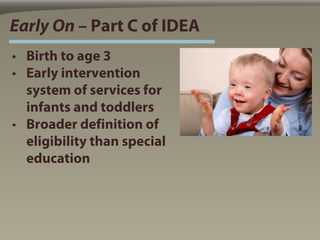
Early On – Part C of IDEA
• Birth to age 3
• Early intervention
  system of services for
  infants and toddlers
• Broader definition of
  eligibility than special
  education
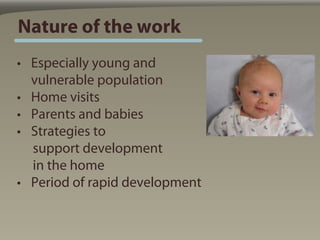
Nature of the work
• Especially young and
  vulnerable population
• Home visits
• Parents and babies
• Strategies to
  support development
  in the home
• Period of rapid development
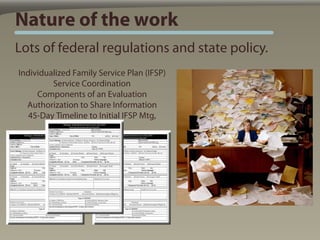
Nature of the work
Lots of federal regulations and state policy.
Individualized Family Service Plan (IFSP)
         Service Coordination
     Components of an Evaluation
  Authorization to Share Information
   45-Day Timeline to Initial IFSP Mtg,
Early On Potential Contention
• Eligible vs. Not Eligible
  – Initial and ongoing
• Services
  – Type (occupational therapy vs. speech therapy
    and provider type)
  – Intensity (2x/week vs. 4x/week)
  – Timeliness (within 30 days vs. ever?)
  – Location (home vs. center)
• Payment for services (ISD vs. Insurance)
Timeline for EO Services
Days are calendar for Part C/Early On unless otherwise
noted

•   Referral to Consent to Evaluate by 10 days
•   Referral to initial IFSP meeting by 45 days
•   Referral to IFSP completion by 60 days
•   IFSP completion to services by 30 days
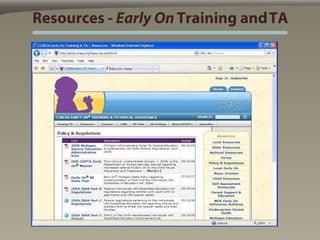
Resources - Early On Training and TA
Early On Resources
• eotta.ccresa.org – provider oriented
• 1800EarlyOn.org – parent oriented
  • Family Rights Guidebook
  • Early On Procedural Safeguards
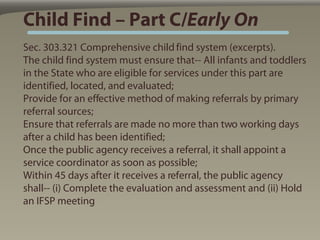
Child Find – Part C/Early On
Sec. 303.321 Comprehensive child find system (excerpts).
The child find system must ensure that-- All infants and toddlers
in the State who are eligible for services under this part are
identified, located, and evaluated;
Provide for an effective method of making referrals by primary
referral sources;
Ensure that referrals are made no more than two working days
after a child has been identified;
Once the public agency receives a referral, it shall appoint a
service coordinator as soon as possible;
Within 45 days after it receives a referral, the public agency
shall-- (i) Complete the evaluation and assessment and (ii) Hold
an IFSP meeting
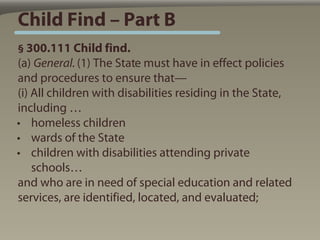
Child Find – Part B
§ 300.111 Child find.
(a) General. (1) The State must have in effect policies
and procedures to ensure that—
(i) All children with disabilities residing in the State,
including …
• homeless children
• wards of the State
• children with disabilities attending private
    schools…
and who are in need of special education and related
services, are identified, located, and evaluated;
Child Find – Part B
Child find also must include—
(1) Children who are suspected of being a child
with a disability … even though they are
advancing from grade to grade; and
(2) Highly mobile children, including migrant
children.
Child Find – Part B
§ 300.131 Each LEA must locate, identify, and evaluate all
children with disabilities who are enrolled by their parents in
private, including religious, elementary schools and secondary
schools located in the school district served by the LEA.
The child find process must be designed to ensure—
(1) The equitable participation of parentally-placed private
school children; and
(2) An accurate count of those children.
In carrying out the requirements of this section, the LEA, or, if
applicable, the SEA, must undertake activities similar to the
activities undertaken for the agency’s public school children.
Child Find in Michigan – B and C

Statewide Child Find Projects – economy of
scale for outreach, marketing, and intake/
referral. Support for locals.
Early On Public Awareness
Project Find Michigan
ISDs and LEAs are responsible and accountable
for child find within their districts
Child Find – Potential Contention
•   Failure to evaluate
•   Eligibility
•   Preschool services
•   Private school responsibilities
Child Find Resources
• Identify, Locate, Evaluate: Child Find Under IDEA
  (Part B) and Section 504
• 1800EarlyOn.org
• ProjectFindMichigan.org
• www.WrightsLaw.com
Response to Intervention (RTI)
Congress added new provisions to federal education
laws:
• No Child Left Behind (NCLB)
   – accountability
   – school improvement
   – adequate yearly progress (AYP)
• Individuals with Disabilities Education Act (IDEA)
   – effective instruction
   – progress monitoring
   – early intervening services
NCLB and IDEA 2004
• Companion laws that address closing the
  achievement gaps
• Underscore importance of high quality, scientific,
  research-based instruction and interventions
• Hold schools accountable for the progress of all
  students in meeting grade level standards
Response to Intervention is…
          the practice of providing high-quality
   instruction/intervention matched to student needs
                            and
              using learning rate over time
                 and level of performance
                             to
               inform educational decisions


Source: NASDSE. Response to Intervention: policy considerations and implementation and
IDEA Partnership, 2007.
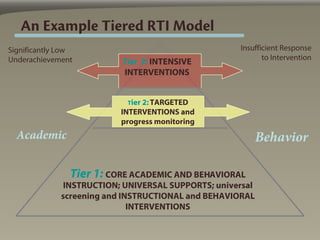
An Example Tiered RTI Model
Significantly Low                                    Insufficient Response
Underachievement                                            to Intervention
                           Tier 3: INTENSIVE
                           INTERVENTIONS


                            Tier 2: TARGETED
                           INTERVENTIONS and
                           progress monitoring
  Academic                                                  Behavior

                Tier 1: CORE ACADEMIC AND BEHAVIORAL
               INSTRUCTION; UNIVERSAL SUPPORTS; universal
              screening and INSTRUCTIONAL and BEHAVIORAL
                              INTERVENTIONS
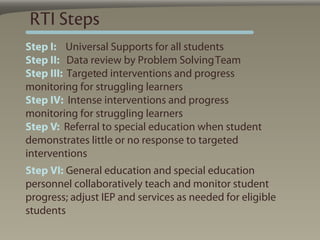
RTI Steps
Step I: Universal Supports for all students
Step II: Data review by Problem Solving Team
Step III: Targeted interventions and progress
monitoring for struggling learners
Step IV: Intense interventions and progress
monitoring for struggling learners
Step V: Referral to special education when student
demonstrates little or no response to targeted
interventions
Step VI: General education and special education
personnel collaboratively teach and monitor student
progress; adjust IEP and services as needed for eligible
students
Response to Intervention –
Potential Contention
Remember: RTI is implemented within the
context of general education
Interface with Child Find responsibilities
• a parent has the right to request an
  evaluation at any time (§ 300.301)
RTI Resources
http://www.RTInetwork.org/
A Parent’s Guide to Response to Intervention,
National Center for Learning Disabilities.
Thank You

   Christy Callahan
callahan_c@ccresa.org
    Victoria Meeder
meeder_v@ccresa.org

Mediator training

  • 1.
    Office of InnovativeProjects Mediator Training March 29th, 2010 Christine Callahan, Director & Victoria Meeder, Marketing/ Public Awareness Supervisor
  • 2.
    Innovative Projects ofCCRESA: • Early On® Training and Technical Assistance (2001) • Early On® Public Awareness (2005) • Project Find since (2005) • Early On® Center for Higher Education (2007)
  • 3.
    Our Topics Today •Early On® Michigan • Child Find • Response to Intervention – For each: • Overview • Potential Conflict • Resources • Scenario
  • 4.
    Early On –Part C of IDEA • Birth to age 3 • Early intervention system of services for infants and toddlers • Broader definition of eligibility than special education
  • 5.
    Nature of thework • Especially young and vulnerable population • Home visits • Parents and babies • Strategies to support development in the home • Period of rapid development
  • 6.
    Nature of thework Lots of federal regulations and state policy. Individualized Family Service Plan (IFSP) Service Coordination Components of an Evaluation Authorization to Share Information 45-Day Timeline to Initial IFSP Mtg,
  • 7.
    Early On PotentialContention • Eligible vs. Not Eligible – Initial and ongoing • Services – Type (occupational therapy vs. speech therapy and provider type) – Intensity (2x/week vs. 4x/week) – Timeliness (within 30 days vs. ever?) – Location (home vs. center) • Payment for services (ISD vs. Insurance)
  • 8.
    Timeline for EOServices Days are calendar for Part C/Early On unless otherwise noted • Referral to Consent to Evaluate by 10 days • Referral to initial IFSP meeting by 45 days • Referral to IFSP completion by 60 days • IFSP completion to services by 30 days
  • 9.
    Resources - EarlyOn Training and TA
  • 10.
    Early On Resources •eotta.ccresa.org – provider oriented • 1800EarlyOn.org – parent oriented • Family Rights Guidebook • Early On Procedural Safeguards
  • 11.
    Child Find –Part C/Early On Sec. 303.321 Comprehensive child find system (excerpts). The child find system must ensure that-- All infants and toddlers in the State who are eligible for services under this part are identified, located, and evaluated; Provide for an effective method of making referrals by primary referral sources; Ensure that referrals are made no more than two working days after a child has been identified; Once the public agency receives a referral, it shall appoint a service coordinator as soon as possible; Within 45 days after it receives a referral, the public agency shall-- (i) Complete the evaluation and assessment and (ii) Hold an IFSP meeting
  • 12.
    Child Find –Part B § 300.111 Child find. (a) General. (1) The State must have in effect policies and procedures to ensure that— (i) All children with disabilities residing in the State, including … • homeless children • wards of the State • children with disabilities attending private schools… and who are in need of special education and related services, are identified, located, and evaluated;
  • 13.
    Child Find –Part B Child find also must include— (1) Children who are suspected of being a child with a disability … even though they are advancing from grade to grade; and (2) Highly mobile children, including migrant children.
  • 14.
    Child Find –Part B § 300.131 Each LEA must locate, identify, and evaluate all children with disabilities who are enrolled by their parents in private, including religious, elementary schools and secondary schools located in the school district served by the LEA. The child find process must be designed to ensure— (1) The equitable participation of parentally-placed private school children; and (2) An accurate count of those children. In carrying out the requirements of this section, the LEA, or, if applicable, the SEA, must undertake activities similar to the activities undertaken for the agency’s public school children.
  • 15.
    Child Find inMichigan – B and C Statewide Child Find Projects – economy of scale for outreach, marketing, and intake/ referral. Support for locals. Early On Public Awareness Project Find Michigan ISDs and LEAs are responsible and accountable for child find within their districts
  • 16.
    Child Find –Potential Contention • Failure to evaluate • Eligibility • Preschool services • Private school responsibilities
  • 17.
    Child Find Resources •Identify, Locate, Evaluate: Child Find Under IDEA (Part B) and Section 504 • 1800EarlyOn.org • ProjectFindMichigan.org • www.WrightsLaw.com
  • 18.
    Response to Intervention(RTI) Congress added new provisions to federal education laws: • No Child Left Behind (NCLB) – accountability – school improvement – adequate yearly progress (AYP) • Individuals with Disabilities Education Act (IDEA) – effective instruction – progress monitoring – early intervening services
  • 19.
    NCLB and IDEA2004 • Companion laws that address closing the achievement gaps • Underscore importance of high quality, scientific, research-based instruction and interventions • Hold schools accountable for the progress of all students in meeting grade level standards
  • 20.
    Response to Interventionis… the practice of providing high-quality instruction/intervention matched to student needs and using learning rate over time and level of performance to inform educational decisions Source: NASDSE. Response to Intervention: policy considerations and implementation and IDEA Partnership, 2007.
  • 21.
    An Example TieredRTI Model Significantly Low Insufficient Response Underachievement to Intervention Tier 3: INTENSIVE INTERVENTIONS Tier 2: TARGETED INTERVENTIONS and progress monitoring Academic Behavior Tier 1: CORE ACADEMIC AND BEHAVIORAL INSTRUCTION; UNIVERSAL SUPPORTS; universal screening and INSTRUCTIONAL and BEHAVIORAL INTERVENTIONS
  • 22.
    RTI Steps Step I:Universal Supports for all students Step II: Data review by Problem Solving Team Step III: Targeted interventions and progress monitoring for struggling learners Step IV: Intense interventions and progress monitoring for struggling learners Step V: Referral to special education when student demonstrates little or no response to targeted interventions Step VI: General education and special education personnel collaboratively teach and monitor student progress; adjust IEP and services as needed for eligible students
  • 23.
    Response to Intervention– Potential Contention Remember: RTI is implemented within the context of general education Interface with Child Find responsibilities • a parent has the right to request an evaluation at any time (§ 300.301)
  • 24.
    RTI Resources http://www.RTInetwork.org/ A Parent’sGuide to Response to Intervention, National Center for Learning Disabilities.
  • 25.
    Thank You Christy Callahan callahan_c@ccresa.org Victoria Meeder meeder_v@ccresa.org