Visual DictionarySp10HipBSCI 2300April 26, 2010
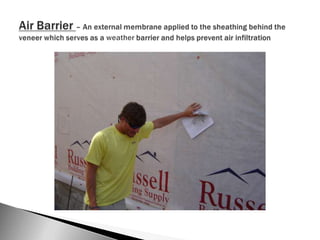
Air Barrier – An external membrane applied to the sheathing behind the veneer which serves as a weather barrier and helps prevent air infiltration
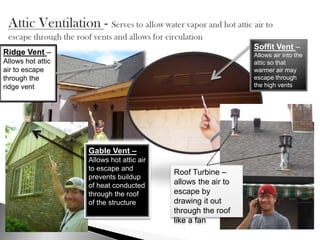
Attic Ventilation - Serves to allow water vapor and hot attic air to escape through the roof vents and allows for circulationSoffit Vent – Allows air into the attic so that warmer air may escape through the high ventsRidge Vent – Allows hot attic air to escape through the ridge ventGable Vent – Allows hot attic air to escape and prevents buildup of heat conducted through the roof of the structureRoof Turbine – allows the air to escape by drawing it out through the roof like a fan
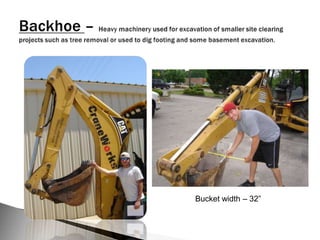
Backhoe – Heavy machinery used for excavation of smaller site clearing projects such as tree removal or used to dig footing and some basement excavation.Bucket width – 32”
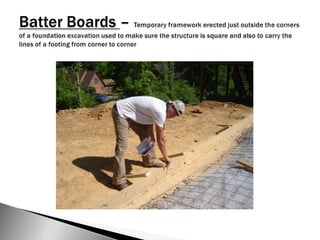
Batter Boards – Temporary framework erected just outside the corners of a foundation excavation used to make sure the structure is square and also to carry the lines of a footing from corner to corner
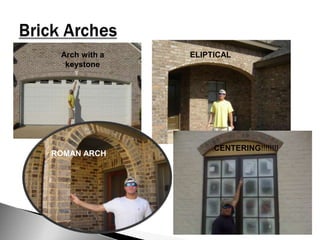
Brick ArchesArch with a keystoneELIPTICALCENTERING!!!!!!!!ROMAN ARCH
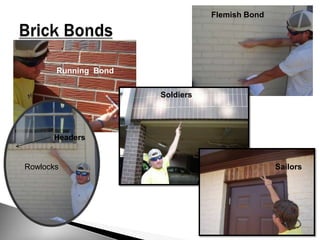
Brick BondsFlemish BondRunning  BondSoldiersHeadersRowlocksSailors
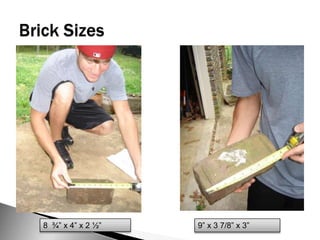
Brick Sizes8  ¾” x 4” x 2 ½”9” x 3 7/8” x 3”
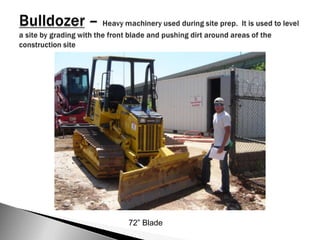
Bulldozer – Heavy machinery used during site prep.  It is used to level a site by grading with the front blade and pushing dirt around areas of the construction site72” Blade
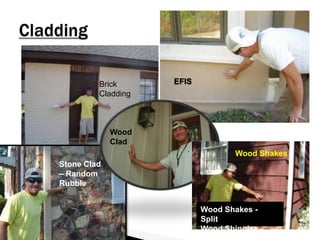
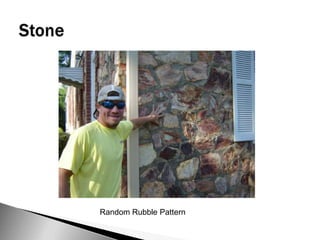
CladdingEFISBrick CladdingWood CladWood ShakesStone Clad – Random RubbleWood Shakes -   SplitWood Shingles - Sawn
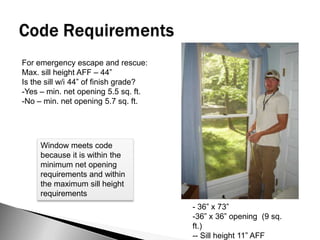
Code RequirementsFor emergency escape and rescue:Max. sill height AFF – 44”Is the sill w/i 44” of finish grade?-Yes – min. net opening 5.5 sq. ft.-No – min. net opening 5.7 sq. ft.Window meets code because it is within the minimum net opening requirements and within the maximum sill height requirements- 36” x 73” 36” x 36” opening  (9 sq. ft.)
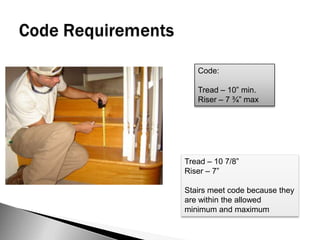
- Sill height 11” AFFCode RequirementsCode:Tread – 10” min.Riser – 7 ¾” maxTread – 10 7/8”Riser – 7”Stairs meet code because they are within the allowed minimum and maximum
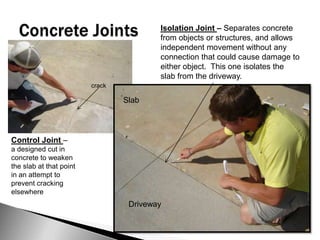
Concrete JointsIsolation Joint – Separates concrete from objects or structures, and allows independent movement without any connection that could cause damage to either object.  This one isolates the slab from the driveway.crackSlabControl Joint – a designed cut in concrete to weaken the slab at that point in an attempt to prevent cracking elsewhereDriveway
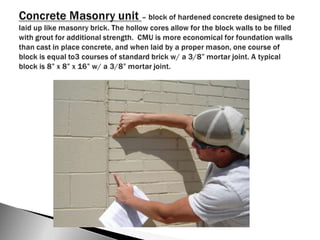
Concrete Masonry unit – block of hardened concrete designed to be laid up like masonry brick. The hollow cores allow for the block walls to be filled with grout for additional strength.  CMU is more economical for foundation walls than cast in place concrete, and when laid by a proper mason, one course of block is equal to3 courses of standard brick w/ a 3/8” mortar joint. A typical block is 8” x 8” x 16” w/ a 3/8” mortar joint.
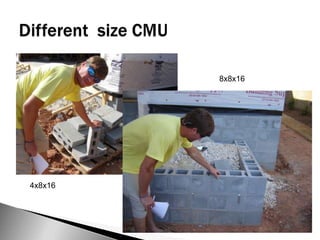
Different  size CMU8x8x164x8x16
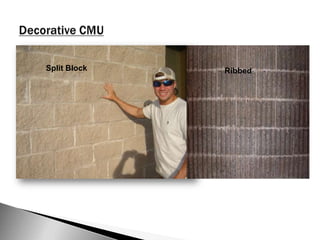
Decorative CMUSplit BlockRibbed
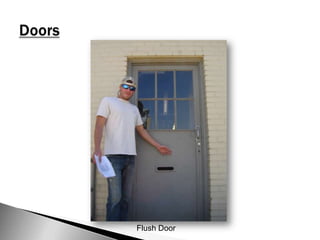
DoorsFlush Door
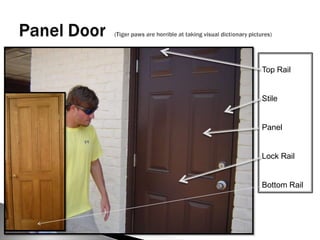
Panel Door  (Tiger paws are horrible at taking visual dictionary pictures)Top RailStilePanelLock RailBottom Rail
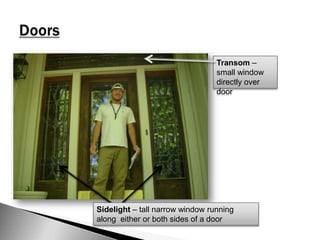
DoorsTransom – small window directly over doorSidelight – tall narrow window running along  either or both sides of a door
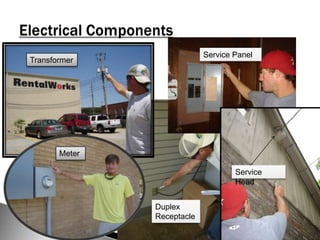
Electrical ComponentsService PanelTransformerMeterService HeadDuplex Receptacle
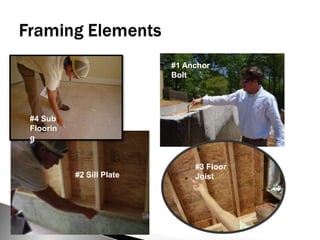
Framing Elements#1 Anchor Bolt#4 Sub Flooring#3 Floor Joist#2 Sill Plate
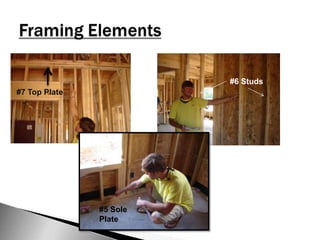
Framing Elements#6 Studs#7 Top Plate#5 Sole Plate
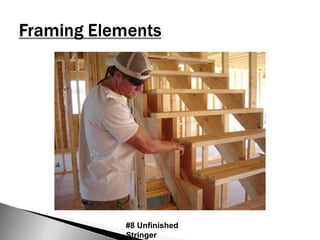
Framing Elements#8 Unfinished Stringer
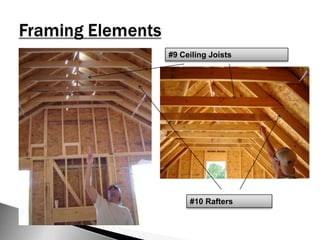
Framing Elements#9 Ceiling Joists#10 Rafters
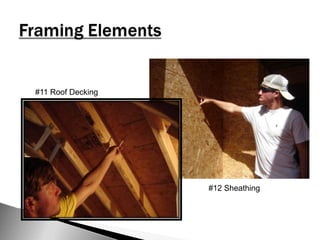
Framing Elements#11 Roof Decking#12 Sheathing
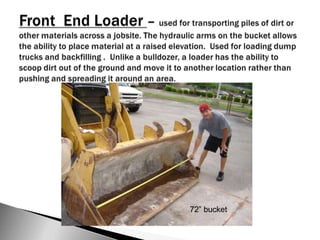
Front  End Loader – used for transporting piles of dirt or other materials across a jobsite. The hydraulic arms on the bucket allows the ability to place material at a raised elevation.  Used for loading dump trucks and backfilling .  Unlike a bulldozer, a loader has the ability to scoop dirt out of the ground and move it to another location rather than pushing and spreading it around an area.72” bucket
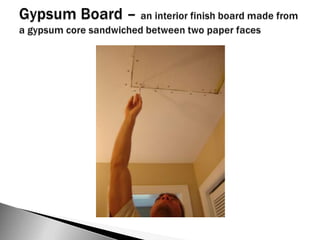
Gypsum Board – an interior finish board made from a gypsum core sandwiched between two paper faces
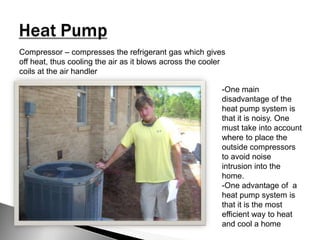
Heat Pump Compressor – compresses the refrigerant gas which gives off heat, thus cooling the air as it blows across the cooler coils at the air handler-One main disadvantage of the heat pump system is that it is noisy. One must take into account where to place the outside compressors to avoid noise intrusion into the home.-One advantage of  a heat pump system is that it is the most efficient way to heat and cool a home
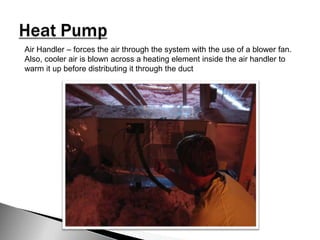
Heat PumpAir Handler – forces the air through the system with the use of a blower fan. Also, cooler air is blown across a heating element inside the air handler to warm it up before distributing it through the duct
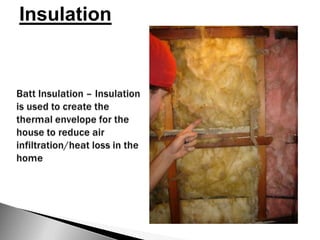
InsulationBatt Insulation – Insulation is used to create the thermal envelope for the house to reduce air infiltration/heat loss in the home
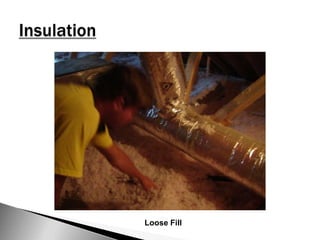
InsulationLoose Fill
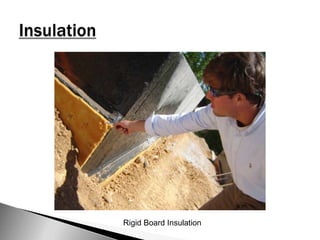
InsulationRigid Board Insulation
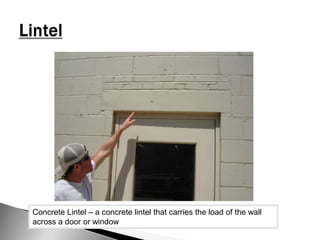
LintelConcrete Lintel – a concrete lintel that carries the load of the wall across a door or window
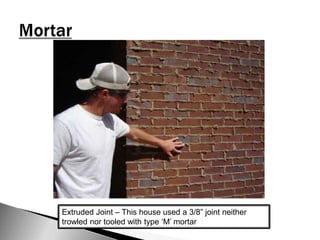
MortarExtruded Joint – This house used a 3/8” joint neither trowled nor tooled with type ‘M’ mortar
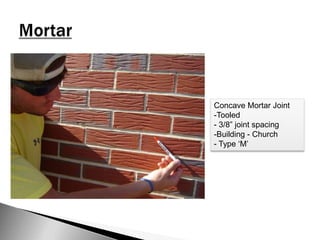
MortarConcave Mortar JointTooled
 3/8” joint spacing
Building - Church
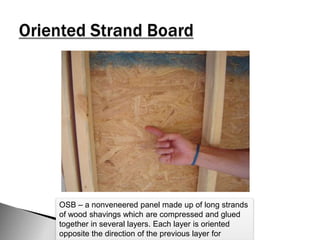
 Type ‘M’Oriented Strand BoardOSB – a nonveneered panel made up of long strands of wood shavings which are compressed and glued together in several layers. Each layer is oriented opposite the direction of the previous layer for strength

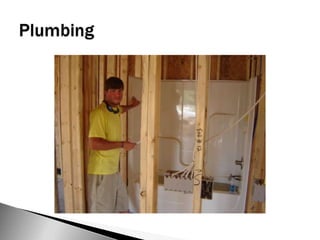
PlumbingLavatory – uses 1 ½” drain pipe
PlumbingWater closet – uses 3” pipe to drain
Plumbing
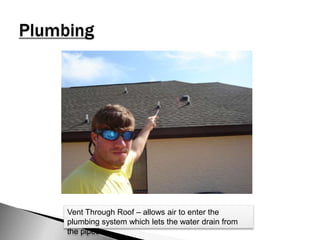
PlumbingVent Through Roof – allows air to enter the plumbing system which lets the water drain from the pipes
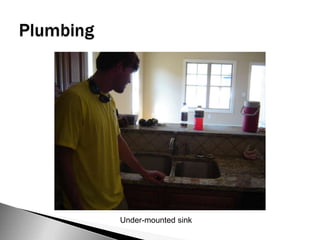
PlumbingUnder-mounted sink
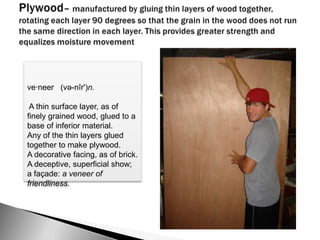
Plywood– manufactured by gluing thin layers of wood together, rotating each layer 90 degrees so that the grain in the wood does not run the same direction in each layer. This provides greater strength and equalizes moisture movementve·neer   (və-nîr')n. A thin surface layer, as of finely grained wood, glued to a base of inferior material.Any of the thin layers glued together to make plywood.A decorative facing, as of brick.A deceptive, superficial show; a façade: a veneer of friendliness.

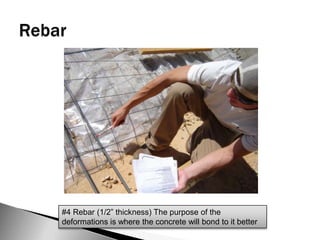
Rebar#4 Rebar (1/2” thickness) The purpose of the deformations is where the concrete will bond to it better
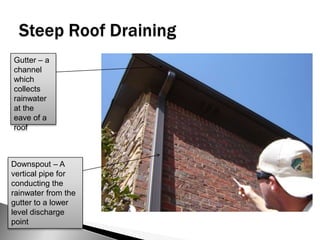
Steep Roof DrainingGutter – a channel which collects rainwater at the eave of a roofDownspout – A vertical pipe for conducting the rainwater from the gutter to a lower level discharge point
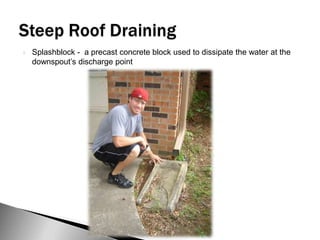
Splashblock -  a precast concrete block used to dissipate the water at the downspout’s discharge pointSteep Roof Draining
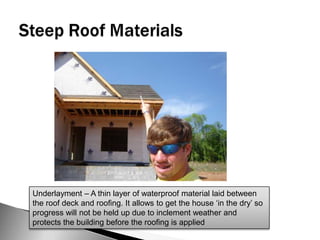
Steep Roof MaterialsUnderlayment – A thin layer of waterproof material laid between the roof deck and roofing. It allows to get the house ‘in the dry’ so progress will not be held up due to inclement weather and protects the building before the roofing is applied
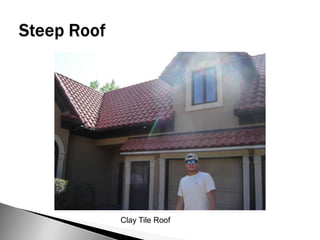
Steep Roof Clay Tile Roof
Shingle – a water resistant material nailed in an overlapping pattern with other like materials to make the roof watertight.Steep Roof Material
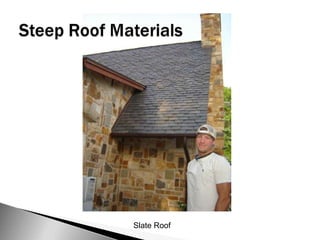
Steep Roof MaterialsSlate Roof
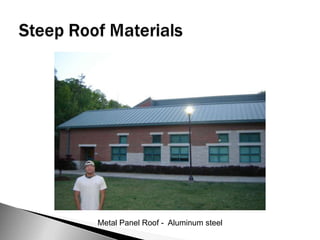
Steep Roof MaterialsMetal Panel Roof -  Aluminum steel
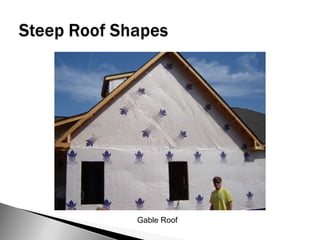
Steep Roof ShapesGable Roof
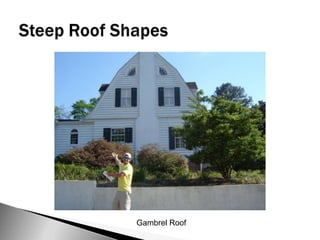
Steep Roof ShapesGambrel Roof
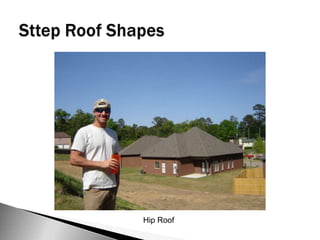
Sttep Roof ShapesHip Roof
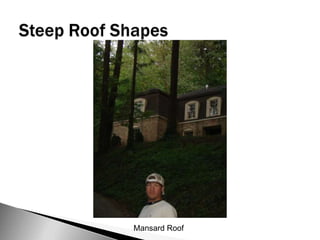
Steep Roof ShapesMansard Roof
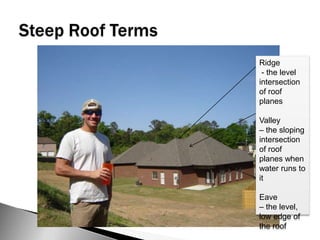
Steep Roof TermsRidge - the level intersection of roof planesValley – the sloping intersection of roof planes when water runs to itEave – the level, low edge of the roof
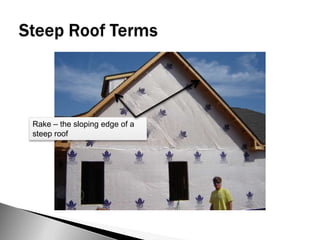
Steep Roof TermsRake – the sloping edge of a steep roof
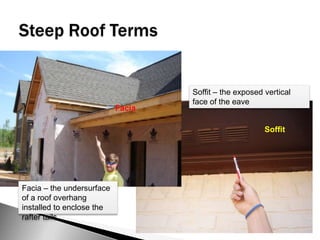
Steep Roof TermsSoffit – the exposed vertical face of the eaveFaciaSoffitFacia – the undersurface of a roof overhang installed to enclose the rafter tails
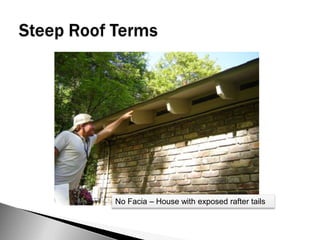
Steep Roof TermsNo Facia – House with exposed rafter tails
StoneRandom Rubble Pattern
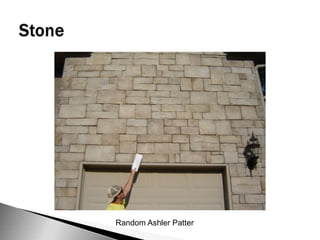
StoneRandom Ashler Patter
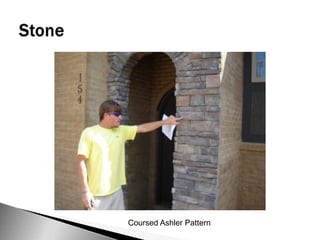
StoneCoursed Ashler Pattern
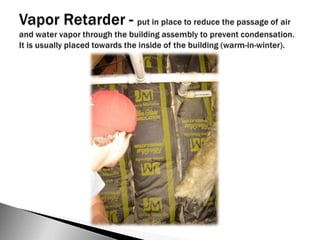
Vapor Retarder - put in place to reduce the passage of air and water vapor through the building assembly to prevent condensation. It is usually placed towards the inside of the building (warm-in-winter).
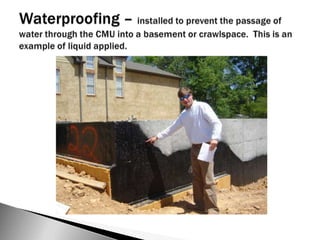
Waterproofing – installed to prevent the passage of water through the CMU into a basement or crawlspace.  This is an example of liquid applied.
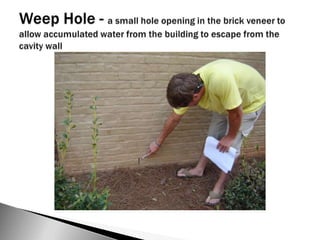
Weep Hole - a small hole opening in the brick veneer to allow accumulated water from the building to escape from the cavity wall

!!!UPDATED!!!Visual Dictionary-Sp10Hip!!!UPDATED!!!

  • 1.
  • 2.
    Air Barrier –An external membrane applied to the sheathing behind the veneer which serves as a weather barrier and helps prevent air infiltration
  • 3.
    Attic Ventilation -Serves to allow water vapor and hot attic air to escape through the roof vents and allows for circulationSoffit Vent – Allows air into the attic so that warmer air may escape through the high ventsRidge Vent – Allows hot attic air to escape through the ridge ventGable Vent – Allows hot attic air to escape and prevents buildup of heat conducted through the roof of the structureRoof Turbine – allows the air to escape by drawing it out through the roof like a fan
  • 4.
    Backhoe – Heavymachinery used for excavation of smaller site clearing projects such as tree removal or used to dig footing and some basement excavation.Bucket width – 32”
  • 5.
    Batter Boards –Temporary framework erected just outside the corners of a foundation excavation used to make sure the structure is square and also to carry the lines of a footing from corner to corner
  • 6.
    Brick ArchesArch witha keystoneELIPTICALCENTERING!!!!!!!!ROMAN ARCH
  • 7.
    Brick BondsFlemish BondRunning BondSoldiersHeadersRowlocksSailors
  • 8.
    Brick Sizes8 ¾” x 4” x 2 ½”9” x 3 7/8” x 3”
  • 9.
    Bulldozer – Heavymachinery used during site prep. It is used to level a site by grading with the front blade and pushing dirt around areas of the construction site72” Blade
  • 10.
    CladdingEFISBrick CladdingWood CladWoodShakesStone Clad – Random RubbleWood Shakes - SplitWood Shingles - Sawn
  • 11.
    Code RequirementsFor emergencyescape and rescue:Max. sill height AFF – 44”Is the sill w/i 44” of finish grade?-Yes – min. net opening 5.5 sq. ft.-No – min. net opening 5.7 sq. ft.Window meets code because it is within the minimum net opening requirements and within the maximum sill height requirements- 36” x 73” 36” x 36” opening (9 sq. ft.)
  • 12.
    - Sill height11” AFFCode RequirementsCode:Tread – 10” min.Riser – 7 ¾” maxTread – 10 7/8”Riser – 7”Stairs meet code because they are within the allowed minimum and maximum
  • 13.
    Concrete JointsIsolation Joint– Separates concrete from objects or structures, and allows independent movement without any connection that could cause damage to either object. This one isolates the slab from the driveway.crackSlabControl Joint – a designed cut in concrete to weaken the slab at that point in an attempt to prevent cracking elsewhereDriveway
  • 14.
    Concrete Masonry unit– block of hardened concrete designed to be laid up like masonry brick. The hollow cores allow for the block walls to be filled with grout for additional strength. CMU is more economical for foundation walls than cast in place concrete, and when laid by a proper mason, one course of block is equal to3 courses of standard brick w/ a 3/8” mortar joint. A typical block is 8” x 8” x 16” w/ a 3/8” mortar joint.
  • 15.
    Different sizeCMU8x8x164x8x16
  • 16.
  • 17.
  • 18.
    Panel Door (Tiger paws are horrible at taking visual dictionary pictures)Top RailStilePanelLock RailBottom Rail
  • 19.
    DoorsTransom – smallwindow directly over doorSidelight – tall narrow window running along either or both sides of a door
  • 20.
  • 21.
    Framing Elements#1 AnchorBolt#4 Sub Flooring#3 Floor Joist#2 Sill Plate
  • 22.
    Framing Elements#6 Studs#7Top Plate#5 Sole Plate
  • 23.
  • 24.
  • 25.
    Framing Elements#11 RoofDecking#12 Sheathing
  • 26.
    Front EndLoader – used for transporting piles of dirt or other materials across a jobsite. The hydraulic arms on the bucket allows the ability to place material at a raised elevation. Used for loading dump trucks and backfilling . Unlike a bulldozer, a loader has the ability to scoop dirt out of the ground and move it to another location rather than pushing and spreading it around an area.72” bucket
  • 27.
    Gypsum Board –an interior finish board made from a gypsum core sandwiched between two paper faces
  • 28.
    Heat Pump Compressor– compresses the refrigerant gas which gives off heat, thus cooling the air as it blows across the cooler coils at the air handler-One main disadvantage of the heat pump system is that it is noisy. One must take into account where to place the outside compressors to avoid noise intrusion into the home.-One advantage of a heat pump system is that it is the most efficient way to heat and cool a home
  • 29.
    Heat PumpAir Handler– forces the air through the system with the use of a blower fan. Also, cooler air is blown across a heating element inside the air handler to warm it up before distributing it through the duct
  • 30.
    InsulationBatt Insulation –Insulation is used to create the thermal envelope for the house to reduce air infiltration/heat loss in the home
  • 31.
  • 32.
  • 33.
    LintelConcrete Lintel –a concrete lintel that carries the load of the wall across a door or window
  • 34.
    MortarExtruded Joint –This house used a 3/8” joint neither trowled nor tooled with type ‘M’ mortar
  • 35.
  • 36.
  • 37.
  • 38.
    Type ‘M’OrientedStrand BoardOSB – a nonveneered panel made up of long strands of wood shavings which are compressed and glued together in several layers. Each layer is oriented opposite the direction of the previous layer for strength
  • 39.
    PlumbingLavatory – uses1 ½” drain pipe
  • 40.
    PlumbingWater closet –uses 3” pipe to drain
  • 41.
  • 42.
    PlumbingVent Through Roof– allows air to enter the plumbing system which lets the water drain from the pipes
  • 43.
  • 44.
    Plywood– manufactured bygluing thin layers of wood together, rotating each layer 90 degrees so that the grain in the wood does not run the same direction in each layer. This provides greater strength and equalizes moisture movementve·neer   (və-nîr')n. A thin surface layer, as of finely grained wood, glued to a base of inferior material.Any of the thin layers glued together to make plywood.A decorative facing, as of brick.A deceptive, superficial show; a façade: a veneer of friendliness.
  • 45.
    Rebar#4 Rebar (1/2”thickness) The purpose of the deformations is where the concrete will bond to it better
  • 46.
    Steep Roof DrainingGutter– a channel which collects rainwater at the eave of a roofDownspout – A vertical pipe for conducting the rainwater from the gutter to a lower level discharge point
  • 47.
    Splashblock - a precast concrete block used to dissipate the water at the downspout’s discharge pointSteep Roof Draining
  • 48.
    Steep Roof MaterialsUnderlayment– A thin layer of waterproof material laid between the roof deck and roofing. It allows to get the house ‘in the dry’ so progress will not be held up due to inclement weather and protects the building before the roofing is applied
  • 49.
  • 50.
    Shingle – awater resistant material nailed in an overlapping pattern with other like materials to make the roof watertight.Steep Roof Material
  • 51.
  • 52.
    Steep Roof MaterialsMetalPanel Roof - Aluminum steel
  • 53.
  • 54.
  • 55.
  • 56.
  • 57.
    Steep Roof TermsRidge- the level intersection of roof planesValley – the sloping intersection of roof planes when water runs to itEave – the level, low edge of the roof
  • 58.
    Steep Roof TermsRake– the sloping edge of a steep roof
  • 59.
    Steep Roof TermsSoffit– the exposed vertical face of the eaveFaciaSoffitFacia – the undersurface of a roof overhang installed to enclose the rafter tails
  • 60.
    Steep Roof TermsNoFacia – House with exposed rafter tails
  • 61.
  • 62.
  • 63.
  • 64.
    Vapor Retarder -put in place to reduce the passage of air and water vapor through the building assembly to prevent condensation. It is usually placed towards the inside of the building (warm-in-winter).
  • 65.
    Waterproofing – installedto prevent the passage of water through the CMU into a basement or crawlspace. This is an example of liquid applied.
  • 66.
    Weep Hole -a small hole opening in the brick veneer to allow accumulated water from the building to escape from the cavity wall