STEAM BOILERS
Course : B.Tech Mechanical
Subject : Elements of Mechanical Engineering
Unit-2
INTRODUCTION
STEAM GENERATOR OR BOILER
A steam generator or boiler is usually a
closed vessel made of steel. Its function is to transfer
the heat produced by the combustion of fuel to water
and ultimately to generate steam.
BOILER PROPERTIES:
(i) Safety. The boiler should be safe under
operating conditions.
(ii) Accessibility. The various parts of the boiler
should be accessible for repair and maintenance.
(iii) Capacity. Should be capable of supplying
steam according to the requirements.
(iv) Efficiency. Should be able to absorb a
maximum amount of heat produced due to burning
of fuel in the furnace.
(v) It should be simple in construction .
(vi) Its initial cost and maintenance cost should be
low.
(vii) The boiler should have no joints exposed to
flames.
(viii) Should be capable of quick starting and
loading.
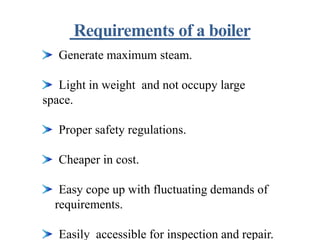
Generate maximum steam.
Light in weight and not occupy large
space.
Proper safety regulations.
Cheaper in cost.
Easy cope up with fluctuating demands of
requirements.
Easily accessible for inspection and repair.
The source of heat for a boiler are :
WOOD
COAL
DIESEL
NATURAL GAS
NUCLEAR ENERGY
CLASSIFICATION
OF
STEAM BOILERS
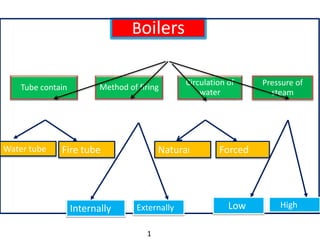
Method of firing
Boilers
Pressure of
steam
Circulation of
water
Tube contain
Water tube Fire tube
HighExternally
Natural Forced
LowInternally
1
CLASSIFICATION OF
STEAM BOILERS
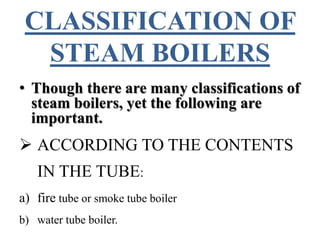
• Though there are many classifications of
steam boilers, yet the following are
important.
 ACCORDING TO THE CONTENTS
IN THE TUBE:
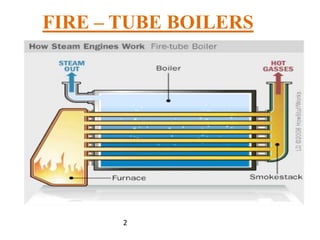
a) fire tube or smoke tube boiler
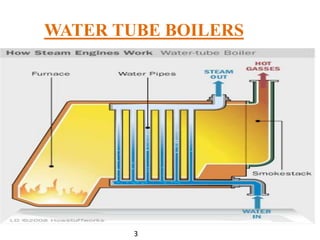
b) water tube boiler.
FIRE – TUBE BOILERS
2
WATER TUBE BOILERS
3
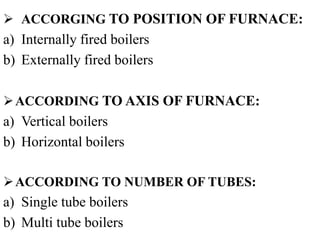
 ACCORGING TO POSITION OF FURNACE:
a) Internally fired boilers
b) Externally fired boilers
ACCORDING TO AXIS OF FURNACE:
a) Vertical boilers
b) Horizontal boilers
ACCORDING TO NUMBER OF TUBES:
a) Single tube boilers
b) Multi tube boilers
 ACCORDING TO METHOD OF CIRCULATION
OF WATER:
a) Natural circulation boilers
b) Forced circulation boilers
 ACCORDING TO THE USE
a) Stationary boilers
b) Mobile boilers
FACTORS AFFACTING TO
SELECTION OF BOILER
Following factors should be considered
 Quality of steam required
 Steam Generation rate
 Accessibility of repair and inspection
 Area
 Cost
 Erection facility
 Fuel and Water available
Boiler shell
Combustion chamber
Furnace
Grate
Heating surface
Mounting
Accessories
COMPONENTS OF A BOILER
Pressure Gauge
Water level indicator
Safety valve
Fusible plug
Blow of cock
Steam stop valve
Feed check valve
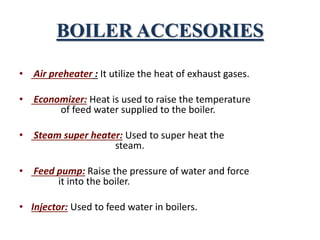
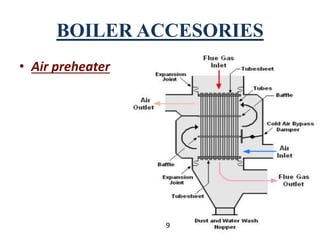
Air preheater : It utilize the heat of exhaust gases.
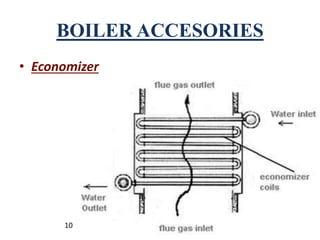
Economizer: Heat is used to raise the temperature
of feed water supplied to the boiler.
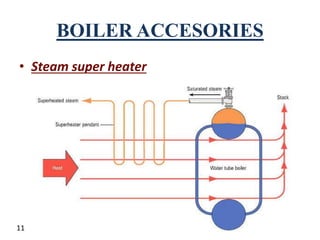
Steam super heater: Used to super heat the
steam.
Feed pump: Raise the pressure of water and force
it into the boiler.
Injector: Used to feed water in boilers.
FIRE TUBE BOILERS
Simple vertical boiler
Lancashire boiler
Locomotive boiler
Cochran boiler
Types of Boiler
* La-Mont boiler
* Babcock and Wilcox boiler.
•La-Mont boiler
•Loeffler boiler
•Benson boiler
Water tube boiler
3-High pressure boiler
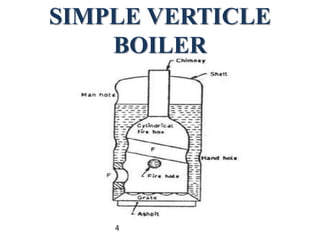
SIMPLE VERTICLE
BOILER
4
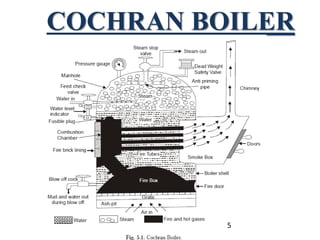
COCHRAN BOILER
5
WORKING OF COCHRAN
BOILER
Considered to be one of the most efficient
type multi tubular boilers.
Consists of external cylindrical shell and
fire box. The shell and fire box both are
hemispherical.
The fire box and combustion chamber is
connected through a short pipe.
The flue gases from the combustion
chamber flow to the smoke box through a
number of smoke tubes.
WORKING OF COCHRAN BOILER
The gases from the smoke box pass to the
atmosphere through a chimney
The external diameter of pipe is 62.5mm and
are 165in number.
Manhole is provided for cleaning.
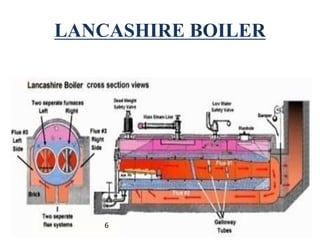
LANCASHIRE BOILER
6
LANCASHIRE BOILER
 The boiler consists of a long cylindrical external shell
(1) built of steel plates in sections riveted together.
 It has two large internal flue tubes (2).
 A fire grate (3) is also called furnace is provided at
one end of the flue tubes on which solid fuel is
burnt.
 At the end of the fire grate there is a brick arch (5)
to deflect the flue gases upwards.
 The hot flue gases leaving internal flue tubes
passes through the bottom tube(6).
LANCASHIRE BOILER
 These flue gases move to the front of the boiler
where they divide and flow into side tube (7).
 The flue gases then enter the main flue (9) which
leads them to chimney.
 The damper (8) is fitted at one side flues to control
the draught and thus regulate the rate of generation
of steam.
 A spring loaded safety valve (10) and stop valve (11)
are mounted.
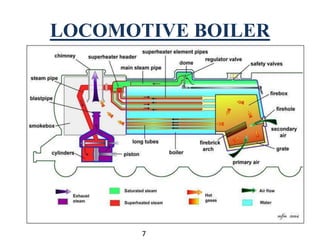
LOCOMOTIVE BOILER
• Locomotive boiler is a horizontal fire tube type
mobile boiler. The main requirement of this
boiler is that it should produce steam at a very
high rate. Therefore, this boiler requires a
large amount of heating surface and large
grate area to burn coal at a rapid rate. In order
to provide the large heating surface area, a
large number of fire tubes are setup and heat
transfer rate is increased by creating strong
draught by means of steam jet
LOCOMOTIVE BOILER
7
ADVANTAGES
• Large rate of steam generation per square metre
of heating surface. To some extent this is due to
the vibration caused by the motion.
• It is free from brickwork, special foundation and
chimney. This reduces the cost of installation.
• It is very compact.
The pressure of the steam is limited to about 20
bar.
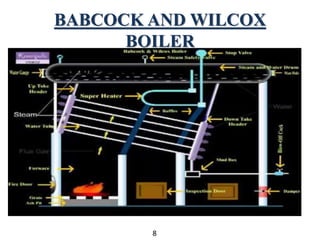
BABCOCK AND WILCOX
BOILER
8
1. This is an example of water tube
boiler and is used in stationary and
marine engine.
2. The efficiency of this boiler is much
greater than that of the fire tube
boiler.
3. This boiler is used when pressure is
above 10bar and steam generating
capacity is required higher then
7000kg/hr.
BOILER MOUNTINGS
 SAFETY MOUTINGS
 Safety valves (2 Nos)
 Fusible plug
 Control mountings
 Water level indicator
 Pressure Gauge
 Blow of cock
 Steam stop valve
 Feed check valve
Inspection Mountings
 Man hole
 Mud hole
BOILER ACCESORIES
• Air preheater : It utilize the heat of exhaust gases.
• Economizer: Heat is used to raise the temperature
of feed water supplied to the boiler.
• Steam super heater: Used to super heat the
steam.
• Feed pump: Raise the pressure of water and force
it into the boiler.
• Injector: Used to feed water in boilers.
BOILER ACCESORIES
• Air preheater
9
BOILER ACCESORIES
• Economizer
10
BOILER ACCESORIES
• Steam super heater
11
BOILER PERFORMENCE
1. Evaporative capacity
2. Equivalent evaporation
3. Factor of evaporation
4. Boiler efficiency
1. Evaporate capacity
• Ability to evaporate water.
• Generally it is expressed in terms of
A. Kg of steam/hour
B. Kg of steam /hour/area of heating surface
C. Kg of steam/kg of fuel is fired
2. Equivalent evaporation
• It can be defined as the amount of water
evaporated from water at 100 deg C to dry
and saturated steam at 100 deg C.
• Simply it means that the capacity of boiler to
generate same evaporation.
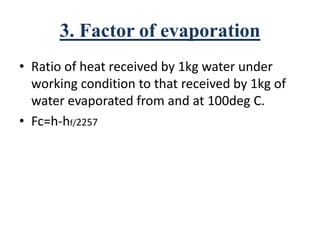
3. Factor of evaporation
• Ratio of heat received by 1kg water under
working condition to that received by 1kg of
water evaporated from and at 100deg C.
• Fc=h-hf/2257
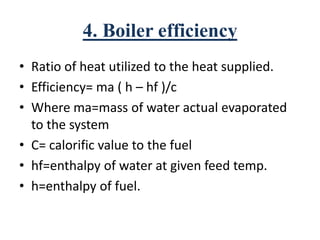
4. Boiler efficiency
• Ratio of heat utilized to the heat supplied.
• Efficiency= ma ( h – hf )/c
• Where ma=mass of water actual evaporated
to the system
• C= calorific value to the fuel
• hf=enthalpy of water at given feed temp.
• h=enthalpy of fuel.
1. http://image.slidesharecdn.com/boilersbykhalid-140602111304-
phpapp01/95/boilers-7-638.jpg?cb=1401729558C:UsersuserDesktopToc
HATDboilerfiretube.gif
2. http://t2.gstatic.com/images?q=tbn:ANd9GcR5WX2MCI21rKBJnBdClUQqP1ghBEcJ
XekJdpqGkipMFFA07IIp
3. http://t0.gstatic.com/images?q=tbn:ANd9GcRZrR9BOVSHGQ95gSzTFKySkqIv6OBxt
1WRVXFXJ7iqxaFaoqpA
4. http://3.bp.blogspot.com/-
NeFjhx244Yo/Urh6_5Dg5JI/AAAAAAAAJvE/zYbMYoRHhSY/s1600/simple+vertical+b
oiler.png
5. http://2.bp.blogspot.com/-
rsyq05cQAo0/TlfbYtfsU8I/AAAAAAAAACk/RvkWUmtXy44/s1600/cochran+boiler.pn
g
6. http://www.doyouknow.in/Articles/images/201111161002290897237.png
7. http://straction.files.wordpress.com/2008/06/steam-engine.jpg
8. http://i.ytimg.com/vi/7Y8gwjLdtww/hqdefault.jpg
Reference-Sources
Reference-Sources
9.
http://en.citizendium.org/images/thumb/2/2e/Tubular_air_preheater.png/350px-
Tubular_air_preheater.png
10. http://img.tjskl.org.cn/pic/z25d9cb2-0x0-1/vertical_exhaust_gas_economizer.g
11. http://www.cleanboiler.org/Images/Superheater_Schematic.jpg
• Content References
• – Elements of Mechanical Engineering by H.G. Katariya, J.P Hadiya, S.M.Bhatt ,
Books India Publication.
• -Elements of Mechanical Engineering by V.K.Manglik, PHI
• -Elements of Mechanical Engineering by R.K Rajput.
• -Elements of Mechanical Engineering by P.S.Desai & S.B.Soni
EXIT

B.tech i eme u 2 steam boilers

  • 1.
    STEAM BOILERS Course :B.Tech Mechanical Subject : Elements of Mechanical Engineering Unit-2
  • 2.
    INTRODUCTION STEAM GENERATOR ORBOILER A steam generator or boiler is usually a closed vessel made of steel. Its function is to transfer the heat produced by the combustion of fuel to water and ultimately to generate steam.
  • 3.
    BOILER PROPERTIES: (i) Safety.The boiler should be safe under operating conditions. (ii) Accessibility. The various parts of the boiler should be accessible for repair and maintenance. (iii) Capacity. Should be capable of supplying steam according to the requirements.
  • 4.
    (iv) Efficiency. Shouldbe able to absorb a maximum amount of heat produced due to burning of fuel in the furnace. (v) It should be simple in construction . (vi) Its initial cost and maintenance cost should be low. (vii) The boiler should have no joints exposed to flames. (viii) Should be capable of quick starting and loading.
  • 5.
    Generate maximum steam. Lightin weight and not occupy large space. Proper safety regulations. Cheaper in cost. Easy cope up with fluctuating demands of requirements. Easily accessible for inspection and repair.
  • 6.
    The source ofheat for a boiler are : WOOD COAL DIESEL NATURAL GAS NUCLEAR ENERGY
  • 7.
  • 8.
    Method of firing Boilers Pressureof steam Circulation of water Tube contain Water tube Fire tube HighExternally Natural Forced LowInternally 1
  • 9.
    CLASSIFICATION OF STEAM BOILERS •Though there are many classifications of steam boilers, yet the following are important.  ACCORDING TO THE CONTENTS IN THE TUBE: a) fire tube or smoke tube boiler b) water tube boiler.
  • 10.
    FIRE – TUBEBOILERS 2
  • 11.
  • 12.
     ACCORGING TOPOSITION OF FURNACE: a) Internally fired boilers b) Externally fired boilers ACCORDING TO AXIS OF FURNACE: a) Vertical boilers b) Horizontal boilers ACCORDING TO NUMBER OF TUBES: a) Single tube boilers b) Multi tube boilers
  • 13.
     ACCORDING TOMETHOD OF CIRCULATION OF WATER: a) Natural circulation boilers b) Forced circulation boilers  ACCORDING TO THE USE a) Stationary boilers b) Mobile boilers
  • 14.
    FACTORS AFFACTING TO SELECTIONOF BOILER Following factors should be considered  Quality of steam required  Steam Generation rate  Accessibility of repair and inspection  Area  Cost  Erection facility  Fuel and Water available
  • 15.
    Boiler shell Combustion chamber Furnace Grate Heatingsurface Mounting Accessories COMPONENTS OF A BOILER
  • 16.
    Pressure Gauge Water levelindicator Safety valve Fusible plug Blow of cock Steam stop valve Feed check valve
  • 17.
    Air preheater :It utilize the heat of exhaust gases. Economizer: Heat is used to raise the temperature of feed water supplied to the boiler. Steam super heater: Used to super heat the steam. Feed pump: Raise the pressure of water and force it into the boiler. Injector: Used to feed water in boilers.
  • 18.
    FIRE TUBE BOILERS Simplevertical boiler Lancashire boiler Locomotive boiler Cochran boiler Types of Boiler
  • 19.
    * La-Mont boiler *Babcock and Wilcox boiler. •La-Mont boiler •Loeffler boiler •Benson boiler Water tube boiler 3-High pressure boiler
  • 20.
  • 21.
  • 22.
    WORKING OF COCHRAN BOILER Consideredto be one of the most efficient type multi tubular boilers. Consists of external cylindrical shell and fire box. The shell and fire box both are hemispherical. The fire box and combustion chamber is connected through a short pipe. The flue gases from the combustion chamber flow to the smoke box through a number of smoke tubes.
  • 23.
    WORKING OF COCHRANBOILER The gases from the smoke box pass to the atmosphere through a chimney The external diameter of pipe is 62.5mm and are 165in number. Manhole is provided for cleaning.
  • 24.
  • 25.
    LANCASHIRE BOILER  Theboiler consists of a long cylindrical external shell (1) built of steel plates in sections riveted together.  It has two large internal flue tubes (2).  A fire grate (3) is also called furnace is provided at one end of the flue tubes on which solid fuel is burnt.  At the end of the fire grate there is a brick arch (5) to deflect the flue gases upwards.  The hot flue gases leaving internal flue tubes passes through the bottom tube(6).
  • 26.
    LANCASHIRE BOILER  Theseflue gases move to the front of the boiler where they divide and flow into side tube (7).  The flue gases then enter the main flue (9) which leads them to chimney.  The damper (8) is fitted at one side flues to control the draught and thus regulate the rate of generation of steam.  A spring loaded safety valve (10) and stop valve (11) are mounted.
  • 27.
    LOCOMOTIVE BOILER • Locomotiveboiler is a horizontal fire tube type mobile boiler. The main requirement of this boiler is that it should produce steam at a very high rate. Therefore, this boiler requires a large amount of heating surface and large grate area to burn coal at a rapid rate. In order to provide the large heating surface area, a large number of fire tubes are setup and heat transfer rate is increased by creating strong draught by means of steam jet
  • 28.
  • 29.
    ADVANTAGES • Large rateof steam generation per square metre of heating surface. To some extent this is due to the vibration caused by the motion. • It is free from brickwork, special foundation and chimney. This reduces the cost of installation. • It is very compact. The pressure of the steam is limited to about 20 bar.
  • 30.
  • 31.
    1. This isan example of water tube boiler and is used in stationary and marine engine. 2. The efficiency of this boiler is much greater than that of the fire tube boiler. 3. This boiler is used when pressure is above 10bar and steam generating capacity is required higher then 7000kg/hr.
  • 32.
    BOILER MOUNTINGS  SAFETYMOUTINGS  Safety valves (2 Nos)  Fusible plug  Control mountings  Water level indicator  Pressure Gauge  Blow of cock  Steam stop valve  Feed check valve Inspection Mountings  Man hole  Mud hole
  • 33.
    BOILER ACCESORIES • Airpreheater : It utilize the heat of exhaust gases. • Economizer: Heat is used to raise the temperature of feed water supplied to the boiler. • Steam super heater: Used to super heat the steam. • Feed pump: Raise the pressure of water and force it into the boiler. • Injector: Used to feed water in boilers.
  • 34.
  • 35.
  • 36.
  • 37.
    BOILER PERFORMENCE 1. Evaporativecapacity 2. Equivalent evaporation 3. Factor of evaporation 4. Boiler efficiency
  • 38.
    1. Evaporate capacity •Ability to evaporate water. • Generally it is expressed in terms of A. Kg of steam/hour B. Kg of steam /hour/area of heating surface C. Kg of steam/kg of fuel is fired
  • 39.
    2. Equivalent evaporation •It can be defined as the amount of water evaporated from water at 100 deg C to dry and saturated steam at 100 deg C. • Simply it means that the capacity of boiler to generate same evaporation.
  • 40.
    3. Factor ofevaporation • Ratio of heat received by 1kg water under working condition to that received by 1kg of water evaporated from and at 100deg C. • Fc=h-hf/2257
  • 41.
    4. Boiler efficiency •Ratio of heat utilized to the heat supplied. • Efficiency= ma ( h – hf )/c • Where ma=mass of water actual evaporated to the system • C= calorific value to the fuel • hf=enthalpy of water at given feed temp. • h=enthalpy of fuel.
  • 42.
    1. http://image.slidesharecdn.com/boilersbykhalid-140602111304- phpapp01/95/boilers-7-638.jpg?cb=1401729558C:UsersuserDesktopToc HATDboilerfiretube.gif 2. http://t2.gstatic.com/images?q=tbn:ANd9GcR5WX2MCI21rKBJnBdClUQqP1ghBEcJ XekJdpqGkipMFFA07IIp 3.http://t0.gstatic.com/images?q=tbn:ANd9GcRZrR9BOVSHGQ95gSzTFKySkqIv6OBxt 1WRVXFXJ7iqxaFaoqpA 4. http://3.bp.blogspot.com/- NeFjhx244Yo/Urh6_5Dg5JI/AAAAAAAAJvE/zYbMYoRHhSY/s1600/simple+vertical+b oiler.png 5. http://2.bp.blogspot.com/- rsyq05cQAo0/TlfbYtfsU8I/AAAAAAAAACk/RvkWUmtXy44/s1600/cochran+boiler.pn g 6. http://www.doyouknow.in/Articles/images/201111161002290897237.png 7. http://straction.files.wordpress.com/2008/06/steam-engine.jpg 8. http://i.ytimg.com/vi/7Y8gwjLdtww/hqdefault.jpg Reference-Sources
  • 43.
    Reference-Sources 9. http://en.citizendium.org/images/thumb/2/2e/Tubular_air_preheater.png/350px- Tubular_air_preheater.png 10. http://img.tjskl.org.cn/pic/z25d9cb2-0x0-1/vertical_exhaust_gas_economizer.g 11. http://www.cleanboiler.org/Images/Superheater_Schematic.jpg •Content References • – Elements of Mechanical Engineering by H.G. Katariya, J.P Hadiya, S.M.Bhatt , Books India Publication. • -Elements of Mechanical Engineering by V.K.Manglik, PHI • -Elements of Mechanical Engineering by R.K Rajput. • -Elements of Mechanical Engineering by P.S.Desai & S.B.Soni
  • 44.