Harmonics in Power
System
Presentation by Er. RAJESH S, ASSISTANT
ENGINEER, NES DIVISION, KALLARKUTTY
(Statutory Trainee- Batch VI)
15.12.2008
WELCOME
Topics of Discussion
 What is Power System Harmonics
 Nonlinear Loads Producing Harmonic
Currents
 Harmonic Distortion
 Identifying presence of Harmonics
 Negative Effects of Harmonics
 Harmonic Control
 Positive uses of Harmonics
 Conclusions
What is Power System
Harmonics
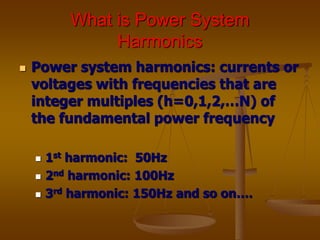
 Power system harmonics: currents or
voltages with frequencies that are
integer multiples (h=0,1,2,…N) of
the fundamental power frequency
 1st harmonic: 50Hz
 2nd harmonic: 100Hz
 3rd harmonic: 150Hz and so on….
What is Power System Harmonics
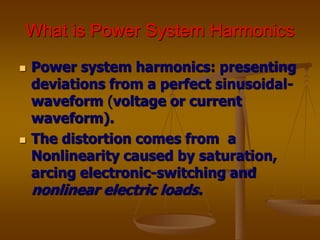
 Power system harmonics: presenting
deviations from a perfect sinusoidal-
waveform (voltage or current
waveform).
 The distortion comes from a
Nonlinearity caused by saturation,
arcing electronic-switching and
nonlinear electric loads.
What is Power System Harmonics
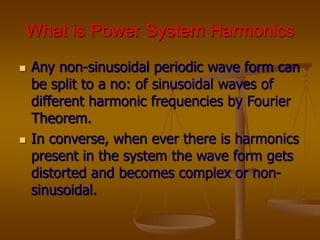
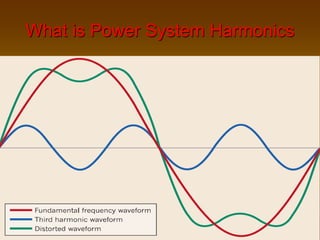
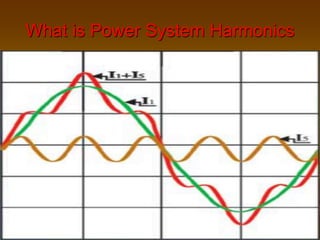
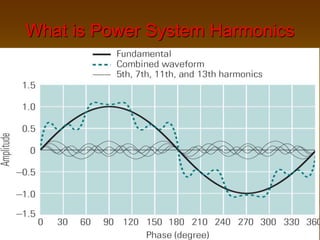
 Any non-sinusoidal periodic wave form can
be split to a no: of sinusoidal waves of
different harmonic frequencies by Fourier
Theorem.
 In converse, when ever there is harmonics
present in the system the wave form gets
distorted and becomes complex or non-
sinusoidal.
What is Power System Harmonics
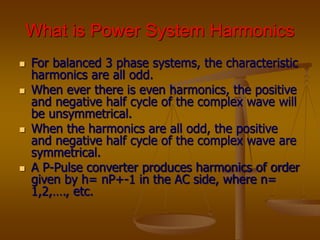
 For balanced 3 phase systems, the characteristic
harmonics are all odd.
 When ever there is even harmonics, the positive
and negative half cycle of the complex wave will
be unsymmetrical.
 When the harmonics are all odd, the positive
and negative half cycle of the complex wave are
symmetrical.
 A P-Pulse converter produces harmonics of order
given by h= nP+-1 in the AC side, where n=
1,2,…., etc.
What is Power System Harmonics
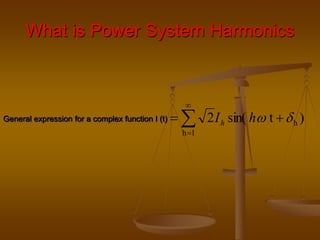
)
t
sin(
2 h
1
h

 
 


h
Ih
General expression for a complex function I (t)
What is Power System Harmonics
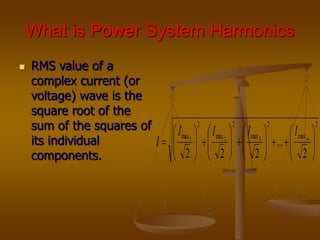
 RMS value of a
complex current (or
voltage) wave is the
square root of the
sum of the squares of
its individual
components.
2
max
2
max
2
max
2
max
2
...
2
2
2
3
2
1




































 m
I
I
I
I
I
What is Power System Harmonics
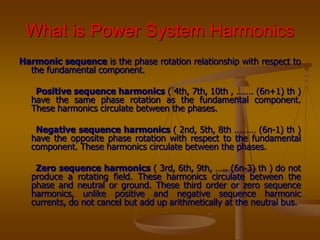
Harmonic sequence is the phase rotation relationship with respect to
the fundamental component.
Positive sequence harmonics ( 4th, 7th, 10th , ……. (6n+1) th )
have the same phase rotation as the fundamental component.
These harmonics circulate between the phases.
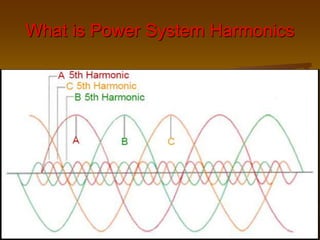
Negative sequence harmonics ( 2nd, 5th, 8th ……… (6n-1) th )
have the opposite phase rotation with respect to the fundamental
component. These harmonics circulate between the phases.
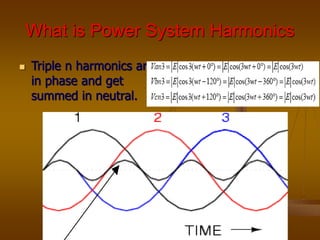
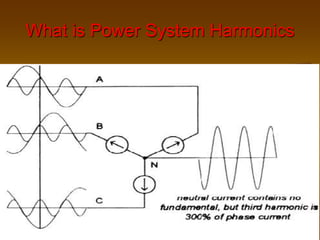
Zero sequence harmonics ( 3rd, 6th, 9th, ….. (6n-3) th ) do not
produce a rotating field. These harmonics circulate between the
phase and neutral or ground. These third order or zero sequence
harmonics, unlike positive and negative sequence harmonic
currents, do not cancel but add up arithmetically at the neutral bus.
What is Power System Harmonics
 Triple n harmonics are
in phase and get
summed in neutral.
What is Power System Harmonics
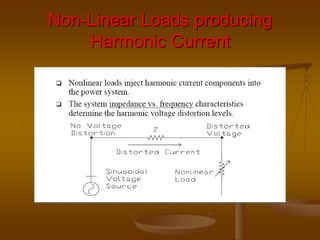
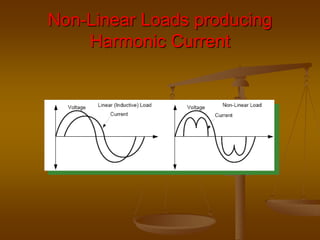
Non-Linear Loads producing
Harmonic Current
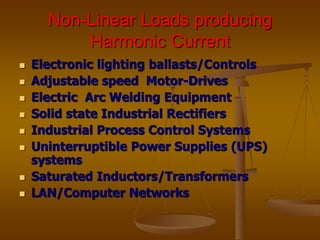
Non-Linear Loads producing
Harmonic Current
Non-Linear Loads producing
Harmonic Current
 Electronic lighting ballasts/Controls
 Adjustable speed Motor-Drives
 Electric Arc Welding Equipment
 Solid state Industrial Rectifiers
 Industrial Process Control Systems
 Uninterruptible Power Supplies (UPS)
systems
 Saturated Inductors/Transformers
 LAN/Computer Networks
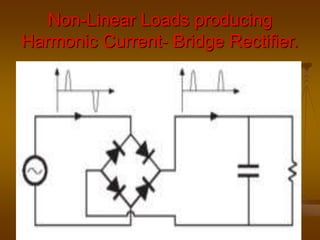
Non-Linear Loads producing
Harmonic Current- Bridge Rectifier.
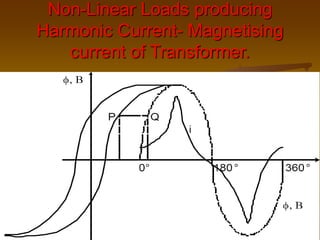
Non-Linear Loads producing
Harmonic Current- Magnetising
current of Transformer.
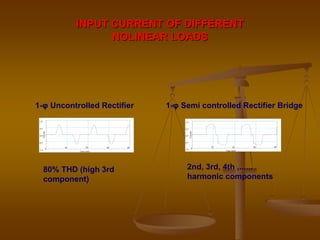
INPUT CURRENT OF DIFFERENT
NOLINEAR LOADS
0
10 20 30 40
-1.0
-0.5
0.0
0.5
1.0
Time (mS)
Current
80% THD (high 3rd
component)
1-φ Uncontrolled Rectifier
0
10 20 30 40
-1.0
-0.5
0.0
0.5
1.0
Time (mS)
Current
1-φ Semi controlled Rectifier Bridge
2nd, 3rd, 4th ,......
harmonic components
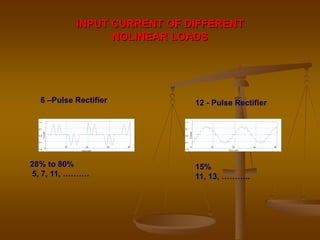
INPUT CURRENT OF DIFFERENT
NOLINEAR LOADS
0
10 20 30 40
-1.0
-0.5
0.0
0.5
1.0
Time (mS)
Current
6 –Pulse Rectifier
28% to 80%
5, 7, 11, ……….
0 10 20 30 40
-1.0
-0.5
0.0
0.5
1.0
Time (mS)
Current
12 - Pulse Rectifier
15%
11, 13, ………..
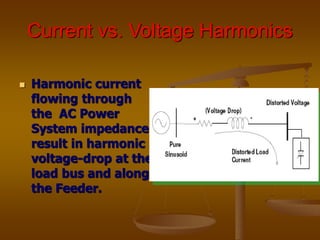
Current vs. Voltage Harmonics
 Harmonic current
flowing through
the AC Power
System impedance
result in harmonic
voltage-drop at the
load bus and along
the Feeder.
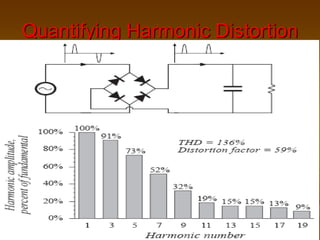
Quantifying Harmonic Distortion
 Total Harmonic Distortion-THD: the
contribution of all harmonic
frequency Currents/Voltages to the
fundamental current.
 Individual Distortion Factor-(DF)-h
quantify Distortion at h –harmonic-
order
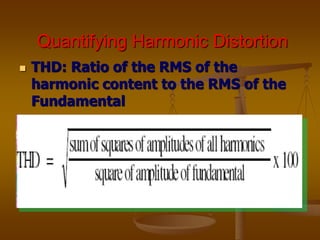
Quantifying Harmonic Distortion
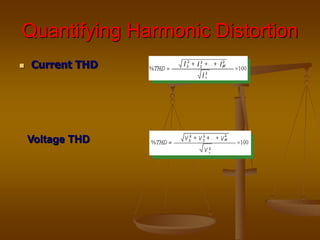
 THD: Ratio of the RMS of the
harmonic content to the RMS of the
Fundamental
Quantifying Harmonic Distortion
 Current THD
Voltage THD
Quantifying Harmonic Distortion
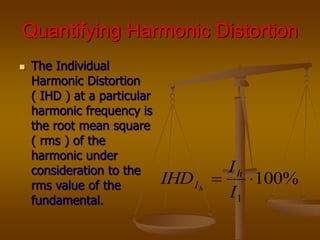
 The Individual
Harmonic Distortion
( IHD ) at a particular
harmonic frequency is
the root mean square
( rms ) of the
harmonic under
consideration to the
rms value of the
fundamental.
%
100
1


I
I
IHD h
Ih
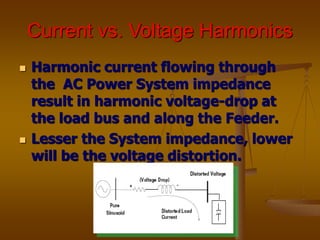
Current vs. Voltage Harmonics
 Harmonic current flowing through
the AC Power System impedance
result in harmonic voltage-drop at
the load bus and along the Feeder.
 Lesser the System impedance, lower
will be the voltage distortion.
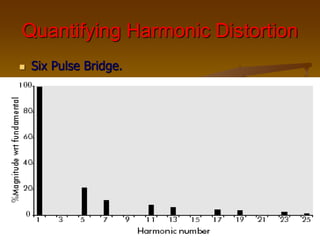
Quantifying Harmonic Distortion
 Six Pulse Bridge.
Quantifying Harmonic Distortion
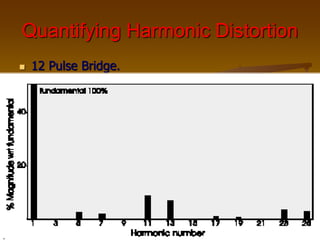
 12 Pulse Bridge.
Quantifying Harmonic Distortion
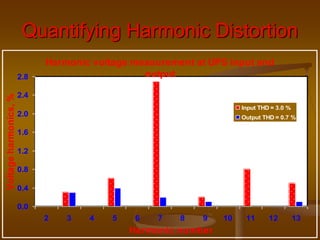
Harmonic voltage measurement at UPS input and
output
0.0
0.4
0.8
1.2
1.6
2.0
2.4
2.8
2 3 4 5 6 7 8 9 10 11 12 13
Harmonic number
Voltage
harmonics,
%
Input THD = 3.0 %
Output THD = 0.7 %
Quantifying Harmonic Distortion
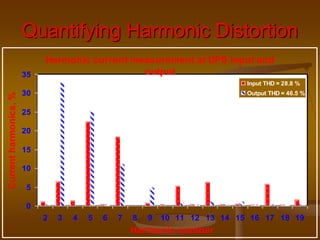
Harmonic current measurement at UPS input and
output
0
5
10
15
20
25
30
35
2 3 4 5 6 7 8 9 10 11 12 13 14 15 16 17 18 19
Harmonic number
Current
harmonics,
%
Input THD = 28.8 %
Output THD = 46.5 %
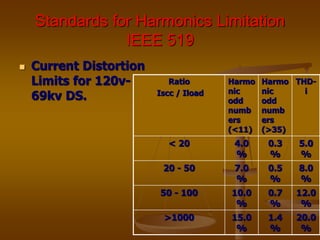
Standards for Harmonics Limitation
IEEE 519
 Current Distortion
Limits for 120v-
69kv DS.
Ratio
Iscc / Iload
Harmo
nic
odd
numb
ers
(<11)
Harmo
nic
odd
numb
ers
(>35)
THD-
i
< 20 4.0
%
0.3
%
5.0
%
20 - 50 7.0
%
0.5
%
8.0
%
50 - 100 10.0
%
0.7
%
12.0
%
>1000 15.0
%
1.4
%
20.0
%
Standards for Harmonics Limitation
IEEE 519
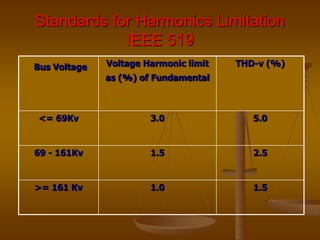
Bus Voltage Voltage Harmonic limit
as (%) of Fundamental
THD-v (%)
<= 69Kv 3.0 5.0
69 - 161Kv 1.5 2.5
>= 161 Kv 1.0 1.5
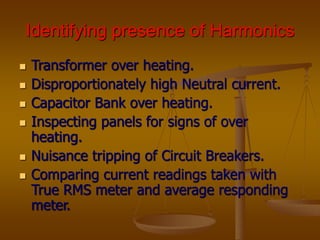
Identifying presence of Harmonics
 Transformer over heating.
 Disproportionately high Neutral current.
 Capacitor Bank over heating.
 Inspecting panels for signs of over
heating.
 Nuisance tripping of Circuit Breakers.
 Comparing current readings taken with
True RMS meter and average responding
meter.
Identifying presence of Harmonics
 Digital Oscilloscope:
Wave shape, THD and Amplitude of
each harmonic.
 Use of Harmonic Meters-Single Phase or
three Phase.
Negative Effects of Harmonics
 Resistive loads - will absorb slightly more
power
 Motor loads - harmonic fluxes within the
motor
 Power transformers - hot spots within the
windings
 Electronic controls - operate improperly
 Communication circuits - can cause
interference
Negative Effects of Harmonics
 Voltage Harmonics can cause additional
heating in induction and synchronous
motors and generators.
 Voltage Harmonics with high peak values
can weaken insulation in cables, windings,
and capacitors.
 Voltage Harmonics can cause malfunction
of different electronic components and
circuits that utilize the voltage waveform
for synchronization or timing.
Negative Effects of Harmonics
 Current Harmonics flowing through cables
can cause higher heating over and above
the heating that is created from the
fundamental component.
 Current Harmonics flowing through a
transformer can cause higher heating over
and above the heating that is created by
the fundamental component.
 Current Harmonics flowing through circuit
breakers and switch-gear can increase
their heating losses.
Negative Effects of Harmonics
 In general, harmonics increase heating
and losses in almost every piece of
equipment in the electric power system.
 High TRV in Circuit Breakers.
 Reduced Power Factor.
 Over heating of phase conductors due to
skin effect.
 Digital Clocks advance in time due to
additional zero crossings.
Negative Effects of Harmonics
 Overheating and premature failure of distribution
transformers
 Increasing iron and copper losses or eddy currents due
to stray flux losses.
 Overheating and mechanical oscillations in the
motor-load system
 Producing rotating magnitude field, which is opposite to
the fundamental magnitude field.
 Overheating and damage of neutral ground
conductors
 A 3-phase 4-wire system: Triple n harmonics will add
rather than cancel on the neutral conductor.
Negative Effects of Harmonics
 False or spurious Relay operations and trips of
Circuit Breakers.
 Failure of the Firing/Commutation circuits, found
in DC motor-drives and AC drives with Silicon
Controlled Rectifiers.
 Mal-Operation instability of voltage regulator.
 Power factor correction capacitor failure
 Reactance (impedance)-Zc of a capacitor bank decreases
as the frequency increases.
 Capacitor bank acts as a sink for higher harmonic
currents.
 The System-Series and parallel Resonance can cause
dielectric failure or rupture the power factor correction
capacitor failure due to Over-Voltages & Over-Currents.
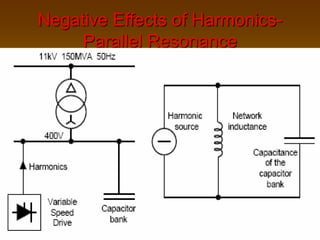
Negative Effects of Harmonics-
Parallel Resonance
 Harmonic currents produced by variable speed
motor-drives: can be amplified up to 10-15 times
in parallel resonance circuit formed by the
capacitance bank and network inductance
 Amplified/intensified harmonic currents:
leading to internal overheating of the capacitor
unit.
 Higher frequency currents: causing more losses
than 50hz currents having same amplitude.
Negative Effects of Harmonics-
Parallel Resonance
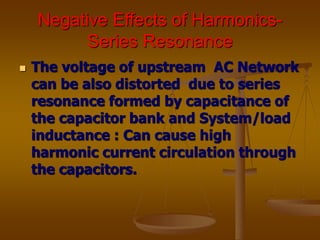
Negative Effects of Harmonics-
Series Resonance
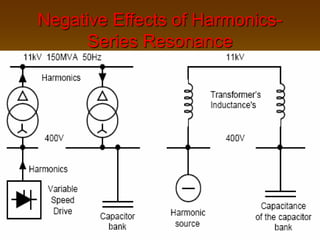
 The voltage of upstream AC Network
can be also distorted due to series
resonance formed by capacitance of
the capacitor bank and System/load
inductance : Can cause high
harmonic current circulation through
the capacitors.
Negative Effects of Harmonics-
Series Resonance
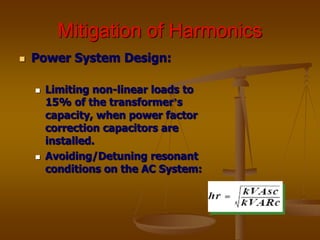
Mitigation of Harmonics
 Power System Design:
 Limiting non-linear loads to
15% of the transformer’s
capacity, when power factor
correction capacitors are
installed.
 Avoiding/Detuning resonant
conditions on the AC System:
Mitigation of Harmonics
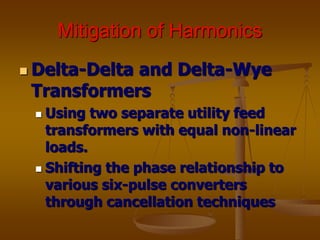
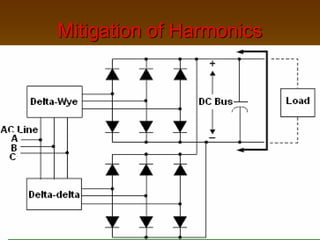
 Delta-Delta and Delta-Wye
Transformers
 Using two separate utility feed
transformers with equal non-linear
loads.
 Shifting the phase relationship to
various six-pulse converters
through cancellation techniques
Mitigation of Harmonics
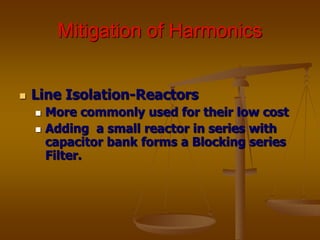
 Line Isolation-Reactors
 More commonly used for their low cost
 Adding a small reactor in series with
capacitor bank forms a Blocking series
Filter.
Mitigation of Harmonics
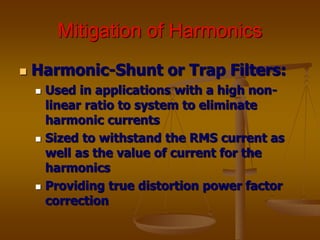
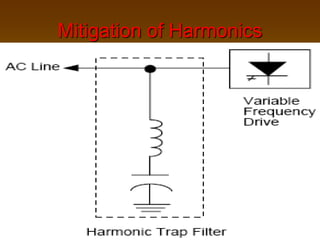
 Harmonic-Shunt or Trap Filters:
 Used in applications with a high non-
linear ratio to system to eliminate
harmonic currents
 Sized to withstand the RMS current as
well as the value of current for the
harmonics
 Providing true distortion power factor
correction
Mitigation of Harmonics
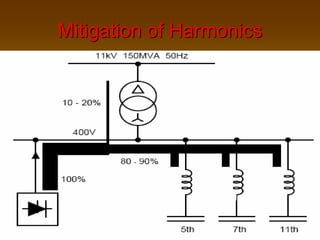
 Tuned to a specific harmonic order
such as the 5th, 7th, 11th,… etc to
meet requirements of IEEE 519-1992
Standard
 The number of tuned filter-branches
depends on the offending steady-
state harmonics to be absorbed and
on required reactive power level to
be compensated
Mitigation of Harmonics
 Isolating harmonic current to protect electrical
equipment from damage due to harmonic voltage
distortion
 Passive Filter-Low cost:
 Built-up by combinations of capacitors, inductors
(reactors) and resistors
 most common and available for all voltage levels
 Active Power Filter APF:
 Inserting negative phase compensating harmonics into
the AC-Network, thus eliminating the undesirable
harmonics on the AC Power Network.
 APF-Used only for for low voltage networks
Positive uses of Harmonics
 Second Harmonic current used to provide
restraint against mal operation of Transformer
Differential Relay during charging.
 Fifth Harmonic current used to provide restraint
against mal operation of Transformer Differential
Relay during over excitation conditions.
 Third Harmonic voltage based techniques used
to provide 100% Stator Earth Fault protection
for high impedance grounded Generators.
Conclusion
 The harmonic distortion principally comes
from Nonlinear-Type Loads.
 The application of power electronics is
causing increased level of harmonics due
to Switching.
 Harmonic distortion can cause serious
Failure/Damage problems.
 Harmonics are important aspect of power
operation that requires Mitigation.
 Over-Sizing and Power Filtering methods
are commonly used to limit Overheating
Effects of Sustained Harmonics.
References
 IEEE 519 “Recommended Practices and
Requirements for Harmonic Control in
Electric Power Systems.
 Electrical Technology- Vol.2 by A.K.
Thereja & B.L. Thereja.
 www.schneiderelectric.com
Thank You

Power System Harmonics Causes and Effect.ppt

  • 1.
    Harmonics in Power System Presentationby Er. RAJESH S, ASSISTANT ENGINEER, NES DIVISION, KALLARKUTTY (Statutory Trainee- Batch VI) 15.12.2008
  • 2.
  • 3.
    Topics of Discussion What is Power System Harmonics  Nonlinear Loads Producing Harmonic Currents  Harmonic Distortion  Identifying presence of Harmonics  Negative Effects of Harmonics  Harmonic Control  Positive uses of Harmonics  Conclusions
  • 4.
    What is PowerSystem Harmonics  Power system harmonics: currents or voltages with frequencies that are integer multiples (h=0,1,2,…N) of the fundamental power frequency  1st harmonic: 50Hz  2nd harmonic: 100Hz  3rd harmonic: 150Hz and so on….
  • 5.
    What is PowerSystem Harmonics  Power system harmonics: presenting deviations from a perfect sinusoidal- waveform (voltage or current waveform).  The distortion comes from a Nonlinearity caused by saturation, arcing electronic-switching and nonlinear electric loads.
  • 6.
    What is PowerSystem Harmonics  Any non-sinusoidal periodic wave form can be split to a no: of sinusoidal waves of different harmonic frequencies by Fourier Theorem.  In converse, when ever there is harmonics present in the system the wave form gets distorted and becomes complex or non- sinusoidal.
  • 7.
    What is PowerSystem Harmonics
  • 8.
    What is PowerSystem Harmonics
  • 9.
    What is PowerSystem Harmonics
  • 10.
    What is PowerSystem Harmonics  For balanced 3 phase systems, the characteristic harmonics are all odd.  When ever there is even harmonics, the positive and negative half cycle of the complex wave will be unsymmetrical.  When the harmonics are all odd, the positive and negative half cycle of the complex wave are symmetrical.  A P-Pulse converter produces harmonics of order given by h= nP+-1 in the AC side, where n= 1,2,…., etc.
  • 11.
    What is PowerSystem Harmonics ) t sin( 2 h 1 h        h Ih General expression for a complex function I (t)
  • 12.
    What is PowerSystem Harmonics  RMS value of a complex current (or voltage) wave is the square root of the sum of the squares of its individual components. 2 max 2 max 2 max 2 max 2 ... 2 2 2 3 2 1                                      m I I I I I
  • 13.
    What is PowerSystem Harmonics
  • 14.
    What is PowerSystem Harmonics
  • 15.
    What is PowerSystem Harmonics Harmonic sequence is the phase rotation relationship with respect to the fundamental component. Positive sequence harmonics ( 4th, 7th, 10th , ……. (6n+1) th ) have the same phase rotation as the fundamental component. These harmonics circulate between the phases. Negative sequence harmonics ( 2nd, 5th, 8th ……… (6n-1) th ) have the opposite phase rotation with respect to the fundamental component. These harmonics circulate between the phases. Zero sequence harmonics ( 3rd, 6th, 9th, ….. (6n-3) th ) do not produce a rotating field. These harmonics circulate between the phase and neutral or ground. These third order or zero sequence harmonics, unlike positive and negative sequence harmonic currents, do not cancel but add up arithmetically at the neutral bus.
  • 16.
    What is PowerSystem Harmonics
  • 17.
    What is PowerSystem Harmonics  Triple n harmonics are in phase and get summed in neutral.
  • 18.
    What is PowerSystem Harmonics
  • 19.
  • 20.
  • 21.
    Non-Linear Loads producing HarmonicCurrent  Electronic lighting ballasts/Controls  Adjustable speed Motor-Drives  Electric Arc Welding Equipment  Solid state Industrial Rectifiers  Industrial Process Control Systems  Uninterruptible Power Supplies (UPS) systems  Saturated Inductors/Transformers  LAN/Computer Networks
  • 22.
    Non-Linear Loads producing HarmonicCurrent- Bridge Rectifier.
  • 23.
    Non-Linear Loads producing HarmonicCurrent- Magnetising current of Transformer.
  • 24.
    INPUT CURRENT OFDIFFERENT NOLINEAR LOADS 0 10 20 30 40 -1.0 -0.5 0.0 0.5 1.0 Time (mS) Current 80% THD (high 3rd component) 1-φ Uncontrolled Rectifier 0 10 20 30 40 -1.0 -0.5 0.0 0.5 1.0 Time (mS) Current 1-φ Semi controlled Rectifier Bridge 2nd, 3rd, 4th ,...... harmonic components
  • 25.
    INPUT CURRENT OFDIFFERENT NOLINEAR LOADS 0 10 20 30 40 -1.0 -0.5 0.0 0.5 1.0 Time (mS) Current 6 –Pulse Rectifier 28% to 80% 5, 7, 11, ………. 0 10 20 30 40 -1.0 -0.5 0.0 0.5 1.0 Time (mS) Current 12 - Pulse Rectifier 15% 11, 13, ………..
  • 26.
    Current vs. VoltageHarmonics  Harmonic current flowing through the AC Power System impedance result in harmonic voltage-drop at the load bus and along the Feeder.
  • 27.
    Quantifying Harmonic Distortion Total Harmonic Distortion-THD: the contribution of all harmonic frequency Currents/Voltages to the fundamental current.  Individual Distortion Factor-(DF)-h quantify Distortion at h –harmonic- order
  • 28.
    Quantifying Harmonic Distortion THD: Ratio of the RMS of the harmonic content to the RMS of the Fundamental
  • 29.
    Quantifying Harmonic Distortion Current THD Voltage THD
  • 30.
    Quantifying Harmonic Distortion The Individual Harmonic Distortion ( IHD ) at a particular harmonic frequency is the root mean square ( rms ) of the harmonic under consideration to the rms value of the fundamental. % 100 1   I I IHD h Ih
  • 31.
    Current vs. VoltageHarmonics  Harmonic current flowing through the AC Power System impedance result in harmonic voltage-drop at the load bus and along the Feeder.  Lesser the System impedance, lower will be the voltage distortion.
  • 32.
  • 33.
  • 34.
  • 35.
    Quantifying Harmonic Distortion Harmonicvoltage measurement at UPS input and output 0.0 0.4 0.8 1.2 1.6 2.0 2.4 2.8 2 3 4 5 6 7 8 9 10 11 12 13 Harmonic number Voltage harmonics, % Input THD = 3.0 % Output THD = 0.7 %
  • 36.
    Quantifying Harmonic Distortion Harmoniccurrent measurement at UPS input and output 0 5 10 15 20 25 30 35 2 3 4 5 6 7 8 9 10 11 12 13 14 15 16 17 18 19 Harmonic number Current harmonics, % Input THD = 28.8 % Output THD = 46.5 %
  • 37.
    Standards for HarmonicsLimitation IEEE 519  Current Distortion Limits for 120v- 69kv DS. Ratio Iscc / Iload Harmo nic odd numb ers (<11) Harmo nic odd numb ers (>35) THD- i < 20 4.0 % 0.3 % 5.0 % 20 - 50 7.0 % 0.5 % 8.0 % 50 - 100 10.0 % 0.7 % 12.0 % >1000 15.0 % 1.4 % 20.0 %
  • 38.
    Standards for HarmonicsLimitation IEEE 519 Bus Voltage Voltage Harmonic limit as (%) of Fundamental THD-v (%) <= 69Kv 3.0 5.0 69 - 161Kv 1.5 2.5 >= 161 Kv 1.0 1.5
  • 39.
    Identifying presence ofHarmonics  Transformer over heating.  Disproportionately high Neutral current.  Capacitor Bank over heating.  Inspecting panels for signs of over heating.  Nuisance tripping of Circuit Breakers.  Comparing current readings taken with True RMS meter and average responding meter.
  • 40.
    Identifying presence ofHarmonics  Digital Oscilloscope: Wave shape, THD and Amplitude of each harmonic.  Use of Harmonic Meters-Single Phase or three Phase.
  • 41.
    Negative Effects ofHarmonics  Resistive loads - will absorb slightly more power  Motor loads - harmonic fluxes within the motor  Power transformers - hot spots within the windings  Electronic controls - operate improperly  Communication circuits - can cause interference
  • 42.
    Negative Effects ofHarmonics  Voltage Harmonics can cause additional heating in induction and synchronous motors and generators.  Voltage Harmonics with high peak values can weaken insulation in cables, windings, and capacitors.  Voltage Harmonics can cause malfunction of different electronic components and circuits that utilize the voltage waveform for synchronization or timing.
  • 43.
    Negative Effects ofHarmonics  Current Harmonics flowing through cables can cause higher heating over and above the heating that is created from the fundamental component.  Current Harmonics flowing through a transformer can cause higher heating over and above the heating that is created by the fundamental component.  Current Harmonics flowing through circuit breakers and switch-gear can increase their heating losses.
  • 44.
    Negative Effects ofHarmonics  In general, harmonics increase heating and losses in almost every piece of equipment in the electric power system.  High TRV in Circuit Breakers.  Reduced Power Factor.  Over heating of phase conductors due to skin effect.  Digital Clocks advance in time due to additional zero crossings.
  • 45.
    Negative Effects ofHarmonics  Overheating and premature failure of distribution transformers  Increasing iron and copper losses or eddy currents due to stray flux losses.  Overheating and mechanical oscillations in the motor-load system  Producing rotating magnitude field, which is opposite to the fundamental magnitude field.  Overheating and damage of neutral ground conductors  A 3-phase 4-wire system: Triple n harmonics will add rather than cancel on the neutral conductor.
  • 46.
    Negative Effects ofHarmonics  False or spurious Relay operations and trips of Circuit Breakers.  Failure of the Firing/Commutation circuits, found in DC motor-drives and AC drives with Silicon Controlled Rectifiers.  Mal-Operation instability of voltage regulator.  Power factor correction capacitor failure  Reactance (impedance)-Zc of a capacitor bank decreases as the frequency increases.  Capacitor bank acts as a sink for higher harmonic currents.  The System-Series and parallel Resonance can cause dielectric failure or rupture the power factor correction capacitor failure due to Over-Voltages & Over-Currents.
  • 47.
    Negative Effects ofHarmonics- Parallel Resonance  Harmonic currents produced by variable speed motor-drives: can be amplified up to 10-15 times in parallel resonance circuit formed by the capacitance bank and network inductance  Amplified/intensified harmonic currents: leading to internal overheating of the capacitor unit.  Higher frequency currents: causing more losses than 50hz currents having same amplitude.
  • 48.
    Negative Effects ofHarmonics- Parallel Resonance
  • 49.
    Negative Effects ofHarmonics- Series Resonance  The voltage of upstream AC Network can be also distorted due to series resonance formed by capacitance of the capacitor bank and System/load inductance : Can cause high harmonic current circulation through the capacitors.
  • 50.
    Negative Effects ofHarmonics- Series Resonance
  • 51.
    Mitigation of Harmonics Power System Design:  Limiting non-linear loads to 15% of the transformer’s capacity, when power factor correction capacitors are installed.  Avoiding/Detuning resonant conditions on the AC System:
  • 52.
    Mitigation of Harmonics Delta-Delta and Delta-Wye Transformers  Using two separate utility feed transformers with equal non-linear loads.  Shifting the phase relationship to various six-pulse converters through cancellation techniques
  • 53.
  • 54.
    Mitigation of Harmonics Line Isolation-Reactors  More commonly used for their low cost  Adding a small reactor in series with capacitor bank forms a Blocking series Filter.
  • 55.
    Mitigation of Harmonics Harmonic-Shunt or Trap Filters:  Used in applications with a high non- linear ratio to system to eliminate harmonic currents  Sized to withstand the RMS current as well as the value of current for the harmonics  Providing true distortion power factor correction
  • 56.
  • 57.
    Mitigation of Harmonics Tuned to a specific harmonic order such as the 5th, 7th, 11th,… etc to meet requirements of IEEE 519-1992 Standard  The number of tuned filter-branches depends on the offending steady- state harmonics to be absorbed and on required reactive power level to be compensated
  • 58.
  • 59.
    Mitigation of Harmonics Isolating harmonic current to protect electrical equipment from damage due to harmonic voltage distortion  Passive Filter-Low cost:  Built-up by combinations of capacitors, inductors (reactors) and resistors  most common and available for all voltage levels  Active Power Filter APF:  Inserting negative phase compensating harmonics into the AC-Network, thus eliminating the undesirable harmonics on the AC Power Network.  APF-Used only for for low voltage networks
  • 60.
    Positive uses ofHarmonics  Second Harmonic current used to provide restraint against mal operation of Transformer Differential Relay during charging.  Fifth Harmonic current used to provide restraint against mal operation of Transformer Differential Relay during over excitation conditions.  Third Harmonic voltage based techniques used to provide 100% Stator Earth Fault protection for high impedance grounded Generators.
  • 61.
    Conclusion  The harmonicdistortion principally comes from Nonlinear-Type Loads.  The application of power electronics is causing increased level of harmonics due to Switching.  Harmonic distortion can cause serious Failure/Damage problems.  Harmonics are important aspect of power operation that requires Mitigation.  Over-Sizing and Power Filtering methods are commonly used to limit Overheating Effects of Sustained Harmonics.
  • 62.
    References  IEEE 519“Recommended Practices and Requirements for Harmonic Control in Electric Power Systems.  Electrical Technology- Vol.2 by A.K. Thereja & B.L. Thereja.  www.schneiderelectric.com
  • 63.