PRESENTED BY; OJASWITA ROLL No. 30 MBA-IB      UNITED NATIONS ORGANISATION                           
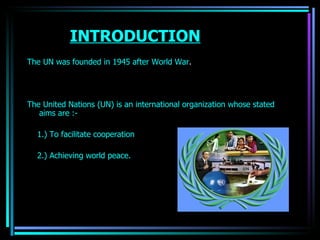
INTRODUCTION The UN was founded in 1945 after   World War . The United Nations (UN) is an   international organization   whose stated aims are :- 1.) To facilitate cooperation 2.) Achieving   world peace . OJASWITA (MBA-IB)
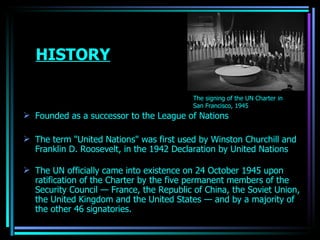
HISTORY Founded as a successor to the  League of Nations The term "United Nations" was first used by  Winston Churchill  and  Franklin D.   Roosevelt , in the 1942  Declaration by United Nations   The UN officially came into existence on 24 October 1945 upon ratification of the Charter by the five permanent members of the  Security Council  —  France , the  Republic of China , the  Soviet Union , the  United Kingdom  and the United  States  — and by a majority of the other 46 signatories. The signing of the  UN Charter  in  San Francisco , 1945   OJASWITA (MBA-IB)
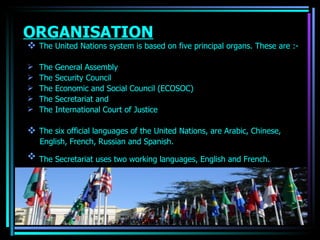
ORGANISATION The United Nations system is based on five principal organs. These are :- The General Assembly The Security Council The Economic and Social Council (ECOSOC) The Secretariat and  The International Court of Justice The six official  languages  of the United Nations, are Arabic, Chinese, English, French, Russian and Spanish. The Secretariat uses two working languages,  English  and  French .   OJASWITA (MBA-IB)
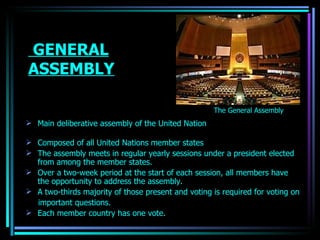
GENERAL ASSEMBLY Main  deliberative assembly  of the United Nation  Composed of all  United Nations member states   The assembly meets in regular yearly sessions under a president elected from among the member states. Over a two-week period at the start of each session, all members have the opportunity to address the assembly. A two-thirds majority of those present and voting is required for voting on important questions. Each member country has one vote.   The General Assembly   OJASWITA (MBA-IB)
SECURITY COUNCIL Charged with maintaining peace and security among countries Has the power to make binding decisions that member governments have agreed to carry out. Consisting of 5 permanent members -  China ,  France ,  Russia , the United Kingdom  and the  United States  - and 10 non-permanent members currently Austria,  Bosnia and Herzegovina ,  Brazil ,  Gabon , Japan,  Lebanon , Mexico,  Nigeria ,  Turkey , and  Uganda . The five permanent members hold  veto power . The ten temporary seats are held for two-year terms. The presidency of the Security Council is rotated alphabetically each month, and is currently held by Gabon.   Interior of the Security Council chambers OJASWITA (MBA-IB)
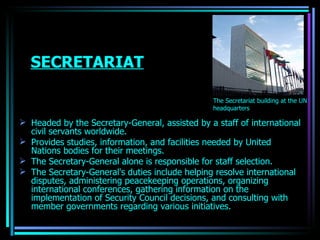
SECRETARIAT Headed by the Secretary-General, assisted by a staff of international civil servants worldwide.  Provides studies, information, and facilities needed by United Nations bodies for their meetings. The Secretary-General alone is responsible for staff selection.  The Secretary-General's duties include helping resolve international disputes, administering peacekeeping operations, organizing international conferences, gathering information on the implementation of Security Council decisions, and consulting with member governments regarding various initiatives.  The Secretariat building at the UN headquarters OJASWITA (MBA-IB)
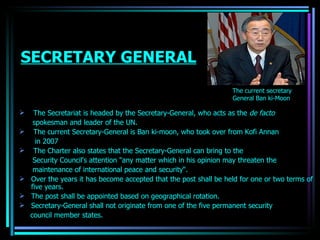
SECRETARY GENERAL The Secretariat is headed by the  Secretary-General , who acts as the  de facto spokesman and leader of the UN.  The current Secretary-General is  Ban ki-moon , who took over from  Kofi Annan in 2007  The Charter also states that the Secretary-General can bring to the  Security Council 's attention "any matter which in his opinion may threaten the maintenance of international  peace  and security“. Over the years it has become accepted that the post shall be held for one or two  terms  of five years. The post shall be appointed based on geographical rotation. Secretary-General shall not originate from one of the five permanent security council member states. The current secretary  General Ban ki-Moon OJASWITA (MBA-IB)
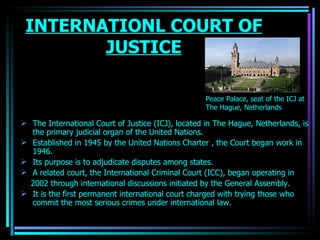
INTERNATIONL COURT OF JUSTICE The International Court of Justice (ICJ), located in  The Hague ,  Netherlands , is the primary judicial organ of the United Nations.  Established in 1945 by the United Nations Charter , the Court began work in 1946.   Its purpose is to adjudicate disputes among states. A related court, the  International Criminal Court  (ICC), began operating in 2002 through international discussions initiated by the General Assembly. It is the first permanent international court charged with trying those who commit the most serious crimes under international law.  Peace Palace, seat of the ICJ at The Hague, Netherlands OJASWITA (MBA-IB)
THE ECONOMIC AND SOCIAL COUNCIL(ECOSOC) The Economic and Social Council (ECOSOC) assists the General Assembly in promoting international economic and social cooperation and development. ECOSOC has 54 members, all of whom are elected by the General Assembly for a three-year term. The president is elected for a one-year term. ECOSOC meets once a year in July for a four-week session. ECOSOC's functions include information gathering, advising member nations, making recommendations, provide policy  coherence  and coordinate the overlapping functions of the UN’s subsidiary bodies.  OJASWITA (MBA-IB)
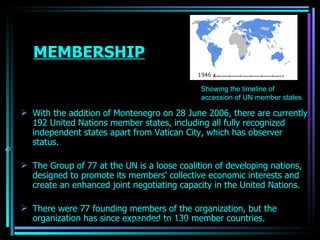
MEMBERSHIP With the addition of  Montenegro  on 28 June 2006, there are currently 192  United Nations member states , including all fully recognized independent  states  apart from  Vatican City , which has observer status. The  Group of 77  at the UN is a loose coalition of  developing nations , designed to promote its members' collective  economic  interests and create an enhanced joint negotiating capacity in the United Nations. There were 77 founding members of the organization, but the organization has since expanded to 130 member countries.                                                                   Showing the timeline of accession of UN member states OJASWITA (MBA-IB)
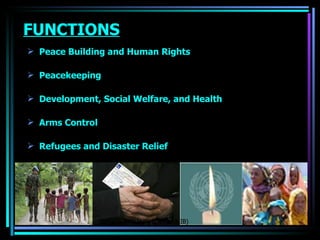
FUNCTIONS Peace Building and Human Rights Peacekeeping Development, Social Welfare, and Health Arms Control Refugees and Disaster Relief OJASWITA (MBA-IB)
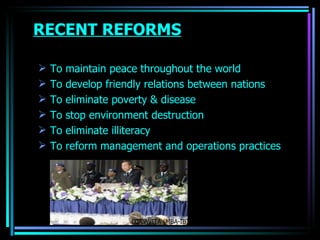
RECENT REFORMS To maintain peace throughout the world To develop friendly relations between nations To eliminate poverty & disease To stop environment destruction To eliminate illiteracy To reform management and operations practices OJASWITA (MBA-IB)
FUNDING The UN is financed from assessed and voluntary contributions from member states The Assembly has established the principle that the UN should not be overly dependent on any one member to finance its operations.  The current operating budget is estimated at $4.19 billion. A large share of UN expenditures addresses the core UN mission of peace and security OJASWITA (MBA-IB)
CONT… As of 1 January 2010, the top 10 providers of assessed financial contributions to United Nations peacekeeping operations were: the  United States ,  Japan ,  Germany , the  United Kingdom ,  France ,  Italy ,  China ,  Canada ,  Spain  and the  Republic of Korea .   Special UN programmes not included in the regular budget (such as UNICEF and  UNDP ) are financed by voluntary contributions from member governments. Most of this is financial contributions, but some is in the form of agricultural  commodities  donated for afflicted populations.  OJASWITA (MBA-IB)
SPECIALIZED INSTITUTIONS There are many UN organizations and agencies that function to work on particular issues. Some of the most well-known agencies are the World Health Organization (WHO), United Nations Children's Fund (UNICEF), United Nations Educational, Scientific and Cultural Organization (UNESCO), United Nations Conference on Trade and Development (UNCTAD) and World Bank. The United Nations Charter stipulates that each primary organ of the UN can establish various specialized agencies to fulfill its duties. Flag of the W H O WHO Headquarters in Geneva   UNICEF Flag The World Bank headquarters in Washington, D.C. World Bank Logo UNCTAD Logo OJASWITA (MBA-IB)
WORLD HEALTH ORGANISATION The World Health Organization (WHO) is a specialized agency of the United Nations (UN) that acts as a coordinating authority on international public health. Established on 7 April 1948, and headquartered in Geneva, Switzerland. The WHO's constitution states that its objective "is the attainment by all peoples of the highest possible level of health."Its major task is to combat disease, especially key infectious diseases, and to promote the general health of the people of the world. Its constitution formally coming into force on the first World Health Day, (7 April 1948), when it was ratified by the 26th member state.  Flag of the WHO OJASWITA (MBA-IB)
CONT… The WHO aims to eradicate polio within the next few years. The WHO also conducts research, on, for instance, whether the electromagnetic field surrounding cell phones has a negative influence on health. The WHO has 193 Member States, including all UN Member States except Liechtenstein , and 2 non-UN members, Niue and the Cook Islands.  Margaret Chan, incumbent Director General of the WHO WHO Headquarters in Geneva   OJASWITA (MBA-IB)
UNICEF The United Nations International Children's Emergency Fund (or UNICEF) was created by the United Nations General Assembly on 11 December 1946, to provide emergency food and healthcare to children in countries that had been devastated by World War II.  Headquartered in New York City, UNICEF provides long-term humanitarian and developmental assistance to Children and mothers in developing countries. The heart of UNICEF's work is in the field, with staff in over 150 countries and territories. More than 120 country offices carry out UNICEF's mission through a unique program of cooperation developed with host governments. Seven regional offices guide their work and provide technical assistance to country offices as needed. Overall management and administration of the organization takes place at its headquarters in New York.  UNICEF's Supply Division is based in Copenhagen  UNICEF Flag OJASWITA (MBA-IB)
UNCTAD The United Nations Conference on Trade and Development (UNCTAD) was established in 1964 as a permanent intergovernmental body. It is the principal organ of the United Nations General Assembly dealing with trade, investment and development issues. The organization's goals are to "maximize the  trade ,  investment  and development opportunities of  developing countries  and assist them in their efforts to integrate into the world economy on an equitable basis.". In the 1970s and 1980s, UNCTAD was closely associated with the idea of a  New International Economic Order  (NIEO). Currently, UNCTAD has 193 member States and is headquartered in  Geneva ,  Switzerland .   UNCTAD Logo OJASWITA (MBA-IB)
WORLD BANK The  World Bank  is a  bank  that provides financial and technical assistance to developing countries for development programs (e.g. bridges, roads, schools, etc.) with the stated goal of reducing  poverty . The World Bank was created following the ratification of the United Nations Monetary and Financial Conference Bretton Woods agreement. The concept was originally conceived in July 1944 at the United Nations Monetary and Financial Conference. The World Bank is one of the two  Bretton Woods Institutions  which were created in 1944 to rebuild a war-torn  Europe  after  World War II . In the 1980s and 1990s its main focus was both debt management and structural adjustment. Headquarters in Washington,D.C. [ edit ] Millennium Development Goals World Bank Logo OJASWITA (MBA-IB)                                         
ACHIEVEMENTS OF UNO Maintaining peace and security Making peace Promoting democracy Promoting development Promoting human rights Protecting the environment Preventing nuclear proliferation Promoting self determination and independence Strengthening international law OJASWITA (MBA-IB)
OJASWITA (MBA-IB)

Uno india ojaswita_swn

  • 1.
    PRESENTED BY; OJASWITAROLL No. 30 MBA-IB UNITED NATIONS ORGANISATION                        
  • 2.
    INTRODUCTION The UNwas founded in 1945 after World War . The United Nations (UN) is an international organization whose stated aims are :- 1.) To facilitate cooperation 2.) Achieving world peace . OJASWITA (MBA-IB)
  • 3.
    HISTORY Founded asa successor to the League of Nations The term "United Nations" was first used by Winston Churchill and Franklin D. Roosevelt , in the 1942 Declaration by United Nations The UN officially came into existence on 24 October 1945 upon ratification of the Charter by the five permanent members of the Security Council — France , the Republic of China , the Soviet Union , the United Kingdom and the United States — and by a majority of the other 46 signatories. The signing of the UN Charter in San Francisco , 1945 OJASWITA (MBA-IB)
  • 4.
    ORGANISATION The UnitedNations system is based on five principal organs. These are :- The General Assembly The Security Council The Economic and Social Council (ECOSOC) The Secretariat and The International Court of Justice The six official languages of the United Nations, are Arabic, Chinese, English, French, Russian and Spanish. The Secretariat uses two working languages, English and French . OJASWITA (MBA-IB)
  • 5.
    GENERAL ASSEMBLY Main deliberative assembly of the United Nation Composed of all United Nations member states The assembly meets in regular yearly sessions under a president elected from among the member states. Over a two-week period at the start of each session, all members have the opportunity to address the assembly. A two-thirds majority of those present and voting is required for voting on important questions. Each member country has one vote. The General Assembly OJASWITA (MBA-IB)
  • 6.
    SECURITY COUNCIL Chargedwith maintaining peace and security among countries Has the power to make binding decisions that member governments have agreed to carry out. Consisting of 5 permanent members - China , France , Russia , the United Kingdom and the United States - and 10 non-permanent members currently Austria, Bosnia and Herzegovina , Brazil , Gabon , Japan, Lebanon , Mexico, Nigeria , Turkey , and Uganda . The five permanent members hold veto power . The ten temporary seats are held for two-year terms. The presidency of the Security Council is rotated alphabetically each month, and is currently held by Gabon. Interior of the Security Council chambers OJASWITA (MBA-IB)
  • 7.
    SECRETARIAT Headed bythe Secretary-General, assisted by a staff of international civil servants worldwide. Provides studies, information, and facilities needed by United Nations bodies for their meetings. The Secretary-General alone is responsible for staff selection. The Secretary-General's duties include helping resolve international disputes, administering peacekeeping operations, organizing international conferences, gathering information on the implementation of Security Council decisions, and consulting with member governments regarding various initiatives. The Secretariat building at the UN headquarters OJASWITA (MBA-IB)
  • 8.
    SECRETARY GENERAL TheSecretariat is headed by the Secretary-General , who acts as the de facto spokesman and leader of the UN. The current Secretary-General is Ban ki-moon , who took over from Kofi Annan in 2007 The Charter also states that the Secretary-General can bring to the Security Council 's attention "any matter which in his opinion may threaten the maintenance of international peace and security“. Over the years it has become accepted that the post shall be held for one or two terms of five years. The post shall be appointed based on geographical rotation. Secretary-General shall not originate from one of the five permanent security council member states. The current secretary General Ban ki-Moon OJASWITA (MBA-IB)
  • 9.
    INTERNATIONL COURT OFJUSTICE The International Court of Justice (ICJ), located in The Hague , Netherlands , is the primary judicial organ of the United Nations. Established in 1945 by the United Nations Charter , the Court began work in 1946. Its purpose is to adjudicate disputes among states. A related court, the International Criminal Court (ICC), began operating in 2002 through international discussions initiated by the General Assembly. It is the first permanent international court charged with trying those who commit the most serious crimes under international law. Peace Palace, seat of the ICJ at The Hague, Netherlands OJASWITA (MBA-IB)
  • 10.
    THE ECONOMIC ANDSOCIAL COUNCIL(ECOSOC) The Economic and Social Council (ECOSOC) assists the General Assembly in promoting international economic and social cooperation and development. ECOSOC has 54 members, all of whom are elected by the General Assembly for a three-year term. The president is elected for a one-year term. ECOSOC meets once a year in July for a four-week session. ECOSOC's functions include information gathering, advising member nations, making recommendations, provide policy coherence and coordinate the overlapping functions of the UN’s subsidiary bodies. OJASWITA (MBA-IB)
  • 11.
    MEMBERSHIP With theaddition of Montenegro on 28 June 2006, there are currently 192 United Nations member states , including all fully recognized independent states apart from Vatican City , which has observer status. The Group of 77 at the UN is a loose coalition of developing nations , designed to promote its members' collective economic interests and create an enhanced joint negotiating capacity in the United Nations. There were 77 founding members of the organization, but the organization has since expanded to 130 member countries.                                                                 Showing the timeline of accession of UN member states OJASWITA (MBA-IB)
  • 12.
    FUNCTIONS Peace Buildingand Human Rights Peacekeeping Development, Social Welfare, and Health Arms Control Refugees and Disaster Relief OJASWITA (MBA-IB)
  • 13.
    RECENT REFORMS Tomaintain peace throughout the world To develop friendly relations between nations To eliminate poverty & disease To stop environment destruction To eliminate illiteracy To reform management and operations practices OJASWITA (MBA-IB)
  • 14.
    FUNDING The UNis financed from assessed and voluntary contributions from member states The Assembly has established the principle that the UN should not be overly dependent on any one member to finance its operations. The current operating budget is estimated at $4.19 billion. A large share of UN expenditures addresses the core UN mission of peace and security OJASWITA (MBA-IB)
  • 15.
    CONT… As of1 January 2010, the top 10 providers of assessed financial contributions to United Nations peacekeeping operations were: the United States , Japan , Germany , the United Kingdom , France , Italy , China , Canada , Spain and the Republic of Korea . Special UN programmes not included in the regular budget (such as UNICEF and UNDP ) are financed by voluntary contributions from member governments. Most of this is financial contributions, but some is in the form of agricultural commodities donated for afflicted populations. OJASWITA (MBA-IB)
  • 16.
    SPECIALIZED INSTITUTIONS Thereare many UN organizations and agencies that function to work on particular issues. Some of the most well-known agencies are the World Health Organization (WHO), United Nations Children's Fund (UNICEF), United Nations Educational, Scientific and Cultural Organization (UNESCO), United Nations Conference on Trade and Development (UNCTAD) and World Bank. The United Nations Charter stipulates that each primary organ of the UN can establish various specialized agencies to fulfill its duties. Flag of the W H O WHO Headquarters in Geneva UNICEF Flag The World Bank headquarters in Washington, D.C. World Bank Logo UNCTAD Logo OJASWITA (MBA-IB)
  • 17.
    WORLD HEALTH ORGANISATIONThe World Health Organization (WHO) is a specialized agency of the United Nations (UN) that acts as a coordinating authority on international public health. Established on 7 April 1948, and headquartered in Geneva, Switzerland. The WHO's constitution states that its objective "is the attainment by all peoples of the highest possible level of health."Its major task is to combat disease, especially key infectious diseases, and to promote the general health of the people of the world. Its constitution formally coming into force on the first World Health Day, (7 April 1948), when it was ratified by the 26th member state. Flag of the WHO OJASWITA (MBA-IB)
  • 18.
    CONT… The WHOaims to eradicate polio within the next few years. The WHO also conducts research, on, for instance, whether the electromagnetic field surrounding cell phones has a negative influence on health. The WHO has 193 Member States, including all UN Member States except Liechtenstein , and 2 non-UN members, Niue and the Cook Islands. Margaret Chan, incumbent Director General of the WHO WHO Headquarters in Geneva OJASWITA (MBA-IB)
  • 19.
    UNICEF The UnitedNations International Children's Emergency Fund (or UNICEF) was created by the United Nations General Assembly on 11 December 1946, to provide emergency food and healthcare to children in countries that had been devastated by World War II. Headquartered in New York City, UNICEF provides long-term humanitarian and developmental assistance to Children and mothers in developing countries. The heart of UNICEF's work is in the field, with staff in over 150 countries and territories. More than 120 country offices carry out UNICEF's mission through a unique program of cooperation developed with host governments. Seven regional offices guide their work and provide technical assistance to country offices as needed. Overall management and administration of the organization takes place at its headquarters in New York. UNICEF's Supply Division is based in Copenhagen UNICEF Flag OJASWITA (MBA-IB)
  • 20.
    UNCTAD The UnitedNations Conference on Trade and Development (UNCTAD) was established in 1964 as a permanent intergovernmental body. It is the principal organ of the United Nations General Assembly dealing with trade, investment and development issues. The organization's goals are to "maximize the trade , investment and development opportunities of developing countries and assist them in their efforts to integrate into the world economy on an equitable basis.". In the 1970s and 1980s, UNCTAD was closely associated with the idea of a New International Economic Order (NIEO). Currently, UNCTAD has 193 member States and is headquartered in Geneva , Switzerland . UNCTAD Logo OJASWITA (MBA-IB)
  • 21.
    WORLD BANK The World Bank is a bank that provides financial and technical assistance to developing countries for development programs (e.g. bridges, roads, schools, etc.) with the stated goal of reducing poverty . The World Bank was created following the ratification of the United Nations Monetary and Financial Conference Bretton Woods agreement. The concept was originally conceived in July 1944 at the United Nations Monetary and Financial Conference. The World Bank is one of the two Bretton Woods Institutions which were created in 1944 to rebuild a war-torn Europe after World War II . In the 1980s and 1990s its main focus was both debt management and structural adjustment. Headquarters in Washington,D.C. [ edit ] Millennium Development Goals World Bank Logo OJASWITA (MBA-IB)                                      
  • 22.
    ACHIEVEMENTS OF UNOMaintaining peace and security Making peace Promoting democracy Promoting development Promoting human rights Protecting the environment Preventing nuclear proliferation Promoting self determination and independence Strengthening international law OJASWITA (MBA-IB)
  • 23.