Information Sources
News Report
Information Sources
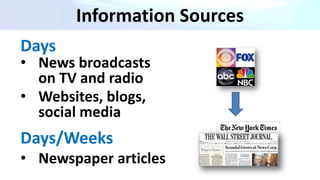
Days
• News broadcasts
on TV and radio
• Websites, blogs,
social media
Days/Weeks
• Newspaper articles
Information Sources
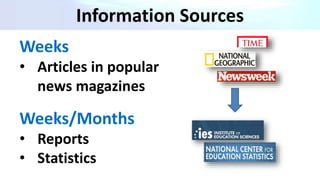
Weeks
• Articles in popular
news magazines
Weeks/Months
• Reports
• Statistics
Information Sources
Months
• Articles in
scholarly journals
Years
• Books
• Textbooks
• Encyclopedias
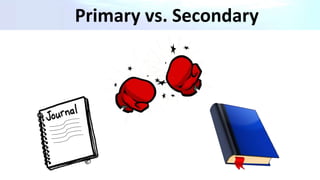
Primary vs. Secondary
Primary Sources
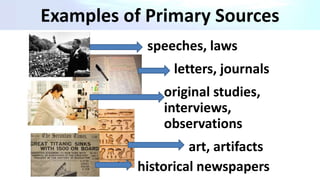
speeches, laws
letters, journals
original studies,
interviews,
observations
art, artifacts
historical newspapers
Examples of Primary Sources
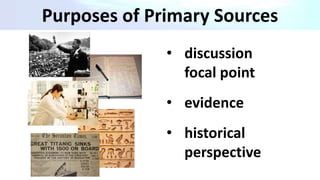
Purposes of Primary Sources
• discussion
focal point
• evidence
• historical
perspective
Secondary Sources
encyclopedias
books,
textbooks
magazine articles,
reviews, essays
Examples of Secondary Sources
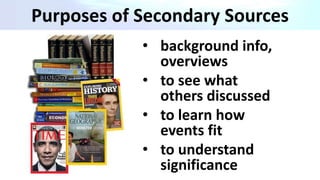
• background info,
overviews
• to see what
others discussed
• to learn how
events fit
• to understand
significance
Purposes of Secondary Sources
Primary vs. Secondary
Did the author(s) actually
conduct the research presented?
Primary vs. Secondary
Did the author(s) actually
conduct the research presented?
• If yes, it’s primary
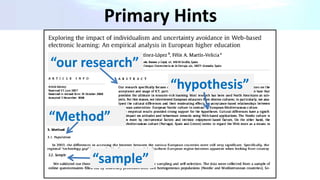
Primary Hints
Primary Hints
“our research”
“hypothesis”
“sample”
“Method”
Primary vs. Secondary
Did the author(s) actually
conduct the research presented?
• If no, it’s secondary
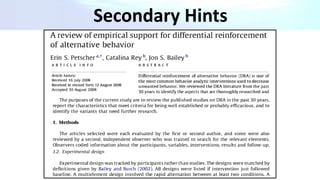
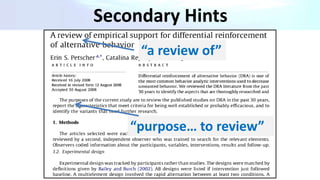
Secondary Hints
Secondary Hints
“a review of”
“purpose… to review”
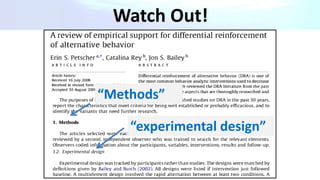
Watch Out!
“Methods”
“experimental design”
Not sure? Ask a Librarian!
954-262-5413
http://lib.nova.edu/ask

Primary vs Secondary Sources

Editor's Notes

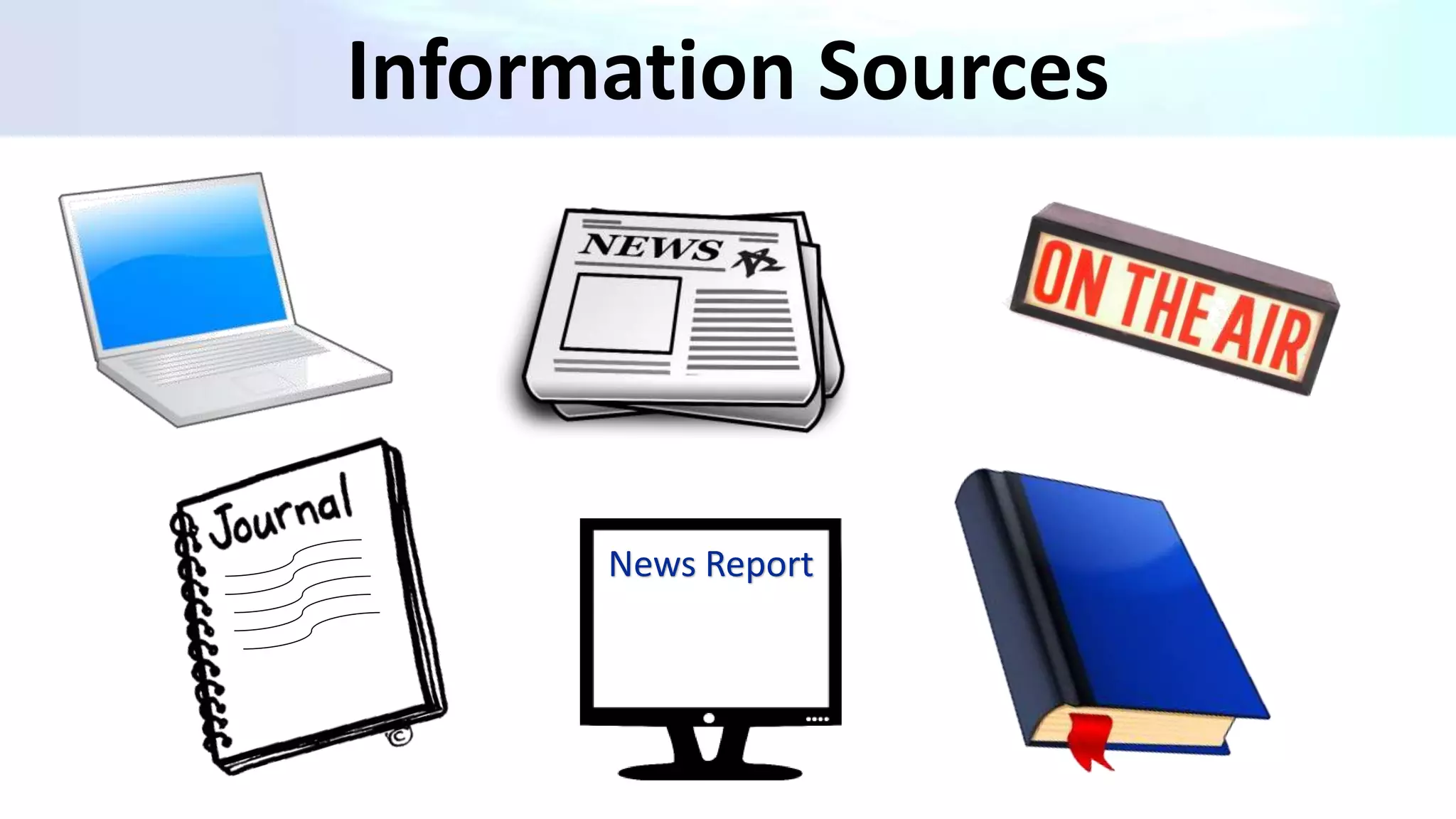
  • #2 Information comes from a variety of sources and these different types of sources serve different purposes. Before we discuss how information is classified, let’s take a closer look at the most common types of information sources.
  • #3 When an event first occurs or an issue arises, it is usually covered by news stations on TV, radio, and the Internet. Over the next few days and weeks, articles may appear in newspapers.
  • #4 In the coming weeks, if the event or issue is significant enough, it may be featured in popular news magazines. Over the next several months, data may be collected and presented in reports and statistics by various agencies and organizations.
  • #5 Over the next several months and years, research may be conducted and published as academic journal articles. Eventually, when enough information has been produced, books, textbooks, and reference books like encyclopedias may be published on the topic.
  • #6 Information sources are commonly classified as either primary or secondary. Let’s take a look on how to differentiate these two types of resources.
  • #7 A primary source is a first-hand account. Primary sources are original documentation and usually do not describe or analyze other documents.
  • #8 Examples include original research studies, interviews, observations, speeches, personal letters, and historical documents.
  • #9 Primary sources can be used as a focal point for discussion about a topic, to support claims or criticisms, as evidence for theories and research, or to provide historical perspectives.
  • #10 A secondary source is created when an author interprets and analyzes a primary source. While a primary source speaks to the actual creation of the source, a secondary source speaks in detail about something that has already been created.
  • #11 Examples of secondary sources include encyclopedias, books, and textbooks that summarize or synthesize information from primary sources as well as magazine and journal articles that review rather than conduct research studies.
  • #12 Secondary sources can be used to get background information, to understand the scope of a topic, to see what others have discussed or hypothesized, to learn how a recent event fits into a larger picture, and to understand the significance of events, data, and other works.
  • #13 When you find an article, ask yourself this question: “Did the author(s) actually conduct the research presented in the article?” Your answer will help you determine if the article is a primary or secondary source.
  • #14 If the answer is “yes,” it is a primary source.
  • #15 To answer this question, look at the language in the abstract and throughout the full text of the article for hints.
  • #16 For example, look for phrasing such as “our research” and “our findings.” Other hints include words such as “methodology,” “sample size,” and “hypothesis” as well as section headings for “Methods, “Results,” and “Findings.” Basically, as you read through the article, look to see if the authors are writing about their own research rather than research conducted by someone else.
  • #17 Now, going back to our original question, if the answer is “no,” then it is a secondary source.
  • #18 Again look for hints in the language of the abstract and throughout the full text.
  • #19 In this example, we see that the title and purpose statement both indicate that it is a review of other studies. This suggests that the authors did not actually conduct the studies that they are writing about, so the source is considered secondary.
  • #20 However, be careful! Notice that the authors still used phrases like “methods” and “experimental design” to explain how they created their review. Don’t let that confuse you. Also, remember that many primary sources might still include a literature review section. It’s also important to recognize that a source’s classification as either primary or secondary is relative depending on your topic. Since this designation is relative, most databases will not allow you to limit searches to only primary sources so it’s up to you to determine.
  • #21 Remember, if you need help identifying primary and secondary sources, ask a librarian!