UNIV
4995
Grammar Review
UNIV
4995
Using the Past Tense
 Simple Past
◦ [VERB+ed] or irregular verbs
 Examples:
◦ You called Debbie.
◦ Did you call Debbie?
◦ You did not call Debbie.
UNIV
4995
USE 1:
Completed Action in the Past
 Use the Simple Past to express the
idea that an action started and
finished at a specific time in the past.
◦ Sometimes, the speaker may not actually
mention the specific time, but they do
have one specific time in mind.
 Examples:
◦ I saw a movie yesterday.
◦ I didn't see a play yesterday.
◦ Last year, I traveled to Japan.
UNIV
4995
USE 2:
A Series of Completed Actions
 We use the Simple Past to list a series
of completed actions.
 Examples:
◦ I finished work, walked to the beach, and
found a nice place to swim.
◦ He arrived from the airport at 8 o’clock,
checked into the hotel at 9, and met the
others at 10.
◦ Did you add flour, pour in the milk, and
then add the eggs?
UNIV
4995
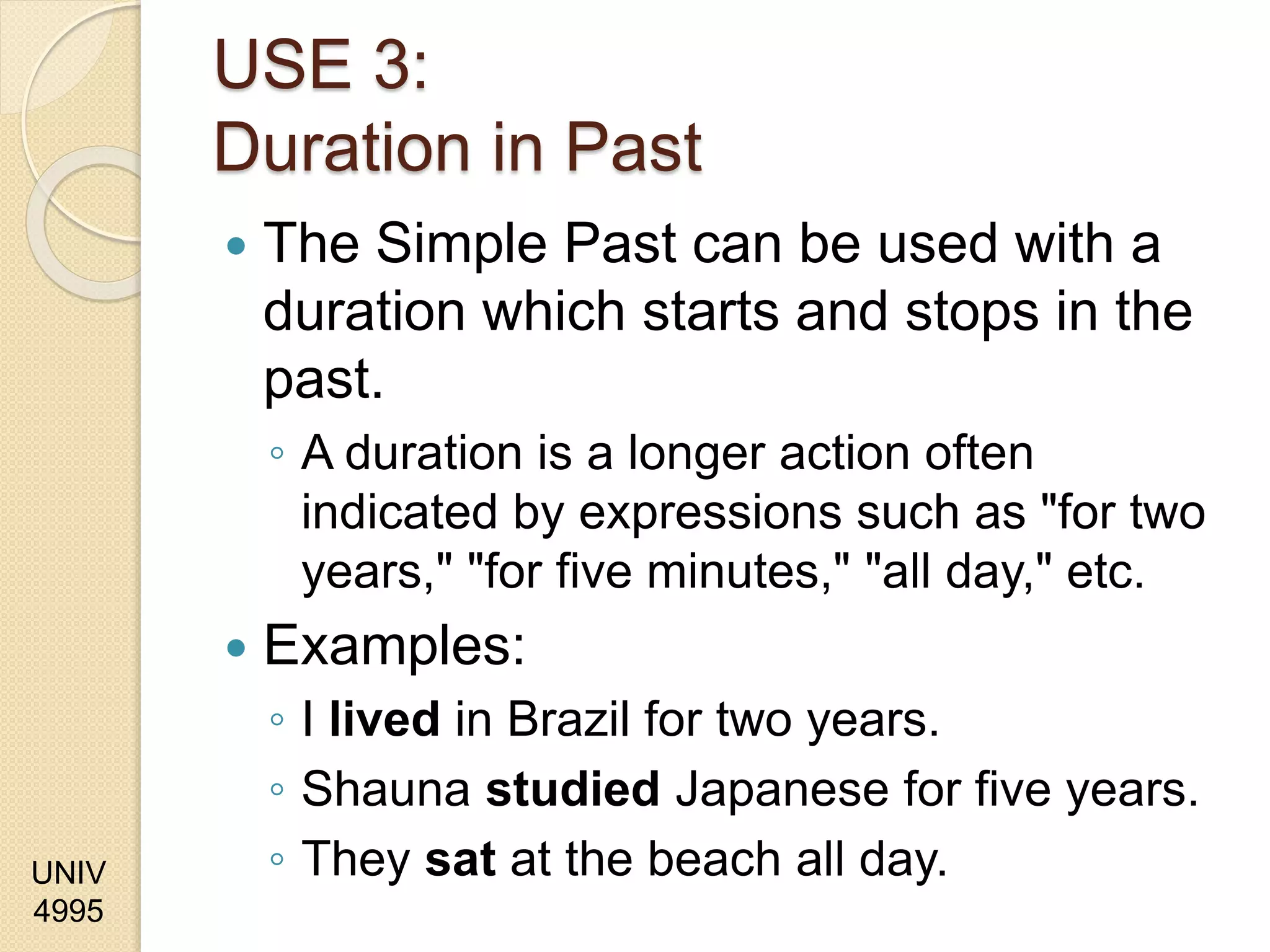
USE 3:
Duration in Past
 The Simple Past can be used with a
duration which starts and stops in the
past.
◦ A duration is a longer action often
indicated by expressions such as "for two
years," "for five minutes," "all day," etc.
 Examples:
◦ I lived in Brazil for two years.
◦ Shauna studied Japanese for five years.
◦ They sat at the beach all day.
UNIV
4995
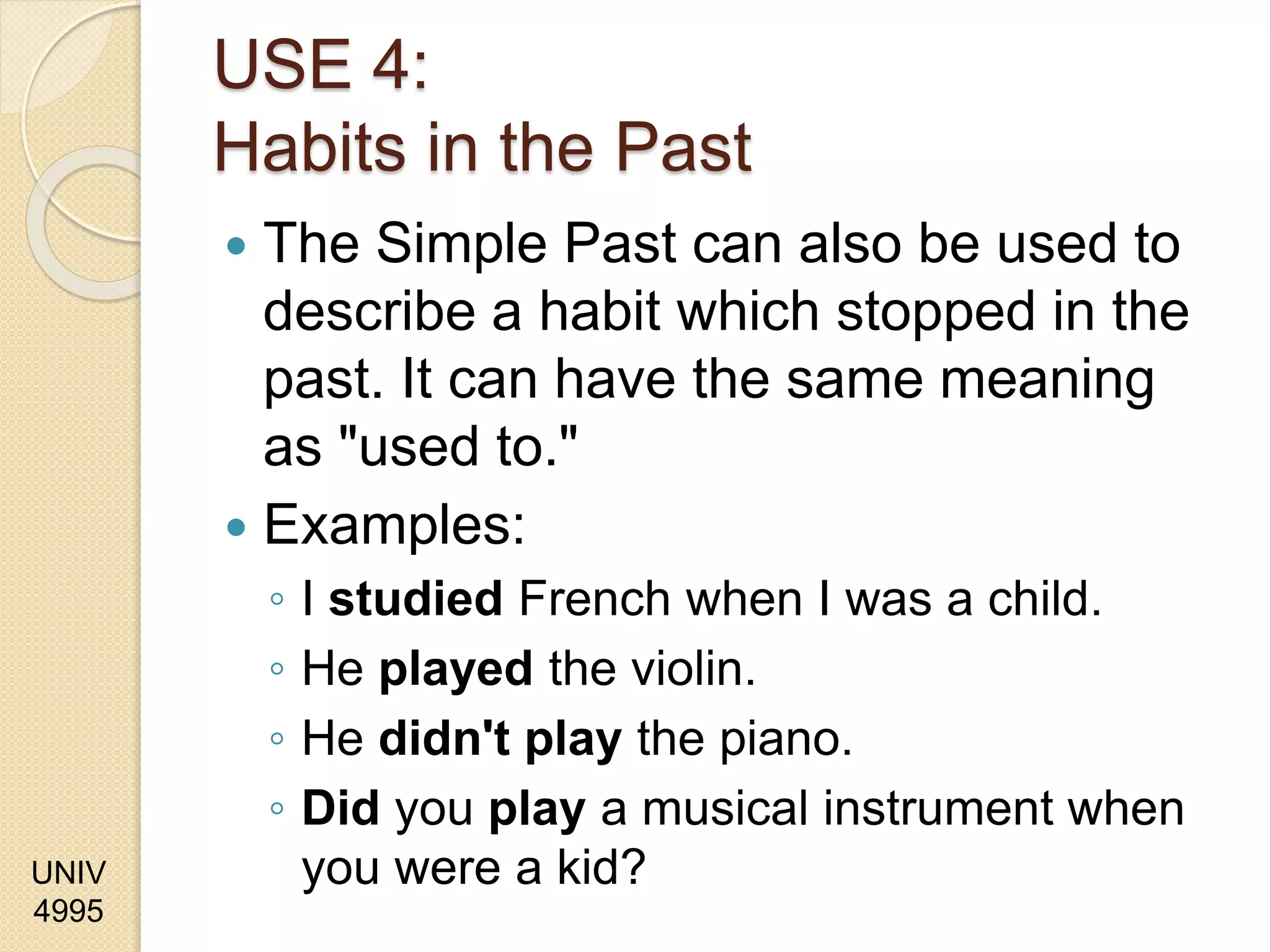
USE 4:
Habits in the Past
 The Simple Past can also be used to
describe a habit which stopped in the
past. It can have the same meaning
as "used to."
 Examples:
◦ I studied French when I was a child.
◦ He played the violin.
◦ He didn't play the piano.
◦ Did you play a musical instrument when
you were a kid?
UNIV
4995
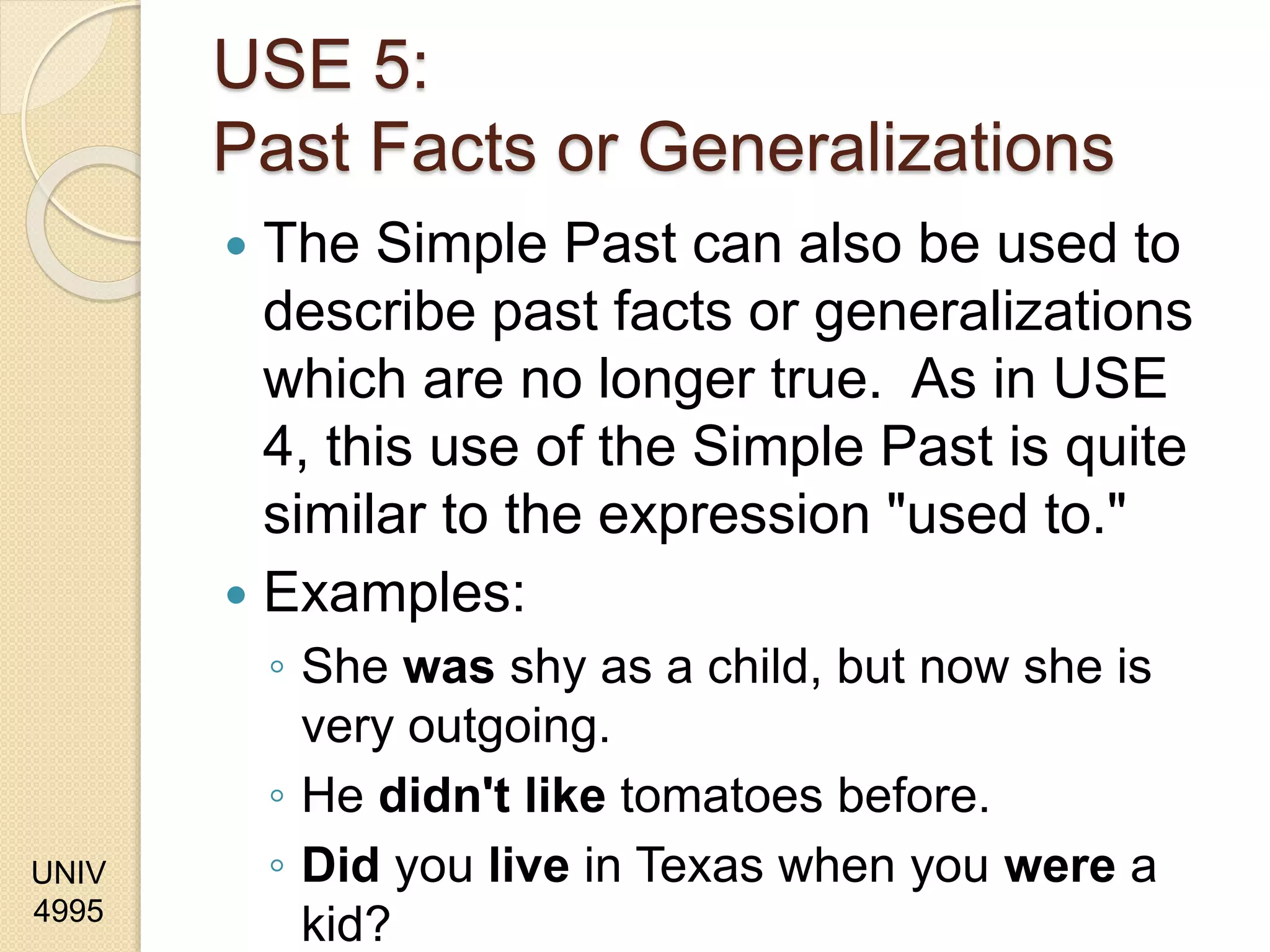
USE 5:
Past Facts or Generalizations
 The Simple Past can also be used to
describe past facts or generalizations
which are no longer true. As in USE
4, this use of the Simple Past is quite
similar to the expression "used to."
 Examples:
◦ She was shy as a child, but now she is
very outgoing.
◦ He didn't like tomatoes before.
◦ Did you live in Texas when you were a
kid?
UNIV
4995
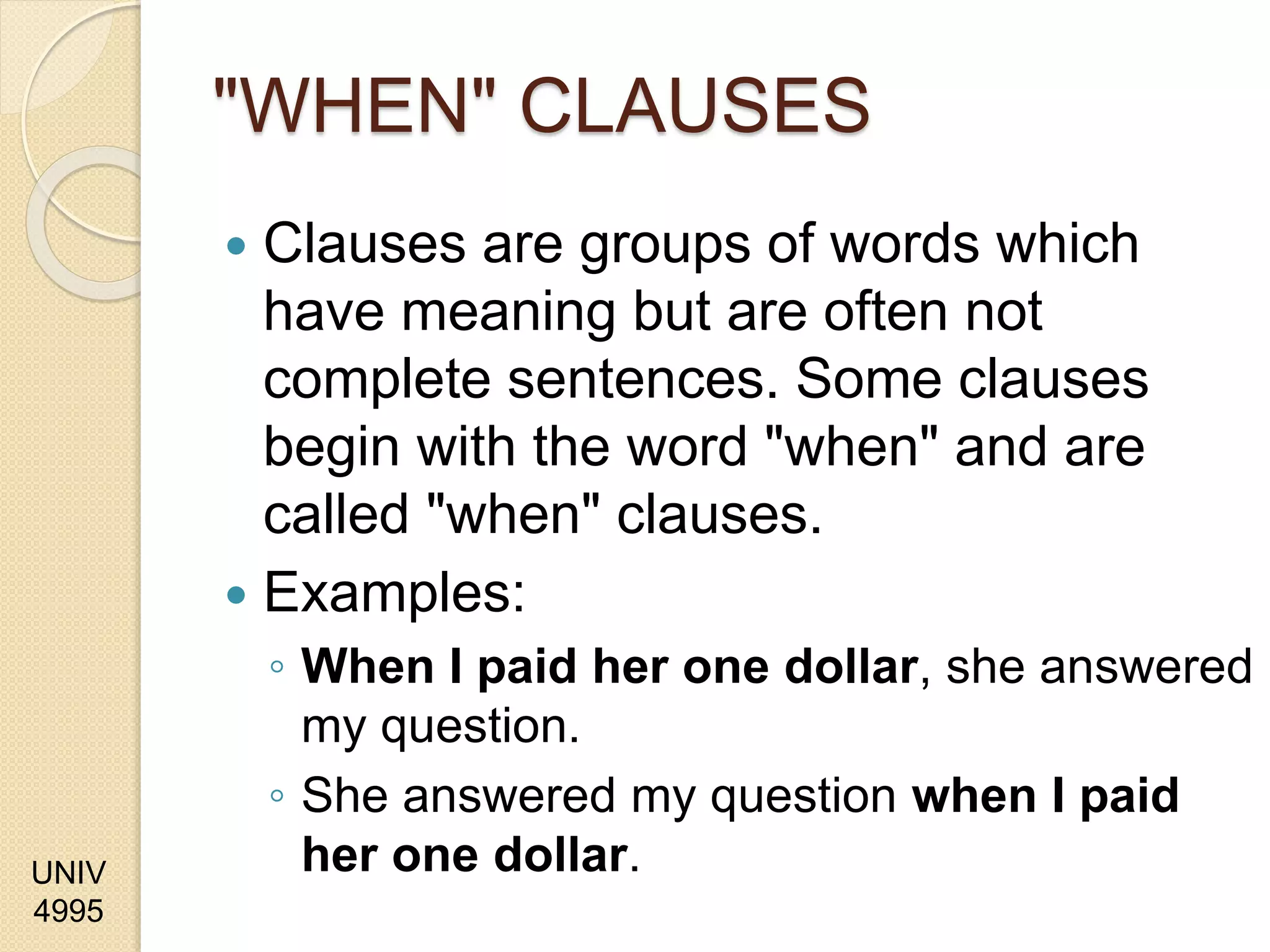
"WHEN" CLAUSES
 Clauses are groups of words which
have meaning but are often not
complete sentences. Some clauses
begin with the word "when" and are
called "when" clauses.
 Examples:
◦ When I paid her one dollar, she answered
my question.
◦ She answered my question when I paid
her one dollar.
UNIV
4995
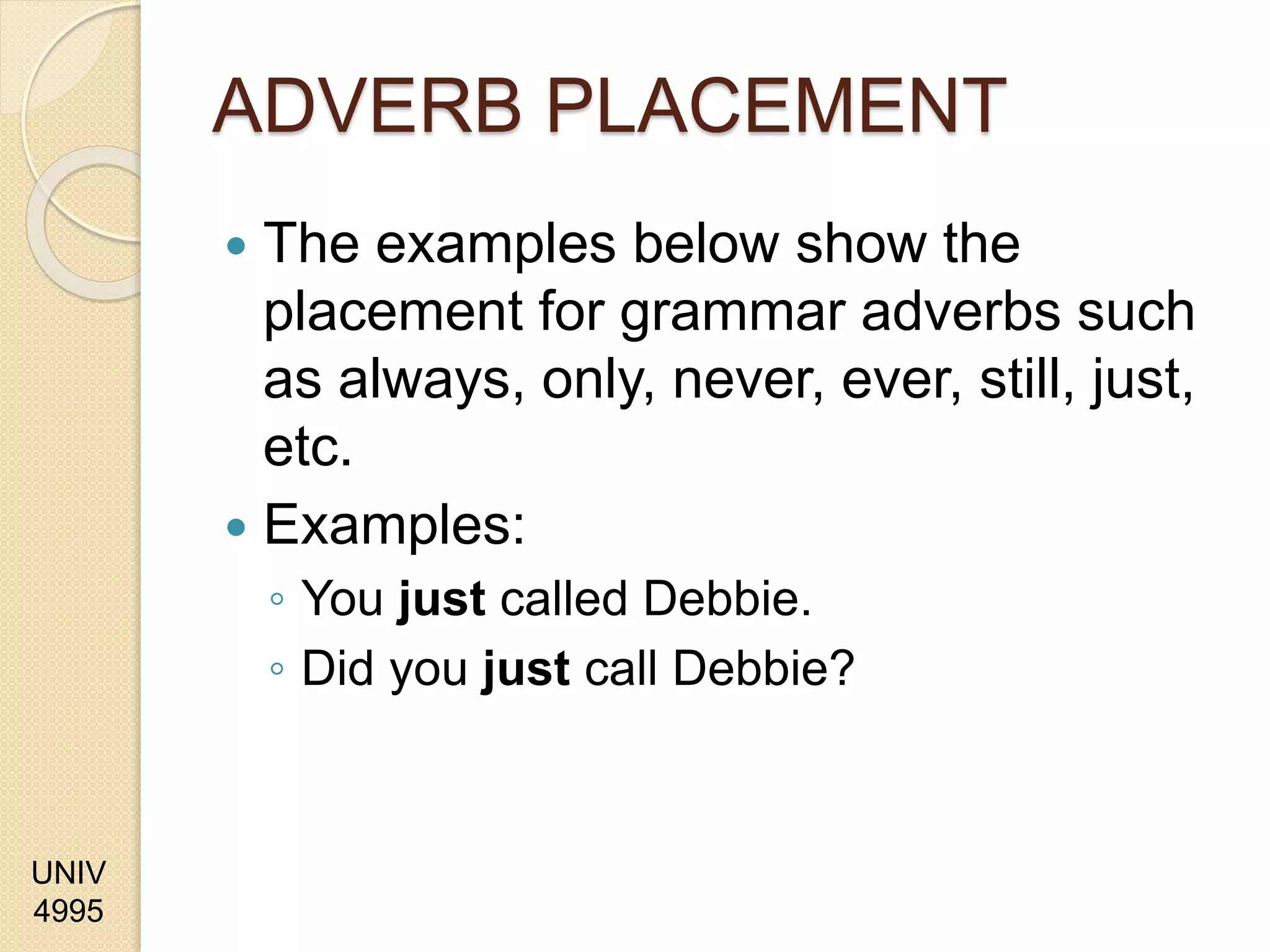
ADVERB PLACEMENT
 The examples below show the
placement for grammar adverbs such
as always, only, never, ever, still, just,
etc.
 Examples:
◦ You just called Debbie.
◦ Did you just call Debbie?
UNIV
4995
ACTIVE / PASSIVE TENSE
 In the active tense, the thing doing the
action is the subject of the sentence.
 In the passive tense the thing
receiving the action is the subject of
the sentence.
 Examples:
◦ Active:
Tom repaired the car.
◦ Passive:
The car was repaired by Tom.
UNIV
4995
Using the Simple Present
Tense
 [VERB] + s/es in third person
 Examples:
◦ You speak English.
◦ Do you speak English?
◦ You do not speak English.
UNIV
4995
USE 1:
Repeated Actions
 Use the Simple Present to express the
idea that an action is repeated or
usual.
◦ The action can be a habit, a hobby, a daily
event, a scheduled event or something
that often happens. It can also be
something a person often forgets or
usually does not do.
 Examples:
◦ I play tennis.
◦ She does not play tennis.
UNIV
4995
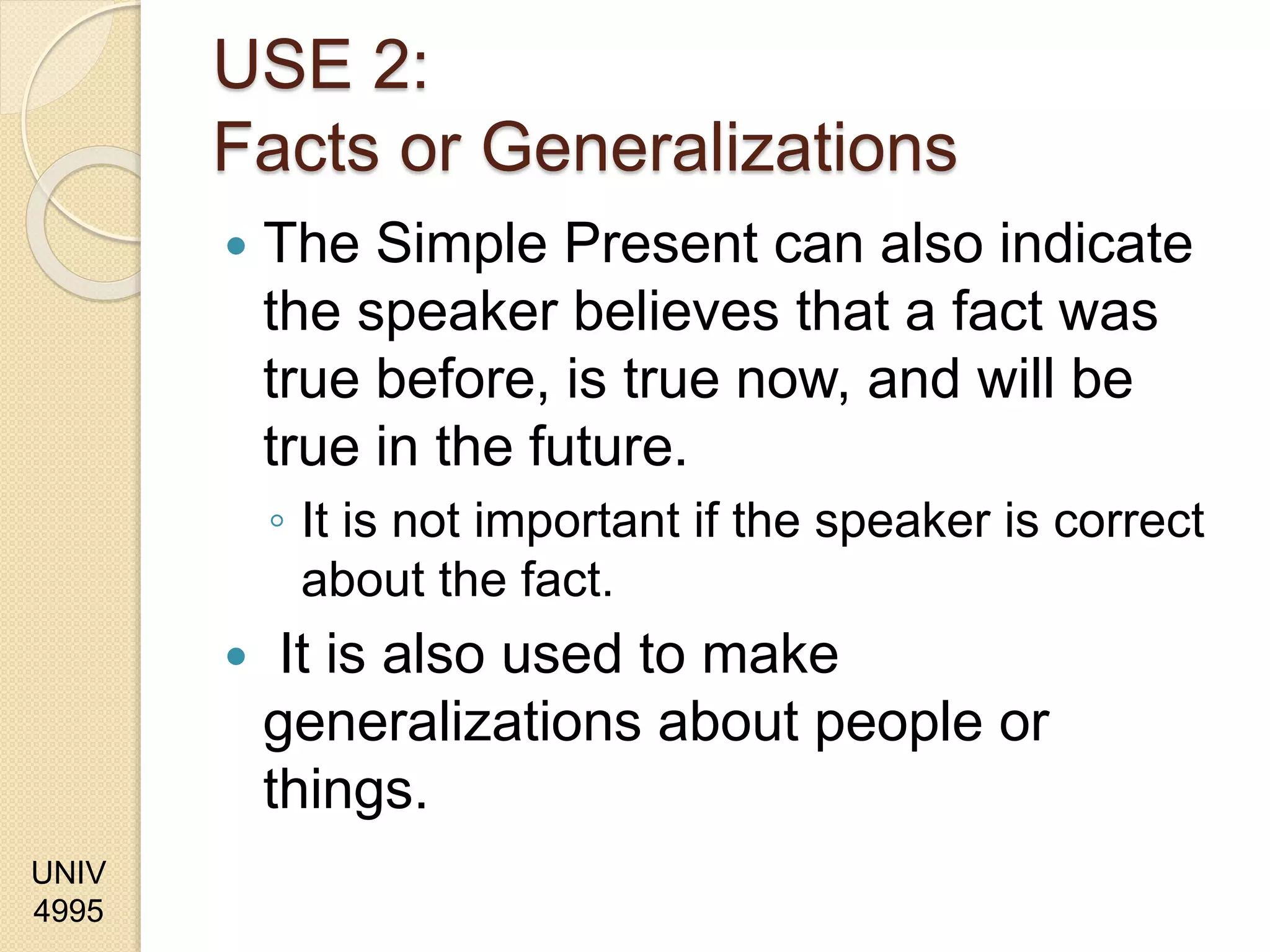
USE 2:
Facts or Generalizations
 The Simple Present can also indicate
the speaker believes that a fact was
true before, is true now, and will be
true in the future.
◦ It is not important if the speaker is correct
about the fact.
 It is also used to make
generalizations about people or
things.
UNIV
4995
USE 2:
Facts or Generalizations
 Examples:
◦ Cats like milk.
◦ Birds do not like milk.
◦ Do pigs like milk?
◦ California is in America.
◦ California is not in the United Kingdom.
◦ Windows are made of glass.
◦ Windows are not made of wood.
◦ New York is a small city.
UNIV
4995
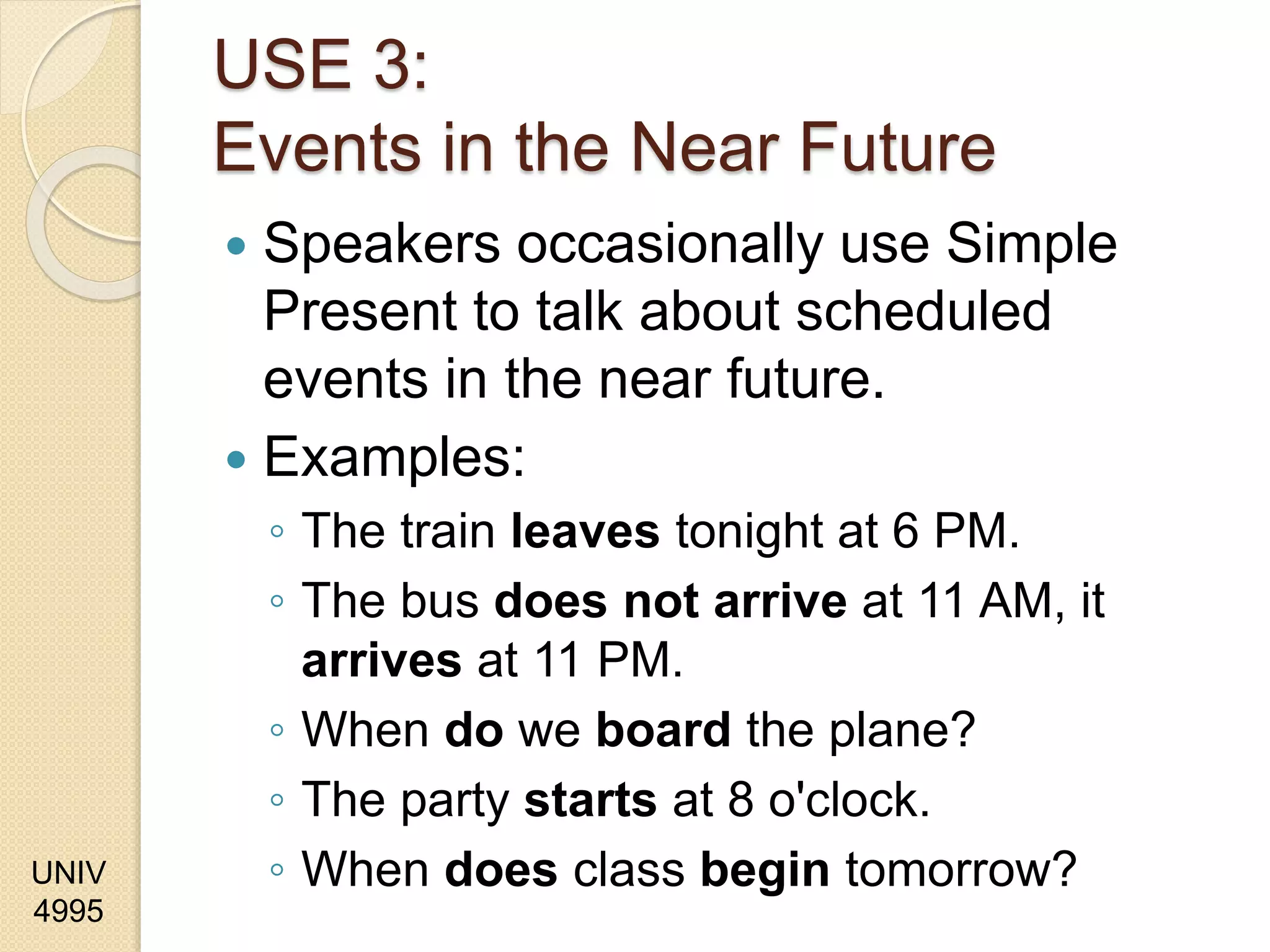
USE 3:
Events in the Near Future
 Speakers occasionally use Simple
Present to talk about scheduled
events in the near future.
 Examples:
◦ The train leaves tonight at 6 PM.
◦ The bus does not arrive at 11 AM, it
arrives at 11 PM.
◦ When do we board the plane?
◦ The party starts at 8 o'clock.
◦ When does class begin tomorrow?
UNIV
4995
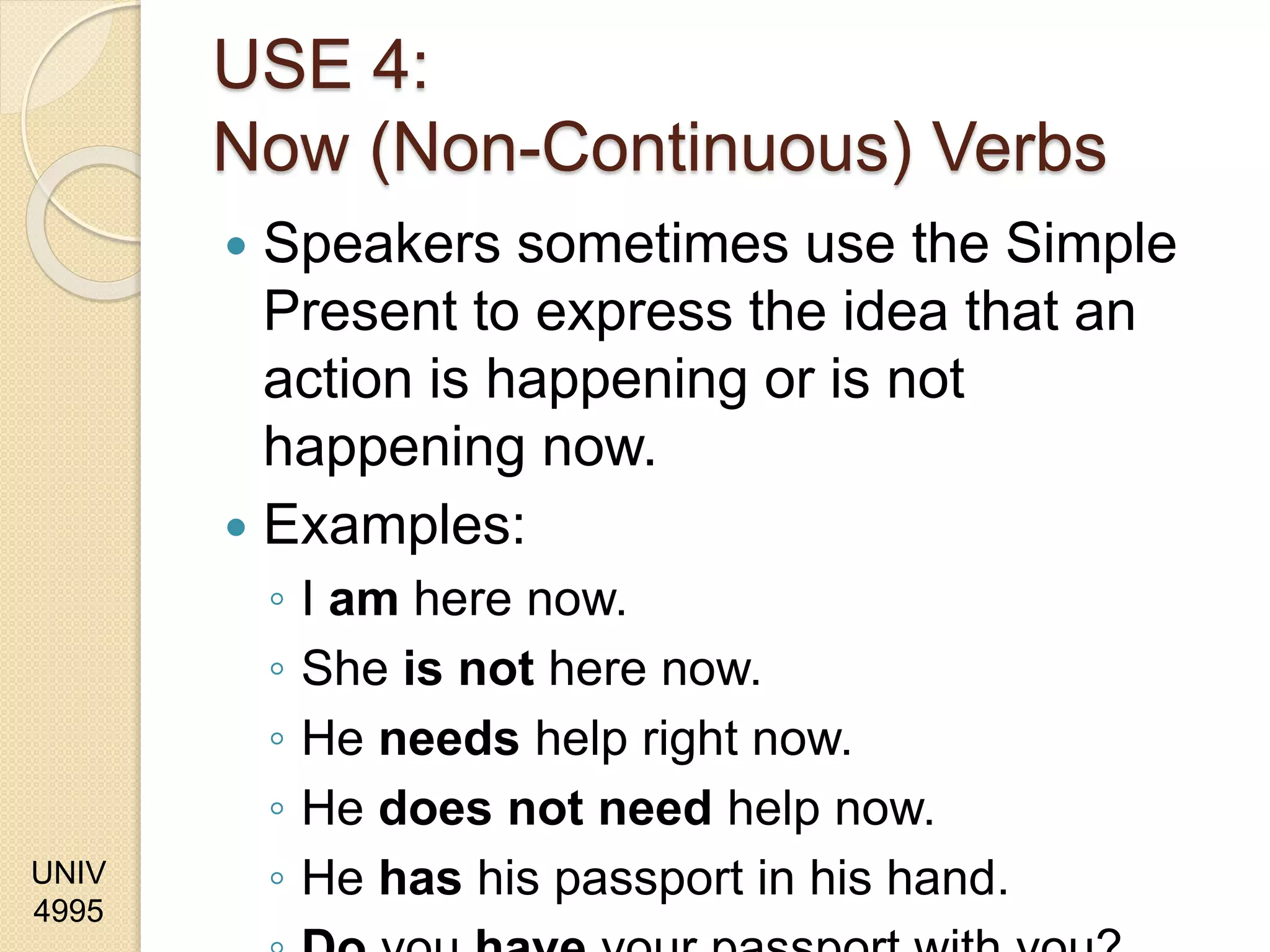
USE 4:
Now (Non-Continuous) Verbs
 Speakers sometimes use the Simple
Present to express the idea that an
action is happening or is not
happening now.
 Examples:
◦ I am here now.
◦ She is not here now.
◦ He needs help right now.
◦ He does not need help now.
◦ He has his passport in his hand.
UNIV
4995
ADVERB PLACEMENT
 The examples below show the
placement for grammar adverbs such
as: always, only, never, ever, still, just,
etc.
◦ You only speak English.
◦ Do you only speak English?
UNIV
4995
ACTIVE / PASSIVE
 Examples:
◦ Active:
Once a week, Tom cleans the car.
◦ Passive:
Once a week, the car is cleaned by Tom.
UNIV
4995
Using the Simple Future
Tense
 Simple Future has two different forms
in English:
◦ "will"
◦ "be going to"
 Although the two forms can
sometimes be used interchangeably,
they often express two very different
meanings.
 Both "will" and "be going to" refer to a
specific time in the future.
UNIV
4995
FORM "Will"
 [will + verb]
 Examples:
◦ You will help him later.
◦ Will you help him later?
◦ You will not help him later.
UNIV
4995
FORM "Be Going To"
 [am/is/are + going to + verb]
 Examples:
◦ You are going to meet Jane tonight.
◦ Are you going to meet Jane tonight?
◦ You are not going to meet Jane tonight.
UNIV
4995
USE 1:
"Will" to Express a Voluntary
Action
 "Will" often suggests that a speaker
will do something voluntarily.
◦ A voluntary action is one the speaker
offers to do for someone else.
◦ Often, we use "will" to respond to
someone else's complaint or request for
help.
◦ We also use "will" when we request that
someone help us or volunteer to do
something for us.
◦ Similarly, we use "will not" or "won't" when
UNIV
4995
USE 1:
"Will" to Express a Voluntary
Action
 Examples:
◦ I will send you the information when I get
it.
◦ Will you help me move this heavy table?
◦ I won't do all the housework myself!
◦ I'll make some sandwiches.
UNIV
4995
USE 2:
"Will" to Express a Promise
 "Will" is usually used in promises.
 Examples:
◦ I will call you when I arrive.
◦ If I am elected President of the United
States, I will make sure everyone has
access to inexpensive health insurance.
◦ I promise I will not tell him about the
surprise party.
◦ Don't worry, I'll be careful.
◦ I won't tell anyone your secret.
UNIV
4995
USE 3:
"Be going to" to Express a Plan
 "Be going to" expresses that
something is a plan and/or that a
person intends to do in the future.
◦ It does not matter whether the plan is
realistic or not.
 Examples:
◦ He is going to spend his vacation in
Hawaii.
◦ She is not going to spend her vacation
in Hawaii.
◦ I'm going to be an actor when I grow up.
UNIV
4995
USE 4:
"Will" or "Be Going to" to Predict
 Both "will" and "be going to" can
express the idea of a general
prediction about the future.
◦ Predictions are guesses about what might
happen in the future.
 In "prediction" sentences, the subject
usually has little control over the
future; therefore USES 1-3 do not
apply. In the following slide, there is no
difference in meaning in the examples.
UNIV
4995
USE 4:
"Will" or "Be Going to" to Predict
 Examples
 The year 2222 will be a very
interesting year.
 The year 2222 is going to be a very
interesting year.
 John Smith will be the next President.
 John Smith is going to be the next
President.
UNIV
4995
IMPORTANT
In the Simple Future, it is not always
clear which USE the speaker has in
mind. Often, there is more than one way
to interpret a sentence's meaning.
UNIV
4995
No Future in Time Clauses
 Like all future forms, the Simple
Future cannot be used in clauses
beginning with time expressions such
as when, while, before, after, by the
time, as soon as, if, unless, etc.
◦ Instead of Simple Future, simple present
is used.
UNIV
4995
No Future in Time Clauses
 Examples
◦ Not Correct :
When you will arrive tonight, we will go
out for dinner.
◦ Correct :
When you arrive tonight, we will go out
for dinner.
UNIV
4995
ADVERB PLACEMENT
 The examples below show the
placement for grammar adverbs such
as always, only, never, ever, still, just,
etc.
 Examples:
◦ You will never help him.
◦ Will you ever help him?
◦ You are never going to meet Jane.
◦ Are you ever going to meet Jane?
UNIV
4995
ACTIVE / PASSIVE
 Examples:
◦ Active:
John will finish the work by 5:00 PM.
◦ Passive :
The work will be finished by 5:00 PM.
◦ Active :
Sally is going to make a beautiful dinner
tonight.
◦ Passive :
A beautiful dinner is going to be made by
Sally tonight.

UNIV 4995: Grammar Review

  • 1.
  • 2.
    UNIV 4995 Using the PastTense  Simple Past ◦ [VERB+ed] or irregular verbs  Examples: ◦ You called Debbie. ◦ Did you call Debbie? ◦ You did not call Debbie.
  • 3.
    UNIV 4995 USE 1: Completed Actionin the Past  Use the Simple Past to express the idea that an action started and finished at a specific time in the past. ◦ Sometimes, the speaker may not actually mention the specific time, but they do have one specific time in mind.  Examples: ◦ I saw a movie yesterday. ◦ I didn't see a play yesterday. ◦ Last year, I traveled to Japan.
  • 4.
    UNIV 4995 USE 2: A Seriesof Completed Actions  We use the Simple Past to list a series of completed actions.  Examples: ◦ I finished work, walked to the beach, and found a nice place to swim. ◦ He arrived from the airport at 8 o’clock, checked into the hotel at 9, and met the others at 10. ◦ Did you add flour, pour in the milk, and then add the eggs?
  • 5.
    UNIV 4995 USE 3: Duration inPast  The Simple Past can be used with a duration which starts and stops in the past. ◦ A duration is a longer action often indicated by expressions such as "for two years," "for five minutes," "all day," etc.  Examples: ◦ I lived in Brazil for two years. ◦ Shauna studied Japanese for five years. ◦ They sat at the beach all day.
  • 6.
    UNIV 4995 USE 4: Habits inthe Past  The Simple Past can also be used to describe a habit which stopped in the past. It can have the same meaning as "used to."  Examples: ◦ I studied French when I was a child. ◦ He played the violin. ◦ He didn't play the piano. ◦ Did you play a musical instrument when you were a kid?
  • 7.
    UNIV 4995 USE 5: Past Factsor Generalizations  The Simple Past can also be used to describe past facts or generalizations which are no longer true. As in USE 4, this use of the Simple Past is quite similar to the expression "used to."  Examples: ◦ She was shy as a child, but now she is very outgoing. ◦ He didn't like tomatoes before. ◦ Did you live in Texas when you were a kid?
  • 8.
    UNIV 4995 "WHEN" CLAUSES  Clausesare groups of words which have meaning but are often not complete sentences. Some clauses begin with the word "when" and are called "when" clauses.  Examples: ◦ When I paid her one dollar, she answered my question. ◦ She answered my question when I paid her one dollar.
  • 9.
    UNIV 4995 ADVERB PLACEMENT  Theexamples below show the placement for grammar adverbs such as always, only, never, ever, still, just, etc.  Examples: ◦ You just called Debbie. ◦ Did you just call Debbie?
  • 10.
    UNIV 4995 ACTIVE / PASSIVETENSE  In the active tense, the thing doing the action is the subject of the sentence.  In the passive tense the thing receiving the action is the subject of the sentence.  Examples: ◦ Active: Tom repaired the car. ◦ Passive: The car was repaired by Tom.
  • 11.
    UNIV 4995 Using the SimplePresent Tense  [VERB] + s/es in third person  Examples: ◦ You speak English. ◦ Do you speak English? ◦ You do not speak English.
  • 12.
    UNIV 4995 USE 1: Repeated Actions Use the Simple Present to express the idea that an action is repeated or usual. ◦ The action can be a habit, a hobby, a daily event, a scheduled event or something that often happens. It can also be something a person often forgets or usually does not do.  Examples: ◦ I play tennis. ◦ She does not play tennis.
  • 13.
    UNIV 4995 USE 2: Facts orGeneralizations  The Simple Present can also indicate the speaker believes that a fact was true before, is true now, and will be true in the future. ◦ It is not important if the speaker is correct about the fact.  It is also used to make generalizations about people or things.
  • 14.
    UNIV 4995 USE 2: Facts orGeneralizations  Examples: ◦ Cats like milk. ◦ Birds do not like milk. ◦ Do pigs like milk? ◦ California is in America. ◦ California is not in the United Kingdom. ◦ Windows are made of glass. ◦ Windows are not made of wood. ◦ New York is a small city.
  • 15.
    UNIV 4995 USE 3: Events inthe Near Future  Speakers occasionally use Simple Present to talk about scheduled events in the near future.  Examples: ◦ The train leaves tonight at 6 PM. ◦ The bus does not arrive at 11 AM, it arrives at 11 PM. ◦ When do we board the plane? ◦ The party starts at 8 o'clock. ◦ When does class begin tomorrow?
  • 16.
    UNIV 4995 USE 4: Now (Non-Continuous)Verbs  Speakers sometimes use the Simple Present to express the idea that an action is happening or is not happening now.  Examples: ◦ I am here now. ◦ She is not here now. ◦ He needs help right now. ◦ He does not need help now. ◦ He has his passport in his hand.
  • 17.
    UNIV 4995 ADVERB PLACEMENT  Theexamples below show the placement for grammar adverbs such as: always, only, never, ever, still, just, etc. ◦ You only speak English. ◦ Do you only speak English?
  • 18.
    UNIV 4995 ACTIVE / PASSIVE Examples: ◦ Active: Once a week, Tom cleans the car. ◦ Passive: Once a week, the car is cleaned by Tom.
  • 19.
    UNIV 4995 Using the SimpleFuture Tense  Simple Future has two different forms in English: ◦ "will" ◦ "be going to"  Although the two forms can sometimes be used interchangeably, they often express two very different meanings.  Both "will" and "be going to" refer to a specific time in the future.
  • 20.
    UNIV 4995 FORM "Will"  [will+ verb]  Examples: ◦ You will help him later. ◦ Will you help him later? ◦ You will not help him later.
  • 21.
    UNIV 4995 FORM "Be GoingTo"  [am/is/are + going to + verb]  Examples: ◦ You are going to meet Jane tonight. ◦ Are you going to meet Jane tonight? ◦ You are not going to meet Jane tonight.
  • 22.
    UNIV 4995 USE 1: "Will" toExpress a Voluntary Action  "Will" often suggests that a speaker will do something voluntarily. ◦ A voluntary action is one the speaker offers to do for someone else. ◦ Often, we use "will" to respond to someone else's complaint or request for help. ◦ We also use "will" when we request that someone help us or volunteer to do something for us. ◦ Similarly, we use "will not" or "won't" when
  • 23.
    UNIV 4995 USE 1: "Will" toExpress a Voluntary Action  Examples: ◦ I will send you the information when I get it. ◦ Will you help me move this heavy table? ◦ I won't do all the housework myself! ◦ I'll make some sandwiches.
  • 24.
    UNIV 4995 USE 2: "Will" toExpress a Promise  "Will" is usually used in promises.  Examples: ◦ I will call you when I arrive. ◦ If I am elected President of the United States, I will make sure everyone has access to inexpensive health insurance. ◦ I promise I will not tell him about the surprise party. ◦ Don't worry, I'll be careful. ◦ I won't tell anyone your secret.
  • 25.
    UNIV 4995 USE 3: "Be goingto" to Express a Plan  "Be going to" expresses that something is a plan and/or that a person intends to do in the future. ◦ It does not matter whether the plan is realistic or not.  Examples: ◦ He is going to spend his vacation in Hawaii. ◦ She is not going to spend her vacation in Hawaii. ◦ I'm going to be an actor when I grow up.
  • 26.
    UNIV 4995 USE 4: "Will" or"Be Going to" to Predict  Both "will" and "be going to" can express the idea of a general prediction about the future. ◦ Predictions are guesses about what might happen in the future.  In "prediction" sentences, the subject usually has little control over the future; therefore USES 1-3 do not apply. In the following slide, there is no difference in meaning in the examples.
  • 27.
    UNIV 4995 USE 4: "Will" or"Be Going to" to Predict  Examples  The year 2222 will be a very interesting year.  The year 2222 is going to be a very interesting year.  John Smith will be the next President.  John Smith is going to be the next President.
  • 28.
    UNIV 4995 IMPORTANT In the SimpleFuture, it is not always clear which USE the speaker has in mind. Often, there is more than one way to interpret a sentence's meaning.
  • 29.
    UNIV 4995 No Future inTime Clauses  Like all future forms, the Simple Future cannot be used in clauses beginning with time expressions such as when, while, before, after, by the time, as soon as, if, unless, etc. ◦ Instead of Simple Future, simple present is used.
  • 30.
    UNIV 4995 No Future inTime Clauses  Examples ◦ Not Correct : When you will arrive tonight, we will go out for dinner. ◦ Correct : When you arrive tonight, we will go out for dinner.
  • 31.
    UNIV 4995 ADVERB PLACEMENT  Theexamples below show the placement for grammar adverbs such as always, only, never, ever, still, just, etc.  Examples: ◦ You will never help him. ◦ Will you ever help him? ◦ You are never going to meet Jane. ◦ Are you ever going to meet Jane?
  • 32.
    UNIV 4995 ACTIVE / PASSIVE Examples: ◦ Active: John will finish the work by 5:00 PM. ◦ Passive : The work will be finished by 5:00 PM. ◦ Active : Sally is going to make a beautiful dinner tonight. ◦ Passive : A beautiful dinner is going to be made by Sally tonight.