Erika Jeanett Salazar Larios.
Tics Aplicadas A La Enseñanza Del Idioma Inglés.
OBJETIVE:
LEARN ABOUT THE USES OF THE VERB
“CAN” IN AN EASY AND SIMPLE WAY.
"Can" is one of the most commonly used modal verbs
in English. It can be used to express ability or
opportunity, to request or offer permission, and to show
possibility or impossibility.
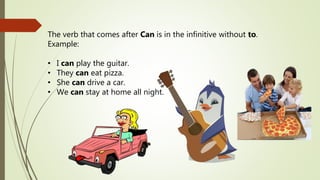
The verb that comes after Can is in the infinitive without to.
Example:
• I can play the guitar.
• They can eat pizza.
• She can drive a car.
• We can stay at home all night.
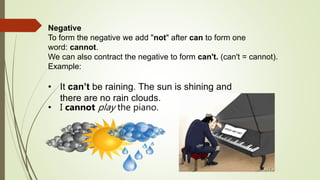
Negative
To form the negative we add "not" after can to form one
word: cannot.
We can also contract the negative to form can't. (can't = cannot).
Example:
• It can’t be raining. The sun is shining and
there are no rain clouds.
• I cannot play the piano.
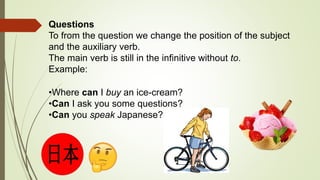
Questions
To from the question we change the position of the subject
and the auxiliary verb.
The main verb is still in the infinitive without to.
Example:
•Where can I buy an ice-cream?
•Can I ask you some questions?
•Can you speak Japanese?
short answers.
•Can I sit here please? Yes, you can.
•Can you play videogames? No, I can't.
REFERENCES:
Woodward English (2018). Cqn – cannot – can’t. [en línea] disponiblen en:
http://www.grammar.cl/Basic/Can_Cannot.htm
English Estudy Page (2018). Modal Verbs – “Can”. [en línea] disponible en:
https://englishstudypage.com/grammar/modal-verbs-can/

Can

  • 1.
    Erika Jeanett SalazarLarios. Tics Aplicadas A La Enseñanza Del Idioma Inglés.
  • 2.
    OBJETIVE: LEARN ABOUT THEUSES OF THE VERB “CAN” IN AN EASY AND SIMPLE WAY.
  • 3.
    "Can" is oneof the most commonly used modal verbs in English. It can be used to express ability or opportunity, to request or offer permission, and to show possibility or impossibility.
  • 4.
    The verb thatcomes after Can is in the infinitive without to. Example: • I can play the guitar. • They can eat pizza. • She can drive a car. • We can stay at home all night.
  • 5.
    Negative To form thenegative we add "not" after can to form one word: cannot. We can also contract the negative to form can't. (can't = cannot). Example: • It can’t be raining. The sun is shining and there are no rain clouds. • I cannot play the piano.
  • 6.
    Questions To from thequestion we change the position of the subject and the auxiliary verb. The main verb is still in the infinitive without to. Example: •Where can I buy an ice-cream? •Can I ask you some questions? •Can you speak Japanese?
  • 7.
    short answers. •Can Isit here please? Yes, you can. •Can you play videogames? No, I can't.
  • 8.
    REFERENCES: Woodward English (2018).Cqn – cannot – can’t. [en línea] disponiblen en: http://www.grammar.cl/Basic/Can_Cannot.htm English Estudy Page (2018). Modal Verbs – “Can”. [en línea] disponible en: https://englishstudypage.com/grammar/modal-verbs-can/