United Nations Global Issues
How the UN Works Established on 24 October 1945 51 countries were committed to preserving peace through international cooperation UN Membership: 192 countries States agree to accept obligations of the  UN Charter , an international treaty that sets out basic principles
How the UN Works According to the Charter the UN has 4 basic principles: 1. Maintain international peace and security 2. Develop friendly relations among nations 3. Cooperate in solving international problems and promote respect for human rights 4. Be the center for harmonizing the actions of nations
How the UN Works The UN is not a world government It does not make laws Large or small, rich or poor, and with differing political views and social systems: All member states have a voice All member states have a vote
Main Bodies General Assembly (New York) Security Council (NY) Economic and Social Council (NY) Trusteeship Council (NY) Secretariat (NY) International Court of Justice (Netherlands)
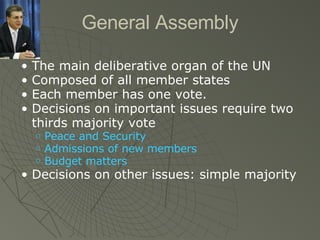
General Assembly The main deliberative organ of the UN Composed of all member states Each member has one vote. Decisions on important issues require two thirds majority vote Peace and Security Admissions of new members Budget matters Decisions on other issues: simple majority
Functions and Powers  Maintain international peace and security (disarmament) Make recommendations to the Security council Promote international political cooperation Develop international law Promote human rights Over see international collaboration in the economic, social, humanitarian, cultural, and educational and health fields
Functions and Powers Receive and consider reports from the Security Council and other UN organs Consider and approve UN budget Establish financial assessments of Member States Elect non-permanent members to SC and other UN councils and organs Appoint Secretary General
General Assembly Subsidiary Organs Committee on Information Human Rights Council Candidacies
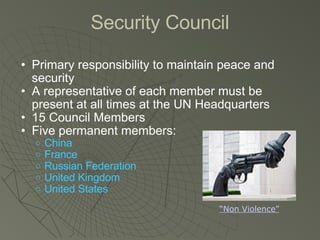
Security Council Primary responsibility to maintain peace and security A representative of each member must be present at all times at the UN Headquarters 15 Council Members Five permanent members: China France Russian Federation United Kingdom United States “Non Violence”
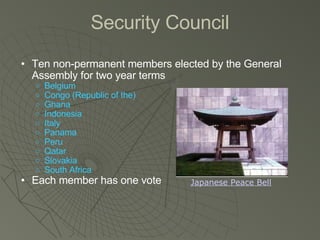
Security Council Ten non-permanent members elected by the General Assembly for two year terms Belgium Congo (Republic of the) Ghana Indonesia Italy Panama Peru Qatar Slovakia South Africa Each member has one vote Japanese Peace Bell
Security Council In the event of fighting the Council: Tries to secure a ceasefire May send peace keeping mission Impose economic sanctions Order an arms embargo Rare occasions “all means necessary” The Council makes recommendations to the General Assembly on: appointment of Secretary General admission of new Members to the UN
Economic and Social Council Council has 54 members Elected by the General Assembly Three year terms Serves as central forum for discussing international economic and social issues
Economic and Social Council This Council is responsible for: Promoting higher standards of living Full employment Economic and social progress Identifying solutions to international economic, social and health problems Facilitating international cultural and educational cooperation Encourage universal respect for human rights and fundamental freedoms ECOSOC
Trusteeship Council Suspended operation 1 Nov, 1994 Palau: last remaining UN trust territory Council amended rule to meet annually Meet when required by President, General Assembly, Security Council or a majority of members Established to promote the advancement of developing countries towards self-government or independence. China, France, Russian Federation, UK and US
Secretariat  International staff working in duty stations around the world Carry out diverse day to day work of the UN Survey economic and social trends Prepare studies on human rights and sustainable development Inform the media about work of the UN
Secretariat Organize international conferences Interpret speeches Translate documents Staff 8,900 under a regular budget from some 170 countries Take oath not to seek or receive instructions from any government
International Court of Justice Hears cases involving legal disputes among governments Clarifies questions of international law Interprets the UN Charter Composed of 15 judges, elected to office for 9 year terms by UN GA&SC Official languages are English and French
Specialized Agencies Linked to the UN but remain autonomous  (independent) ILO  – International Labor Organization: improve working conditions and employment agencies WHO  – World Health Organization: solve health problems, health education, immunizations The World Bank  – provides loans and economic assistance to nations WTO  – World Trade Organization: oversees world trade

united nations

  • 1.
  • 2.
    How the UNWorks Established on 24 October 1945 51 countries were committed to preserving peace through international cooperation UN Membership: 192 countries States agree to accept obligations of the UN Charter , an international treaty that sets out basic principles
  • 3.
    How the UNWorks According to the Charter the UN has 4 basic principles: 1. Maintain international peace and security 2. Develop friendly relations among nations 3. Cooperate in solving international problems and promote respect for human rights 4. Be the center for harmonizing the actions of nations
  • 4.
    How the UNWorks The UN is not a world government It does not make laws Large or small, rich or poor, and with differing political views and social systems: All member states have a voice All member states have a vote
  • 5.
    Main Bodies GeneralAssembly (New York) Security Council (NY) Economic and Social Council (NY) Trusteeship Council (NY) Secretariat (NY) International Court of Justice (Netherlands)
  • 6.
    General Assembly Themain deliberative organ of the UN Composed of all member states Each member has one vote. Decisions on important issues require two thirds majority vote Peace and Security Admissions of new members Budget matters Decisions on other issues: simple majority
  • 7.
    Functions and Powers Maintain international peace and security (disarmament) Make recommendations to the Security council Promote international political cooperation Develop international law Promote human rights Over see international collaboration in the economic, social, humanitarian, cultural, and educational and health fields
  • 8.
    Functions and PowersReceive and consider reports from the Security Council and other UN organs Consider and approve UN budget Establish financial assessments of Member States Elect non-permanent members to SC and other UN councils and organs Appoint Secretary General
  • 9.
    General Assembly SubsidiaryOrgans Committee on Information Human Rights Council Candidacies
  • 10.
    Security Council Primaryresponsibility to maintain peace and security A representative of each member must be present at all times at the UN Headquarters 15 Council Members Five permanent members: China France Russian Federation United Kingdom United States “Non Violence”
  • 11.
    Security Council Tennon-permanent members elected by the General Assembly for two year terms Belgium Congo (Republic of the) Ghana Indonesia Italy Panama Peru Qatar Slovakia South Africa Each member has one vote Japanese Peace Bell
  • 12.
    Security Council Inthe event of fighting the Council: Tries to secure a ceasefire May send peace keeping mission Impose economic sanctions Order an arms embargo Rare occasions “all means necessary” The Council makes recommendations to the General Assembly on: appointment of Secretary General admission of new Members to the UN
  • 13.
    Economic and SocialCouncil Council has 54 members Elected by the General Assembly Three year terms Serves as central forum for discussing international economic and social issues
  • 14.
    Economic and SocialCouncil This Council is responsible for: Promoting higher standards of living Full employment Economic and social progress Identifying solutions to international economic, social and health problems Facilitating international cultural and educational cooperation Encourage universal respect for human rights and fundamental freedoms ECOSOC
  • 15.
    Trusteeship Council Suspendedoperation 1 Nov, 1994 Palau: last remaining UN trust territory Council amended rule to meet annually Meet when required by President, General Assembly, Security Council or a majority of members Established to promote the advancement of developing countries towards self-government or independence. China, France, Russian Federation, UK and US
  • 16.
    Secretariat Internationalstaff working in duty stations around the world Carry out diverse day to day work of the UN Survey economic and social trends Prepare studies on human rights and sustainable development Inform the media about work of the UN
  • 17.
    Secretariat Organize internationalconferences Interpret speeches Translate documents Staff 8,900 under a regular budget from some 170 countries Take oath not to seek or receive instructions from any government
  • 18.
    International Court ofJustice Hears cases involving legal disputes among governments Clarifies questions of international law Interprets the UN Charter Composed of 15 judges, elected to office for 9 year terms by UN GA&SC Official languages are English and French
  • 19.
    Specialized Agencies Linkedto the UN but remain autonomous (independent) ILO – International Labor Organization: improve working conditions and employment agencies WHO – World Health Organization: solve health problems, health education, immunizations The World Bank – provides loans and economic assistance to nations WTO – World Trade Organization: oversees world trade