United Nation of Organization
The Flag of UN
 The UNO General Assembly adopted the
UN flag on October 20 1947, The white
UNO emblem is superimposed on a light
blue background. The UNO flag is not to be
subordinated to any other flag in the world.
 The emblem consists of the global map
projected from the north pole and embraced
in twin olive branches {symbol of peace}.
 The color blue is also stand for Peace.
Introduction
 The United Nation is an international
organization designed to make the enforcement of
international law, security, economic development,
social progress, and human rights easier for
countries around the world. The United Nation
includes 93 member countries and it’s main
headquarters are located in New York City.
 The UN officially came into existence on 24,
October, 1945.
 The principal of the UN are to save future
generation from war , reaffirm human right, and
establish equal rights for all persons. In addition it
also aim to promote justice, freedom, and social
progress for the people of all its member states.
History of UN
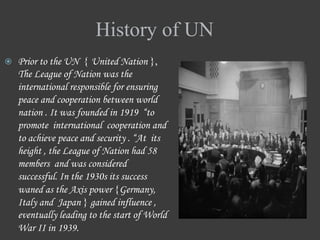
 Prior to the UN { United Nation },
The League of Nation was the
international responsible for ensuring
peace and cooperation between world
nation . It was founded in 1919 “to
promote international cooperation and
to achieve peace and security . “At its
height , the League of Nation had 58
members and was considered
successful. In the 1930s its success
waned as the Axis power {Germany,
Italy and Japan } gained influence ,
eventually leading to the start of World
War II in 1939.
League of Nations
 The league lacked it own armed force and depended on
the great power to enforce its resolutions, Keep to its
economics sanctions, or provide an army when needed.
 After a number of notable successes and some early
failures in the 1920s, the League ultimately provide
incapable of aggression by the Axis power in the 1930s.
 The Onset of the Second World War showed that the
League had failed its.
Formation of UNO
 Conference of the representatives of 46 countries in San
Francisco {USA}.
 Formed un Charter/ Law.
 26/06/1945. 6 more countries signed the charter.
 1945 October 24th The UN charter came into existence.
 The Founding the member of the UN are 51, India is a
founding member.
Membership of the UNO
 Admission of Members : New member are admitted to
general assembly on recommendation of the security council
and two – third of the member should vote in favor .
 Member are expelled or suspended in the same Manner.
MEMBER STATES OF UNO
 The are 192 member state in the UN
 Montenegro was the last country to become the UN member
on 28 June 2006.
 There are also 6 Non-UN members, such as, Turkish Cyprus,
Kosovo, Palestine, Sahrawi, Arab Democratic Republic
{S.A.D.R}, Taiwan, Vatican City.
 There are also Observatory Countries like Vatican, Taiwan,
Palestine.
GENERAL ASSEMBLY
 It is the common and important body.
 Meets at least once a year
 Consists of representative from all the member
states.
 Each countries will have one vote but can send
maximum five representatives.
 It elects its own president and vice-president every
year.
SECURITY COUNCIL
 There are 5 Permanent Countries {ABCFR}{Veto Power}
A negative vote by a permanent member bars action by the
Security Council and is called a veto.
 Also 10 non-permanent member elected by the General
Assembly for two years. Brazil, Gabon, Mexico, Japan,
Austria, Lebanon, Turkey, Nigeria, Uganda.
 The UN Peace Keeping Army is under them.
 The emergency situation it has right to use the military
power .
ECONOMIC AND SOCIAL
COUNCIL
 There are 54 member in this council.
 Members are elected for 3 years.
 Catering to Statistic , Transportation, Information , and
Communication, Social situation, population , Human
Rights, etc.
 World Trade Organization is under them.
ACHIEVEMENTS OF UNO
 Could save from dangerous situations.
 Keeps focus on poor Afro Asian Countries.
 Could Sensitize the world on various issues, Nuclear
disarmament, the climatic change, economic developments.
 Praiseworthy functions of other branches of UN such as
UNICEF, WHO, WTO, etc.
FAILURES OF UNO
 There have been nearly 600 regional conflicts since 1945.
 Could not stop fully the Nuclear Arm Rage.
 Wide disparity between developed and developing nations,
 Improper use of Veto power by the permanent members.
 Could not prevent Gulf war of 1990’s Iraq and Afghanistan
war, Korean war, Vietnam war, etc.
 Terrorism are major hurdle.
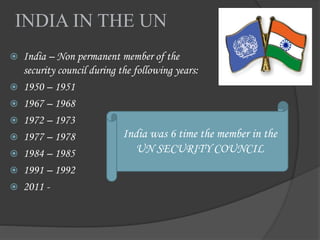
INDIA IN THE UN
 India – Non permanent member of the
security council during the following years:
 1950 – 1951
 1967 – 1968
 1972 – 1973
 1977 – 1978
 1984 – 1985
 1991 – 1992
 2011 -
India was 6 time the member in the
UN SECURITY COUNCIL
INDIA IN THE UN
 India was the among founding member of United Nation that
signed the Declaration by the United Nation at Washington on 1
January 1942 and also participated in the history of UN
Conference of International Organization at San Francisco from
25 April to 24 June 1945.
 1953: Vijaya Lakshmi Pandit Became the first women president
of United Nation General Assembly and in 1979 She was
appointed the Indian representative to the UN Human Right
Commission.
 23 Jan 1957: To date, V.K Krishna Menon’s {Led the Indian
delegation {1952 – 1962} to the United Nation} Speech is the
Longest ever delivered in the United Nation Council.
 23/10/1966: M.S Subbalakshmi presented her concert at
Carnegie Hall, New York; in UN general assembly on the
occasion of UN day celebrations.
 1977: A.B Vajpayee became the first person to deliver a
speech to the United Nation General Assembly in Hindi , the
“most unforgettable” moment in his life by his own
admission.
 April 18, 1989: Justice R.S Pathak, chief justice of India
was elected judge of the ICJ. He became the Indian on whom
this honour have been bestowed. The other two were justice
B.N Rao and Nagendra Singh.
AIM AND Objective of United Nation
 To maintain international peace and security.
 To develop friendly relationship among nations.
 To cooperate in solving international problem.
 To promote human rights.
 To be a center for helping nation.
 To respect the principal of equal rights.
THE END
THANK YOU

Abhishek vishwakarma on uno

  • 1.
    United Nation ofOrganization
  • 2.
    The Flag ofUN  The UNO General Assembly adopted the UN flag on October 20 1947, The white UNO emblem is superimposed on a light blue background. The UNO flag is not to be subordinated to any other flag in the world.  The emblem consists of the global map projected from the north pole and embraced in twin olive branches {symbol of peace}.  The color blue is also stand for Peace.
  • 3.
    Introduction  The UnitedNation is an international organization designed to make the enforcement of international law, security, economic development, social progress, and human rights easier for countries around the world. The United Nation includes 93 member countries and it’s main headquarters are located in New York City.  The UN officially came into existence on 24, October, 1945.  The principal of the UN are to save future generation from war , reaffirm human right, and establish equal rights for all persons. In addition it also aim to promote justice, freedom, and social progress for the people of all its member states.
  • 4.
    History of UN Prior to the UN { United Nation }, The League of Nation was the international responsible for ensuring peace and cooperation between world nation . It was founded in 1919 “to promote international cooperation and to achieve peace and security . “At its height , the League of Nation had 58 members and was considered successful. In the 1930s its success waned as the Axis power {Germany, Italy and Japan } gained influence , eventually leading to the start of World War II in 1939.
  • 5.
    League of Nations The league lacked it own armed force and depended on the great power to enforce its resolutions, Keep to its economics sanctions, or provide an army when needed.  After a number of notable successes and some early failures in the 1920s, the League ultimately provide incapable of aggression by the Axis power in the 1930s.  The Onset of the Second World War showed that the League had failed its.
  • 6.
    Formation of UNO Conference of the representatives of 46 countries in San Francisco {USA}.  Formed un Charter/ Law.  26/06/1945. 6 more countries signed the charter.  1945 October 24th The UN charter came into existence.  The Founding the member of the UN are 51, India is a founding member.
  • 7.
    Membership of theUNO  Admission of Members : New member are admitted to general assembly on recommendation of the security council and two – third of the member should vote in favor .  Member are expelled or suspended in the same Manner.
  • 8.
    MEMBER STATES OFUNO  The are 192 member state in the UN  Montenegro was the last country to become the UN member on 28 June 2006.  There are also 6 Non-UN members, such as, Turkish Cyprus, Kosovo, Palestine, Sahrawi, Arab Democratic Republic {S.A.D.R}, Taiwan, Vatican City.  There are also Observatory Countries like Vatican, Taiwan, Palestine.
  • 9.
    GENERAL ASSEMBLY  Itis the common and important body.  Meets at least once a year  Consists of representative from all the member states.  Each countries will have one vote but can send maximum five representatives.  It elects its own president and vice-president every year.
  • 10.
    SECURITY COUNCIL  Thereare 5 Permanent Countries {ABCFR}{Veto Power} A negative vote by a permanent member bars action by the Security Council and is called a veto.  Also 10 non-permanent member elected by the General Assembly for two years. Brazil, Gabon, Mexico, Japan, Austria, Lebanon, Turkey, Nigeria, Uganda.  The UN Peace Keeping Army is under them.  The emergency situation it has right to use the military power .
  • 11.
    ECONOMIC AND SOCIAL COUNCIL There are 54 member in this council.  Members are elected for 3 years.  Catering to Statistic , Transportation, Information , and Communication, Social situation, population , Human Rights, etc.  World Trade Organization is under them.
  • 12.
    ACHIEVEMENTS OF UNO Could save from dangerous situations.  Keeps focus on poor Afro Asian Countries.  Could Sensitize the world on various issues, Nuclear disarmament, the climatic change, economic developments.  Praiseworthy functions of other branches of UN such as UNICEF, WHO, WTO, etc.
  • 13.
    FAILURES OF UNO There have been nearly 600 regional conflicts since 1945.  Could not stop fully the Nuclear Arm Rage.  Wide disparity between developed and developing nations,  Improper use of Veto power by the permanent members.  Could not prevent Gulf war of 1990’s Iraq and Afghanistan war, Korean war, Vietnam war, etc.  Terrorism are major hurdle.
  • 14.
    INDIA IN THEUN  India – Non permanent member of the security council during the following years:  1950 – 1951  1967 – 1968  1972 – 1973  1977 – 1978  1984 – 1985  1991 – 1992  2011 - India was 6 time the member in the UN SECURITY COUNCIL
  • 15.
    INDIA IN THEUN  India was the among founding member of United Nation that signed the Declaration by the United Nation at Washington on 1 January 1942 and also participated in the history of UN Conference of International Organization at San Francisco from 25 April to 24 June 1945.  1953: Vijaya Lakshmi Pandit Became the first women president of United Nation General Assembly and in 1979 She was appointed the Indian representative to the UN Human Right Commission.  23 Jan 1957: To date, V.K Krishna Menon’s {Led the Indian delegation {1952 – 1962} to the United Nation} Speech is the Longest ever delivered in the United Nation Council.
  • 16.
     23/10/1966: M.SSubbalakshmi presented her concert at Carnegie Hall, New York; in UN general assembly on the occasion of UN day celebrations.  1977: A.B Vajpayee became the first person to deliver a speech to the United Nation General Assembly in Hindi , the “most unforgettable” moment in his life by his own admission.  April 18, 1989: Justice R.S Pathak, chief justice of India was elected judge of the ICJ. He became the Indian on whom this honour have been bestowed. The other two were justice B.N Rao and Nagendra Singh.
  • 17.
    AIM AND Objectiveof United Nation  To maintain international peace and security.  To develop friendly relationship among nations.  To cooperate in solving international problem.  To promote human rights.  To be a center for helping nation.  To respect the principal of equal rights.
  • 18.